
Inertial Navigation Systems Market Report 2026
Global Outlook – By Component (Accelerometers, Gyroscopes, Other Components), By Technology (Mechanical Gyro, Ring Laser Gyro, Fiber Optics Gyro, Micro-Electro-Mechanical Systems, Other Technologies), By Grade (Aircraft Grade, Marine Grade, Space Grade, Tactical Grade, Other Grades), By Application (Space Launch Vehicles, Unmanned Ground Vehicles, Missiles, Unmanned Aerial Vehicles, Aircraft, Military Armored Vehicles, Marine, Unmanned Marine Vehicles), By End User Industry (Automotive, Commercial Aviation, Marine, Military and Defense) – Market Size, Trends, Strategies, and Forecast to 2035
Inertial Navigation Systems Market Overview
• Inertial Navigation Systems market size has reached to $12.43 billion in 2025 • Expected to grow to $16.61 billion in 2030 at a compound annual growth rate (CAGR) of 6% • Growth Driver: Surge In Autonomous Vehicles Fueling The Growth Of The Market Due To Advancements In AI And Sensor Technology • Market Trend: ANELLO Photonics Unveils High-Precision Maritime INS To Advance Navigation In GPS-Denied Environments • North America was the largest region in 2025 and Asia-Pacific is the fastest growing region.Market Gains By 2030 – Top Opportunities By Segment
Market Gain identifies the most promising market opportunities by highlighting the segments or products expected to generate the highest incremental revenue growth over the next five years.
What Is Covered Under Inertial Navigation Systems Market?
Inertial navigation systems (INS) refer to self-contained navigation technologies that use motion and rotation sensors such as accelerometers and gyroscopes to calculate the position, orientation, and velocity of a moving object without external input. These systems are used for precise navigation in aerospace, defense, marine, and autonomous vehicle applications where GPS signals may be unavailable or unreliable. The main components of inertial navigation systems include accelerometers, gyroscopes, and others. Accelerometers refer to sensors that measure the rate of change of velocity of an object, commonly known as acceleration. The various technologies involved are mechanical gyro, ring laser gyro, fiber optics gyro, micro-electro-mechanical systems, and others. The multiple grades include aircraft grade, marine grade, space grade, tactical grade, and others. The multiple applications include space launch vehicles, unmanned ground vehicles, missiles, unmanned aerial vehicles, aircraft, military armored vehicles, marine, and unmanned marine vehicles and are used by several end-user industries such as automotive, commercial aviation, marine, and military and defense.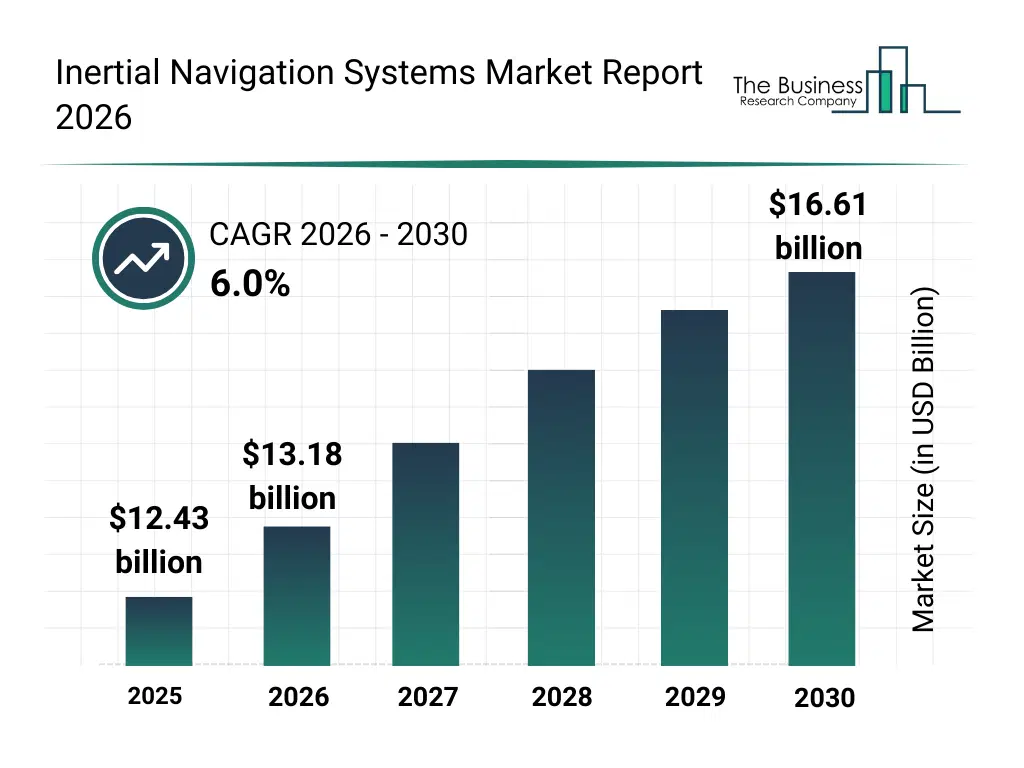
What Is The Inertial Navigation Systems Market Size and Share 2026?
The inertial navigation systems market size has grown strongly in recent years. It will grow from $12.43 billion in 2025 to $13.18 billion in 2026 at a compound annual growth rate (CAGR) of 6.0%. The growth in the historic period can be attributed to development of early gyroscope and accelerometer technologies for navigation, adoption of inertial navigation systems in aerospace and defense applications, growth in industrial and railway navigation solutions, advancements in surveying and mapping using ins technology, government-funded programs for precise navigation in gps-denied environments.What Is The Inertial Navigation Systems Market Growth Forecast?
The inertial navigation systems market size is expected to see strong growth in the next few years. It will grow to $16.61 billion in 2030 at a compound annual growth rate (CAGR) of 6.0%. The growth in the forecast period can be attributed to rising demand for INS in autonomous vehicles and drones, growth in industrial and marine navigation applications, advancements in micro-electromechanical systems (MEMS) ins technologies, integration of AI and sensor fusion for enhanced navigation accuracy, increasing investment in personal and foot-mounted ins for military and commercial use. Major trends in the forecast period include rising demand for gps-denied navigation solutions, increasing adoption in unmanned and autonomous platforms, expansion of mems-based ins in commercial applications, miniaturization and performance enhancement of sensors, growing use in surveying, mapping and industrial automation.
Global Inertial Navigation Systems Market Segmentation
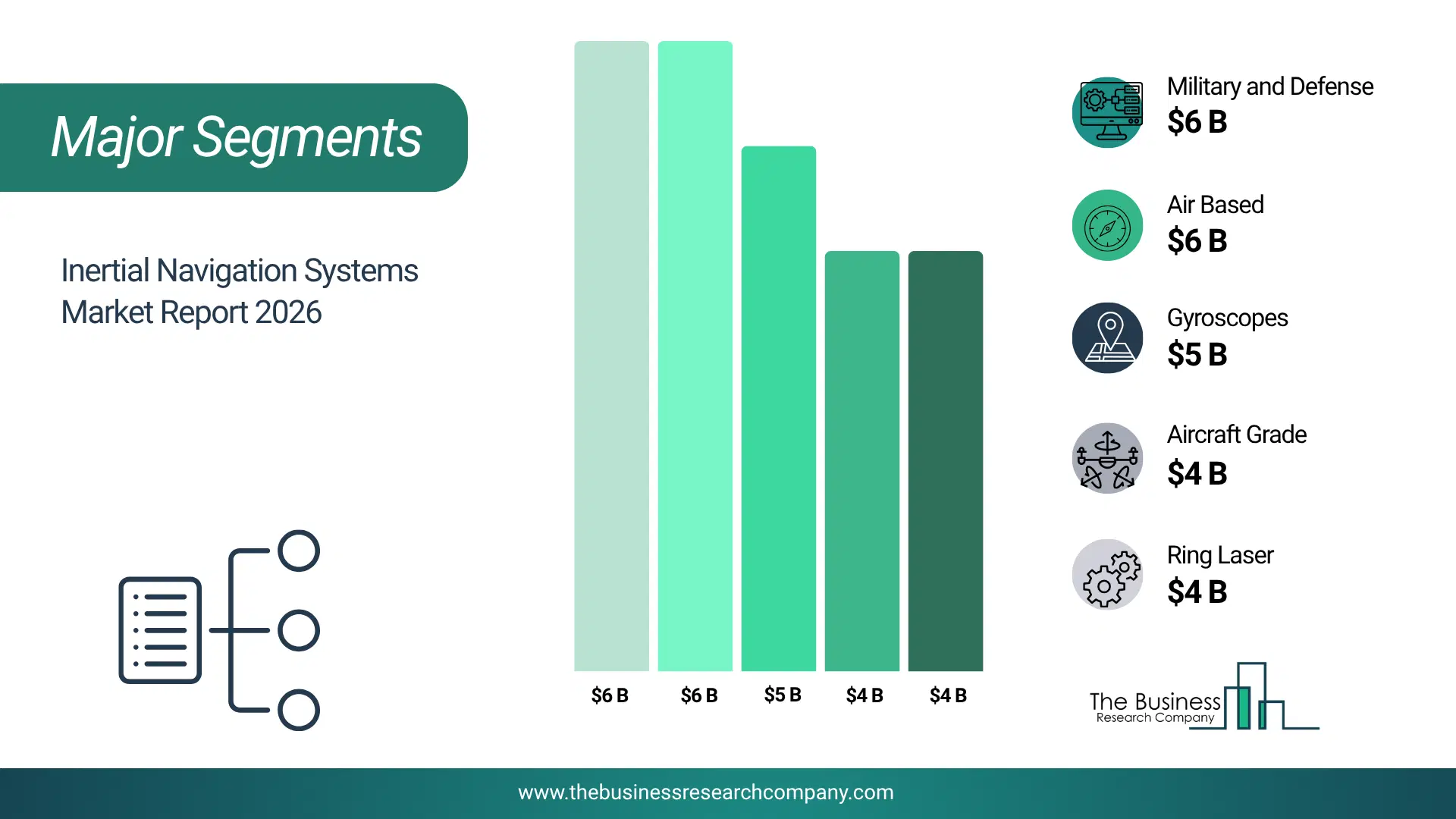
1) By Component: Accelerometers, Gyroscopes, Other Components 2) By Technology: Mechanical Gyro, Ring Laser Gyro, Fiber Optics Gyro, Micro-Electro-Mechanical Systems, Other Technologies 3) By Grade: Aircraft Grade, Marine Grade, Space Grade, Tactical Grade, Other Grades 4) By Application: Space Launch Vehicles, Unmanned Ground Vehicles, Missiles, Unmanned Aerial Vehicles, Aircraft, Military Armored Vehicles, Marine, Unmanned Marine Vehicles 5) By End User Industry: Automotive, Commercial Aviation, Marine, Military and Defense Subsegments: 1) By Accelerometers: Mechanical Accelerometers, Micro-Electro-Mechanical Systems Accelerometers, Fiber Optic Accelerometers, Ring Laser Accelerometers, Quartz Accelerometers 2) By Gyroscopes: Mechanical Gyroscopes, Micro-Electro-Mechanical Systems Gyroscopes, Ring Laser Gyroscopes (RLG), Fiber Optic Gyroscopes (FOG), Hemispherical Resonator Gyroscopes (HRG), Dynamically Tuned Gyroscopes (DTG) 3) By Other Components: Magnetometers, Navigation Processors, inertial measurement units (IMUs), GPS Receivers, Control Systems The top segments in the inertial navigation systems market will be: • Military and Defense will reach $6299.5 Million by 2025. • Air Based will reach $5875.2 Million by 2025. • Gyroscopes will reach $5374 Million by 2025. • Aircraft Grade will reach $4498.3 Million by 2025. • Ring Laser will reach $4032.2 Million by 2025.What Is Driver Of The Inertial Navigation Systems Market?
The rise in demand for autonomous vehicles is expected to propel the growth of the inertial navigation systems market going forward. Autonomous vehicles are self-driving vehicles that use sensors, software, and AI to navigate and operate without human intervention. Advancements in AI and sensor technology drive the increase in demand for autonomous vehicles as they enhance safety, efficiency, and convenience in transportation. Inertial navigation systems (INS) are used in autonomous vehicles to provide accurate real-time positioning and motion tracking, even in GPS-denied environments, ensuring precise navigation and stability during operation. For instance, in 2025, according to the Salvi, Schostok & Pritchard P.C., a US-based law firm, around 58 million self-driving cars would be sold by 2030. Moreover, in October 2023, according to the Department for Science, Innovation, and Technology (DSIT), a UK-based geospatial commission, in the United Kingdom, 40% of automobiles may be capable of autonomous driving by 2035. Therefore, the rise in demand for autonomous vehicles is driving the growth of the inertial navigation systems industry.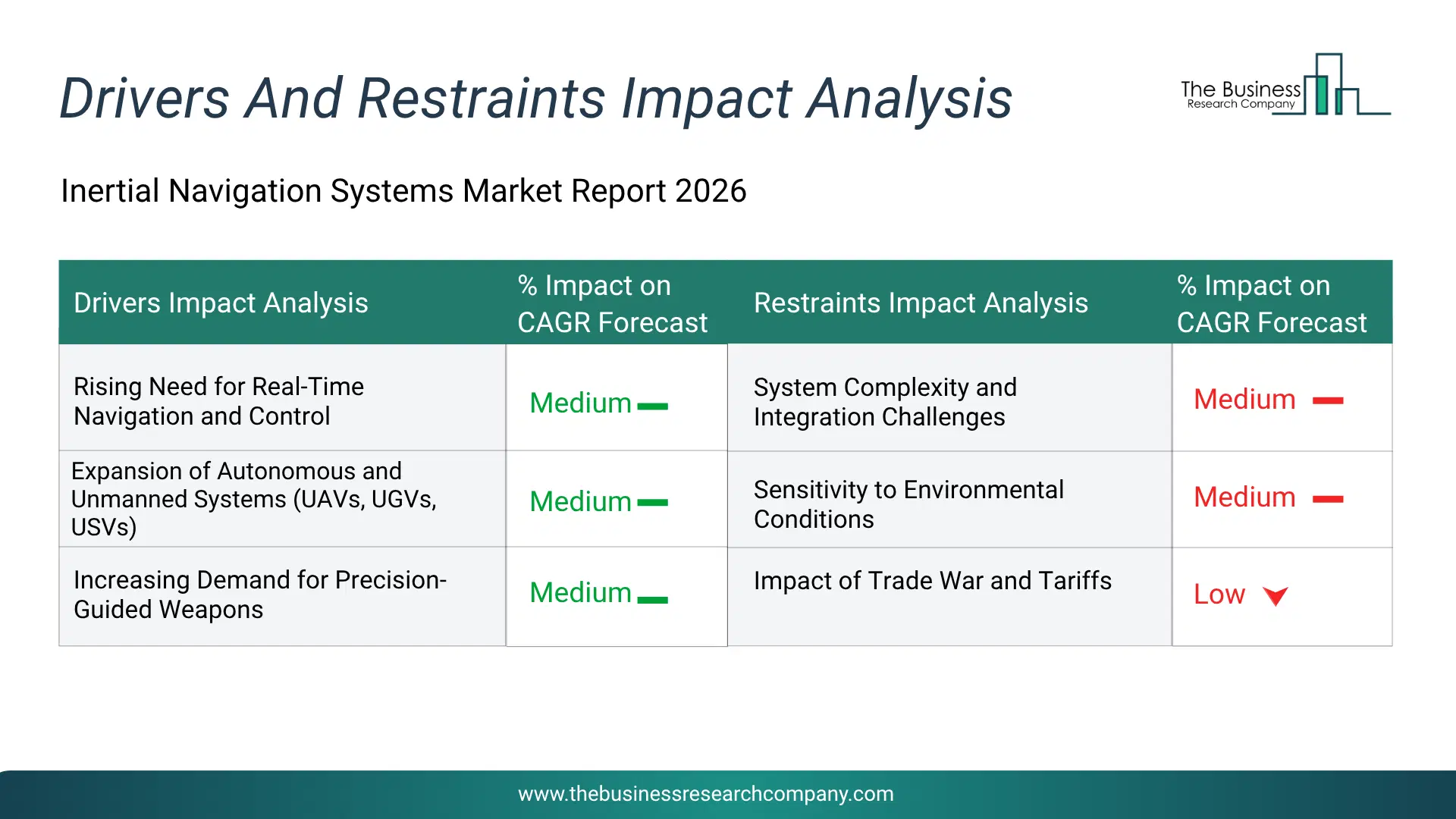
Infographic Chart Showing Key Market Drivers Analysis And Restraints For Inertial Navigation Systems Market
The chart presents an impact analysis of key drivers and restraints, quantifying their relative influence on the market's growth rate and helping assess the balance between growth enablers and limiting factors. This chart offers a high-level perspective; the full report contains more detailed insights.
How Will The Drivers Impact Growth In The Global Inertial Navigation Systems Market?
• Rising Need for Real-Time Navigation and Control (Medium) – The rising need for real-time navigation and control will become a key driver of growth in the inertial navigation systems market by 2030. INS solutions enable real-time tracking of position, velocity and orientation without external dependencies, ensuring operational continuity and reliability. This capability is particularly vital for applications such as unmanned systems, precision-guided platforms and smart manufacturing, where even minimal latency or signal disruption can lead to significant operational inefficiencies or safety risks. As a result, organizations are increasingly investing in advanced INS technologies to enhance system responsiveness, improve control accuracy and support the growing shift toward automation and autonomy across industries. As a result, the rising need for real-time navigation and control is anticipated to contributing to a 1.5% annual growth in the market. • Expansion of Autonomous and Unmanned Systems (UAVs, UGVs, USVs) (Medium) – The expansion of autonomous and unmanned systems (UAVs, UGVs, USVs) will emerge as a major factor driving the expansion of the market by 2030. These platforms operate with minimal or no human intervention and rely heavily on accurate real-time data for positioning, motion tracking and path planning to execute missions safely and efficiently. INS provides a self-contained navigation capability that ensures uninterrupted guidance by measuring acceleration and rotational movement, enabling these systems to maintain operational stability even when external signals such as GNSS are weak, obstructed, or intentionally disrupted. As industries such as defense, logistics, agriculture and maritime increasingly adopt autonomous technologies to enhance productivity, reduce labor dependency and improve mission outcomes, the demand for reliable navigation solutions continues to intensify. Consequently, the expansion of autonomous and unmanned systems (UAVs, UGVs, USVs) is projected to contributing to a 1.3% annual growth in the market. • Increasing Demand for Precision-Guided Weapons (Medium) – The increasing demand for precision-guided weapons will serve as a key growth catalyst for the market by 2030, Precision-guided munitions rely on highly accurate navigation and targeting data to strike specific objectives while minimizing collateral damage, making robust guidance systems essential. INS plays a critical role by providing continuous, high-precision positioning, velocity and orientation data independent of external signals, ensuring reliable weapon guidance even in GPS-denied or electronically contested environments where jamming and spoofing are prevalent. As defense forces worldwide invest in advanced missile systems, smart munitions and unmanned combat platforms, the integration of INS enhances targeting accuracy, mission success rates and system resilience. Therefore, this increasing demand for precision-guided weapons is projected to supporting to a 1.0% annual growth in the market. • Growth in Underground Mining and Tunneling Activities (Low) – The growth in underground mining and tunneling activities will become a significant driver contributing to the growth of the market by 2030. In underground operations, satellite-based positioning systems such as GNSS are largely ineffective because signals cannot penetrate deep rock layers, creating a critical need for self-contained navigation solutions. INS addresses this gap by providing continuous, real-time tracking of position, direction and movement without relying on external signals, thereby enabling precise guidance of drilling equipment, autonomous haulage systems and tunnel-boring machines. As mining companies and infrastructure developers increasingly adopt automation to improve safety, operational efficiency and productivity, the demand for accurate and reliable navigation in GPS-denied environments continues to rise. Consequently, the growth in underground mining and tunneling activities is projected to contributing to a 0.8% annual growth in the market.How Will The Restraints Impact Growth In The Global Inertial Navigation Systems Market?
• System Complexity and Integration Challenges (Medium) – System complexity and integration challenges is expected to restrain market growth during the forecast period. It creates operational, financial, regulatory, or commercial challenges that can increase costs, delay projects, reduce investments, or discourage purchasing decisions depending on the market. These challenges can reduce product adoption, affect business confidence, and limit the ability of companies to expand efficiently across key regions. This can disrupt long-term growth strategies and reduce the ability of companies to capitalize on emerging market opportunities. • Sensitivity to Environmental Conditions (Medium) – During the forecast period, sensitivity to environmental conditions is likely to limit market expansion. It creates operational, financial, regulatory, or commercial challenges that can increase costs, delay projects, reduce investments, or discourage purchasing decisions depending on the market. These challenges can reduce product adoption, affect business confidence, and limit the ability of companies to expand efficiently across key regions. As a result, organizations may postpone purchasing decisions, limiting demand across both established and emerging markets. • Impact of Trade War and Tariffs (Medium) – The market is expected to face challenges due to impact of trade war and tariffs over the forecast period. It creates operational, financial, regulatory, or commercial challenges that can increase costs, delay projects, reduce investments, or discourage purchasing decisions depending on the market. These challenges can reduce product adoption, affect business confidence, and limit the ability of companies to expand efficiently across key regions. This may reduce production efficiency, extend project timelines, and create challenges in meeting evolving customer requirements.Key Players In The Global Inertial Navigation Systems Market
Major companies operating in the inertial navigation systems market are Robert Bosch GmbH, RTX Corporation, Northrop Grumman Corporation, Honeywell International Inc., Safran SA, Thales Group, Parker Hannifin Corporation, TDK Corporation, STMicroelectronics N.V., Teledyne Technologies Inc., Trimble Inc., Moog Inc., MEMSIC Inc., iMAR Navigation GmbH, VectorNav Technologies LLC, Oxford Technical Solutions Ltd., SBG Systems S.A.S., Inertial Labs Inc., Point One Navigation, Tersus GNSS Inc.
This chart is for illustrative purposes; the full report includes a detailed competitor analysis and comprehensive overview of the top 10 companies in the market.

This chart maps companies by product innovation and brand strength, with bubble size indicating relative revenue, helping identify market leaders, challengers, and niche players. This is an illustrative chart; the full report provides a complete and accurate competitive analysis.
Global Inertial Navigation Systems Market Trends and Insights
Major companies operating in the inertial navigation systems market are focusing on developing innovative systems, such as maritime inertial navigation systems, to meet the growing demand for maritime applications. A maritime inertial navigation system (INS) is a self-contained navigation solution used on ships and submarines to determine their position, velocity, and orientation (attitude) without relying on external references such as GPS. For instance, in January 2025, ANELLO Photonics, a US-based company specializing in silicon photonics optical gyroscopes, introduced the ANELLO Maritime INS, a state-of-the-art Inertial Navigation System (INS) designed for maritime use. This breakthrough technology enhances navigation capabilities for marine operations in environments where GPS signals are unavailable or vulnerable to spoofing. The launch underscores a significant step forward in providing reliable navigation solutions for challenging maritime conditions. The ANELLO Maritime INS integrates advanced SiPhOG technology for precise and robust performance.What Are Latest Mergers And Acquisitions In The Inertial Navigation Systems Market? Strategic Acquisition Honeywell Boosts Autonomous Tech Portfolio With Civitanavi Deal
In March 2024, Honeywell International Inc., a US-based company that provides integrated automation and software solutions, acquired Civitanavi Systems S.p.A. for €200 million ($226 million). With this acquisition, Honeywell aims to enhance its capabilities in high-precision inertial navigation solutions and strengthen its position in the autonomous technology market across aerospace, defense, and industrial sectors. Civitanavi Systems is an Italy-based company that specializes in the development, production, and commercialization of inertial navigation and stabilization systems.
Regional Insights
North America was the largest region in the inertial navigation systems market in 2025. Asia-Pacific is expected to be the fastest-growing region in the forecast period. The regions covered in this market report are Asia-Pacific, South East Asia, Western Europe, Eastern Europe, North America, South America, Middle East, Africa. The countries covered in this market report are Australia, Brazil, China, France, Germany, India, Indonesia, Japan, Taiwan, Russia, South Korea, UK, USA, Canada, Italy, SpainWhat Defines the Inertial Navigation Systems Market?
The inertial navigation systems market consists of revenues earned by entities by providing services such as navigation services, guidance services, surveying, and mapping services. The market value includes the value of related goods sold by the service provider or included within the service offering. The inertial navigation systems market includes sales of railway inertial navigation systems, personal/foot-mounted inertial navigation systems, and industrial inertial navigation systems. Values in this market are ‘factory gate’ values, that is, the value of goods sold by the manufacturers or creators of the goods, whether to other entities (including downstream manufacturers, wholesalers, distributors, and retailers) or directly to end customers. The value of goods in this market includes related services sold by the creators of the goods.How is Market Value Defined and Measured?
The market value is defined as the revenues that enterprises gain from the sale of goods and/or services within the specified market and geography through sales, grants, or donations in terms of the currency (in USD unless otherwise specified). The revenues for a specified geography are consumption values that are revenues generated by organizations in the specified geography within the market, irrespective of where they are produced. It does not include revenues from resales along the supply chain, either further along the supply chain or as part of other products.
This chart presents market attractiveness based on a quantitative evaluation of growth, competition, strategic alignment, and risk, offering a clear view of opportunity areas for decision-making. This chart is for illustrative purposes; the full report contains the complete analysis.

This chart highlights the Total Addressable Market (TAM) by estimating the maximum revenue opportunity using an assumption-driven approach, supporting strategic planning and opportunity sizing across markets. The chart is illustrative; the full report provides a more comprehensive analysis.
What Key Data and Analysis Are Included in the Inertial Navigation Systems Market Report 2026?
The inertial navigation systems market research report is one of a series of new reports from The Business Research Company that provides market statistics, including industry global market size, regional shares, competitors with the market share, detailed market segments, market trends and opportunities, and any further data you may need to thrive in the inertial navigation systems industry. The market research report delivers a complete perspective of everything you need, with an in-depth analysis of the current and future state of the industry.Inertial Navigation Systems Market Report Forecast Analysis
| Report Attribute | Details |
|---|---|
| Market Size Value In 2026 | $13.18 billion |
| Revenue Forecast In 2035 | $16.61 billion |
| Growth Rate | CAGR of 6.0% from 2026 to 2035 |
| Base Year For Estimation | 2025 |
| Actual Estimates/Historical Data | 2020-2025 |
| Forecast Period | 2026 - 2030 - 2035 |
| Market Representation | Revenue in USD Billion and CAGR from 2026 to 2035 |
| Segments Covered | Component, Technology, Grade, Application, End User Industry |
| Regional Scope | Asia-Pacific, Western Europe, Eastern Europe, North America, South America, Middle East, Africa |
| Country Scope | The countries covered in the report are Australia, Brazil, China, France, Germany, India, ... |
| Key Companies Profiled | Robert Bosch GmbH, RTX Corporation, Northrop Grumman Corporation, Honeywell International Inc., Safran SA, Thales Group, Parker Hannifin Corporation, TDK Corporation, STMicroelectronics N.V., Teledyne Technologies Inc., Trimble Inc., Moog Inc., MEMSIC Inc., iMAR Navigation GmbH, VectorNav Technologies LLC, Oxford Technical Solutions Ltd., SBG Systems S.A.S., Inertial Labs Inc., Point One Navigation, Tersus GNSS Inc. |
| Customization Scope | Request for Customization |
| Pricing And Purchase Options | Explore Purchase Options |