
IoT In Retail Market Report 2026
Global Outlook – By Offering (Solution, Service), By Type (Beacons, RFID Tags, Sensors, Wearables, Other Types), By Technology (Bluetooth Low Energy, Near field Communication, ZigBee, Other Technologies), By Deployment Mode (On-Premise, Cloud), By Application (Supply Chain Operations Management, Customer Management, Sales And Customer Management, Asset Management, Other Applications) – Market Size, Trends, Strategies, and Forecast to 2030
IoT In Retail Market Overview
• IoT In Retail market size has reached to $46.41 billion in 2025 • Expected to grow to $107.58 billion in 2030 at a compound annual growth rate (CAGR) of 18.1% • Growth Driver: Accelerated Growth Driven By The Surging Influence Of E-Commerce • Market Trend: Strategic Partnerships Fueling Innovation In The IoT in Retail Market • North America was the largest region in 2025 and Asia-Pacific is the fastest growing region.What Is Covered Under IoT In Retail Market?
The internet of things (IoT) is a physical object network that contains integrated technologies that allow it to connect, sense, and interact with internal or external environments. It is a collection of end-to-end services where companies contract with external vendors to design, build, install, and operate IoT solutions, including consulting advice for IoT planning. IoT in the retail industry is used for flow management in the stores, inventory management, and improving the customer experience using real-time customer data. The main types of IoT in retail include Beacons, RFID tags, sensors, wearables, and others. Beacons refer to small battery-powered wireless devices that send Bluetooth signals to cellphones nearby. The offerings include solutions and services by using Bluetooth low energy, near-field communication, ZigBee, and other technologies. It is employed through various deployment modes including on-premise and cloud and is used for different applications including supply chain operations management, customer management, sales and customer management, asset management, and others.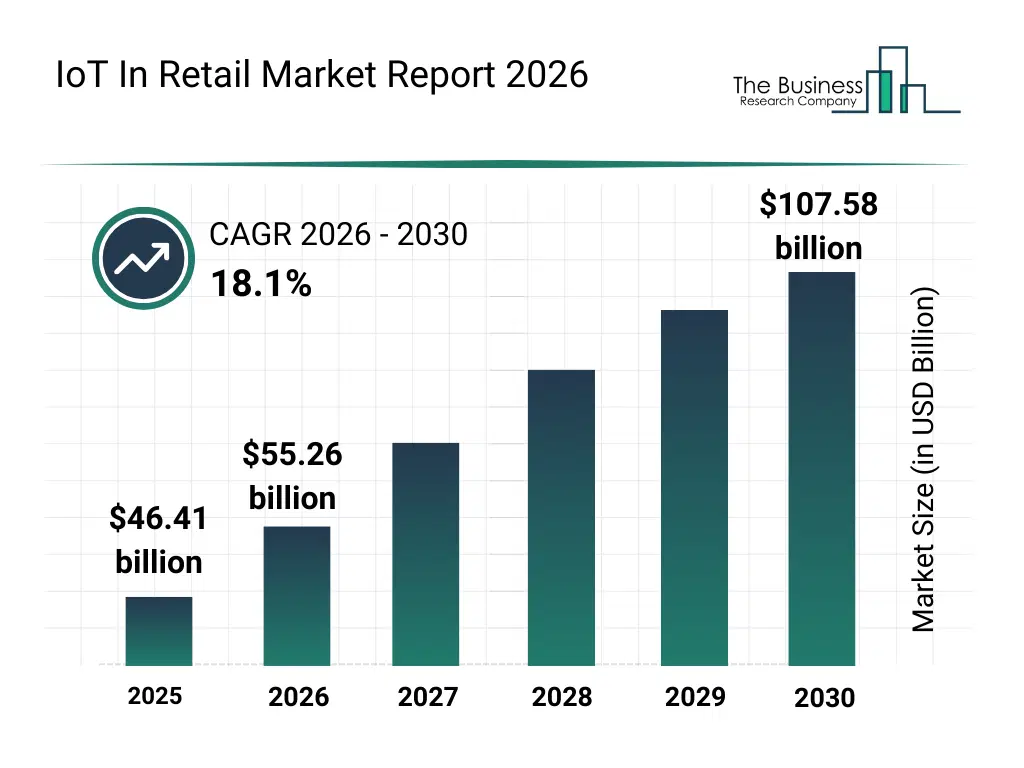
What Is The IoT In Retail Market Size and Share 2026?
The iot in retail market size has grown rapidly in recent years. It will grow from $46.41 billion in 2025 to $55.26 billion in 2026 at a compound annual growth rate (CAGR) of 19.1%. The growth in the historic period can be attributed to expansion of organized retail formats, adoption of rfid and sensor technologies, growth in real-time inventory tracking, rising focus on customer experience, increasing digital transformation initiatives.What Is The IoT In Retail Market Growth Forecast?
The iot in retail market size is expected to see rapid growth in the next few years. It will grow to $107.58 billion in 2030 at a compound annual growth rate (CAGR) of 18.1%. The growth in the forecast period can be attributed to increasing investments in smart retail infrastructure, rising demand for ai-driven customer analytics, expansion of cloud-based retail platforms, growing focus on personalized shopping experiences, increasing integration of iot with supply chains. Major trends in the forecast period include increasing adoption of smart inventory management systems, rising deployment of in-store analytics platforms, growing use of connected pos and payment systems, expansion of customer behavior tracking technologies, enhanced focus on omnichannel retail operations.
Global IoT In Retail Market Segmentation
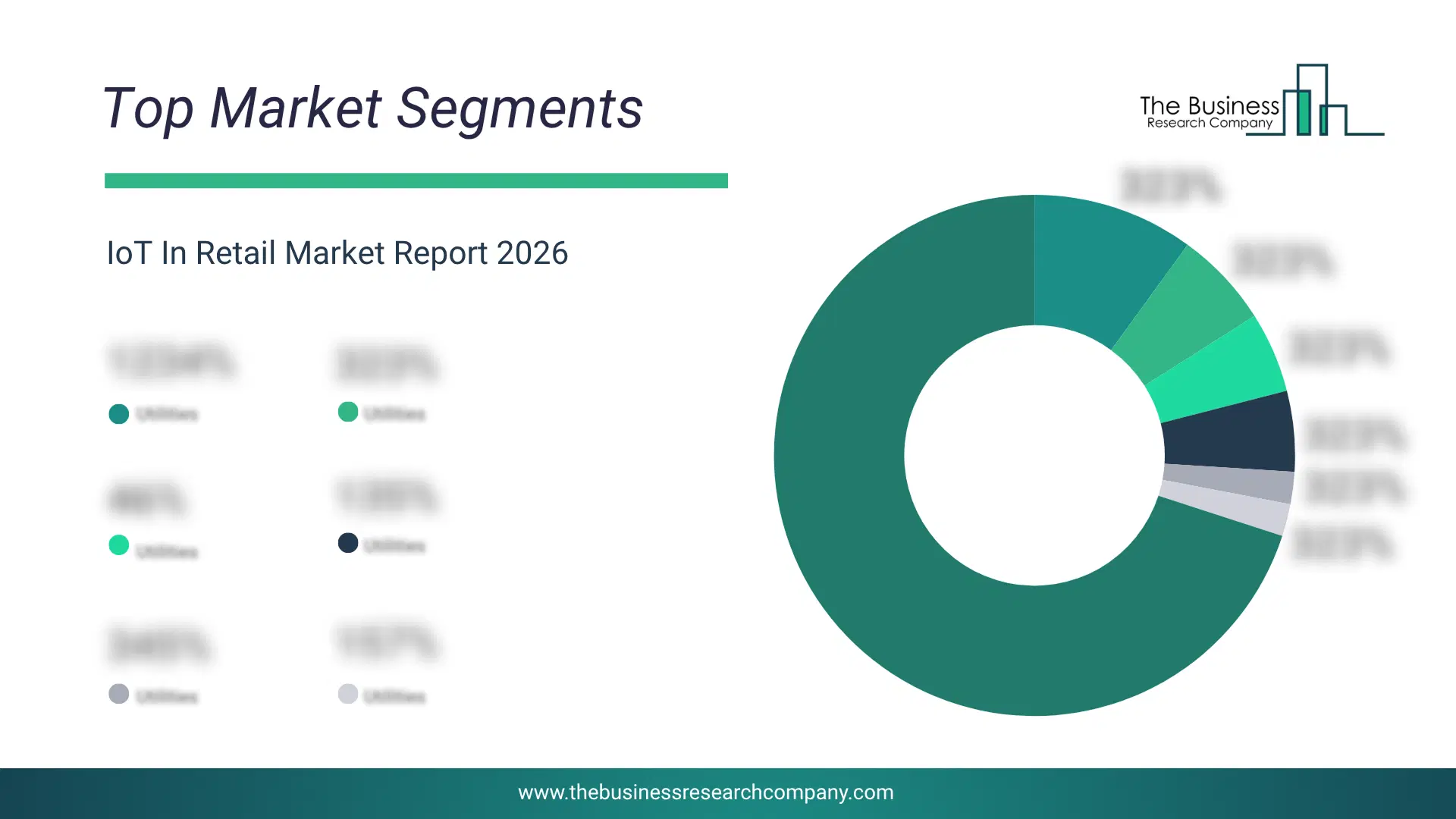
1) By Offering: Solution, Service 2) By Type: Beacons, RFID Tags, Sensors, Wearables, Other Types 3) By Technology: Bluetooth Low Energy, Near field Communication, ZigBee, Other Technologies 4) By Deployment Mode: On-Premise, Cloud 5) By Application: Supply Chain Operations Management, Customer Management, Sales And Customer Management, Asset Management, Other Applications Subsegments: 1) By Solution: Smart Shelves, Inventory Management Systems, Customer Analytics Platforms, Point Of Sale (POS) Systems, Beacon Technology 2) By Service: Consulting Services, Integration Services, Maintenance And Support Services, Data Management And Analytics Services, Training ServicesWhat Is The Driver Of The IoT In Retail Market?
The increasing penetration of e-commerce is expected to propel the growth of the IoT in the retail market going forward. E-commerce, often known as electronic commerce or online commerce, refers to the purchase and sale of goods or services over the internet, as well as the transmission of money and data to complete these transactions. In e-commerce, IoT is used in inventory management such as using radio frequency identification tags that enable the learning of all crucial item information regarding the product type, its availability, and expiration date, without the necessity of any human involvement. The precise and detailed tracking of the item journey during supply chain management, remote assessment of products and items to predict their maintenance and analyze their performance, business personalization, customer and sales management, and other features are possible by IoT to optimize the retail operations in e-commerce. For instance, in August 2024, according to the U.S. Census Bureau, a US-based government agency, in the US retail e-commerce sales reached $291.6 billion in quarter 2 2024, up 1.3% from Q1 and 6.7% year-over-year. Total retail sales were $1,826.9 billion, increasing 0.5% from Q1 and 2.1% from Q2 2023. Therefore, the increasing penetration of E-commerce is driving the growth of the IoT in the retail market.Key Players In The Global IoT In Retail Market
Major companies operating in the iot in retail market are ARM Limited; Cisco Systems Inc.; Alphabet Inc.; IBM Corporation; Impinj Corporation; Intel Corporation; Microsoft Corporation; PTC Inc.; RetailNext Inc.; SAP SE; Softweb Solutions Inc.; Zebra Technologies Corporation; Huawei Technologies Company Limited; Amazon Web Services Inc.; Software AG; Bosch Software Innovations GmbH; NEC Corporation; Oracle Corporation; Vodafone Group Plc.; Allergen Technologies Private Limited; Sierra Wireless Inc.; Happiest Minds Technologies Limited; Losant IoT Inc.; NXP Semiconductors N.V.; Verizon Communications Inc.; Microchip Technology Incorporated; Bsquare Corporation; Fujitsu Limited; Hewlett Packard Enterprise Development LP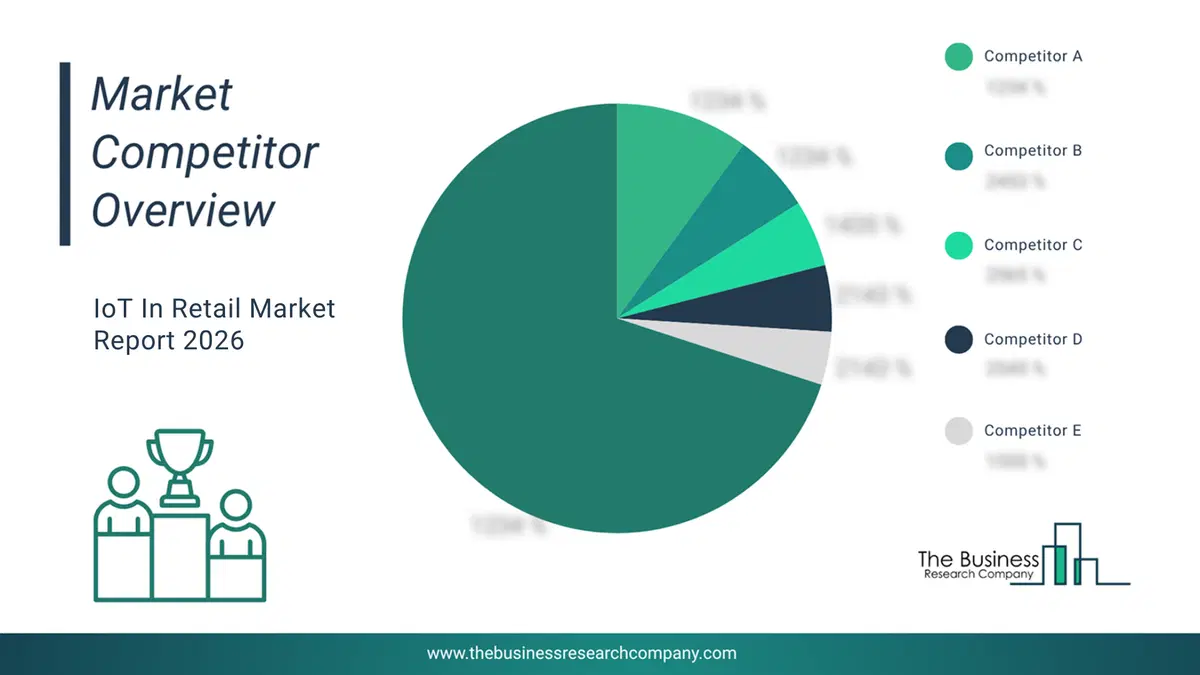
This chart is for illustrative purposes; the full report includes a detailed competitor analysis and comprehensive overview of the top 10 companies in the market.
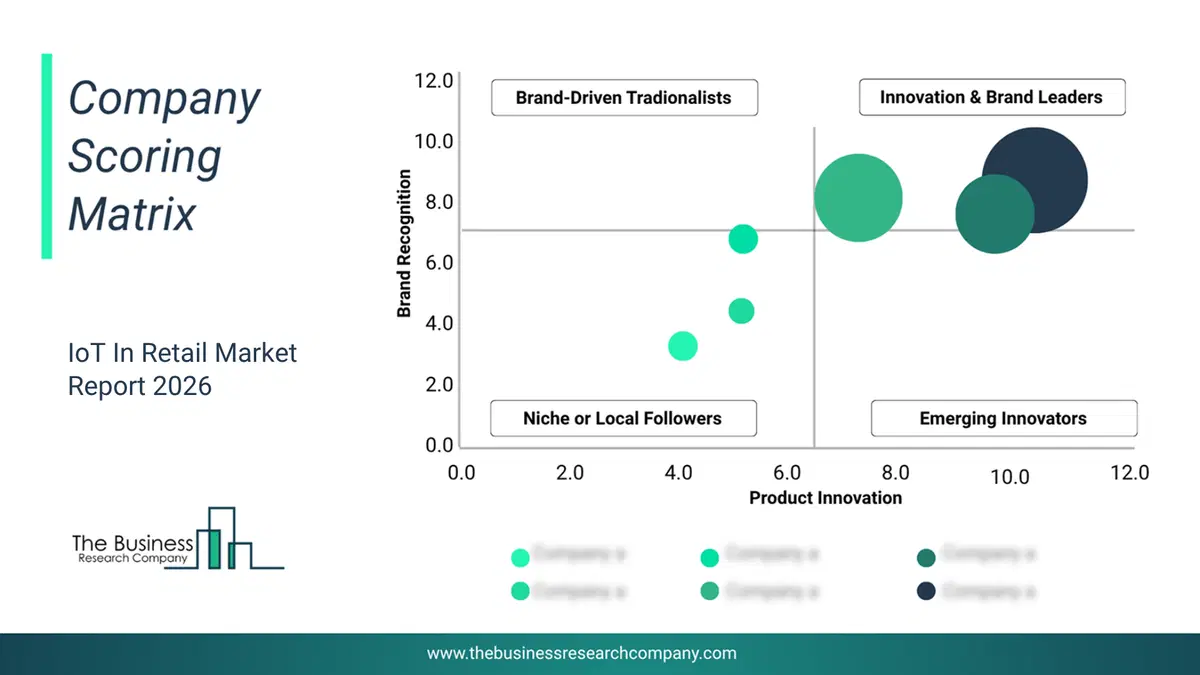
This chart maps companies by product innovation and brand strength, with bubble size indicating relative revenue, helping identify market leaders, challengers, and niche players. This is an illustrative chart; the full report provides a complete and accurate competitive analysis.
Global IoT In Retail Market Trends and Insights
Major companies operating in the IoT in retail market are adopting a strategic partnership approach to create IoT applications for in-store retail powered wirelessly. Strategic partnerships refer to a process in which companies leverage each other's strengths and resources to achieve mutual benefits and success. For instance, in January 2023, Energous Corporation, a US-based developer of wireless power transfer (WPT) technologies partnered with SATO Holdings Corporation, a Japan-based provider of auto-ID solutions. The partnership aims to collaborate on solutions by integrating Energous' 1W WattUp PowerBridge transmitters with IoT applications designed for advanced smart store functionalities. This collaboration seeks to achieve wireless powering capabilities for Wiliot IoT Pixel sensor tags within a range of 5m to 10m, catering to asset and inventory management solutions in stores and warehouses developed by SATO. The IoT Pixels, compact Bluetooth Low Energy tags equipped with sensors for parameters such as humidity and temperature, among others, utilize data communication initiated by multiple tags receiving signals from an Energous transmitter. Acting as a bridge, the transmitter intelligently filters and relays data from the tags to the cloud. Implementing IoT Pixels on individual products and specific fixtures on shelves enables retailers to monitor real-time product quantity and condition, eliminating the need for manual checks.What Are Latest Mergers And Acquisitions In The IoT In Retail Market?
In May 2023, ServiceNow Inc., a US-based software company, acquired G2k Group GmbH for an undisclosed amount. This acquisition aims to integrate G2K’s technology into ServiceNow's Now Platform, enabling businesses to effectively utilize both digital and in-store data through enterprise-grade workflows. G2k Group GmbH is a Germany-based company that specializes in smart IoT technology that enables retailers to connect real-time data across multiple storefronts and physical spaces.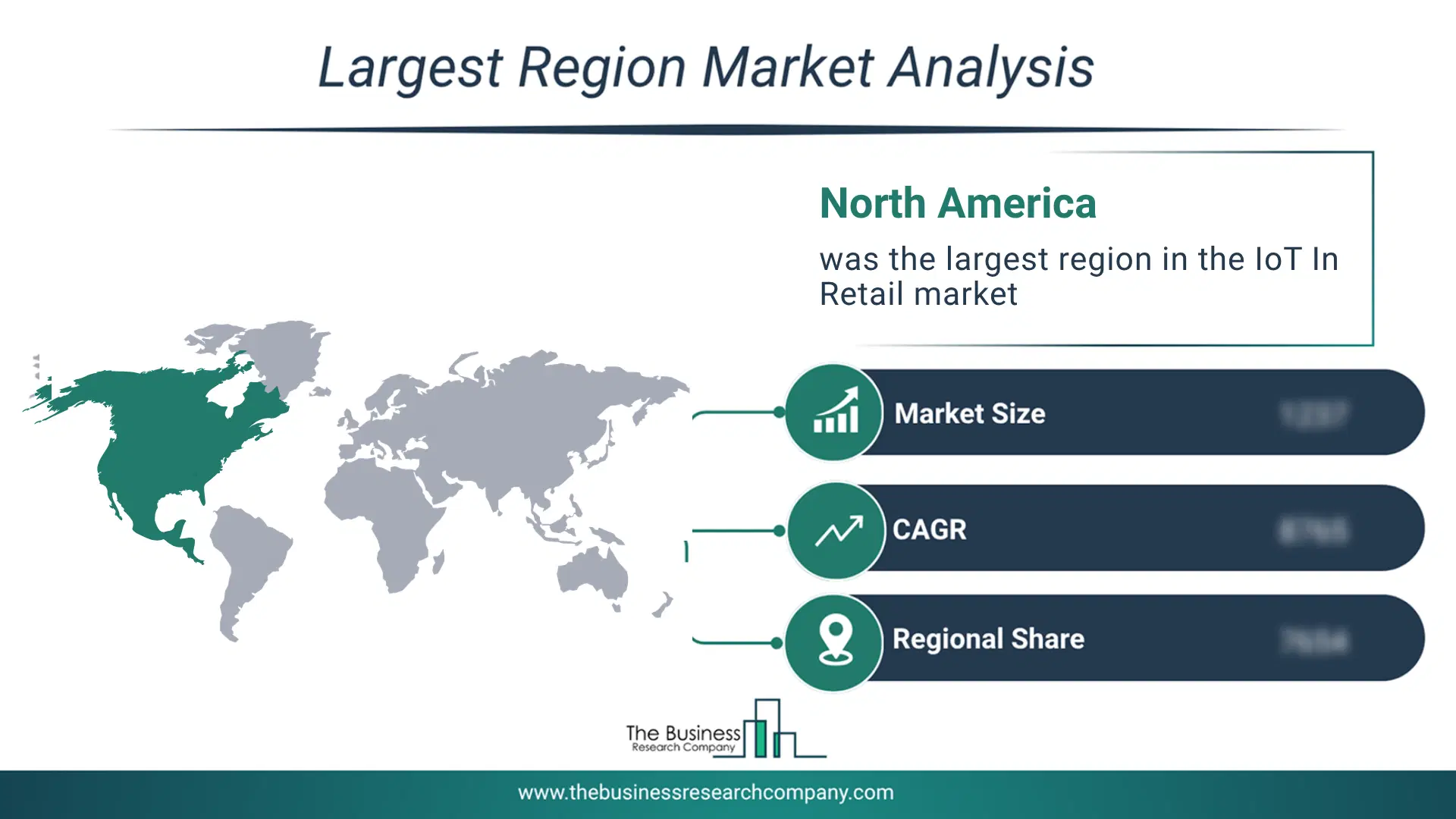
Regional Insights
North America was the largest region in the IoT in retail market in 2025. Asia-Pacific is expected to be the fastest-growing region in the IoT in retail market report during the forecast period. The regions covered in this market report are Asia-Pacific, South East Asia, Western Europe, Eastern Europe, North America, South America, Middle East, Africa. The countries covered in this market report are Australia, Brazil, China, France, Germany, India, Indonesia, Japan, Taiwan, Russia, South Korea, UK, USA, Canada, Italy, SpainWhat Defines the IoT In Retail Market?
The IoT in retail market consists of revenues earned by entities by offering IoT-enabled services for retail such as security, and safety, and inventory management. The market value includes the value of related goods sold by the service provider or included within the service offering. The IoT in retail market also includes sales of electronic systems, devices, and software that are used in providing IoT services in retail. Values in this market are ‘factory gate’ values, that is the value of goods sold by the manufacturers or creators of the goods, whether to other entities (including downstream manufacturers, wholesalers, distributors, and retailers) or directly to end customers. The value of goods in this market includes related services sold by the creators of the goods.How is Market Value Defined and Measured?
The market value is defined as the revenues that enterprises gain from the sale of goods and/or services within the specified market and geography through sales, grants, or donations in terms of the currency (in USD unless otherwise specified). The revenues for a specified geography are consumption values that are revenues generated by organizations in the specified geography within the market, irrespective of where they are produced. It does not include revenues from resales along the supply chain, either further along the supply chain or as part of other products.
This chart presents market attractiveness based on a quantitative evaluation of growth, competition, strategic alignment, and risk, offering a clear view of opportunity areas for decision-making. This chart is for illustrative purposes; the full report contains the complete analysis.

This chart highlights the Total Addressable Market (TAM) by estimating the maximum revenue opportunity using an assumption-driven approach, supporting strategic planning and opportunity sizing across markets. The chart is illustrative; the full report provides a more comprehensive analysis.
What Key Data and Analysis Are Included in the IoT In Retail Market Report 2026?
The iot in retail market research report is one of a series of new reports from The Business Research Company that provides market statistics, including industry global market size, regional shares, competitors with the market share, detailed market segments, market trends and opportunities, and any further data you may need to thrive in the iot in retail industry. The market research report delivers a complete perspective of everything you need, with an in-depth analysis of the current and future state of the industry.IoT In Retail Market Report Forecast Analysis
| Report Attribute | Details |
|---|---|
| Market Size Value In 2026 | $55.26 billion |
| Revenue Forecast In 2030 | $107.58 billion |
| Growth Rate | CAGR of 18.1% from 2026 to 2030 |
| Base Year For Estimation | 2025 |
| Actual Estimates/Historical Data | 2020-2025 |
| Forecast Period | 2026 - 2030 |
| Market Representation | Revenue in USD Billion and CAGR from 2026 to 2030 |
| Segments Covered | Offering, Type, Technology, Deployment Mode, Application |
| Regional Scope | Asia-Pacific, Western Europe, Eastern Europe, North America, South America, Middle East, Africa |
| Country Scope | The Countries Covered In This Market Report Are Australia, Brazil, China, France, Germany, India, Indonesia, Japan, Taiwan, Russia, South Korea, Uk, Usa, Canada, Italy, Spain. |
| Key Companies Profiled | ARM Limited, Cisco Systems Inc., Alphabet Inc., IBM Corporation, Impinj Corporation, Intel Corporation, Microsoft Corporation, PTC Inc., RetailNext Inc., SAP SE, Softweb Solutions Inc., Zebra Technologies Corporation, Huawei Technologies Company Limited, Amazon Web Services Inc., Software AG, Bosch Software Innovations GmbH, NEC Corporation, Oracle Corporation, Vodafone Group Plc., Allergen Technologies Private Limited, Sierra Wireless Inc., Happiest Minds Technologies Limited, Losant IoT Inc., NXP Semiconductors N.V., Verizon Communications Inc., Microchip Technology Incorporated, Bsquare Corporation, Fujitsu Limited, Hewlett Packard Enterprise Development LP |
| Customization Scope | Request for Customization |
| Pricing And Purchase Options | Explore Purchase Options |