
Low Melting Fiber Market Report 2026
Global Outlook – By Type (Melting Point Below 130 Degrees Celsius, Melting Point Above 130 Degrees Celsius), By Structure Type (Sheath Or Core, Side By Side), By Application (Automotive Industry, Construction, Bedding Industry, Other Applications) – Market Size, Trends, Strategies, and Forecast to 2030
Low Melting Fiber Market Overview
• Low Melting Fiber market size has reached to $2.32 billion in 2025 • Expected to grow to $3.12 billion in 2030 at a compound annual growth rate (CAGR) of 6.3% • Growth Driver: Rising Demand For Mattresses Fuels Growth In The Low-Melting Fiber Market • Market Trend: Innovative Sustainability Efforts In The Low-Melting Fiber Market • Asia-Pacific was the largest region in 2025.What Is Covered Under Low Melting Fiber Market?
Low-melting fiber is a type of textile fiber with a relatively low melting point compared to traditional fibers, allowing it to melt and fuse at lower temperatures during manufacturing processes such as bonding or shaping. It can be utilized for headliners, automotive interiors, door trims, ceiling materials and mattress and seat cushions, among other things. The main types of low-melting fiber include those with a melting point below 130 degrees Celsius and one above 130 degrees Celsius. Low-melting fibers with a melting temperature below 130 degrees Celsius are designed to soften and fuse at relatively low temperatures, making them suitable for applications where heat bonding is required without damaging the other components of the material used as a binder in core-sheath constructions, where they act as the bonding agent for other fibers. They are formulated in a sheath or core as well as in side-by-side structure types to be used in applications such as the automotive industry, construction, bedding industry and others.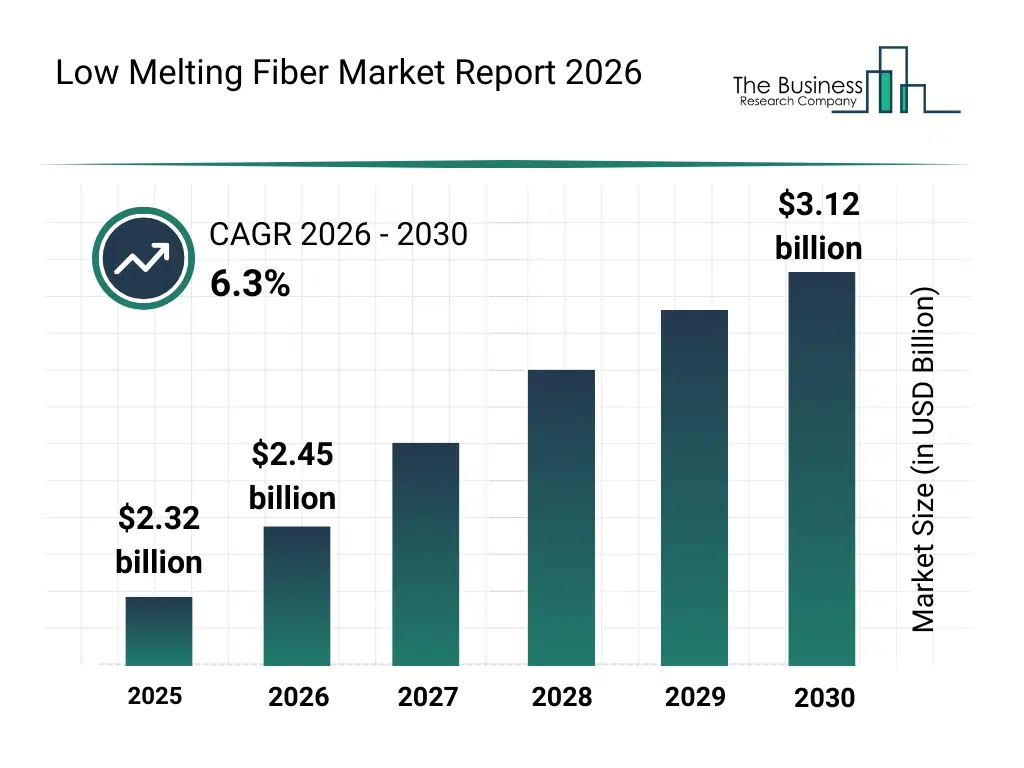
What Is The Low Melting Fiber Market Size and Share 2026?
The low melting fiber market size has grown strongly in recent years. It will grow from $2.32 billion in 2025 to $2.45 billion in 2026 at a compound annual growth rate (CAGR) of 5.5%. The growth in the historic period can be attributed to growth of automotive interior manufacturing, expansion of bedding and furniture industries, adoption of nonwoven textile technologies, availability of polymer-based fibers, increasing use of thermal bonding techniques.What Is The Low Melting Fiber Market Growth Forecast?
The low melting fiber market size is expected to see strong growth in the next few years. It will grow to $3.12 billion in 2030 at a compound annual growth rate (CAGR) of 6.3%. The growth in the forecast period can be attributed to increasing demand for lightweight vehicle materials, rising focus on sustainable textile solutions, expansion of electric vehicle interior applications, growing use in construction insulation, increased investments in advanced fiber technologies. Major trends in the forecast period include increasing use of lightweight bonding fibers, rising demand from automotive interior applications, growing adoption in mattress and cushion manufacturing, expansion of thermally bonded nonwovens, enhanced focus on recyclable fiber materials.
Global Low Melting Fiber Market Segmentation
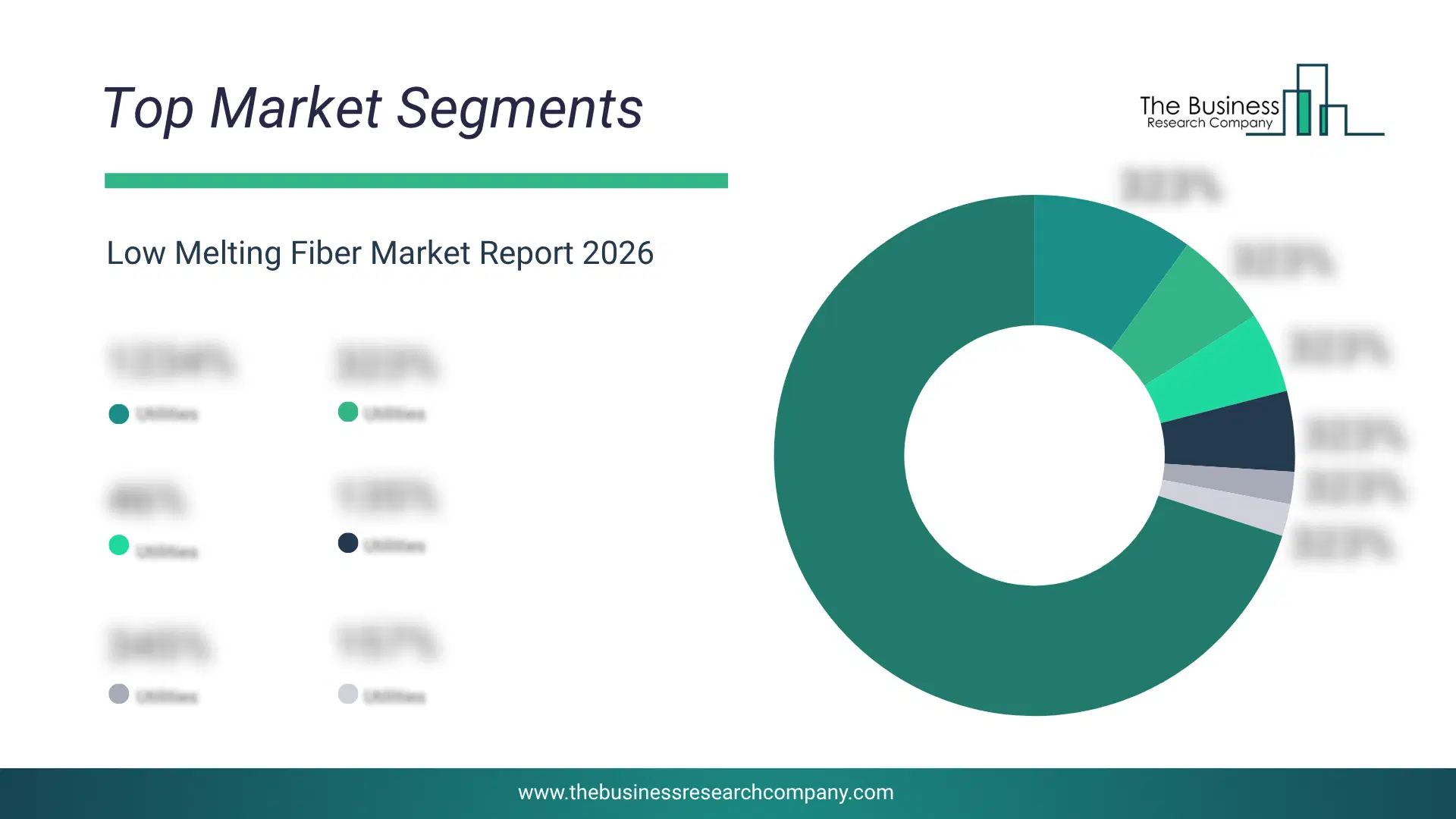
1) By Type: Melting Point Below 130 Degrees Celsius, Melting Point Above 130 Degrees Celsius 2) By Structure Type: Sheath Or Core, Side By Side 3) By Application: Automotive Industry, Construction, Bedding Industry, Other Applications Subsegments: 1) By Melting Point Below 130 Degrees Celsius: Polyethylene (PE) Fibers, Polypropylene (PP) Fibers 2) By Melting Point Above 130 Degrees Celsius: Polyamide (PA) Fibers, Polyester Fibers, Polyethylene Terephthalate (PET) FibersWhat Is The Driver Of The Low Melting Fiber Market?
The increasing demand for mattresses is expected to propel the growth of the low-melting fiber market going forward. A mattress is a cushioned surface designed for sleeping and resting, typically constructed with various materials and available in different sizes and firmness levels. Low-melting fiber is a vital component in mattress manufacturing. Its unique properties enhance mattress performance by providing better comfort, support and durability through improved bonding during production. For instance, in June 2023, according to Mattress Clarity, a US-based company specializing in mattress reviews and comparisons, the mattress industry was valued at $50.61 billion in 2022 and is expected to grow to $52.45 billion by 2024. By 2030, the industry's value is projected to reach $78.34 billion. Therefore, the increasing demand for mattresses will drive the growth of the low-melting fiber market.Key Players In The Global Low Melting Fiber Market
Major companies operating in the low melting fiber market are BASF SE, Mitsubishi Chemical Corporation, Saudi Arabia's Basic Industries Corporation (SABIC), Asahi Kasei Corporation, Sumitomo Chemical Company Limited, Evonik Industries AG, DuPont De Nemours Inc., Eastman Chemical Company, Lanxess Corporation, Formosa Plastics Corporation, Far Eastern New Century, Teijin Limited, Nan Ya Plastics Corporation, Kuraray Co. Ltd., Hyosung Corporation, Toyobo Co. Ltd., Taekwang Industrial Co. Ltd., Huvis Corporation, Xiamen Xianglu Chemical Fiber Co. Ltd., Kolon Industries, Fiber Visions Corporation, Thai Poly Acrylic, Toray Chemical Korea Inc., Zhejiang Hengyi Group Co. Ltd.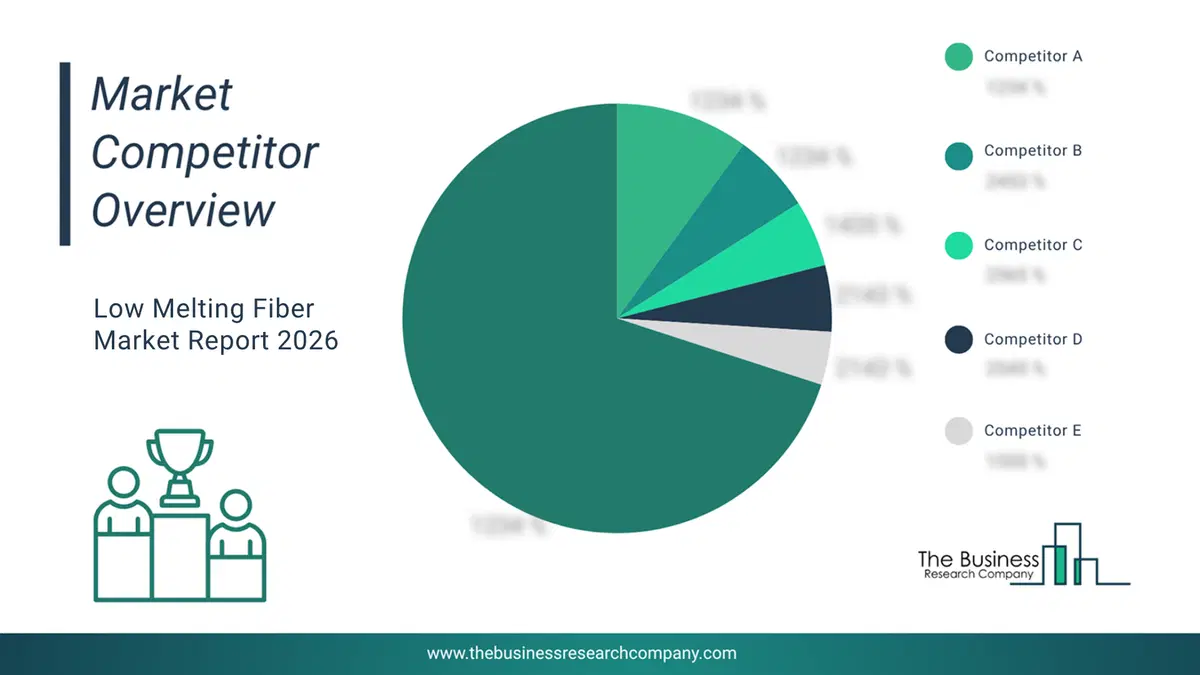
This chart is for illustrative purposes; the full report includes a detailed competitor analysis and comprehensive overview of the top 10 companies in the market.
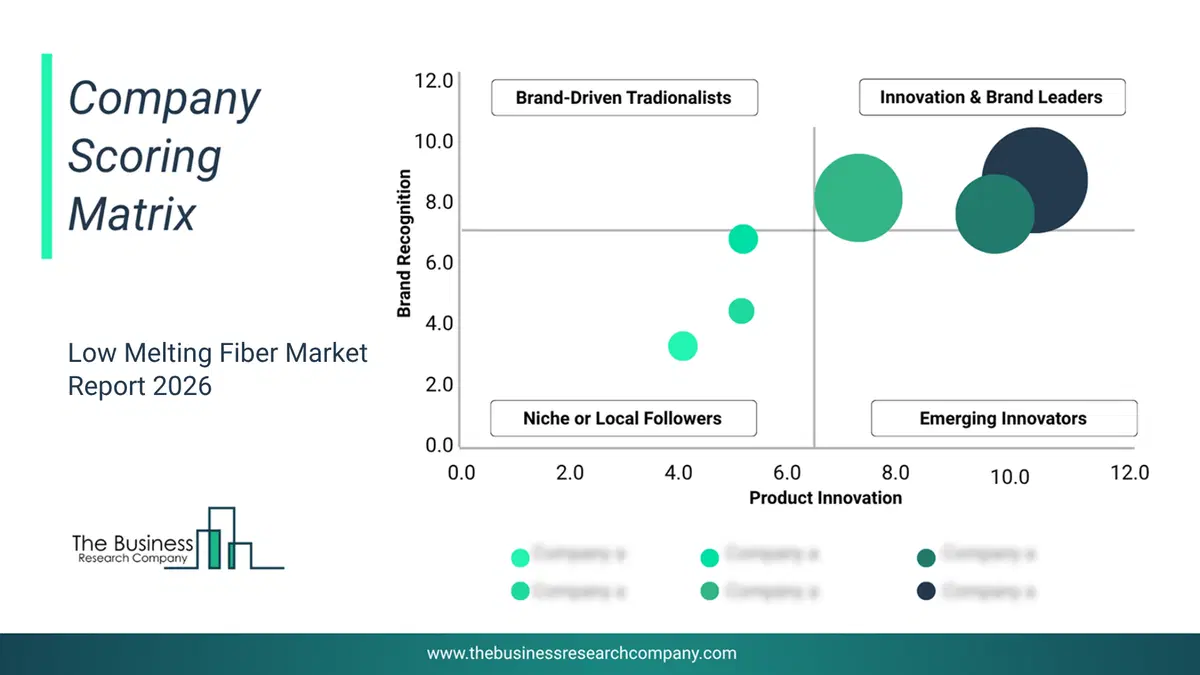
This chart maps companies by product innovation and brand strength, with bubble size indicating relative revenue, helping identify market leaders, challengers, and niche players. This is an illustrative chart; the full report provides a complete and accurate competitive analysis.
Global Low Melting Fiber Market Trends and Insights
Major companies operating in the low-melting fiber market are focused on developing sustainable solutions to sustain their position in the market. Sustainable solutions refer to environmentally friendly practices and materials that reduce resource consumption, minimize waste, and lower the environmental impact of production and usage. For instance, in August 2024, Unifi, Inc., a US-based manufacturer and marketer of recycled and synthetic products launched white-dyeable filament yarn and ThermaLoop insulation. White-dyeable filament yarn is a high-performance polyester made from 100% recycled feedstock, with at least 50% sourced from textile waste, achieving virgin-quality standards and incorporating FiberPrint tracer technology for U-Trust certification. ThermaLoop insulation features innovative insulation solutions in down-like fiber, fibreball, and padding formats, engineered with Repreve low melt fiber for improved thermal efficiency. The black insulation variant showcases the diverse textile waste that can be utilized as feedstock, promoting sustainable practices in supply chains. Together, these products advance Unifi’s goal of recycling 1.5 billion t-shirts’ worth of textile waste by 2030.What Are Latest Mergers And Acquisitions In The Low Melting Fiber Market?
In January 2023, Stein Fibers, LLC, a US-based manufacturing company in the synthetic fiber and textile products industry, acquired the North American fiber operations of Fibertex Corporation for an undisclosed amount. With this acquisition, Stein Fibers aimed to expand and diversify its fiber product portfolio in North America to better serve customers and strengthen its market position across fiber segments. Fibertex Corporation is a US-based manufacturing company that specializes in providing a broad range of fiber products for the non woven industries in the United States and Canada, supported by logistics and established supplier relationships.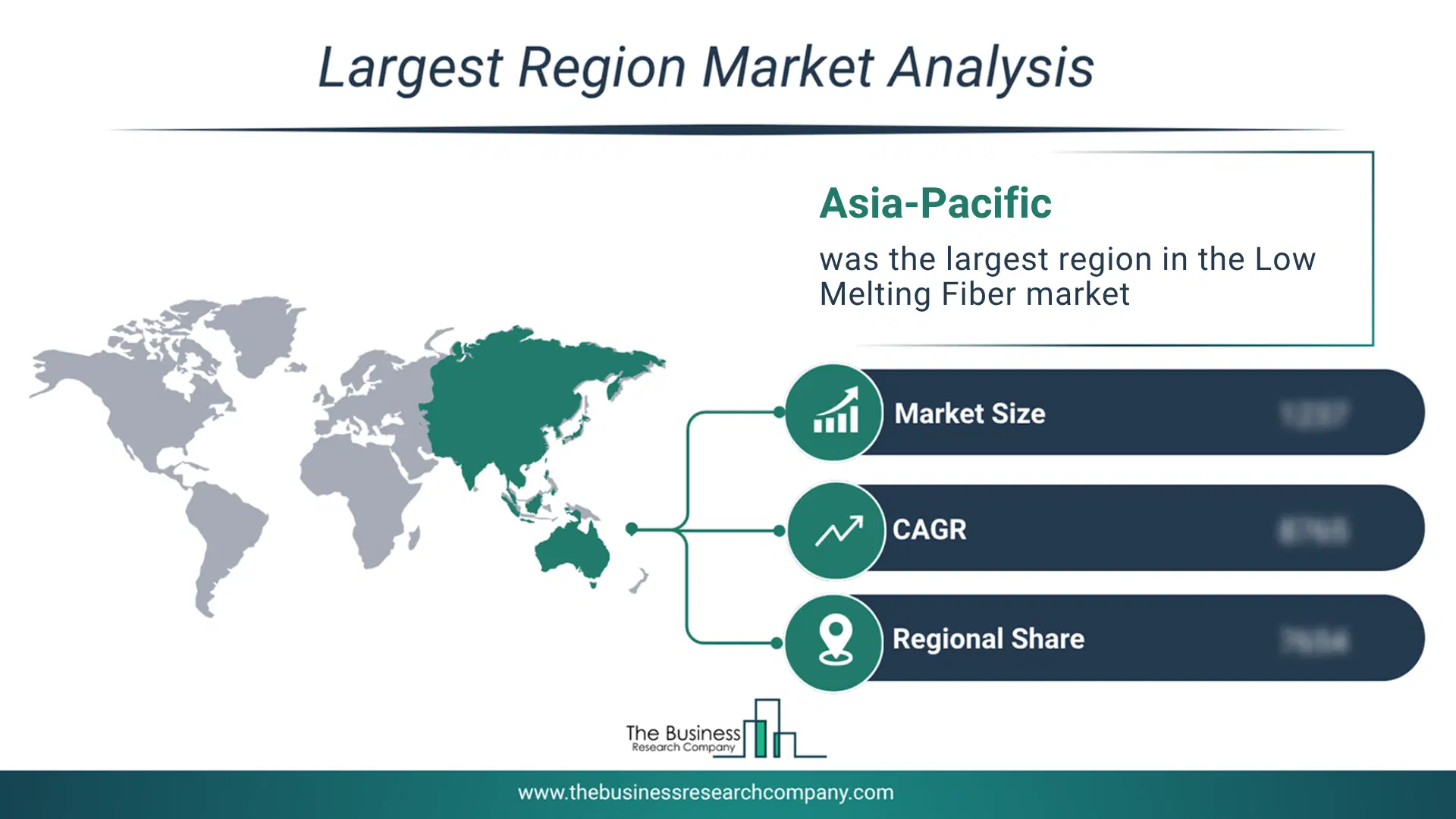
Regional Outlook
Asia-Pacific was the largest region in the low melting fiber market in 2025. The regions covered in this market report are Asia-Pacific, South East Asia, Western Europe, Eastern Europe, North America, South America, Middle East, Africa. The countries covered in this market report are Australia, Brazil, China, France, Germany, India, Indonesia, Japan, Taiwan, Russia, South Korea, UK, USA, Canada, Italy, Spain.What Defines the Low Melting Fiber Market?
The low-melting fiber market consists of sales of nonwoven fabrics, composite materials, thermally bonded fabrics, filtration products and insulation products. Values in this market are ‘factory gate’ values, that is the value of goods sold by the manufacturers or creators of the goods, whether to other entities (including downstream manufacturers, wholesalers, distributors and retailers) or directly to end customers. The value of goods in this market includes related services sold by the creators of the goods.How is Market Value Defined and Measured?
The market value is defined as the revenues that enterprises gain from the sale of goods and/or services within the specified market and geography through sales, grants, or donations in terms of the currency (in USD unless otherwise specified). The revenues for a specified geography are consumption values that are revenues generated by organizations in the specified geography within the market, irrespective of where they are produced. It does not include revenues from resales along the supply chain, either further along the supply chain or as part of other products.
This chart presents market attractiveness based on a quantitative evaluation of growth, competition, strategic alignment, and risk, offering a clear view of opportunity areas for decision-making. This chart is for illustrative purposes; the full report contains the complete analysis.

This chart highlights the Total Addressable Market (TAM) by estimating the maximum revenue opportunity using an assumption-driven approach, supporting strategic planning and opportunity sizing across markets. The chart is illustrative; the full report provides a more comprehensive analysis.
What Key Data and Analysis Are Included in the Low Melting Fiber Market Report 2026?
The low melting fiber market research report is one of a series of new reports from The Business Research Company that provides market statistics, including Market Report 2026?global market size, regional shares, competitors with the market share, detailed market segments, market trends and opportunities, and any further data you may need to thrive in the low melting fiber Market Report 2026? The market research report delivers a complete perspective of everything you need, with an in-depth analysis of the current and future state of the Market Report 2026?Low Melting Fiber Market Report Forecast Analysis
| Report Attribute | Details |
|---|---|
| Market Size Value In 2026 | $2.45 billion |
| Revenue Forecast In 2030 | $3.12 billion |
| Growth Rate | CAGR of 5.5% from 2026 to 2030 |
| Base Year For Estimation | 2025 |
| Actual Estimates/Historical Data | 2020-2025 |
| Forecast Period | 2026 - 2030 |
| Market Representation | Revenue in USD Billion and CAGR from 2026 to 2030 |
| Segments Covered | Type, Structure Type, Application |
| Regional Scope | Asia-Pacific, Western Europe, Eastern Europe, North America, South America, Middle East, Africa |
| Country Scope | The countries covered in the report are Australia, Brazil, China, France, Germany, India, Indonesia, Japan, Taiwan, Russia, South Korea, UK, USA, Canada, Italy, Spain. |
| Key Companies Profiled | BASF SE, Mitsubishi Chemical Corporation, Saudi Arabia's Basic Industries Corporation (SABIC), Asahi Kasei Corporation, Sumitomo Chemical Company Limited, Evonik Industries AG, DuPont De Nemours Inc., Eastman Chemical Company, Lanxess Corporation, Formosa Plastics Corporation, Far Eastern New Century, Teijin Limited, Nan Ya Plastics Corporation, Kuraray Co. Ltd., Hyosung Corporation, Toyobo Co. Ltd., Taekwang Industrial Co. Ltd., Huvis Corporation, Xiamen Xianglu Chemical Fiber Co. Ltd., Kolon Industries, Fiber Visions Corporation, Thai Poly Acrylic, Toray Chemical Korea Inc., Zhejiang Hengyi Group Co. Ltd. |
| Customization Scope | Request for Customization |
| Pricing And Purchase Options | Explore Purchase Options |