
Natural Fibers Market Report 2026
Global Outlook – By Type (Cellulose based natural fiber, Protein based natural fiber), By Distribution Channel (Direct/Institutional Sales, Retail Sales, Other Channel Sales), By End-Use Industry (Automotive, Textile, Medical, Other End Use) – Market Size, Trends, Strategies, and Forecast to 2030
Natural Fibers Market Overview
• Natural Fibers market size has reached to $78.47 billion in 2025 • Expected to grow to $110.23 billion in 2030 at a compound annual growth rate (CAGR) of 7% • Growth Driver: The Automotive Industry's Impact On The Surging Growth Of The Natural Fibers Market • Market Trend: Advancements In Fabric And Yarn Technology • Asia-Pacific was the largest region in 2025 and North America is the fastest growing region.What Is Covered Under Natural Fibers Market?
The natural fibers are used in various industries for their better renewable, cost-effective, abundant, formability, and eco-friendly features. Natural fibers refer to long, thin, and flexible thread structures with various advantages, including high specific stiffness and strength, a good fiber aspect ratio, biodegradability, and easy accessibility from natural sources. The main types of natural fibers are cellulose-based, and protein-based fibers. The cellulose-based fibers refer to fibers consisting primarily of cellulose and a varying amount of hemicellulose, lignin, pectins, and waxes depending on the origin of extraction from part of the plant. The distribution channels include direct or institutional sales, retail sales, and other channel sales. The various end-use industries include automotive, textiles, medical, and other end-user industries.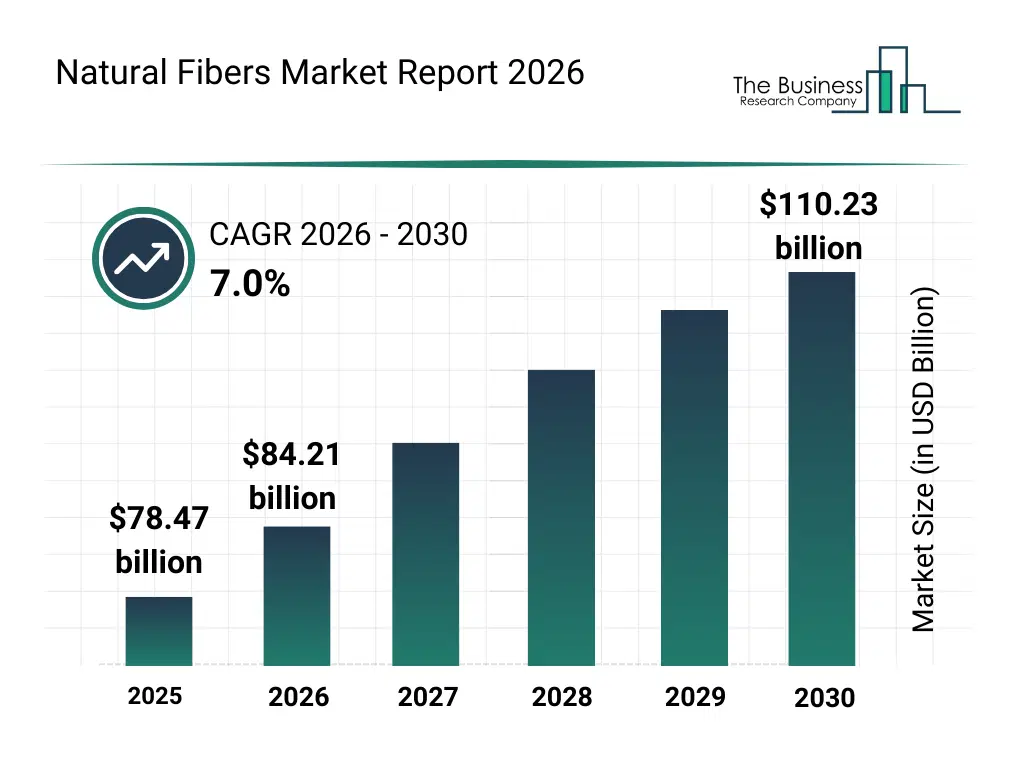
What Is The Natural Fibers Market Size and Share 2026?
The natural fibers market size has grown strongly in recent years. It will grow from $78.47 billion in 2025 to $84.21 billion in 2026 at a compound annual growth rate (CAGR) of 7.3%. The growth in the historic period can be attributed to increasing textile manufacturing activities, availability of abundant natural fiber sources, rising demand for biodegradable materials, adoption of fibers in traditional industries, improvements in fiber extraction techniques.What Is The Natural Fibers Market Growth Forecast?
The natural fibers market size is expected to see strong growth in the next few years. It will grow to $110.23 billion in 2030 at a compound annual growth rate (CAGR) of 7.0%. The growth in the forecast period can be attributed to increasing focus on sustainable materials, expansion of lightweight composite usage, rising demand from automotive electrification, growing investments in green manufacturing, increasing innovation in natural fiber processing. Major trends in the forecast period include increasing use of natural fibers in automotive applications, rising demand for eco-friendly textile materials, expansion of bio-based composite development, growing adoption in medical and hygiene products, enhanced focus on fiber processing efficiency.
Global Natural Fibers Market Segmentation
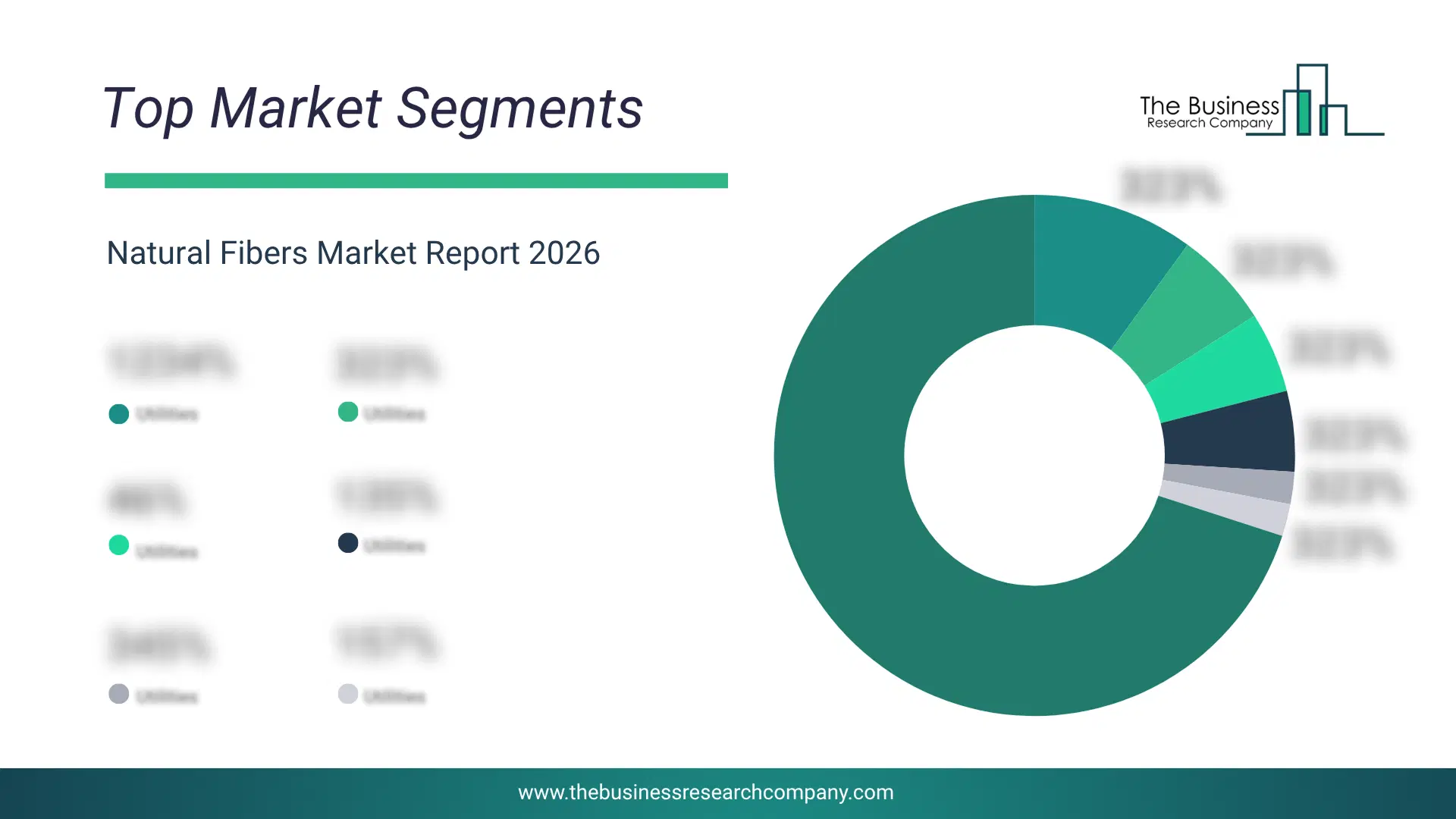
1) By Type: Cellulose based natural fiber, Protein based natural fiber 2) By Distribution Channel: Direct/Institutional Sales, Retail Sales, Other Channel Sales 3) By End-Use Industry: Automotive, Textile, Medical, Other End Use Subsegments: 1) By Cellulose-Based Natural Fiber: Cotton, Flax, Jute, Hemp, Bamboo 2) By Protein-Based Natural Fiber: Wool, Silk, Cashmere, Mohair, AlpacaWhat Is The Driver Of The Natural Fibers Market?
The increasing demand in the automotive industry is expected to propel the growth of the natural fibers market going forward. The automotive industry refers to the collection of companies involved in the design, development, manufacture, marketing, and sale of motor vehicles. The use of natural fibers in the automotive industry offers weight reduction, environmental sustainability, reduced dependency on non-renewable resources, biodegradability, improved energy efficiency, recyclability, aesthetic appeal, and reduced carbon footprint. For instance, in April 2024, according to the Serbian Association of Vehicle and Parts Importers, a Serbia-based professional automotive organization, 93,546,599 vehicles (including 67,133,570 passenger vehicles) were produced worldwide in 2023, up from 84,830,376 vehicles in 2022. Therefore, the increasing demand in the automotive industry is driving the growth of the natural fibers industry.Key Players In The Global Natural Fibers Market
Major companies operating in the natural fibers market are BASF SE, UPM-Kymmene Oyj, Trex Company Inc., Fiberon LLC, Barnhardt Natural Fibers LLC, Polyvlies Franz Beyer GMBH & Co KG, Bcomp Ltd., Procotex SA Corporation NV, Ananas Anam, FlexForm Technologies, Swicofil AG, JELU-WERK J. Ehrler GmbH and Co KG, Tecnaro GmbH, Bast Fiber Technologies Inc., The Natural Fibre Company, Dividan LLC, GreenGran BV, The Flax Company SARL, Industrial Hemp Manufacturing LLC, Jaydeep Cotton Fibers Pvt Ltd., Asha Cotton Industries Limited, Vrijesh Natural Fibre & Fabrics Pvt Ltd., Dun Agro Hemp Group, NATURALUS PLUOŠTAS UAB, GreenCore Composites Inc., Meshlin Composites Zrt, BAFA Neu GmbH, Castellins NV, Circular Systems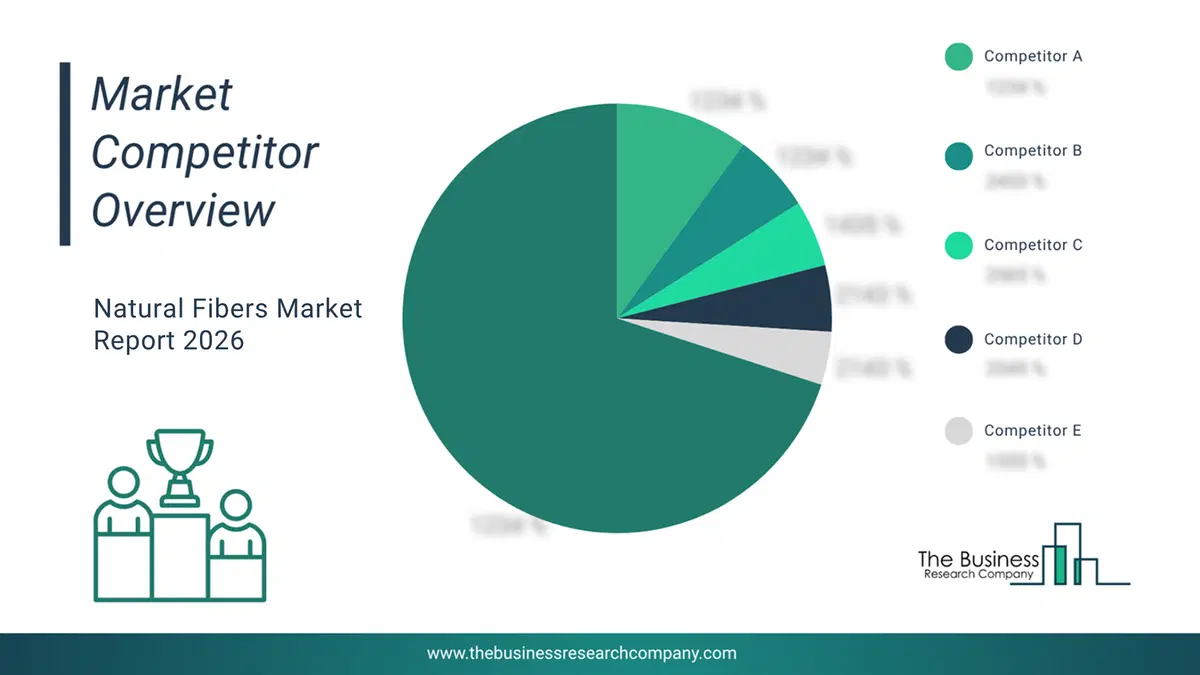
This chart is for illustrative purposes; the full report includes a detailed competitor analysis and comprehensive overview of the top 10 companies in the market.
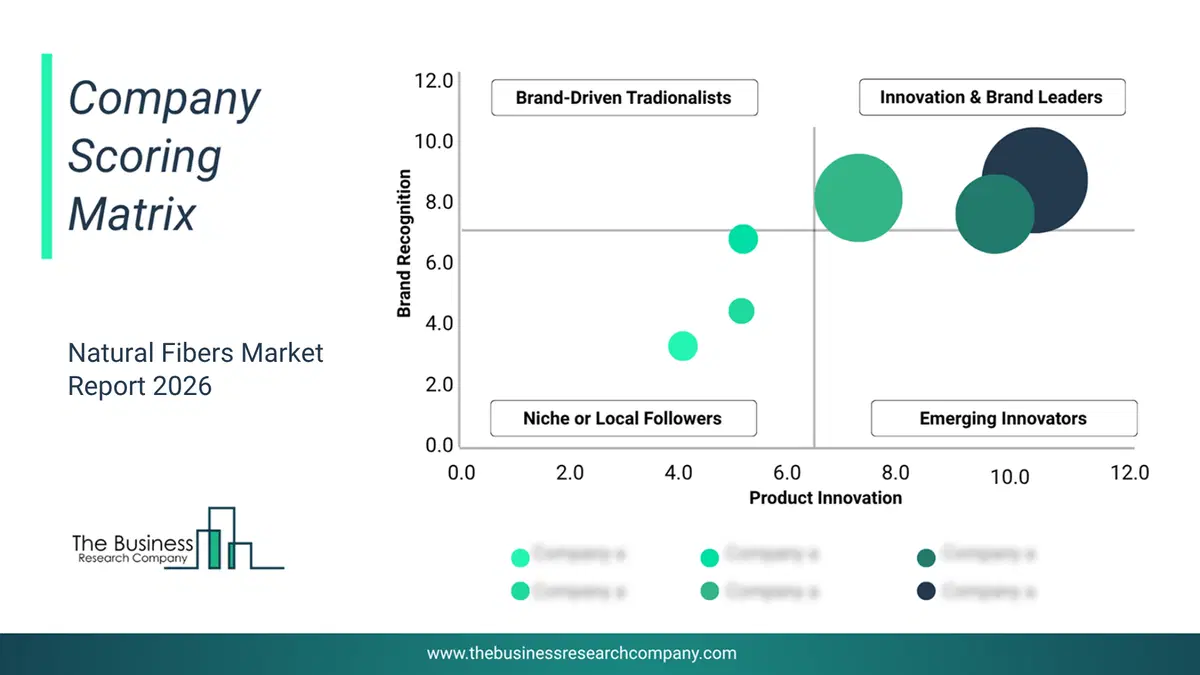
This chart maps companies by product innovation and brand strength, with bubble size indicating relative revenue, helping identify market leaders, challengers, and niche players. This is an illustrative chart; the full report provides a complete and accurate competitive analysis.
Global Natural Fibers Market Trends and Insights
Major companies operating in the natural fibers market are developing new technologies such as fabric and yarn technology to gain a competitive edge in the market. Fabric and yarn technology refer to the advancements and innovations in the processes, materials, and techniques involved in the production of fabrics and yarns. For instance, in November 2023, Transforming Textiles AB, a Sweden-based manufacturer of narrow woven fabrics launched Sense-Tex. Sense-Tex is a smart, environmentally friendly textile technology that promises to provide customers with an amazing experience by fusing style, smart technology, and sustainability. Sense-Tex is a novel 5-fiber yarn-thread technology that makes it possible to accomplish total circularity and mechanical recycling achievements that have never been made possible on a wide scale previously. The technique supports hygiene, durability, and less washing by incorporating health-improving properties into its fibers. It offers health indicators like those of a smartwatch when linked to sensors, enabling the wear of a fabric that monitors health in addition to enhancing well-being.What Are Latest Mergers And Acquisitions In The Natural Fibers Market?
In June 2023, Albany International, a U.S.-based manufacturing company, acquired Heimbach Group for approximately $177.86 million (€153 million). With this acquisition, Albany International aimed to expand its scale and geographic footprint while gaining complementary technologies and creating margin-expansion opportunities. Heimbach Group is a Germany-based manufacturing company that specializes in providing natural fiber.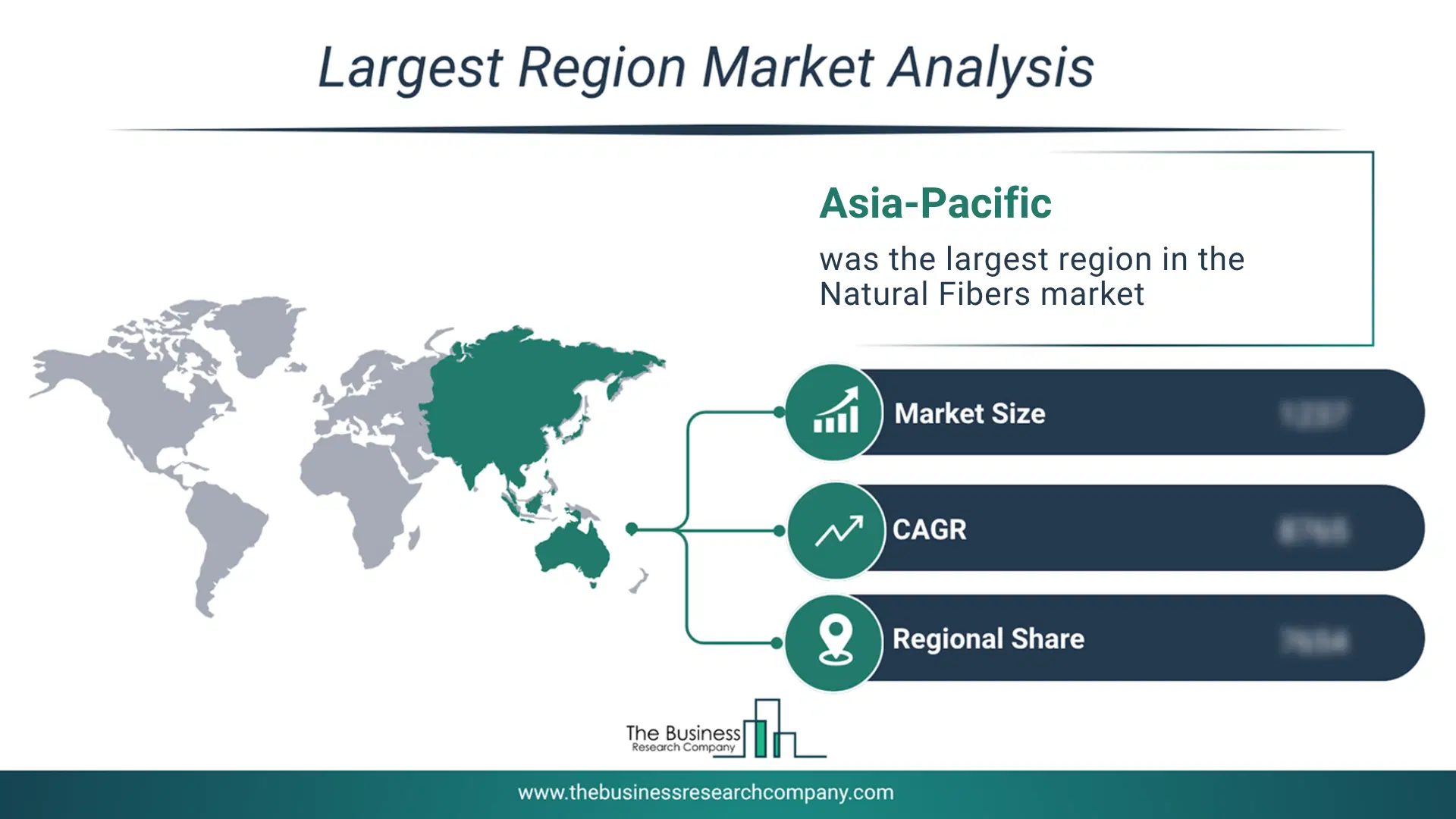
Regional Outlook
Asia-Pacific was the largest region in the natural fibers market in 2025. North America is expected to be the fastest-growing region in the forecast period. The regions covered in this market report are Asia-Pacific, South East Asia, Western Europe, Eastern Europe, North America, South America, Middle East and Africa. The countries covered in this market report are Australia, Brazil, China, France, Germany, India, Indonesia, Japan, Taiwan, Russia, South Korea, UK, USA, Italy, Spain, CanadaWhat Defines the Natural Fibers Market?
The natural fiber market consists of sales of cotton, flax, hemp, bamboo, sisal, and jute. Values in this market are ‘factory gate’ values, that is the value of goods sold by the manufacturers or creators of the goods, whether to other entities (including downstream manufacturers, wholesalers, distributors and retailers) or directly to end customers. The value of goods in this market includes related services sold by the creators of the goods.How is Market Value Defined and Measured?
The market value is defined as the revenues that enterprises gain from the sale of goods and/or services within the specified market and geography through sales, grants, or donations in terms of the currency (in USD unless otherwise specified). The revenues for a specified geography are consumption values that are revenues generated by organizations in the specified geography within the market, irrespective of where they are produced. It does not include revenues from resales along the supply chain, either further along the supply chain or as part of other products.
This chart presents market attractiveness based on a quantitative evaluation of growth, competition, strategic alignment, and risk, offering a clear view of opportunity areas for decision-making. This chart is for illustrative purposes; the full report contains the complete analysis.

This chart highlights the Total Addressable Market (TAM) by estimating the maximum revenue opportunity using an assumption-driven approach, supporting strategic planning and opportunity sizing across markets. The chart is illustrative; the full report provides a more comprehensive analysis.
What Key Data and Analysis Are Included in the Natural Fibers Market Report 2026?
The natural fibers market research report is one of a series of new reports from The Business Research Company that provides market statistics, including industry global market size, regional shares, competitors with the market share, detailed market segments, market trends and opportunities, and any further data you may need to thrive in the natural fibers industry. The market research report delivers a complete perspective of everything you need, with an in-depth analysis of the current and future state of the industry.Natural Fibers Market Report Forecast Analysis
| Report Attribute | Details |
|---|---|
| Market Size Value In 2026 | $84.21 billion |
| Revenue Forecast In 2030 | $110.23 billion |
| Growth Rate | CAGR of 7.3% from 2026 to 2030 |
| Base Year For Estimation | 2025 |
| Actual Estimates/Historical Data | 2020-2025 |
| Forecast Period | 2026 - 2030 |
| Market Representation | Revenue in USD Billion and CAGR from 2026 to 2030 |
| Segments Covered | Type, Distribution Channel, End-Use Industry |
| Regional Scope | Asia-Pacific, Western Europe, Eastern Europe, North America, South America, Middle East, Africa |
| Country Scope | The countries covered in the report are Australia, Brazil, China, France, Germany, India, Indonesia, Japan, Taiwan, Russia, South Korea, UK, USA, Canada, Italy, Spain. |
| Key Companies Profiled | BASF SE, UPM-Kymmene Oyj, Trex Company Inc., Fiberon LLC, Barnhardt Natural Fibers LLC, Polyvlies Franz Beyer GMBH & Co KG, Bcomp Ltd., Procotex SA Corporation NV, Ananas Anam, FlexForm Technologies, Swicofil AG, JELU-WERK J. Ehrler GmbH and Co KG, Tecnaro GmbH, Bast Fiber Technologies Inc., The Natural Fibre Company, Dividan LLC, GreenGran BV, The Flax Company SARL, Industrial Hemp Manufacturing LLC, Jaydeep Cotton Fibers Pvt Ltd., Asha Cotton Industries Limited, Vrijesh Natural Fibre & Fabrics Pvt Ltd., Dun Agro Hemp Group, NATURALUS PLUOŠTAS UAB, GreenCore Composites Inc., Meshlin Composites Zrt, BAFA Neu GmbH, Castellins NV, Circular Systems |
| Customization Scope | Request for Customization |
| Pricing And Purchase Options | Explore Purchase Options |