
Luxury Beauty Market Report 2026
Global Outlook – By Product Type (Skincare, Haircare, Makeup, Fragrances, Other Product Types), By Application (Personal Care And Self-Grooming, Hospitality And Spa Industry, Fashion And Entertainment Industry, Retail And Travel Retail), By Distribution Channel (Online Retail, Specialty Stores, Department Stores, Other Distribution Channels), By End-User (Men, Women, Unisex) – Market Size, Trends, Strategies, and Forecast to 2030
Luxury Beauty Market Overview
• Luxury Beauty market size has reached to $78.71 billion in 2025 • Expected to grow to $121.94 billion in 2030 at a compound annual growth rate (CAGR) of 9.1% • Growth Driver: Rising E-Commerce Sales Driving The Growth Of The Market Due To Increasing Internet Access And Smartphone Usage • Market Trend: Science-Backed Beauty Solutions Set New Standards For Skin Health • North America was the largest region in 2025 and Asia-Pacific is the fastest growing region.What Is Covered Under Luxury Beauty Market?
Luxury beauty refers to high-end cosmetic, skincare, and fragrance products that are crafted with premium ingredients, advanced formulations, and sophisticated packaging to offer an exclusive and elevated consumer experience. These products are often associated with prestige, status, and exceptional quality, targeting discerning customers willing to pay a premium for superior performance and brand reputation. The main product types of luxury beauty are skincare, haircare, makeup, fragrances, and other product types. Skincare refers to high-end skincare products formulated with premium ingredients, advanced technologies, and elegant packaging to provide superior results and an indulgent self-care experience. These products are utilized across various applications, such as personal care and self-grooming, the hospitality and spa industry, the fashion and entertainment industry, and retail and travel retail. They are distributed through multiple channels, including online retail, specialty stores, department stores, and other distribution channels, serving a diverse range of end users such as men, women, and unisex.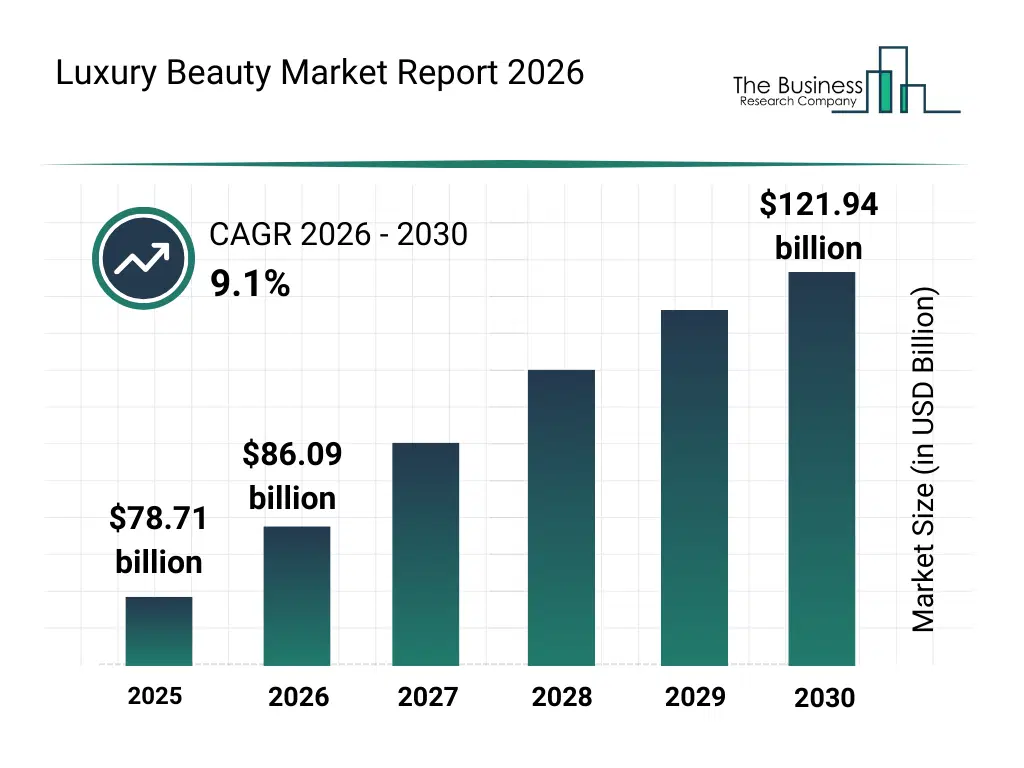
What Is The Luxury Beauty Market Size and Share 2026?
The luxury beauty market size has grown strongly in recent years. It will grow from $78.71 billion in 2025 to $86.09 billion in 2026 at a compound annual growth rate (CAGR) of 9.4%. The growth in the historic period can be attributed to brand driven consumer demand, rising disposable incomes, premiumization of beauty products, retail expansion, celebrity and influencer marketing.What Is The Luxury Beauty Market Growth Forecast?
The luxury beauty market size is expected to see strong growth in the next few years. It will grow to $121.94 billion in 2030 at a compound annual growth rate (CAGR) of 9.1%. The growth in the forecast period can be attributed to digital luxury shopping growth, sustainable ingredient adoption, biotechnology based formulations, personalization technologies, emerging market luxury demand. Major trends in the forecast period include rising demand for premium skincare products, growing preference for clean and sustainable beauty, expansion of online and digital luxury retail, increased focus on advanced formulations, personalization and custom beauty experiences.
Global Luxury Beauty Market Segmentation
1) By Product Type: Skincare, Haircare, Makeup, Fragrances, Other Product Types 2) By Application: Personal Care And Self-Grooming, Hospitality And Spa Industry, Fashion And Entertainment Industry, Retail And Travel Retail 3) By Distribution Channel: Online Retail, Specialty Stores, Department Stores, Other Distribution Channels 4) By End-User: Men, Women, Unisex Subsegments: 1) By Skincare: Anti-Aging Creams, Hydrating Serums, Exfoliators, Brightening Creams, Night Creams, Face Oils, Sheet Masks, Pore Refiners 2) By Haircare: Volumizing Shampoos, Leave-In Conditioners, Heat Protection Sprays, Hair Repair Masks, Hair Gloss Treatments 3) By Makeup: Liquid Foundations, Lip Glosses, Eyeliners, Brow Pencils, Compact Powders, Makeup Removers 4) By Fragrances: Floral Scents, Woody Scents, Citrus Scents, Oriental Scents, Fresh Scents, Spicy Scents 5) By Other Product Types: Body Scrubs, Hand Creams, Foot Care Products, Nail Polishes, Makeup Brushes, Beauty Blenders, Beard Oils, DeodorantsWhat Is The Driver Of The Luxury Beauty Market?
The rising e-commerce sales are expected to propel the growth of the luxury beauty market going forward. E-commerce sales refer to the transaction of goods or services conducted online through digital platforms, where payments and order processing are completed electronically. Rising e-commerce sales are driven by an increase in internet access and smartphone usage, which make online shopping more convenient and accessible to a larger population. E-commerce enables luxury beauty brands to reach a wider audience, offer personalized shopping experiences, and showcase exclusive products, which can contribute to higher engagement and potential sales growth. For instance, in February 2025, according to the Census Bureau, a US-based government agency, total e-commerce sales in 2024 were estimated at $1,192.6 billion, reflecting an 8.1% increase (±1.1) compared to 2023. Further, in 2024, e-commerce sales represented 16.1% of overall retail sales, up from 15.3% in 2023, highlighting the growing importance of online channels in retail. Therefore, rising e-commerce sales are expected to create opportunities for growth in the luxury beauty industry.Key Players In The Global Luxury Beauty Market
Major companies operating in the luxury beauty market are Christian Dior, L'Oréal, Kering Group, Chanel, Estée Lauder, Gucci, Shiseido, Coty, Puig, Burberry, Amorepacific, Clarins, La Colline Skincare, La Prairie, La Mer, Decorté, POLA Orbis, Sisley Paris, Helena Rubinstein, SK‑II, Giorgio Armani Beauty, Tom Ford Beauty, Dolce & Gabbana Beauty, Valentino Beauty, Givenchy Beauty, Yves Saint Laurent Beauté, Lancôme, Hermès Parfums, Prada Beauty, Bvlgari Parfums, Creed Fragrance & Beauty, Maison Francis Kurkdjian, Diptyque, Byredo
This chart is for illustrative purposes; the full report includes a detailed competitor analysis and comprehensive overview of the top 10 companies in the market.
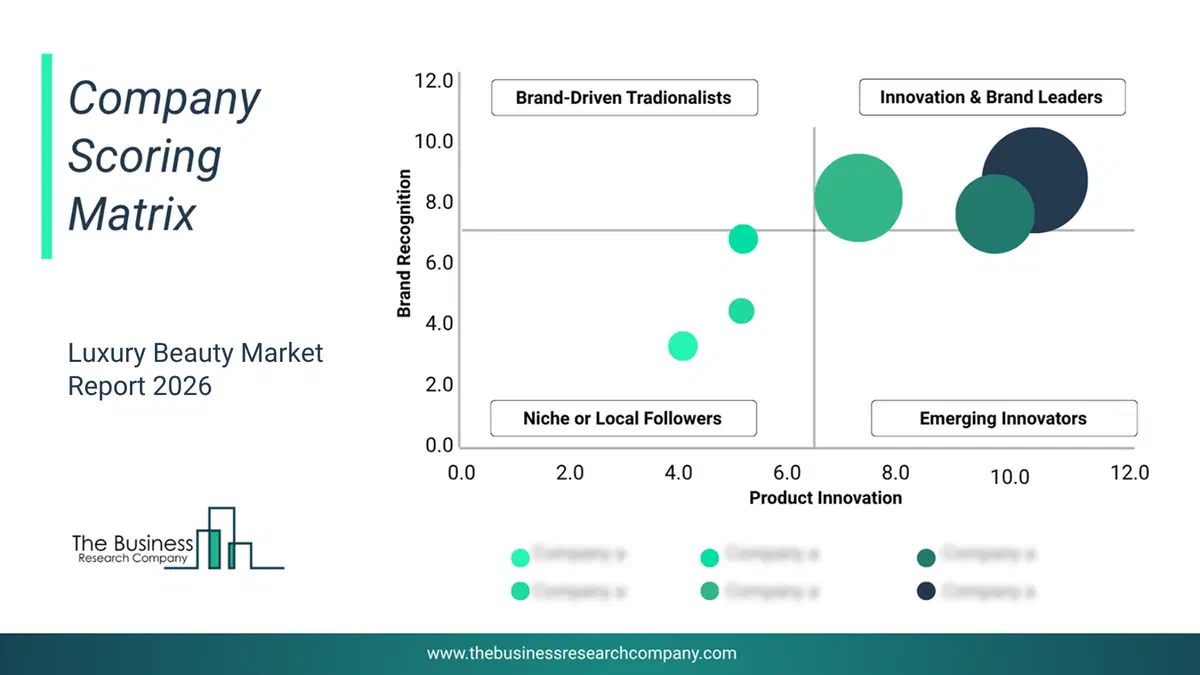
This chart maps companies by product innovation and brand strength, with bubble size indicating relative revenue, helping identify market leaders, challengers, and niche players. This is an illustrative chart; the full report provides a complete and accurate competitive analysis.
Global Luxury Beauty Market Trends and Insights
Major companies operating in the luxury beauty market are focusing on developing innovative solutions, such as premium haircare and skincare brands, to meet the rising demand for high-performance, science-backed beauty products. Premium haircare and skincare brands are high-end beauty lines that use advanced formulations, quality ingredients, and innovative technologies to deliver superior results and a luxury experience. For instance, in October 2024, Reliance Retail Limited, an India-based retail company, through its beauty platform Tira, launched the global luxury skincare and haircare brand Augustinus Bader in India. The brand is distinguished by its patented TFC8 technology, a unique combination of natural amino acids, high-grade vitamins, and peptides developed from over 30 years of regenerative medicine research. This technology promotes cellular renewal and skin healing, helping to reduce fine lines, wrinkles, redness, hyperpigmentation, stretch marks, and damage caused by environmental stressors, resulting in healthier, firmer, and more even-toned skin. The formulations are designed to adapt to individual skin needs across all genders, ages, and ethnicities, making them suitable for a wide variety of skin types and conditions.What Are Latest Mergers And Acquisitions In The Luxury Beauty Market?
In April 2023, The Estée Lauder Companies Inc., a US-based cosmetics company, acquired TOM FORD for $2.25 billion. With this acquisition, The Estée Lauder Companies Inc. aims to unlock new opportunities and fortify its growth plans for Tom Ford Beauty while expanding its presence in the luxury beauty and fashion market to compete more effectively with major luxury conglomerates globally. Tom Ford SA is a US-based company that provides luxury beauty products.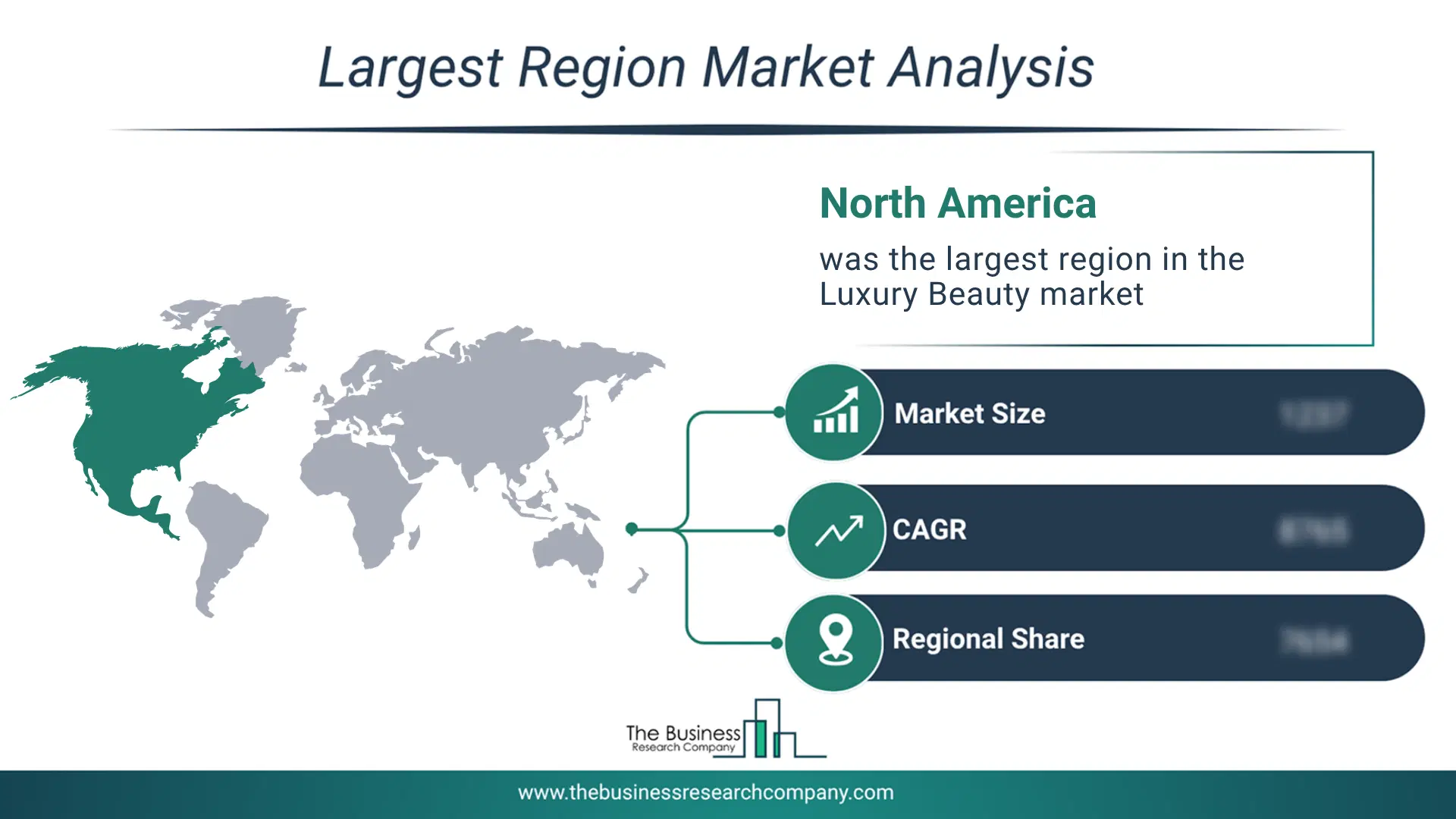
Regional Insights
North America was the largest region in the luxury beauty market in 2025. Asia-Pacific is expected to be the fastest-growing region in the forecast period. The regions covered in this market report are Asia-Pacific, South East Asia, Western Europe, Eastern Europe, North America, South America, Middle East, Africa The countries covered in this market report are Australia, Brazil, China, France, Germany, India, Indonesia, Japan, Taiwan, Russia, South Korea, UK, USA, Canada, Italy, SpainWhat Defines the Luxury Beauty Market?
The luxury beauty market consists of sales of face masks, serums, body oils, hair serums and oils and luxury bath and shower products. Values in this market are ‘factory gate’ values, that is the value of goods sold by the manufacturers or creators of the goods, whether to other entities (including downstream manufacturers, wholesalers, distributors and retailers) or directly to end customers. The value of goods in this market includes related services sold by the creators of the goods.How is Market Value Defined and Measured?
The market value is defined as the revenues that enterprises gain from the sale of goods and/or services within the specified market and geography through sales, grants, or donations in terms of the currency (in USD unless otherwise specified). The revenues for a specified geography are consumption values that are revenues generated by organizations in the specified geography within the market, irrespective of where they are produced. It does not include revenues from resales along the supply chain, either further along the supply chain or as part of other products.
This chart presents market attractiveness based on a quantitative evaluation of growth, competition, strategic alignment, and risk, offering a clear view of opportunity areas for decision-making. This chart is for illustrative purposes; the full report contains the complete analysis.

This chart highlights the Total Addressable Market (TAM) by estimating the maximum revenue opportunity using an assumption-driven approach, supporting strategic planning and opportunity sizing across markets. The chart is illustrative; the full report provides a more comprehensive analysis.
What Key Data and Analysis Are Included in the Luxury Beauty Market Report 2026?
The luxury beauty market research report is one of a series of new reports from The Business Research Company that provides market statistics, including industry global market size, regional shares, competitors with the market share, detailed market segments, market trends and opportunities, and any further data you may need to thrive in the luxury beauty industry. The market research report delivers a complete perspective of everything you need, with an in-depth analysis of the current and future state of the industry.Luxury Beauty Market Report Forecast Analysis
| Report Attribute | Details |
|---|---|
| Market Size Value In 2026 | $86.09 billion |
| Revenue Forecast In 2030 | $121.94 billion |
| Growth Rate | CAGR of 9.4% from 2026 to 2030 |
| Base Year For Estimation | 2025 |
| Actual Estimates/Historical Data | 2020-2025 |
| Forecast Period | 2026 - 2030 |
| Market Representation | Revenue in USD Billion and CAGR from 2026 to 2030 |
| Segments Covered | Product Type, Application, Distribution Channel, End-User |
| Regional Scope | Asia-Pacific, Western Europe, Eastern Europe, North America, South America, Middle East, Africa |
| Country Scope | The countries covered in this market report are Australia, Brazil, China, France, Germany, India, Indonesia, Japan, Taiwan, Russia, South Korea, UK, USA, Canada, Italy, Spain |
| Key Companies Profiled | Christian Dior, L'Oréal, Kering Group, Chanel, Estée Lauder, Gucci, Shiseido, Coty, Puig, Burberry, Amorepacific, Clarins, La Colline Skincare, La Prairie, La Mer, Decorté, POLA Orbis, Sisley Paris, Helena Rubinstein, SK‑II, Giorgio Armani Beauty, Tom Ford Beauty, Dolce & Gabbana Beauty, Valentino Beauty, Givenchy Beauty, Yves Saint Laurent Beauté, Lancôme, Hermès Parfums, Prada Beauty, Bvlgari Parfums, Creed Fragrance & Beauty, Maison Francis Kurkdjian, Diptyque, Byredo |
| Customization Scope | Request for Customization |
| Pricing And Purchase Options | Explore Purchase Options |