
Multi-Band Global Navigation Satellite System (GNSS) Receiver Market Report 2026
Global Outlook – By Product Type (Handheld Receivers, Fixed Receivers, Wearable Receivers, Other Product Types), By Frequency Band (Dual-Band, Triple-Band, Quad-Band, Other Frequency Bands), By Distribution Channel (Direct Sales, Distributors Or Resellers, Online Sales, Other Distribution Channels), By Application (Surveying And Mapping, Precision Agriculture, Marine, Aviation, Automotive, Military And Defense, Other Applications), By End-User (Commercial, Industrial, Government, Other End-Users) – Market Size, Trends, Strategies, and Forecast to 2030
Multi-Band Global Navigation Satellite System (GNSS) Receiver Market Overview
• Multi-Band Global Navigation Satellite System (GNSS) Receiver market size has reached to $2.92 billion in 2025 • Expected to grow to $5.77 billion in 2030 at a compound annual growth rate (CAGR) of 14.5% • Growth Driver: Rising Adoption Of Autonomous Vehicles Driving The Growth Of The Market Due To Enhanced Road Safety And Precise Navigation • Market Trend: Advancements And Innovations In Multi-Constellation GNSS Smart Antenna Receivers Enhancing Accuracy And Reliability • North America was the largest region in 2025 and Asia-Pacific is the fastest growing region.What Is Covered Under Multi-Band Global Navigation Satellite System (GNSS) Receiver Market?
A multi-band global navigation satellite system (GNSS) receiver is a highly advanced device that captures and processes signals from multiple global navigation satellite systems across several frequency bands at the same time, ensuring continuous and stable satellite signal reception. It provides enhanced precision, stronger signal reliability, and greater resilience against interference and signal degradation, delivering consistently accurate positional data. The main types of products in multi-band global navigation satellite system (GNSS) receiver handheld receivers, fixed receivers, wearable receivers, and others. handheld receivers are portable communication or signal reception devices designed for mobility, ease of use, and flexibility in field operations. it include various frequency bands, such as dual-band, triple-band, quad-band, others, and are distributed through direct sales, distributors or resellers, online sales, others. it finds applications in surveying and mapping, precision agriculture, marine, aviation, automotive, military and defense, others, serving end-users such as commercial, industrial, government, others.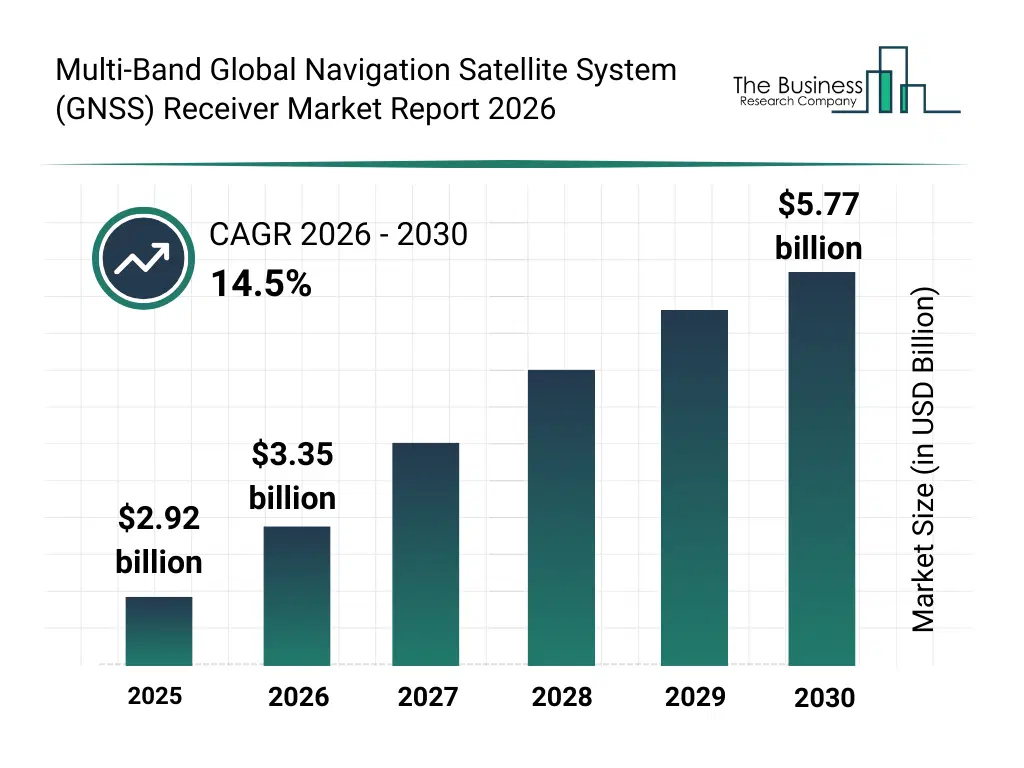
What Is The Multi-Band Global Navigation Satellite System (GNSS) Receiver Market Size and Share 2026?
The multi-band global navigation satellite system (gnss) receiver market size has grown rapidly in recent years. It will grow from $2.92 billion in 2025 to $3.35 billion in 2026 at a compound annual growth rate (CAGR) of 14.8%. The growth in the historic period can be attributed to adoption of single-band gnss receivers in civil and military applications, improvements in multi-frequency antenna technologies, development of precise timing and positioning algorithms, rising demand for reliable geospatial data, integration of gnss receivers in surveying and mapping equipment.What Is The Multi-Band Global Navigation Satellite System (GNSS) Receiver Market Growth Forecast?
The multi-band global navigation satellite system (gnss) receiver market size is expected to see rapid growth in the next few years. It will grow to $5.77 billion in 2030 at a compound annual growth rate (CAGR) of 14.5%. The growth in the forecast period can be attributed to expansion of multi-constellation gnss support, development of anti-jamming and interference-resistant receivers, adoption in autonomous vehicles and drones, integration with AI for predictive positioning analytics, enhanced miniaturization for portable and wearable applications. Major trends in the forecast period include rising demand for high-precision multi-frequency gnss solutions, expansion of gnss integration in emerging commercial and industrial applications, growing adoption of gnss receivers in drones and autonomous surveying platforms, increased development of interference-resistant and anti-spoofing receiver architectures, advancements in compact, low-power gnss modules for mobile and wearable systems,.
Global Multi-Band Global Navigation Satellite System (GNSS) Receiver Market Segmentation
1) By Product Type: Handheld Receivers, Fixed Receivers, Wearable Receivers, Other Product Types 2) By Frequency Band: Dual-Band, Triple-Band, Quad-Band, Other Frequency Bands 3) By Distribution Channel: Direct Sales, Distributors Or Resellers, Online Sales, Other Distribution Channels 4) By Application: Surveying And Mapping, Precision Agriculture, Marine, Aviation, Automotive, Military And Defense, Other Applications 5) By End-User: Commercial, Industrial, Government, Other End-Users Subsegments: 1) By Handheld Receivers: Surveying, Mapping, Navigation, Geolocation 2) By Fixed Receivers: Base Stations, Reference Stations, Monitoring Stations, Infrastructure Receivers 3) By Wearable Receivers: Smart Watches, Fitness Trackers, Outdoor Activity Devices, Personal Navigation Devices 4) By Other Product Types: Vehicle-Mounted Receivers, Drone-Mounted Receivers, Marine Receivers, Aviation ReceiversWhat Is Driver Of The Multi-Band Global Navigation Satellite System (GNSS) Receiver Market?
The rising adoption of autonomous vehicles is expected to propel the growth of the multi-band global navigation satellite system (GNSS) receiver market going forward. Autonomous vehicles are self-driving vehicles that use sensors and artificial intelligence to navigate and operate without human intervention. The adoption of autonomous vehicles is increasing as growing concerns over road safety drive the demand for technologies that can reduce accidents caused by human error while ensuring more reliable and efficient transportation. Multi-band GNSS receivers support autonomous vehicles by providing highly accurate and reliable real-time positioning from multiple satellite signals, enabling safer and more efficient navigation. For instance, according to the Insurance Institute for Highway Safety, a US-based non-profit organization, the number of self-driving vehicles on U.S. roads is projected to reach 3.5 million by 2025 and 4.5 million by 2030. Therefore, the rising adoption of autonomous vehicles is driving the growth of the multi-band global navigation satellite system (GNSS) receiver industry.Key Players In The Global Multi-Band Global Navigation Satellite System (GNSS) Receiver Market
Major companies operating in the multi-band global navigation satellite system (gnss) receiver market are Raytheon Technologies Corporation, Broadcom Inc., Qualcomm Technologies Inc., STMicroelectronics, Garmin Ltd., Trimble Inc., Quectel Wireless Solutions Co. Ltd., Topcon Corporation, Hexagon AB, Furuno Electric Co. Ltd., u-blox AG, NovAtel Inc., Satlabs Geosolutions AB, Unicore Communications Inc., LOCOSYS Technology Inc., SkyTraq Technology Inc., Allystar Technology Co. Ltd., NavCom Technology Inc., ComNav Technology Ltd., Navika Electronics, Tersus GNSS Inc.
This chart is for illustrative purposes; the full report includes a detailed competitor analysis and comprehensive overview of the top 10 companies in the market.
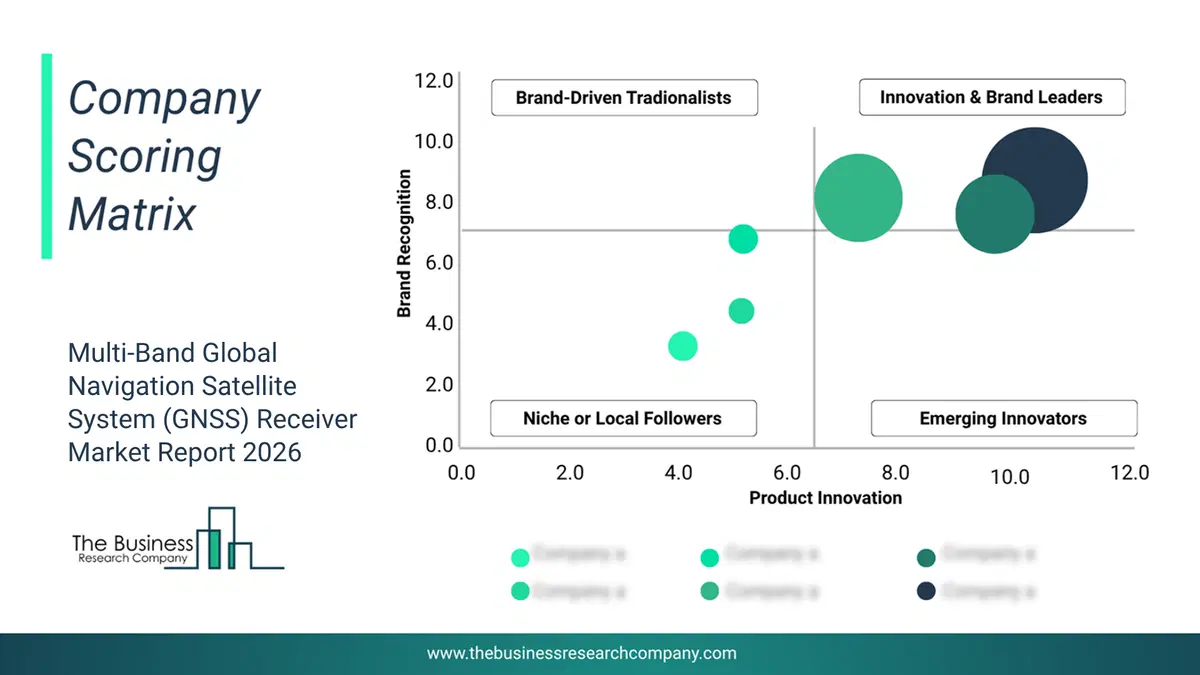
This chart maps companies by product innovation and brand strength, with bubble size indicating relative revenue, helping identify market leaders, challengers, and niche players. This is an illustrative chart; the full report provides a complete and accurate competitive analysis.
Global Multi-Band Global Navigation Satellite System (GNSS) Receiver Market Trends and Insights
Major companies operating in the multi-band global navigation satellite system (GNSS) receiver market are focusing on developing innovative solutions, such as multi-constellation navigation satellite system (GNSS) smart antenna receivers, to enhance accuracy, reliability, and overall performance across diverse navigation applications. Multi-constellation GNSS smart antenna receivers are advanced devices that receive signals from multiple satellite systems simultaneously, using intelligent antennas to enhance positioning accuracy and reliability. For instance, in September 2024, Quectel Wireless Solutions Co., Ltd., a China-based IoT solutions provider, launched the QLM29H series, a dual-band, multi-constellation GNSS smart antenna receiver combining their LC29H GNSS module with an integrated patch antenna. This receiver supports concurrent reception of global GNSS constellations like GPS, GLONASS, Galileo, BDS, and NavIC across both L1 and L5 frequency bands, significantly improving positioning accuracy and mitigating multipath interference, especially in challenging urban environments. With autonomous positioning accuracy of 1 meter and centimeter-level precision in RTK versions, it features dead reckoning for reliable performance even in weak or absent GNSS signal areas.What Are Latest Mergers And Acquisitions In The Multi-Band Global Navigation Satellite System (GNSS) Receiver Market? Hexagon AB Acquires Septentrio NV To Strengthen Mission-Critical GNSS And Autonomy Solutions
In March 2025, Hexagon AB, a Sweden-based provider of sensor fusion technologies and autonomous system platforms, acquired Septentrio NV for an undisclosed amount. With this acquisition, Hexagon aims to enhance its technological capabilities in mission-critical navigation and autonomy applications, expanding its reach in resilient and assured positioning solutions for robotics, UAVs, and other autonomous systems. Septentrio NV is a Belgium-based provider of high-precision GNSS positioning technology and a wide range of multi-band GNSS receivers.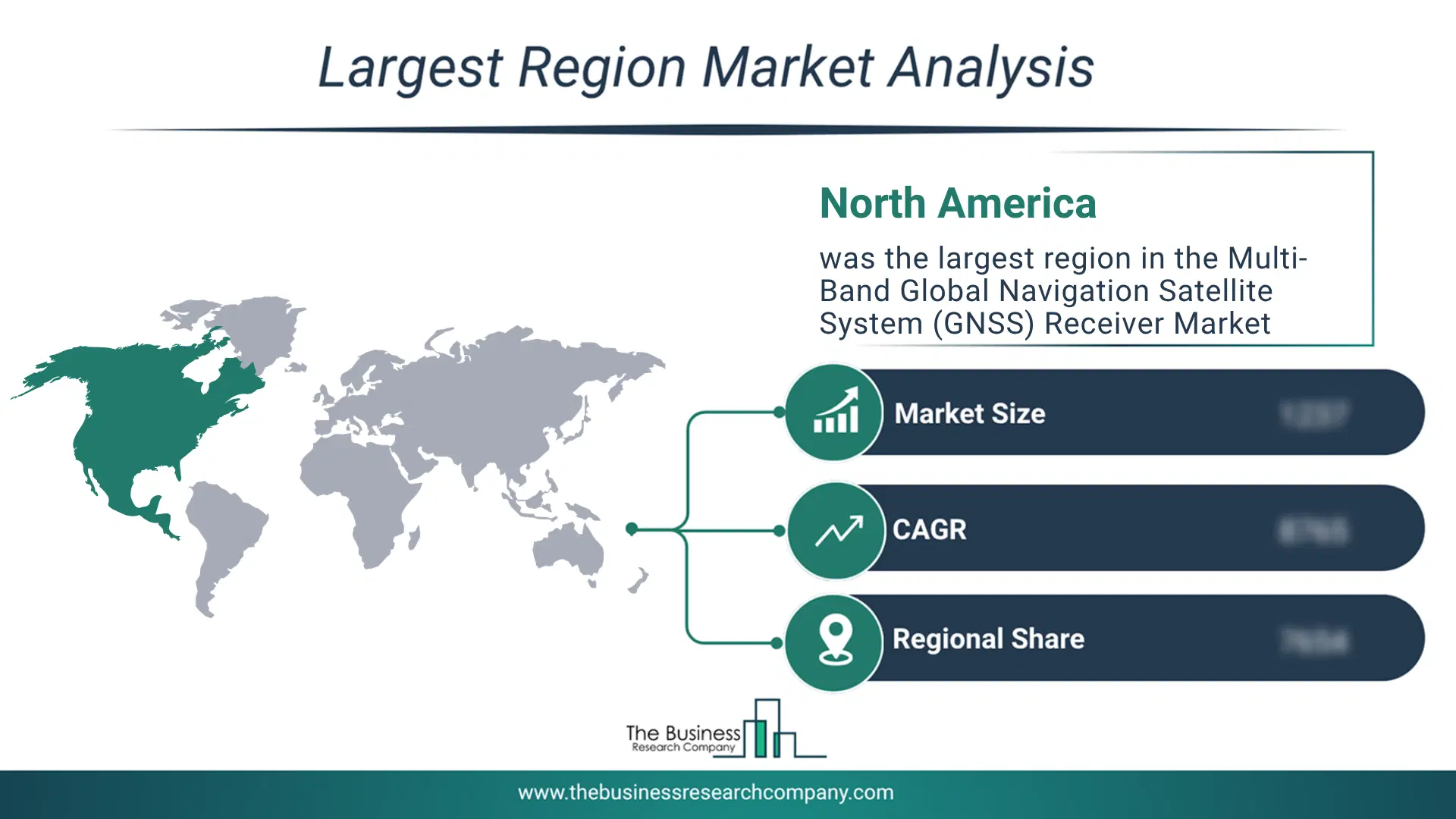
Regional Insights
North America was the largest region in the multi-band global navigation satellite system (GNSS) receiver market in 2025. Asia-Pacific is expected to be the fastest-growing region in the forecast period. The regions covered in this market report are Asia-Pacific, South East Asia, Western Europe, Eastern Europe, North America, South America, Middle East, Africa. The countries covered in this market report are Australia, Brazil, China, France, Germany, India, Indonesia, Japan, Taiwan, Russia, South Korea, UK, USA, Canada, Italy, SpainWhat Defines the Multi-Band Global Navigation Satellite System (GNSS) Receiver Market?
The multi-band global navigation satellite system (GNSS) receiver market consists of sales of GNSS receiver modules, multi-frequency antennas, navigation systems, timing devices, and geospatial surveying equipment. Values in this market are ‘factory gate’ values, that is, the value of goods sold by the manufacturers or creators of the goods, whether to other entities (including downstream manufacturers, wholesalers, distributors, and retailers) or directly to end customers. The value of goods in this market includes related services sold by the creators of the goods.How is Market Value Defined and Measured?
The market value is defined as the revenues that enterprises gain from the sale of goods and/or services within the specified market and geography through sales, grants, or donations in terms of the currency (in USD unless otherwise specified). The revenues for a specified geography are consumption values that are revenues generated by organizations in the specified geography within the market, irrespective of where they are produced. It does not include revenues from resales along the supply chain, either further along the supply chain or as part of other products.
This chart presents market attractiveness based on a quantitative evaluation of growth, competition, strategic alignment, and risk, offering a clear view of opportunity areas for decision-making. This chart is for illustrative purposes; the full report contains the complete analysis.

This chart highlights the Total Addressable Market (TAM) by estimating the maximum revenue opportunity using an assumption-driven approach, supporting strategic planning and opportunity sizing across markets. The chart is illustrative; the full report provides a more comprehensive analysis.
What Key Data and Analysis Are Included in the Multi-Band Global Navigation Satellite System (GNSS) Receiver Market Report 2026?
The multi-band global navigation satellite system (gnss) receiver market research report is one of a series of new reports from The Business Research Company that provides market statistics, including industry global market size, regional shares, competitors with the market share, detailed market segments, market trends and opportunities, and any further data you may need to thrive in the multi-band global navigation satellite system (gnss) receiver industry. The market research report delivers a complete perspective of everything you need, with an in-depth analysis of the current and future state of the industry.Multi-Band Global Navigation Satellite System (GNSS) Receiver Market Report Forecast Analysis
| Report Attribute | Details |
|---|---|
| Market Size Value In 2026 | $3.35 billion |
| Revenue Forecast In 2030 | $5.77 billion |
| Growth Rate | CAGR of 14.5% from 2026 to 2030 |
| Base Year For Estimation | 2025 |
| Actual Estimates/Historical Data | 2020-2025 |
| Forecast Period | 2026 - 2030 |
| Market Representation | Revenue in USD Billion and CAGR from 2026 to 2030 |
| Segments Covered | Product Type, Frequency Band, Distribution Channel, Application, End-User |
| Regional Scope | Asia-Pacific, Western Europe, Eastern Europe, North America, South America, Middle East, Africa |
| Country Scope | The countries covered in the multi-band global navigation satellite system (gnss) receiver market report are Australia, Brazil, China, France, Germany, India, Indonesia, Japan, Taiwan, Russia, South Korea, UK, USA, Canada, Italy, Spain |
| Key Companies Profiled | Raytheon Technologies Corporation, Broadcom Inc., Qualcomm Technologies Inc., STMicroelectronics, Garmin Ltd., Trimble Inc., Quectel Wireless Solutions Co. Ltd., Topcon Corporation, Hexagon AB, Furuno Electric Co. Ltd., u-blox AG, NovAtel Inc., Satlabs Geosolutions AB, Unicore Communications Inc., LOCOSYS Technology Inc., SkyTraq Technology Inc., Allystar Technology Co. Ltd., NavCom Technology Inc., ComNav Technology Ltd., Navika Electronics, Tersus GNSS Inc. |
| Customization Scope | Request for Customization |
| Pricing And Purchase Options | Explore Purchase Options |