
Passenger Car Sensors Market Report 2026
Global Outlook – By Sensor Type (Pressure Sensors, Position Sensors, Speed Sensors, Temperature Sensors, Oxygen (O, And Nitrogen Oxide (Nox) Sensors, Safety And Comfort Sensors, Other Sensor Types), By Vehicle Type (Passenger Vehicle, Light Commercial Vehicle), By Application (Powertrain Or Drivetrain, Exhaust, Interior Or Comfort, Body Control, Driver Assistance System) – Market Size, Trends, Strategies, and Forecast to 2030
Passenger Car Sensors Market Overview
• Passenger Car Sensors market size has reached to $5.67 billion in 2025 • Expected to grow to $7.29 billion in 2030 at a compound annual growth rate (CAGR) of 5.1% • Growth Driver: Impact of Autonomous Passenger Cars on the Passenger Car Sensors Market • Market Trend: Advancements in NOx Sensor Technology by Leading Passenger Car Sensor Manufacturers • Europe was the largest region in 2025 and Asia-Pacific is the fastest growing region.What Is Covered Under Passenger Car Sensors Market?
Passenger car sensors are electronic devices used in vehicles to monitor and report various conditions and parameters, such as engine performance, emissions, and safety features. These sensors collect data that helps in optimizing vehicle operations, enhancing safety, and improving fuel efficiency. They play a crucial role in enabling advanced driver-assistance systems (ADAS) and autonomous driving technologies. The main types of sensors in the passenger car sensors market are pressure sensors, position sensors, speed sensors, temperature sensors, oxygen (O2) and nitric oxide (NOx) sensors, safety and comfort sensors, and others. Pressure sensors refer to devices that measure and monitor the pressure of gases or liquids. The various body controls include weight reduction, multiplex compatibility, and stringent safety regulations. It is used for passenger vehicle and light commercial vehicle. Its applied into powertrain or drivetrain, exhaust, interior or comfort, body control, and driver assistance system.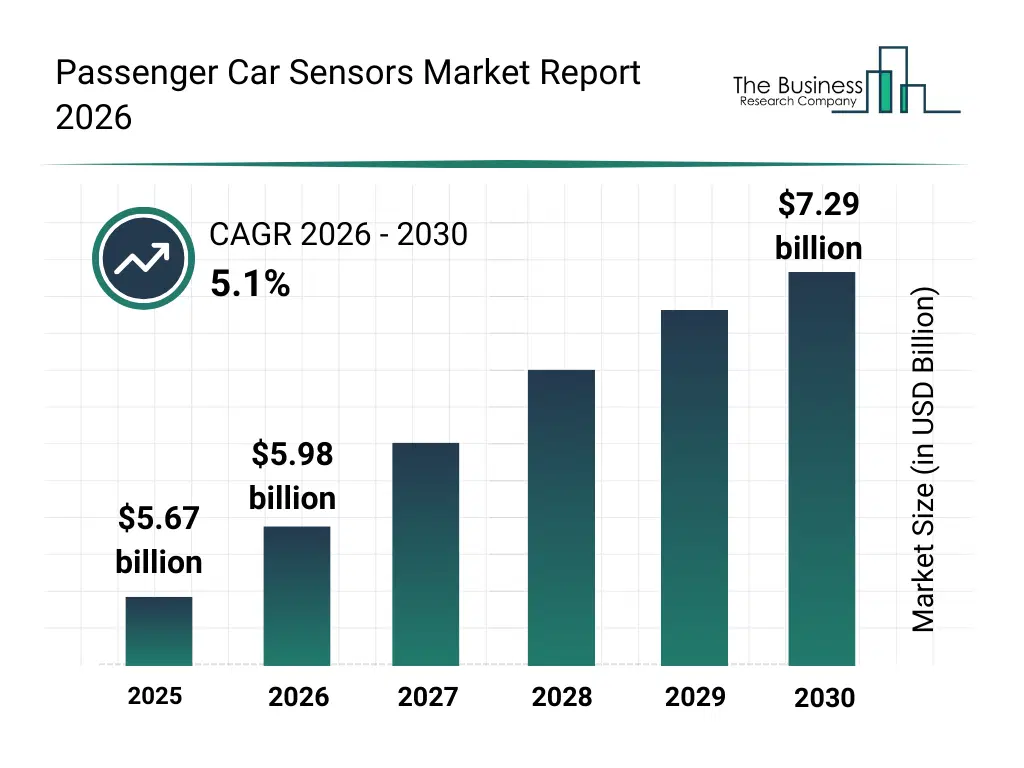
What Is The Passenger Car Sensors Market Size and Share 2026?
The passenger car sensors market size has grown strongly in recent years. It will grow from $5.67 billion in 2025 to $5.98 billion in 2026 at a compound annual growth rate (CAGR) of 5.5%. The growth in the historic period can be attributed to vehicle safety regulations, emission compliance requirements, growth of electronic vehicle systems, sensor miniaturization advances, adas deployment.What Is The Passenger Car Sensors Market Growth Forecast?
The passenger car sensors market size is expected to see strong growth in the next few years. It will grow to $7.29 billion in 2030 at a compound annual growth rate (CAGR) of 5.1%. The growth in the forecast period can be attributed to autonomous driving development, electric vehicle growth, smart vehicle architectures, stricter safety mandates, demand for real time data. Major trends in the forecast period include increasing adoption of adas sensors, growing use of emission monitoring sensors, expansion of cabin comfort sensors, rising demand for high precision sensors, integration of multi sensor fusion systems.
Global Passenger Car Sensors Market Segmentation
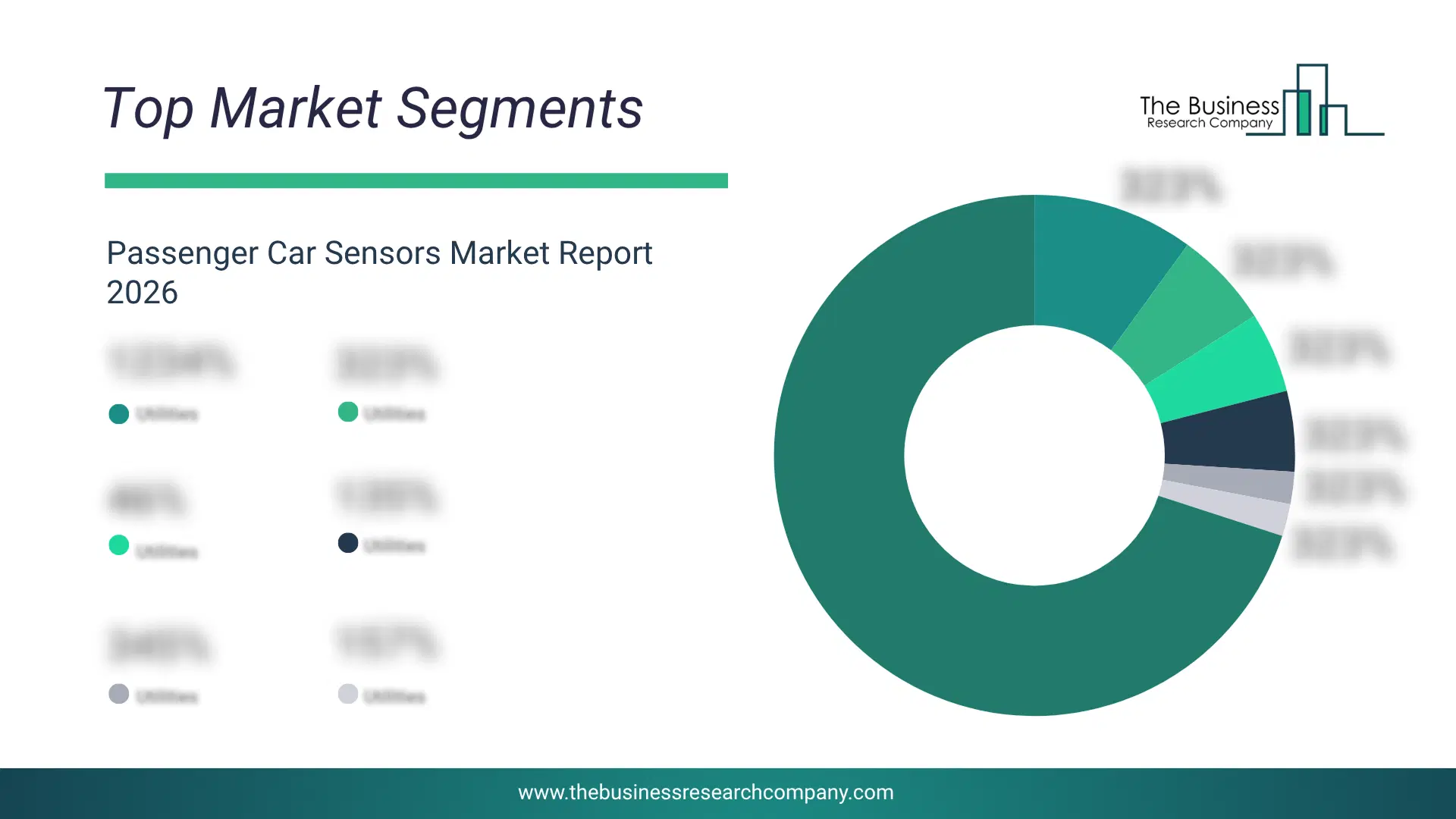
1) By Sensor Type: Pressure Sensors, Position Sensors, Speed Sensors, Temperature Sensors, Oxygen (O2) And Nitrogen Oxide (Nox) Sensors, Safety And Comfort Sensors, Other Sensor Types 2) By Vehicle Type: Passenger Vehicle, Light Commercial Vehicle 3) By Application: Powertrain Or Drivetrain, Exhaust, Interior Or Comfort, Body Control, Driver Assistance System Subsegments: 1) By Pressure Sensors: Tire Pressure Sensors, Fuel Pressure Sensors, Oil Pressure Sensors, Coolant Pressure Sensors 2) By Position Sensors: Throttle Position Sensors, Crankshaft Position Sensors, Camshaft Position Sensors, Seat Position Sensors 3) By Speed Sensors: Wheel Speed Sensors, Vehicle Speed Sensors, Transmission Speed Sensors 4) By Temperature Sensors: Engine Temperature Sensors, Cabin Temperature Sensors, Exhaust Gas Temperature Sensors 5) By Oxygen (O2) And Nitrogen Oxide (NOx) Sensors: O2 Sensors For Emission Control, NOx Sensors for Emission Control, Wideband O2 Sensors 6) By Safety and Comfort Sensors: Airbag Sensors, Proximity Sensors, Rain Sensors, Parking Sensors, Adaptive Cruise Control Sensors 7) By Other Sensor Types: Light Sensors, Humidity Sensors, CO2 Sensors, Gesture SensorsWhat Is The Driver Of The Passenger Car Sensors Market?
The growing adoption of autonomous passenger cars is expected to propel the growth of the passenger car sensors market going forward. Autonomous passenger cars are vehicles designed for personal use that can navigate and operate without human intervention, using advanced technologies. Autonomous vehicles (AVs) use advanced sensors, cameras, and artificial intelligence to detect and respond to potential hazards, significantly reducing the risk of accidents caused by human error. Passenger car sensors, including LiDAR, radar, cameras, ultrasonic sensors, GPS, IMU, and V2X communication, enable autonomous vehicles to perceive their surroundings, navigate accurately, and make real-time decisions for safe and efficient operation. For instance, in October 2024, according to Statistics Canada, a Canada based national statistical agency, registered light duty vehicles in Canada included 5.2 % electric vehicles, up from 3.9 % in 2023. Therefore, the growing adoption of autonomous passenger cars drives the growth of the passenger car sensors industry.Key Players In The Global Passenger Car Sensors Market
Major companies operating in the passenger car sensors market report include Robert Bosch GmbH, Panasonic Holdings Corporation, Denso Corporation, ZF Friedrichshafen AG, Continental AG, Mitsubishi Electric Corporation, Honeywell International Inc., Valeo S.A., Texas Instruments Incorporated, Aptiv PLC, TE Connectivity Ltd., STMicroelectronics NV, Infineon Technologies AG, Murata Manufacturing Co. Ltd., NXP Semiconductors N.V., Amphenol Corporation, Analog Devices Inc., Renesas Electronics Corporation, Hella GmbH & Co. KGaA, Omron Corporation, ROHM Co. Ltd., Sensata Technologies Inc., Allegro Microsystems Inc., Melexis NV, Quanergy Systems Inc., Innoviz Technologies Ltd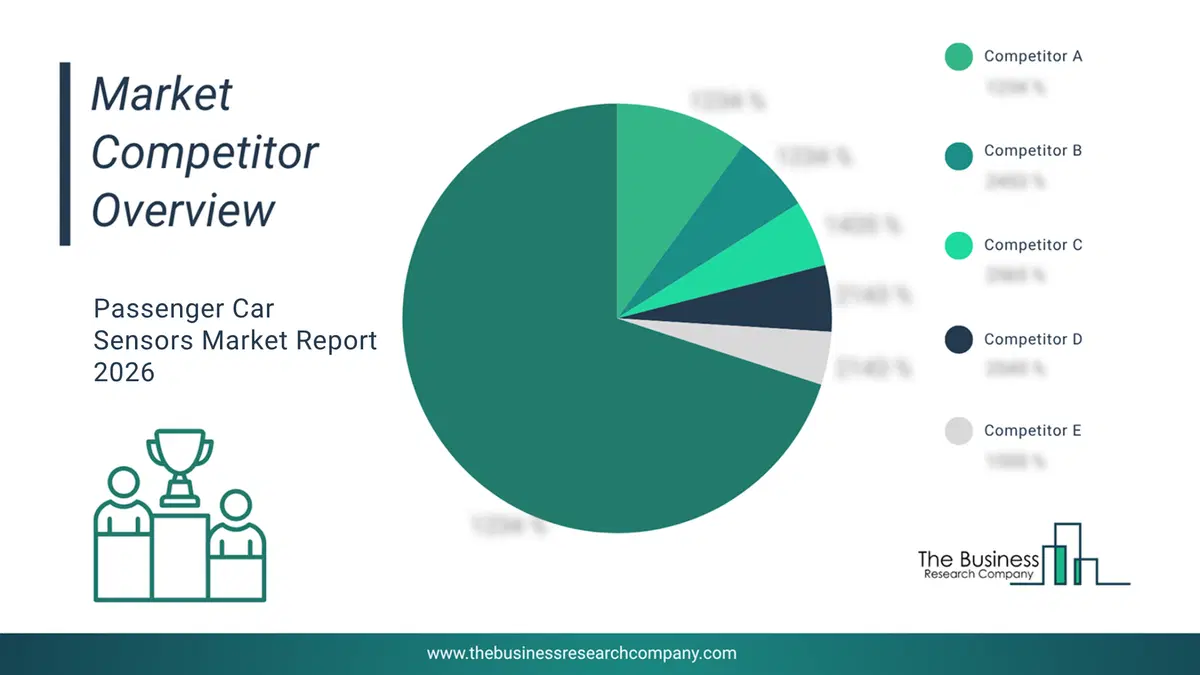
This chart is for illustrative purposes; the full report includes a detailed competitor analysis and comprehensive overview of the top 10 companies in the market.
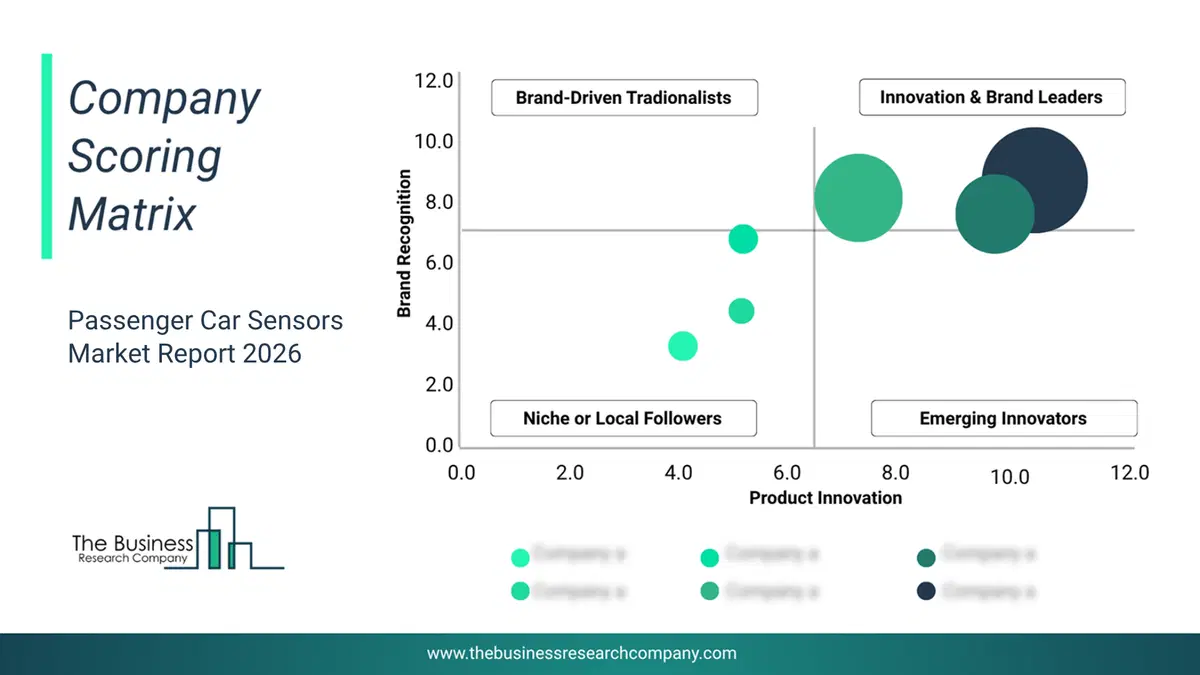
This chart maps companies by product innovation and brand strength, with bubble size indicating relative revenue, helping identify market leaders, challengers, and niche players. This is an illustrative chart; the full report provides a complete and accurate competitive analysis.
Global Passenger Car Sensors Market Trends and Insights
Major companies operating in the passenger car sensors market are developing nitrogen oxide (NOx) sensors to address increasingly stringent emissions regulations, improve engine efficiency, and enhance overall vehicle performance. NOx sensor are crucial for monitoring and controlling NOx emissions in real-time, ensuring compliance with environmental standards and reducing harmful pollutants. For instance, in December 2023, Delphi Technologies, a UK-based automotive company, launched a range of NOx sensors for the European aftermarket. These sensors measure the amount of NOx in exhaust gases and help vehicles comply with current and future emission regulations. The sensors cover popular passenger car brands such as Mercedes-Benz, Peugeot, Opel, Skoda, BMW, Renault, and Volkswagen and commercial vehicles from brands such as DAF, MAN, and Scania.What Are Latest Mergers And Acquisitions In The Passenger Car Sensors Market?
In February 2023, indie Semiconductor, a U.S.-based developer of automotive semiconductors and multi modal sensor platforms for Advanced Driver Assistance Systems (ADAS), acquired Silicon Radar GmbH for an undisclosed amount. With this acquisition, indie Semiconductor aimed to bolster its radar sensor portfolio and accelerate development of high frequency radar SoCs, thereby strengthening its competitive position in automotive radar solutions for external and in cabin sensing. Silicon Radar GmbH, a Germany-based specialist in designing advanced, highly integrated system on chips (SoCs) for automotive radar applications covering 60 GHz, 120 GHz, and 140 GHz, enabling radar based sensing for passenger cars.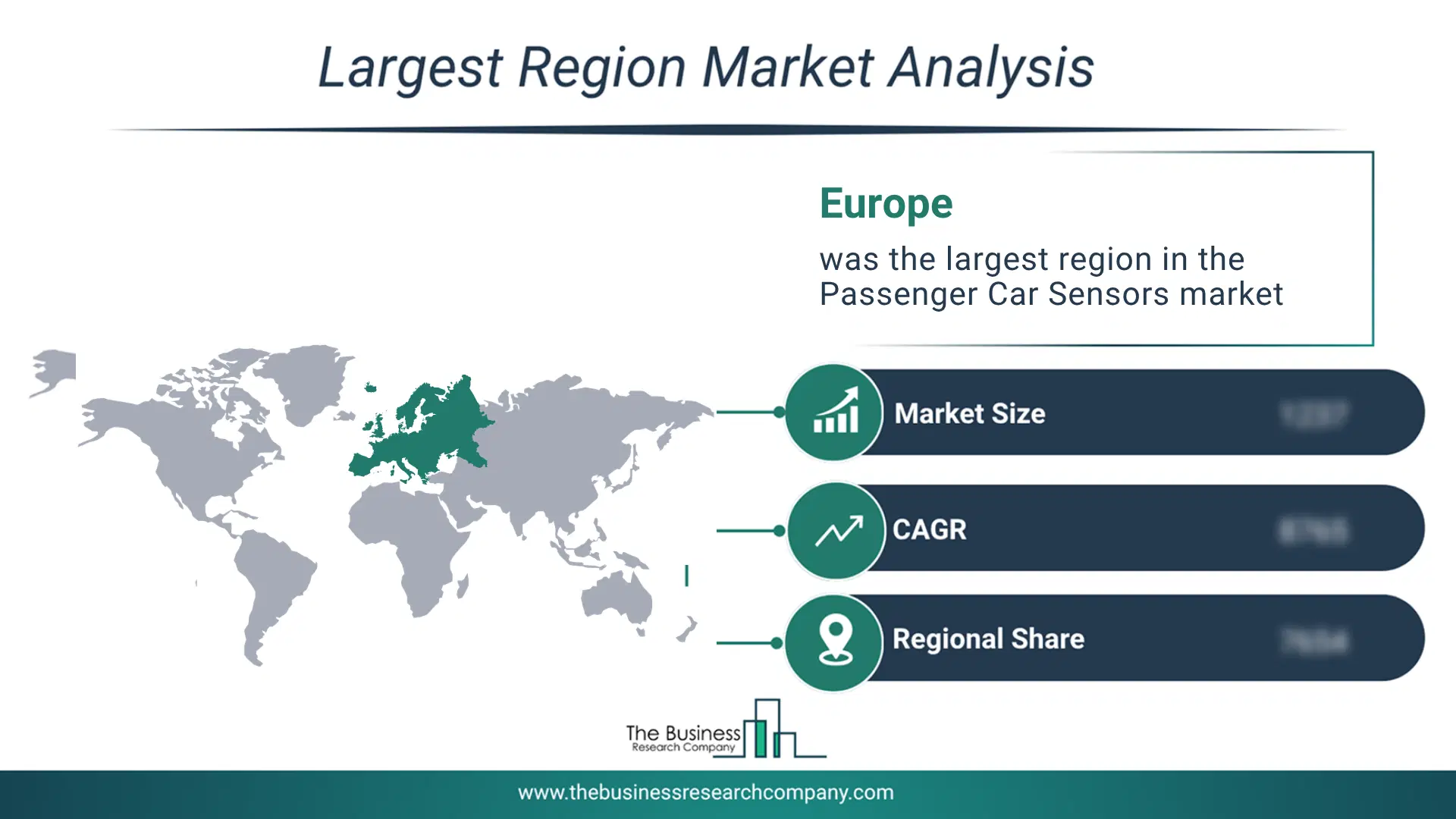
Regional Outlook
Europe was the largest region in the passenger car sensors market in 2025. Asia-Pacific is expected to be the fastest-growing region in the forecast period. The regions covered in this market report include Asia-Pacific, South East Asia, Western Europe, Eastern Europe, North America, South America, Middle East, Africa. The countries covered in this market report include Australia, Brazil, China, France, Germany, India, Indonesia, Japan, Taiwan, Russia, South Korea, UK, USA, Canada, Italy, SpainWhat Defines the Passenger Car Sensors Market?
The passenger car sensors market consists of sales of proximity sensors, lidar sensors, radar sensors, ultrasonic sensors, and camera sensors. Values in this market are ‘factory gate’ values, that is the value of goods sold by the manufacturers or creators of the goods, whether to other entities (including downstream manufacturers, wholesalers, distributors and retailers) or directly to end customers. The value of goods in this market includes related services sold by the creators of the goods.How is Market Value Defined and Measured?
The market value is defined as the revenues that enterprises gain from the sale of goods and/or services within the specified market and geography through sales, grants, or donations in terms of the currency (in USD unless otherwise specified). The revenues for a specified geography are consumption values that are revenues generated by organizations in the specified geography within the market, irrespective of where they are produced. It does not include revenues from resales along the supply chain, either further along the supply chain or as part of other products.
This chart presents market attractiveness based on a quantitative evaluation of growth, competition, strategic alignment, and risk, offering a clear view of opportunity areas for decision-making. This chart is for illustrative purposes; the full report contains the complete analysis.

This chart highlights the Total Addressable Market (TAM) by estimating the maximum revenue opportunity using an assumption-driven approach, supporting strategic planning and opportunity sizing across markets. The chart is illustrative; the full report provides a more comprehensive analysis.
What Key Data and Analysis Are Included in the Passenger Car Sensors Market Report 2026?
The passenger car sensors market research report is one of a series of new reports from The Business Research Company that provides market statistics, including industry global market size, regional shares, competitors with the market share, detailed market segments, market trends and opportunities, and any further data you may need to thrive in the passenger car sensors industry. The market research report delivers a complete perspective of everything you need, with an in-depth analysis of the current and future state of the industry.Passenger Car Sensors Market Report Forecast Analysis
| Report Attribute | Details |
|---|---|
| Market Size Value In 2026 | $5.98 billion |
| Revenue Forecast In 2030 | $7.29 billion |
| Growth Rate | CAGR of 5.5% from 2026 to 2030 |
| Base Year For Estimation | 2025 |
| Actual Estimates/Historical Data | 2020-2025 |
| Forecast Period | 2026 - 2030 - 2030 |
| Market Representation | Revenue in USD Billion and CAGR from 2026 to 2030 |
| Segments Covered | Sensor Type, Vehicle Type, Application |
| Regional Scope | Asia-Pacific, Western Europe, Eastern Europe, North America, South America, Middle East, Africa |
| Country Scope | The countries covered in the report are Australia, Brazil, China, France, Germany, India, Indonesia, Japan, Taiwan, Russia, South Korea, UK, USA, Canada, Italy, Spain. |
| Key Companies Profiled | Robert Bosch GmbH, Panasonic Holdings Corporation, Denso Corporation, ZF Friedrichshafen AG, Continental AG, Mitsubishi Electric Corporation, Honeywell International Inc., Valeo S.A., Texas Instruments Incorporated, Aptiv PLC, TE Connectivity Ltd., STMicroelectronics NV, Infineon Technologies AG, Murata Manufacturing Co. Ltd., NXP Semiconductors N.V., Amphenol Corporation, Analog Devices Inc., Renesas Electronics Corporation, Hella GmbH & Co. KGaA, Omron Corporation, ROHM Co. Ltd., Sensata Technologies Inc., Allegro Microsystems Inc., Melexis NV, Quanergy Systems Inc., Innoviz Technologies Ltd |
| Customization Scope | Request for Customization |
| Pricing And Purchase Options | Explore Purchase Options |