
Automotive Sensors Market Report 2026
Global Outlook – By Type ( Temperature Sensors, Pressure Sensors, Speed Sensors, Level/Position Sensors, Magnetic Sensors, Gas Sensors, Inertial Sensors), By Vehicle Type ( Passenger Car, Light Commercial Vehicle, Heavy Commercial Vehicle), By Technology ( Nano-Electro-Mechanical Systems, Micro-Electro-Mechanical Systems), By Application Type ( Powertrain, Chassis, Exhaust, ADAS, Other Applications) – Market Size, Trends, Strategies, and Forecast to 2030
Automotive Sensors Market Overview
• Automotive Sensors market size has reached to $35.49 billion in 2025 • Expected to grow to $63.76 billion in 2030 at a compound annual growth rate (CAGR) of 12.4% • Growth Driver: Surging Adoption Of Autonomous Vehicles Drives Growth In The Automotive Sensors Market • Market Trend: Advancements In Automotive Sensors And Chassis Systems Enhancing Vehicle Performance And Safety • Asia-Pacific was the largest region in 2025.What Is Covered Under Automotive Sensors Market?
The automotive sensors are used to detect, transmit, analyse, record, and display information about the vehicle's internal and external surroundings. Automotive sensors are intelligent sensors that monitor the vehicle's condition and either provide information to the user or automatically make the required changes to the vehicle. Automotive sensors check incoming air temperature, fuel-air mixture, manifold pressure, wheel speed, and others. The main types of automotive sensors are temperature sensors, pressure sensors, speed sensors, level-position sensors, magnetic sensors, gas sensors, and inertial sensors. Temperature sensors measure the temperature of the air outside the automobile. It usually consists of thermocouples, thermistors, or resistance. Automotive sensors are based on different types of technology, such as nano-electro-mechanical systems and micro-electro-mechanical systems. Automotive sensors are used in various vehicle types, including passenger cars, light commercial vehicles, and heavy commercial vehicles. These automotive sensors are used on the powertrain, chassis, exhaust, ADAS, and other applications.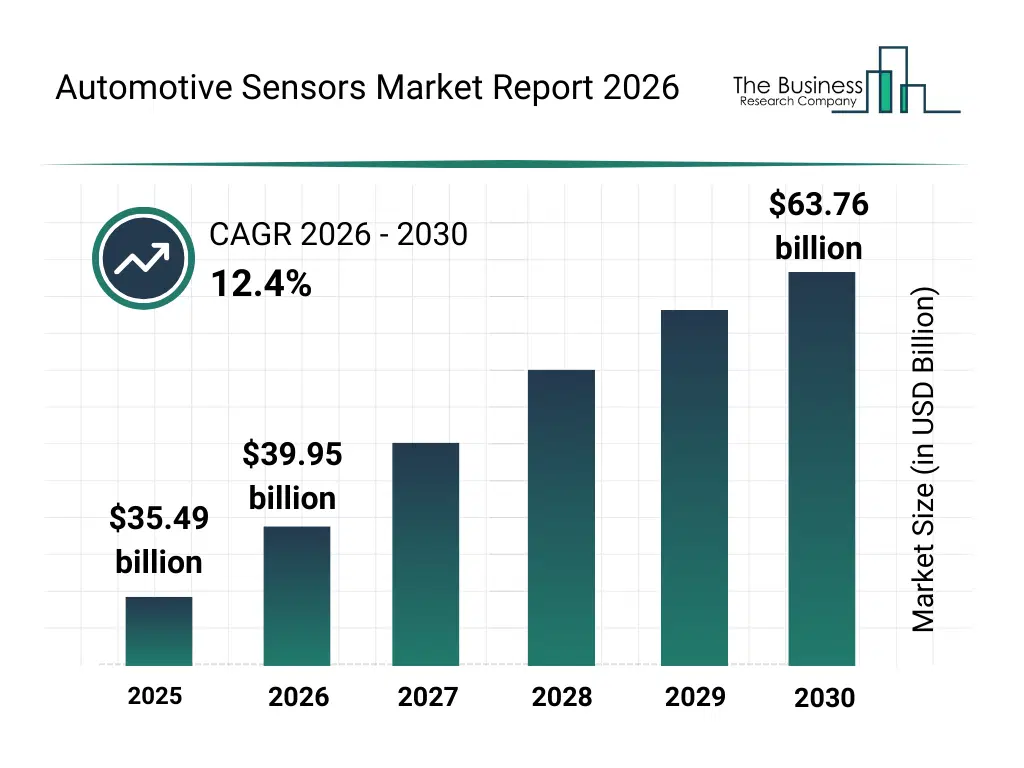
What Is The Automotive Sensors Market Size 2026 And Growth Rate?
The automotive sensors market size has grown rapidly in recent years. It will grow from $35.49 billion in 2025 to $39.95 billion in 2026 at a compound annual growth rate (CAGR) of 12.6%. The growth in the historic period can be attributed to rise in use of conventional temperature, pressure, and speed sensors, growth in passenger and commercial vehicles, increasing focus on vehicle safety, adoption in chassis and powertrain systems, use in exhaust and emission monitoring.What Is The Automotive Sensors Market Growth Forecast?
The automotive sensors market size is expected to see rapid growth in the next few years. It will grow to $63.76 billion in 2030 at a compound annual growth rate (CAGR) of 12.4%. The growth in the forecast period can be attributed to increase in AI-integrated sensors, rising adoption of mems and nano-electro-mechanical sensors, expansion of predictive maintenance systems, growth in adas and smart vehicle applications, increase in integration with connected vehicle platforms. Major trends in the forecast period include deployment of AI-integrated automotive sensors, adoption of IoT-based sensor networks, implementation of advanced vehicle monitoring systems, expansion of mems-based sensor technologies, integration of predictive maintenance sensors.
Global Automotive Sensors Market Segmentation
1) By Type: Temperature Sensors, Pressure Sensors, Speed Sensors, Level/Position Sensors, Magnetic Sensors, Gas Sensors, Inertial Sensors 2) By Vehicle Type: Passenger Car, Light Commercial Vehicle, Heavy Commercial Vehicle 3) By Technology: Nano-Electro-Mechanical Systems, Micro-Electro-Mechanical Systems 4) By Application Type: Powertrain, Chassis, Exhaust, ADAS, Other Applications Subsegments: 1) By Temperature Sensors: Thermocouples, Thermistors, Infrared Temperature Sensors 2) By Pressure Sensors: Piezoelectric Pressure Sensors, Strain Gauge Pressure Sensors, Capacitive Pressure Sensors 3) By Speed Sensors: Hall Effect Speed Sensors, Inductive Speed Sensors, Optical Speed Sensors 4) By Level/Position Sensors: Ultrasonic Level Sensors, Capacitive Level Sensors, Linear Position Sensors 5) By Magnetic Sensors: Hall Effect Sensors, Magnetoresistive Sensors, Fluxgate Sensors 6) By Gas Sensors: Oxygen Sensors, Carbon Dioxide Sensors, Nitrogen Oxide Sensors 7) By Inertial Sensors: Accelerometers, Gyroscopes, Inertial Measurement Units (IMUs)What Is The Driver Of The Automotive Sensors Market?
The rising adoption of autonomous vehicles is expected to propel the growth of the automotive sensors market. Autonomous vehicles are driverless vehicles that operate and perform necessary functions on their own without any human intervention. The use of automotive sensors in autonomous vehicles has reduced the drivers' stress and increased the productivity of the vehicle. For instance, in June 2025, according to the Ministry of Defence, a UK-based government ministry, In 2025, the UK is investing a record £350 million ($0.45) to boost Ukraine’s drone supply, aiming to increase the number from 10,000 in 2024 to 100,000. Therefore, the rising adoption of autonomous vehicles is driving the growth of the automotive sensors industry.Key Players In The Global Automotive Sensors Market
Major companies operating in the automotive sensors market are Robert Bosch GmbH, Continental AG, DENSO Corporation, Infineon Technologies AG, Sensata Technologies, Analog Devices Inc., Aptiv plc, NXP Semiconductors N.V., STMicroelectronics N.V., CTS Corporation, Texas Instruments Incorporated, TE Connectivity Ltd, ZF Friedrichshafen, Melexis N.V., ON Semiconductor, Amphenol Advanced Sensors, Velodyne Lidar Inc., Quanergy Systems Inc., Innoviz Technologies Ltd., Broadcom Inc., Bosch Sensortec GmbH, Maxim Integrated, Hitachi Automotive Systems Americas Inc., OmniVision Technologies Inc., Valeo Group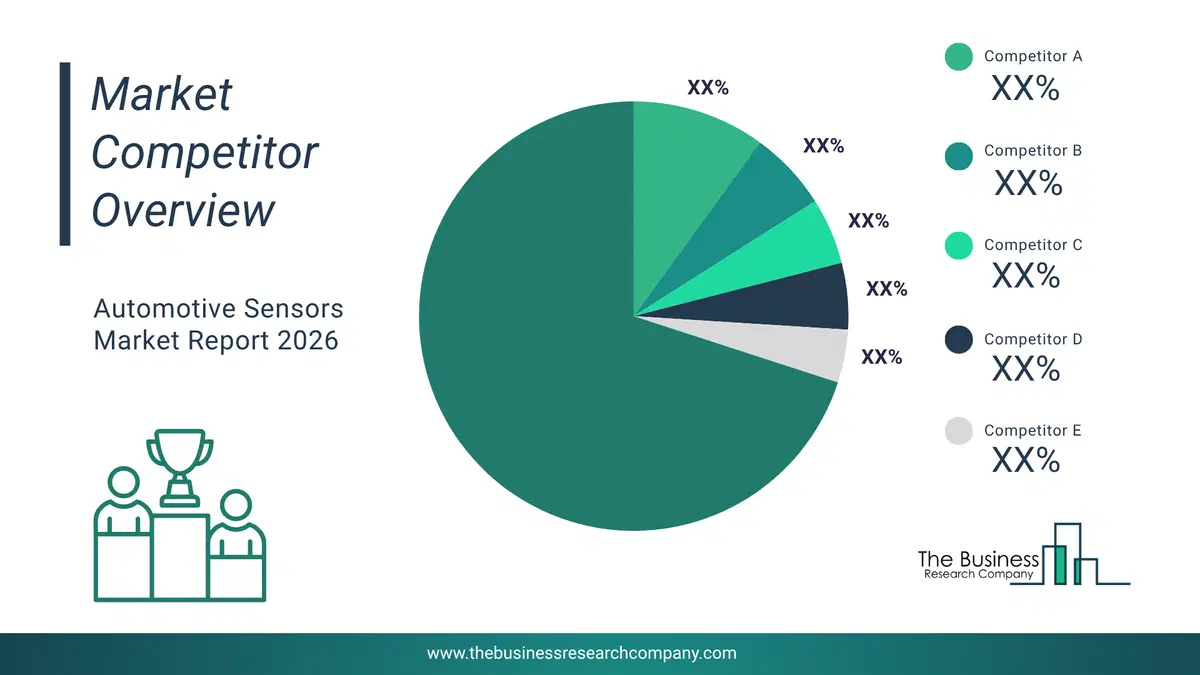
This chart is for illustrative purposes; the full report includes a detailed competitor analysis and comprehensive overview of the top 10 companies in the market.
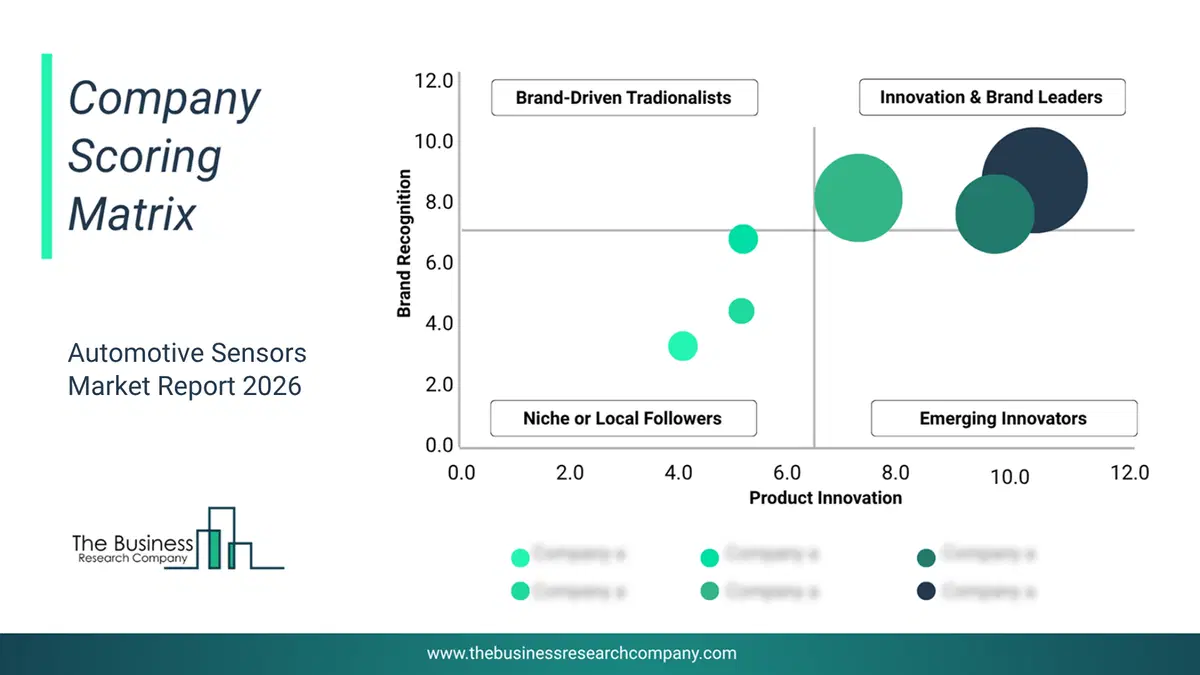
This chart maps companies by product innovation and brand strength, with bubble size indicating relative revenue, helping identify market leaders, challengers, and niche players. This is an illustrative chart; the full report provides a complete and accurate competitive analysis.
Global Automotive Sensors Market Trends and Insights
Major companies operating in the automotive sensor market are focusing on developing innovative products such as chassis and steering components to enhance vehicle safety, performance, and driving precision. Chassis and steering components refer to the structural and control systems that support vehicle stability, handling, and overall driving dynamics. For instance, in September 2024, Continental AG, a Germany-based automotive manufacturing company, launched a major product-range expansion for its aftermarket segment, introducing new product groups including camera and radar sensors for driver-assistance systems, chassis and steering components, and high-pressure fuel pumps. This expansion aims to strengthen Continental’s aftermarket portfolio by offering advanced solutions that enhance driving safety and system efficiency. The rollout began in late 2024, with full market availability expected by mid-2025.What Are Latest Mergers And Acquisitions In The Automotive Sensors Market?
In June 2024, Continental, a leading German automotive technology company, partnered with Samsara to deliver data-driven fleet management and safety solutions. The partnership aims to enhance vehicle connectivity, optimize fleet efficiency, and improve road safety by integrating Continental’s advanced sensor technologies with Samsara’s telematics and data analytics platform. Samsara is a US-based technology company specializing in automotive sensors and connected operations solutions.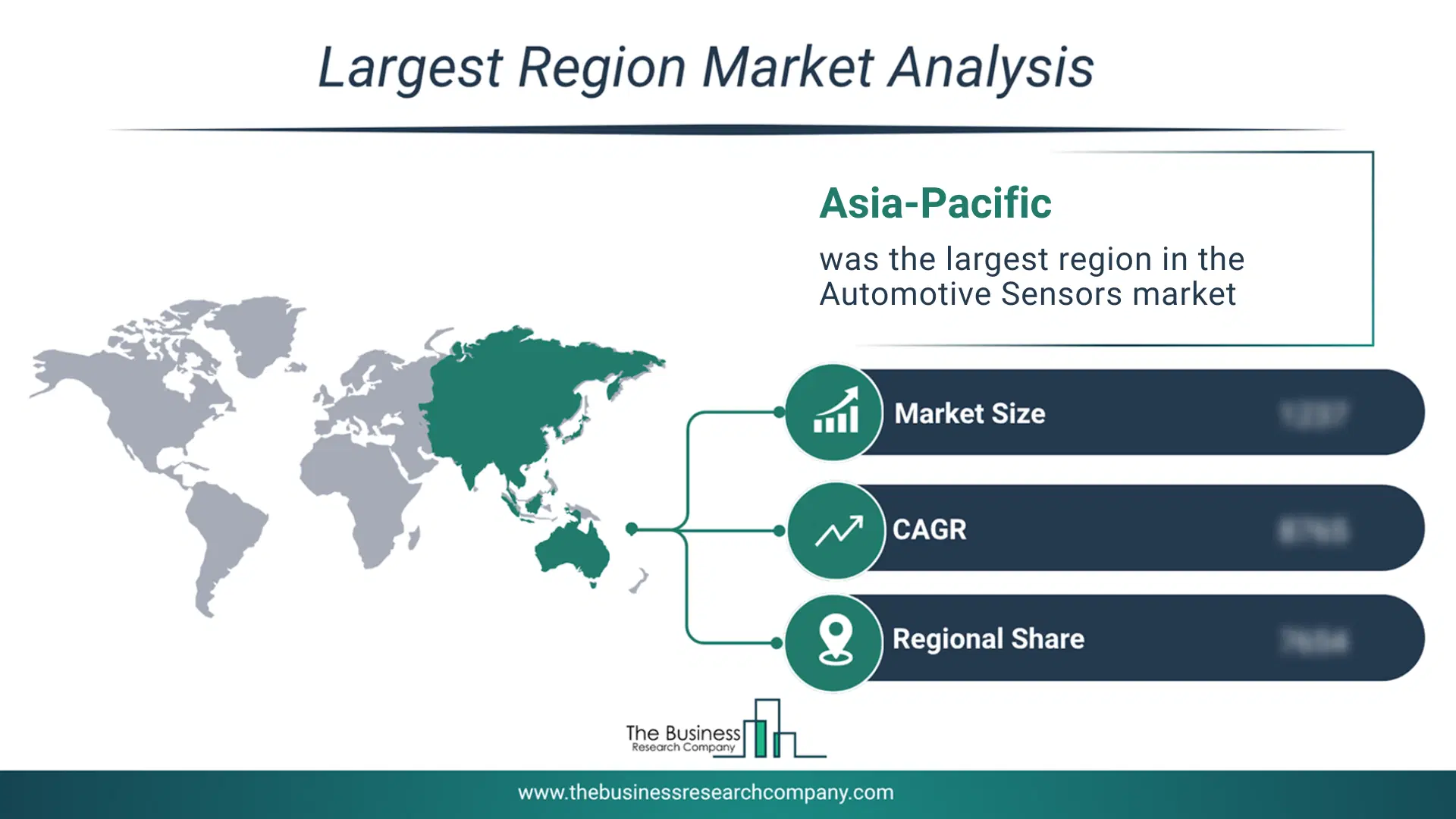
Regional Outlook
Asia-Pacific was the largest region in the automotive sensors market in 2025 and is also expected to be the fastest-growing region in the forecast period. The regions covered in this market report are Asia-Pacific, South East Asia, Western Europe, Eastern Europe, North America, South America, Middle East, Africa. The countries covered in this market report are Australia, Brazil, China, France, Germany, India, Indonesia, Japan, Taiwan, Russia, South Korea, UK, USA, Canada, Italy, Spain.What Defines the Automotive Sensors Market?
The automotive sensors market consists of revenues earned by entities by providing automotive sensors services such as autonomous driving and automated parking system. The market value includes the value of related goods sold by the service provider or included within the service offering. The automotive sensors market also includes sales of battery mini-breakers, thermal cutoff devices, capacitors, contactors, DC power distribution modules, DC solenoids and relays equipment which are used in providing automotive sensors services. Values in this market are ‘factory gate’ values, that is the value of goods sold by the manufacturers or creators of the goods, whether to other entities (including downstream manufacturers, wholesalers, distributors and retailers) or directly to end customers. The value of goods in this market includes related services sold by the creators of the goods.How is Market Value Defined and Measured?
The market value is defined as the revenues that enterprises gain from the sale of goods and/or services within the specified market and geography through sales, grants, or donations in terms of the currency (in USD unless otherwise specified). The revenues for a specified geography are consumption values that are revenues generated by organizations in the specified geography within the market, irrespective of where they are produced. It does not include revenues from resales along the supply chain, either further along the supply chain or as part of other products.
This chart presents market attractiveness based on a quantitative evaluation of growth, competition, strategic alignment, and risk, offering a clear view of opportunity areas for decision-making. This chart is for illustrative purposes; the full report contains the complete analysis.

This chart highlights the Total Addressable Market (TAM) by estimating the maximum revenue opportunity using an assumption-driven approach, supporting strategic planning and opportunity sizing across markets. The chart is illustrative; the full report provides a more comprehensive analysis.
What Key Data and Analysis Are Included in the Automotive Sensors Market Report 2026?
The automotive sensors market research report is one of a series of new reports from The Business Research Company that provides market statistics, including industry global market size, regional shares, competitors with the market share, detailed market segments, market trends and opportunities, and any further data you may need to thrive in the automotive sensors industry. The market research report delivers a complete perspective of everything you need, with an in-depth analysis of the current and future state of the industry.Automotive Sensors Market Report Forecast Analysis
| Report Attribute | Details |
|---|---|
| Market Size Value In 2026 | $39.95 billion |
| Revenue Forecast In 2030 | $63.76 billion |
| Growth Rate | CAGR of 12.4% from 2026 to 2030 |
| Base Year For Estimation | 2025 |
| Actual Estimates/Historical Data | 2020-2025 |
| Forecast Period | 2026 - 2030 |
| Market Representation | Revenue in USD Billion and CAGR from 2026 to 2030 |
| Segments Covered | Type, Vehicle Type, Technology, Application Type |
| Regional Scope | Asia-Pacific, Western Europe, Eastern Europe, North America, South America, Middle East, Africa |
| Country Scope | The countries covered in the report are Australia, Brazil, China, France, Germany, India, Indonesia, Japan, Taiwan, Russia, South Korea, UK, USA, Canada, Italy, Spain. |
| Key Companies Profiled | Robert Bosch GmbH, Continental AG, DENSO Corporation, Infineon Technologies AG, Sensata Technologies, Analog Devices Inc., Aptiv plc, NXP Semiconductors N.V., STMicroelectronics N.V., CTS Corporation, Texas Instruments Incorporated, TE Connectivity Ltd, ZF Friedrichshafen, Melexis N.V., ON Semiconductor, Amphenol Advanced Sensors, Velodyne Lidar Inc., Quanergy Systems Inc., Innoviz Technologies Ltd., Broadcom Inc., Bosch Sensortec GmbH, Maxim Integrated, Hitachi Automotive Systems Americas Inc., OmniVision Technologies Inc., Valeo Group |
| Customization Scope | Request for Customization |
| Pricing And Purchase Options | Explore Purchase Options |