
Personal Mobility Devices Market Report 2026
Global Outlook – By Product Type (Walking Aids, Handbikes, Mobility Scooters, Medical Beds, Stair-lifts, Power Add On Products, Wheelchairs, Other Product Types), By Distribution Channel (Wholesalers Or Distributors, Online Retailers, Multi-Brand Stores, Specialty Stores), By End User (Hospital And Clinics, Ambulatory Surgical Centers, Rehabilitation Centers, Homecare Setting, Other End Users) – Market Size, Trends, Strategies, and Forecast to 2030
Personal Mobility Devices Market Overview
• Personal Mobility Devices market size has reached to $12.57 billion in 2025 • Expected to grow to $18.03 billion in 2030 at a compound annual growth rate (CAGR) of 7.4% • Growth Driver: Rising Prevalence Of Disabilities Fueling The Growth Of The Market Due To Aging Population And Chronic Health Conditions • Market Trend: Revolutionizing Personal Mobility With Hands-Free Transportation Solutions For All • North America was the largest region in 2025 and Asia-Pacific is the fastest growing region.What Is Covered Under Personal Mobility Devices Market?
Personal mobility devices (PMDs) are compact, lightweight transportation tools specifically designed to help individuals travel short distances more efficiently, offering greater independence and flexibility in their daily movements. They play a crucial role in promoting personal convenience, enhancing urban mobility, and supporting accessibility for people who experience mobility challenges or prefer alternative transport options. The main product types in personal mobility devices are walking aids, handbikes, mobility scooters, medical beds, stair-lifts, power add on products, wheelchairs, and others. Walking aids are assistive devices designed to enhance mobility and provide support for individuals with difficulty walking, including canes, walkers, crutches, and rollators. These are distributed through various channels such as wholesalers or distributors, online retailers, multi-brand stores, and specialty stores for the end user, including hospitals and clinics, ambulatory surgical centers, urgent care centers, homecare settings, and others.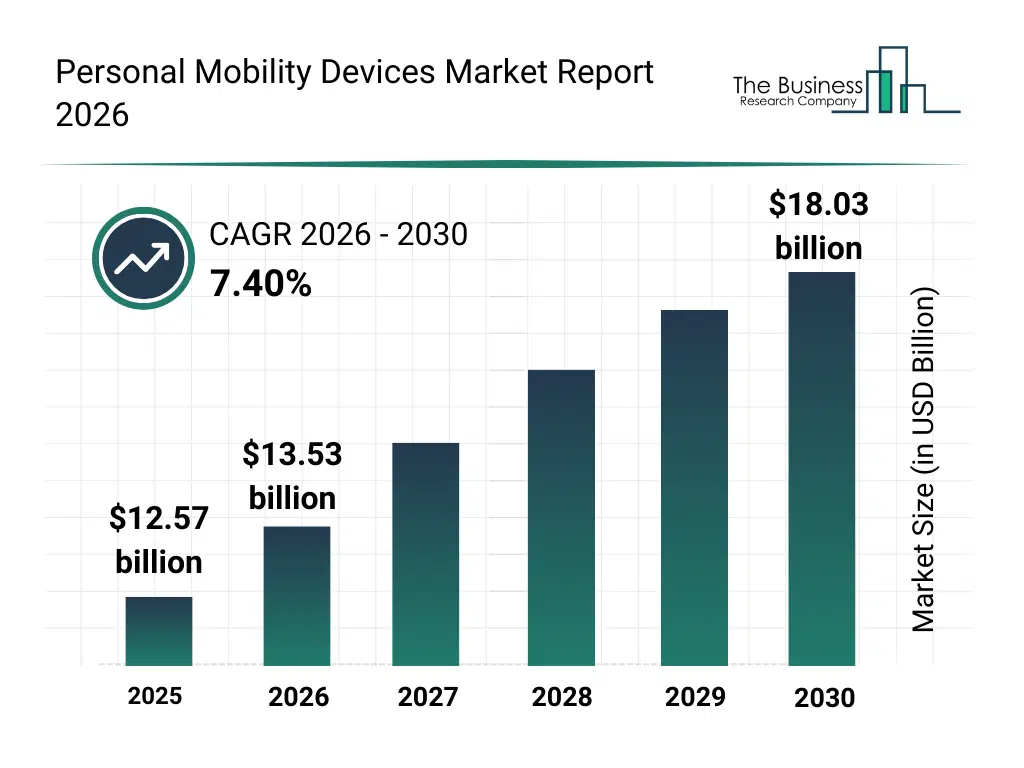
What Is The Personal Mobility Devices Market Size and Share 2026?
The personal mobility devices market size has grown strongly in recent years. It will grow from $12.57 billion in 2025 to $13.53 billion in 2026 at a compound annual growth rate (CAGR) of 7.6%. The growth in the historic period can be attributed to limited availability of electric mobility options, high dependency on traditional walking aids, growing urban population with mobility needs, increasing hospital and clinic mobility requirements, nascent awareness of smart mobility devices.What Is The Personal Mobility Devices Market Growth Forecast?
The personal mobility devices market size is expected to see strong growth in the next few years. It will grow to $18.03 billion in 2030 at a compound annual growth rate (CAGR) of 7.4%. The growth in the forecast period can be attributed to technological advancements in electric and hybrid PMDs, rising investment in smart and connected mobility solutions, increasing government initiatives for accessible urban transport, growth in homecare and outpatient services, expanding adoption of IoT-enabled and autonomous mobility devices. Major trends in the forecast period include rising adoption of personal mobility devices for urban commuting, growing demand for compact and lightweight mobility solutions, increasing focus on accessibility for elderly and differently-abled individuals, integration of smart features and iot connectivity in pmds, expansion of homecare and outpatient mobility services.
Global Personal Mobility Devices Market Segmentation
1) By Product Type: Walking Aids, Handbikes, Mobility Scooters, Medical Beds, Stair-lifts, Power Add On Products, Wheelchairs, Other Product Types 2) By Distribution Channel: Wholesalers Or Distributors, Online Retailers, Multi-Brand Stores, Specialty Stores 3) By End User: Hospital And Clinics, Ambulatory Surgical Centers, Rehabilitation Centers, Homecare Setting, Other End Users Subsegments: 1) By Walking Aids: Canes, Crutches, Walkers, Rollators 2) By Handbikes: Manual Handbikes, Electric Handbikes, Hybrid Handbikes 3) By Mobility Scooters: 3-Wheel Scooters, 4-Wheel Scooters, Foldable Or Portable Scooters, Heavy-Duty Scooters 4) By Medical Beds: Manual Beds, Semi-Electric Beds, Fully Electric Beds, Bariatric Beds 5) By Stair-Lifts: Straight Stair-Lifts, Curved Stair-Lifts, Outdoor Stair-Lifts, Platform Stair-Lifts 6) By Power Add On Products: Power Assist Wheels, Power Drive Units, Motorized Attachments 7) By Wheelchairs: Manual Wheelchairs, Power Wheelchairs, Transport Wheelchairs, Sports Wheelchairs 8) By Other Product Types: Patient Lifts, Transfer Aids, Standing Frames, Mobility AccessoriesWhat Is The Driver Of The Personal Mobility Devices Market?
The rising prevalence of disabilities is expected to propel the growth of the personal mobility devices market going forward. Disabilities refer to long-term physical, mental, intellectual, or sensory impairments that, in interaction with various barriers, may hinder an individual's full and effective participation in society on an equal basis with others. The prevalence of disabilities is rising primarily due to the aging population, as age-related conditions such as arthritis, vision impairment, and dementia become more common with longer life expectancy. Personal mobility devices, such as wheelchairs and scooters, are essential for individuals with disabilities, as they enhance independence, improve access to daily activities, and support greater participation in social and professional life. For instance, in June 2025, according to a report published by the Department for Work and Pensions, a UK-based government department, during the 2023-24 period, the number of working-age people reporting a long-term health condition increased by 300,000 (2.0%), the number classed as disabled increased by 290,000 (3.1%), and those whose day-to-day activities are limited a lot increased by 170,000 (4.4%). Therefore, the rising prevalence of disabilities is driving the growth of the personal mobility devices industry.Key Players In The Global Personal Mobility Devices Market
Major companies operating in the personal mobility devices market are Medline Industries Inc., Stryker Corporation, Hill Rom Holdings Inc., Ottobock, Arjo AB, Invacare Holdings Corporation, NOVA Medical Products, Permobil, Sunrise Medical LLC, DRIVE MEDICAL GMBH & CO. KG, Performance Health Supply Inc., Pride Mobility Products Corp., Carex Health Brands Inc., Compass Health Brands, GF Health Products Inc., Handicare Group, Golden Technologies, Falcon Mobility Singapore, Rehabilitation Manufacturing Services Limited (RMS), Karman Healthcare, Triride srl, Eurovema Mobility AB, Rollz International.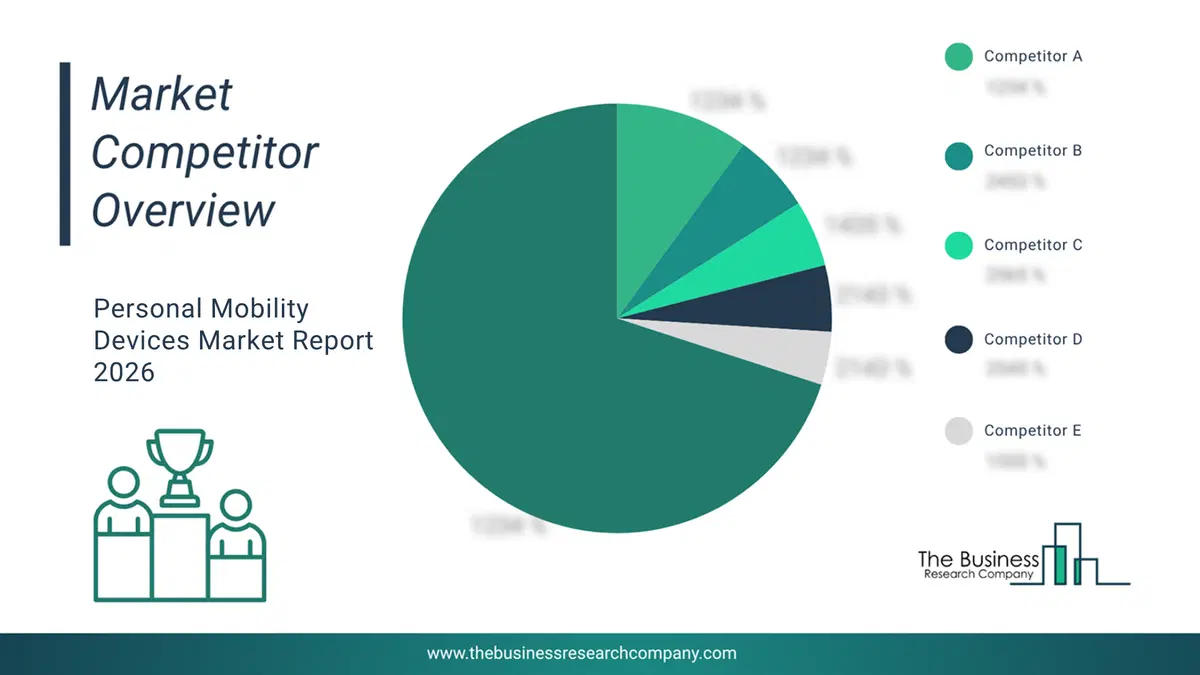
This chart is for illustrative purposes; the full report includes a detailed competitor analysis and comprehensive overview of the top 10 companies in the market.
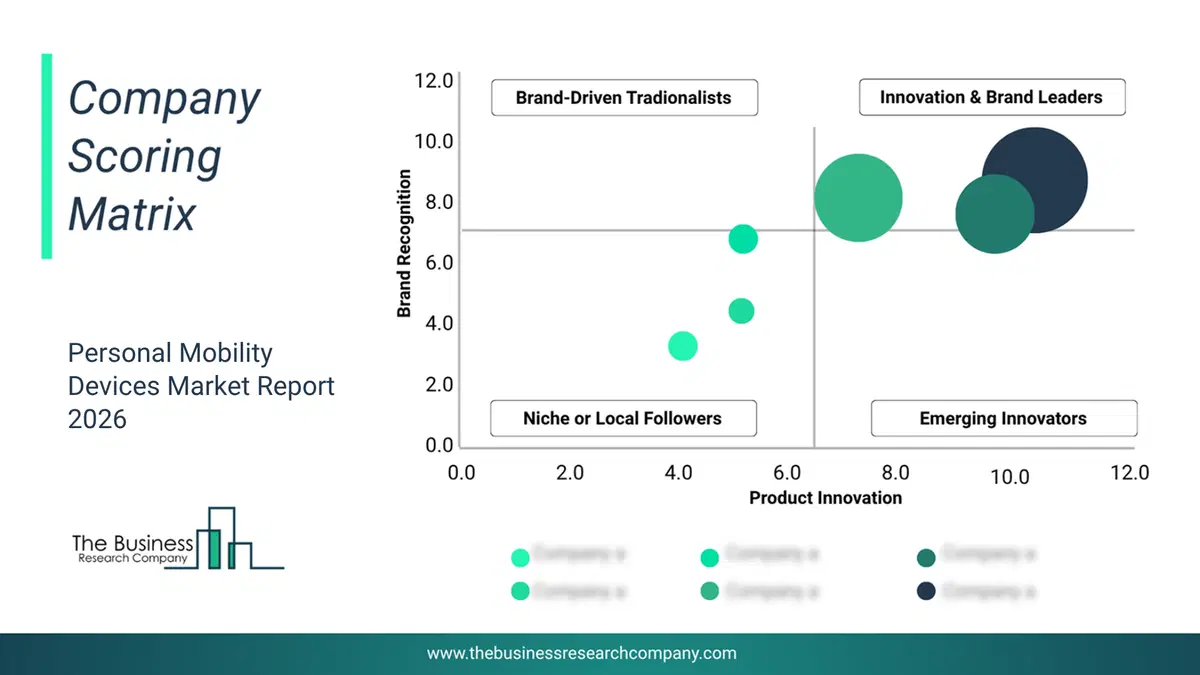
This chart maps companies by product innovation and brand strength, with bubble size indicating relative revenue, helping identify market leaders, challengers, and niche players. This is an illustrative chart; the full report provides a complete and accurate competitive analysis.
Global Personal Mobility Devices Market Trends and Insights
Major companies operating in the personal mobility devices market are focusing on developing technologically advanced products, such as hands-free personal mobility devices, to advance personal mobility by combining movement assistance with immersive digital experiences for broader applications. A hands-free personal mobility device is a self-balancing, motorized transportation solution that allows users to move without using their hands, typically operated through body movements or posture control for short-distance, personal travel. For instance, in February 2024, Honda Motor Co., Ltd., a Japan-based automotive manufacturer, announced the launch of the UNI-ONE, a hands-free personal mobility device designed to enhance user interaction and mobility through advanced self-balancing technology and intuitive control mechanisms. The UNI-ONE features a seat that can be raised or lowered, allowing users to maintain eye-level communication with both standing and seated individuals, thereby facilitating more natural social interactions. Additionally, the device is equipped with Honda's Omni Traction Drive Systems, enabling smooth, multi-directional movement controlled by the user's body posture, which not only provides a seamless mobility experience but also expands accessibility for users with varying mobility needs.What Are Latest Mergers And Acquisitions In The Personal Mobility Devices Market?
In May 2024, Everybot Inc., a South Korea-based home service robot company, acquired Hycore Co. Ltd. for an undisclosed amount. Through this acquisition, Everybot aims to strengthen its position in the personal mobility sector by acquiring hyCore, leveraging its advanced artificial intelligence (AI) and motor control technologies, autonomous driving capabilities, and collaborative experience. Hycore Co. Ltd. is a South Korea-based company providing e-mobility robots, specializing in AI-powered robot mobility, including personal mobility devices.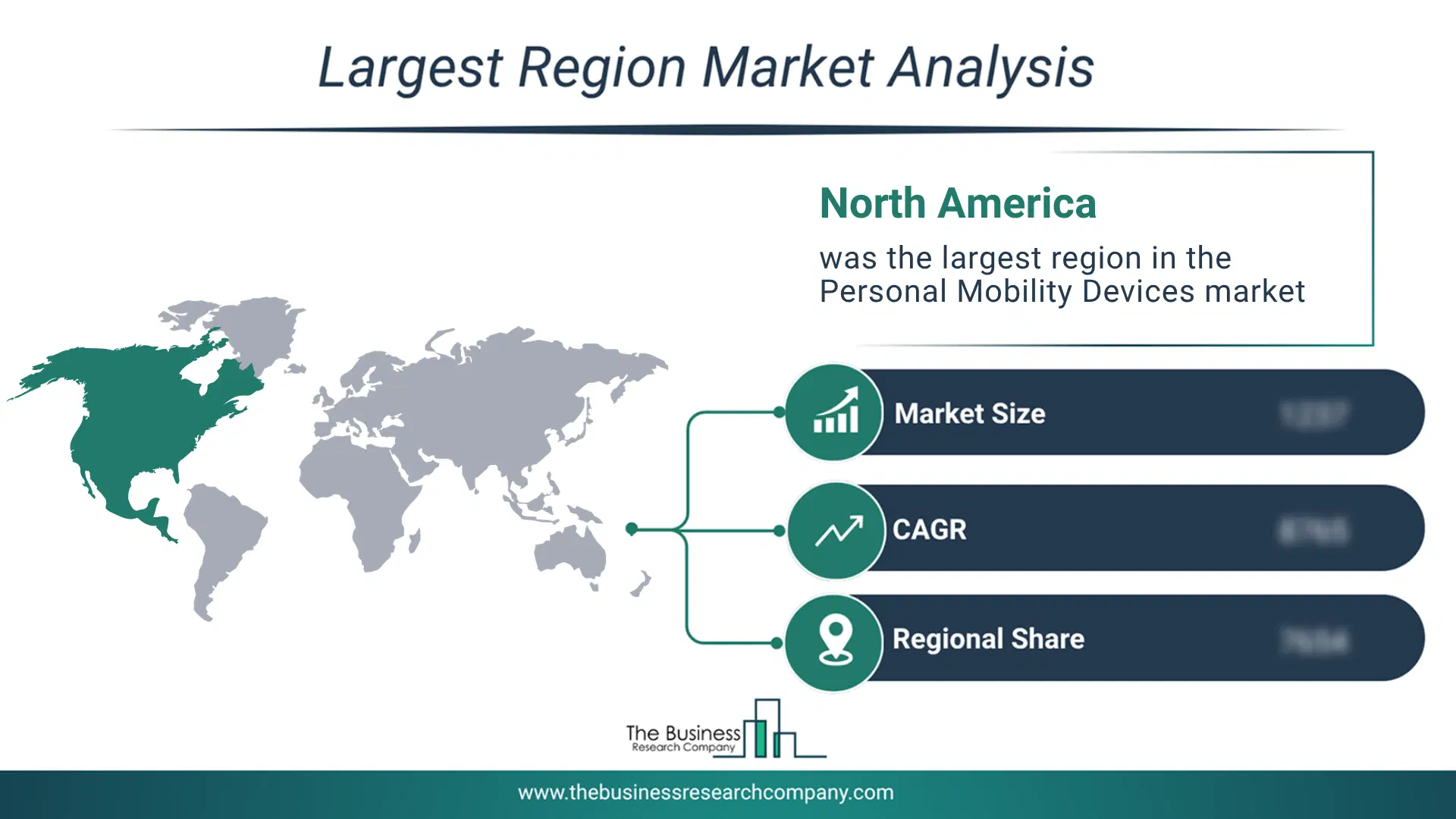
Regional Outlook
North America was the largest region in the personal mobility devices market in 2025. Asia-Pacific is expected to be the fastest-growing region in the forecast period. The regions covered in this market report are Asia-Pacific, South East Asia, Western Europe, Eastern Europe, North America, South America, Middle East, Africa. The countries covered in this market report are Australia, Brazil, China, France, Germany, India, Indonesia, Japan, Taiwan, Russia, South Korea, UK, USA, Canada, Italy, SpainWhat Defines the Personal Mobility Devices Market?
The personal mobility devices market consists of sales of mobility-assist beds, hospital and rehab mobility equipment, shower and commode mobility chairs, pediatric mobility devices, and post-surgical mobility aids. Values in this market are ‘factory gate’ values, that is, the value of goods sold by the manufacturers or creators of the goods, whether to other entities (including downstream manufacturers, wholesalers, distributors, and retailers) or directly to end customers. The value of goods in this market includes related services sold by the creators of the goods.How is Market Value Defined and Measured?
The market value is defined as the revenues that enterprises gain from the sale of goods and/or services within the specified market and geography through sales, grants, or donations in terms of the currency (in USD unless otherwise specified). The revenues for a specified geography are consumption values that are revenues generated by organizations in the specified geography within the market, irrespective of where they are produced. It does not include revenues from resales along the supply chain, either further along the supply chain or as part of other products.
This chart presents market attractiveness based on a quantitative evaluation of growth, competition, strategic alignment, and risk, offering a clear view of opportunity areas for decision-making. This chart is for illustrative purposes; the full report contains the complete analysis.

This chart highlights the Total Addressable Market (TAM) by estimating the maximum revenue opportunity using an assumption-driven approach, supporting strategic planning and opportunity sizing across markets. The chart is illustrative; the full report provides a more comprehensive analysis.
What Key Data and Analysis Are Included in the Personal Mobility Devices Market Report 2026?
The personal mobility devices market research report is one of a series of new reports from The Business Research Company that provides market statistics, including industry global market size, regional shares, competitors with the market share, detailed market segments, market trends and opportunities, and any further data you may need to thrive in the personal mobility devices industry. The market research report delivers a complete perspective of everything you need, with an in-depth analysis of the current and future state of the industry.Personal Mobility Devices Market Report Forecast Analysis
| Report Attribute | Details |
|---|---|
| Market Size Value In 2026 | $13.53 billion |
| Revenue Forecast In 2030 | $18.03 billion |
| Growth Rate | CAGR of 7.4% from 2026 to 2030 |
| Base Year For Estimation | 2025 |
| Actual Estimates/Historical Data | 2020-2025 |
| Forecast Period | 2026 - 2030 |
| Market Representation | Revenue in USD Billion and CAGR from 2026 to 2030 |
| Segments Covered | Product Type, Distribution Channel, End User |
| Regional Scope | Asia-Pacific, Western Europe, Eastern Europe, North America, South America, Middle East, Africa |
| Country Scope | The countries covered in the report are Australia, Brazil, China, France, Germany, India, Indonesia, Japan, Taiwan, Russia, South Korea, UK, USA, Canada, Italy, Spain. |
| Key Companies Profiled | Medline Industries Inc., Stryker Corporation, Hill Rom Holdings Inc., Ottobock, Arjo AB, Invacare Holdings Corporation, NOVA Medical Products, Permobil, Sunrise Medical LLC, DRIVE MEDICAL GMBH & CO. KG, Performance Health Supply Inc., Pride Mobility Products Corp., Carex Health Brands Inc., Compass Health Brands, GF Health Products Inc., Handicare Group, Golden Technologies, Falcon Mobility Singapore, Rehabilitation Manufacturing Services Limited (RMS), Karman Healthcare, Triride srl, Eurovema Mobility AB, Rollz International. |
| Customization Scope | Request for Customization |
| Pricing And Purchase Options | Explore Purchase Options |