
Plant-Based Feed Enzymes Market Report 2026
Global Outlook – By Type (Phytase, Protease, Carbohydrase), By Form (Liquid, Dry), By Livestock (Ruminants, Swine, Poultry, Aquatic animals, Pets, Horses) – Market Size, Trends, Strategies, and Forecast to 2030
Plant-Based Feed Enzymes Market Overview
• Plant-Based Feed Enzymes market size has reached to $1.94 billion in 2025 • Expected to grow to $2.27 billion in 2030 at a compound annual growth rate (CAGR) of 3.4% • Growth Driver: Surge In Crop Production Fuels Growth In Plant-Based Feed Enzyme Market • Market Trend: Thermostable Xylanase Enhances Feed Efficiency And Sustainability • North America was the largest region in 2025.What Is Covered Under Plant-Based Feed Enzymes Market?
Plant-based feed enzymes refer to enzymes that are derived from plant sources and are used as feed additives in animal nutrition. These enzymes offer various nutritional advantages and appear to solely benefit the animal by aiding in the breakdown of specific feed ingredients, including phytates, glucans, and proteins that the animal may have trouble digesting. The main types of plant-based feed enzymes are phytase, protease, and carbohydrate. Phytases are a group of enzymes that catalyze the hydrolysis of phytic acid (also known as phytate) and its salts. In plant-based feed enzymes, phytase helps to reduce the antinutritional effect of phytate and improves the digestion of phosphorous, calcium, amino acids, and energy. They are available in liquid and dry forms for various livestock including ruminants, swine, poultry, aquatic animals, pets, and horses.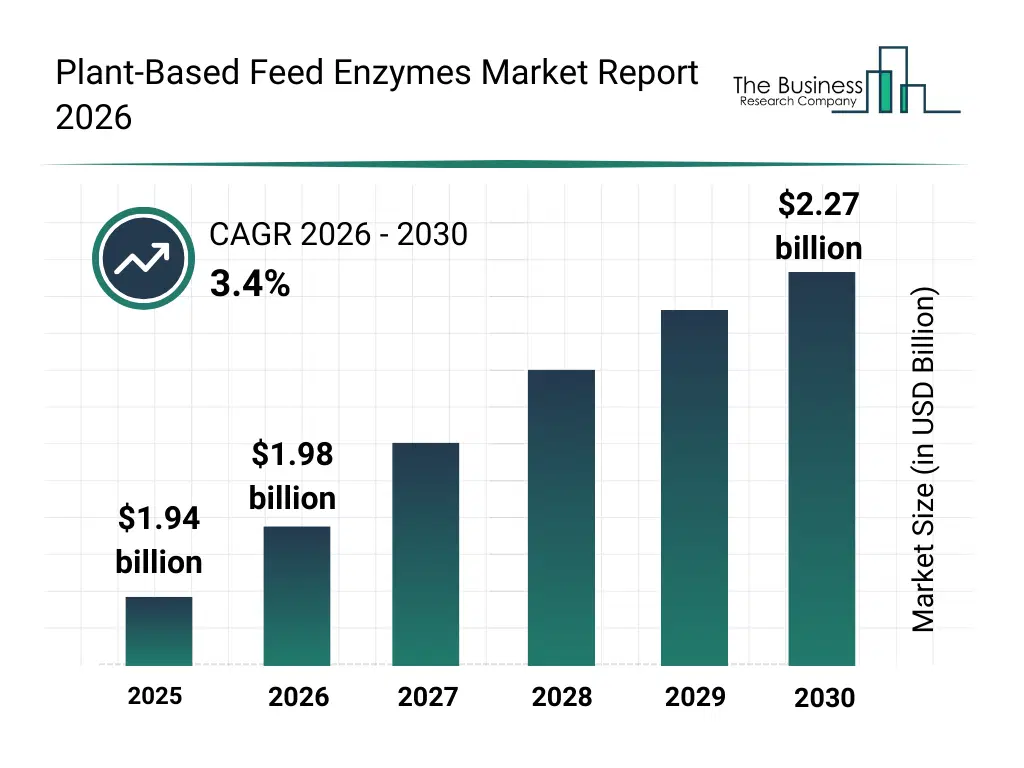
What Is The Plant-Based Feed Enzymes Market Size and Share 2026?
The plant-based feed enzymes market size has grown steadily in recent years. It will grow from $1.94 billion in 2025 to $1.98 billion in 2026 at a compound annual growth rate (CAGR) of 2.5%. The growth in the historic period can be attributed to increasing use of compound animal feed, rising pressure to improve feed conversion ratios, expansion of commercial livestock farming, early adoption of phytase and protease enzymes, growing awareness of animal nutrition optimization.What Is The Plant-Based Feed Enzymes Market Growth Forecast?
The plant-based feed enzymes market size is expected to see steady growth in the next few years. It will grow to $2.27 billion in 2030 at a compound annual growth rate (CAGR) of 3.4%. The growth in the forecast period can be attributed to increasing demand for sustainable animal nutrition, rising focus on antibiotic-free feed solutions, expansion of precision livestock farming, growing investments in enzyme biotechnology, increasing regulatory focus on feed efficiency. Major trends in the forecast period include increasing adoption of enzyme-based feed optimization, rising demand for natural feed additives, growing focus on digestibility enhancement, expansion of species-specific enzyme formulations, enhanced emphasis on feed efficiency improvement.
Global Plant-Based Feed Enzymes Market Segmentation
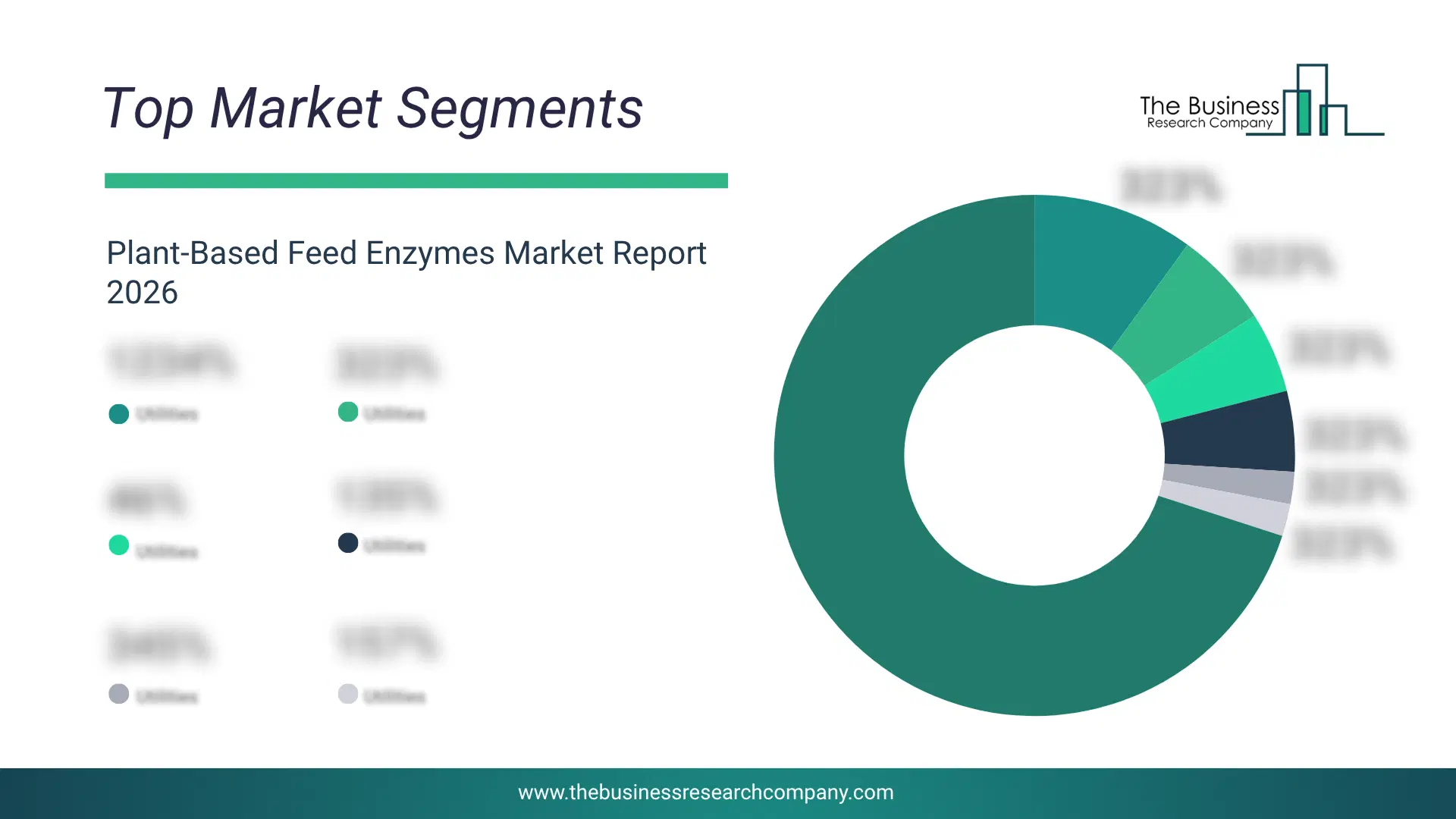
1) By Type: Phytase, Protease, Carbohydrase 2) By Form: Liquid, Dry 3) By Livestock: Ruminants, Swine, Poultry, Aquatic animals, Pets, Horses Subsegments: 1) By Phytase: Bacterial Phytase, Fungal Phytase 2) By Protease: Acid Protease, Neutral Protease, Alkaline Protease 3) By Carbohydrase: Amylase, Xylanase, Cellulase, MannanaseWhat Is The Driver Of The Plant-Based Feed Enzymes Market?
Increased production of crops such as wheat and corn are expected to boost the growth of the plant-based feed enzyme market. The production of crops refers to the process of cultivating crops for domestic and commercial reasons. Increased production of crops such as wheat and corn results in higher availability of these plant-based ingredients for animal feed. Plant-based feed enzymes play a crucial role in breaking down the complex components of these feedstocks, enhancing their digestibility for animals. For instance, in October 2024, according to the Food and Agriculture Organization of the United Nations, an Italy-based specialized agency of the United, in 2024, global cereal production is projected to reach 2,853 million metric tons, slightly up from the previous month. Notably, world rice production is expected to hit a record high of 539.2 million metric tons, reflecting a 0.9% increase from the revised estimates for 2023/24. Therefore, increased production of crops such as wheat and corn is driving the growth of the plant-based feed enzyme industry.Key Players In The Global Plant-Based Feed Enzymes Market
Major companies operating in the plant-based feed enzymes market are Cargill Incorporated, BASF SE, DuPont, DSM, Novozymes, Bluestar Adisseo Co. Ltd., Chr. Hansen Holding A/S, Kemin Industries Inc., Novus International Inc., Huvepharma, Advanced Enzyme Technologies, Bestzyme, Maxgrow Biotech Pvt. Ltd., Xike Biotechnology Co. Ltd., Amano Enzyme Inc., AUM Enzymes, Jiangsu Boli Bioproducts Co.Ltd., Antozyme Biotech, Beijing Smistyle Sic. & Tech. Development Co. Ltd., XD BIOCHEM, Biolaxi Corporation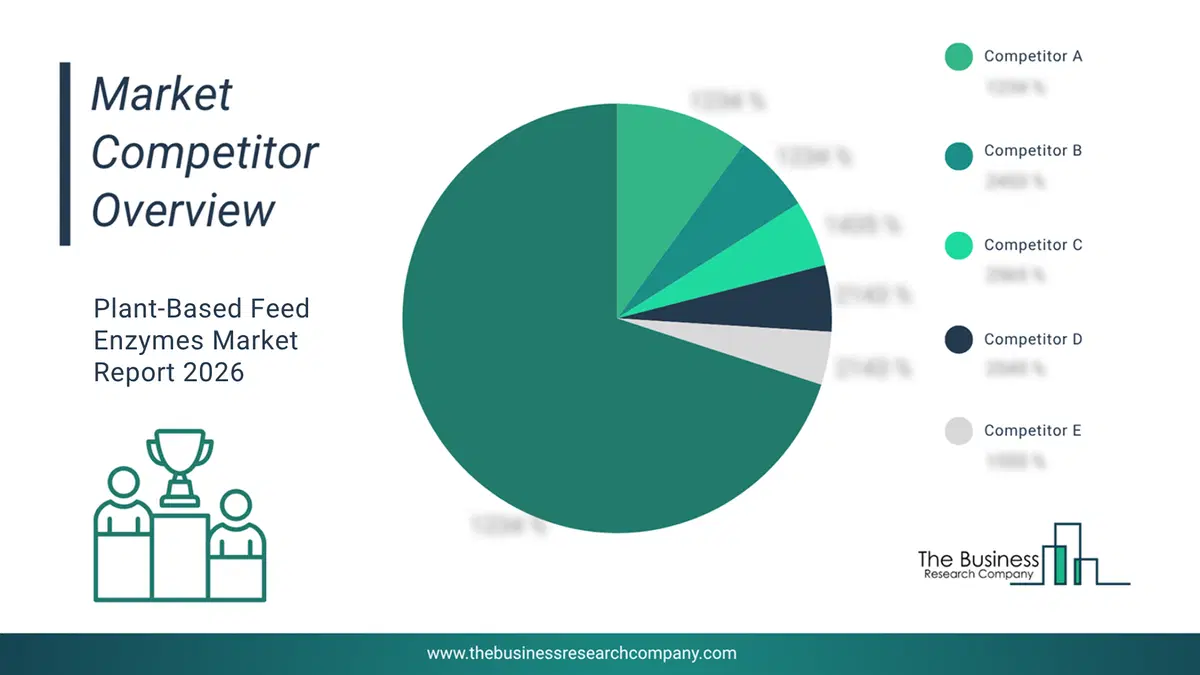
This chart is for illustrative purposes; the full report includes a detailed competitor analysis and comprehensive overview of the top 10 companies in the market.
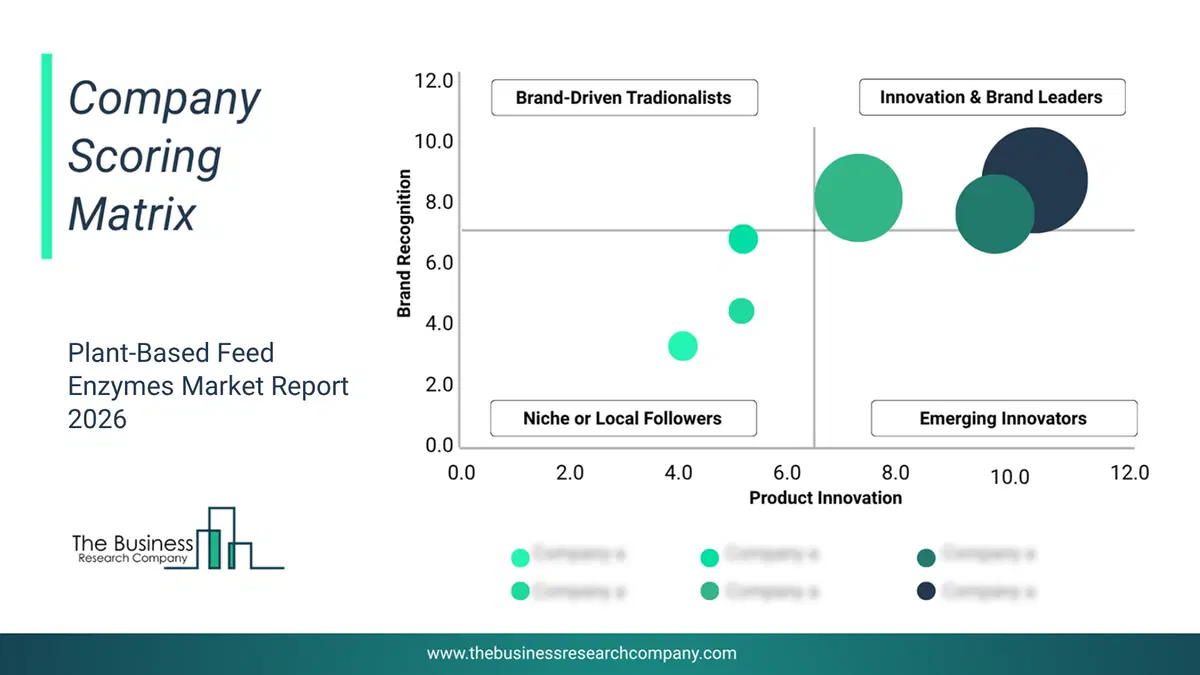
This chart maps companies by product innovation and brand strength, with bubble size indicating relative revenue, helping identify market leaders, challengers, and niche players. This is an illustrative chart; the full report provides a complete and accurate competitive analysis.
Global Plant-Based Feed Enzymes Market Trends and Insights
Major companies operating in the plant-based feed enzyme market are focusing on specifically engineered products, such as thermostable xylanase, to gain a competitive edge. Thermostable xylanase refers to a type of enzyme that remains active and effective at high temperatures, making it particularly useful in the feed industry. For instance, in March 2024, EW Nutrition, a Germany-based animal nutrition company, launched Axxess XY, a new xylanase product aimed at improving nutrient absorption and gut health in poultry. This enzyme, sourced from a bacterium in volcanic hot springs, is thermostable and designed for high-temperature feed processing, enhancing digestibility and environmental sustainability. It is also resistant to common inhibitors, making it versatile for various feed formulations.What Are Latest Mergers And Acquisitions In The Plant-Based Feed Enzymes Market?
In March 2024, Novus International, Inc., a US-based animal health and nutrition company, acquired BioResource International, Inc. for an undisclosed amount. With this acquisition, Novus International, Inc. aims to strengthen its innovation pipeline and enhance its product portfolio by gaining full ownership of BRI's enzyme products, thereby allowing for greater control over the supply chain. BioResource International, Inc. is a US-based biotechnology company specializing in high-performance enzyme feed additives.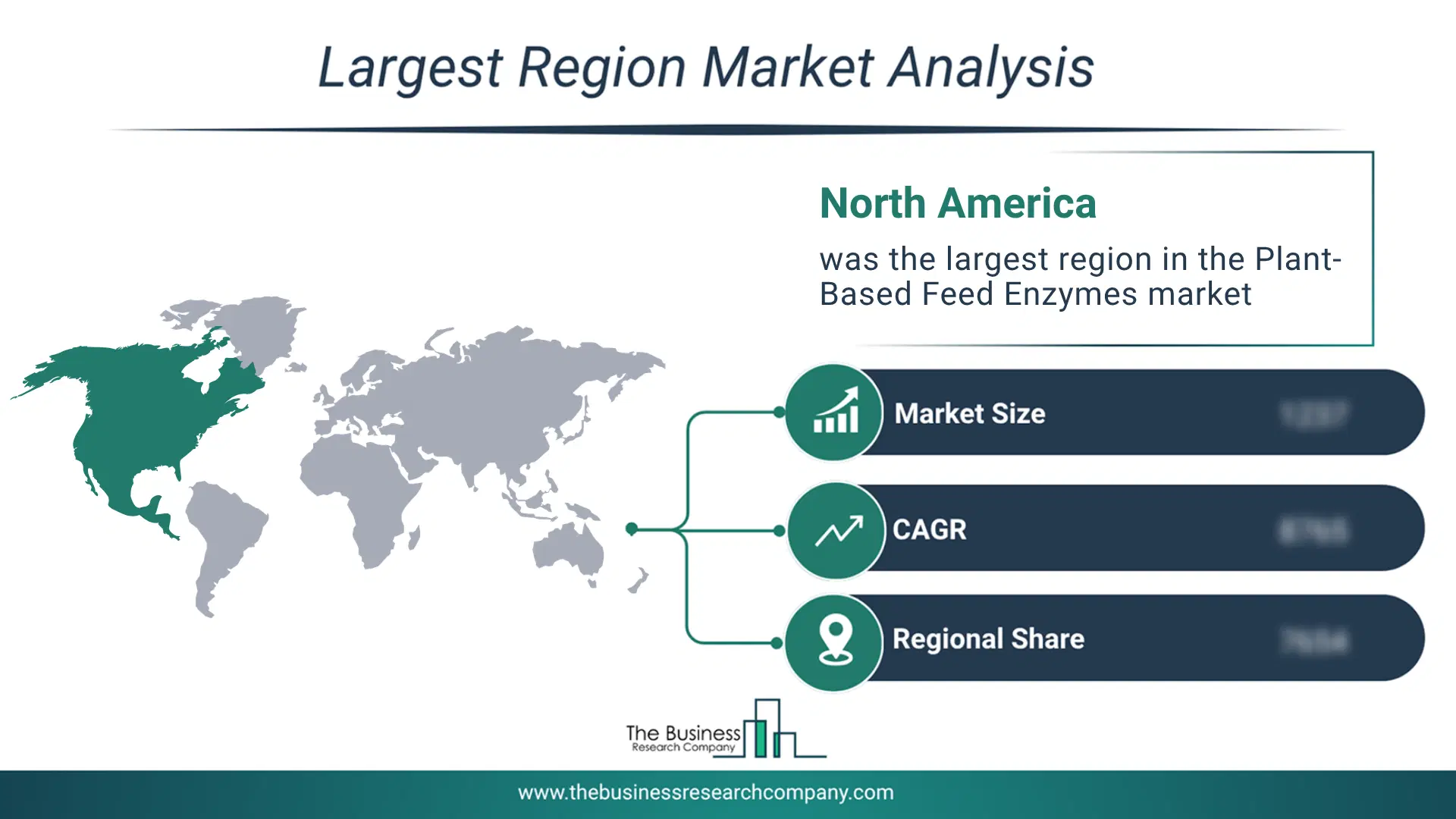
Regional Outlook
North America was the largest region in the plant-based feed enzymes market in 2025. The regions covered in this market report are Asia-Pacific, South East Asia, Western Europe, Eastern Europe, North America, South America, Middle East and Africa. The countries covered in this market report are Australia, Brazil, China, France, Germany, India, Indonesia, Japan, Taiwan, Russia, South Korea, UK, USA, Italy, Spain, CanadaWhat Defines the Plant-Based Feed Enzymes Market?
The plant-based feed enzymes market consists of sales of amylase, invertase, papain, bromelain, ficin, and lipoxygenase. Values in this market are ‘factory gate’ values, that is the value of goods sold by the manufacturers or creators of the goods, whether to other entities (including downstream manufacturers, wholesalers, distributors and retailers) or directly to end customers. The value of goods in this market includes related services sold by the creators of the goods.How is Market Value Defined and Measured?
The market value is defined as the revenues that enterprises gain from the sale of goods and/or services within the specified market and geography through sales, grants, or donations in terms of the currency (in USD unless otherwise specified). The revenues for a specified geography are consumption values that are revenues generated by organizations in the specified geography within the market, irrespective of where they are produced. It does not include revenues from resales along the supply chain, either further along the supply chain or as part of other products.
This chart presents market attractiveness based on a quantitative evaluation of growth, competition, strategic alignment, and risk, offering a clear view of opportunity areas for decision-making. This chart is for illustrative purposes; the full report contains the complete analysis.

This chart highlights the Total Addressable Market (TAM) by estimating the maximum revenue opportunity using an assumption-driven approach, supporting strategic planning and opportunity sizing across markets. The chart is illustrative; the full report provides a more comprehensive analysis.
What Key Data and Analysis Are Included in the Plant-Based Feed Enzymes Market Report 2026?
The plant-based feed enzymes market research report is one of a series of new reports from The Business Research Company that provides market statistics, including industry global market size, regional shares, competitors with the market share, detailed market segments, market trends and opportunities, and any further data you may need to thrive in the plant-based feed enzymes industry. The market research report delivers a complete perspective of everything you need, with an in-depth analysis of the current and future state of the industry.Plant-Based Feed Enzymes Market Report Forecast Analysis
| Report Attribute | Details |
|---|---|
| Market Size Value In 2026 | $1.98 billion |
| Revenue Forecast In 2030 | $2.27 billion |
| Growth Rate | CAGR of 2.5% from 2026 to 2030 |
| Base Year For Estimation | 2025 |
| Actual Estimates/Historical Data | 2020-2025 |
| Forecast Period | 2026 - 2030 |
| Market Representation | Revenue in USD Billion and CAGR from 2026 to 2030 |
| Segments Covered | Type, Form, Livestock |
| Regional Scope | Asia-Pacific, Western Europe, Eastern Europe, North America, South America, Middle East, Africa |
| Country Scope | The countries covered in the report are Australia, Brazil, China, France, Germany, India, Indonesia, Japan, Taiwan, Russia, South Korea, UK, USA, Canada, Italy, Spain. |
| Key Companies Profiled | Cargill Incorporated, BASF SE, DuPont, DSM, Novozymes, Bluestar Adisseo Co. Ltd., Chr. Hansen Holding A/S, Kemin Industries Inc., Novus International Inc., Huvepharma, Advanced Enzyme Technologies, Bestzyme, Maxgrow Biotech Pvt. Ltd., Xike Biotechnology Co. Ltd., Amano Enzyme Inc., AUM Enzymes, Jiangsu Boli Bioproducts Co.Ltd., Antozyme Biotech, Beijing Smistyle Sic. & Tech. Development Co. Ltd., XD BIOCHEM, Biolaxi Corporation |
| Customization Scope | Request for Customization |
| Pricing And Purchase Options | Explore Purchase Options |