
Regenerated Cellulose Market Report 2026
Global Outlook – By Type (Fiber, Film), By Manufacturing Source (Viscose, Cuprammonium, N-Ethyl-Morpholine-N-Oxide (NMMO)), By End Use Industry (Fabric, Automotive, Agriculture, Packaging, Other End Use Industries) – Market Size, Trends, Strategies, and Forecast to 2030
Regenerated Cellulose Market Overview
• Regenerated Cellulose market size has reached to $17.62 billion in 2025 • Expected to grow to $27.27 billion in 2030 at a compound annual growth rate (CAGR) of 9% • Growth Driver: Fashioning Sustainability Surging Demand For Eco-Friendly Textiles Propels The Regenerated Cellulose Market • Market Trend: Innovative Technology Sets New Benchmark For Sustainable Regenerated Cellulose Production • Asia-Pacific was the largest region and fastest growing region.What Is Covered Under Regenerated Cellulose Market?
Regenerated cellulose is a type of material created by converting natural cellulose to a soluble cellulosic derivative and then regenerating it to form either a fiber or a film. Cellulose, the primary structural component of plant cell walls, is naturally insoluble in most solvents. The main types of regenerated cellulose include fiber and film. Regenerated cellulosic fibers are created by extracting cellulose from wood pulp, which is then chemically dissolved and extruded as a continuous filament that can be cut into staple fibers. The different regenerated cellulose manufacturing sources include viscose, cuprammonium, and N-methyl-morpholine-N-oxide (NMMO). The end-user industries for regenerated cellulose include fabric, automotive, agriculture, packaging, and other end-use industries.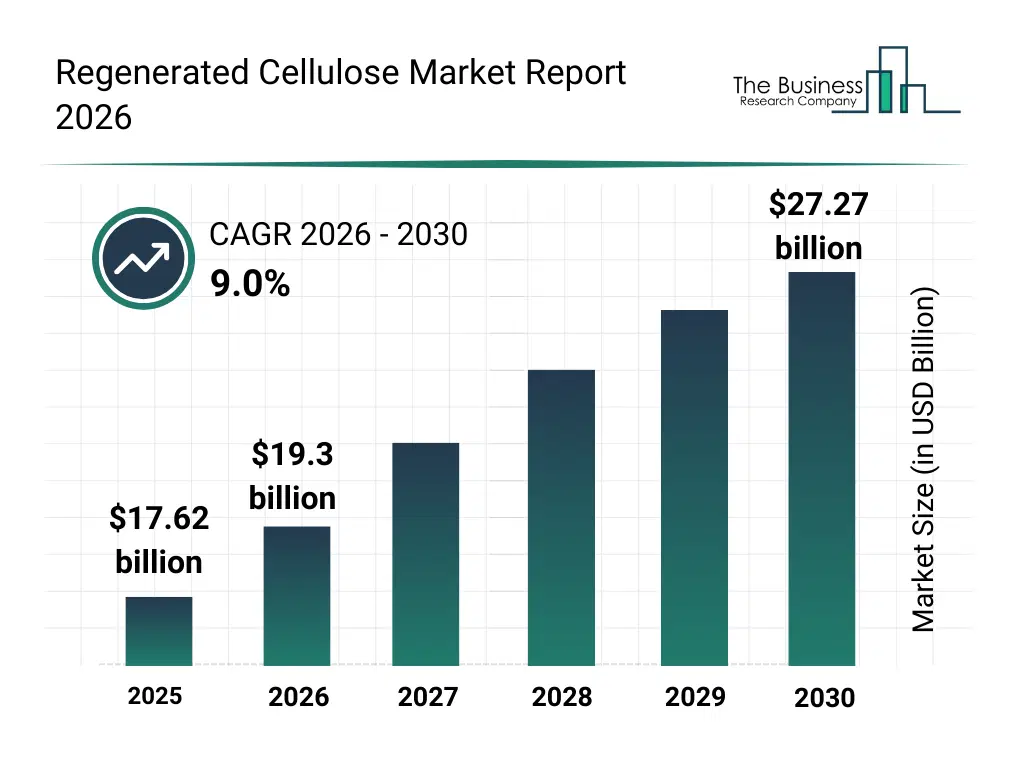
What Is The Regenerated Cellulose Market Size and Share 2026?
The regenerated cellulose market size has grown strongly in recent years. It will grow from $17.62 billion in 2025 to $19.3 billion in 2026 at a compound annual growth rate (CAGR) of 9.5%. The growth in the historic period can be attributed to expansion of textile manufacturing using viscose fibers, growth of packaging film applications, availability of natural cellulose feedstock, increasing demand for breathable fabrics, early adoption of regenerated cellulose films.What Is The Regenerated Cellulose Market Growth Forecast?
The regenerated cellulose market size is expected to see strong growth in the next few years. It will grow to $27.27 billion in 2030 at a compound annual growth rate (CAGR) of 9.0%. The growth in the forecast period can be attributed to increasing demand for sustainable textile materials, rising use of biodegradable packaging films, expansion of automotive interior applications, growing investments in circular material solutions, increasing adoption of low-emission cellulose processing technologies. Major trends in the forecast period include increasing adoption of bio-based regenerated fibers, rising demand for sustainable packaging films, growing use of lyocell and modal fibers, expansion of high-transparency cellulose films, enhanced focus on low-impact manufacturing processes.
Global Regenerated Cellulose Market Segmentation
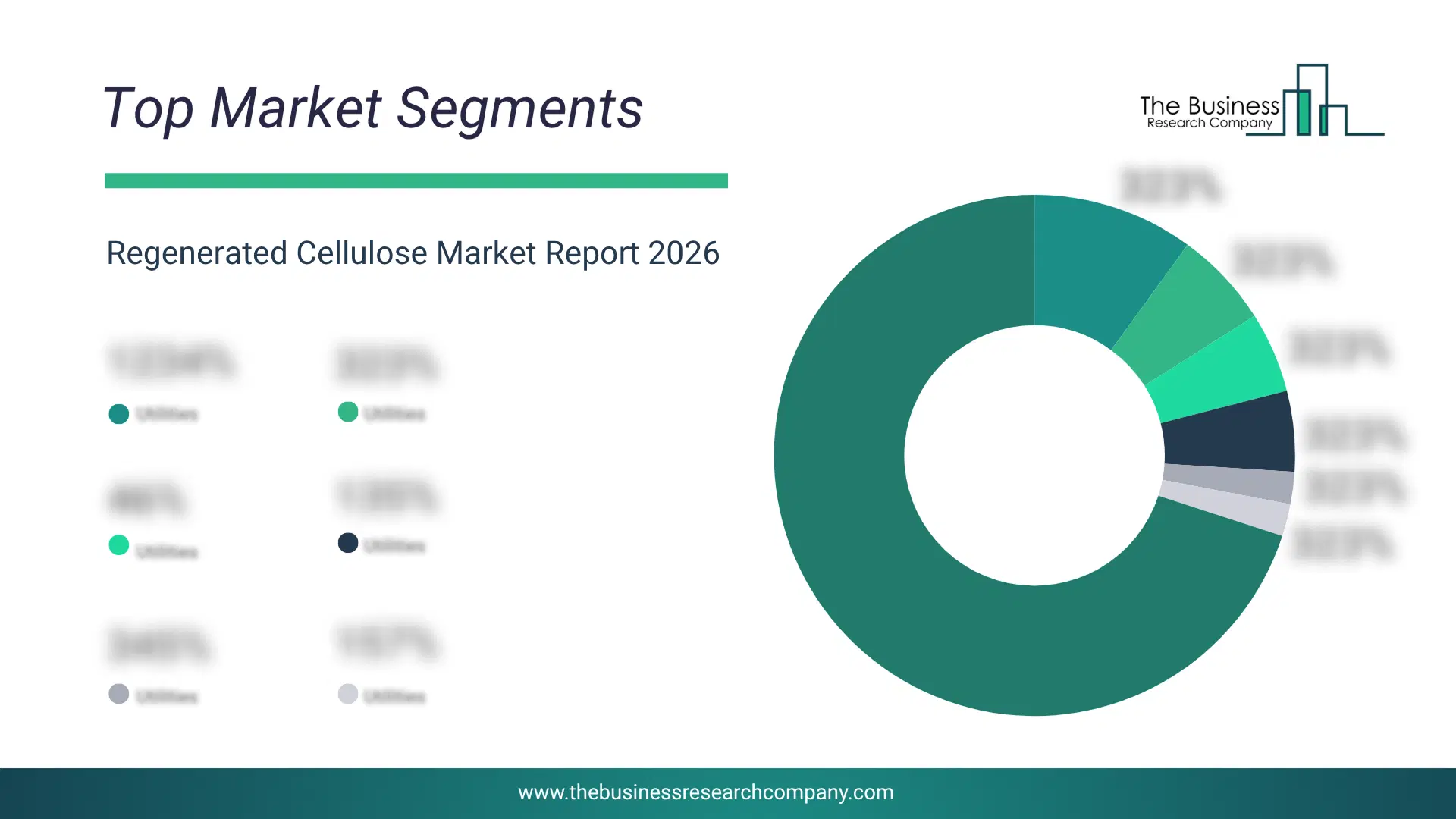
1) By Type: Fiber, Film 2) By Manufacturing Source: Viscose, Cuprammonium, N-Ethyl-Morpholine-N-Oxide (NMMO) 3) By End Use Industry: Fabric, Automotive, Agriculture, Packaging, Other End Use Industries Subsegments: 1) By Fiber: Viscose Fiber, Lyocell Fiber, Modal Fiber 2) By Film: Cellophane Film, Acetate Film, Specialty Regenerated Cellulose FilmsWhat Is The Driver Of The Regenerated Cellulose Market?
Increasing global demand for eco-friendly textiles is expected to propel the growth of the regenerated cellulose market going forward. The eco-friendly textile is made from fabrics that are produced in an environmentally friendly manner, without the use of chemicals and pesticides during the growing process. Regenerated cellulose is a type of material created by converting natural cellulose to a soluble cellulosic derivative and then regenerating it to form either a fiber or a film. For instance, in July 2023, according to TheRoundup, a US-based website committed to increasing environmental awareness and sustainability in our daily lives, the global yearly sales of eco-friendly clothes will increase by $1, 574.2 million by 2025. Therefore, the increasing global demand for eco-friendly textiles is driving the growth of the regenerated cellulose industry.Key Players In The Global Regenerated Cellulose Market
Major companies operating in the regenerated cellulose market are Natureworks LLC, Bio-On SRL, BASE SE, Tianan Plantic Technologies Limited, Asahi Kasei Corporation, CFF GmbH & Co. K.G., Grasim Industries Limited, Kelheim Fibres GmbH, Lenzing AG, Corbion NV, Danimer Scientific, Yield10 Bioscience Inc., International Paper, GP cellulose LLC, Sateri, Fulida Group, Eastman Chemical Company, Synthesia, Futamura Group, AMS Group PLC, Shandong Henglian New Materials, Zhejiang Kerui, Cobetter, EMD Millipore, Parkson Corporation, Hiller Separation & Process, Rotex Automation, IFS Industriefabrik Schneider GmbH, Kaisha Russell Finex, Forsberg’s Inc., Schlumberger Asia Services Limited, SWECO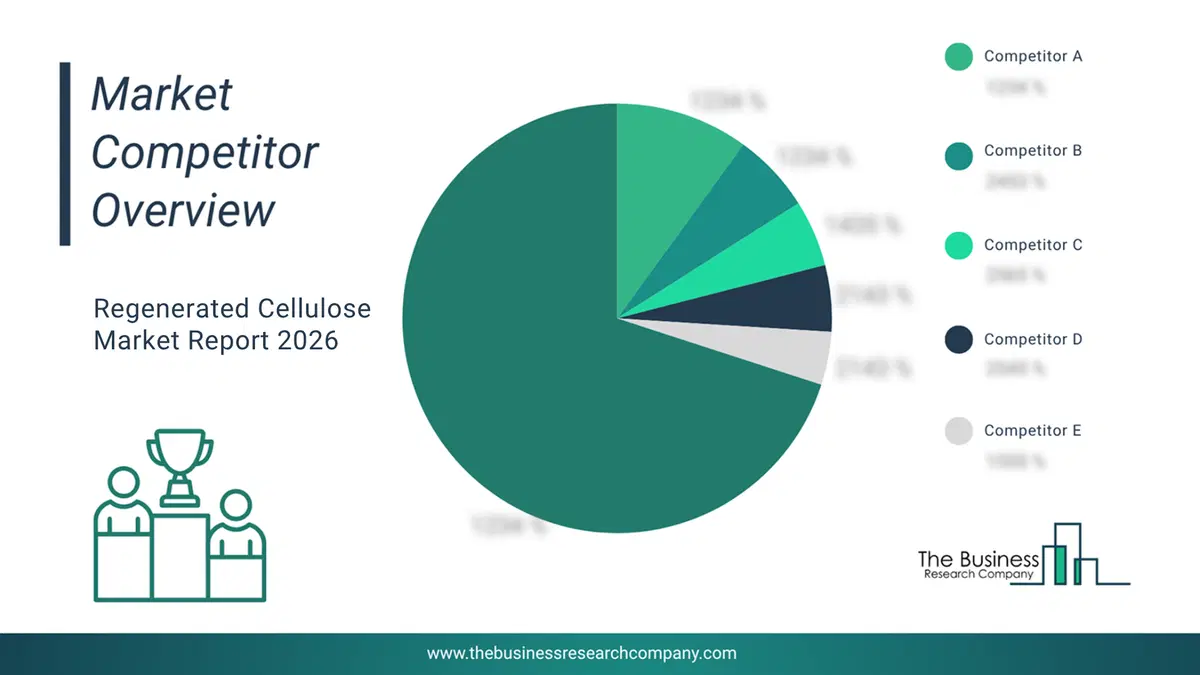
This chart is for illustrative purposes; the full report includes a detailed competitor analysis and comprehensive overview of the top 10 companies in the market.
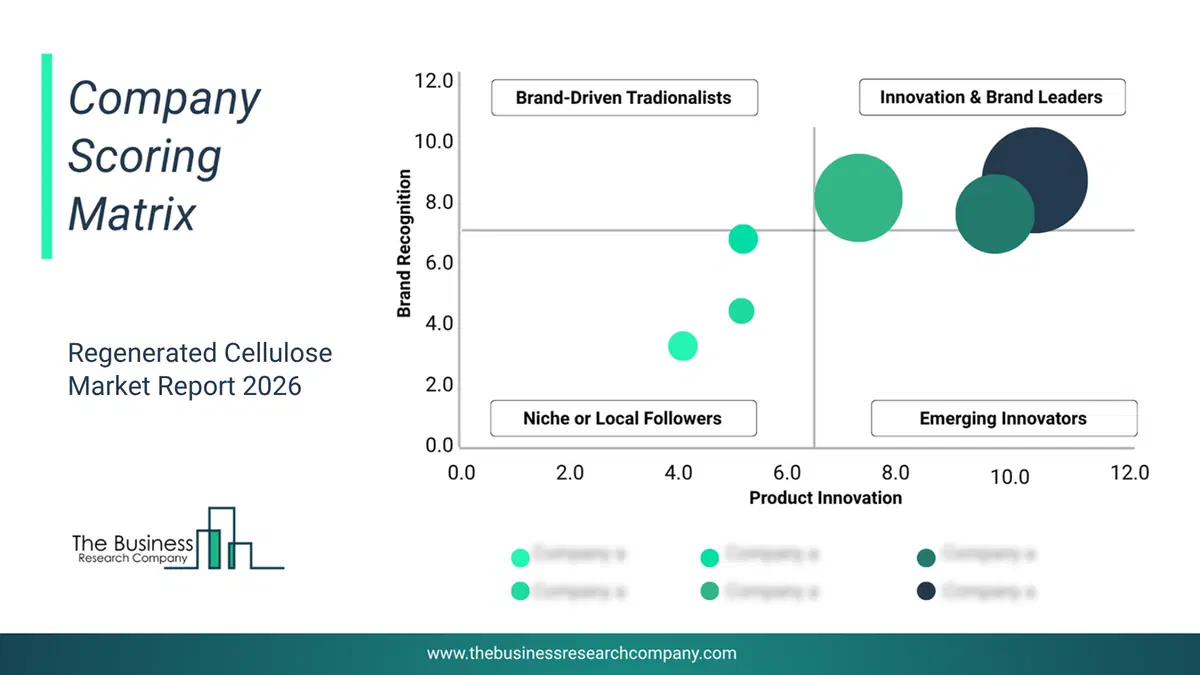
This chart maps companies by product innovation and brand strength, with bubble size indicating relative revenue, helping identify market leaders, challengers, and niche players. This is an illustrative chart; the full report provides a complete and accurate competitive analysis.
Global Regenerated Cellulose Market Trends and Insights
Major companies operating in the regenerated cellulose market are focusing on developing innovative solutions, such as ionic liquid-based regenerated cellulose technology, to meet the rising demand for low-emission, waste-reducing, and environmentally sustainable fiber production. Ionic liquid-based regenerated cellulose technology uses stable, non-volatile ionic liquids to dissolve cellulose, offering a safer and greener alternative to traditional solvents such as carbon disulfide or NMMO. For instance, in July 2025, the Institute of Process Engineering (IPE), a China-based research institute under the Chinese Academy of Sciences, launched the 1, 000-ton ionic liquid-based regenerated cellulose fiber plant, an innovative technology related to this market. The technology dissolves cellulose using non-volatile ionic liquids and replaces hazardous solvents used in conventional viscose production. It features over 99% solvent-recovery efficiency, enabling near-zero emissions and eliminating wastewater, waste gas, and solid waste. The regenerated fibers meet international standards for fineness, tensile strength, elongation, and uniformity, making them suitable for textile applications. This industrial-scale plant demonstrates a sustainable, low-carbon approach for producing regenerated cellulose fibers.What Are Latest Mergers And Acquisitions In The Regenerated Cellulose Market?
In September 2024, Suzano Papel e Celulose SA, a Brazil-based company, acquired Lenzing AG for $251.56 million. With this acquisition, Suzano aims to expand its portfolio by incorporating Lenzing's expertise in providing regenerated cellulose. Lenzing AG is an Austria-based company that offers regenerated cellulose.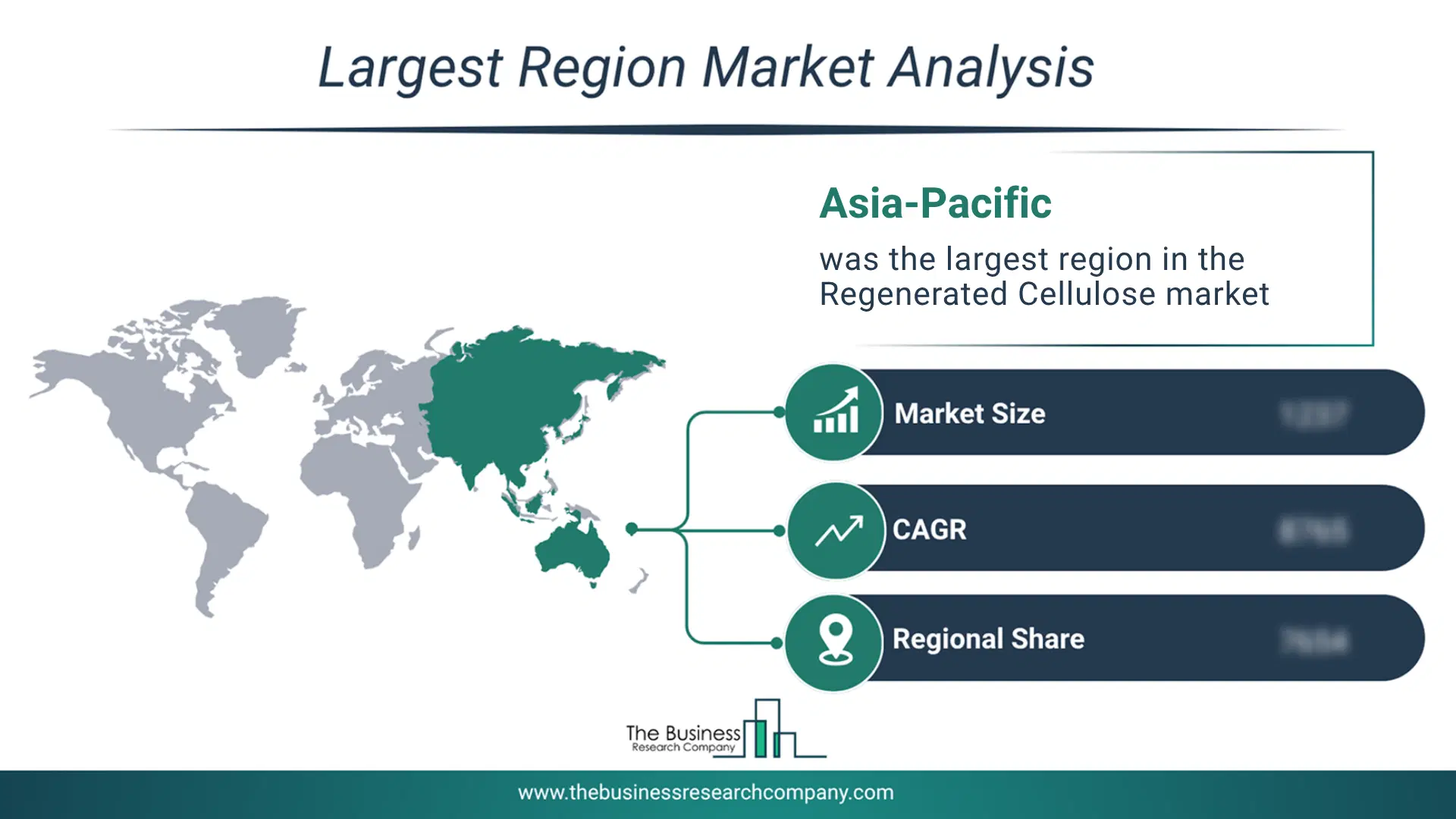
Regional Outlook
Asia-Pacific was the largest region in the regenerated cellulose market share in 2025 and is expected to be the fastest-growing region in the forecast period. The regions covered in this market report are Asia-Pacific, South East Asia, Western Europe, Eastern Europe, North America, South America, Middle East, Africa. The countries covered in this market report are Australia, Brazil, China, France, Germany, India, Indonesia, Japan, Taiwan, Russia, South Korea, UK, USA, Canada, Italy, Spain.What Defines the Regenerated Cellulose Market?
The regenerated cellulose market consists of sales of regenerated cellulose by product type including rayon regenerated cellulose, lyocell regenerated cellulose and modal regenerated cellulose. Values in this market are ‘factory gate’ values, that is the value of goods sold by the manufacturers or creators of the goods, whether to other entities (including downstream manufacturers, wholesalers, distributors, and retailers) or directly to end customers. The value of goods in this market includes related services sold by the creators of the goods.How is Market Value Defined and Measured?
The market value is defined as the revenues that enterprises gain from the sale of goods and/or services within the specified market and geography through sales, grants, or donations in terms of the currency (in USD unless otherwise specified). The revenues for a specified geography are consumption values that are revenues generated by organizations in the specified geography within the market, irrespective of where they are produced. It does not include revenues from resales along the supply chain, either further along the supply chain or as part of other products.
This chart presents market attractiveness based on a quantitative evaluation of growth, competition, strategic alignment, and risk, offering a clear view of opportunity areas for decision-making. This chart is for illustrative purposes; the full report contains the complete analysis.

This chart highlights the Total Addressable Market (TAM) by estimating the maximum revenue opportunity using an assumption-driven approach, supporting strategic planning and opportunity sizing across markets. The chart is illustrative; the full report provides a more comprehensive analysis.
What Key Data and Analysis Are Included in the Regenerated Cellulose Market Report 2026?
The regenerated cellulose market research report is one of a series of new reports from The Business Research Company that provides market statistics, including Market Report 2026?global market size, regional shares, competitors with the market share, detailed market segments, market trends and opportunities, and any further data you may need to thrive in the regenerated cellulose Market Report 2026? The market research report delivers a complete perspective of everything you need, with an in-depth analysis of the current and future state of the Market Report 2026?Regenerated Cellulose Market Report Forecast Analysis
| Report Attribute | Details |
|---|---|
| Market Size Value In 2026 | $19.3 billion |
| Revenue Forecast In 2030 | $27.27 billion |
| Growth Rate | CAGR of 9.5% from 2026 to 2030 |
| Base Year For Estimation | 2025 |
| Actual Estimates/Historical Data | 2020-2025 |
| Forecast Period | 2026 - 2030 |
| Market Representation | Revenue in USD Billion and CAGR from 2026 to 2030 |
| Segments Covered | Type, Manufacturing Source, End Use Industry |
| Regional Scope | Asia-Pacific, Western Europe, Eastern Europe, North America, South America, Middle East, Africa |
| Country Scope | The countries covered in the report are Australia, Brazil, China, France, Germany, India, Indonesia, Japan, Taiwan, Russia, South Korea, UK, USA, Canada, Italy, Spain. |
| Key Companies Profiled | Natureworks LLC, Bio-On SRL, BASE SE, Tianan Plantic Technologies Limited, Asahi Kasei Corporation, CFF GmbH & Co. K.G., Grasim Industries Limited, Kelheim Fibres GmbH, Lenzing AG, Corbion NV, Danimer Scientific, Yield10 Bioscience Inc., International Paper, GP cellulose LLC, Sateri, Fulida Group, Eastman Chemical Company, Synthesia, Futamura Group, AMS Group PLC, Shandong Henglian New Materials, Zhejiang Kerui, Cobetter, EMD Millipore, Parkson Corporation, Hiller Separation & Process, Rotex Automation, IFS Industriefabrik Schneider GmbH, Kaisha Russell Finex, Forsberg’s Inc., Schlumberger Asia Services Limited, SWECO |
| Customization Scope | Request for Customization |
| Pricing And Purchase Options | Explore Purchase Options |