
Satellite Connectivity Market Report 2026
Global Outlook – By Component (Video, Fixed, Mobility), By Orbit (Elliptical, Geostationary Earth Orbit, Low Earth Orbit, Medium Earth Orbit), By Application (Earth Observation, Communication, Navigation Or Surveillance), By End User (Civil And Earth Observation, Government And Military, Commercial) – Market Size, Trends, Strategies, and Forecast to 2030
Satellite Connectivity Market Overview
• Satellite Connectivity market size has reached to $8.37 billion in 2025 • Expected to grow to $13.24 billion in 2030 at a compound annual growth rate (CAGR) of 9.5% • Growth Driver: Rising Demand For High-Speed Internet Fueling The Growth Of The Market Due To Expanding Need For Reliable Access In Underserved Regions • Market Trend: Development Of Advanced Antenna Technologies Driving Innovation In Satellite Connectivity Market Due To Demand For High-Speed, Precision Communication Solutions • North America was the largest region and fastest growing region.What Is Covered Under Satellite Connectivity Market?
Satellite connectivity refers to the use of communication satellites to provide internet, phone, TV, or data services by transmitting signals between Earth-based equipment and satellites orbiting the planet, a type of wireless communication, especially useful in areas where traditional land-based infrastructure (like fiber optic cables or cellular towers) is unavailable or unreliable. The main components of satellite connectivity are video, fixed, and mobility. Video in satellite connectivity refers to the transmission of high-quality video content using satellite networks, including broadcasting, streaming, and live feeds from remote locations. It is uses various orbit types such as elliptical, geostationary earth orbit, low earth orbit, and medium earth orbit and is applied for earth observation, communication, and navigation or surveillance. It is used by various end users including civil and earth observation, government and military, and commercial.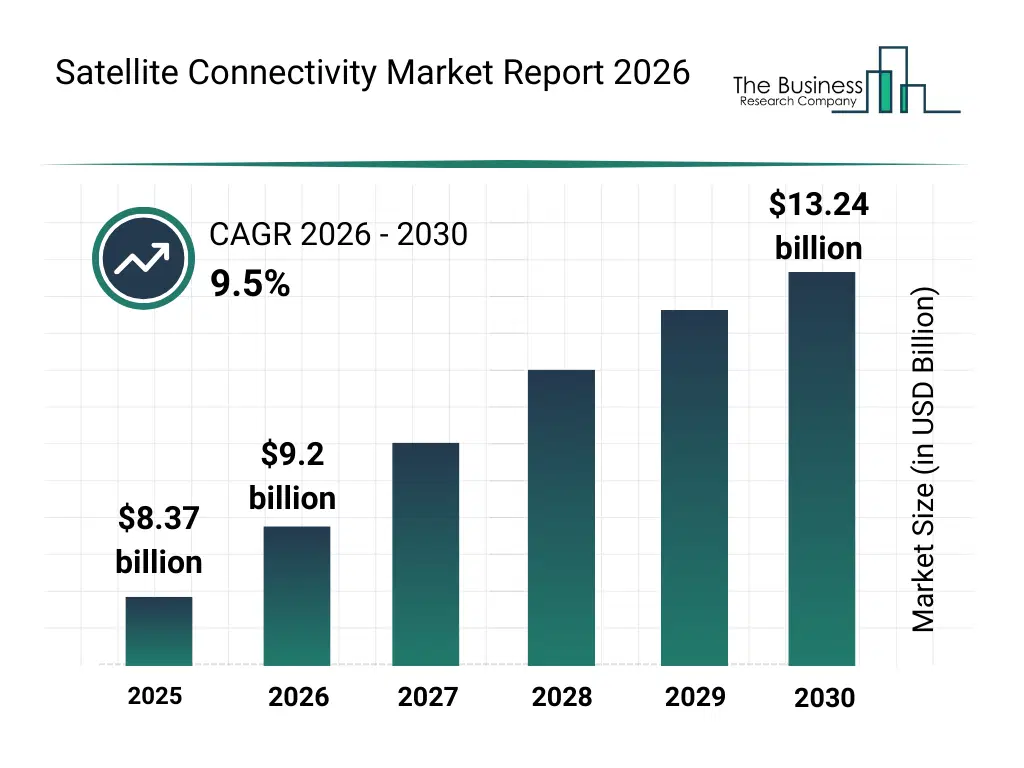
What Is The Satellite Connectivity Market Size and Share 2026?
The satellite connectivity market size has grown strongly in recent years. It will grow from $8.37 billion in 2025 to $9.2 billion in 2026 at a compound annual growth rate (CAGR) of 9.9%. The growth in the historic period can be attributed to growing need for connectivity in remote and underserved regions driving adoption of satellite communication services, expansion of television broadcasting networks using satellite distribution infrastructure, development of satellite phones enabling communication in mission-critical and disaster environments, early deployment of mobility connectivity solutions for maritime and aviation sectors, advancements in satellite modems and routers improving data transmission reliability.What Is The Satellite Connectivity Market Growth Forecast?
The satellite connectivity market size is expected to see strong growth in the next few years. It will grow to $13.24 billion in 2030 at a compound annual growth rate (CAGR) of 9.5%. The growth in the forecast period can be attributed to rapid expansion of low earth orbit satellite constellations increasing availability of high-speed satellite internet, rising demand for mobility services across aviation, maritime, and connected vehicle segments, innovation in user terminals and consumer communication devices enhancing accessibility and affordability, increasing frequency of climate-related disasters driving growth in emergency and resilience-based satellite services, growing integration of satellite connectivity with 5g and hybrid networks expanding service capabilities. Major trends in the forecast period include rising demand for connectivity in remote and underserved regions, growth of satellite-based mobility services, expansion of low earth orbit constellations, increased adoption of satellite backhaul for telecom operators, integration of satellite connectivity into consumer electronics.
Global Satellite Connectivity Market Segmentation
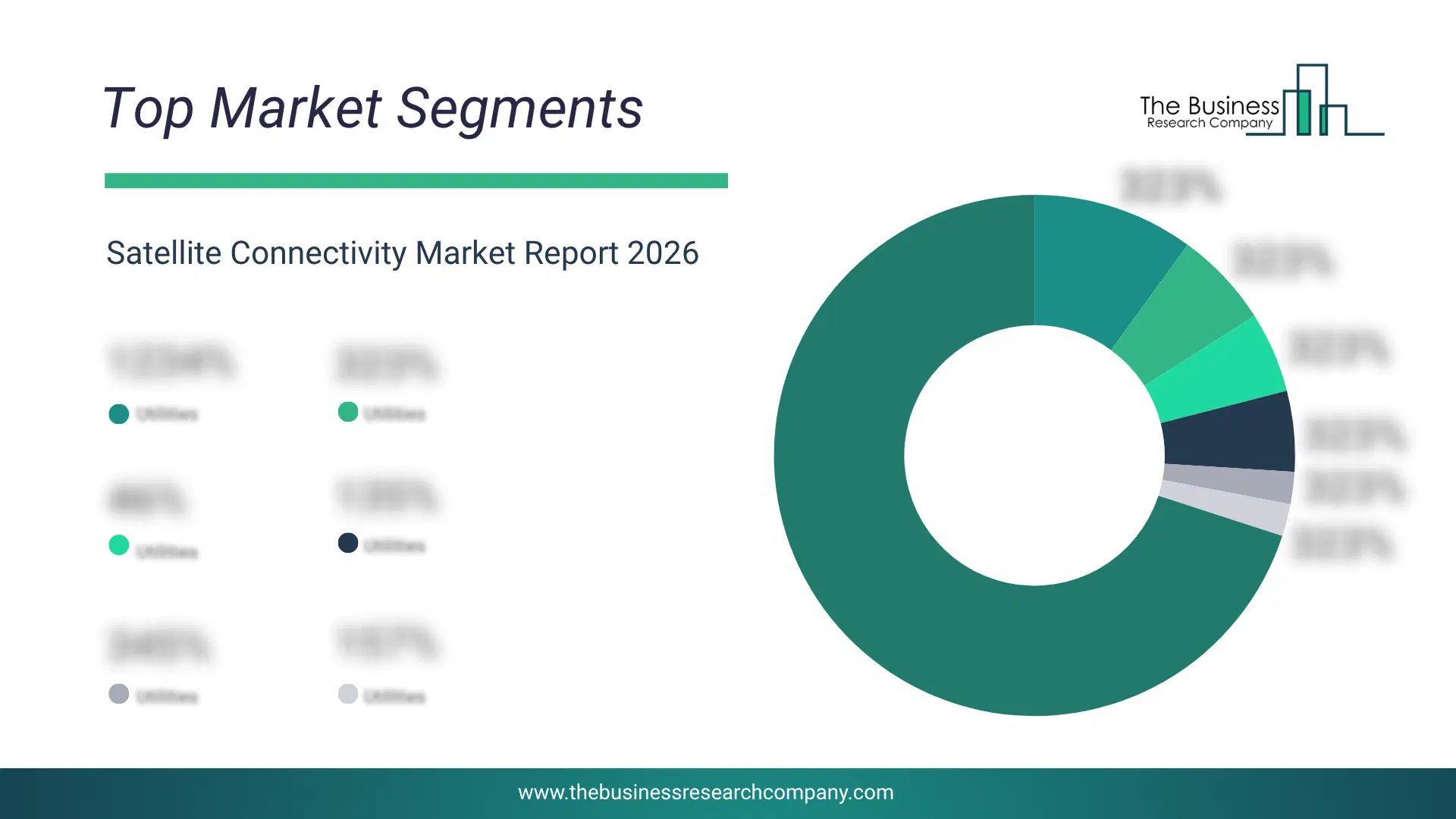
1) By Component: Video, Fixed, Mobility 2) By Orbit: Elliptical, Geostationary Earth Orbit, Low Earth Orbit, Medium Earth Orbit 3) By Application: Earth Observation, Communication, Navigation Or Surveillance 4) By End User: Civil And Earth Observation, Government And Military, Commercial Subsegments: 1) By Video: Broadcast Video, Video Contribution And Distribution, Direct-To-Home (DTH) 2) By Fixed: Consumer Broadband, Enterprise And Government Networks, Backhaul And Trunking 3) By Mobility: Maritime, Aeronautical, Land-MobileWhat Is Driver Of The Satellite Connectivity Market?
The increasing demand for high-speed internet connectivity is expected to propel the growth of the satellite connectivity market going forward. High-speed internet connectivity refers to internet access that allows for fast data transmission and reception. The rise of high-speed internet connectivity is due to the people preference for faster, more reliable, and always-available digital experiences. Satellite connectivity helps high-speed internet connectivity by allowing internet access in remote, rural, or underserved areas where traditional wired infrastructure (like fiber or cable) is unavailable or too expensive to install. For instance, in June 2024, according to the National Telecommunications and Information Administration, a US-based government agency, the proportion of people living in homes that had access to both fixed and mobile internet connections rose to 72% by 2023, compared to 69% in 2021. Therefore, the increasing demand for high-speed internet connectivity is driving the growth of satellite connectivity industry.Key Players In The Global Satellite Connectivity Market
Major companies operating in the satellite connectivity market are General Dynamics, Honeywell International Inc., Thales Group, L3Harris Technologies Inc., Leonardo S.p.A, SpaceX Corp., Viasat Inc., SES, Aselasan AS, Inmarsat Global Ltc., Intelsat LLC, Marlink SAS, Iridium Communications Inc., Telesat, Hughes Network Systems LLC, Globalstar Inc., Astranis Space Technologies, Norsat International Inc., Telemar Group, OneWeb Technologies Inc.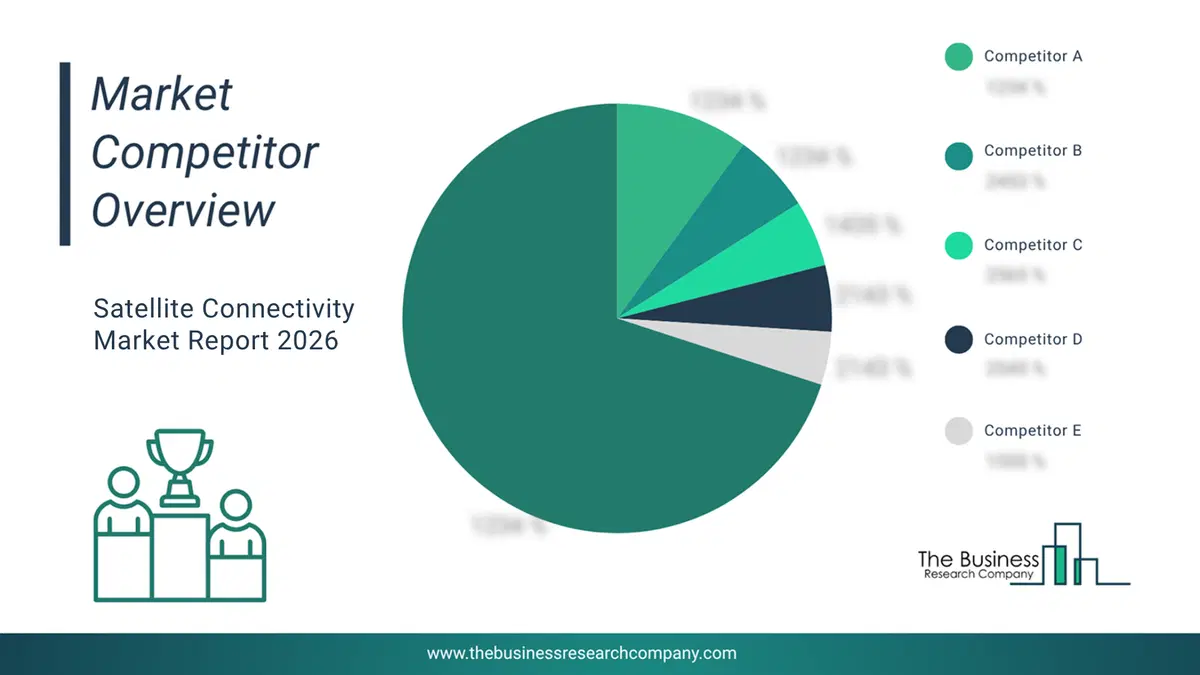
This chart is for illustrative purposes; the full report includes a detailed competitor analysis and comprehensive overview of the top 10 companies in the market.
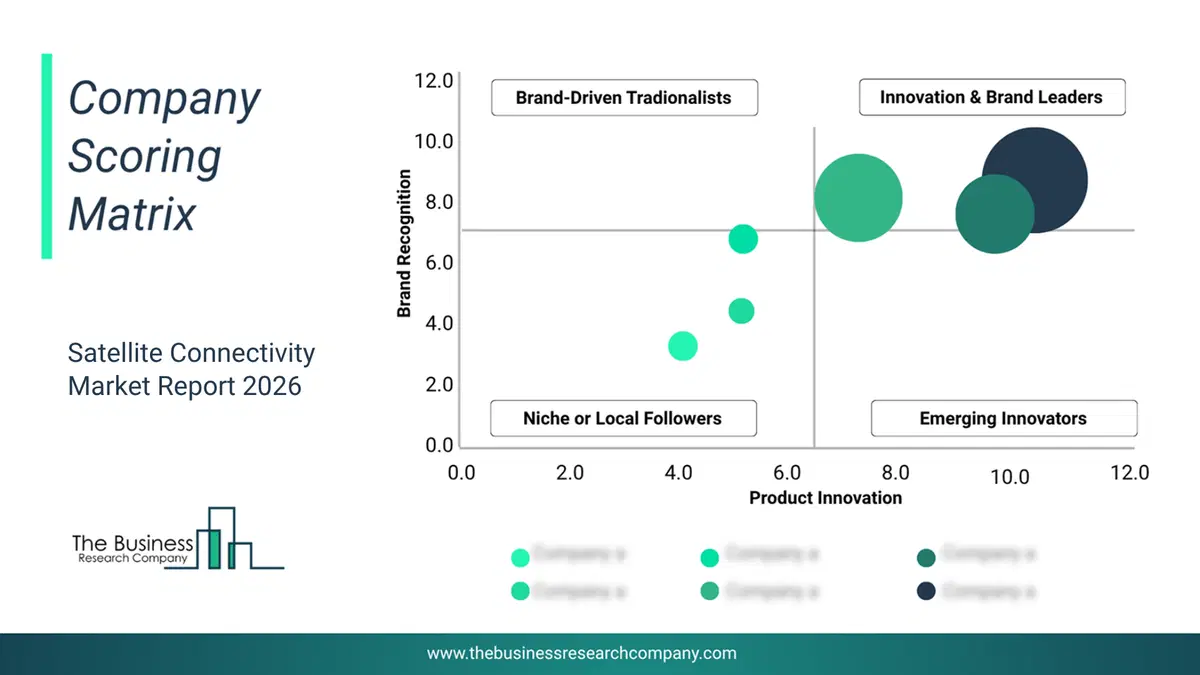
This chart maps companies by product innovation and brand strength, with bubble size indicating relative revenue, helping identify market leaders, challengers, and niche players. This is an illustrative chart; the full report provides a complete and accurate competitive analysis.
Global Satellite Connectivity Market Trends and Insights
Major companies operating in the satellite connectivity market are focusing on developing advanced solutions such as phased array antennas which allows for instantaneous electronic beam steering and multi-target tracking without moving parts, enabling high-speed, high-precision communication and radar systems. Phased array antennas are advanced antenna systems that use multiple small antenna elements arranged in a specific pattern and these elements work together to form a directional beam of radio waves. For instance, in 2025, Amazon, a US-based company specializing in in e-commerce, cloud computing and satellite communications launches Kuiper internet satellites, a network of low Earth orbit (LEO) satellites that is deploying as part of its Project Kuiper initiative to provide global broadband internet access and goal is to connect underserved and remote regions around the world with high-speed, low-latency internet. Additionally, it also offers enhanced connectivity solutions for Internet of Things (IoT) devices, enabling seamless communication in remote locations where traditional infrastructure is unavailable.What Are Latest Mergers And Acquisitions In The Satellite Connectivity Market? Viasat Completes The Acquisition Of Inmarsat To Enhance Space-Based Connectivity
In May 2023, Viasat Inc., a US-based satellite technology company, acquired Inmarsat for $7.3 billion. With this acquisition, Viasat strengthens its satellite communications by combining Inmarsat's GEO mobility expertise with its own high-capacity broadband technologies to serve aviation, maritime, and government markets. Inmarsat is a UK-based company specializing in satellite connectivity services.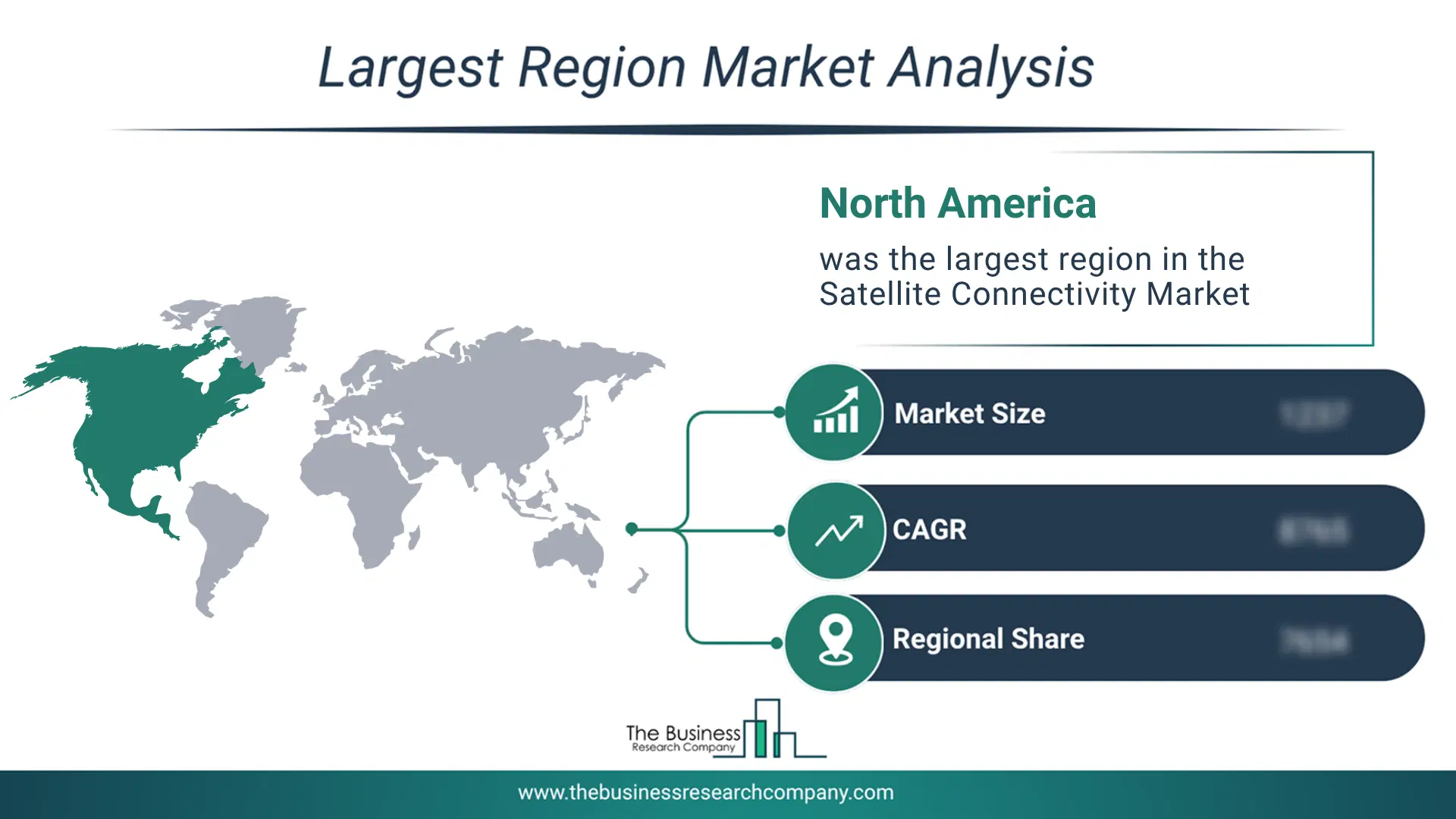
Regional Insights
North America was the largest region in the satellite connectivity market in 2025. North America is expected to be the fastest-growing region in the forecast period. The regions covered in this market report are Asia-Pacific, South East Asia, Western Europe, Eastern Europe, North America, South America, Middle East, Africa. The countries covered in this market report are Australia, Brazil, China, France, Germany, India, Indonesia, Japan, Taiwan, Russia, South Korea, UK, USA, Canada, Italy, SpainWhat Defines the Satellite Connectivity Market?
The satellite connectivity market includes of revenues earned by entities by providing services such as internet access, voice and messaging services, television broadcasting, mobility services and disaster response and emergency services. The market value includes the value of related goods sold by the service provider or included within the service offering. Only goods and services traded between entities or sold to end consumers are included. The satellite connectivity market consists of sales of consumer internet and communication products, satellite phones, satellite modems and routers, mobility and transportation products and broadcasting equipment. Values in this market are ‘factory gate’ values, that is the value of goods sold by the manufacturers or creators of the goods, whether to other entities (including downstream manufacturers, wholesalers, distributors and retailers) or directly to end customers. The value of goods in this market includes related services sold by the creators of the goods.How is Market Value Defined and Measured?
The market value is defined as the revenues that enterprises gain from the sale of goods and/or services within the specified market and geography through sales, grants, or donations in terms of the currency (in USD unless otherwise specified). The revenues for a specified geography are consumption values that are revenues generated by organizations in the specified geography within the market, irrespective of where they are produced. It does not include revenues from resales along the supply chain, either further along the supply chain or as part of other products.
This chart presents market attractiveness based on a quantitative evaluation of growth, competition, strategic alignment, and risk, offering a clear view of opportunity areas for decision-making. This chart is for illustrative purposes; the full report contains the complete analysis.

This chart highlights the Total Addressable Market (TAM) by estimating the maximum revenue opportunity using an assumption-driven approach, supporting strategic planning and opportunity sizing across markets. The chart is illustrative; the full report provides a more comprehensive analysis.
What Key Data and Analysis Are Included in the Satellite Connectivity Market Report 2026?
The satellite connectivity market research report is one of a series of new reports from The Business Research Company that provides market statistics, including industry global market size, regional shares, competitors with the market share, detailed market segments, market trends and opportunities, and any further data you may need to thrive in the satellite connectivity industry. The market research report delivers a complete perspective of everything you need, with an in-depth analysis of the current and future state of the industry.Satellite Connectivity Market Report Forecast Analysis
| Report Attribute | Details |
|---|---|
| Market Size Value In 2026 | $9.2 billion |
| Revenue Forecast In 2030 | $13.24 billion |
| Growth Rate | CAGR of 9.5% from 2026 to 2030 |
| Base Year For Estimation | 2025 |
| Actual Estimates/Historical Data | 2020-2025 |
| Forecast Period | 2026 - 2030 |
| Market Representation | Revenue in USD Billion and CAGR from 2026 to 2030 |
| Segments Covered | Component, Orbit, Application, End User |
| Regional Scope | Asia-Pacific, Western Europe, Eastern Europe, North America, South America, Middle East, Africa |
| Country Scope | The countries covered in the satellite connectivity market report are Australia, Brazil, China, France, Germany, India, Indonesia, Japan, Taiwan, Russia, South Korea, UK, USA, Canada, Italy, Spain |
| Key Companies Profiled | General Dynamics, Honeywell International Inc., Thales Group, L3Harris Technologies Inc., Leonardo S.p.A, SpaceX Corp., Viasat Inc., SES, Aselasan AS, Inmarsat Global Ltc., Intelsat LLC, Marlink SAS, Iridium Communications Inc., Telesat, Hughes Network Systems LLC, Globalstar Inc., Astranis Space Technologies, Norsat International Inc., Telemar Group, OneWeb Technologies Inc. |
| Customization Scope | Request for Customization |
| Pricing And Purchase Options | Explore Purchase Options |