
Ship Building Market Report 2026
Global Outlook – By Product (Bulkers, Tankers, Containers, Cruise And Ferry, Other Products), By Application (Passenger Transportation, Goods Transportation), By End-User (Logistics Companies, Cruise Operators, Other End-Users) – Market Size, Trends, Strategies, and Forecast to 2035
Ship Building Market Overview
• Ship Building market size has reached to $206.89 billion in 2025 • Expected to grow to $275.09 billion in 2030 at a compound annual growth rate (CAGR) of 6% • Growth Driver: Impact Of Increasing Seaborne Trade On The Shipbuilding Market • Market Trend: Shipbuilding Companies Embrace Green Container Ships For Environmental Impact • Asia-Pacific was the largest region in 2025 and Western Europe is the fastest growing region.Market Gains By 2030 – Top Opportunities By Segment
Market Gain identifies the most promising market opportunities by highlighting the segments or products expected to generate the highest incremental revenue growth over the next five years.
What Is Covered Under Ship Building Market?
Shipbuilding refers to the creation of ships and other watercraft, encompassing tasks such as design, engineering, material sourcing, and assembly. This work is performed in shipyards, using specialized tools and expertise to construct different types of vessels, including commercial, military, and leisure ships. The main types of shipbuilding are bulkers, tankers, containers, cruises, ferries, and other types. Container ships have no hatches, which means there is no continuous main deck running the length of the ship, as well as other types of well, such as passenger transportation and goods transportation. The various applications include passenger transportation and goods transportation. These are used by transport companies, the military, and other end-users.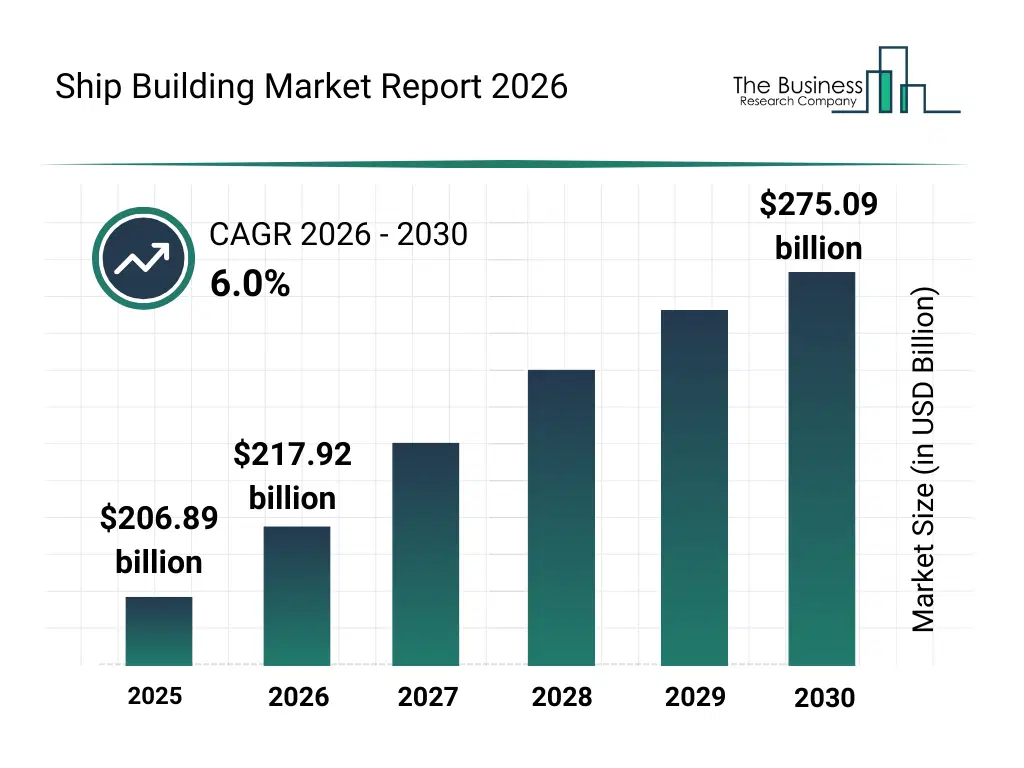
What Is The Ship Building Market Size and Share 2026?
The ship building market size has grown strongly in recent years. It will grow from $206.89 billion in 2025 to $217.92 billion in 2026 at a compound annual growth rate (CAGR) of 5.3%. The growth in the historic period can be attributed to expansion of global seaborne trade, growth in container and bulk carrier orders, increasing investments in shipyard capacity, rising demand for specialized vessels, availability of skilled marine engineering workforce.What Is The Ship Building Market Growth Forecast?
The ship building market size is expected to see strong growth in the next few years. It will grow to $275.09 billion in 2030 at a compound annual growth rate (CAGR) of 6.0%. The growth in the forecast period can be attributed to increasing tightening of maritime emission norms, rising adoption of alternative fuel vessels, expansion of cruise and ferry construction, growing investments in digital shipbuilding tools, increasing demand for high-capacity cargo ships. Major trends in the forecast period include increasing demand for fuel-efficient vessel designs, rising adoption of advanced hull construction techniques, growing integration of automation in shipyards, expansion of lng and alternative fuel ships, enhanced focus on safety and compliance.
Global Ship Building Market Segmentation
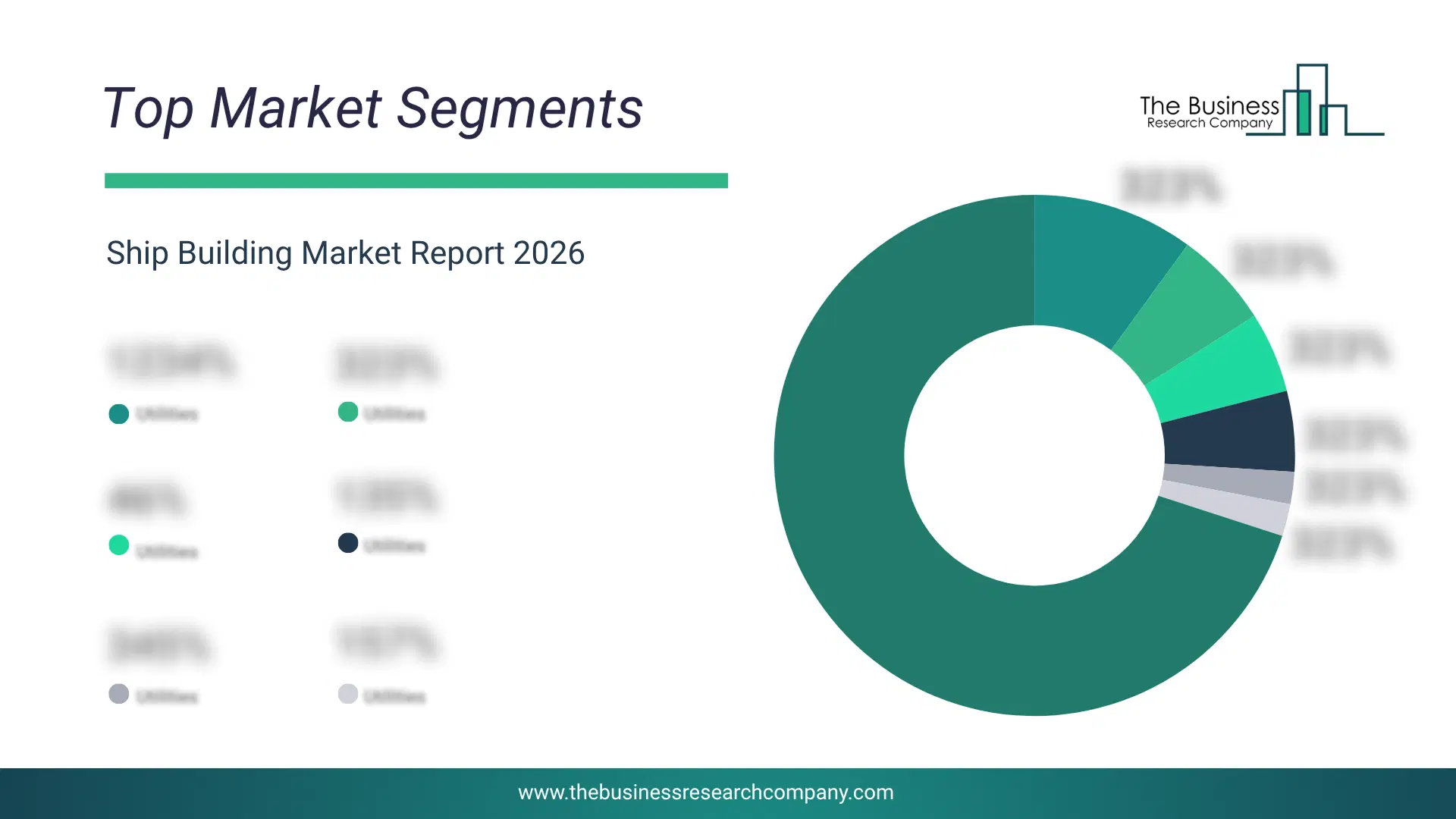
1) By Product: Bulkers, Tankers, Containers, Cruise And Ferry, Other Products 2) By Application: Passenger Transportation, Goods Transportation 3) By End-User: Logistics Companies, Cruise Operators, Other End-Users Subsegments: 1) By Bulkers: Dry Bulk Carriers, Specialized Bulk Carriers 2) By Tankers: Crude Oil Tankers, Product Tankers, Liquefied Natural Gas (LNG) Carriers 3) By Containers: Container Ships, Multi-Purpose Container Vessels 4) By Cruise And Ferry: Ocean Cruise Ships, River Cruise Ships, Passenger Ferries 5) By Other Products: Offshore Support Vessels, Research Vessels, Fishing Vessels, Military Ships The top segments in the ship building market will be: • Goods Transportation will reach $179163.6 Million by 2025. • Logistics Companies will reach $176514.6 Million by 2025. • Bulkers will reach $66833.5 Million by 2025. • Tankers will reach $53169.7 Million by 2025. • Containers will reach $44222.5 Million by 2025.What Is The Driver Of The Ship Building Market?
The increasing seaborne trade is predicted to contribute to the growth of the shipbuilding market. The rising population, the surging purchasing power of consumers, and improving standards of living are increasing the demand for consumer goods, leading to high production and rapid industrialization. For instance, in June 2023, according to the REVIEW OF MARITIME TRANSPORT 2023 report published by the UNCTAD United Nations Conference on Trade and Development, In 2022, total seaborne trade reached 12,027 million tons, with a decline in containerized trade of 3.7%, while oil and gas trade grew by 6% and 4.6%, respectively; projections for 2023 indicate a 2.4% growth in total seaborne trade and a 1.2% increase in containerized trade, followed by expected annual growth rates of 2.1% for total seaborne trade and 3.2% for containerized trade in 2024. Therefore The increasing seaborne trade contributing to the growth of the shipbuilding market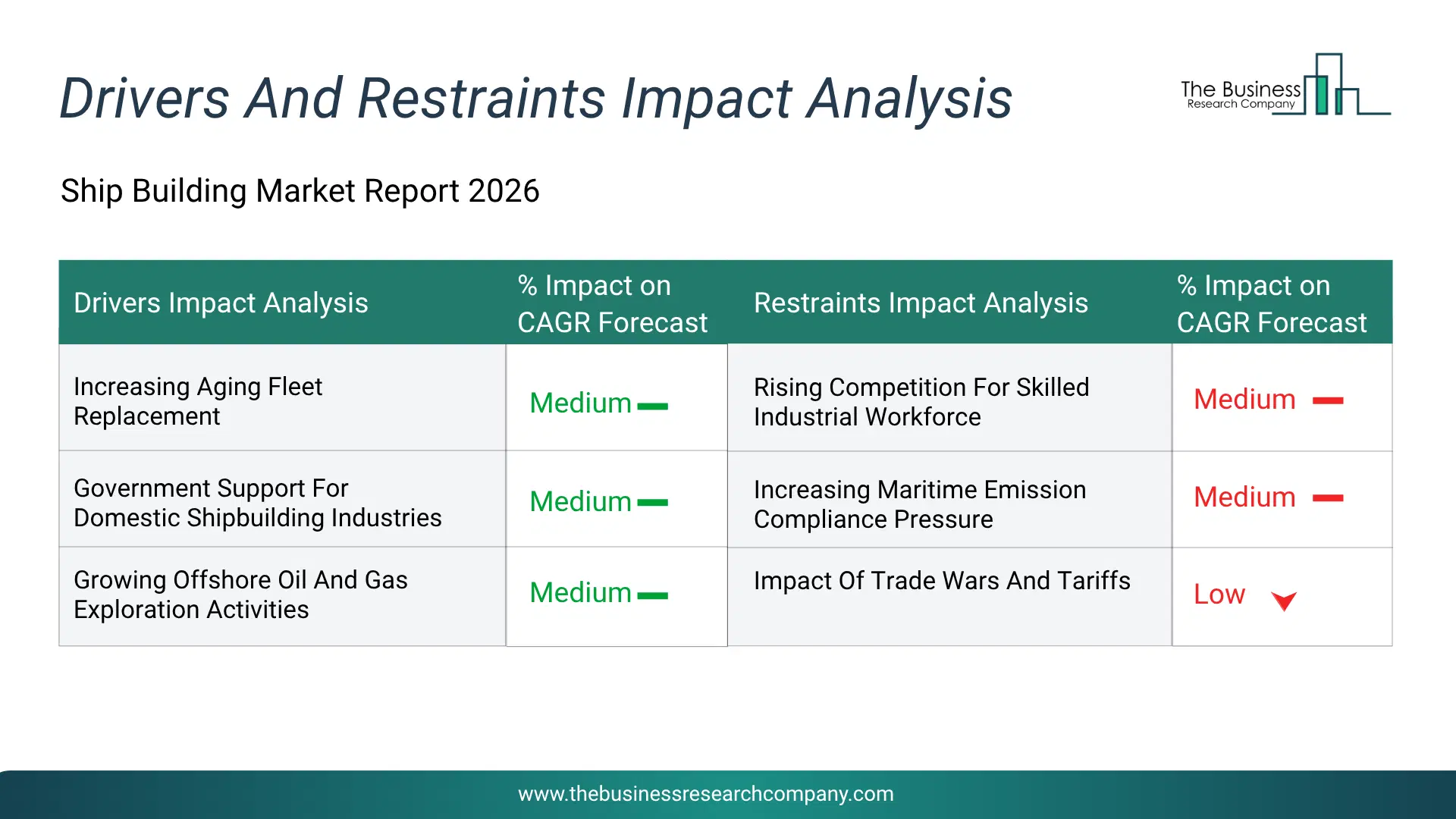
Infographic Chart Showing Key Market Drivers Analysis And Restraints For Ship Building Market
The chart presents an impact analysis of key drivers and restraints, quantifying their relative influence on the market's growth rate and helping assess the balance between growth enablers and limiting factors. This chart offers a high-level perspective; the full report contains more detailed insights.
How Will The Drivers Impact Growth In The Global Ship Building Market?
• Increasing Aging Fleet Replacement (Medium) – The increasing aging fleet replacement will become a key driver of growth in the ship building market by 2030. As global maritime fleets continue to age, shipowners and operators are increasingly facing higher maintenance costs, operational inefficiencies and safety risks associated with older vessels. Aging fleets typically refer to ships that have been in service for extended periods, often exceeding 20–25 years and are more prone to mechanical failures, structural deterioration and compliance challenges with modern safety and environmental regulations. The growing number of vessels approaching the later stages of their operational lifecycle is increasing pressure on fleet operators to modernize their fleets; maritime industry stakeholders are continuously evaluating fleet renewal strategies and adopting newly built vessels that align with evolving regulatory standards and operational requirements, reflecting the broader transition toward safer and more efficient maritime transportation. This increasing emphasis on replacing aging vessels is supporting demand for new ship construction. As a result, the increasing aging fleet replacement is anticipated to contributing to a 1.5% annual growth in the market. • Government Support For Domestic Shipbuilding Industries (Medium) – The government support for domestic ship building industries will emerge as a major factor driving the expansion of the ship building market by 2030. As global maritime trade and strategic supply chain security become increasingly important, governments across multiple economies are introducing financial incentives, subsidies and industrial policies aimed at strengthening their domestic shipbuilding capabilities. These support measures include direct funding, tax incentives, export credits and preferential procurement policies designed to enhance shipyard capacity, encourage technological development and improve global competitiveness. The growing focus on national maritime infrastructure and industrial self-reliance is encouraging shipbuilders to expand production capabilities and invest in modern ship construction technologies. This rising level of public investment and policy support is enabling shipbuilders to increase production capacity, stimulate innovation and strengthen local maritime supply chains. Consequently, the government support for domestic ship building industries is projected to contributing to a 1.3% annual growth in the market. • Growing Offshore Oil And Gas Exploration Activities (Medium) – The growing offshore oil and gas exploration activities will serve as a key growth catalyst for the ship building market by 2030. As global energy demand rises and exploration activities expand into deepwater regions, the demand for specialized vessels used in offshore operations is increasing. Offshore exploration requires various support ships, including platform supply vessels and anchor handling tug supply vessels, to transport equipment, materials and personnel to offshore drilling sites. The increasing investments in offshore drilling projects and the discovery of new hydrocarbon reserves are encouraging energy companies to expand their offshore fleets. This rise in offshore energy exploration is supporting the demand for new vessel construction and upgrades. Therefore, this growing offshore oil and gas exploration activities is projected to supporting to a 1.0% annual growth in the market. • Increasing Naval Defense Procurement And Fleet Expansion (Low) – The increasing naval defense procurement and fleet expansion will become a significant driver contributing to the growth of the ship building market by 2030. As geopolitical tensions and maritime security concerns continue to rise, governments across various regions are increasing investments in naval capabilities to strengthen maritime defense and protect critical sea routes. The expansion of naval fleets involves the procurement of new warships, submarines and support vessels that enhance operational readiness and maritime surveillance capabilities. The rising focus on modernizing aging naval assets and expanding combat fleets is encouraging defense agencies to invest in advanced shipbuilding programs capable of delivering technologically sophisticated vessels with improved combat systems, propulsion technologies and mission versatility. This sustained rise in naval defense spending and fleet expansion programs is supporting the increasing demand for advanced vessel construction. Consequently, the increasing naval defense procurement and fleet expansion is projected to contributing to a 0.5% annual growth in the market.How Will The Restraints Impact Growth In The Global Ship Building Market?
• Rising Competition For Skilled Industrial Workforce (Medium) – Rising competition for skilled industrial workforce is expected to restrain market growth during the forecast period. It creates operational, financial, regulatory, or commercial challenges that can increase costs, delay projects, reduce investments, or discourage purchasing decisions depending on the market. These challenges can reduce product adoption, affect business confidence, and limit the ability of companies to expand efficiently across key regions. This can disrupt long-term growth strategies and reduce the ability of companies to capitalize on emerging market opportunities. • Increasing Maritime Emission Compliance Pressure (Medium) – During the forecast period, increasing maritime emission compliance pressure is likely to limit market expansion. It creates operational, financial, regulatory, or commercial challenges that can increase costs, delay projects, reduce investments, or discourage purchasing decisions depending on the market. These challenges can reduce product adoption, affect business confidence, and limit the ability of companies to expand efficiently across key regions. As a result, organizations may postpone purchasing decisions, limiting demand across both established and emerging markets. • Impact Of Trade Wars And Tariffs (Medium) – The market is expected to face challenges due to impact of trade wars and tariffs over the forecast period. It creates operational, financial, regulatory, or commercial challenges that can increase costs, delay projects, reduce investments, or discourage purchasing decisions depending on the market. These challenges can reduce product adoption, affect business confidence, and limit the ability of companies to expand efficiently across key regions. This may reduce production efficiency, extend project timelines, and create challenges in meeting evolving customer requirements.Key Players In The Global Ship Building Market
Major companies operating in the ship building market report include Korea Shipbuilding & Offshore Engineering Co. Ltd, Samsung Heavy Industries, Fincantieri S.p.A., Daewoo Shipbuilding & Marine Engineering Co Ltd, Imabari Shipbuilding Co. Ltd, Yangzijiang Shipbuilding Ltd, CSSC Offshore and Marine Engineering Group Company Limited, Mitsubishi Heavy Industries, United Shipbuilding Corporation, Tsuneishi Shipbuilding, Cochin Shipyard Limited, Western India Shipyard, Hindustan Shipyard Ltd, Adani Kattupalli Shipyard (Larsen & Toubro), Shanghai Waigaoqiao Shipbuilding Co., Ltd, China Shipbuilding Industry Co., Ltd, Amur Shipbuilding Plant, Vyborg Shipyard JSC, Zvezda Shipbuilding (SSK), JSC Okskaya Shipyard, Fosen Yard Emden GmbH, Monterey Boats, Bertram Yachts, Back Cove Yachts, Crestliner Boats, Master Boat Builders, Inc., Flexboat Năutica, OKEAN YACHTS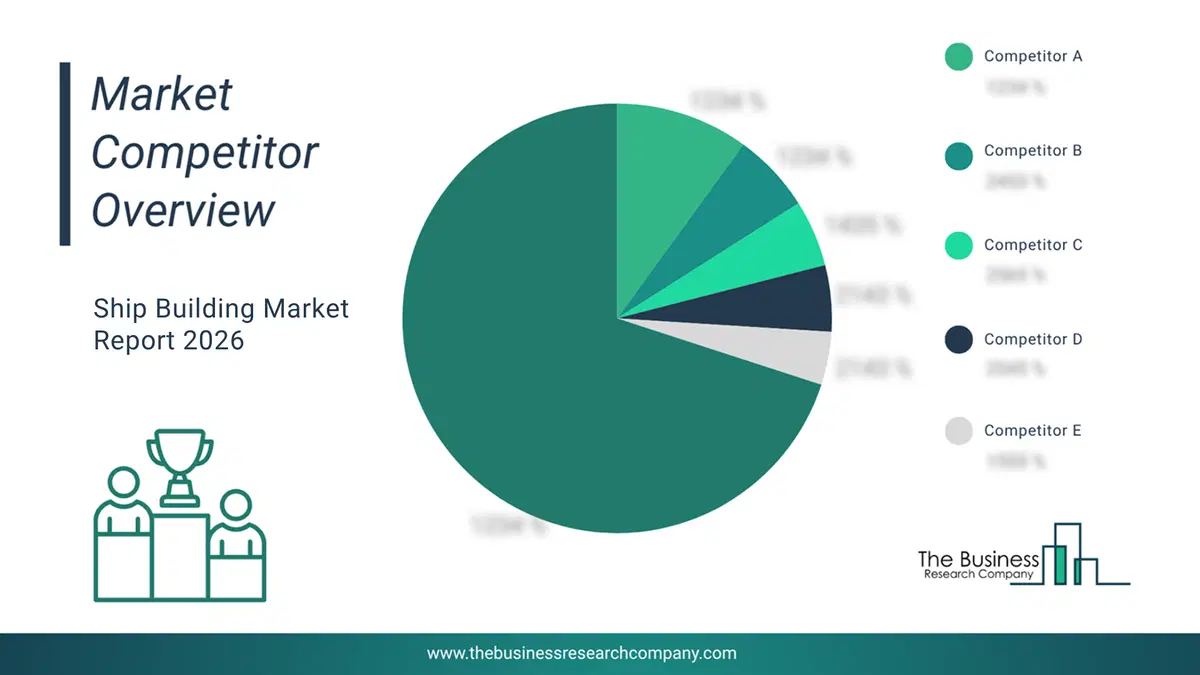
This chart is for illustrative purposes; the full report includes a detailed competitor analysis and comprehensive overview of the top 10 companies in the market.
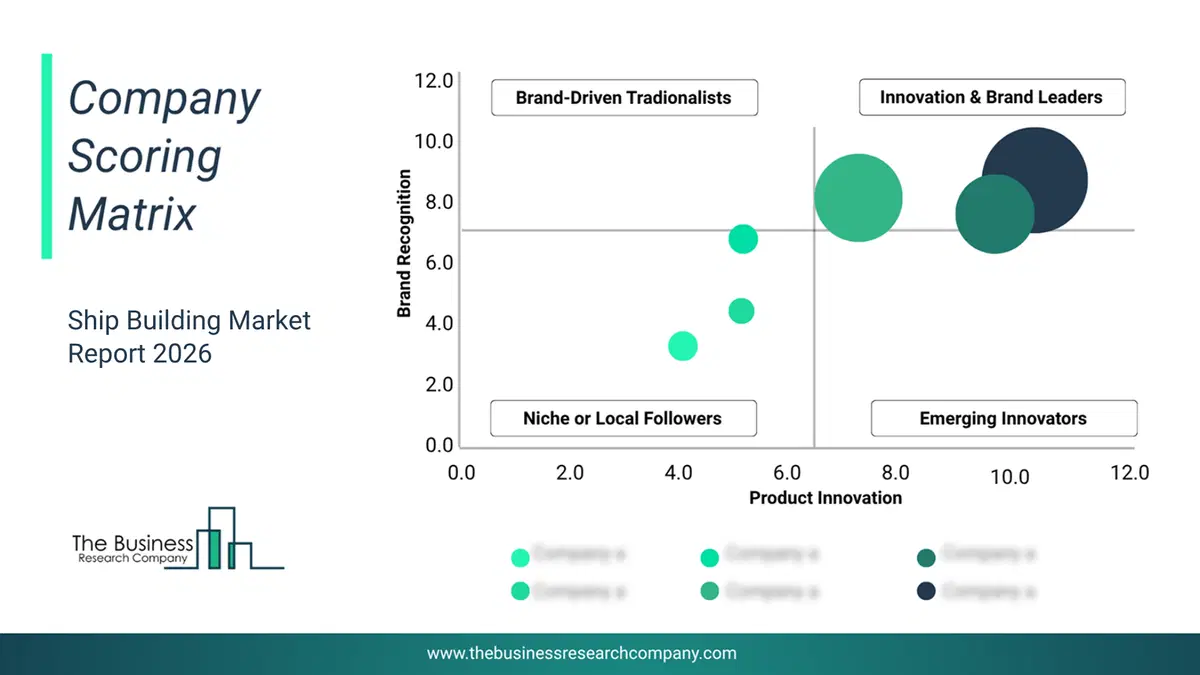
This chart maps companies by product innovation and brand strength, with bubble size indicating relative revenue, helping identify market leaders, challengers, and niche players. This is an illustrative chart; the full report provides a complete and accurate competitive analysis.
Global Ship Building Market Trends and Insights
Major companies operating in the shipbuilding and repairing market are developing new products, such as the green container ships to meet larger customer bases, more sales, and increased revenue. Green container ships are vessels that are designed to reduce their environmental impact and carbon footprint. For instance, in April 2023, Maersk A/S, a Denmark-based shipping company, launched a green methanol-powered container ship. The product's distinguishing feature is that it is a feeder ship with a 2,100 TEU capacity, the first of nineteen carbon-neutral vessels that will run on green methanol fuel. Maersk has been busy securing suppliers to supply the roughly 1 million metric tons of green methanol fuel per year that the vessels will need to power its methanol-fueled fleet. Compared to ships that use conventional fuel, this will prevent the atmospheric emissions of around 2.3 million metric tons of CO2 per year.What Are Latest Mergers And Acquisitions In The Ship Building Market?
In February 2025, Maersk, a Denmark-based shipping and logistics company, partnered with Cochin Shipyard Limited (CSL) to explore ship repair and shipbuilding activities. Through this partnership, Maersk aims to enhance maritime capabilities and promote local shipbuilding and maintenance expertise by leveraging CSL’s advanced infrastructure and experience in constructing and servicing vessels, thereby supporting efficient and high-quality shipbuilding and repair operations. Cochin Shipyard Limited is an India-based shipbuilding and maintenance company specializing in constructing and servicing both commercial and defense ships.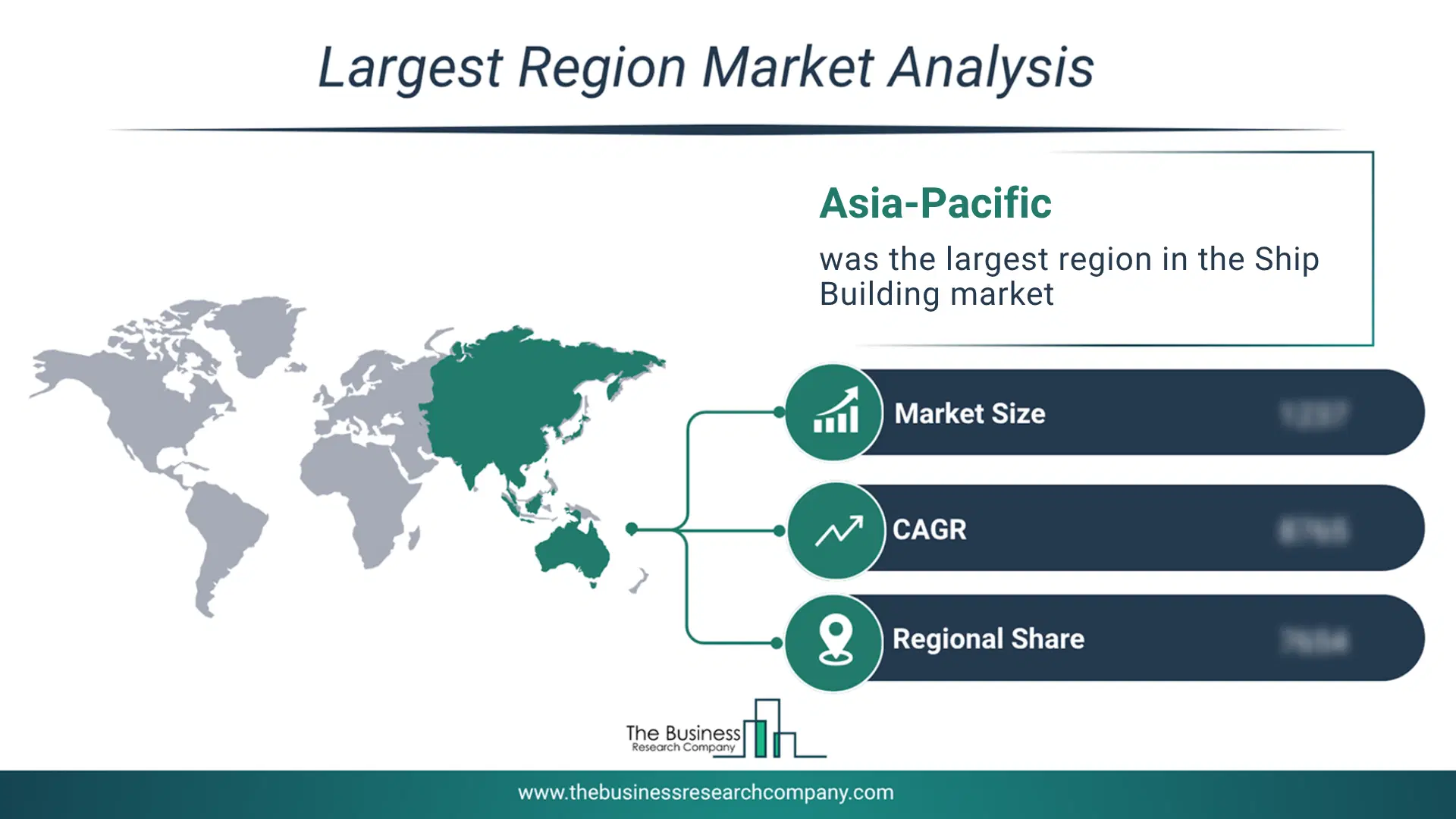
Regional Outlook
Asia-Pacific was the largest region in the shipbuilding market in 2025. Western Europe was the second largest market in global shipbuilding market share. The regions covered in this market report include Asia-Pacific, South East Asia, Western Europe, Eastern Europe, North America, South America, Middle East, Africa. The countries covered in this market report include Australia, Brazil, China, France, Germany, India, Indonesia, Japan, Taiwan, Russia, South Korea, UK, USA, Canada, Italy, SpainWhat Defines the Ship Building Market?
The shipbuilding market include revenues earned by entities by construction of ships, conversion, and alteration. The market value includes the value of related goods sold by the service provider or included within the service offering. Only goods and services traded between entities or sold to end consumers are included.How is Market Value Defined and Measured?
The market value is defined as the revenues that enterprises gain from the sale of goods and/or services within the specified market and geography through sales, grants, or donations in terms of the currency (in USD unless otherwise specified). The revenues for a specified geography are consumption values that are revenues generated by organizations in the specified geography within the market, irrespective of where they are produced. It does not include revenues from resales along the supply chain, either further along the supply chain or as part of other products.
This chart presents market attractiveness based on a quantitative evaluation of growth, competition, strategic alignment, and risk, offering a clear view of opportunity areas for decision-making. This chart is for illustrative purposes; the full report contains the complete analysis.

This chart highlights the Total Addressable Market (TAM) by estimating the maximum revenue opportunity using an assumption-driven approach, supporting strategic planning and opportunity sizing across markets. The chart is illustrative; the full report provides a more comprehensive analysis.
What Key Data and Analysis Are Included in the Ship Building Market Report 2026?
The ship building market research report is one of a series of new reports from The Business Research Company that provides market statistics, including industry global market size, regional shares, competitors with the market share, detailed market segments, market trends and opportunities, and any further data you may need to thrive in the ship building industry. The market research report delivers a complete perspective of everything you need, with an in-depth analysis of the current and future state of the industry.Ship Building Market Report Forecast Analysis
| Report Attribute | Details |
|---|---|
| Market Size Value In 2026 | $217.92 billion |
| Revenue Forecast In 2035 | $275.09 billion |
| Growth Rate | CAGR of 5.3% from 2026 to 2035 |
| Base Year For Estimation | 2025 |
| Actual Estimates/Historical Data | 2020-2025 |
| Forecast Period | 2026 - 2030 - 2035 |
| Market Representation | Revenue in USD Billion and CAGR from 2026 to 2035 |
| Segments Covered | Product, Application, End-User |
| Regional Scope | Asia-Pacific, Western Europe, Eastern Europe, North America, South America, Middle East, Africa |
| Country Scope | The countries covered in the report are Australia, Brazil, China, France, Germany, India, ... |
| Key Companies Profiled | Korea Shipbuilding & Offshore Engineering Co. Ltd, Samsung Heavy Industries, Fincantieri S.p.A., Daewoo Shipbuilding & Marine Engineering Co Ltd, Imabari Shipbuilding Co. Ltd, Yangzijiang Shipbuilding Ltd, CSSC Offshore and Marine Engineering Group Company Limited, Mitsubishi Heavy Industries, United Shipbuilding Corporation, Tsuneishi Shipbuilding, Cochin Shipyard Limited, Western India Shipyard, Hindustan Shipyard Ltd, Adani Kattupalli Shipyard (Larsen & Toubro), Shanghai Waigaoqiao Shipbuilding Co., Ltd, China Shipbuilding Industry Co., Ltd, Amur Shipbuilding Plant, Vyborg Shipyard JSC, Zvezda Shipbuilding (SSK), JSC Okskaya Shipyard, Fosen Yard Emden GmbH, Monterey Boats, Bertram Yachts, Back Cove Yachts, Crestliner Boats, Master Boat Builders, Inc., Flexboat Năutica, OKEAN YACHTS |
| Customization Scope | Request for Customization |
| Pricing And Purchase Options | Explore Purchase Options |