
Ship Repairing Market Report 2026
Global Outlook – By Vessel Type (General Cargo Ships, Bulk Cargo Carrier, Crude Oil Tankers, Chemical Tankers, Container Ships, Liquefied Natural Gas Tankers, Navy And Passenger Ships, Other Vessels), By Application (General Services, Dockage, Hull Part, Engine Parts, Electric Works, Auxiliary Services), By End-User (Transport Companies, Military, Other End-Users) – Market Size, Trends, Strategies, and Forecast to 2030
Ship Repairing Market Overview
• Ship Repairing market size has reached to $38.45 billion in 2025 • Expected to grow to $58.77 billion in 2030 at a compound annual growth rate (CAGR) of 9.1% • Growth Driver: Increase In Seaborne Trade Fueling The Growth Of The Market Due To Rising Global Cargo Demand • Market Trend: Cochin Shipyard Limited Expands Global Footprint With Launch Of New Ship Repair Operations At ISRF In Kochi • Asia-Pacific was the largest region in 2025 and Western Europe is the fastest growing region.What Is Covered Under Ship Repairing Market?
Ship repairing is the process of fixing, maintaining, and improving ships to keep them in operational condition. This includes tasks like repairing the hull, overhauling engines and machinery, upgrading systems, and resolving structural or operational problems that develop due to wear and tear or damage. Regular ship repairs help to extend the life of vessels, ensure safety, and meet regulatory standards. The main types in the ship repairing market are oil and chemical tankers, bulk carriers, general cargo, container ships, gas carriers, offshore vessels, passenger ships, ferries, mega yachts, and other vessels. Oil and chemical tankers refer to the tankers that provide oil on ships and are transported. The various applications include general services, dockage, hull parts, engine parts, electric works, auxiliary services. The various end-users are transport companies, the military, and other end-users.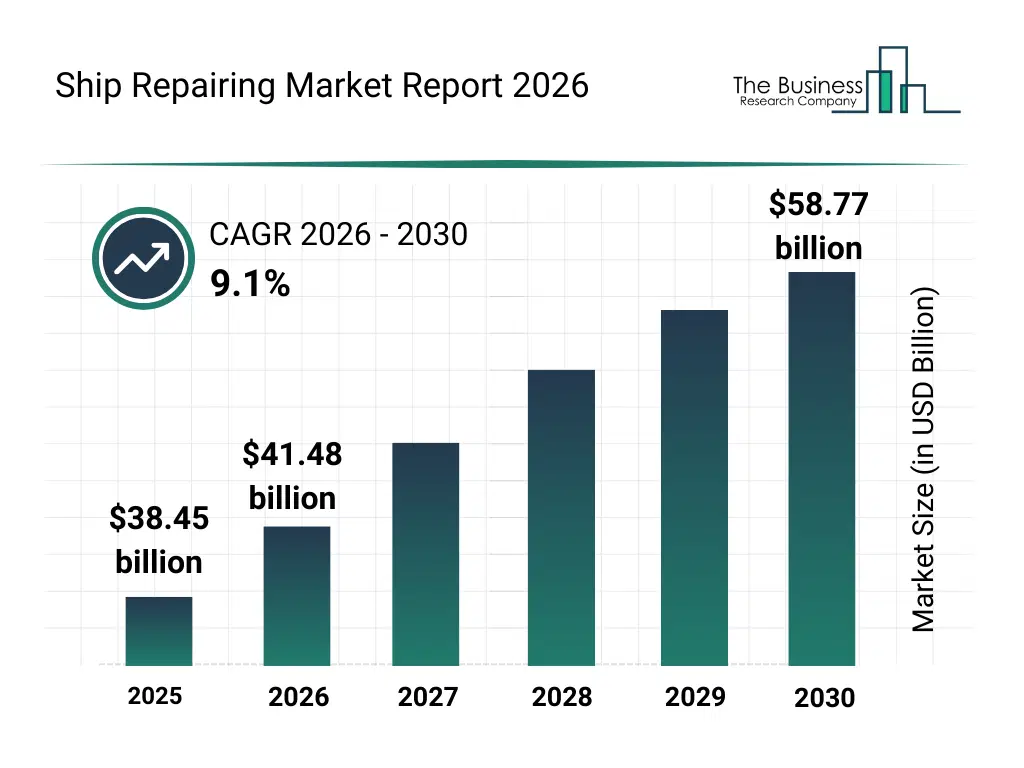
What Is The Ship Repairing Market Size and Share 2026?
The ship repairing market size has grown strongly in recent years. It will grow from $38.45 billion in 2025 to $41.48 billion in 2026 at a compound annual growth rate (CAGR) of 7.9%. The growth in the historic period can be attributed to growth of global shipping operations, aging commercial and naval fleets, rising frequency of vessel maintenance cycles, expansion of maritime trade routes, availability of global repair dock networks.What Is The Ship Repairing Market Growth Forecast?
The ship repairing market size is expected to see strong growth in the next few years. It will grow to $58.77 billion in 2030 at a compound annual growth rate (CAGR) of 9.1%. The growth in the forecast period can be attributed to increasing investments in advanced repair technologies, rising demand for quick turnaround repair services, expansion of offshore vessel maintenance, growing adoption of remote diagnostics, increasing regulatory compliance requirements. Major trends in the forecast period include increasing adoption of condition-based maintenance practices, rising demand for engine and hull repair services, growing use of digital inspection tools, expansion of emergency repair capabilities, enhanced focus on safety standards.
Global Ship Repairing Market Segmentation
1) By Vessel Type: General Cargo Ships, Bulk Cargo Carrier, Crude Oil Tankers, Chemical Tankers, Container Ships, Liquefied Natural Gas Tankers, Navy And Passenger Ships, Other Vessels 2) By Application: General Services, Dockage, Hull Part, Engine Parts, Electric Works, Auxiliary Services 3) By End-User: Transport Companies, Military, Other End-Users Subsegments: 1) By General Cargo Ships: Multi-Purpose Vessels, Roll-On/Roll-Off (RoRo) Ships 2) By Bulk Cargo Carriers: Dry Bulk Carriers, Specialized Bulk Carriers 3) By Crude Oil Tankers: Very Large Crude Carriers (VLCCs), Suezmax And Aframax Tankers 4) By Chemical Tankers: Stainless Steel Tankers, Coated Tankers For Hazardous Materials 5) By Container Ships: Feeder, Panamax, And Post-Panamax Container Vessels 6) By Liquefied Natural Gas (LNG) Tankers: Conventional LNG Carriers, Membrane-Type LNG Carriers 7) By Navy And Passenger Ships: Naval Vessels, Cruise Ships And Ferries 8) By Other Vessels: Fishing Vessels, Offshore Support Vessels, Research And Survey VesselsWhat Is The Driver Of The Ship Repairing Market?
The increasing seaborne trade is expected to propel the growth of the ship repairing market going forward. Seaborne trade refers to the transportation of goods and commodities by sea, representing the backbone of international commerce, as it enables large-scale, cost-efficient movement of raw materials, energy resources, and manufactured products across global supply chains. The rise in seaborne trade is being driven by expanding global consumption, industrial output, and energy demand, which require a larger and more modern fleet to handle increasing cargo volumes. This growth in maritime transport directly boosts the need for new vessels and fleet expansion, supporting the expansion of the shipbuilding sector. For instance, in October 2024, according to the Review of Maritime Transport 2024, published by the United Nations Conference on Trade and Development (UNCTAD), a Switzerland-based intergovernmental organization, global seaborne trade reached 12,292 million tons in 2023, a 2.4% increase over 2022, reversing the earlier decline. Therefore, the increasing seaborne trade is driving the growth of the ship repairing industry.Key Players In The Global Ship Repairing Market
Major companies operating in the ship repairing market report include Fincantieri S.p.A., United Shipbuilding Corporation, Sembcorp Marine Ltd, China Shipbuilding Industry Corporation, Imabari Shipbuilding Co. Ltd., Hyundai Mipo Dockyard Co. Ltd., Damen Shipyards Group, Cochin Shipyard Limited, Hanjin Heavy Industries And Construction, Arab Shipbuilding and Repair Yard, Hindustan Shipyard Limited, Garden Reach Shipbuilders and Engineers, Mitsubishi Heavy Industries, Yangzijiang Shipbuilding (Holdings) Ltd., New Times Shipbuilding Co. Ltd., Daewoo Shipbuilding & Marine Engineering Co. Ltd (DSME), Tsuneishi Holdings, Naval Yards Kiel GmbH, Lloyd Werft Bremerhaven, Neptune Werft GmbH, Schiffswerft Hermann Barthel GmbH, Meyer Werft, Limited Liability Company Fesco Integrated Transport, Remontowa, Seatech Engineering, General Dynamics Corporation, International Ship Repair and Marine Services Inc., GMD Shipyard Corp., Irving Shipbuilding Inc., Victoria Shipyards, BAE Systems, Lyon Shipyard, Gulf Copper, Astillero Nacional, Servicios Industriales De La Marine S.A., Estaleiros sermetal ltd, Enavi & Renave, Caribbean Drydock Company, Damex Shipbuilding & Engineering, ShipTech, Dammam Shipyard, Zamil Offshore, Israel Shipyards Ltd., Gemak Group of Companies, Sefine Shipyard, Kuzey Star Shipyard, Desan Shipyard, Southern African Shipyards, Dormac Marine & Engineering, Southern Engineering Co. Ltd., West Atlantic Shipyard, Nigerdock FZE
This chart is for illustrative purposes; the full report includes a detailed competitor analysis and comprehensive overview of the top 10 companies in the market.
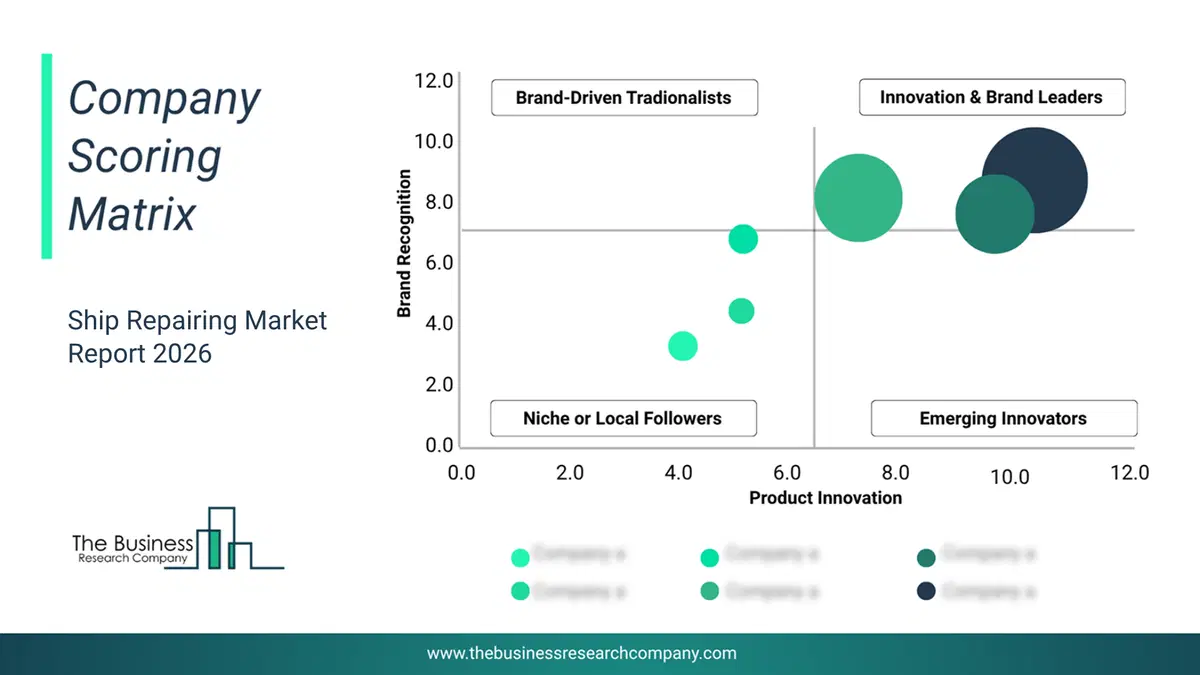
This chart maps companies by product innovation and brand strength, with bubble size indicating relative revenue, helping identify market leaders, challengers, and niche players. This is an illustrative chart; the full report provides a complete and accurate competitive analysis.
Global Ship Repairing Market Trends and Insights
Major companies in the ship repairing market are focusing on developing innovative solutions such as integrated smart docking optimization systems (ISDOS) to enhance repair efficiency, reduce vessel turnaround time, and improve workflow transparency across complex shipyard operations. Integrated smart docking optimization systems (ISDOS) refer to advanced, digitally enabled platforms that leverage artificial intelligence, internet of things (IoT) sensors, and predictive analytics to streamline dock planning, automate condition assessments, and optimize resource allocation during repair and maintenance activities. For instance, in August 2024, Cochin Shipyard Limited (CSL), an India-based shipbuilding and repair company, launched its commercial operation at the newly established International Ship Repair Facility (ISRF) in Kochi, and has successfully docked the HSC Parali, a vessel belonging to the Lakshadweep Administration. The Kerala state-owned shipyard is keen to position itself as a global center for ship repairs, catering to both commercial vessels and naval/military ships.What Are Latest Mergers And Acquisitions In The Ship Repairing Market?
In February 2023, Lone Star Funds, a US-based private equity company, acquired Titan Acquisition Holdings for an undisclosed amount. Through the acquisition, Titan and its operating companies will maintain their steadfast commitment to their core values and unwavering focus on safety, compliance, quality, customer satisfaction, and competitiveness. Titan Acquisition Holdings is a US-based ship-repairing company.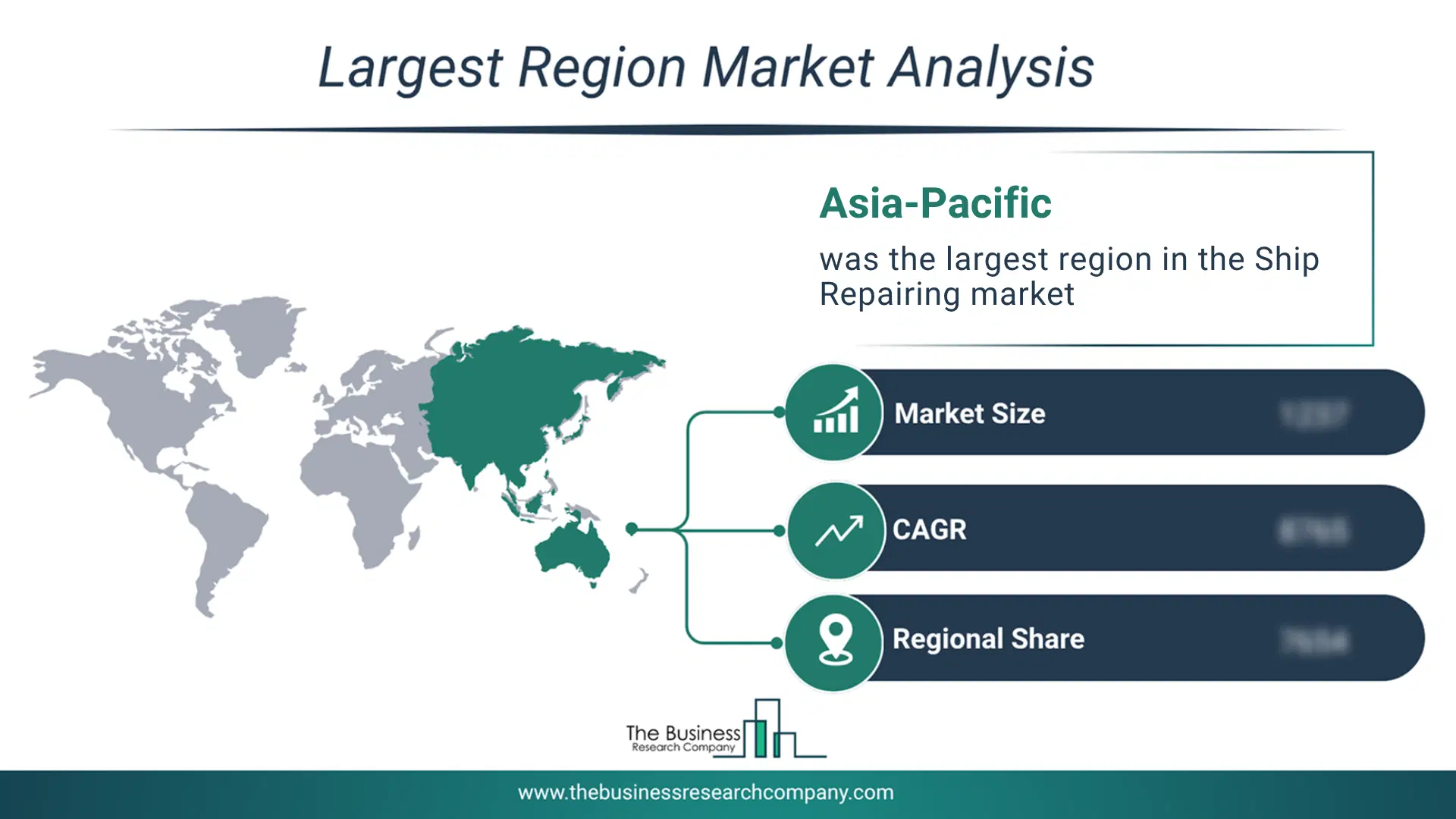
Regional Outlook
Asia-Pacific was the largest region in the global ship repairing market in 2025. Western Europe was the second largest market in the global ship repairing market share. The regions covered in this market report include Asia-Pacific, South East Asia, Western Europe, Eastern Europe, North America, South America, Middle East, Africa. The countries covered in this market report include Australia, Brazil, China, France, Germany, India, Indonesia, Japan, Taiwan, Russia, South Korea, UK, USA, Canada, Italy, SpainWhat Defines the Ship Repairing Market?
The ship repairing market include revenues earned by entities by repairing of ships, conversion, and alteration. The market value includes the value of related goods sold by the service provider or included within the service offering. Only goods and services traded between entities or sold to end consumers are included.How is Market Value Defined and Measured?
The market value is defined as the revenues that enterprises gain from the sale of goods and/or services within the specified market and geography through sales, grants, or donations in terms of the currency (in USD unless otherwise specified). The revenues for a specified geography are consumption values that are revenues generated by organizations in the specified geography within the market, irrespective of where they are produced. It does not include revenues from resales along the supply chain, either further along the supply chain or as part of other products.
This chart presents market attractiveness based on a quantitative evaluation of growth, competition, strategic alignment, and risk, offering a clear view of opportunity areas for decision-making. This chart is for illustrative purposes; the full report contains the complete analysis.

This chart highlights the Total Addressable Market (TAM) by estimating the maximum revenue opportunity using an assumption-driven approach, supporting strategic planning and opportunity sizing across markets. The chart is illustrative; the full report provides a more comprehensive analysis.
What Key Data and Analysis Are Included in the Ship Repairing Market Report 2026?
The ship repairing market research report is one of a series of new reports from The Business Research Company that provides market statistics, including industry global market size, regional shares, competitors with the market share, detailed market segments, market trends and opportunities, and any further data you may need to thrive in the ship repairing industry. The market research report delivers a complete perspective of everything you need, with an in-depth analysis of the current and future state of the industry.Ship Repairing Market Report Forecast Analysis
| Report Attribute | Details |
|---|---|
| Market Size Value In 2026 | $41.48 billion |
| Revenue Forecast In 2030 | $58.77 billion |
| Growth Rate | CAGR of 7.9% from 2026 to 2030 |
| Base Year For Estimation | 2025 |
| Actual Estimates/Historical Data | 2020-2025 |
| Forecast Period | 2026 - 2030 - 2030 |
| Market Representation | Revenue in USD Billion and CAGR from 2026 to 2030 |
| Segments Covered | Vessel Type, Application, End-User |
| Regional Scope | Asia-Pacific, Western Europe, Eastern Europe, North America, South America, Middle East, Africa |
| Country Scope | The countries covered in the report are Australia, Brazil, China, France, Germany, India, Indonesia, Japan, Taiwan, Russia, South Korea, UK, USA, Canada, Italy, Spain. |
| Key Companies Profiled | Fincantieri S.p.A., United Shipbuilding Corporation, Sembcorp Marine Ltd, China Shipbuilding Industry Corporation, Imabari Shipbuilding Co. Ltd., Hyundai Mipo Dockyard Co. Ltd., Damen Shipyards Group, Cochin Shipyard Limited, Hanjin Heavy Industries And Construction, Arab Shipbuilding and Repair Yard, Hindustan Shipyard Limited, Garden Reach Shipbuilders and Engineers, Mitsubishi Heavy Industries, Yangzijiang Shipbuilding (Holdings) Ltd., New Times Shipbuilding Co. Ltd., Daewoo Shipbuilding & Marine Engineering Co. Ltd (DSME), Tsuneishi Holdings, Naval Yards Kiel GmbH, Lloyd Werft Bremerhaven, Neptune Werft GmbH, Schiffswerft Hermann Barthel GmbH, Meyer Werft, Limited Liability Company Fesco Integrated Transport, Remontowa, Seatech Engineering, General Dynamics Corporation, International Ship Repair and Marine Services Inc., GMD Shipyard Corp., Irving Shipbuilding Inc., Victoria Shipyards, BAE Systems, Lyon Shipyard, Gulf Copper, Astillero Nacional, Servicios Industriales De La Marine S.A., Estaleiros sermetal ltd, Enavi & Renave, Caribbean Drydock Company, Damex Shipbuilding & Engineering, ShipTech, Dammam Shipyard, Zamil Offshore, Israel Shipyards Ltd., Gemak Group of Companies, Sefine Shipyard, Kuzey Star Shipyard, Desan Shipyard, Southern African Shipyards, Dormac Marine & Engineering, Southern Engineering Co. Ltd., West Atlantic Shipyard, Nigerdock FZE |
| Customization Scope | Request for Customization |
| Pricing And Purchase Options | Explore Purchase Options |