
Smart Ferry Electrification Market Report 2026
Global Outlook – By Propulsion Type (Fully Electric; Hybrid Electric), By Ferry Type (Passenger Ferry; Vehicle Ferry; Cargo Ferry; Other Ferry Types), By Battery Type (Lithium-Ion; Lead-Acid; Solid-State; Other Battery Types), By Power Output (Up To 1 Megawatt (MW); 1–5 Megawatt (MW); Above 5 Megawatt (MW)), By End-User (Commercial; Government; Other End-Users) – Market Size, Trends, Strategies, and Forecast to 2030
Smart Ferry Electrification Market Overview
• Smart Ferry Electrification market size has reached to $1.42 billion in 2025 • Expected to grow to $2.8 billion in 2030 at a compound annual growth rate (CAGR) of 14.5% • Growth Driver: The Rising Fuel Prices Are Fueling The Growth Of The Market Due To Increasing Operating Costs Of Traditional Ferries • Market Trend: Advancements In Hybrid-Electric Ferries Boosting Energy Efficiency And Reducing Emissions • Europe was the largest region in 2025 and Asia-Pacific is the fastest growing region.What Is Covered Under Smart Ferry Electrification Market?
Smart ferry electrification involves implementing electric propulsion systems and advanced digital technologies in ferries to minimize or replace reliance on fossil fuels. It combines battery storage, renewable energy integration, and intelligent charging infrastructure to enhance efficiency, reduce emissions, and lower operating costs. This strategy promotes sustainable maritime transport while enhancing both passenger experience and environmental performance. The main types of smart ferry electrification are fully electric and hybrid electric. Fully electric ferries are powered entirely by electric propulsion systems, eliminating the need for conventional fuel and reducing emissions. The ferry types are passenger ferry, vehicle ferry, cargo ferry, and others, and they are available with various battery types, including lithium-ion, lead-acid, solid-state, and others. It provides several powers, such as up to 1 megawatt (MW), 1–5 megawatts (MW), and above 5 megawatts (MW), and is used by different end-users, including commercial, government, and others.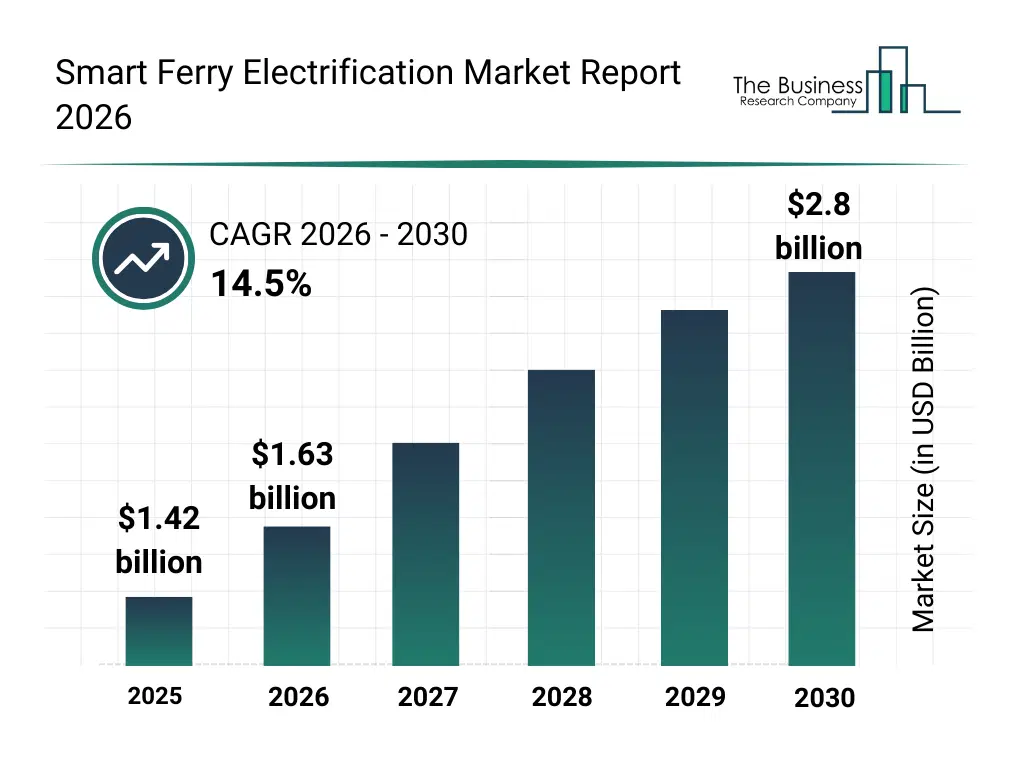
What Is The Smart Ferry Electrification Market Size and Share 2026?
The smart ferry electrification market size has grown rapidly in recent years. It will grow from $1.42 billion in 2025 to $1.63 billion in 2026 at a compound annual growth rate (CAGR) of 14.8%. The growth in the historic period can be attributed to expansion of short-distance ferry routes, early adoption of hybrid electric ferries, rising fuel cost pressures on operators, initial government incentives for electric vessels, development of port-side charging infrastructure.What Is The Smart Ferry Electrification Market Growth Forecast?
The smart ferry electrification market size is expected to see rapid growth in the next few years. It will grow to $2.8 billion in 2030 at a compound annual growth rate (CAGR) of 14.5%. The growth in the forecast period can be attributed to increasing investments in green maritime transport, expansion of battery technology capacity, growing regulatory pressure on maritime emissions, rising deployment of hydrogen fuel cell ferries, increased public funding for smart ferry projects. Major trends in the forecast period include increasing adoption of battery-electric ferry propulsion, expansion of smart charging and energy management systems, growing integration of renewable energy sources, rising deployment of digital fleet monitoring platforms, enhanced focus on zero-emission maritime transport.
Global Smart Ferry Electrification Market Segmentation
1) By Propulsion Type: Fully Electric, Hybrid Electric 2) By Ferry Type: Passenger Ferry, Vehicle Ferry, Cargo Ferry, Other Ferry Types 3) By Battery Type: Lithium-Ion, Lead-Acid, Solid-State, Other Battery Types 4) By Power Output: Up To 1 Megawatt (MW), 1–5 Megawatt (MW), Above 5 Megawatt (MW) 5) By End-User: Commercial, Government, Other End-Users Subsegments: 1) By Fully Electric: Battery Electric, Hydrogen Fuel Cell 2) By Hybrid Electric: Diesel-Electric, Gas-ElectricWhat Is The Driver Of The Smart Ferry Electrification Market?
The rising fuel prices are expected to propel the growth of the smart ferry electrification market going forward. Fuel prices are climbing as global demand for crude oil rises, leading to tighter supply and higher costs, affecting transportation and production efficiency. Rising fuel prices raise the operating costs of traditional ferries, making electric propulsion systems a more cost-effective alternative, which encourages operators to adopt smart ferry electrification to cut fuel use, reduce expenses, and enhance long-term efficiency. For instance, in March 2025, according to the Competition and Markets Authority (CMA), a UK-based government department, in October 2024, petrol averaged 134.4 pence per liter (ppl) and diesel 139.7 pence per liter (ppl), rising by February 2025 to 139.6 pence per liter (ppl) for petrol and 146.8 pence per liter (ppl) for diesel, representing increases of 5.2 pence per liter (ppl) and 7.1 pence per liter (ppl) respectively. Therefore, rising fuel prices are driving the growth of the smart ferry electrification industry.Key Players In The Global Smart Ferry Electrification Market
Major companies operating in the smart ferry electrification market are GE Vernova LLC, ABB Ltd, Mitsubishi Heavy Industries, Ltd., LG Energy Solution Ltd., Rolls-Royce Holdings plc, Nidec Corporation, Danfoss Editron A/S, Fincantieri S.p.A., Kongsberg Gruppen ASA, Damen Shipyards Group, AVL, MAN Energy Solutions SE, Austal Limited, Meyer Werft GmbH & Co. KG, Corvus Energy ASA, Artemis Technologies, Incat Tasmania Pty Ltd, Leclanché SA, EST-Floattech AS, Schottel GmbH.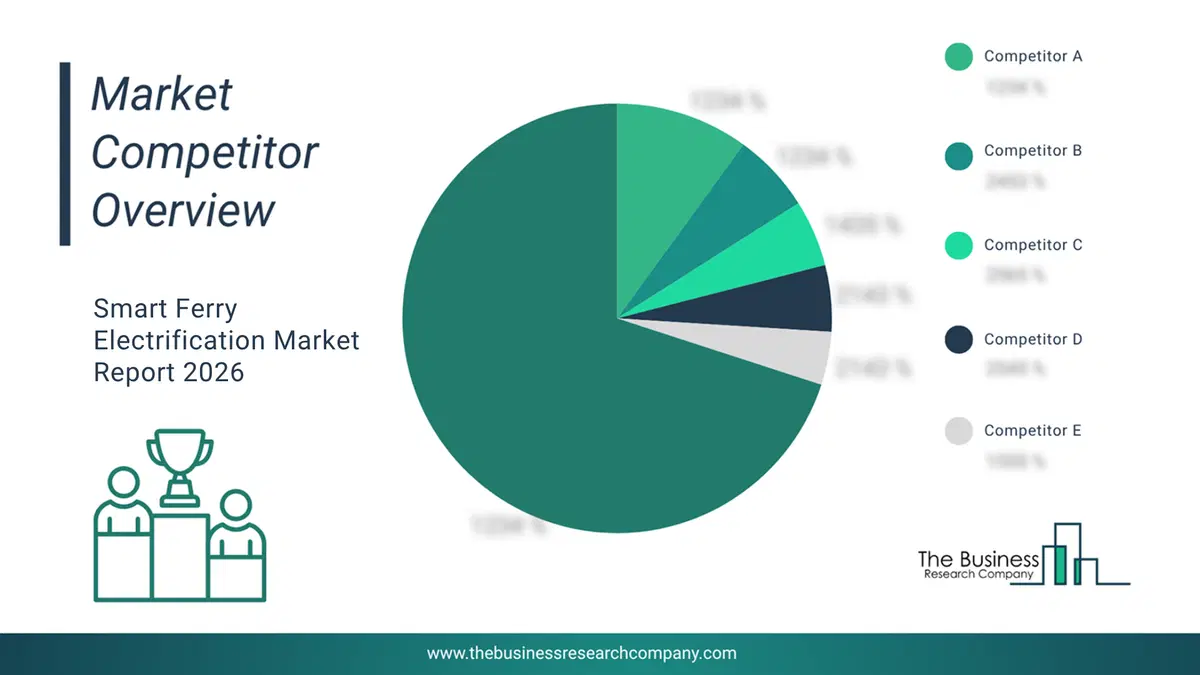
This chart is for illustrative purposes; the full report includes a detailed competitor analysis and comprehensive overview of the top 10 companies in the market.
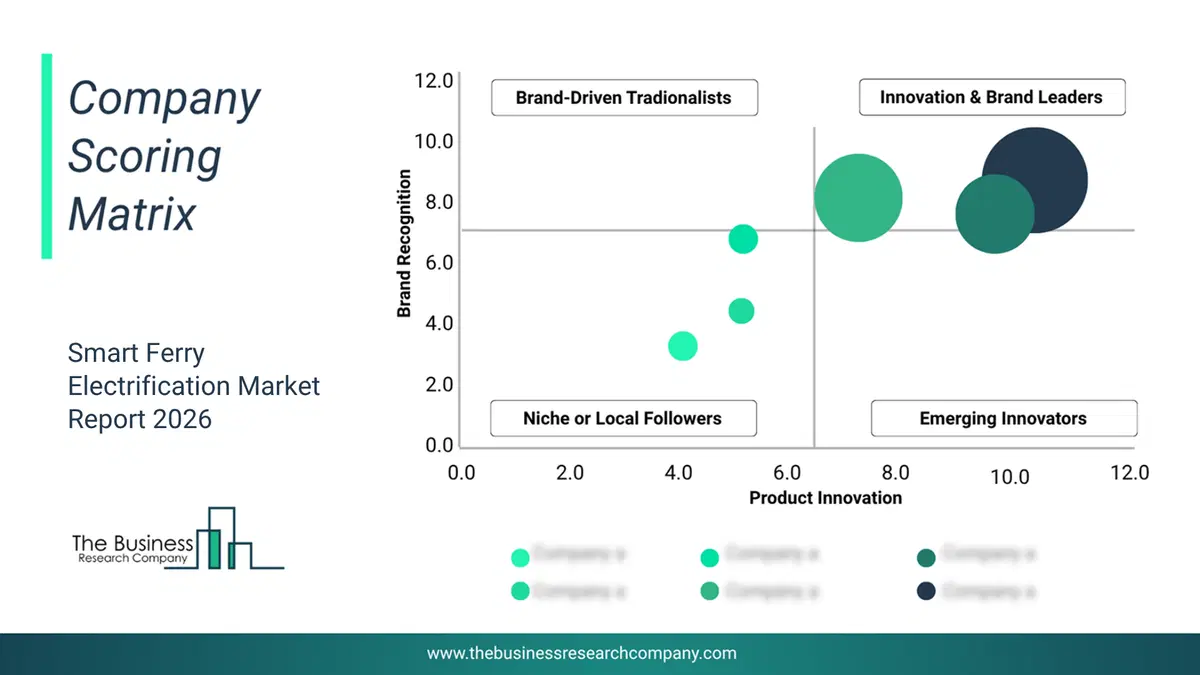
This chart maps companies by product innovation and brand strength, with bubble size indicating relative revenue, helping identify market leaders, challengers, and niche players. This is an illustrative chart; the full report provides a complete and accurate competitive analysis.
Global Smart Ferry Electrification Market Trends and Insights
Major companies operating in the smart ferry electrification market are focusing on developing innovative products, such as the Island-class electric-ready ferry, to enhance energy efficiency, reduce emissions, and improve passenger and vehicle transport capabilities. The Island-class electric-ready ferry is a hybrid-electric vessel designed to operate on battery power that efficiently transports passengers and vehicles while reducing emissions. For instance, in May 2025, Damen Shipyards Galati, a Romania-based shipbuilding company, launched Damen RoRo 8117 E3, a fully electric-ready Island Class ferry for BC Ferries. It is the seventh Damen vessel in BC Ferries' fleet, is battery-equipped and diesel-hybrid, and is designed to carry up to 47 vehicles and 390 passengers. It can operate exclusively on electric power once terminal charging infrastructure is installed, recharging using renewable energy during passenger embarkation and disembarkation. This ferry is part of an order of four such vessels that will serve routes connecting coastal communities in British Columbia, replacing diesel-powered ships with greener, low-emission alternatives.What Are Latest Mergers And Acquisitions In The Smart Ferry Electrification Market?
In October 2025, ABB Ltd., a Switzerland-based technology company, acquired BrightLoop for an undisclosed amount. Through this acquisition, ABB aims to expand its smart ferry electrification solutions and strengthen its presence in sustainable marine transport. BrightLoop is a France-based electronics company that manufactures power converters for the marine industry, transitioning toward hybrid power solutions and electrification.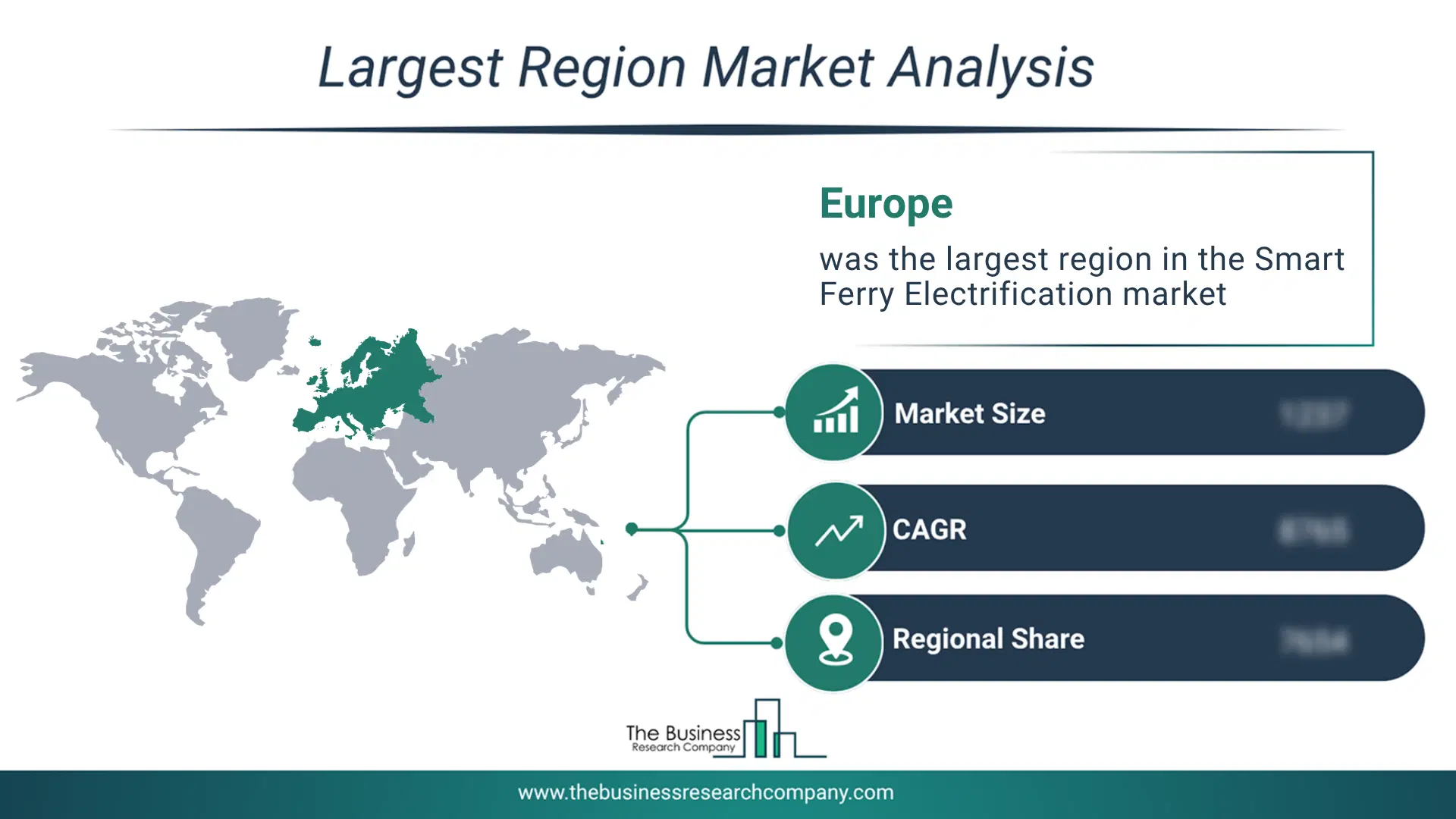
Regional Outlook
Europe was the largest region in the smart ferry electrification market in 2025. Asia-Pacific is expected to be the fastest-growing region in the forecast period. The regions covered in this market report are Asia-Pacific, South East Asia, Western Europe, Eastern Europe, North America, South America, Middle East, Africa. The countries covered in this market report are Australia; Brazil; China; France; Germany; India; Indonesia; Japan; Taiwan; Russia; South Korea; UK; USA; Canada; Italy; Spain.What Defines the Smart Ferry Electrification Market?
The smart ferry electrification market consists of revenues earned by entities by providing services such as battery management and maintenance, route optimization, charging infrastructure management, onboard energy monitoring, and fleet digital integration. The market value includes the value of related goods sold by the service provider or included within the service offering. The smart ferry electrification market also includes sales of battery packs, charging infrastructure, power management units, renewable energy integration hardware, sensors and IoT devices, and communication and navigation equipment. Values in this market are ‘factory gate’ values, that is, the value of goods sold by the manufacturers or creators of the goods, whether to other entities (including downstream manufacturers, wholesalers, distributors, and retailers) or directly to end customers. The value of goods in this market includes related services sold by the creators of the goods.How is Market Value Defined and Measured?
The market value is defined as the revenues that enterprises gain from the sale of goods and/or services within the specified market and geography through sales, grants, or donations in terms of the currency (in USD unless otherwise specified). The revenues for a specified geography are consumption values that are revenues generated by organizations in the specified geography within the market, irrespective of where they are produced. It does not include revenues from resales along the supply chain, either further along the supply chain or as part of other products.
This chart presents market attractiveness based on a quantitative evaluation of growth, competition, strategic alignment, and risk, offering a clear view of opportunity areas for decision-making. This chart is for illustrative purposes; the full report contains the complete analysis.

This chart highlights the Total Addressable Market (TAM) by estimating the maximum revenue opportunity using an assumption-driven approach, supporting strategic planning and opportunity sizing across markets. The chart is illustrative; the full report provides a more comprehensive analysis.
What Key Data and Analysis Are Included in the Smart Ferry Electrification Market Report 2026?
The smart ferry electrification market research report is one of a series of new reports from The Business Research Company that provides market statistics, including Market Report 2026?global market size, regional shares, competitors with the market share, detailed market segments, market trends and opportunities, and any further data you may need to thrive in the smart ferry electrification Market Report 2026? The market research report delivers a complete perspective of everything you need, with an in-depth analysis of the current and future state of the Market Report 2026?Smart Ferry Electrification Market Report Forecast Analysis
| Report Attribute | Details |
|---|---|
| Market Size Value In 2026 | $1.63 billion |
| Revenue Forecast In 2030 | $2.8 billion |
| Growth Rate | CAGR of 14.8% from 2026 to 2030 |
| Base Year For Estimation | 2025 |
| Actual Estimates/Historical Data | 2020-2025 |
| Forecast Period | 2026 - 2030 - 2030 |
| Market Representation | Revenue in USD Billion and CAGR from 2026 to 2030 |
| Segments Covered | Propulsion Type, Ferry Type, Battery Type, Power Output, End-User |
| Regional Scope | Asia-Pacific, Western Europe, Eastern Europe, North America, South America, Middle East, Africa |
| Country Scope | The countries covered in the report are Australia, Brazil, China, France, Germany, India, Indonesia, Japan, Taiwan, Russia, South Korea, UK, USA, Canada, Italy, Spain. |
| Key Companies Profiled | GE Vernova LLC, ABB Ltd, Mitsubishi Heavy Industries, Ltd., LG Energy Solution Ltd., Rolls-Royce Holdings plc, Nidec Corporation, Danfoss Editron A/S, Fincantieri S.p.A., Kongsberg Gruppen ASA, Damen Shipyards Group, AVL, MAN Energy Solutions SE, Austal Limited, Meyer Werft GmbH & Co. KG, Corvus Energy ASA, Artemis Technologies, Incat Tasmania Pty Ltd, Leclanché SA, EST-Floattech AS, Schottel GmbH. |
| Customization Scope | Request for Customization |
| Pricing And Purchase Options | Explore Purchase Options |