
Smart Shopping Cart Market Report 2026
Global Outlook – By Component (Wheels, Handles, Bags, Frames, Scanner, Display, Other Components), By Technology (Barcodes, Radio-Frequency Identification (RFID), Zigbee), By Mode Of Sales (Direct, Distributor), By Application (Supermarket, Shopping Malls, Other Applications) – Market Size, Trends, Strategies, and Forecast to 2030
Smart Shopping Cart Market Overview
• Smart Shopping Cart market size has reached to $2.19 billion in 2025 • Expected to grow to $6.53 billion in 2030 at a compound annual growth rate (CAGR) of 24.3% • Growth Driver: Surge In Retail Sector Drives Growth Of The Smart Shopping Cart Market • Market Trend: In-Store Automation Enhancing Checkout Efficiency And Customer Experience • North America was the largest region in 2025.What Is Covered Under Smart Shopping Cart Market?
A smart shopping cart refers to a technologically enhanced shopping cart designed to improve and modernize the traditional shopping experience. These innovative carts incorporate various technologies and features to enhance efficiency, convenience, and overall customer satisfaction during the shopping process. The main types of components in smart shopping carts are wheels, handles, bags, frames, scanners, displays, and others. A wheel refers to the physical or digital components that enable the cart to move smoothly and efficiently within a store. This includes various technologies, such as barcodes, radio-frequency identification (RFID), and Zigbee, and can be sold through several modes of sales, including direct and distributor. These are used for various applications, such as supermarkets, shopping malls, and others.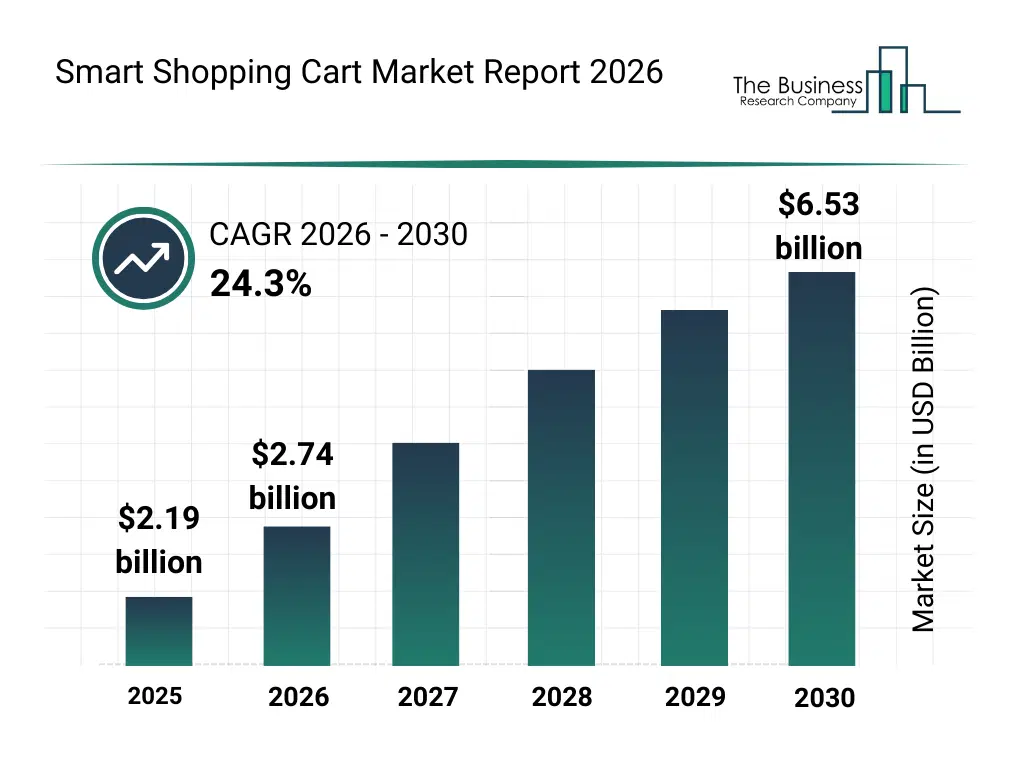
What Is The Smart Shopping Cart Market Size and Share 2026?
The smart shopping cart market size has grown exponentially in recent years. It will grow from $2.19 billion in 2025 to $2.74 billion in 2026 at a compound annual growth rate (CAGR) of 25.0%. The growth in the historic period can be attributed to rising adoption of barcode systems in retail, growing demand for self-checkout convenience, increasing supermarket modernization, high labor costs driving automation, early adoption of digital displays in stores.What Is The Smart Shopping Cart Market Growth Forecast?
The smart shopping cart market size is expected to see exponential growth in the next few years. It will grow to $6.53 billion in 2030 at a compound annual growth rate (CAGR) of 24.3%. The growth in the forecast period can be attributed to integration of AI-powered navigation in carts, expansion of iot-enabled shopping infrastructure, growth of cashless payment adoption, rising demand for personalized shopping experiences, deployment of smart cart fleets in emerging markets. Major trends in the forecast period include cashless payment integration, personalized shopping experience, real-time inventory tracking, enhanced customer analytics, smart cart fleet management.
Global Smart Shopping Cart Market Segmentation
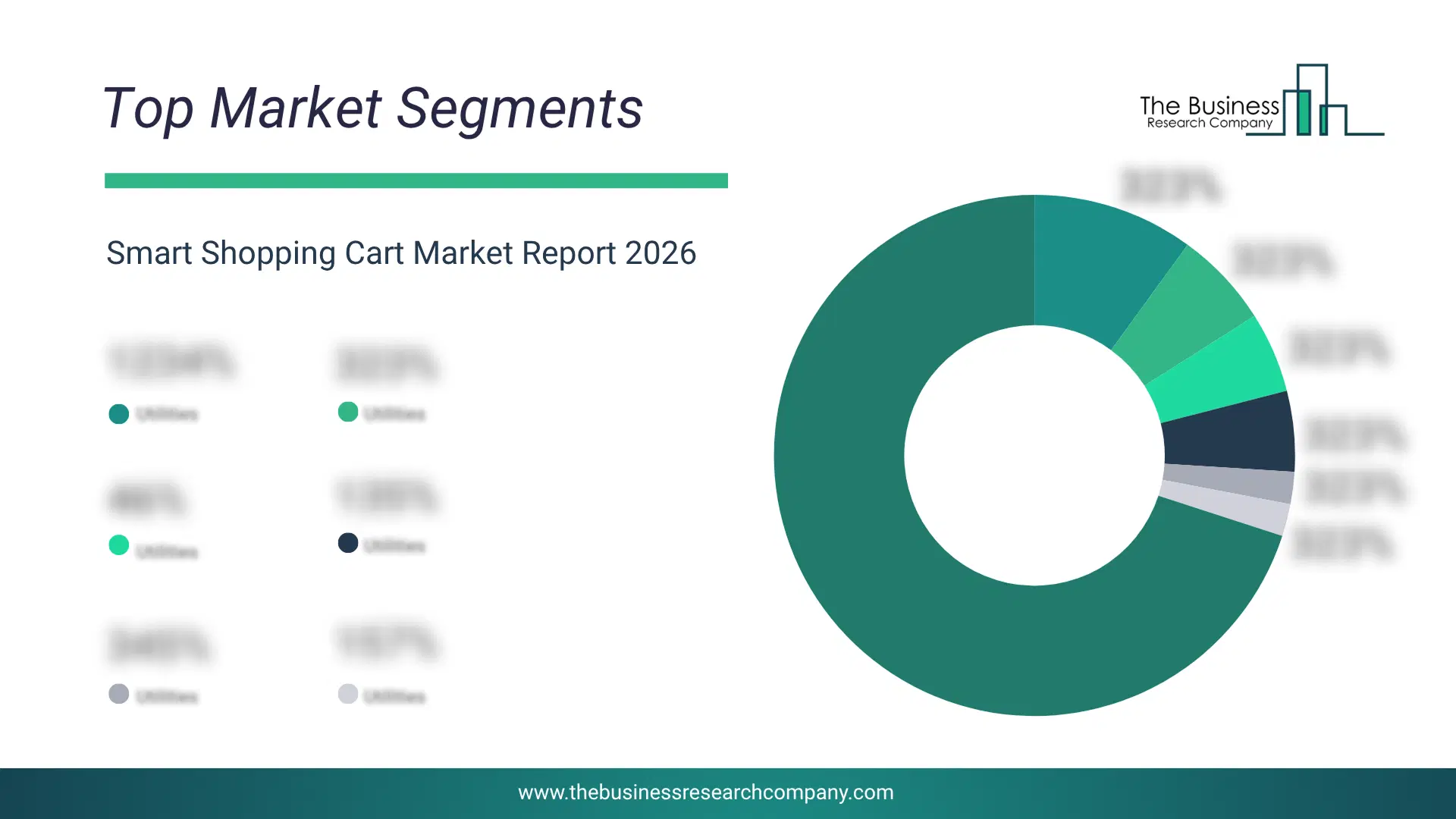
1) By Component: Wheels, Handles, Bags, Frames, Scanner, Display, Other Components 2) By Technology: Barcodes, Radio-Frequency Identification (RFID), Zigbee 3) By Mode Of Sales: Direct, Distributor 4) By Application: Supermarket, Shopping Malls, Other Applications Subsegments: 1) By Wheels: Standard Wheels, Smart Navigation Wheels 2) By Handles: Ergonomic Handles, Smart Touchscreen Handles 3) By Bags: Insulated Shopping Bags, Detachable Storage Bags 4) By Frames: Lightweight Frames, Foldable Frames 5) By Scanner: Barcode Scanners, RFID Scanners 6) By Display: Digital Displays, Touchscreen Displays 7) By Other Components: Payment Modules, Battery PacksWhat Is The Driver Of The Smart Shopping Cart Market?
The increasing retail sector is expected to propel the growth of the smart shopping cart market going forward. The retail sector refers to a segment of the economy where businesses sell goods or services directly to consumers. The rector sector growth is influenced by various factors, including changing consumer behavior, increased internet shopping, and challenging economic conditions. Smart shopping carts are primarily used in the retail sector to improve the shopping experience for customers, increase efficiency for retailers, and create a more modern, efficient, and customer-centric shopping environment. For instance, in March 2023, according to reports published by the National Retail Federation, a US-based retail trade association, US annual retail sales increased to $5.23 trillion in 2023 from $4.94 trillion in 2022, and it is anticipated that retail sales will expand between 4% and 6% in 2023. Therefore, the increasing retail sector is driving the growth of the smart shopping cart industry.Key Players In The Global Smart Shopping Cart Market
Major companies operating in the smart shopping cart market are Amazon.com Inc., Walmart Inc., Panasonic, International Business Machines Corporation, Fujitsu Limited, Toshiba Global Commerce Solutions Inc., Carttronics LLC, Zippin Inc., Focal Systems Inc., Mashgin Inc., Nourish Technology, Inc., Imagr Ltd., Grabango Co., SuperSmart, Sensei Technologies Inc., Standard Cognition Corporation, Veeve Systems, Caper Inc., Shopic Ltd., Cust2Mate Ltd., Tracxpoint LLC, AiFi Inc.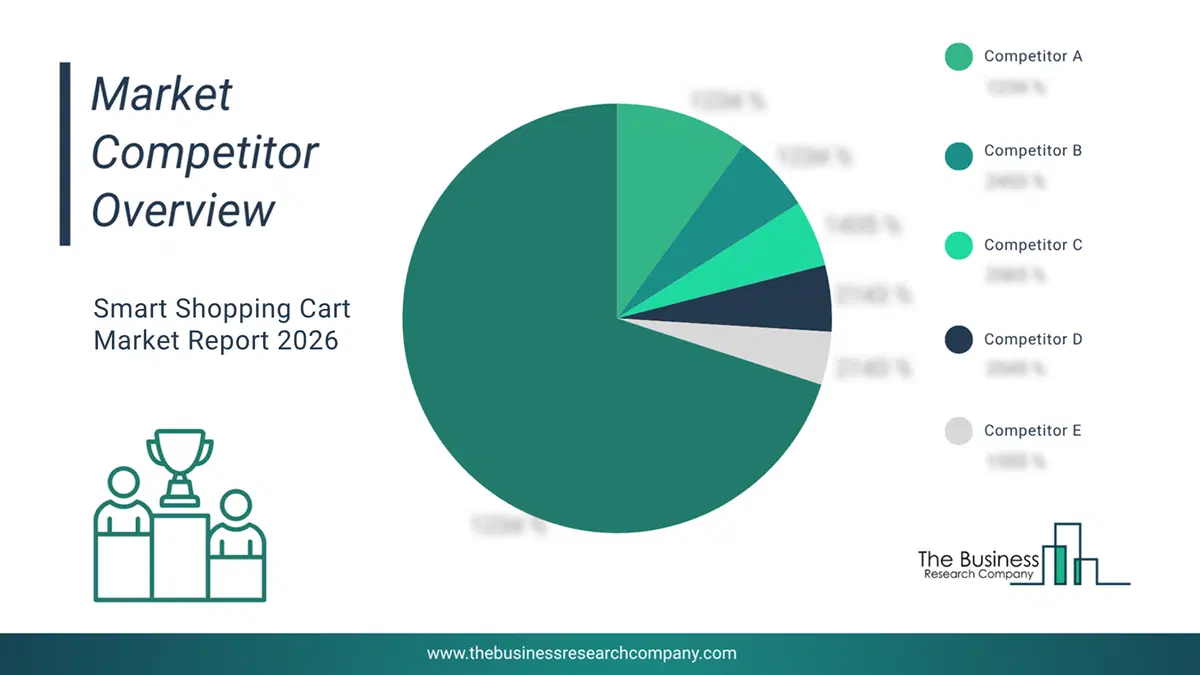
This chart is for illustrative purposes; the full report includes a detailed competitor analysis and comprehensive overview of the top 10 companies in the market.
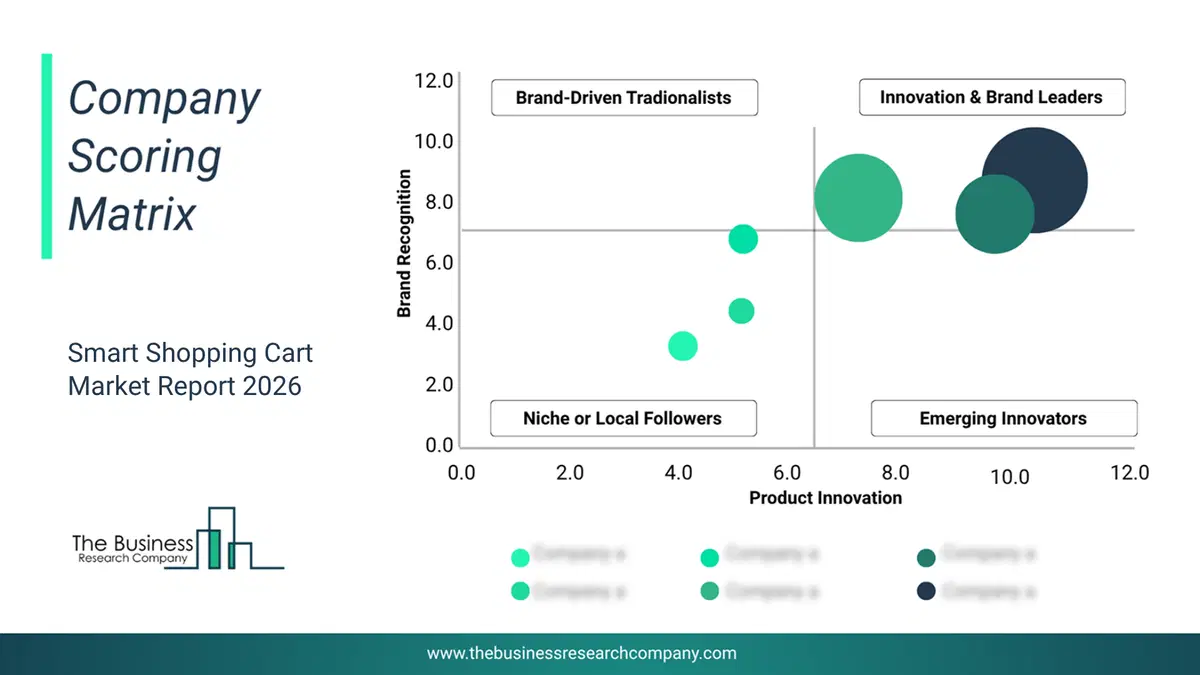
This chart maps companies by product innovation and brand strength, with bubble size indicating relative revenue, helping identify market leaders, challengers, and niche players. This is an illustrative chart; the full report provides a complete and accurate competitive analysis.
Global Smart Shopping Cart Market Trends and Insights
Major companies operating in the smart shopping cart market are focusing on integrating advanced in-store automation technologies such as artificial intelligence (AI)-powered smart shopping carts to enhance checkout efficiency, shopper convenience, and in-store engagement. AI-powered smart shopping carts are sensor- and camera-enabled trolleys that automatically identify products as they are added, calculate totals in real time, and support seamless in-cart checkout, enabling capabilities such as item recognition, digital product displays, and frictionless payments. For instance, in February 2025, Instacart, a US-based grocery technology company, launched Instacart smart trolleys, also known as Caper Carts, a smart shopping cart technology designed to streamline the in-store shopping and checkout experience at Coles supermarkets, featuring AI-enabled cameras and weight sensors for automatic item recognition, an integrated digital screen showing real-time totals and personalized offers, and built-in contactless payment functionality. Instacart smart trolleys improve operational efficiency, reduce checkout times, and enhance the overall customer shopping experience.What Are Latest Mergers And Acquisitions In The Smart Shopping Cart Market?
In June 2024, Aldi, a Germany-based company, partnered with Instacart for an undisclosed amount. The partnership will allow customers to seamlessly add items to their carts, view running totals on a digital display, and use expedited checkout options to reduce wait times. Instacart is a US-based company known for developing AI-powered shopping carts, specifically caper carts, designed to simplify and digitize the grocery shopping experience.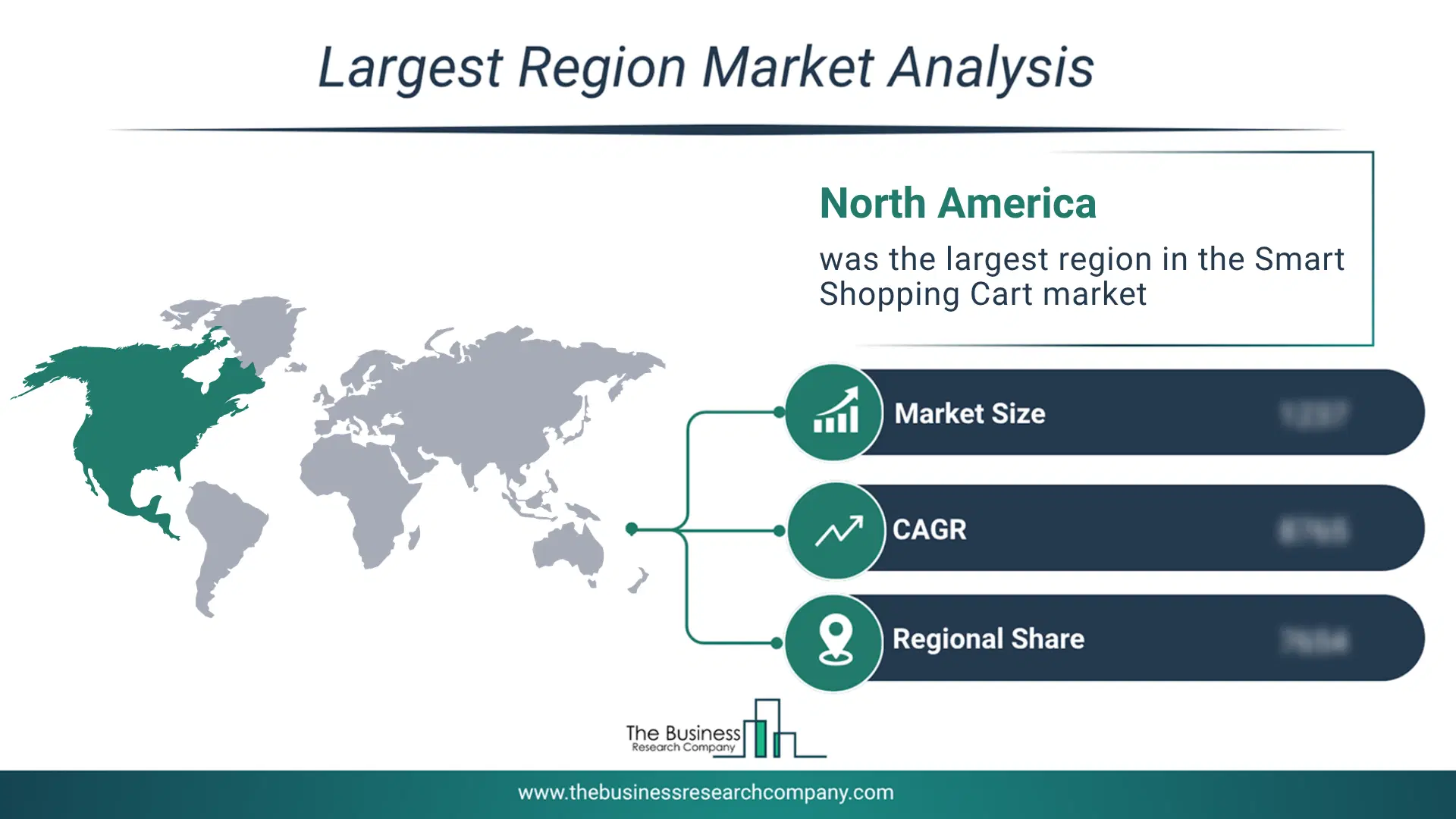
Regional Outlook
North America was the largest region in the smart shopping cart market in 2025. The regions covered in this market report are Asia-Pacific, South East Asia, Western Europe, Eastern Europe, North America, South America, Middle East and Africa. The countries covered in this market report are Australia; Brazil; China; France; Germany; India; Indonesia; Japan; Taiwan; Russia; South Korea; UK; USA; Canada; Italy; Spain.What Defines the Smart Shopping Cart Market?
The smart shopping cart market consists of revenues earned by entities providing services such as automated scanning, navigation assistance, seamless checkout, contactless payment options, and inventory management. The market value includes the value of related goods sold by the service provider or included within the service offering. The smart shopping cart market also includes sales of automated scanning systems, display screens, navigation and mapping systems, and integrated payment systems. Values in this market are ‘factory gate’ values, that is, the value of goods sold by the manufacturers or creators of the goods, whether to other entities (including downstream manufacturers, wholesalers, distributors, and retailers) or directly to end customers. The value of goods in this market includes related services sold by the creators of the goods.How is Market Value Defined and Measured?
The market value is defined as the revenues that enterprises gain from the sale of goods and/or services within the specified market and geography through sales, grants, or donations in terms of the currency (in USD unless otherwise specified). The revenues for a specified geography are consumption values that are revenues generated by organizations in the specified geography within the market, irrespective of where they are produced. It does not include revenues from resales along the supply chain, either further along the supply chain or as part of other products.
This chart presents market attractiveness based on a quantitative evaluation of growth, competition, strategic alignment, and risk, offering a clear view of opportunity areas for decision-making. This chart is for illustrative purposes; the full report contains the complete analysis.

This chart highlights the Total Addressable Market (TAM) by estimating the maximum revenue opportunity using an assumption-driven approach, supporting strategic planning and opportunity sizing across markets. The chart is illustrative; the full report provides a more comprehensive analysis.
What Key Data and Analysis Are Included in the Smart Shopping Cart Market Report 2026?
The smart shopping cart market research report is one of a series of new reports from The Business Research Company that provides market statistics, including industry global market size, regional shares, competitors with the market share, detailed market segments, market trends and opportunities, and any further data you may need to thrive in the smart shopping cart industry. The market research report delivers a complete perspective of everything you need, with an in-depth analysis of the current and future state of the industry.Smart Shopping Cart Market Report Forecast Analysis
| Report Attribute | Details |
|---|---|
| Market Size Value In 2026 | $2.74 billion |
| Revenue Forecast In 2030 | $6.53 billion |
| Growth Rate | CAGR of 24.3% from 2026 to 2030 |
| Base Year For Estimation | 2025 |
| Actual Estimates/Historical Data | 2020-2025 |
| Forecast Period | 2026 - 2030 |
| Market Representation | Revenue in USD Billion and CAGR from 2026 to 2030 |
| Segments Covered | Component, Technology, Mode Of Sales, Application |
| Regional Scope | Asia-Pacific, Western Europe, Eastern Europe, North America, South America, Middle East, Africa |
| Country Scope | The countries covered in the report are Australia, Brazil, China, France, Germany, India, Indonesia, Japan, Taiwan, Russia, South Korea, UK, USA, Canada, Italy, Spain. |
| Key Companies Profiled | Amazon.com Inc., Walmart Inc., Panasonic, International Business Machines Corporation, Fujitsu Limited, Toshiba Global Commerce Solutions Inc., Carttronics LLC, Zippin Inc., Focal Systems Inc., Mashgin Inc., Nourish Technology, Inc., Imagr Ltd., Grabango Co., SuperSmart, Sensei Technologies Inc., Standard Cognition Corporation, Veeve Systems, Caper Inc., Shopic Ltd., Cust2Mate Ltd., Tracxpoint LLC, AiFi Inc. |
| Customization Scope | Request for Customization |
| Pricing And Purchase Options | Explore Purchase Options |