
Space Resource Utilization Market Report 2026
Global Outlook – By Resource Type (Water, Metals, Minerals, Gases, Other Resource Types), By Application (Construction, Propellant Production, Life Support, Manufacturing, Other Applications), By End-User (Government, Commercial, Other End-Users) – Market Size, Trends, Strategies, and Forecast to 2030
Space Resource Utilization Market Overview
• Space Resource Utilization market size has reached to $1.64 billion in 2025 • Expected to grow to $4.1 billion in 2030 at a compound annual growth rate (CAGR) of 20.1% • Growth Driver: Rising Demand For Rare Minerals Fueling The Growth Of The Market Due To Increasing Need For Sustainable Resource Supply For Advanced Technologies • Market Trend: Innovative Lunar Ice Mining Technologies Drive Space Resource Utilization Efforts • North America was the largest region in 2025.What Is Covered Under Space Resource Utilization Market?
Space resource utilization refers to the process of identifying, extracting, processing, and using materials found in space, such as on the Moon, asteroids, or other celestial bodies, to support space missions and long-term human presence beyond Earth. These resources are used for life support, fuel production, construction materials, or space manufacturing. Space resource utilization aims to reduce reliance on Earth-based supplies, lower mission costs, and enable sustainable space exploration and development. The main types of resources in space resource utilization are water, metals, minerals, gases, and others. Water refers to frozen or liquid water found on celestial bodies such as the moon or asteroids. It is used for various applications, such as construction, propellant production, life support, manufacturing, and others, catering to diverse end users, including government, commercial, and others.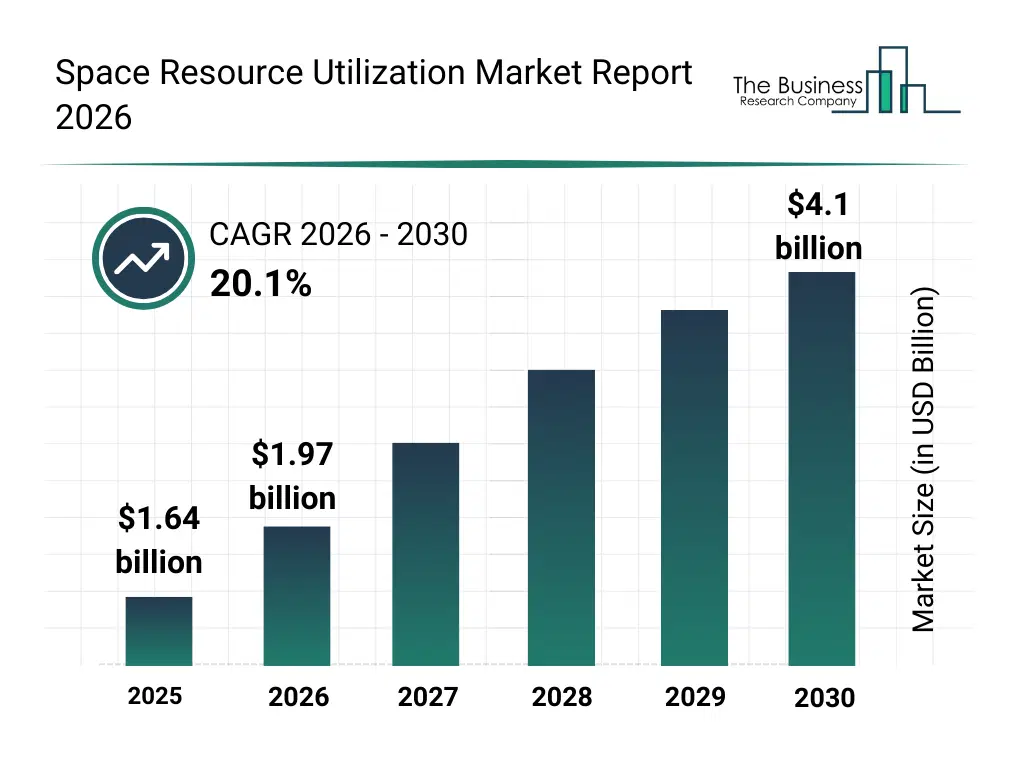
What Is The Space Resource Utilization Market Size and Share 2026?
The space resource utilization market size has grown exponentially in recent years. It will grow from $1.64 billion in 2025 to $1.97 billion in 2026 at a compound annual growth rate (CAGR) of 20.1%. The growth in the historic period can be attributed to early research into lunar and asteroid material composition for extraction potential, initial development of life support resource supply systems using in-situ resources, foundational experiments in orbital debris recycling for material reuse, growth in on-demand manufacturing technologies for space-based assembly, early pilot projects for using extraterrestrial materials in fuel production and construction.What Is The Space Resource Utilization Market Growth Forecast?
The space resource utilization market size is expected to see exponential growth in the next few years. It will grow to $4.1 billion in 2030 at a compound annual growth rate (CAGR) of 20.1%. The growth in the forecast period can be attributed to expansion of large-scale lunar and asteroid mining initiatives for sustainable resource supply, increasing deployment of orbital recycling and material recovery platforms, development of advanced in-situ manufacturing and 3d printing technologies, rising investment in space-based power generation utilizing local resources, growing commercial and governmental partnerships to establish self-sufficient off-earth resource ecosystems. Major trends in the forecast period include expansion of lunar and asteroid mining missions, growth in in-situ resource processing technologies, rising demand for on-orbit manufacturing and repair, increased investment in propellant production infrastructure, advancements in closed-loop life support resource systems.
Global Space Resource Utilization Market Segmentation
1) By Resource Type: Water, Metals, Minerals, Gases, Other Resource Types 2) By Application: Construction, Propellant Production, Life Support, Manufacturing, Other Applications 3) By End-User: Government, Commercial, Other End-Users Subsegments: 1) By Water: Lunar Ice Deposits, Asteroid Water Extraction, In-Situ Water Production, Water For Life Support, Water For Propellant Production 2) By Metals: Iron, Nickel, Platinum Group Metals, Aluminum, Titanium, Rare Earth Metals 3) By Minerals: Regolith (Lunar Soil), Silicates, Basalt, Helium-3 Containing Minerals, Construction-Grade Aggregates 4) By Gases: Helium-3, Oxygen, Hydrogen, Carbon Dioxide, Nitrogen 5) By Other Resource Types: Solar Energy, Space-Based Rare Volatile Compounds, Organic Compounds, Exotic Isotopes, Radiation Shielding MaterialsWhat Is Driver Of The Space Resource Utilization Market?
The increasing demand for rare minerals is expected to propel the growth of the space resource utilization market going forward. Rare minerals refer to naturally occurring materials that are scarce in the Earth's crust and are highly valued for their unique properties used in electronics, renewable energy, and aerospace technologies. The demand for rare minerals is increasing due to their essential role in manufacturing batteries for electric vehicles. Space resource utilization helps balance the use of rare minerals, enabling the extraction of scarce and valuable elements from asteroids and the lunar surface, helping to meet industrial demand and reduce reliance on Earth's depleting resources. For instance, In January 2025, the United States Geological Survey, a US-based government agency, reported that global rare earth production rose from 376,000 metric tons in 2022 to 390,000 metric tons in 2024, marking a 3.7% increase over the two-year period. The increasing demand for rare minerals drives the growth of the space resource utilization industry.Key Players In The Global Space Resource Utilization Market
Major companies operating in the space resource utilization market are Lockheed Martin Corporation, Northrop Grumman Corporation, Airbus Defence and Space SA, Blue Origin Enterprises L.P., Thales Alenia Space SAS, Sierra Nevada Company LLC, AMi Exploration, ispace Inc., Turion Space Corp., Wyvern, AstroForge Inc., Bradford Space Inc., Interlune Corporation, Astrobotic Technology Inc., Moon Express Inc., Orbit Fab Inc., Trans Astronautica Corporation, Astronika, Off-World Inc., Polimak Space, Lunasonde
This chart is for illustrative purposes; the full report includes a detailed competitor analysis and comprehensive overview of the top 10 companies in the market.
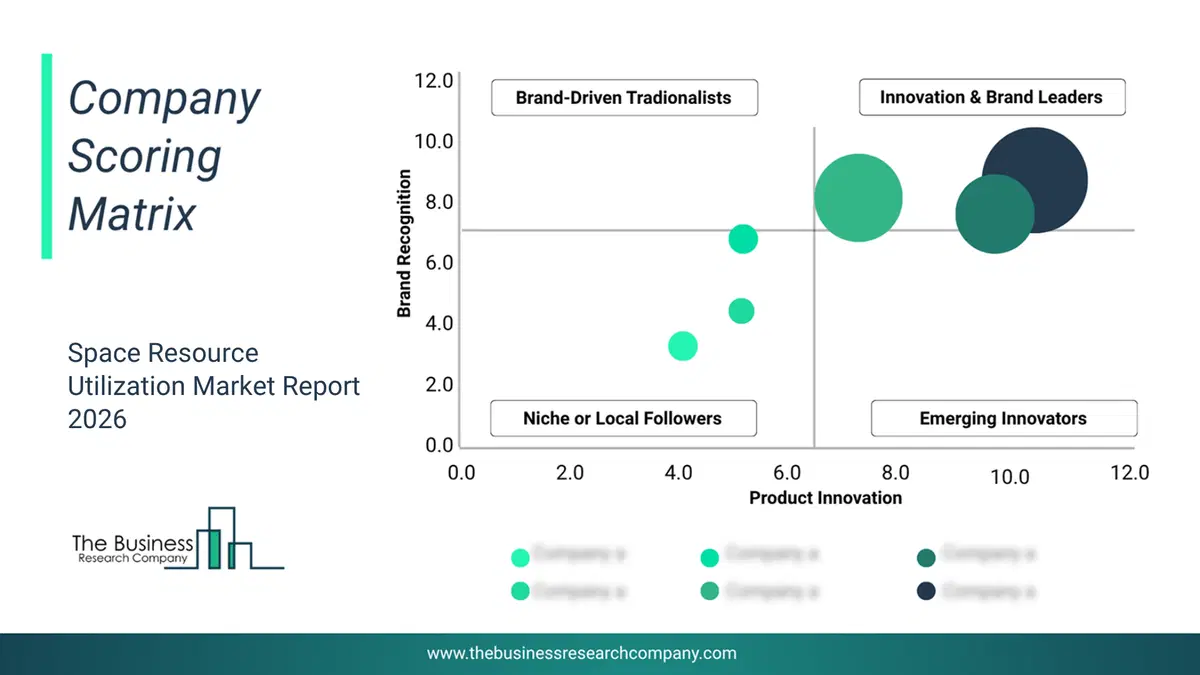
This chart maps companies by product innovation and brand strength, with bubble size indicating relative revenue, helping identify market leaders, challengers, and niche players. This is an illustrative chart; the full report provides a complete and accurate competitive analysis.
Global Space Resource Utilization Market Trends and Insights
Major companies operating in the space resource utilization market are focusing on developing innovative solutions, such as polar resources ice mining equipment, to develop technologies for extracting and processing water ice from lunar poles. Polar resources ice mining equipment refers to specialized tools designed to excavate lunar polar soil and analyze it for the presence of water ice and other volatiles. For instance, in February 2025, Space Exploration Technologies Corp., a US-based space technology company, launched the Intuitive Machines IM-2 mission, carrying PRIME-1 (Polar Resources Ice Mining Experiment-1). It is a NASA payload designed to demonstrate key technologies for locating and extracting water ice from the Moon’s surface. PRIME-1 aims to test a drill and a mass spectrometer to detect and analyze subsurface ice. The mission supports future lunar exploration by helping to develop methods for in-situ resource utilization (ISRU), which is critical for enabling long-term human presence on the Moon and reducing reliance on Earth-supplied resources.What Are Latest Mergers And Acquisitions In The Space Resource Utilization Market? Space Ocean Corp Partners With Astrum Drive To Advance Space Exploration Through Propellantless Propulsion Technology
In August 2025, Space Ocean Corp, a US-based aerospace company, entered partnership with Astrum Drive Inc. The aim of the partnership between Space Ocean Corp and Astrum Drive Inc. is to accelerate advancements in space exploration and resource development by integrating Astrum Drive's propellantless propulsion technology with Space Ocean's expertise in orbital fluid transfer and satellite logistics. Astrum Drive Inc. is a US-based technology company that develops and provides solutions for space exploration and propulsion systems, specifically focusing on innovative, propellantless propulsion technologies.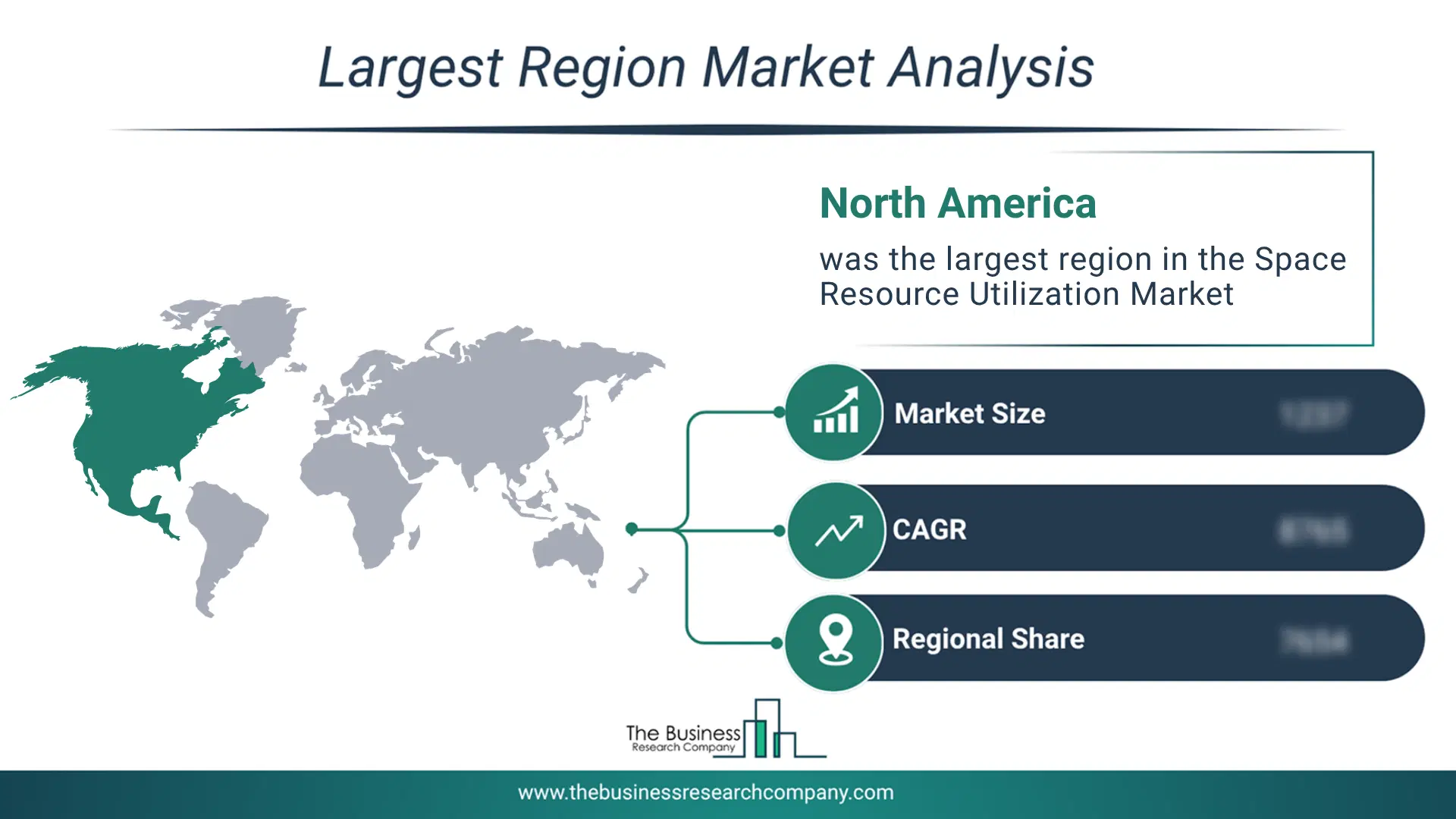
Regional Insights
North America was the largest region in the space resource utilization market in 2025. The regions covered in this market report are Asia-Pacific, South East Asia, Western Europe, Eastern Europe, North America, South America, Middle East, Africa. The countries covered in this market report are Australia, Brazil, China, France, Germany, India, Indonesia, Japan, Taiwan, Russia, South Korea, UK, USA, Canada, Italy, SpainWhat Defines the Space Resource Utilization Market?
The space resource utilization market includes revenues earned by entities by providing services such as life support resource supply, orbital debris recycling, power generation services, and on-demand manufacturing support. The market value includes the value of related goods sold by the service provider or included within the service offering. Only goods and services traded between entities or sold to end consumers are included.How is Market Value Defined and Measured?
The market value is defined as the revenues that enterprises gain from the sale of goods and/or services within the specified market and geography through sales, grants, or donations in terms of the currency (in USD unless otherwise specified). The revenues for a specified geography are consumption values that are revenues generated by organizations in the specified geography within the market, irrespective of where they are produced. It does not include revenues from resales along the supply chain, either further along the supply chain or as part of other products.
This chart presents market attractiveness based on a quantitative evaluation of growth, competition, strategic alignment, and risk, offering a clear view of opportunity areas for decision-making. This chart is for illustrative purposes; the full report contains the complete analysis.

This chart highlights the Total Addressable Market (TAM) by estimating the maximum revenue opportunity using an assumption-driven approach, supporting strategic planning and opportunity sizing across markets. The chart is illustrative; the full report provides a more comprehensive analysis.
What Key Data and Analysis Are Included in the Space Resource Utilization Market Report 2026?
The space resource utilization market research report is one of a series of new reports from The Business Research Company that provides market statistics, including industry global market size, regional shares, competitors with the market share, detailed market segments, market trends and opportunities, and any further data you may need to thrive in the space resource utilization industry. The market research report delivers a complete perspective of everything you need, with an in-depth analysis of the current and future state of the industry.Space Resource Utilization Market Report Forecast Analysis
| Report Attribute | Details |
|---|---|
| Market Size Value In 2026 | $1.97 billion |
| Revenue Forecast In 2030 | $4.1 billion |
| Growth Rate | CAGR of 20.1% from 2026 to 2030 |
| Base Year For Estimation | 2025 |
| Actual Estimates/Historical Data | 2020-2025 |
| Forecast Period | 2026 - 2030 |
| Market Representation | Revenue in USD Billion and CAGR from 2026 to 2030 |
| Segments Covered | Resource Type, Application, End-User |
| Regional Scope | Asia-Pacific, Western Europe, Eastern Europe, North America, South America, Middle East, Africa |
| Country Scope | The countries covered in the space resource utilization market report are Australia, Brazil, China, France, Germany, India, Indonesia, Japan, Taiwan, Russia, South Korea, UK, USA, Canada, Italy, Spain |
| Key Companies Profiled | Lockheed Martin Corporation, Northrop Grumman Corporation, Airbus Defence and Space SA, Blue Origin Enterprises L.P., Thales Alenia Space SAS, Sierra Nevada Company LLC, AMi Exploration, ispace Inc., Turion Space Corp., Wyvern, AstroForge Inc., Bradford Space Inc., Interlune Corporation, Astrobotic Technology Inc., Moon Express Inc., Orbit Fab Inc., Trans Astronautica Corporation, Astronika, Off-World Inc., Polimak Space, Lunasonde |
| Customization Scope | Request for Customization |
| Pricing And Purchase Options | Explore Purchase Options |