
Spectroscopy Software Market Report 2026
Global Outlook – By Type Of Spectroscopy (Ultraviolet-Visible Spectroscopy Software, Infrared Spectroscopy Software, Nuclear Magnetic Resonance Spectroscopy Software, Mass Spectrometry Software, Fluorescence Spectroscopy Software), By Deployment Type (On-Premise Software, Cloud-Based Software, Hybrid Software), By Functionality (Data Acquisition, Data Analysis, Data Management, Reporting And Visualization, Instrument Control), By Application (Food Testing, Environmental Testing, Forensic Science, Pharmaceuticals, Other Applications), By End-User (Pharmaceuticals And Biotechnology Industries, Forensics, Food Industries, Polymers And Organic Chemistry Industries) – Market Size, Trends, Strategies, and Forecast to 2030
Spectroscopy Software Market Overview
• Spectroscopy Software market size has reached to $1.49 billion in 2025 • Expected to grow to $2.61 billion in 2030 at a compound annual growth rate (CAGR) of 11.8% • Growth Driver: Surge In Consumer Demand For Food Safety Fueling The Growth Of The Market Due To Rising Contamination Risks And Demand For Rapid Quality Analysis • Market Trend: Advanced Interactive Reporting Tools Transform Data Analysis In Scientific And Industrial Sectors • North America was the largest region in 2025 and Asia-Pacific is the fastest growing region.What Is Covered Under Spectroscopy Software Market?
Spectroscopy software is a specialized tool designed to acquire, process, and analyze spectral data from various spectroscopy instruments. It enables users to visualize spectra, identify peaks, and perform quantitative or qualitative assessments of the data. Spectroscopy software enhances accuracy, efficiency, and reproducibility in interpreting spectral information. The main types of spectroscopy software include ultraviolet-visible spectroscopy software, infrared spectroscopy software, nuclear magnetic resonance spectroscopy software, mass spectrometry software, and fluorescence spectroscopy software. Ultraviolet-visible (UV-Vis) spectroscopy software is a specialized program used to control UV-Vis spectrometers, acquire spectral data, and analyze the absorbance or transmittance of samples across ultraviolet and visible light wavelengths. It has deployed types such as on-premise software, cloud-based software, and hybrid software. It supports varied functionalities including data acquisition, data analysis, data management, reporting, and visualization, and instrument control. The software is used in various applications such as food testing, environmental testing, forensic science, pharmaceuticals, and others. The different end-users include the pharmaceutical and biotechnology industries, forensic laboratories, food industries, and the polymers and organic chemistry sectors.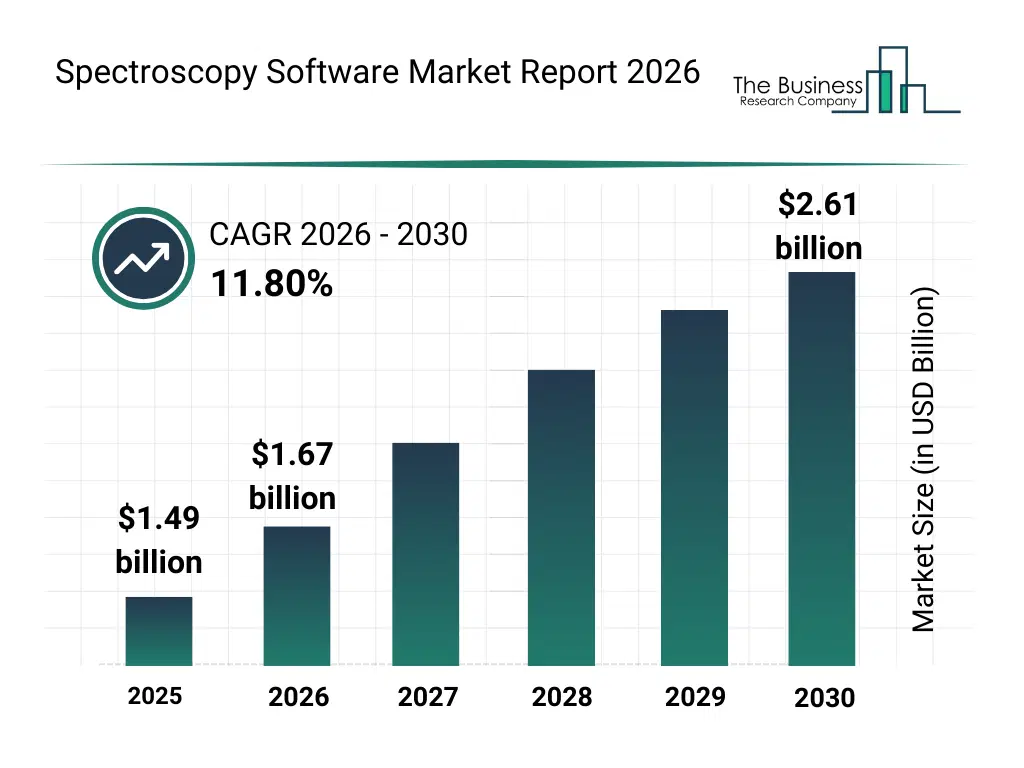
What Is The Spectroscopy Software Market Size and Share 2026?
The spectroscopy software market size has grown rapidly in recent years. It will grow from $1.49 billion in 2025 to $1.67 billion in 2026 at a compound annual growth rate (CAGR) of 12.1%. The growth in the historic period can be attributed to growing adoption of spectroscopy in pharmaceuticals, rising demand for quality control in food industries, increasing use in environmental testing, advancements in uv-vis and ir spectroscopy software, expansion of analytical laboratories.What Is The Spectroscopy Software Market Growth Forecast?
The spectroscopy software market size is expected to see rapid growth in the next few years. It will grow to $2.61 billion in 2030 at a compound annual growth rate (CAGR) of 11.8%. The growth in the forecast period can be attributed to integration of ai and machine learning in spectroscopy software, cloud-based and hybrid software deployment growth, increasing demand in forensic science applications, rising automation in pharmaceutical and biotech labs, expansion of remote and collaborative research platforms. Major trends in the forecast period include automation of spectral data processing, integration with laboratory information management systems (lims), real-time instrument monitoring, advanced visualization & reporting tools, remote and collaborative analysis.
Global Spectroscopy Software Market Segmentation
1) By Type Of Spectroscopy: Ultraviolet-Visible Spectroscopy Software, Infrared Spectroscopy Software, Nuclear Magnetic Resonance Spectroscopy Software, Mass Spectrometry Software, Fluorescence Spectroscopy Software 2) By Deployment Type: On-Premise Software, Cloud-Based Software, Hybrid Software 3) By Functionality: Data Acquisition, Data Analysis, Data Management, Reporting And Visualization, Instrument Control 4) By Application: Food Testing, Environmental Testing, Forensic Science, Pharmaceuticals, Other Applications 5) By End-User: Pharmaceuticals And Biotechnology Industries, Forensics, Food Industries, Polymers And Organic Chemistry Industries Subsegments: 1) By Ultraviolet-Visible Spectroscopy Software: Single-Beam Ultraviolet-Visible Software, Double-Beam Ultraviolet-Visible Software, Array-Based Ultraviolet-Visible Software, Portable Ultraviolet-Visible Software 2) By Infrared Spectroscopy Software: Near-Infrared (NIR) Spectroscopy Software, Mid-Infrared (MIR) Spectroscopy Software, Far-Infrared (FIR) Spectroscopy Software, Fourier-Transform Infrared (FTIR) Software 3) By Nuclear Magnetic Resonance Spectroscopy Software: 1D Nuclear Magnetic Resonance (NMR) Software, 2D Or 3D Nuclear Magnetic Resonance (NMR) Software, Solid-state Nuclear Magnetic Resonance (NMR) Software, High-Resolution Nuclear Magnetic Resonance (NMR) Software 4) By Mass Spectrometry Software: Gas Chromatography-Mass Spectrometry Software, Liquid Chromatography-Mass Spectrometry Software, Matrix-Assisted Laser Desorption Or Ionization Software, Tandem Mass Spectrometry Software 5) By Fluorescence Spectroscopy Software: Steady-State Fluorescence Software, Time-Resolved Fluorescence Software, Fluorescence Lifetime Imaging Software, Forster Resonance Energy Transfer (FRET) SoftwareWhat Is The Driver Of The Spectroscopy Software Market?
The increasing consumer demand for food safety is expected to propel the growth of the spectroscopy software market going forward. Food safety refers to the practices and conditions that preserve the quality of food to prevent contamination and foodborne illnesses. The food safety concerns are rising due to the increasing globalization of the food supply chain, which heightens the risk of contamination during production, processing, and distribution. Spectroscopy software helps ensure food safety by enabling rapid, non-destructive analysis of food products to detect contaminants, verify ingredient authenticity, and monitor quality parameters throughout the supply chain. For instance, in April 2024, Public Interest Research Group (PIRG), a US-based nonprofit organization, food and beverage recalls in the United States increased by 8% in 2023 from 6% in 2022. Therefore, increasing consumer demand for food safety is driving the growth of the spectroscopy software industry.Key Players In The Global Spectroscopy Software Market
Major companies operating in the spectroscopy software market are Thermo Fisher Scientific Inc., Danaher Corporation, Agilent Technologies Inc., PerkinElmer Inc., Mettler-Toledo International Inc., Shimadzu Corporation, Waters Corporation, Bruker Corporation, HORIBA Ltd., JEOL Ltd., Anton Paar GmbH, Renishaw plc, Metrohm AG, Genedata AG, HunterLab Europe GmbH, Avantes B.V.Renishaw plc, JASCO Corporation, Wasatch Photonics Inc., Lablicate GmbH, StellarNet Inc.
This chart is for illustrative purposes; the full report includes a detailed competitor analysis and comprehensive overview of the top 10 companies in the market.
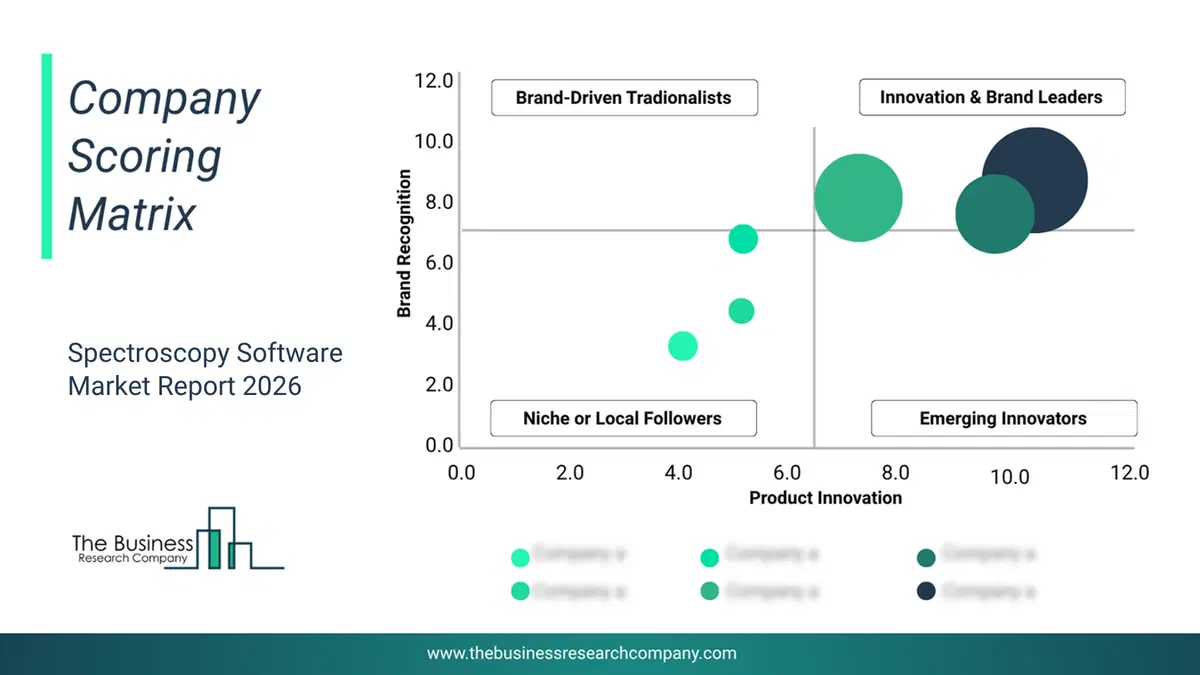
This chart maps companies by product innovation and brand strength, with bubble size indicating relative revenue, helping identify market leaders, challengers, and niche players. This is an illustrative chart; the full report provides a complete and accurate competitive analysis.
Global Spectroscopy Software Market Trends and Insights
Major companies operating in the spectroscopy software market are focusing on developing innovative solutions such as interactive reports to enhance data visualization, enable in-depth analysis, and provide customizable insights that support faster and more informed decision-making for users across scientific and industrial applications. Interactive reports refer to dynamic, user-friendly digital reporting tools that allow users to explore, filter, and visualize spectroscopy data in real time. For instance, in June 2023, Mirion Technologies, Inc., a US-based technology and manufacturing company, introduced Genie 4.0, a major update to its flagship spectroscopy software. Genie 4.0 offers enhanced user experience with interactive reports, improved accuracy through advanced algorithms, and greater automation via Python-based scripting. It is designed for new and longtime users, and it ensures a smooth transition while increasing flexibility. The update also introduces new subscription and perpetual licensing options, allowing users to choose cost-effective models that suit their needs. Genie 4.0 will be available for download in mid-July.What Are Latest Mergers And Acquisitions In The Spectroscopy Software Market?
In April 2023, Photonis, a France-based technology company, acquired Telops Inc. for an undisclosed amount. With this acquisition, Photonis aims to broaden its technological capabilities by integrating Telops’ hyperspectral imaging, infrared expertise, and advanced spectroscopy software, enabling the group to offer a more comprehensive range of high-end imaging and analytical solutions. The move also positions Photonis to enter the North American methane detection market, tapping into growing environmental monitoring needs and strengthening its role in data-driven, precision sensing applications. Telops Inc. is a Canada-based high-tech company specializing in hyperspectral imaging systems and spectroscopy software for advanced data analysis and imaging solutions.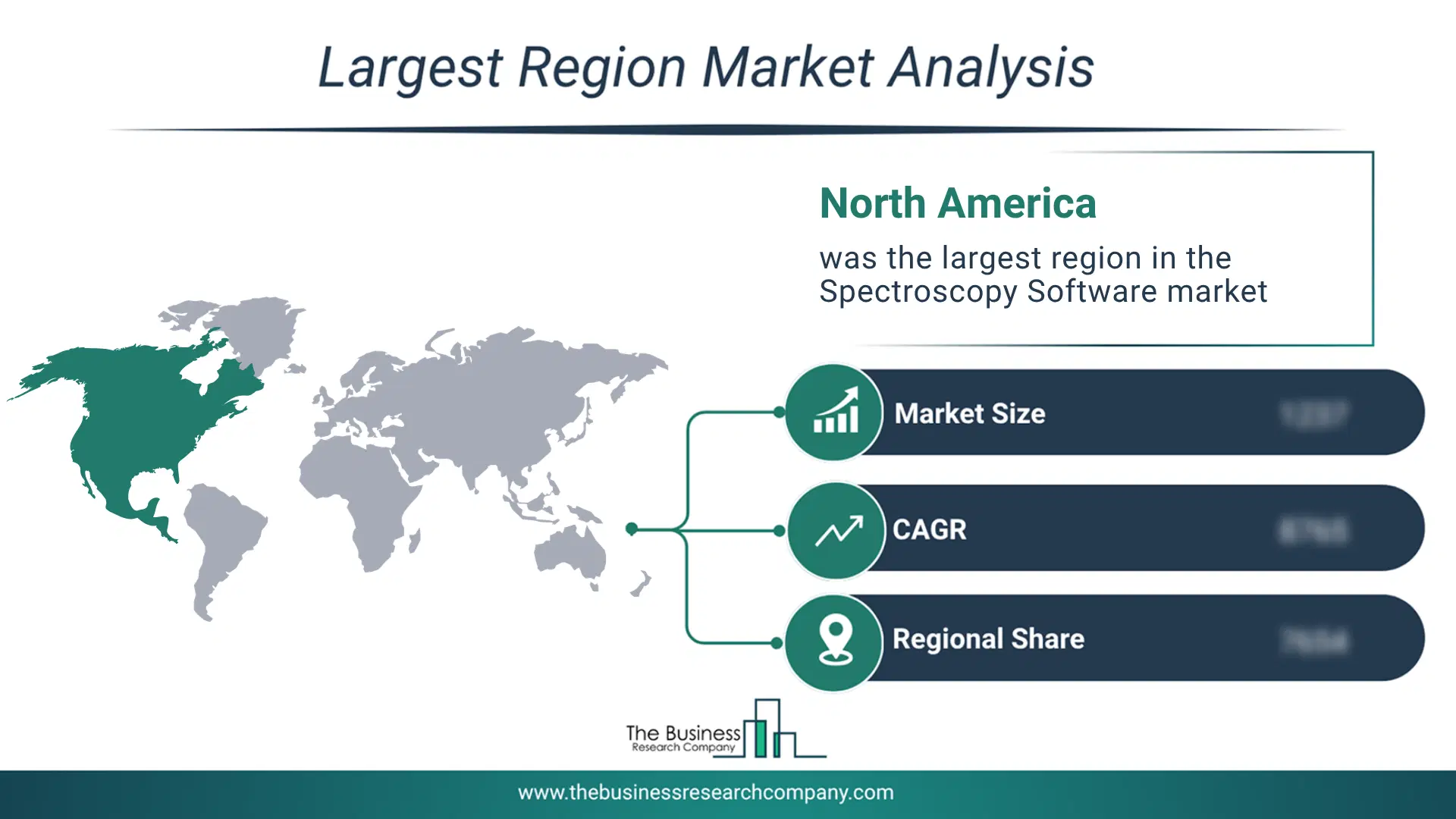
Regional Outlook
North America was the largest region in the spectroscopy software market in 2025. Asia-Pacific is expected to be the fastest-growing region in the forecast period. The regions covered in this market report are Asia-Pacific, South East Asia, Western Europe, Eastern Europe, North America, South America, Middle East, Africa. The countries covered in this market report are Australia, Brazil, China, France, Germany, India, Indonesia, Japan, Taiwan, Russia, South Korea, UK, USA, Canada, Italy, SpainWhat Defines the Spectroscopy Software Market?
The spectroscopy software market consists of revenues earned by entities by providing services such as software integration services, technical support and training services, instrument control and automation for spectroscopic devices, custom report generation, and real-time monitoring and alerts. The market value includes the value of related goods sold by the service provider or included within the service offering. The spectroscopy software market consists of sales of raman spectroscopy software, atomic absorption spectroscopy (AAS) software, near-infrared (NIR) spectroscopy software, terahertz spectroscopy software, and hyperspectral imaging software. Values in this market are ‘factory gate’ values, that is, the value of goods sold by the manufacturers or creators of the goods, whether to other entities (including downstream manufacturers, wholesalers, distributors, and retailers) or directly to end customers. The value of goods in this market includes related services sold by the creators of the goods.How is Market Value Defined and Measured?
The market value is defined as the revenues that enterprises gain from the sale of goods and/or services within the specified market and geography through sales, grants, or donations in terms of the currency (in USD unless otherwise specified). The revenues for a specified geography are consumption values that are revenues generated by organizations in the specified geography within the market, irrespective of where they are produced. It does not include revenues from resales along the supply chain, either further along the supply chain or as part of other products.
This chart presents market attractiveness based on a quantitative evaluation of growth, competition, strategic alignment, and risk, offering a clear view of opportunity areas for decision-making. This chart is for illustrative purposes; the full report contains the complete analysis.

This chart highlights the Total Addressable Market (TAM) by estimating the maximum revenue opportunity using an assumption-driven approach, supporting strategic planning and opportunity sizing across markets. The chart is illustrative; the full report provides a more comprehensive analysis.
What Key Data and Analysis Are Included in the Spectroscopy Software Market Report 2026?
The spectroscopy software market research report is one of a series of new reports from The Business Research Company that provides market statistics, including industry global market size, regional shares, competitors with the market share, detailed market segments, market trends and opportunities, and any further data you may need to thrive in the spectroscopy software industry. The market research report delivers a complete perspective of everything you need, with an in-depth analysis of the current and future state of the industry.Spectroscopy Software Market Report Forecast Analysis
| Report Attribute | Details |
|---|---|
| Market Size Value In 2026 | $1.67 billion |
| Revenue Forecast In 2030 | $2.61 billion |
| Growth Rate | CAGR of 11.8% from 2026 to 2030 |
| Base Year For Estimation | 2025 |
| Actual Estimates/Historical Data | 2020-2025 |
| Forecast Period | 2026 - 2030 |
| Market Representation | Revenue in USD Billion and CAGR from 2026 to 2030 |
| Segments Covered | Type Of Spectroscopy, Deployment Type, Functionality, Application, End-User |
| Regional Scope | Asia-Pacific, Western Europe, Eastern Europe, North America, South America, Middle East, Africa |
| Country Scope | The countries covered in the report are Australia, Brazil, China, France, Germany, India, Indonesia, Japan, Taiwan, Russia, South Korea, UK, USA, Canada, Italy, Spain. |
| Key Companies Profiled | Thermo Fisher Scientific Inc., Danaher Corporation, Agilent Technologies Inc., PerkinElmer Inc., Mettler-Toledo International Inc., Shimadzu Corporation, Waters Corporation, Bruker Corporation, HORIBA Ltd., JEOL Ltd., Anton Paar GmbH, Renishaw plc, Metrohm AG, Genedata AG, HunterLab Europe GmbH, Avantes B.V.Renishaw plc, JASCO Corporation, Wasatch Photonics Inc., Lablicate GmbH, StellarNet Inc. |
| Customization Scope | Request for Customization |
| Pricing And Purchase Options | Explore Purchase Options |