
Sport Utility Vehicle Market Report 2026
Global Outlook – By Type (Sport Utility Vehicle-C, Sport Utility Vehicle-D, Sport Utility Vehicle-E, Sport Utility Vehicle-F), By Size (Mini-Sport Utility Vehicle, Compact, Mid-Size, Full-Size, Extended-Length), By Drivetrain Type (Two-Wheel Drive, Four-Wheel Drive, All-Wheel Drive), By Application (Remote Areas, Recreation, Motorsport), By End-User (Personal, Commercial) – Market Size, Trends, Strategies, and Forecast to 2030
Sport Utility Vehicle Market Overview
• Sport Utility Vehicle market size has reached to $890.07 billion in 2025 • Expected to grow to $1182.5 billion in 2030 at a compound annual growth rate (CAGR) of 5.8% • Growth Driver: Increasing Demand For Luxury Vehicles Propels Market Growth Due To Premium Comfort And Versatility • Market Trend: Role Of Enhanced Connectivity Features In The Evolution Of Sport Utility Vehicles • North America was the largest region in 2025 and Asia-Pacific is the fastest growing region.What Is Covered Under Sport Utility Vehicle Market?
A sport utility vehicle (SUV) refers to a type of automobile designed for both on-road and off-road use, offering higher ground clearance, a robust construction, and often equipped with four-wheel drive (4WD) or all-wheel drive (AWD) systems. SUVs are typically larger than sedans, providing ample passenger and cargo space. The main types in the sport utility vehicle are sport utility vehicle-c, sport utility vehicle-d, sport utility vehicle-e, and sport utility vehicle-f. SUV-C refers to compact sport utility vehicles that combine urban-friendly size with versatility and moderate off-road capability. The various sizes include mini-sport utility vehicle, compact, mid-size, full-size, and extended-length, and several drivetrain options, including two-wheel drive, four-wheel drive, and all-wheel drive. It is applicable to remote areas, recreation, and motorsport. It is catering to various end users, such as personal and commercial.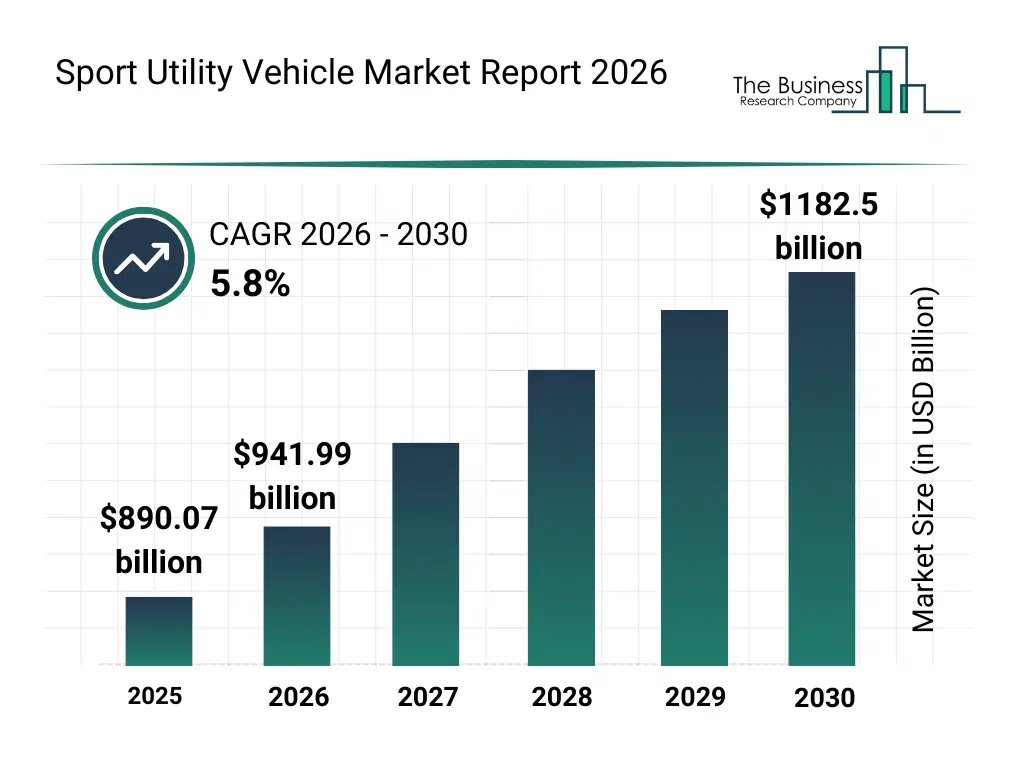
What Is The Sport Utility Vehicle Market Size and Share 2026?
The sport utility vehicle market size has grown strongly in recent years. It will grow from $890.07 billion in 2025 to $941.99 billion in 2026 at a compound annual growth rate (CAGR) of 5.8%. The growth in the historic period can be attributed to rising consumer preference for high-ground-clearance vehicles, expansion of urban and suburban mobility needs, growth in disposable incomes, increasing availability of financing options, expansion of global automotive production.What Is The Sport Utility Vehicle Market Growth Forecast?
The sport utility vehicle market size is expected to see strong growth in the next few years. It will grow to $1182.5 billion in 2030 at a compound annual growth rate (CAGR) of 5.8%. The growth in the forecast period can be attributed to increasing electrification of suv platforms, rising adoption of autonomous driving features, expansion of suv demand in emerging markets, growing focus on sustainable vehicle materials, increasing integration of digital infotainment systems. Major trends in the forecast period include increasing adoption of electric and hybrid suvs, rising demand for advanced driver assistance systems, growing preference for compact and mid-size suvs, expansion of luxury and performance suv segments, enhanced focus on connected vehicle features.
Global Sport Utility Vehicle Market Segmentation
1) By Type: Sport Utility Vehicle-C, Sport Utility Vehicle-D, Sport Utility Vehicle-E, Sport Utility Vehicle-F 2) By Size: Mini-Sport Utility Vehicle, Compact, Mid-Size, Full-Size, Extended-Length 3) By Drivetrain Type: Two-Wheel Drive, Four-Wheel Drive, All-Wheel Drive 4) By Application: Remote Areas, Recreation, Motorsport 5) By End-User: Personal, Commercial Subsegments: 1) By Sport Utility Vehicle-C: Compact Urban SUVs, Off-Road Compact SUVs, Hybrid Compact SUVs, Electric Compact SUVs 2) By Sport Utility Vehicle-D: Mid-Size Family SUVs, Performance-Oriented Mid-Size SUVs, Hybrid Mid-Size SUVs, Electric Mid-Size SUVs 3) By Sport Utility Vehicle-E: Full-Size Luxury SUVs, Performance Full-Size SUVs, Hybrid Full-Size SUVs, Electric Full-Size SUVs 4) By Sport Utility Vehicle-F: Ultra-Luxury SUVs, High-Performance SUVs, Hybrid Ultra-Luxury SUVs, Electric Ultra-Luxury SUVsWhat Is The Driver Of The Sport Utility Vehicle Market?
The increasing demand for luxury vehicles is expected to propel the growth of the sport utility vehicle market going forward. Luxury vehicles are high-end automobiles that offer premium features, superior craftsmanship, advanced technology, enhanced performance, and exceptional comfort, often associated with prestigious brands and higher price points. Luxury vehicles are increasing due to factors such as rising disposable incomes, growing demand for premium features and comfort, advancements in automotive technology, expanding affluent consumer bases, increasing brand consciousness, the rise of electric and hybrid luxury models, strong financing and leasing options, expanding luxury markets in emerging economies, and a focus on sustainability and customization. Sport utility vehicles help luxury vehicles by offering a versatile platform that combines premium comfort, advanced technology, and high performance, catering to the growing consumer demand for luxurious yet practical driving experiences. For instance, in April 2023, a report from CarExpert Pty Ltd, an Australia-based automotive publisher, indicated that the Jaguar F-Pace SUV is the brand's best-selling vehicle in Australia, with 48 units sold so far in 2023. Maserati sold 31 Grecale SUVs in 2023, while Volvo's XC40 luxury SUV experienced an 18.7% increase in sales, totaling 1,505 units. Therefore, the increasing demand for luxury vehicles is driving the growth of the sport utility market.Key Players In The Global Sport Utility Vehicle Market
Major companies operating in the sport utility vehicle market report include Volkswagen AG, Toyota Motor Corporation, Ford Motor Company, Mercedes-Benz Group AG, General Motors Company, Bayerische Motoren Werke AG, Honda Motor Co. Ltd., SAIC Motor Corporation Limited, Hyundai Motor Company, Tesla Inc., Nissan Motor Co. Ltd, Kia Motors Corporation, BYD Company Limited, Tata Motors Limited, Renault Group, Porsche AG , Mazda Motor Corporation, Mitsubishi Motors Corporation, Mahindra And Mahindra Limited, Maruti Suzuki India Limited, Lexus International, Rivian Automotive Inc., Infiniti Motor Company Ltd., Audi India Private Limited, Jaguar Land Rover Automotive plc
This chart is for illustrative purposes; the full report includes a detailed competitor analysis and comprehensive overview of the top 10 companies in the market.
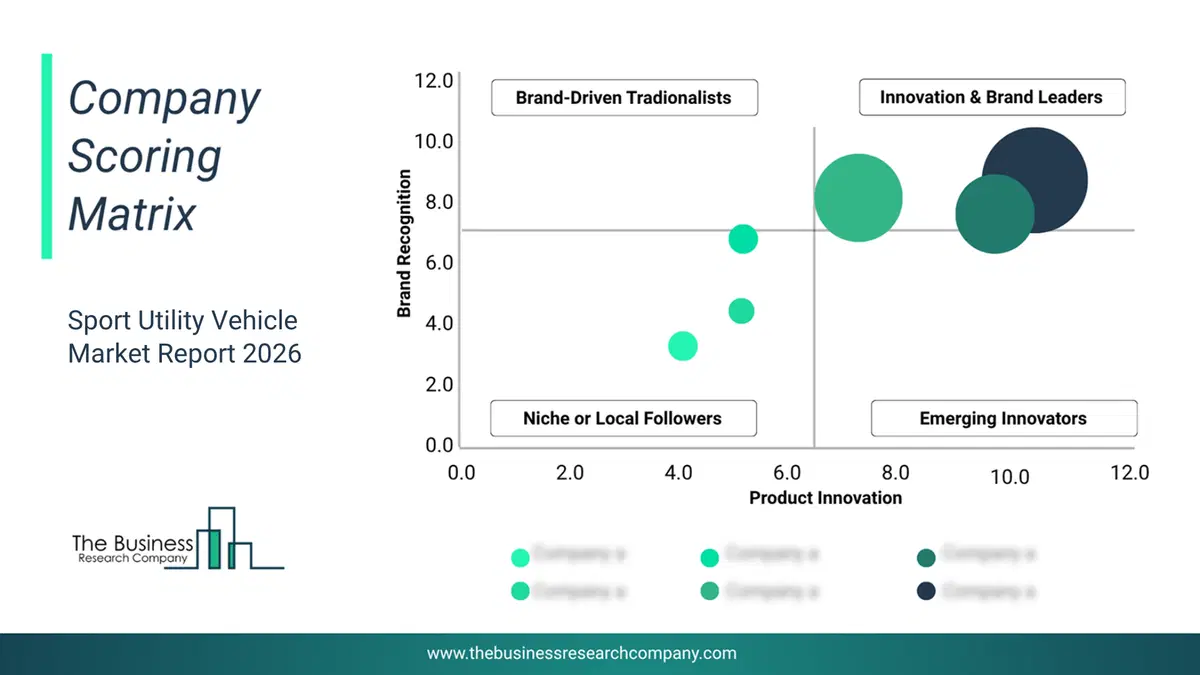
This chart maps companies by product innovation and brand strength, with bubble size indicating relative revenue, helping identify market leaders, challengers, and niche players. This is an illustrative chart; the full report provides a complete and accurate competitive analysis.
Global Sport Utility Vehicle Market Trends and Insights
Major companies operating in the sport utility vehicle (SUV) market are focusing on developing innovative technologies such as luxury SUVs to enhance driving experiences, improve safety features, and incorporate cutting-edge infotainment systems. Luxury SUVs refer to high-end sport utility vehicles that provide superior comfort, advanced technology, high-quality materials, and enhanced performance features, often with premium interiors and cutting-edge safety and infotainment systems. For instance, in May 2024, Audi AG, a Germany-based automobile manufacturer company, launched the Audi Q7 Bold Edition. This edition features a striking black styling package, a powerful 3.0-litre V6 engine with 340 hp, and an 8-speed automatic transmission with Quattro all-wheel drive. It includes advanced technologies like Matrix LED headlamps, a panoramic sunroof, a 19-speaker Bang & Olufsen sound system, and a digital instrument cluster, available in four colors Glacier White, Mythos Black, Navarra Blue, and Samurai Grey.What Are Latest Mergers And Acquisitions In The Sport Utility Vehicle Market?
In January 2025, Jaguar Land Rover (JLR), a UK-based luxury automobile manufacturer, partnered with Tata Communications to integrate the Tata Communications MOVE platform into its next-generation vehicles. Through this collaboration, JLR aims to enhance connectivity for its upcoming medium-sized SUVs built on the Electric Modular Architecture (EMA), enabling real-time vehicle location services, advanced software over-the-air (SOTA) updates, and AI-driven personalized driving experiences across 120 countries. Tata Communications is an India-based telecommunications company, provides global network services, managed cloud and cybersecurity solutions, IoT connectivity, and digital transformation platforms.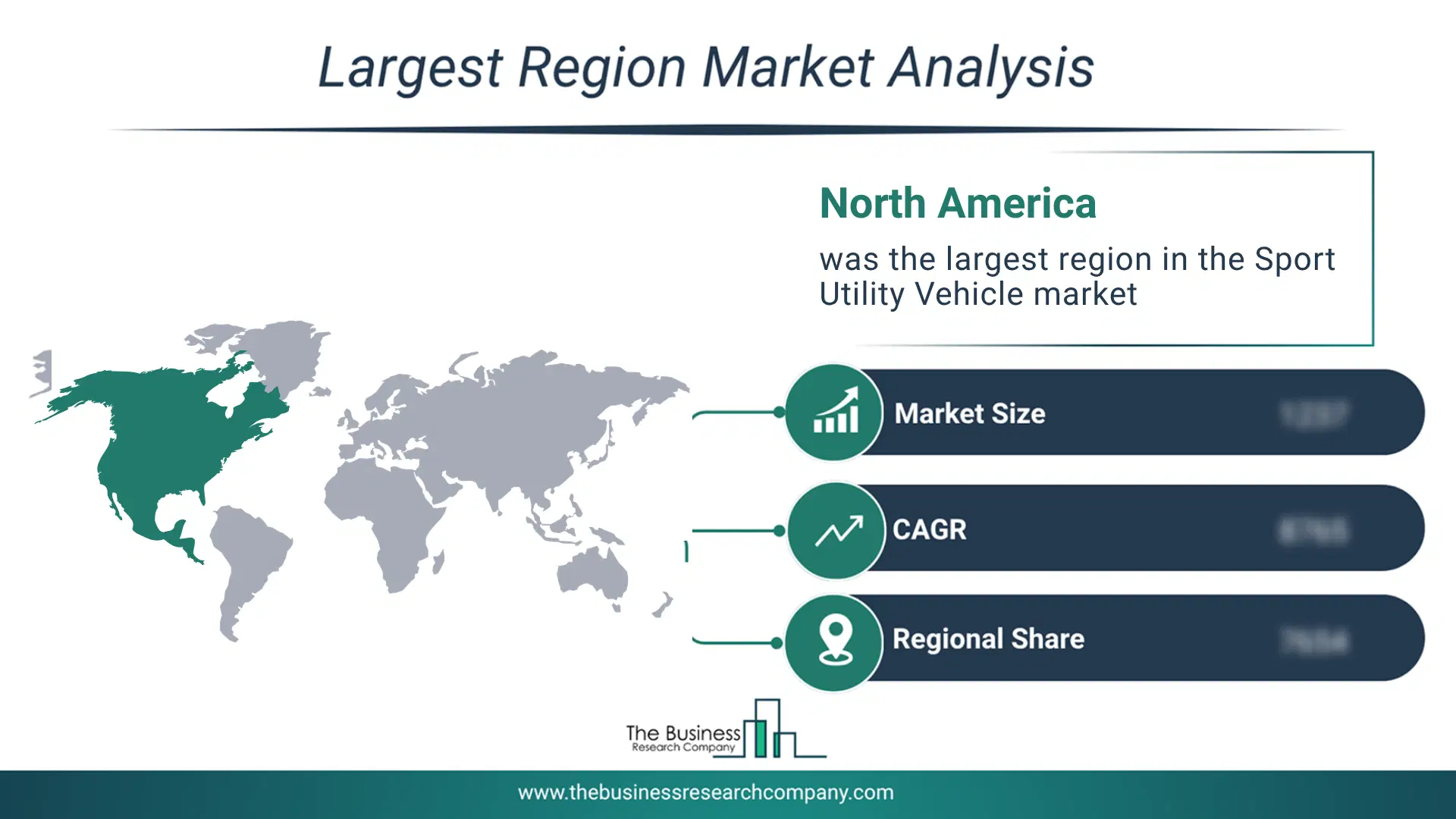
Regional Outlook
North America was the largest region in the sport utility vehicle market in 2025. Asia-Pacific is expected to be the fastest-growing region in the forecast period. The regions covered in this market report include Asia-Pacific, South East Asia, Western Europe, Eastern Europe, North America, South America, Middle East, Africa. The countries covered in this market report include Australia, Brazil, China, France, Germany, India, Indonesia, Japan, Taiwan, Russia, South Korea, UK, USA, Canada, Italy, SpainWhat Defines the Sport Utility Vehicle Market?
The sport utility vehicle market consists of sales of crossover SUVs, traditional SUVs, luxury SUVs, hybrid SUVs, electric SUVs, and off-road SUVs. Values in this market are ‘factory gate’ values, that is the value of goods sold by the manufacturers or creators of the goods, whether to other entities (including downstream manufacturers, wholesalers, distributors and retailers) or directly to end customers. The value of goods in this market includes related services sold by the creators of the goods.How is Market Value Defined and Measured?
The market value is defined as the revenues that enterprises gain from the sale of goods and/or services within the specified market and geography through sales, grants, or donations in terms of the currency (in USD unless otherwise specified). The revenues for a specified geography are consumption values that are revenues generated by organizations in the specified geography within the market, irrespective of where they are produced. It does not include revenues from resales along the supply chain, either further along the supply chain or as part of other products.
This chart presents market attractiveness based on a quantitative evaluation of growth, competition, strategic alignment, and risk, offering a clear view of opportunity areas for decision-making. This chart is for illustrative purposes; the full report contains the complete analysis.

This chart highlights the Total Addressable Market (TAM) by estimating the maximum revenue opportunity using an assumption-driven approach, supporting strategic planning and opportunity sizing across markets. The chart is illustrative; the full report provides a more comprehensive analysis.
What Key Data and Analysis Are Included in the Sport Utility Vehicle Market Report 2026?
The sport utility vehicle market research report is one of a series of new reports from The Business Research Company that provides market statistics, including industry global market size, regional shares, competitors with the market share, detailed market segments, market trends and opportunities, and any further data you may need to thrive in the sport utility vehicle industry. The market research report delivers a complete perspective of everything you need, with an in-depth analysis of the current and future state of the industry.Sport Utility Vehicle Market Report Forecast Analysis
| Report Attribute | Details |
|---|---|
| Market Size Value In 2026 | $941.99 billion |
| Revenue Forecast In 2030 | $1182.5 billion |
| Growth Rate | CAGR of 5.8% from 2026 to 2030 |
| Base Year For Estimation | 2025 |
| Actual Estimates/Historical Data | 2020-2025 |
| Forecast Period | 2026 - 2030 - 2030 |
| Market Representation | Revenue in USD Billion and CAGR from 2026 to 2030 |
| Segments Covered | Type, Size, Drivetrain Type, Application, End-User |
| Regional Scope | Asia-Pacific, Western Europe, Eastern Europe, North America, South America, Middle East, Africa |
| Country Scope | The countries covered in the report are Australia, Brazil, China, France, Germany, India, Indonesia, Japan, Taiwan, Russia, South Korea, UK, USA, Canada, Italy, Spain. |
| Key Companies Profiled | Volkswagen AG, Toyota Motor Corporation, Ford Motor Company, Mercedes-Benz Group AG, General Motors Company, Bayerische Motoren Werke AG, Honda Motor Co. Ltd., SAIC Motor Corporation Limited, Hyundai Motor Company, Tesla Inc., Nissan Motor Co. Ltd, Kia Motors Corporation, BYD Company Limited, Tata Motors Limited, Renault Group, Porsche AG , Mazda Motor Corporation, Mitsubishi Motors Corporation, Mahindra And Mahindra Limited, Maruti Suzuki India Limited, Lexus International, Rivian Automotive Inc., Infiniti Motor Company Ltd., Audi India Private Limited, Jaguar Land Rover Automotive plc |
| Customization Scope | Request for Customization |
| Pricing And Purchase Options | Explore Purchase Options |