
Stem Cell Manufacturing Market Report 2026
Global Outlook – By Product (Consumables, Instruments, Stem Cell Lines), By Application (Research Applications, Clinical Application, Cell And Tissue Banking Applications), By End User (Pharmaceutical And Biotechnology Companies, Academic Institutes, Research Laboratories And Contract Research Organizations, Hospitals And Surgical Centers, Cell And Tissue Banks, Other End Users) - Market Size, Trends, And Global Forecast 2026-2035
Stem Cell Manufacturing Market Overview
• Stem Cell Manufacturing market size has reached to $19.17 billion in 2025 • Expected to grow to $33.55 billion in 2030 at a compound annual growth rate (CAGR) of 11.8% • Growth Driver: Geriatric Population Drives The Stem Cell Manufacturing Market • Market Trend: Innovative Product Development Strategies To Gain A Competitive Edge • North America was the largest region in 2025 and Europe is the fastest growing region.What Is Covered Under Stem Cell Manufacturing Market?
Stem cell manufacturing refers to the necessary technologies that allow stem cell tissue culture, a practice carried out in laboratories for therapeutic purposes, to be transferred to the clinic setting while simultaneously achieving control, reproducibility, automation, validation, and product safety. The main stem cell manufacturing products include consumables, instruments, and stem cell lines. The stem cell manufacturing consumables are used in growing new cells in the culture media, drug development, tissue culture, gene therapy, and toxicity testing. It includes research applications, clinical application and cell and tissue banking applications, used by end-users including pharmaceutical and biotechnology companies, academic institutes, research laboratories and contract research organizations, hospitals and surgical centers, cell and tissue banks and others.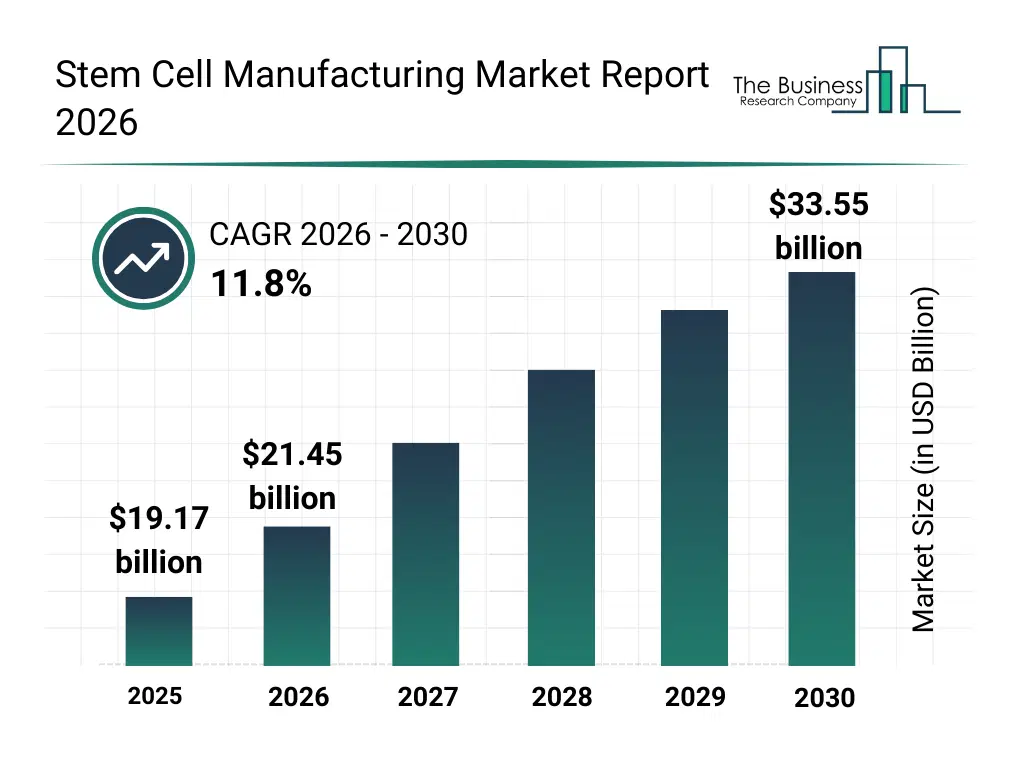
What Is The Stem Cell Manufacturing Market Size and Share 2026?
The stem cell manufacturing market size has grown rapidly in recent years. It will grow from $19.17 billion in 2025 to $21.45 billion in 2026 at a compound annual growth rate (CAGR) of 11.9%. The growth in the historic period can be attributed to clinical trial growth, stem cell therapy approvals, bioprocessing investments, regulatory framework development, contract manufacturing expansion.What Is The Stem Cell Manufacturing Market Growth Forecast?
The stem cell manufacturing market size is expected to see rapid growth in the next few years. It will grow to $33.55 billion in 2030 at a compound annual growth rate (CAGR) of 11.8%. The growth in the forecast period can be attributed to commercial-scale therapy production, cost reduction technologies, decentralized manufacturing models, advanced cell expansion techniques, regulatory harmonization. Major trends in the forecast period include closed-system bioreactors, scalable manufacturing platforms, automation of cell expansion, quality-by-design processes, cryopreservation optimization.
Global Stem Cell Manufacturing Market Segmentation
1) By Product: Consumables, Instruments, Stem Cell Lines 2) By Application: Research Applications, Clinical Application, Cell And Tissue Banking Applications 3) By End User: Pharmaceutical And Biotechnology Companies, Academic Institutes, Research Laboratories And Contract Research Organizations, Hospitals And Surgical Centers, Cell And Tissue Banks, Other End Users Subsegments: 1) By Consumables: Media And Reagents, Cell Culture Vessels, Assay Kits 2) By Instruments: Bioreactors, Cell Counters, Flow Cytometers 3) By Stem Cell Lines: Embryonic Stem Cell Lines, Adult Stem Cell Lines, Induced Pluripotent Stem Cell Lines (iPSCs)What Is The Driver Of The Stem Cell Manufacturing Market?
The rise in geriatric population is expected to propel the stem cell manufacturing market. The geriatric population refers to older adults who are 65 years old and beyond. The geriatric population suffers from various diseases due to low immunity and age. Aging increases the risk of chronic diseases and stem cell manufacturing will help in fighting against these diseases. For instance, in January 2024, according to the Population Reference Bureau, a Kenya-based Nonprofit organization, the population of Americans aged 65 and older is expected to grow from 58 million in 2022 to 82 million by 2050, a 47% increase. This age group’s share of the overall population is also projected to rise from 17% to 23% during the same period. Thus, the rising geriatric population is driving the growth of the stem cell manufacturing industry.Key Players In The Global Stem Cell Manufacturing Market
Major companies operating in the stem cell manufacturing market are Thermo Fisher Scientific Inc., Merck Millipore, Stemcell Technologies, Fujifilm Holdings Corporation, Takara Bio Group, Lonza Group AG, Sartorius AG, Bio-Rad Laboratories, Becton Dickinson and Company, Bio-Techne Corporation, Miltenyi Biotec, Terumo BCT Inc., Corning Inc., Eppendorf AG, ViaCyte Inc., Merck KGaA, Danaher Corporation, Vericel Corporation, American Cryostem Corporation, Cellgenix GMBH, Aspen Neuroscience Inc., Magenta Therapeutics Inc, Pluristem Therapeutics Inc., Takeda Pharmaceutical Company Limited, AbbVie Inc., 3D Biomatrix Inc., Worthington Biochemical Corporation, Bico GroupGlobal Stem Cell Manufacturing Market Trends and Insights
Major companies operating in the stem cell manufacturing market are focused on developing innovative products, such as GM-grade protein, to gain a competitive edge in the market. GM-grade protein is a designation given to protein powders and other protein products that meet certain standards for quality and safety. For instance, in November 2023, ACROBiosystems Inc., a US-based provider of recombinant proteins and other critical reagents, launched GM-grade DLL4 protein. It is a recombinant, soluble form of Delta-like Ligand 4 (DLL4), a key signaling molecule critical in stem cell development and differentiation. The availability of GMP-grade DLL4 is a significant milestone for developing stem cell-based therapies, as it provides a high-quality, consistent, and scalable source of this important protein. DLL4 is known to promote the self-renewal and expansion of hematopoietic stem cells (HSCs), which are the precursors to all blood cells and can be used to supplement stem cell cultures in vitro, thereby enhancing the growth and differentiation of HSCs.What Are Latest Mergers And Acquisitions In The Stem Cell Manufacturing Market?
In April 2025, Neuroscientific Biopharmaceuticals Ltd, a Australia-based biotechnology company, acquired Isopogen WA Ltd. for an undisclosed amount. With this acquisition, NeuroScientific aims to expand its stem cell portfolio, strengthen its research and development capabilities, accelerate the development of novel cell-based therapies, and enhance its position in the regenerative medicine market. Isopogen WA Ltd. is a Australia-based provider of advanced stem cell technologies and solutions for preclinical and translational research.Regional Outlook
North America was the largest region in the stem cell manufacturing market in 2025. Europe was the second-largest region in the stem cell manufacturing market. The regions covered in this market report are Asia-Pacific, South East Asia, Western Europe, Eastern Europe, North America, South America, Middle East, Africa. The countries covered in this market report are Australia, Brazil, China, France, Germany, India, Indonesia, Japan, Taiwan, Russia, South Korea, UK, USA, Canada, Italy, Spain.What Defines the Stem Cell Manufacturing Market?
The stem cell manufacturing market consists of sales of adult stem cells (ASCs), human embryonic stem cells (HESCs), induced pluripotent stem cells (iPSCs), and very small embryonic-like cells. Values in this market are ‘factory gate’ values, that is the value of goods sold by the manufacturers or creators of the goods, whether to other entities (including downstream manufacturers, wholesalers, distributors and retailers) or directly to end customers. The value of goods in this market includes related services sold by the creators of the goods.How is Market Value Defined and Measured?
The market value is defined as the revenues that enterprises gain from the sale of goods and/or services within the specified market and geography through sales, grants, or donations in terms of the currency (in USD unless otherwise specified). The revenues for a specified geography are consumption values that are revenues generated by organizations in the specified geography within the market, irrespective of where they are produced. It does not include revenues from resales along the supply chain, either further along the supply chain or as part of other products.What Key Data and Analysis Are Included in the Stem Cell Manufacturing Market Report 2026?
The stem cell manufacturing market research report is one of a series of new reports from The Business Research Company that provides market statistics, including industry global market size, regional shares, competitors with the market share, detailed market segments, market trends and opportunities, and any further data you may need to thrive in the stem cell manufacturing industry. The market research report delivers a complete perspective of everything you need, with an in-depth analysis of the current and future state of the industry.Stem Cell Manufacturing Market Report Forecast Analysis
| Report Attribute | Details |
|---|---|
| Market Size Value In 2026 | $21.45 billion |
| Revenue Forecast In 2035 | $33.55 billion |
| Growth Rate | CAGR of 11.9% from 2026 to 2035 |
| Base Year For Estimation | 2025 |
| Actual Estimates/Historical Data | 2020-2025 |
| Forecast Period | 2026 - 2030 - 2035 |
| Market Representation | Revenue in USD Billion and CAGR from 2026 to 2035 |
| Segments Covered | Product, Application, End User |
| Regional Scope | Asia-Pacific, Western Europe, Eastern Europe, North America, South America, Middle East, Africa |
| Country Scope | The countries covered in the report are Australia, Brazil, China, France, Germany, India, ... |
| Key Companies Profiled | Thermo Fisher Scientific Inc., Merck Millipore, Stemcell Technologies, Fujifilm Holdings Corporation, Takara Bio Group, Lonza Group AG, Sartorius AG, Bio-Rad Laboratories, Becton Dickinson and Company, Bio-Techne Corporation, Miltenyi Biotec, Terumo BCT Inc., Corning Inc., Eppendorf AG, ViaCyte Inc., Merck KGaA, Danaher Corporation, Vericel Corporation, American Cryostem Corporation, Cellgenix GMBH, Aspen Neuroscience Inc., Magenta Therapeutics Inc, Pluristem Therapeutics Inc., Takeda Pharmaceutical Company Limited, AbbVie Inc., 3D Biomatrix Inc., Worthington Biochemical Corporation, Bico Group |
| Customization Scope | Request for Customization |
| Pricing And Purchase Options | Explore Purchase Options |