
Telecom Tower Market Report 2026
Global Outlook – By Type of Tower (Lattice Tower, Guyed Tower, Monopole Towers, Stealth Towers, Other Types), By Fuel Type (Grid Electricity, Diesel Generators, Solar Power, Hybrid Power Systems, Battery Storage), By Installation (Rooftop, Ground-Based), By Ownership (Operator-Owned, Joint Venture, Private-Owned, Mobile Network Operator (MNO) Captive) – Market Size, Trends, Strategies, and Forecast to 2030
Telecom Tower Market Overview
• Telecom Tower market size has reached to $60.68 billion in 2025 • Expected to grow to $86.69 billion in 2030 at a compound annual growth rate (CAGR) of 7.3% • Growth Driver: Government-Led Expansion Fueling The Surge Of Telecom Towers Through Initiatives In Telecommunications • Market Trend: Innovations In Satellite-Based Connectivity Solutions To Enhance Coverage and Reliability • North America was the largest region in 2025.What Is Covered Under Telecom Tower Market?
A telecom tower is a freestanding mast, pole, free-standing tower, or other structure designed and primarily used for a public utility to support wireless telecommunications facility antennas. The telecom tower is outfitted with electrical equipment and antennas for transmitting and receiving signals to and from cell phones. The main types of telecom towers are lattice towers, guyed towers, monopole towers, stealth towers, and others. Lattice towers are segmentally designed and freestanding with rectangular or triangular base steel lattices, enabling the mounting of a large number of panel or dish antennas, which offer stability and flexibility as compared to other cell towers. These are operated by renewable and non-renewable fuel and installed by rooftop and ground-based facilities. These are mainly operator-owned, joint venture, private-owned, mobile network operator (MNO) captive owned.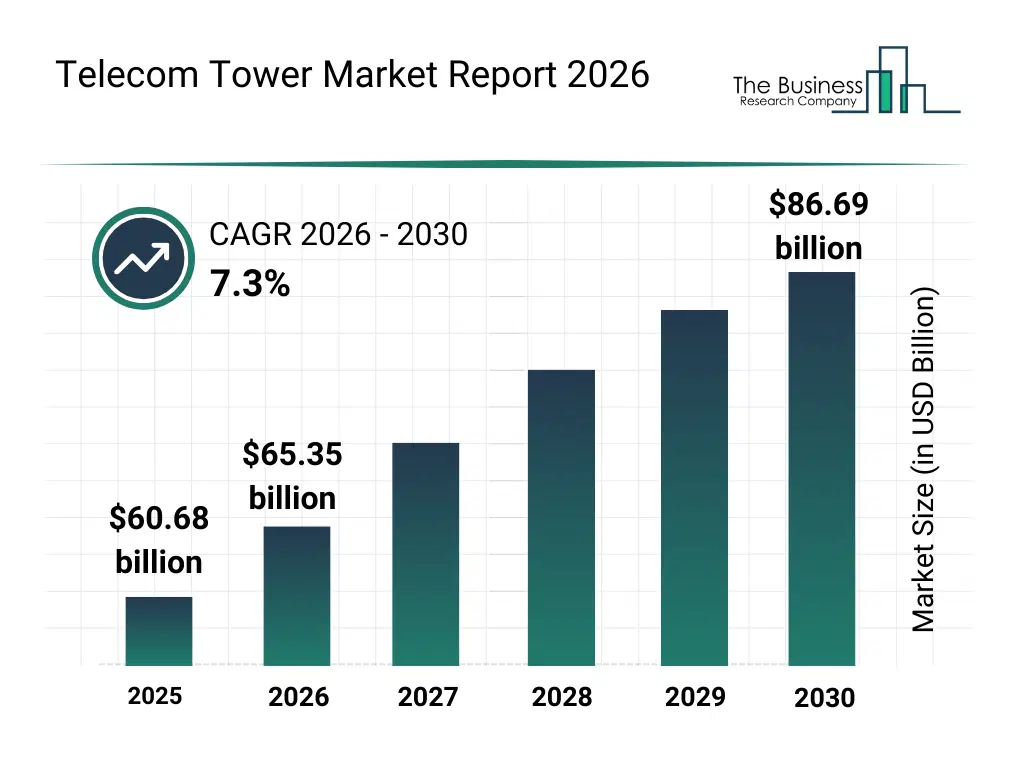
What Is The Telecom Tower Market Size and Share 2026?
The telecom tower market size has grown strongly in recent years. It will grow from $60.68 billion in 2025 to $65.35 billion in 2026 at a compound annual growth rate (CAGR) of 7.7%. The growth in the historic period can be attributed to rapid expansion of mobile networks, rising smartphone penetration, demand for wider network coverage, growth of independent tower companies, early adoption of tower sharing models.What Is The Telecom Tower Market Growth Forecast?
The telecom tower market size is expected to see strong growth in the next few years. It will grow to $86.69 billion in 2030 at a compound annual growth rate (CAGR) of 7.3%. The growth in the forecast period can be attributed to 5G network densification, increasing rural connectivity initiatives, focus on energy efficient tower solutions, expansion of small cell deployments, rising investments in smart tower management. Major trends in the forecast period include tower infrastructure sharing, smart energy management systems, green telecom towers, 5G ready tower deployments, remote tower monitoring.
Global Telecom Tower Market Segmentation
1) By Type of Tower: Lattice Tower, Guyed Tower, Monopole Towers, Stealth Towers, Other Types 2) By Fuel Type: Grid Electricity, Diesel Generators, Solar Power, Hybrid Power Systems, Battery Storage 3) By Installation: Rooftop, Ground-Based 4) By Ownership: Operator-Owned, Joint Venture, Private-Owned, Mobile Network Operator (MNO) Captive Subsegments: 1) By Lattice Tower: Three Legged Lattice Tower, Four Legged Lattice Tower, Self Supporting Lattice Tower, Heavy Duty Lattice Tower, Light Duty Lattice Tower 2) By Guyed Tower: Guyed Mast Tower, Guyed Monopole Tower, Guyed Lightweight Tower, Guyed High Height Tower 3) By Monopole Towers: Ground Based Monopole Tower, Rooftop Monopole Tower, Slim Pole Monopole Tower, Tapered Monopole Tower 4) By Stealth Towers: Tree Pole Tower, Flag Pole Tower, Church Steeple Tower, Street Light Tower, Building Integrated Tower 5) By Other Types: Rooftop Tower, Mobile Tower, Temporary Tower, Camouflaged Tower, Portable TowerWhat Is The Driver Of The Telecom Tower Market?
Increasing government initiatives for the telecommunication sector are expected to propel the growth of the telecom tower market going forward. Government initiatives for the telecommunications sector typically refer to policies, programs, and actions implemented by governments to regulate, support, and promote the development of the telecommunications industry. Government initiatives in the telecommunications sector shape the regulatory, economic, and technological landscape within which telecom towers operate. For instance, in October 2023, according to the data from the Department for Science, Innovation, and Technology, conducted by UK Research and Innovation, a UK-based government agency, in 2023, the UK government allocated $89.6 million (£70 million) to the Future Telecoms UKRI Technology Missions Fund (TMF) program supporting the development of next-generation telecommunications technology in the UK. Therefore, increasing government initiatives for the telecommunication sector is driving the growth of the telecom tower industry.Key Players In The Global Telecom Tower Market
Major companies operating in the telecom tower market are China Tower Co. Ltd.; American Tower Corp.; Indus Towers Ltd.; Crown Castle International Corp.; SBA Communications Corp.; Bharti Infratel Ltd.; Helios Towers Africa; Cellnex Telecom SA; GTL Infrastructure; Phoenix Tower International; IHS Towers; Telesites S.A.B de C.V.; Viom Networks; edotco Group; Tower Bersama Infrastructure; Grupo TorreSur; Vertical Bridge Holdings LLC; InSite Wireless Group LLC; Lendlease Towers; Frontier Tower Solutions; Telxius Towers; Wireless Infrastructure Group; Eaton Towers; Phoenix Tower Partners; ATC Telecom Infrastructure
This chart is for illustrative purposes; the full report includes a detailed competitor analysis and comprehensive overview of the top 10 companies in the market.
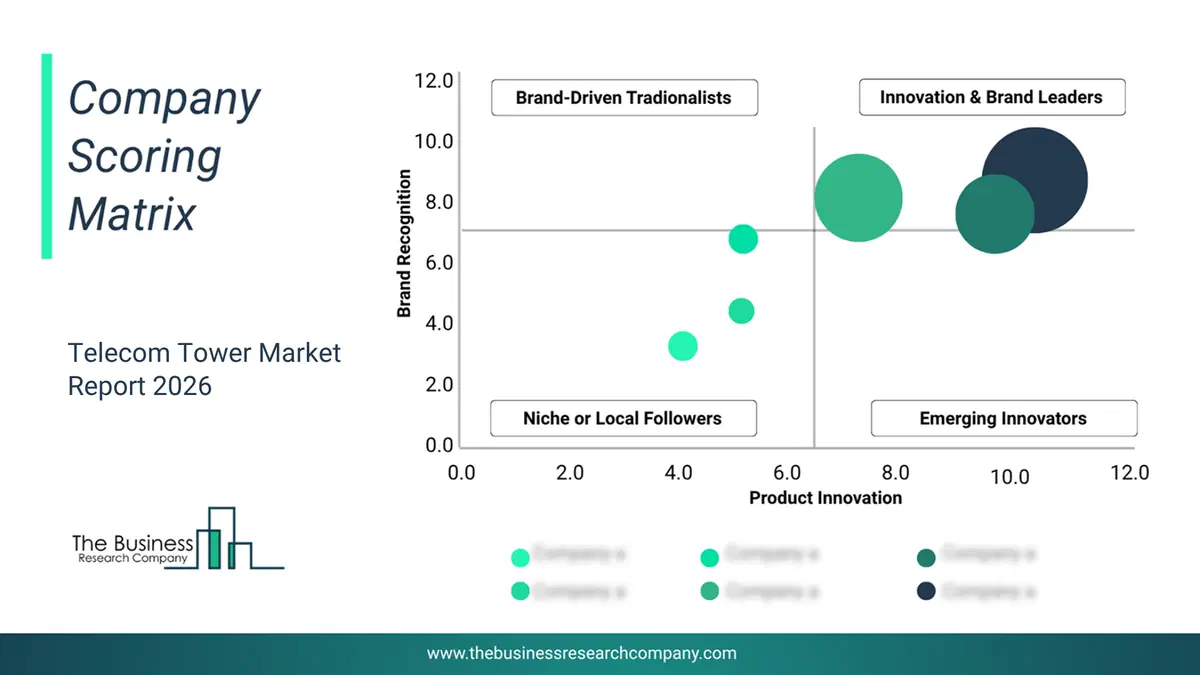
This chart maps companies by product innovation and brand strength, with bubble size indicating relative revenue, helping identify market leaders, challengers, and niche players. This is an illustrative chart; the full report provides a complete and accurate competitive analysis.
Global Telecom Tower Market Trends and Insights
Major companies in the telecom tower market are focusing on the development of satellite-based connectivity solutions to bridge the digital divide, enhance network reliability, and provide improved coverage in remote and underserved regions. Satellite-based connectivity solutions enhance the telecom tower by offering coverage in remote and challenging locations where traditional towers cannot reach, thereby improving overall network accessibility and reliability. For instance, in June 2024, SpaceX, a US-based astronautics company, launched its direct-to-cell technology, using modified Starlink satellites to deliver cellular connectivity in remote areas, enabling reliable voice calls, text messaging, and data services. This innovation features direct satellite links to mobile devices, overcoming dead zones, with plans to enhance transmission speeds and support voice and data services. Its introduction significantly impacts the telecom tower market by reducing reliance on ground-based infrastructure, expanding coverage in underserved regions, and creating new opportunities for telecommunication services worldwide.What Are Latest Mergers And Acquisitions In The Telecom Tower Market?
In January 2024, Actis-led consortium, a UK-based private equity and infrastructure investment company, acquired Telekom Srbija for an undisclosed amount. Through this acquisition, the Actis-led consortium aims to establish an independent telecommunications tower company in the Western Balkans by acquiring Telekom Srbija’s macro tower portfolio. This investment will enhance digital infrastructure, meet rising mobile data demand, and support the rollout of 5G and 6G technologies while improving mobile coverage in the region. Telekom Srbija a.d. is a Serbia-based telecommunications company that specializes in telecommunications services, including fixed-line and mobile telephony, internet services, digital television, and telecom tower services.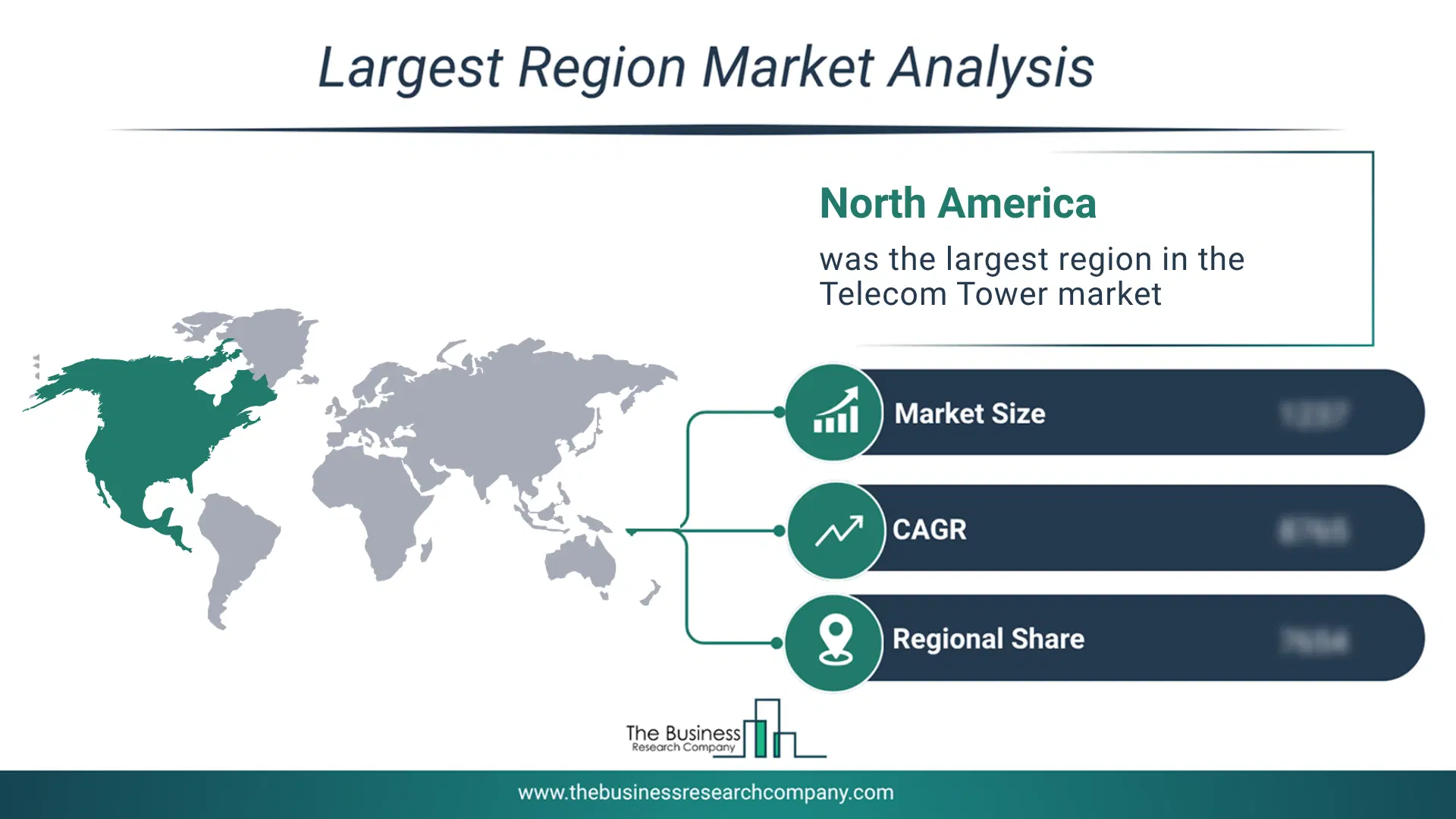
Regional Insights
North America was the largest region in the telecom tower market in 2025. The regions covered in this market report are Asia-Pacific, South East Asia, Western Europe, Eastern Europe, North America, South America, Middle East, Africa. The countries covered in this market report are Australia, Brazil, China, France, Germany, India, Indonesia, Japan, Taiwan, Russia, South Korea, UK, USA, Canada, Italy, SpainWhat Defines the Telecom Tower Market?
The telecom tower market consists of revenues earned by entities by providing telecom services such as fixed-network services and mobile services, voice, data, internet, and cloud services. The market value includes the value of related goods sold by the service provider or included within the service offering. The telecom tower market also includes sales of tubular towers, angular towers, and rooftop towers which are used in providing telecom tower services. Values in this market are ‘factory gate’ values, that is the value of goods sold by the manufacturers or creators of the goods, whether to other entities (including downstream manufacturers, wholesalers, distributors and retailers) or directly to end customers. The value of goods in this market includes related services sold by the creators of the goods.How is Market Value Defined and Measured?
The market value is defined as the revenues that enterprises gain from the sale of goods and/or services within the specified market and geography through sales, grants, or donations in terms of the currency (in USD unless otherwise specified). The revenues for a specified geography are consumption values that are revenues generated by organizations in the specified geography within the market, irrespective of where they are produced. It does not include revenues from resales along the supply chain, either further along the supply chain or as part of other products.
This chart presents market attractiveness based on a quantitative evaluation of growth, competition, strategic alignment, and risk, offering a clear view of opportunity areas for decision-making. This chart is for illustrative purposes; the full report contains the complete analysis.

This chart highlights the Total Addressable Market (TAM) by estimating the maximum revenue opportunity using an assumption-driven approach, supporting strategic planning and opportunity sizing across markets. The chart is illustrative; the full report provides a more comprehensive analysis.
What Key Data and Analysis Are Included in the Telecom Tower Market Report 2026?
The telecom tower market research report is one of a series of new reports from The Business Research Company that provides market statistics, including industry global market size, regional shares, competitors with the market share, detailed market segments, market trends and opportunities, and any further data you may need to thrive in the telecom tower industry. The market research report delivers a complete perspective of everything you need, with an in-depth analysis of the current and future state of the industry.Telecom Tower Market Report Forecast Analysis
| Report Attribute | Details |
|---|---|
| Market Size Value In 2026 | $65.35 billion |
| Revenue Forecast In 2030 | $86.69 billion |
| Growth Rate | CAGR of 7.3% from 2026 to 2030 |
| Base Year For Estimation | 2025 |
| Actual Estimates/Historical Data | 2020-2025 |
| Forecast Period | 2026 - 2030 |
| Market Representation | Revenue in USD Billion and CAGR from 2026 to 2030 |
| Segments Covered | Type of Tower, Fuel Type, Installation, Ownership |
| Regional Scope | Asia-Pacific, Western Europe, Eastern Europe, North America, South America, Middle East, Africa |
| Country Scope | The Countries Covered In This Market Report Are Australia, Brazil, China, France, Germany, India, Indonesia, Japan, Taiwan, Russia, South Korea, Uk, Usa, Canada, Italy, Spain. |
| Key Companies Profiled | China Tower Co. Ltd., American Tower Corp., Indus Towers Ltd., Crown Castle International Corp., SBA Communications Corp., Bharti Infratel Ltd., Helios Towers Africa, Cellnex Telecom SA, GTL Infrastructure, Phoenix Tower International, IHS Towers, Telesites S.A.B de C.V., Viom Networks, edotco Group, Tower Bersama Infrastructure, Grupo TorreSur, Vertical Bridge Holdings LLC, InSite Wireless Group LLC, Lendlease Towers, Frontier Tower Solutions, Telxius Towers, Wireless Infrastructure Group, Eaton Towers, Phoenix Tower Partners, ATC Telecom Infrastructure |
| Customization Scope | Request for Customization |
| Pricing And Purchase Options | Explore Purchase Options |