
Underground Natural Gas Storage Market Report 2026
Global Outlook – By Type (Depleted Gas Reservoir, Salt Caverns, Aquifers, Other Types), By Application (Residential, Commercial, Other Applications), By End-Use Sector (Utilities & Power Generation, Industrial, Residential & Commercial, Oil & Gas Operators) – Market Size, Trends, Strategies, and Forecast to 2030
Underground Natural Gas Storage Market Overview
• Underground Natural Gas Storage market size has reached to $339.93 billion in 2025 • Expected to grow to $436.25 billion in 2030 at a compound annual growth rate (CAGR) of 5.1% • Growth Driver: Rising Natural Gas Production Boosts The Underground Natural Gas Storage Market Growth • Market Trend: Advanced Solutions In Hydrogen Storage For Enhanced Energy Security And Reduced Carbon Emissions • Europe was the largest region in 2025 and Asia-Pacific is the fastest growing region.What Is Covered Under Underground Natural Gas Storage Market?
Underground natural gas storage facilities store large quantities of natural gas, which can be withdrawn and distributed during periods of high demand. These facilities stabilize natural gas prices by mitigating sudden spikes in demand or supply shortages. By releasing stored gas during high-demand periods, they help maintain a steady market supply and control price volatility. The main types of underground natural gas storage are depleted gas reservoirs, salt caverns, aquifers, and others. Depleted gas reservoirs are repurposed old gas fields, emptied of their original gas, and used for storing new gas due to their proven capacity and geological stability. They stored various products, such as natural gas, hydrogen, and others, for several applications, including residential, commercial, and others.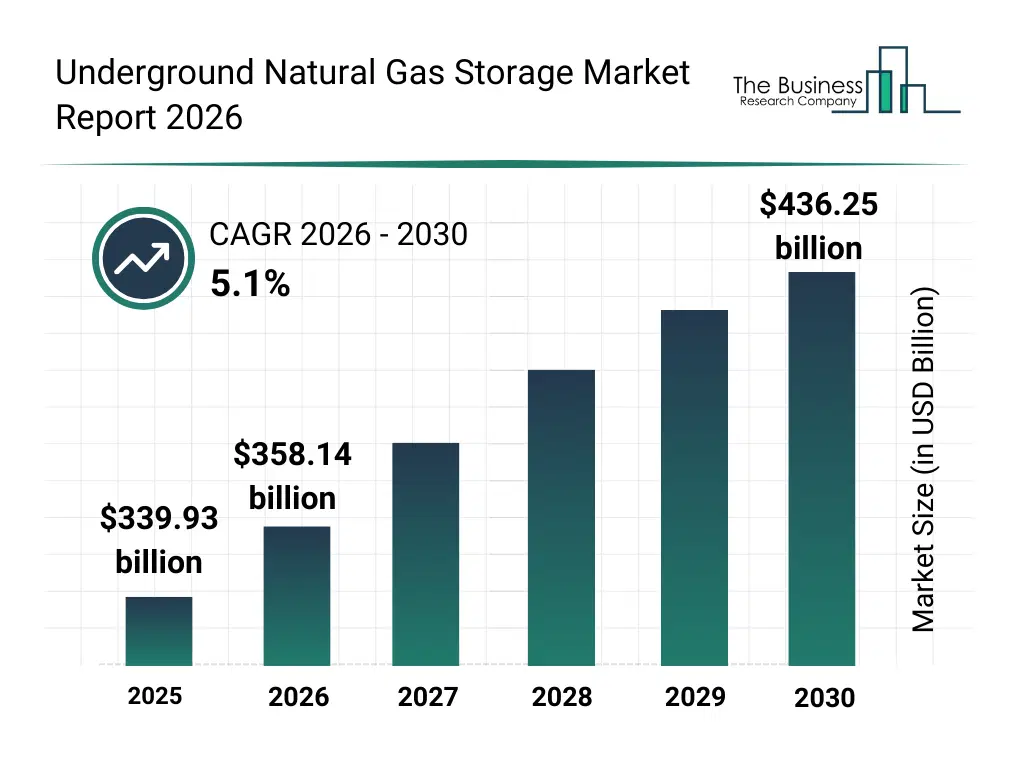
What Is The Underground Natural Gas Storage Market Size and Share 2026?
The underground natural gas storage market size has grown strongly in recent years. It will grow from $339.93 billion in 2025 to $358.14 billion in 2026 at a compound annual growth rate (CAGR) of 5.4%. The growth in the historic period can be attributed to seasonal gas demand fluctuations, growth of natural gas consumption, price volatility management needs, expansion of pipeline networks, government energy security policies.What Is The Underground Natural Gas Storage Market Growth Forecast?
The underground natural gas storage market size is expected to see strong growth in the next few years. It will grow to $436.25 billion in 2030 at a compound annual growth rate (CAGR) of 5.1%. The growth in the forecast period can be attributed to hydrogen blending initiatives, demand for grid balancing, expansion of LNG infrastructure, decarbonization transition needs, digital monitoring of storage assets. Major trends in the forecast period include rising investment in energy storage infrastructure, growing use of salt cavern storage facilities, expansion of strategic gas reserves, increasing integration with smart grid systems, higher focus on supply security and reliability.
Global Underground Natural Gas Storage Market Segmentation
1) By Type: Depleted Gas Reservoir, Salt Caverns, Aquifers, Other Types 2) By Application: Residential, Commercial, Other Applications 3) By End-Use Sector: Utilities & Power Generation, Industrial, Residential & Commercial, Oil & Gas Operators Subsegments: 1) By Depleted Gas Reservoir: Onshore Reservoirs, Offshore Reservoirs 2) By Salt Caverns: Solution-Mined Caverns, Compacted Salt Caverns 3) By Aquifers: Freshwater Aquifers, Brine Aquifers 4) By Other Types: Geological Formations, Non-Conventional StorageWhat Is The Driver Of The Underground Natural Gas Storage Market?
The increasing production of natural gas is expected to propel the growth of the underground natural gas storage market going forward. Natural gas is mainly made up of methane (CH₄), with trace amounts of other hydrocarbons such as ethane, propane, and butane, which are considered cleaner alternatives to other fossil fuels. The demand for natural gas is rising due to several factors, such as the transition to cleaner energy, industrialization, and energy security. Underground storage manages natural gas fluctuations by storing excess gas during low-demand periods and withdrawing it during peaks, ensuring a stable supply and pricing. It also supports grid stability and renewable energy integration by providing backup when renewable generation is low. For instance, in September 2024, the Energy Information Administration (EIA), a US-based government administration, reported that US dry natural gas production in 2023 reached 37.8 trillion cubic feet (Tcf), or 103.6 billion cubic feet per day (Bcf/d), a 4.3% increase from the 2022 level of 99.3 Bcf/d. Therefore, the increasing production of natural gas will drive the underground natural gas storage industry.Key Players In The Global Underground Natural Gas Storage Market
Major companies operating in the underground natural gas storage market are Exxon Mobil Corporation, Equinor ASA, Uniper Energy Storage GmbH, Gazprom PJSC, Enbridge Inc., ONEOK, Inc., Sempra Energy, TC Energy Corporation, The Williams Companies, Inc., National Joint Stock Company Naftogaz of Ukraine, National Fuel Gas Company, China National Petroleum Corporation, Snam S.p.A., ENGIE SA, E.ON SE, Centrica plc, Kinder Morgan, Inc., Dominion Energy, Inc., Polskie Górnictwo Naftowe i Gazownictwo S.A., VNG‑Verbundnetz Gas AG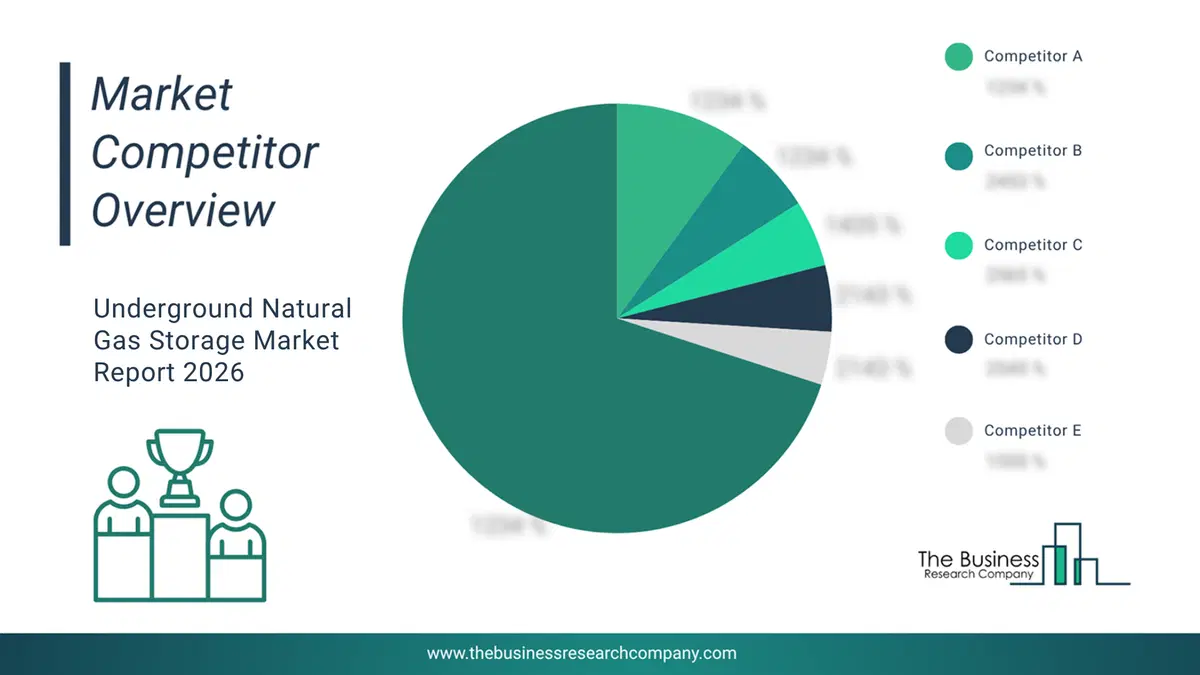
This chart is for illustrative purposes; the full report includes a detailed competitor analysis and comprehensive overview of the top 10 companies in the market.
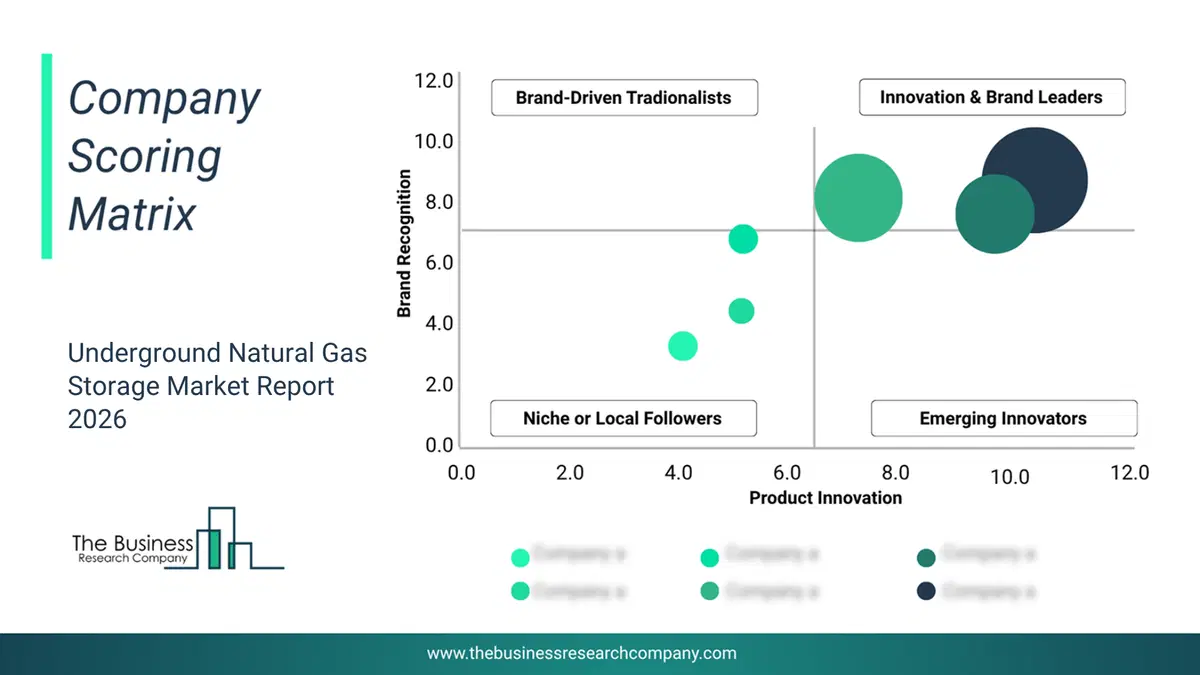
This chart maps companies by product innovation and brand strength, with bubble size indicating relative revenue, helping identify market leaders, challengers, and niche players. This is an illustrative chart; the full report provides a complete and accurate competitive analysis.
Global Underground Natural Gas Storage Market Trends and Insights
Major companies operating in the underground natural gas storage market are focused on developing advanced solutions, such as the hydrogen storage salt caverns initiative, to enhance energy security and reduce carbon emissions. The hydrogen storage salt caverns initiative focuses on utilizing the unique features of salt deposits to securely and efficiently store hydrogen. For instance, in March 2024, the European Consortium, a UK-based association formed by 17 partners and coordinated by Storengy, a UK-based natural gas storage company, launched the FrHyGe project. This project, funded by the European Union's Clean Hydrogen Partnership, intends to validate subterranean hydrogen storage in salt caverns on an industrial scale. The budget is €43 million ($46.91 million). It aims to build an industrial prototype in Manosque, France, and investigate replicability in Harsefeld, Germany, with potential applications throughout Europe. The objectives of this project include converting natural gas or brine salt caverns into hydrogen storage facilities, demonstrating the ability to inject and withdraw 100 metric tons of hydrogen over cycles ranging from one hour to one week, investigating market penetration and supply chains, and planning for replication at other European sites. Furthermore, it will assess environmental implications, safety criteria, and laws in advance of deployment on the GeoH2 (Manosque) and SaltHy (Harsefeld) projects.What Are Latest Mergers And Acquisitions In The Underground Natural Gas Storage Market?
In January 2024, Williams, a US-based oil and gas company, acquired a portfolio of natural gas storage assets from Hartree Partners LP for $1.95 billion. Through this acquisition, Williams purchased six underground storage facilities in Louisiana and Mississippi with a combined capacity of 115 billion cubic feet (Bcf), as well as 230 miles of gas transmission pipelines and 30 pipeline interconnects, connecting to key markets including LNG and Transco. Hartree Partners LP is a US-based company specializing in underground natural gas storage facilities.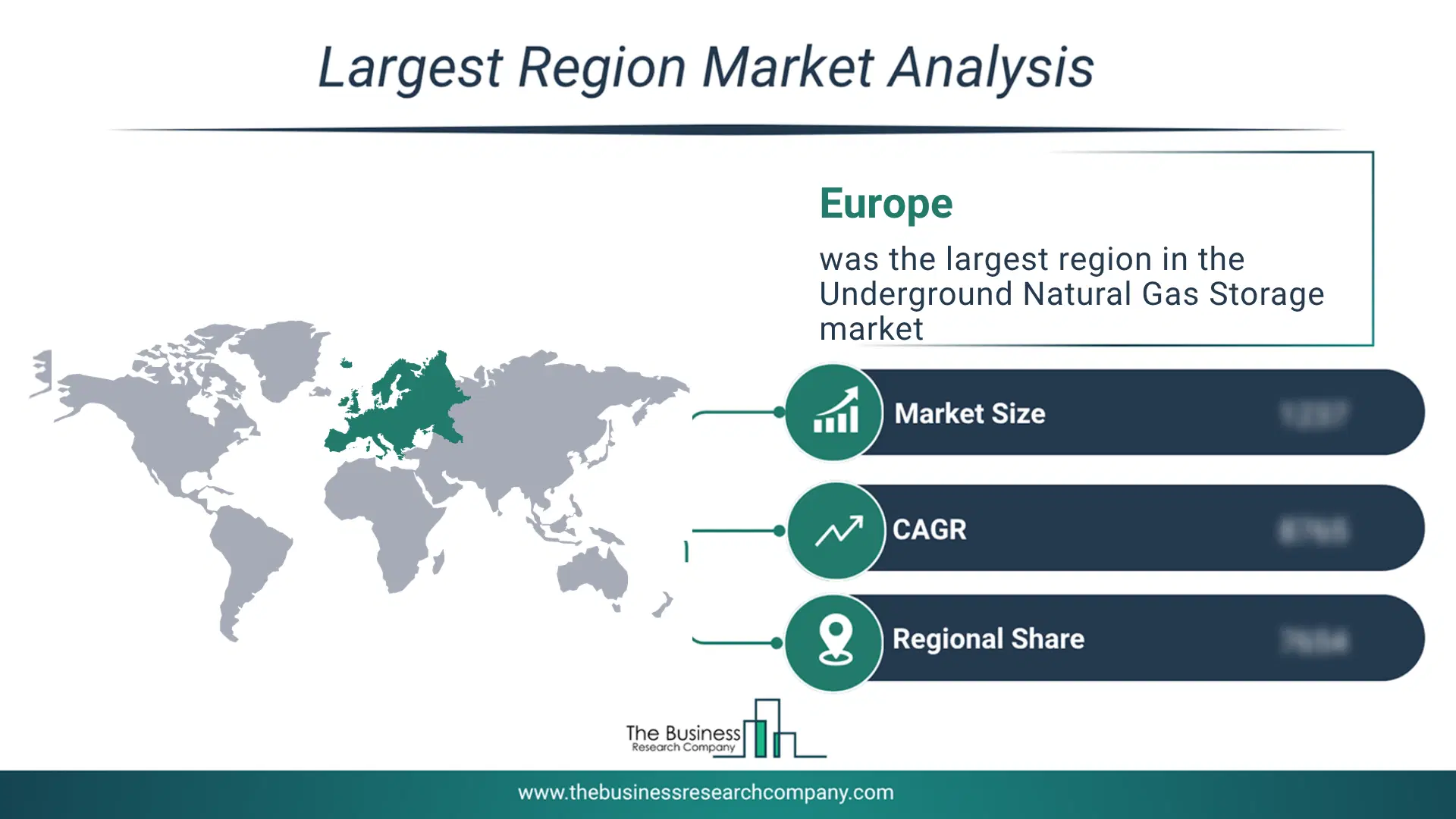
Regional Insights
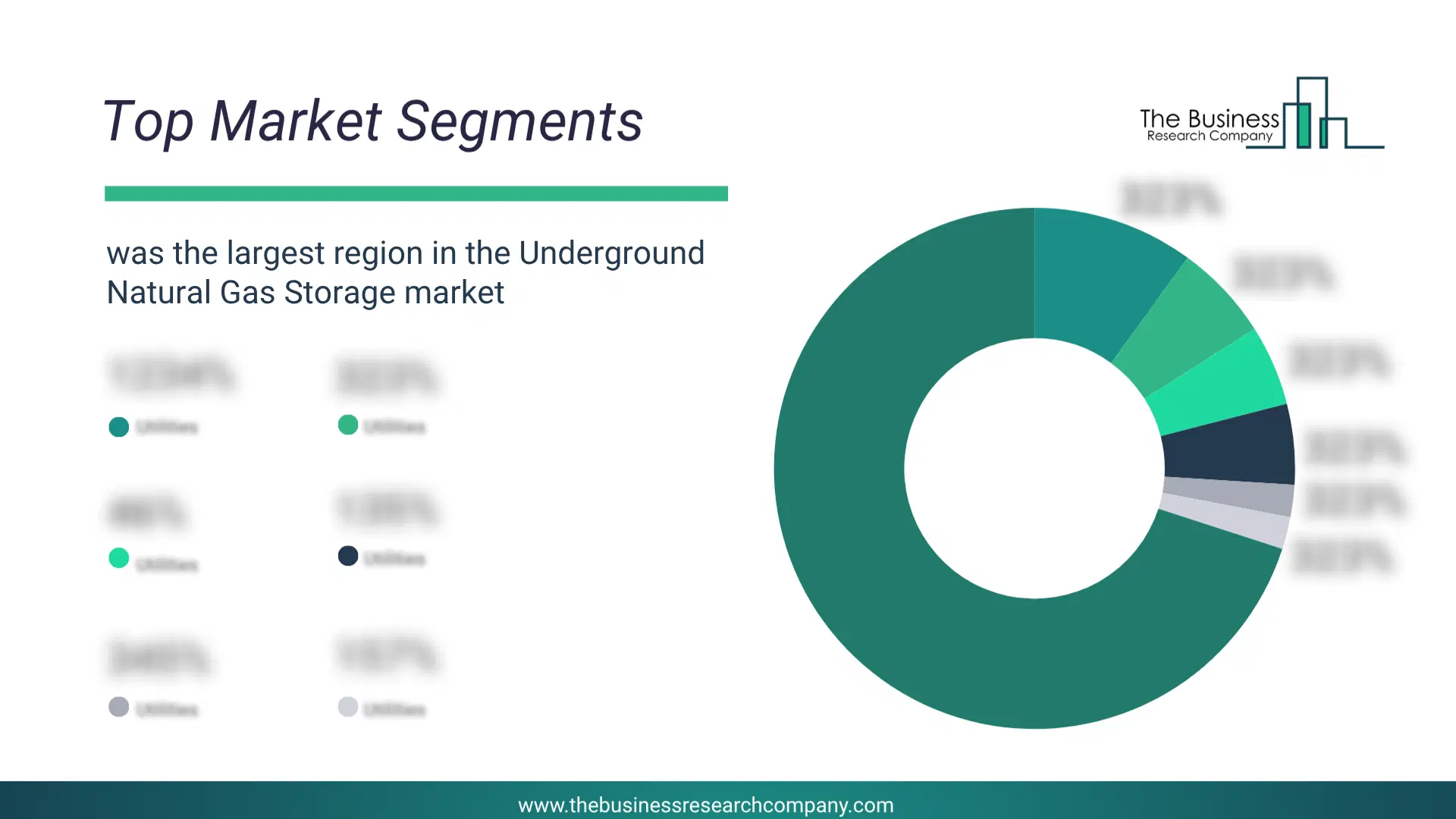
Europe was the largest region in the underground natural gas market in 2025. The regions covered in this market report are Asia-Pacific, South East Asia, Western Europe, Eastern Europe, North America, South America, Middle East, Africa The countries covered in this market report are Australia, Brazil, China, France, Germany, India, Indonesia, Japan, Taiwan, Russia, South Korea, UK, USA, Canada, Italy, SpainWhat Defines the Underground Natural Gas Storage Market?
The underground natural gas storage market consists of revenues earned by entities by providing services such as seasonal supply balancing, operational flexibility, strategic reserve, and emergency backup. The market value includes the value of related goods sold by the service provider or included within the service offering. Only goods and services traded between entities or sold to end consumers are included.How is Market Value Defined and Measured?
The market value is defined as the revenues that enterprises gain from the sale of goods and/or services within the specified market and geography through sales, grants, or donations in terms of the currency (in USD unless otherwise specified). The revenues for a specified geography are consumption values that are revenues generated by organizations in the specified geography within the market, irrespective of where they are produced. It does not include revenues from resales along the supply chain, either further along the supply chain or as part of other products.
This chart presents market attractiveness based on a quantitative evaluation of growth, competition, strategic alignment, and risk, offering a clear view of opportunity areas for decision-making. This chart is for illustrative purposes; the full report contains the complete analysis.

This chart highlights the Total Addressable Market (TAM) by estimating the maximum revenue opportunity using an assumption-driven approach, supporting strategic planning and opportunity sizing across markets. The chart is illustrative; the full report provides a more comprehensive analysis.
What Key Data and Analysis Are Included in the Underground Natural Gas Storage Market Report 2026?
The underground natural gas storage market research report is one of a series of new reports from The Business Research Company that provides market statistics, including industry global market size, regional shares, competitors with the market share, detailed market segments, market trends and opportunities, and any further data you may need to thrive in the underground natural gas storage industry. The market research report delivers a complete perspective of everything you need, with an in-depth analysis of the current and future state of the industry.Underground Natural Gas Storage Market Report Forecast Analysis
| Report Attribute | Details |
|---|---|
| Market Size Value In 2026 | $358.14 billion |
| Revenue Forecast In 2030 | $436.25 billion |
| Growth Rate | CAGR of 5.4% from 2026 to 2030 |
| Base Year For Estimation | 2025 |
| Actual Estimates/Historical Data | 2020-2025 |
| Forecast Period | 2026 - 2030 |
| Market Representation | Revenue in USD Billion and CAGR from 2026 to 2030 |
| Segments Covered | Type, Application, End-Use Sector |
| Regional Scope | Asia-Pacific, Western Europe, Eastern Europe, North America, South America, Middle East, Africa |
| Country Scope | The countries covered in this market report are Australia, Brazil, China, France, Germany, India, Indonesia, Japan, Taiwan, Russia, South Korea, UK, USA, Canada, Italy, Spain |
| Key Companies Profiled | Exxon Mobil Corporation, Equinor ASA, Uniper Energy Storage GmbH, Gazprom PJSC, Enbridge Inc., ONEOK, Inc., Sempra Energy, TC Energy Corporation, The Williams Companies, Inc., National Joint Stock Company Naftogaz of Ukraine, National Fuel Gas Company, China National Petroleum Corporation, Snam S.p.A., ENGIE SA, E.ON SE, Centrica plc, Kinder Morgan, Inc., Dominion Energy, Inc., Polskie Górnictwo Naftowe i Gazownictwo S.A., VNG‑Verbundnetz Gas AG |
| Customization Scope | Request for Customization |
| Pricing And Purchase Options | Explore Purchase Options |