
Zero-Emission Aircraft Market Report 2026
Global Outlook – By Type (Turboprop Rear Bulkhead, Turbofan System, Blended Wing Body), By Source (Hydrogen, Electric, Solar), By Range (Short-Haul, Medium-Haul, Long-Haul), By Technology (Electric Motor Technology, Fuel Cell Technology, Hydrogen Fuel Storage, Power Management And Distribution Technology, Other Technology), By Application (Passenger Aircraft, Cargo Aircraft) – Market Size, Trends, Strategies, and Forecast to 2030
Zero-Emission Aircraft Market Overview
• Zero-Emission Aircraft market size has reached to $28.04 billion in 2025 • Expected to grow to $56.06 billion in 2030 at a compound annual growth rate (CAGR) of 14.8% • Growth Driver: Zero-Emission Aircraft Market Surges In Response To Increasing Air Traffic • Market Trend: Advancements In Battery-Electric Propulsion Enhance Sustainability And Cost Efficiency In Zero-Emission Aircraft • Europe was the largest region in 2025.What Is Covered Under Zero-Emission Aircraft Market?
Zero-emission aircraft refers to aircraft that produce no greenhouse gas emissions during operation, such as carbon dioxide or methane. A zero-emission aircraft provides a sustainable alternative to conventional aircraft, reducing air travel's carbon footprint. The main zero-emission aircraft types are turboprop rear bulkhead, turbofan system, and blended wing body. Turboprop rear bulkhead refers to a structural component that is installed in the fuselage to separate the pressurized zone from the unpressurized zone, and it supports the pressure load in the cabin. The various sources are hydrogen, electric, and solar with various range that includes short-haul, medium-haul, and long-haul. The various technologies are electric motor technology, fuel cell technology, hydrogen fuel storage, power management and distribution technology, and others that are applied in passenger aircraft, and cargo aircraft.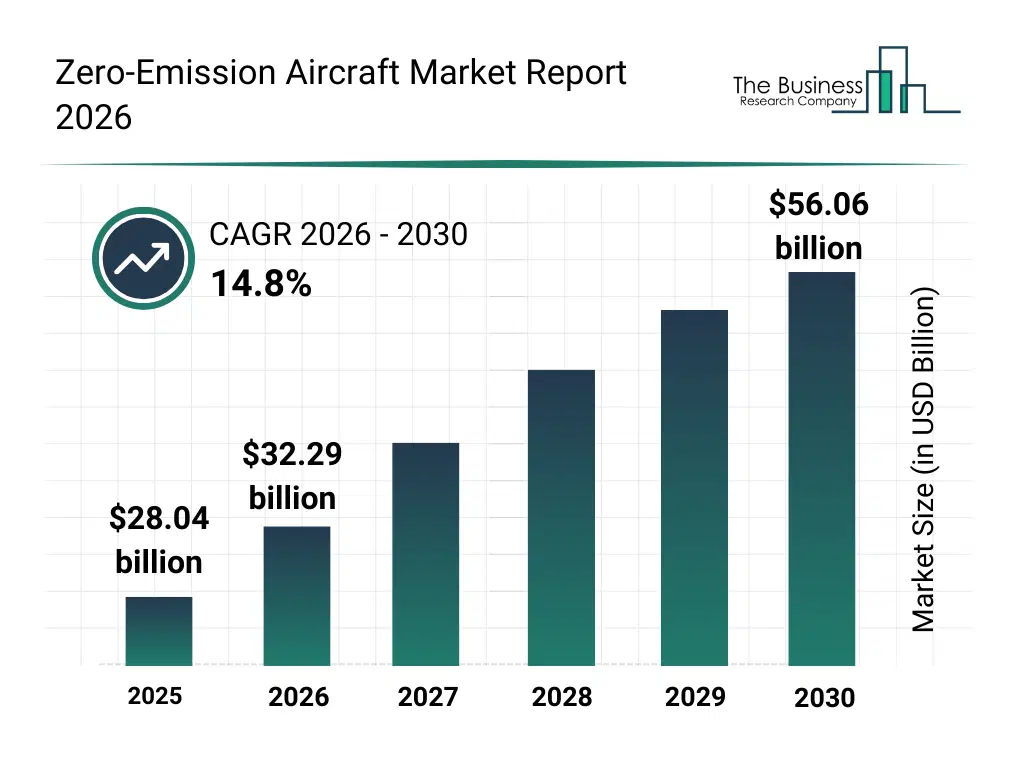
What Is The Zero-Emission Aircraft Market Size and Share 2026?
The zero-emission aircraft market size has grown rapidly in recent years. It will grow from $28.04 billion in 2025 to $32.29 billion in 2026 at a compound annual growth rate (CAGR) of 15.1%. The growth in the historic period can be attributed to increasing global focus on reducing aviation-related greenhouse gas emissions, early development of solar-powered experimental aircraft demonstrating feasibility of zero-emission flight, rising investment in alternative propulsion research including electric and hydrogen systems, growth of government-funded sustainability programs supporting low-emission aviation technologies, expanding ecosystem of suppliers developing lightweight materials and components for zero-emission aircraft prototypes.What Is The Zero-Emission Aircraft Market Growth Forecast?
The zero-emission aircraft market size is expected to see rapid growth in the next few years. It will grow to $56.06 billion in 2030 at a compound annual growth rate (CAGR) of 14.8%. The growth in the forecast period can be attributed to growing adoption of hydrogen and battery-electric propulsion systems for regional and short-haul aircraft, increasing regulatory pressure on airlines and manufacturers to meet stringent emission reduction targets, expansion of infrastructure for green hydrogen production and charging to support zero-emission aviation, development of large-scale commercial zero-emission aircraft to replace conventional fleets, rising partnerships between aerospace manufacturers and energy companies to accelerate zero-emission aircraft deployment. Major trends in the forecast period include advancements in hydrogen fuel storage systems, growing development of lightweight aircraft materials, integration of next-generation solar energy systems, increased r&d in long-haul zero-emission aviation, rising collaborations for hybrid propulsion innovation.
Global Zero-Emission Aircraft Market Segmentation
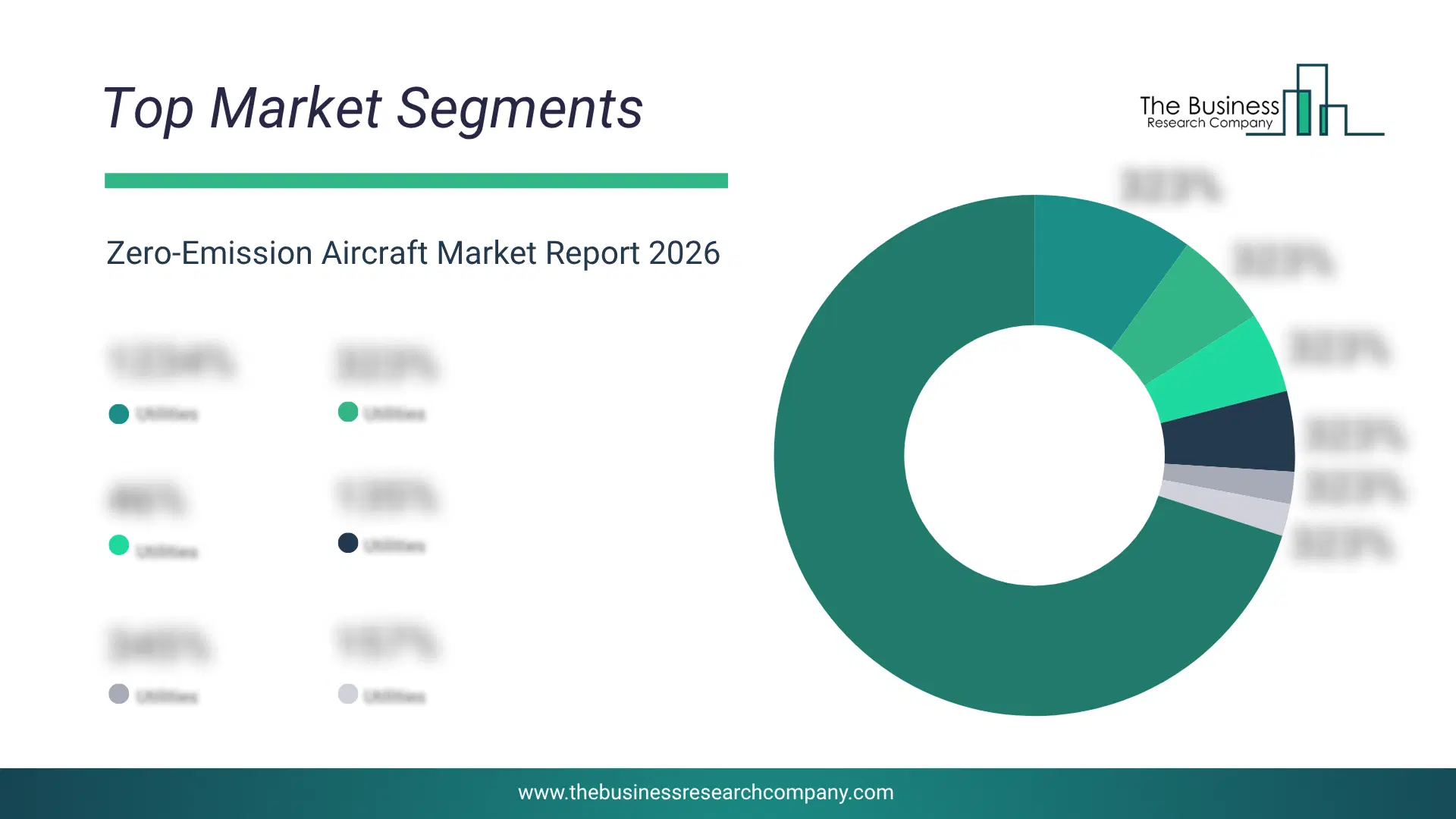
1) By Type: Turboprop Rear Bulkhead, Turbofan System, Blended Wing Body 2) By Source: Hydrogen, Electric, Solar 3) By Range: Short-Haul, Medium-Haul, Long-Haul 4) By Technology: Electric Motor Technology, Fuel Cell Technology, Hydrogen Fuel Storage, Power Management And Distribution Technology, Other Technology 5) By Application: Passenger Aircraft, Cargo Aircraft Subsegments: 1) By Turboprop Rear Bulkhead: Structural Components, Engine Integration Systems, Aerodynamic Features 2) By Turbofan System: Engine Components, Fuel Efficiency Mechanisms, Noise Reduction Technologies 3) By Blended Wing Body: Aerodynamic Design Features, Structural Materials, Engine Placement SystemsWhat Is Driver Of The Zero-Emission Aircraft Market?
The increasing air traffic is expected to propel the growth of the zero-emission aircraft market going forward. Air traffic refers to the operation of aircraft within designated airspace and at airports, including all types of flights such as commercial, cargo, and private aviation. Increasing air traffic can be attributed to several key factors, including economic growth, globalization, and rising tourism. Zero-emission aircraft offer a cleaner alternative to traditional aircraft, addressing climate change concerns and making air travel more acceptable to environmentally conscious travelers and regulators. For instance, in August 2025, according to the International Air Transport Association (IATA), global passenger air traffic reached 9.8 billion passengers in 2025, marking a 3.7% increase from 2024 figures, with continued strong demand in all major regions. Therefore, the increasing air traffic is driving the growth of the zero-emission aircraft industry going forward.Key Players In The Global Zero-Emission Aircraft Market
Major companies operating in the zero-emission aircraft market are AeroDelft, Airbus SE, Bye Aerospace, Eviation Aircraft, Joby Aviation, Lilium GmbH, Wright Electric, Boeing Company, Northrop Grumman Corporation, ZeroAvia Inc., MagniX, Zunum Aero, SkyDrive Inc., Pipistrel d.o.o., HyPoint Inc., Wisk Aero, XTI Aircraft Company, Rolls-Royce plc, Ampaire Inc., Alaka'i Technologies, Volocopter GmbH, Vertical Aerospace, H55, Heart Aerospace, Scaled Composites, Embraer SA, Faradair Aerospace Limited, Beta Technologies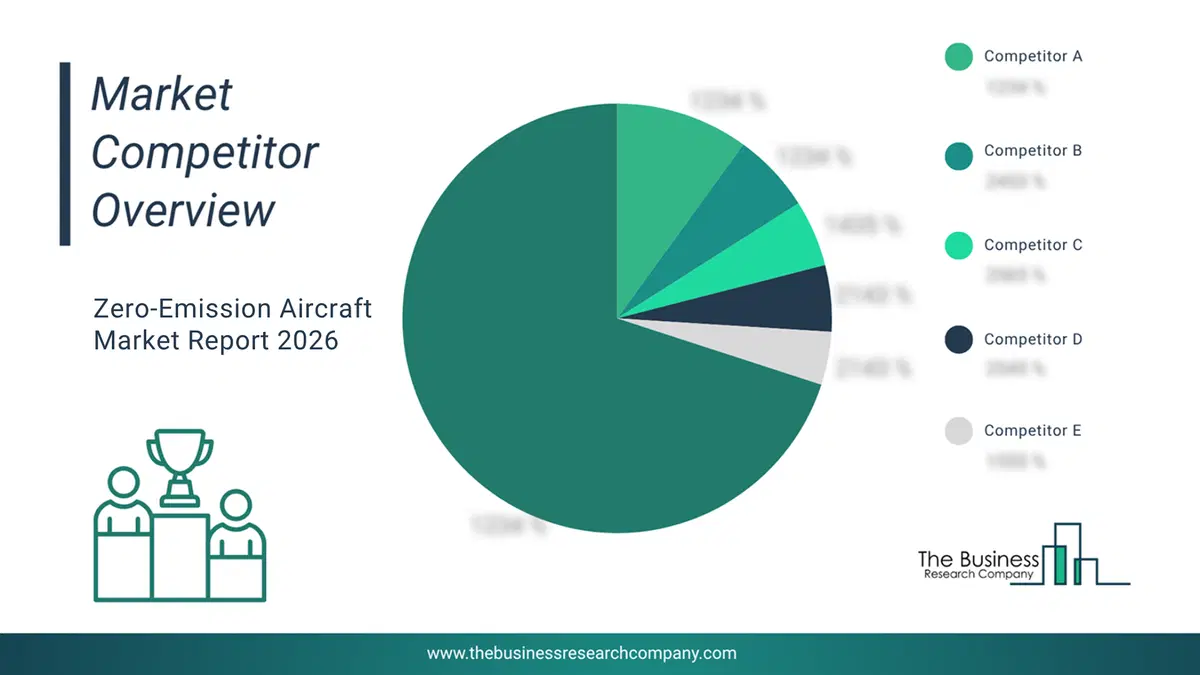
This chart is for illustrative purposes; the full report includes a detailed competitor analysis and comprehensive overview of the top 10 companies in the market.
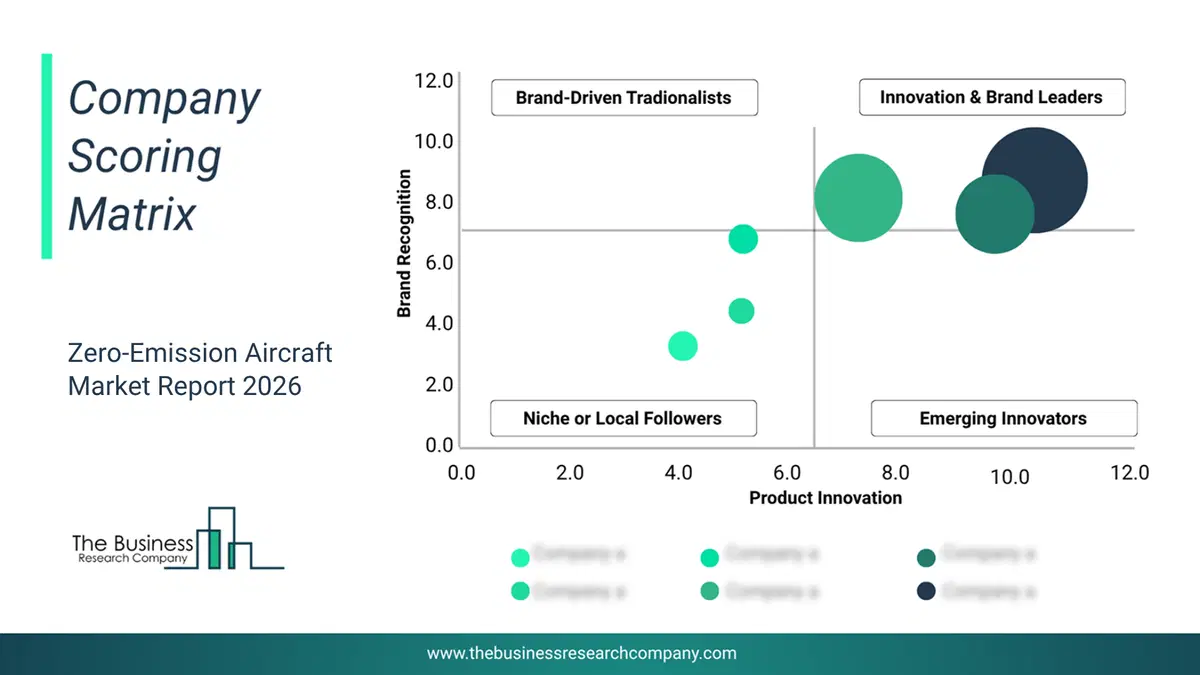
This chart maps companies by product innovation and brand strength, with bubble size indicating relative revenue, helping identify market leaders, challengers, and niche players. This is an illustrative chart; the full report provides a complete and accurate competitive analysis.
Global Zero-Emission Aircraft Market Trends and Insights
Major companies operating in the zero-emission aircraft market are focusing on developing advanced solutions, such as battery-electric propulsion systems, to reduce carbon emissions, lower operating expenses, and improve regional air mobility. Battery-electric propulsion refers to an aircraft power system that uses onboard batteries to drive electric motors, eliminating the need for conventional jet fuel and significantly decreasing environmental impact. For instance, in May 2023, Aura Aero, a France-based aircraft manufacturer, unveiled its redesigned 19-passenger hybrid-electric regional airliner project, the ERA. The updated configuration incorporates eight electric motors an increase from the previous six and features a revised tail design optimized for regional operations. Designed to deliver greater efficiency and reduced operating costs, the aircraft is expected to cut current operating expenses by half compared to traditional fuel-powered aircraft, reinforcing technological progress in the zero-emission aircraft market.What Are Latest Mergers And Acquisitions In The Zero-Emission Aircraft Market? Safran Group Strengthens Commitment To Zero-Emission Aviation With Acquisition Of Thales Aeronautical Electrical Systems
In November 2023, ZeroAvia, a US-based company specializing in hydrogen-electric aviation solutions, partnered with Japan Airlines (JAL) and JAL Engineering Co., Ltd. (JALEC). The collaboration aims to explore the development of hydrogen-powered aircraft, focusing on safety, economic feasibility, and maintainability. Japan Airlines (JAL), is a Japan-based airline and aviation services company renowned for passenger and cargo transport, aircraft maintenance, and aviation technology initiatives.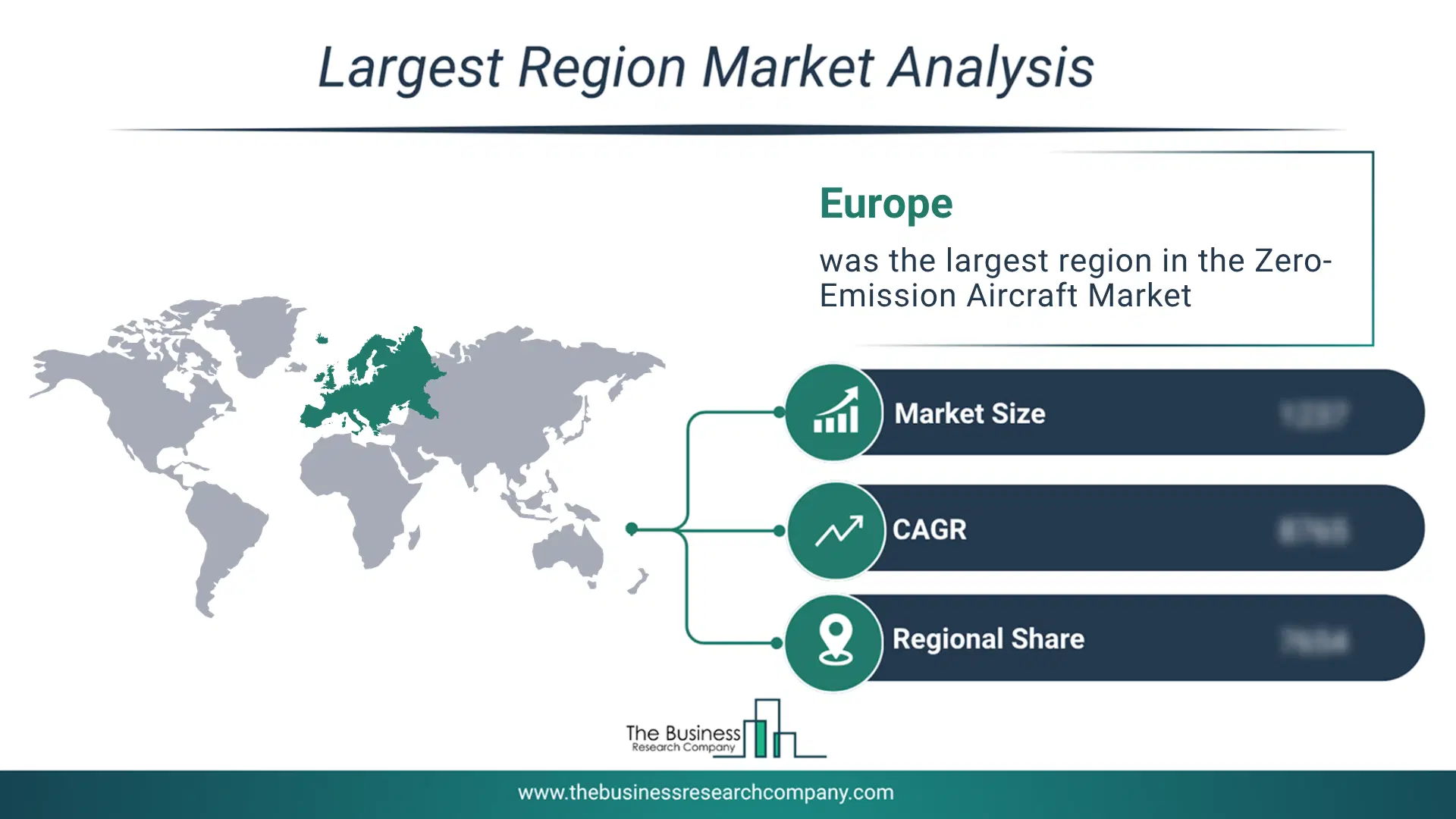
Regional Insights
Europe was the largest region in the zero-emission aircraft market in 2025. The regions covered in the zero-emission aircraft market report are Asia-Pacific, South East Asia, Western Europe, Eastern Europe, North America, South America, Middle East, Africa. The countries covered in the zero-emission aircraft market report are Australia, Brazil, China, France, Germany, India, Indonesia, Japan, Taiwan, Russia, South Korea, UK, USA, Canada, Italy, SpainWhat Defines the Zero-Emission Aircraft Market?
The zero-emission aircraft consist of sales of aircraft that uses various technology including solar power during its operation. Values in this market are ‘factory gate’ values, that is the value of goods sold by the manufacturers or creators of the goods, whether to other entities (including downstream manufacturers, wholesalers, distributors and retailers) or directly to end customers. The value of goods in this market includes related services sold by the creators of the goods.How is Market Value Defined and Measured?
The market value is defined as the revenues that enterprises gain from the sale of goods and/or services within the specified market and geography through sales, grants, or donations in terms of the currency (in USD unless otherwise specified). The revenues for a specified geography are consumption values that are revenues generated by organizations in the specified geography within the market, irrespective of where they are produced. It does not include revenues from resales along the supply chain, either further along the supply chain or as part of other products.
This chart presents market attractiveness based on a quantitative evaluation of growth, competition, strategic alignment, and risk, offering a clear view of opportunity areas for decision-making. This chart is for illustrative purposes; the full report contains the complete analysis.

This chart highlights the Total Addressable Market (TAM) by estimating the maximum revenue opportunity using an assumption-driven approach, supporting strategic planning and opportunity sizing across markets. The chart is illustrative; the full report provides a more comprehensive analysis.
What Key Data and Analysis Are Included in the Zero-Emission Aircraft Market Report 2026?
The zero-emission aircraft market research report is one of a series of new reports from The Business Research Company that provides market statistics, including industry global market size, regional shares, competitors with the market share, detailed market segments, market trends and opportunities, and any further data you may need to thrive in the zero-emission aircraft industry. The market research report delivers a complete perspective of everything you need, with an in-depth analysis of the current and future state of the industry.Zero-Emission Aircraft Market Report Forecast Analysis
| Report Attribute | Details |
|---|---|
| Market Size Value In 2026 | $32.29 billion |
| Revenue Forecast In 2030 | $56.06 billion |
| Growth Rate | CAGR of 14.8% from 2026 to 2030 |
| Base Year For Estimation | 2025 |
| Actual Estimates/Historical Data | 2020-2025 |
| Forecast Period | 2026 - 2030 |
| Market Representation | Revenue in USD Billion and CAGR from 2026 to 2030 |
| Segments Covered | Type, Source, Range, Technology, Application |
| Regional Scope | Asia-Pacific, Western Europe, Eastern Europe, North America, South America, Middle East, Africa |
| Country Scope | The countries covered in the zero-emission aircraft market report are Australia, Brazil, China, France, Germany, India, Indonesia, Japan, Taiwan, Russia, South Korea, UK, USA, Canada, Italy, Spain |
| Key Companies Profiled | AeroDelft, Airbus SE, Bye Aerospace, Eviation Aircraft, Joby Aviation, Lilium GmbH, Wright Electric, Boeing Company, Northrop Grumman Corporation, ZeroAvia Inc., MagniX, Zunum Aero, SkyDrive Inc., Pipistrel d.o.o., HyPoint Inc., Wisk Aero, XTI Aircraft Company, Rolls-Royce plc, Ampaire Inc., Alaka'i Technologies, Volocopter GmbH, Vertical Aerospace, H55, Heart Aerospace, Scaled Composites, Embraer SA, Faradair Aerospace Limited, Beta Technologies |
| Customization Scope | Request for Customization |
| Pricing And Purchase Options | Explore Purchase Options |