

Aerostructures Market Report 2026
Global Outlook – By Component (Fuselage, Empennage, Flight Control Surfaces, Wings, Nose, Nacelle and Pylon, Doors and Skid), By Material (Composites, Alloys and Super Alloys, Metals), By Platform (Fixed Wing, Rotary Wing, Unmanned Aerial Vehicles (UAVs), Advanced Air Mobility), By End Use (OEM, Aftermarket) – Market Size, Trends, Strategies, and Forecast to 2030
Aerostructures Market Overview
• Aerostructures market size has reached to $64.64 billion in 2025 • Expected to grow to $90.67 billion in 2030 at a compound annual growth rate (CAGR) of 6.8% • Growth Driver: Increasing Aircraft Modernization Programs Drive Growth In The Aerostructures Market • Market Trend: Advancements in Lightweight Composite Airframes for Enhanced Aircraft Performance and Efficiency • North America was the largest region in 2025.Market Gains By 2030 – Top Opportunities By Segment
Market Gain identifies the most promising market opportunities by highlighting the segments or products expected to generate the highest incremental revenue growth over the next five years.
What Is Covered Under Aerostructures Market?
Aerostructures refer to subsystems or components of an aircraft's airframe, including the entire fuselage, wings, or flight control surfaces. The aerostructures are used in the design, development, and assembly of an airplane. The main types of components in the aerostructure include fuselage, empennage, flight control surfaces, wings, nose, nacelle and pylon, doors, and skid. The fuselage is a long hollow tube that holds all the pieces of an airplane together. The aerostructures are made of materials such as composites, alloys and superalloys, and metals. The various platforms utilizing aerostructures include fixed-wing, rotary-wing, unmanned aerial vehicles (UAVs), and advanced air mobility. The various end users of aerostructures include OEM and aftermarket.
What Is The Aerostructures Market Size and Share 2026?
The aerostructures market size has grown strongly in recent years. It will grow from $64.64 billion in 2025 to $69.69 billion in 2026 at a compound annual growth rate (CAGR) of 7.8%. The growth in the historic period can be attributed to growth in commercial and military aircraft production increasing demand for primary airframe structures, rising use of lightweight aluminum and titanium alloys to improve aircraft performance, expansion of outsourced aerostructure manufacturing by major aerospace oems, development of high-strength steel components to enhance structural durability, increasing integration of advanced aerostructure designs to support improved aerodynamics.What Is The Aerostructures Market Growth Forecast?
The aerostructures market size is expected to see strong growth in the next few years. It will grow to $90.67 billion in 2030 at a compound annual growth rate (CAGR) of 6.8%. The growth in the forecast period can be attributed to anticipated surge in next-generation aircraft platforms requiring more complex aerostructure assemblies, growing adoption of hybrid material aerostructures combining metals and composites, increasing investments in automated manufacturing technologies for airframe production, expansion of global fleet renewal driving demand for new fuselage and wing structures, rising emphasis on fuel-efficient aircraft boosting demand for lightweight aerostructure solutions. Major trends in the forecast period include increasing adoption of advanced aerostructure materials such as titanium and high-strength alloys, growing demand for modular airframe designs to support faster assembly cycles, rising use of composite aerostructures for weight reduction and fuel efficiency, expanding development of next-generation wing and fuselage architectures, advancements in precision forming, machining, and automated fabrication techniques.
Global Aerostructures Market Segmentation
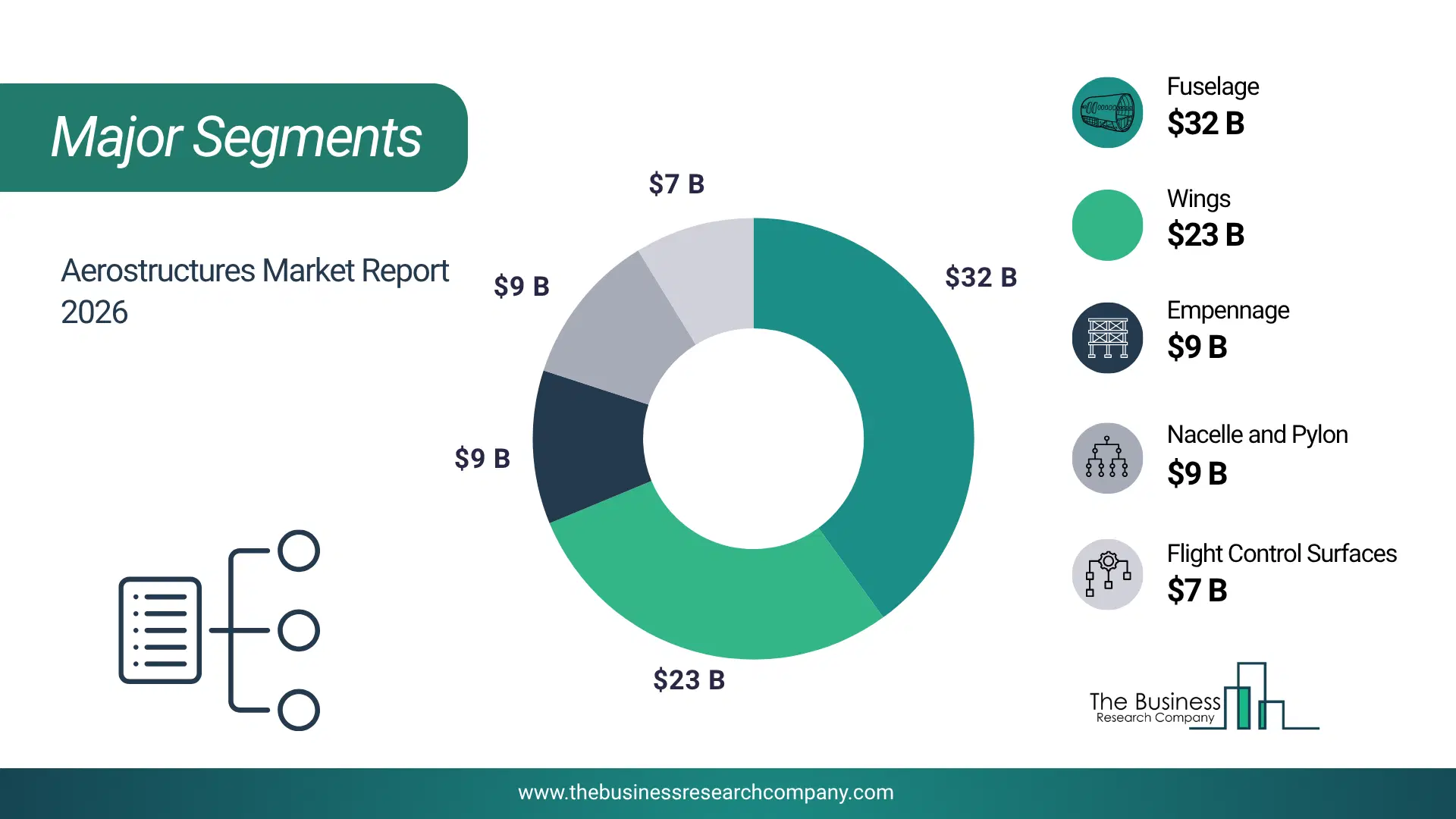
1) By Component: Fuselage, Empennage, Flight Control Surfaces, Wings, Nose, Nacelle and Pylon, Doors and Skid 2) By Material: Composites, Alloys and Super Alloys, Metals 3) By Platform: Fixed Wing, Rotary Wing, Unmanned Aerial Vehicles (UAVs), Advanced Air Mobility 4) By End Use: OEM, Aftermarket Subsegments: 1) By Fuselage: Forward Fuselage, Mid Fuselage, Aft Fuselage 2) By Empennage: Horizontal Stabilizer, Vertical Stabilizer, Rudder and Elevator Assemblies 3) By Flight Control Surfaces: Ailerons, Flaps, Slats, Spoilers 4) By Wings: Wing Structure, Wing Tips, Wing Box 5) By Nose: Nose Cone, Cockpit Canopy, Radar Dome 6) By Nacelle and Pylon: Engine Nacelle, Pylon Assembly 7) By Doors and Skid: Passenger Doors, Cargo Doors, Emergency Exits, Landing Gear Skids The top segments in the aerostructures market will be: • Fuselage will reach $32 Billion by 2030. • Wings will reach $23 Billion by 2030. • Empennage will reach $9 Billion by 2030. • Nacelle and Pylon will reach $9 Billion by 2030. • Flight Control Surfaces will reach $7 Billion by 2030.What Is Driver Of The Aerostructures Market?
The increasing aircraft modernization programs are expected to drive the aerostructures market. Aircraft modernization refers to the process of upgrading and updating an aircraft's components, systems, and technology to improve its overall performance, safety, efficiency, and capabilities. Aerostructures used in aircraft modernization programs are essential for achieving the program's goals, whether they involve extending the aircraft's life, improving its performance, or making it more environmentally friendly. For instance, in June 2024, The U.S. Department of Defense, a US-based federal executive department announced a significant modernization plan for tactical aircraft stationed in Japan, involving an investment of over $10 billion. This initiative aims to enhance the U.S.-Japan alliance and bolster regional deterrence amid rising tensions in the Indo-Pacific region. The Air Force will replace 48 F-15C/D fighter jets with 36 F-15EX jets. The Air Force will replace 48 F-15C/D fighter jets with 36 F-15EX jets. Therefore, the increasing aircraft modernization programs are driving the aerostructures industry.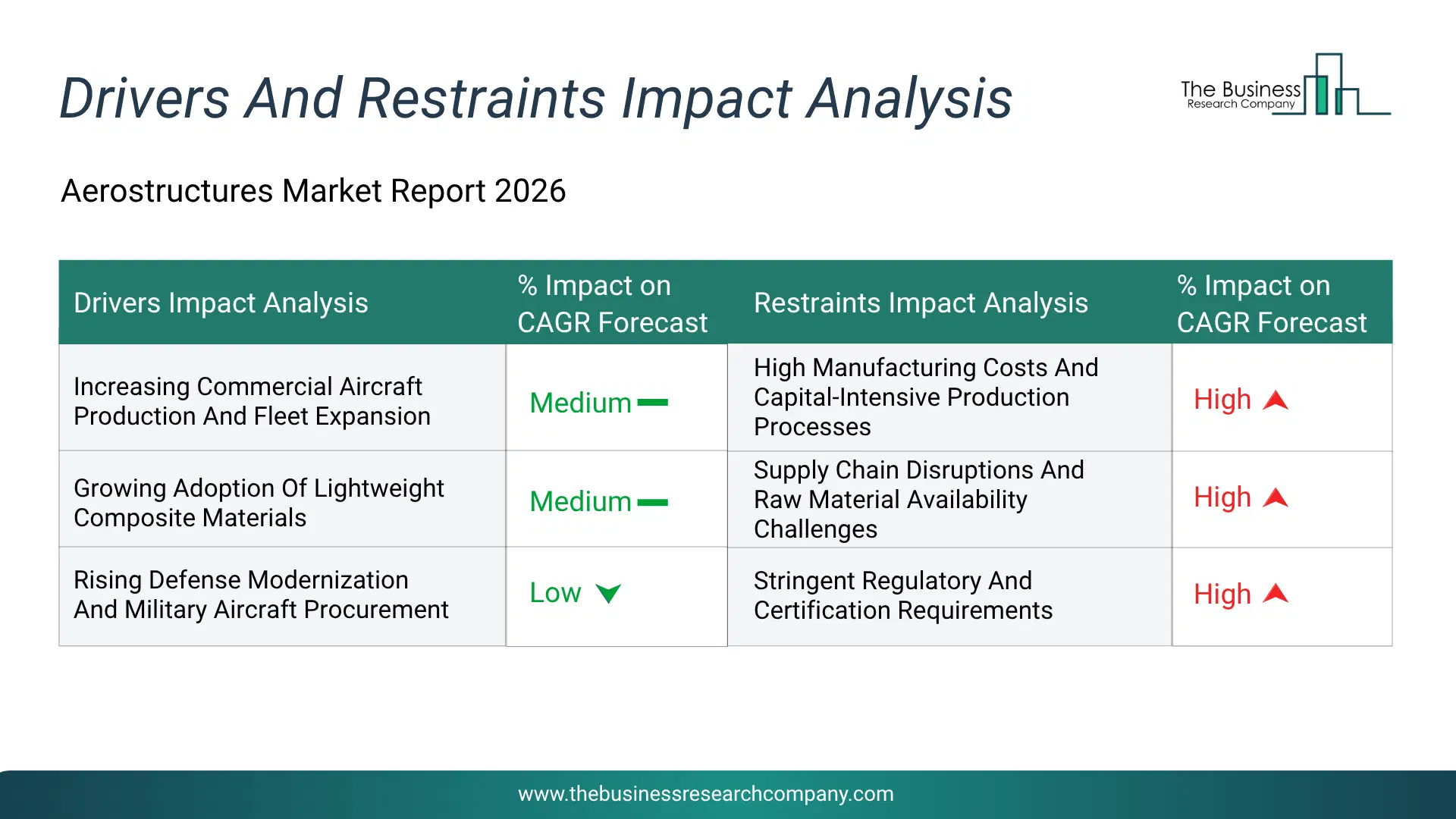
Infographic Chart Showing Key Market Drivers Analysis And Restraints For Aerostructures Market
The chart presents an impact analysis of key drivers and restraints, quantifying their relative influence on the market's growth rate and helping assess the balance between growth enablers and limiting factors. This chart offers a high-level perspective; the full report contains more detailed insights.
How Will The Drivers Impact Growth In The Global Aerostructures Market?
• Increasing Commercial Aircraft Production And Fleet Expansion (Medium) – During the forecast period, the increasing commercial aircraft production and fleet expansion are expected to emerge as a major factor driving the expansion of the aerostructures market by 2030. rising global passenger traffic and air cargo demand are encouraging aircraft manufacturers to increase production while airlines continue replacing aging fleets with new-generation aircraft. this is creating sustained demand for critical structural components such as fuselages, wings, empennages, nacelles, pylons, and flight control surfaces across the aerospace supply chain. • Growing Adoption Of Lightweight Composite Materials (Medium) – During the forecast period, the growing adoption of lightweight composite materials is expected to emerge as a major factor driving the expansion of the aerostructures market by 2030. aircraft manufacturers are increasingly utilizing carbon fiber composites, titanium alloys, and advanced aluminum materials to reduce structural weight while improving strength, durability, and corrosion resistance. these material innovations enhance fuel efficiency, extend aircraft range, reduce emissions, and support compliance with evolving environmental standards, encouraging broader adoption across commercial and military aircraft programs. • Rising Defense Modernization And Military Aircraft Procurement (Low) – During the forecast period, the rising defense modernization and military aircraft procurement are expected to act as a key growth catalyst for the aerostructures market by 2030. governments are expanding investments in advanced fighter aircraft, transport aircraft, helicopters, surveillance platforms, aerial refueling systems, and unmanned aerial vehicles to strengthen defense capabilities. ongoing military fleet upgrades and indigenous aircraft development programs are further increasing demand for high-performance structural assemblies, advanced aerospace materials, and precision manufacturing solutions.How Will The Restraints Impact Growth In The Global Aerostructures Market?
• High Manufacturing Costs And Capital-Intensive Production Processes (Medium) – During the forecast period, high Manufacturing Costs And Capital-Intensive Production Processes are among the biggest restraints affecting the Aerostructures Market because manufacturing aircraft structural components requires substantial investments in advanced production facilities, precision machining equipment, robotic assembly systems, composite fabrication technologies, and specialized tooling. Aerospace-grade raw materials such as carbon fiber composites, titanium, and high-strength aluminum alloys are expensive, while maintaining strict quality standards requires continuous investment in testing, inspection, and certification. Manufacturers must also employ highly skilled engineers and technicians capable of producing components with extremely tight tolerances. These significant capital requirements increase production costs, reduce profitability, and create high barriers to entry for small and medium-sized companies, limiting manufacturing capacity expansion and slowing overall market growth. • Supply Chain Disruptions And Raw Material Availability Challenges (Medium) – During the forecast period, supply Chain Disruptions And Raw Material Availability Challenges significantly restrain the Aerostructures Market because the industry depends on a highly complex global supply chain involving aerospace-grade metals, composite fibers, electronic components, precision fasteners, forgings, castings, and specialized manufacturing equipment. Disruptions caused by geopolitical conflicts, trade restrictions, inflation, transportation delays, labor shortages, and shortages of critical raw materials can interrupt production schedules and delay aircraft deliveries. Since aircraft manufacturing follows strict production timelines, even small supply chain disruptions can lead to substantial financial losses for OEMs and suppliers. Rising raw material prices also increase manufacturing costs and reduce profit margins, making it difficult for companies to maintain stable production while meeting growing customer demand. • Stringent Regulatory And Certification Requirements (Low) – During the forecast period, stringent Regulatory And Certification Requirements act as a major restraint on the Aerostructures Market because every aircraft structural component must comply with rigorous safety, airworthiness, reliability, and environmental regulations established by aviation authorities before entering commercial or military service. Manufacturers are required to perform extensive structural testing, fatigue analysis, crashworthiness evaluations, material qualification, documentation, and certification for every new design or manufacturing process. These procedures require considerable financial investment and often take several years to complete before products receive regulatory approval. The lengthy certification cycle delays product launches, slows the adoption of innovative materials and manufacturing technologies, increases research and development expenses, and limits the ability of companies to respond quickly to changing market demands, ultimately restraining market expansion.Key Players In The Global Aerostructures Market
Major companies operating in the aerostructures market are Spirit AeroSystems, Saab AB, Triumph Group Inc., Leonardo SpA, Elbit Systems Ltd., Airbus S.A.S., The Boeing Company, Lockheed Martin Corporation, Northrop Grumman Corporation, BAE Systems plc, Raytheon Technologies Corporation, Safran S.A., Bombardier Inc., Embraer S.A., General Dynamics Corporation, Kawasaki Heavy Industries Ltd., Mitsubishi Heavy Industries Ltd., GKN Aerospace Ltd., FACC AG, RUAG Group, Collins Aerospace Ltd., Dassault Aviation S.A., Meggitt PLC, Premium AEROTEC GmbH, Belge de Constructions Aéronautiques SA, Aero Vodochody AEROSPACE a.s., Singapore Technologies Engineering Ltd., Aviation Industry Corporation of China.
This chart is for illustrative purposes; the full report includes a detailed competitor analysis and comprehensive overview of the top 10 companies in the market.

This chart maps companies by product innovation and brand strength, with bubble size indicating relative revenue, helping identify market leaders, challengers, and niche players. This is an illustrative chart; the full report provides a complete and accurate competitive analysis.
Global Aerostructures Market Trends and Insights
Major companies operating in the aerostructures market are focusing on developing innovative products such as advanced composite airframes to enhance aircraft performance, reduce weight, and improve fuel efficiency. Advanced composite airframes are aircraft structures made from lightweight, high-strength materials such as carbon fiber-reinforced polymers, which reduce overall weight, improve fuel efficiency, increase payload capacity, and enhance corrosion resistance. For instance, in August 2025, Vertical Aerospace Ltd., a UK-based aerospace and technology company, partnered with Aciturri Aerostructures S.A., a Spain-based aerostructures manufacturing company, to supply and produce the complete airframe for its VX4 eVTOL aircraft, including wings, fuselage, and empennage. The collaboration focuses on integrating lightweight composite materials and advanced structural design to enhance performance, reduce weight, and enable efficient, scalable production. The VX4 airframe is engineered for electric flight, emphasizing structural durability, aerodynamic efficiency, and seamless integration with electric propulsion systems, which minimizes emissions and noise while accelerating assembly time and lowering operational costs compared to traditional aircraft frameworks.What Are Latest Mergers And Acquisitions In The Aerostructures Market? Avem Partners Acquires FMI Aerostructures Inc. To Strengthen Aerospace Manufacturing Capabilities
In April 2025, Avem Partners, a US-based private equity company, acquired FMI Aerostructures Inc. for an undisclosed amount. With this acquisition, Avem Partners aims to revitalize FMI Aerostructures by leveraging its industry expertise and financial resources to strengthen customer relationships, enhance manufacturing processes, restore operational excellence, and position the company for long-term growth and success in the aerospace market. FMI Aerostructures Inc. is a US-based aerospace and defense company that offers aerostructures.
Regional Insights
North America was the largest region in the aerostructures market in 2025, and it is also expected to be the fastest-growing region in the aerostructures market share during the forecast period. The regions covered in the aerostructures market report are Asia-Pacific, South East Asia, Western Europe, Eastern Europe, North America, South America, Middle East, Africa. The countries covered in the aerostructures market report are Australia, Brazil, China, France, Germany, India, Indonesia, Japan, Taiwan, Russia, South Korea, UK, USA, Canada, Italy, SpainWhat Defines the Aerostructures Market?
The aerostructures market consists of sales of aerostructures' products such as titanium alloys, aluminum alloys and high-strength steels. Values in this market are ‘factory gate’ values, that is the value of goods sold by the manufacturers or creators of the goods, whether to other entities (including downstream manufacturers, wholesalers, distributors, and retailers) or directly to end customers. The value of goods in this market includes related services sold by the creators of the goods.How is Market Value Defined and Measured?
The market value is defined as the revenues that enterprises gain from the sale of goods and/or services within the specified market and geography through sales, grants, or donations in terms of the currency (in USD unless otherwise specified). The revenues for a specified geography are consumption values that are revenues generated by organizations in the specified geography within the market, irrespective of where they are produced. It does not include revenues from resales along the supply chain, either further along the supply chain or as part of other products.
This chart presents market attractiveness based on a quantitative evaluation of growth, competition, strategic alignment, and risk, offering a clear view of opportunity areas for decision-making. This chart is for illustrative purposes; the full report contains the complete analysis.

This chart highlights the Total Addressable Market (TAM) by estimating the maximum revenue opportunity using an assumption-driven approach, supporting strategic planning and opportunity sizing across markets. The chart is illustrative; the full report provides a more comprehensive analysis.
What Key Data and Analysis Are Included in the Aerostructures Market Report 2026?
The aerostructures market research report is one of a series of new reports from The Business Research Company that provides market statistics, including industry global market size, regional shares, competitors with the market share, detailed market segments, market trends and opportunities, and any further data you may need to thrive in the aerostructures industry. The market research report delivers a complete perspective of everything you need, with an in-depth analysis of the current and future state of the industry.Aerostructures Market Report Forecast Analysis
| Report Attribute | Details |
|---|---|
| Market Size Value In 2026 | $69.69 billion |
| Revenue Forecast In 2030 | $90.67 billion |
| Growth Rate | CAGR of 6.8% from 2026 to 2030 |
| Base Year For Estimation | 2025 |
| Actual Estimates/Historical Data | 2020-2025 |
| Forecast Period | 2026 - 2030 |
| Market Representation | Revenue in USD Billion and CAGR from 2026 to 2030 |
| Segments Covered | Component, Material, Platform, End Use |
| Regional Scope | Asia-Pacific, Western Europe, Eastern Europe, North America, South America, Middle East, Africa |
| Country Scope | The countries covered in the report are Australia, Brazil, China, France, Germany, India, Indonesia, Japan, Taiwan, Russia, South Korea, UK, USA, Canada, Italy, Spain. |
| Key Companies Profiled | Spirit AeroSystems, Saab AB, Triumph Group Inc., Leonardo SpA, Elbit Systems Ltd., Airbus S.A.S., The Boeing Company, Lockheed Martin Corporation, Northrop Grumman Corporation, BAE Systems plc, Raytheon Technologies Corporation, Safran S.A., Bombardier Inc., Embraer S.A., General Dynamics Corporation, Kawasaki Heavy Industries Ltd., Mitsubishi Heavy Industries Ltd., GKN Aerospace Ltd., FACC AG, RUAG Group, Collins Aerospace Ltd., Dassault Aviation S.A., Meggitt PLC, Premium AEROTEC GmbH, Belge de Constructions Aéronautiques SA, Aero Vodochody AEROSPACE a.s., Singapore Technologies Engineering Ltd., Aviation Industry Corporation of China. |
| Customization Scope | Request for Customization |
| Pricing And Purchase Options | Explore Purchase Options |