
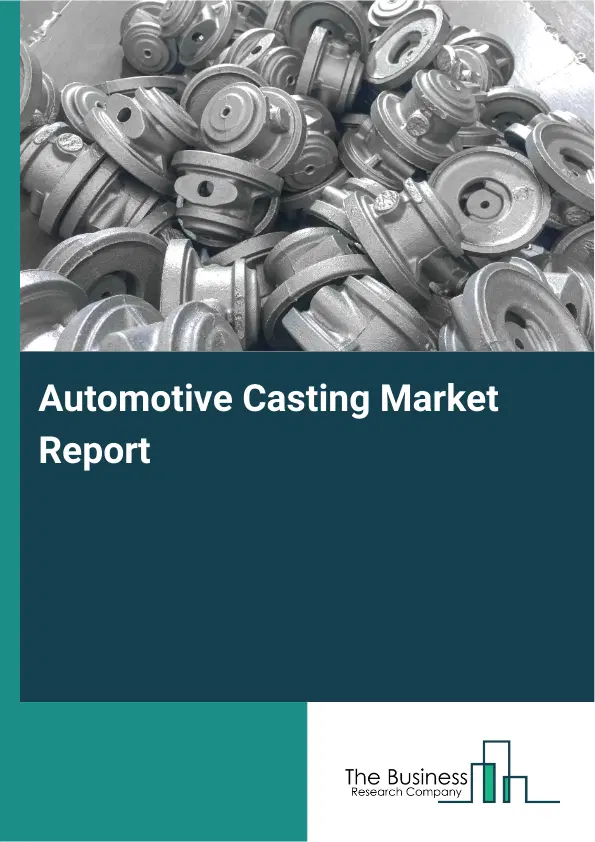
Automotive Casting Market Report 2026
Global Outlook – By Material Type (Iron, Steel, Aluminum, Other Material Types), By Process Type (Sand Casting, Die Casting, Investment Casting, Other Processes), By Application Type (Engine, Transmission And Suspension, Brakes And Wheels, Other Applications), By Distribution Channel Type (Original Equipment Manufacturer (OEM), Aftermarket) – Market Size, Trends, Strategies, and Forecast to 2030
Automotive Casting Market Overview
• Automotive Casting market size has reached to $106.57 billion in 2025 • Expected to grow to $140.48 billion in 2030 at a compound annual growth rate (CAGR) of 5.7% • Growth Driver: Increase In Vehicle Production Driving The Growth Of The Market Due To Rising Demand For High-Performance Components • Market Trend: Innovative Die Casting Solutions For Complex Metal Components • Asia-Pacific was the largest region in 2025.What Is Covered Under Automotive Casting Market?
Automotive casting is a manufacturing process in which molten metal is poured into a mold to produce vehicle components. It allows for creating complex, durable parts with precise shapes, making it cost-effective for mass production. Automotive casting is widely used to manufacture engine blocks, cylinder heads, suspension components, and other critical parts. The main types of material of automotive casting are iron, steel, aluminum, and others. Iron is a strong and durable metal commonly used for making components that need high strength and wear resistance. It is widely used in industrial applications where toughness and heat resistance are required. The various process types include sand casting, die casting, investment casting, and others and are used in various applications such as engines, transmissions and suspensions, brakes and wheels, and others. They are distributed through multiple channels, including original equipment manufacturer (OEM) and aftermarket.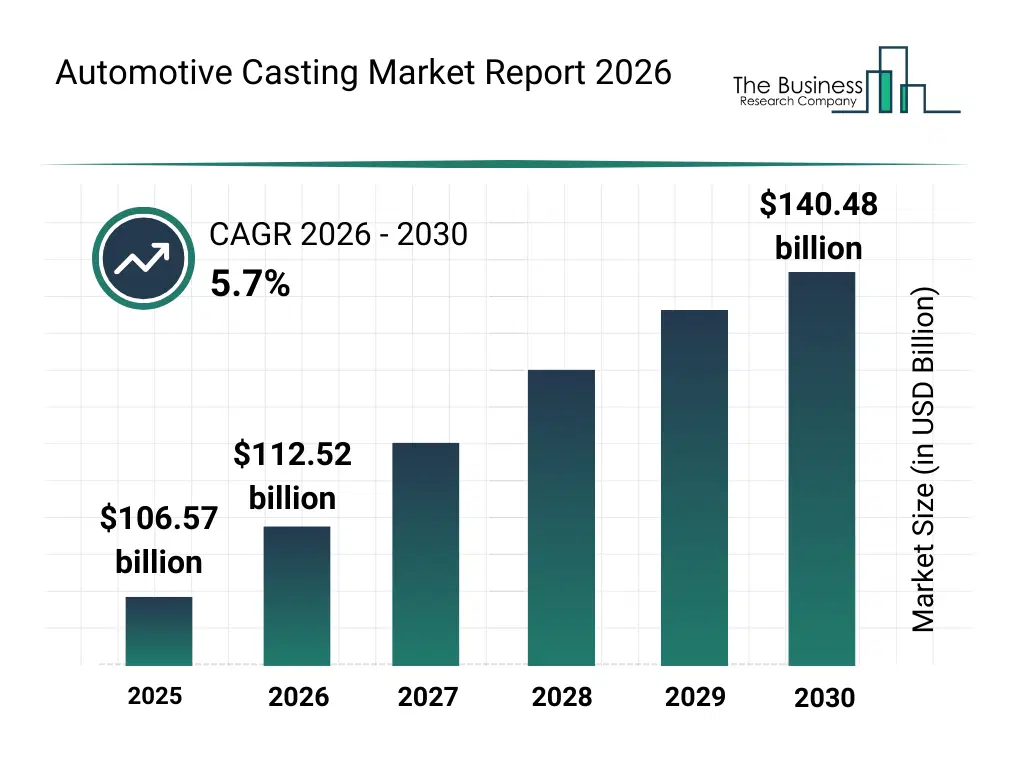
What Is The Automotive Casting Market Size and Share 2026?
The automotive casting market size has grown strongly in recent years. It will grow from $106.57 billion in 2025 to $112.52 billion in 2026 at a compound annual growth rate (CAGR) of 5.6%. The growth in the historic period can be attributed to automotive mass production, iron and steel casting dominance, foundry infrastructure growth, demand for durable components, engine manufacturing expansion.What Is The Automotive Casting Market Growth Forecast?
The automotive casting market size is expected to see strong growth in the next few years. It will grow to $140.48 billion in 2030 at a compound annual growth rate (CAGR) of 5.7%. The growth in the forecast period can be attributed to ev platform adoption, lightweighting regulations, giga casting adoption, automation in foundries, sustainable casting practices. Major trends in the forecast period include shift toward lightweight metal castings, adoption of aluminum and magnesium castings, integration of automation in foundries, demand for complex component shapes, growth of ev-specific castings.
Global Automotive Casting Market Segmentation
1) By Material Type: Iron, Steel, Aluminum, Other Material Types 2) By Process Type: Sand Casting, Die Casting, Investment Casting, Other Processes 3) By Application Type: Engine, Transmission And Suspension, Brakes And Wheels, Other Applications 4) By Distribution Channel Type: Original Equipment Manufacturer (OEM), Aftermarket Subsegments: 1) By Iron: Gray Iron Casting, Ductile Iron Casting, Malleable Iron Casting 2) By Steel: Carbon Steel Casting, Alloy Steel Casting, Stainless Steel Casting 3) By Aluminum: High-Pressure Die Casting (HPDC), Low-Pressure Die Casting (LPDC), Gravity Die Casting, Sand Casting 4) By Other Material Types: Magnesium Casting, Zinc Casting, Copper and Bronze CastingWhat Is The Driver Of The Automotive Casting Market?
The increase in vehicle production is expected to propel the growth of the automotive casting market going forward. Vehicle production refers to manufacturing automobiles through assembly and fabrication stages, including passenger cars, commercial vehicles, and electric vehicles. The increase in vehicle production is due to rising global demand, advancements in manufacturing technology, and supportive government policies. As economies grow and consumer purchasing power improves, more people seek personal and commercial vehicles, driving up production. Automotive casting plays a crucial role in vehicle production by enabling the mass manufacturing of high-strength, lightweight, and precision-engineered components essential for engine performance, structural integrity, and overall vehicle efficiency. For instance, in 2023, according to the International Organization of Motor Vehicle Manufacturers (OICA), a France-based international association of automobile manufacturers, the global automotive sector saw significant growth 2023, with total vehicle production reaching 93.55 million units, up from 85.02 million units in 2022. Therefore, the rising vehicle production is driving the growth of the automotive casting industry.Key Players In The Global Automotive Casting Market
Major companies operating in the automotive casting market report include Rheinmetall Automotive AG, Linamar Corporation, Nemak S.A.B. de C.V., Bühler AG, Sundaram-Clayton Limited, Rockman Industries Limited, Dynacast International Inc., Endurance Technologies Limited, Ahresty Corporation, Teksid S.p.A., Pace Industries LLC, Impro Industries USA Inc., Metal Technologies Inc., Ryobi Die Casting (USA) Inc., Gibbs Die Casting Corporation, Atek Metal Technologies LLC, Chicago White Metal Casting Inc., Cadillac Casting Inc., Aisin Automotive Casting LLC, Georg Fischer Automotive
This chart is for illustrative purposes; the full report includes a detailed competitor analysis and comprehensive overview of the top 10 companies in the market.
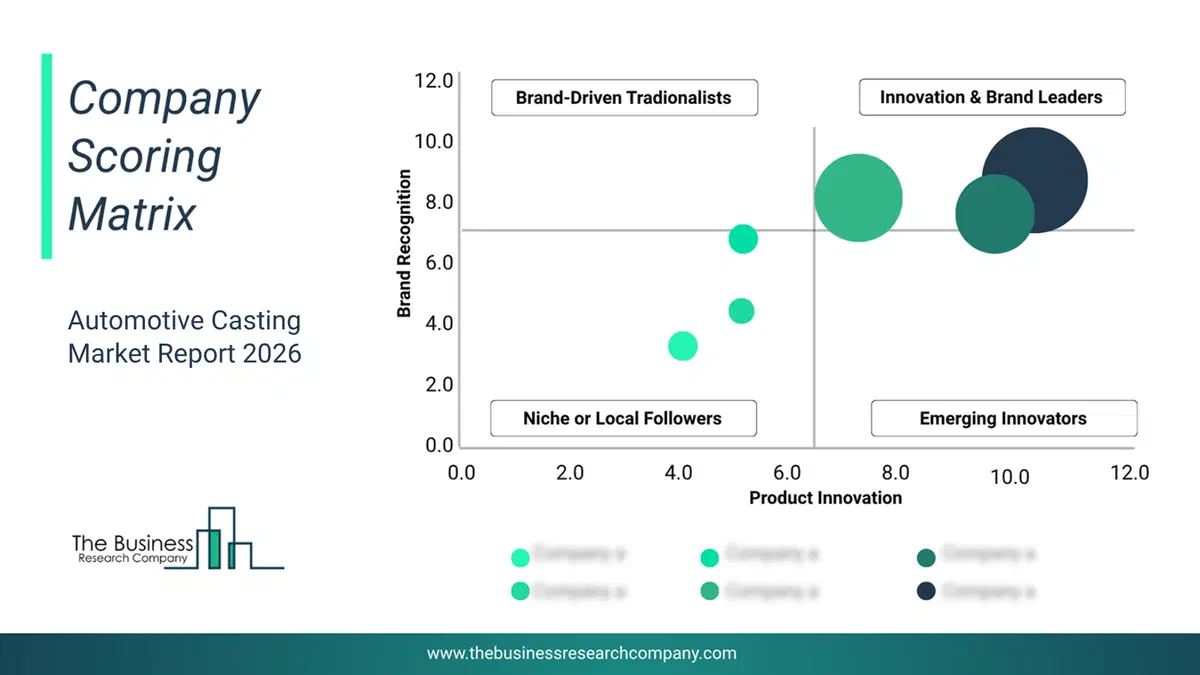
This chart maps companies by product innovation and brand strength, with bubble size indicating relative revenue, helping identify market leaders, challengers, and niche players. This is an illustrative chart; the full report provides a complete and accurate competitive analysis.
Global Automotive Casting Market Trends and Insights
Major companies operating in the automotive casting market are focusing on developing innovative technologies, such as die-casting systems, to reduce manufacturing costs, boost efficiency, and produce lighter vehicle parts. A die-casting system is a manufacturing process used to produce metal parts by injecting molten metal into a mold (or die) under high pressure. This system is typically used for creating intricate, high-precision components made from non-ferrous metals such as aluminum, zinc, and magnesium. For instance, in June 2023, Buhler Holding AG, a Switzerland-based plant equipment manufacturer, introduced its Carat 840 mega-casting solution to European customers. This advanced die-casting system is designed to produce large, high-strength structural components, particularly for the automotive industry. It offers high precision, efficiency, and scalability, enabling manufacturers to produce complex aluminum parts in a single casting process, reducing assembly requirements, and enhancing vehicle performance.What Are Latest Mergers And Acquisitions In The Automotive Casting Market?
In November 2023, General Motors Company, a US-based automotive manufacturer, acquired Tooling and Equipment International for an undisclosed amount. With this acquisition, General Motors aims to enhance its giga-casting capabilities, streamline prototype and low-volume aluminum casting production, and accelerate the development of large, lightweight structural components for electric vehicles (EVs). Tooling and Equipment International is a US-based company that manufactures aluminum castings for the automotive industry.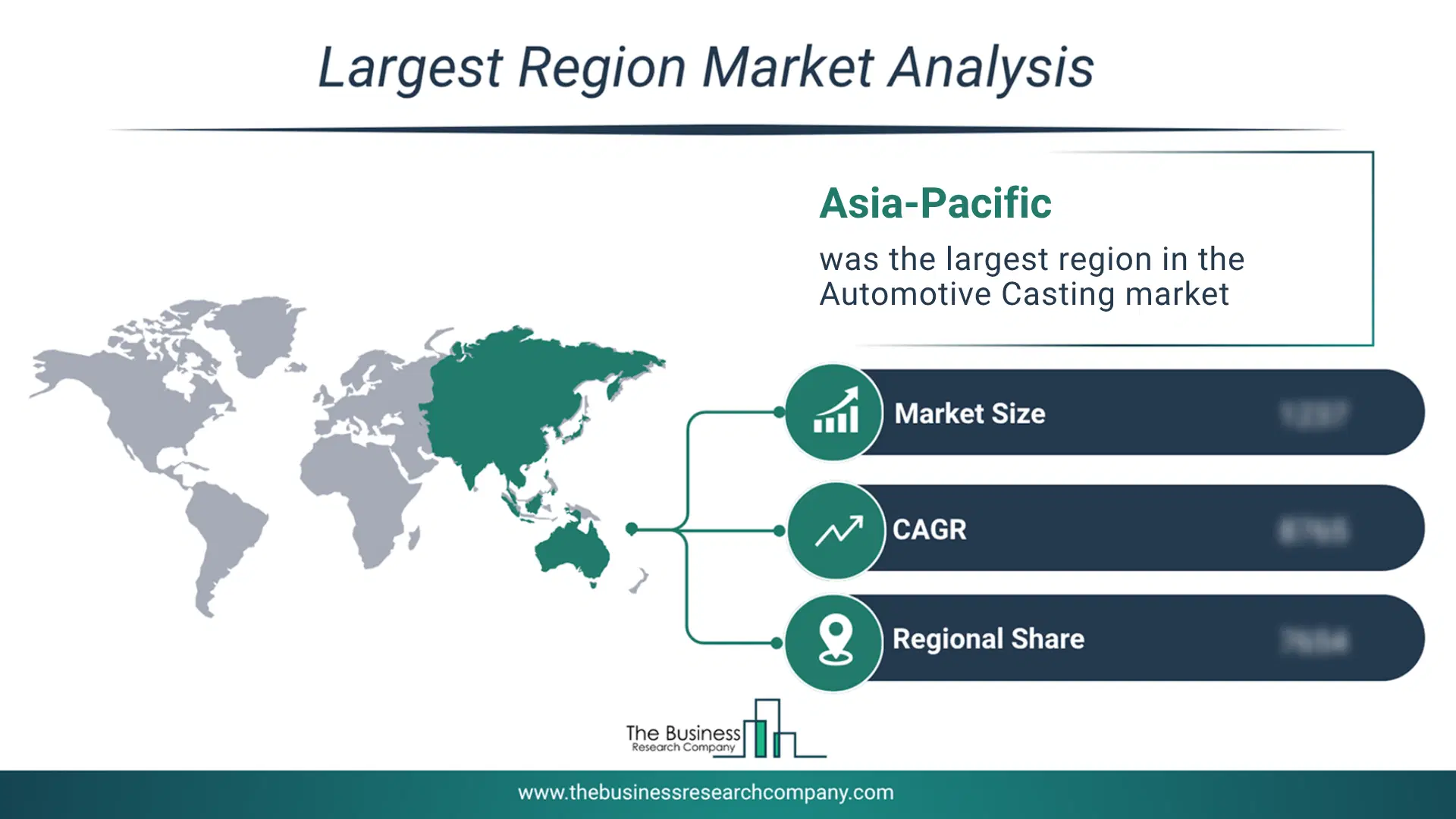
Regional Outlook
Asia-Pacific was the largest region in the automotive casting market in 2025. The regions covered in this market report include Asia-Pacific, South East Asia, Western Europe, Eastern Europe, North America, South America, Middle East, Africa. The countries covered in this market report include Australia, Brazil, China, France, Germany, India, Indonesia, Japan, Taiwan, Russia, South Korea, UK, USA, Canada, Italy, SpainWhat Defines the Automotive Casting Market?
The automotive casting market consists of sales of engine blocks, transmission housings, suspension parts, and structural vehicle components. Values in this market are ‘factory gate’ values, that is the value of goods sold by the manufacturers or creators of the goods, whether to other entities (including downstream manufacturers, wholesalers, distributors and retailers) or directly to end customers. The value of goods in this market includes related services sold by the creators of the goods.How is Market Value Defined and Measured?
The market value is defined as the revenues that enterprises gain from the sale of goods and/or services within the specified market and geography through sales, grants, or donations in terms of the currency (in USD unless otherwise specified). The revenues for a specified geography are consumption values that are revenues generated by organizations in the specified geography within the market, irrespective of where they are produced. It does not include revenues from resales along the supply chain, either further along the supply chain or as part of other products.
This chart presents market attractiveness based on a quantitative evaluation of growth, competition, strategic alignment, and risk, offering a clear view of opportunity areas for decision-making. This chart is for illustrative purposes; the full report contains the complete analysis.

This chart highlights the Total Addressable Market (TAM) by estimating the maximum revenue opportunity using an assumption-driven approach, supporting strategic planning and opportunity sizing across markets. The chart is illustrative; the full report provides a more comprehensive analysis.
What Key Data and Analysis Are Included in the Automotive Casting Market Report 2026?
The automotive casting market research report is one of a series of new reports from The Business Research Company that provides market statistics, including industry global market size, regional shares, competitors with the market share, detailed market segments, market trends and opportunities, and any further data you may need to thrive in the automotive casting industry. The market research report delivers a complete perspective of everything you need, with an in-depth analysis of the current and future state of the industry.Automotive Casting Market Report Forecast Analysis
| Report Attribute | Details |
|---|---|
| Market Size Value In 2026 | $112.52 billion |
| Revenue Forecast In 2030 | $140.48 billion |
| Growth Rate | CAGR of 5.6% from 2026 to 2030 |
| Base Year For Estimation | 2025 |
| Actual Estimates/Historical Data | 2020-2025 |
| Forecast Period | 2026 - 2030 - 2030 |
| Market Representation | Revenue in USD Billion and CAGR from 2026 to 2030 |
| Segments Covered | Material Type, Process Type, Application Type, Distribution Channel Type |
| Regional Scope | Asia-Pacific, Western Europe, Eastern Europe, North America, South America, Middle East, Africa |
| Country Scope | The countries covered in the report are Australia, Brazil, China, France, Germany, India, Indonesia, Japan, Taiwan, Russia, South Korea, UK, USA, Canada, Italy, Spain. |
| Key Companies Profiled | Rheinmetall Automotive AG, Linamar Corporation, Nemak S.A.B. de C.V., Bühler AG, Sundaram-Clayton Limited, Rockman Industries Limited, Dynacast International Inc., Endurance Technologies Limited, Ahresty Corporation, Teksid S.p.A., Pace Industries LLC, Impro Industries USA Inc., Metal Technologies Inc., Ryobi Die Casting (USA) Inc., Gibbs Die Casting Corporation, Atek Metal Technologies LLC, Chicago White Metal Casting Inc., Cadillac Casting Inc., Aisin Automotive Casting LLC, Georg Fischer Automotive |
| Customization Scope | Request for Customization |
| Pricing And Purchase Options | Explore Purchase Options |