
Autonomous Emergency Braking Market Report 2026
Global Outlook – By Vehicle Type (Passenger Cars, Commercial Vehicles ), By Technology (Crash Imminent Braking, Dynamic Braking Support), By System (Low Speed AEB System, Higher Speed AEB System, Pedestrian AEB System) – Market Size, Trends, Strategies, and Forecast to 2030
Autonomous Emergency Braking Market Overview
• Autonomous Emergency Braking market size has reached to $59.47 billion in 2025 • Expected to grow to $125.37 billion in 2030 at a compound annual growth rate (CAGR) of 16.1% • Growth Driver: Addressing The Surge In Accidents With The Autonomous Emergency Braking Market • Market Trend: Strategic Partnerships Driving Innovation In The Autonomous Emergency Braking Market • Asia-Pacific was the largest region in 2025.What Is Covered Under Autonomous Emergency Braking Market?
Autonomous emergency braking refers to an automatic braking system that constantly keeps track of the road. Using this type of system in cars and heavy trucks helps to control road accidents. The autonomous emergency braking is mostly used in cars that automatically apply the brake if the driver fails to respond to a sudden threat. The main vehicle types for autonomous emergency braking are passenger cars and commercial vehicles. A passenger car is a road motor vehicle, other than a motorcycle, intended for the carriage of passengers and designed to seat no more than nine people (including the driver). The different brake types available are disc and drum, and the technology used includes crash imminent braking and dynamic braking support. The various systems involved are low speed AEB system, higher speed AEB system and pedestrian AEB systems.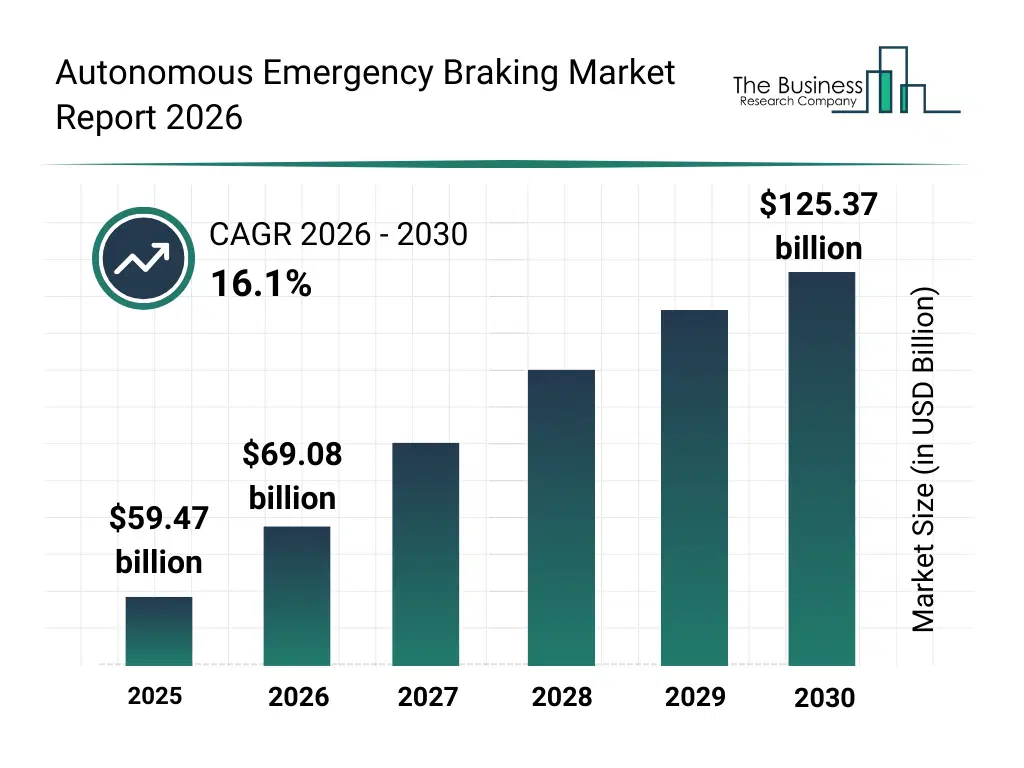
What Is The Autonomous Emergency Braking Market Size and Share 2026?
The autonomous emergency braking market size has grown rapidly in recent years. It will grow from $59.47 billion in 2025 to $69.08 billion in 2026 at a compound annual growth rate (CAGR) of 16.2%. The growth in the historic period can be attributed to road safety regulations, accident reduction initiatives, adas integration, early braking system adoption, vehicle safety mandates.What Is The Autonomous Emergency Braking Market Growth Forecast?
The autonomous emergency braking market size is expected to see rapid growth in the next few years. It will grow to $125.37 billion in 2030 at a compound annual growth rate (CAGR) of 16.1%. The growth in the forecast period can be attributed to mandatory aeb regulations, autonomous vehicle integration, sensor cost reduction, ai safety validation, global vehicle safety standards. Major trends in the forecast period include integration of sensor-based braking systems, adoption of AI-driven collision detection, expansion of aeb in commercial vehicles, growth of pedestrian detection systems, standardization of safety features.
Global Autonomous Emergency Braking Market Segmentation
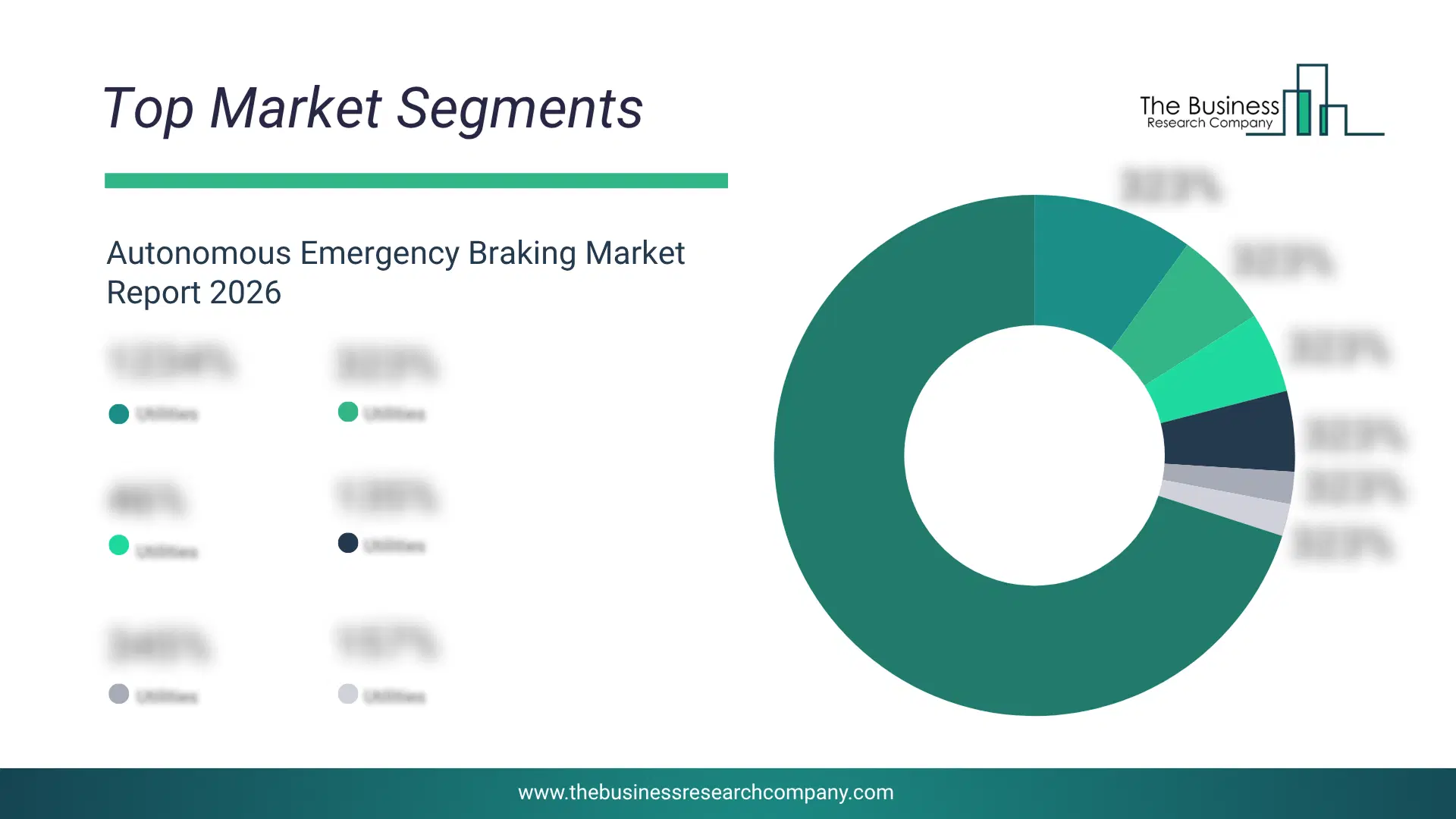
1) By Vehicle Type: Passenger Cars, Commercial Vehicles 2) By Technology: Crash Imminent Braking, Dynamic Braking Support 3) By System: Low Speed AEB System, Higher Speed AEB System, Pedestrian AEB System Subsegments: 1) By Passenger Cars: Compact Cars, Sedans, SUVs, Electric Vehicles (EVs) 2) By Commercial Vehicles: Light Commercial Vehicles (LCVs), Heavy Commercial Vehicles (HCVs), Buses, TrucksWhat Are The Drivers Of The Autonomous Emergency Braking Market?
The rising number of accidents is expected to propel the growth of the autonomous emergency braking market going forward. Accidents refer to any injury due to crashes involving a vehicle partially or fully on a public road. Autonomous emergency braking assists in recognizing when a potential collision is likely to happen and reacts by automatically applying the brakes to slow a vehicle down before impact or bring it to a stop to avoid a collision. For instance, in May 2025, according to the official statistics, a UK-based government agencies, total road fatalities in Great Britain rose from 1,624 in 2023 to 1,633 in 2024 a 1% increase. Therefore, the rising number of accidents is driving the growth of the autonomous emergency braking industry. The increasing sales of passenger vehicles are expected to propel the growth of the autonomous emergency braking market going forward. Passenger vehicles are motor vehicles that include cars, SUVs, minivans, and other similar vehicles primarily used for personal transportation or carrying small groups of people with a capacity of 8 or fewer passengers, excluding the driver. Passenger vehicle demand is rising due to increasing urbanization and the need for convenient personal mobility. Autonomous emergency braking are used in passenger vehicles to automatically detects imminent collisions and applies the brakes to prevent or reduce impact. For instance, in January 2024, according to the European Automobile Manufacturers Association, a Belgium-based automobile industry association, reported that in 2023, the EU car market grew by 13.9% over 2022, bringing total annual sales to 10.5 million vehicles. Therefore, the increasing sales of passenger vehicles drive the autonomous emergency braking industry.Key Players In The Global Autonomous Emergency Braking Market
Major companies operating in the autonomous emergency braking market report include Robert Bosch GmbH, Continental AG, ZF Friedrichshafen AG, Mobileye NV, Autoliv Inc., Hyundai Mobis Co Ltd., Aisin Corporation, Hitachi Automotive Systems Pvt Ltd., Mando Corporation, Tesla Inc., Magna International Inc., DENSO Corporation, Valeo SA, General Motors Company, Delphi Technologies plc, Aptiv plc, WABCO Holdings Inc., Hella KGaA Hueck & Co., TRW Automotive Holdings Corp., Ficosa International SA, Knorr-Bremse AG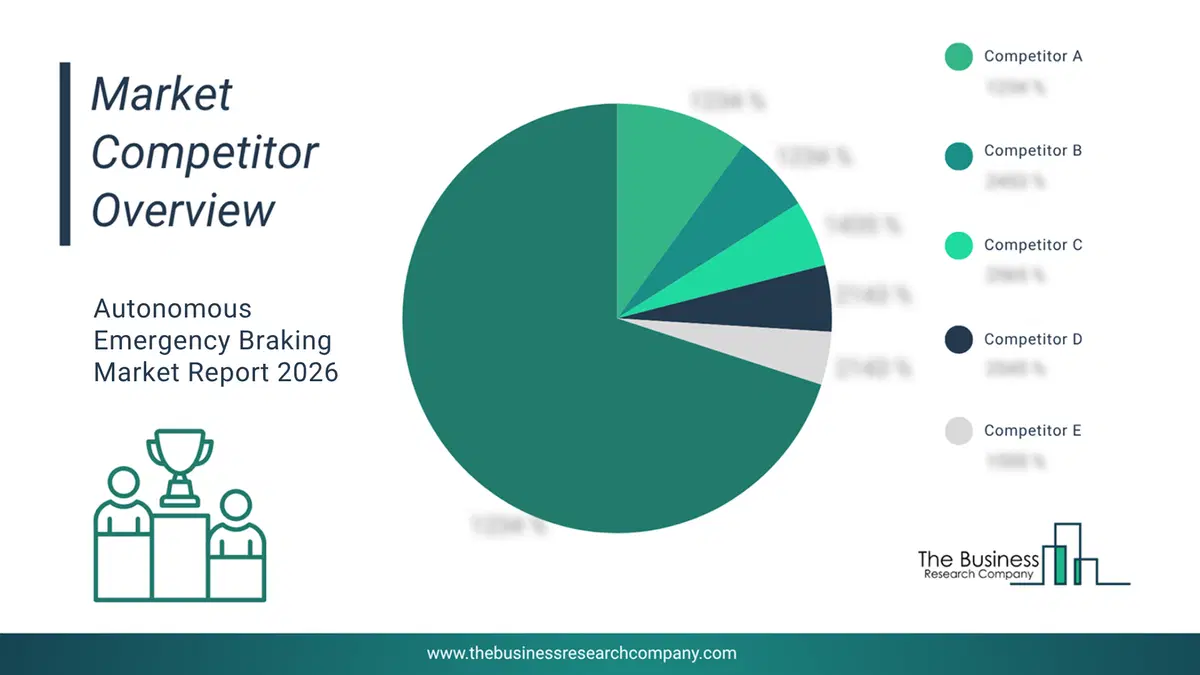
This chart is for illustrative purposes; the full report includes a detailed competitor analysis and comprehensive overview of the top 10 companies in the market.
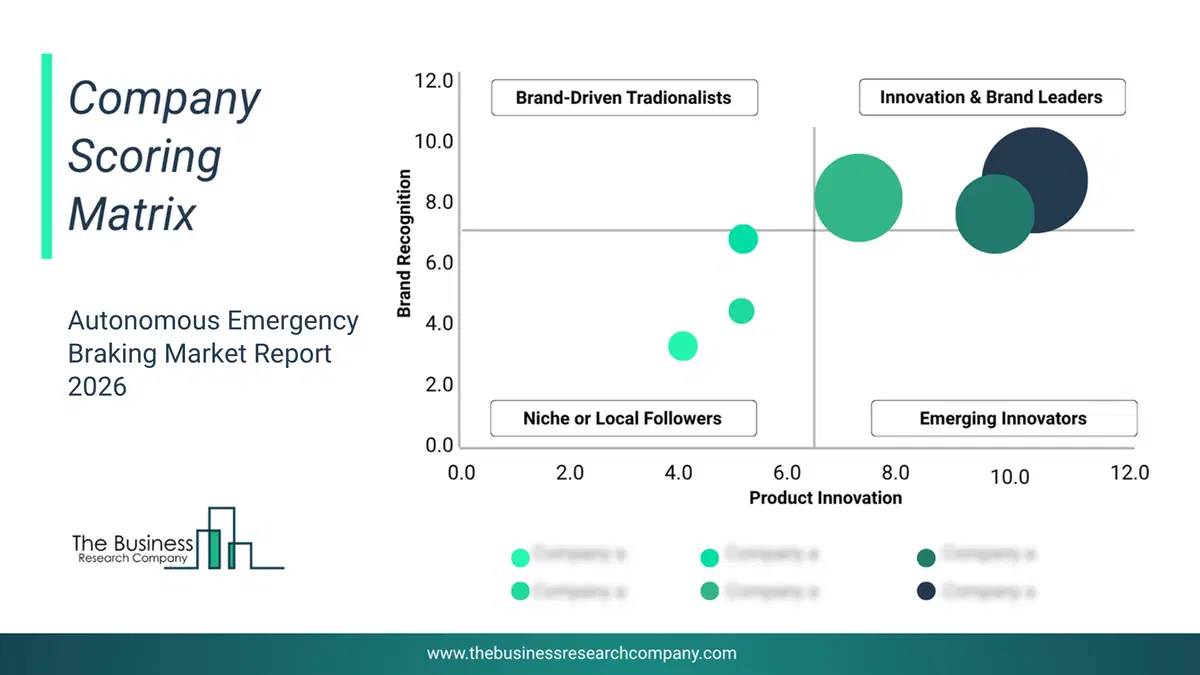
This chart maps companies by product innovation and brand strength, with bubble size indicating relative revenue, helping identify market leaders, challengers, and niche players. This is an illustrative chart; the full report provides a complete and accurate competitive analysis.
Global Autonomous Emergency Braking Market Trends and Insights
Major companies operating in the autonomous emergency braking market are adopting a strategic partnership approach to design, develop, and manufacture advanced braking products. Strategic partnerships refer to a process in which companies leverage each other's strengths and resources to achieve mutual benefits and success. For instance, in June 2024, Brakes India, an India-based developer of braking systems, partnered with ADVICS, a Japan-based developer of autonomous emergency braking systems. The new joint venture, a greenfield project, is set to be established with an investment of over INR 500 crore. Brakes India will retain a 51% stake, while ADVICS will hold 49%. Situated in southern India, the venture is expected to create over 300 jobs in the coming years. This partnership aims to merge Brakes India's localization expertise and customer relationships with ADVICS's cutting-edge global technology and quality systems.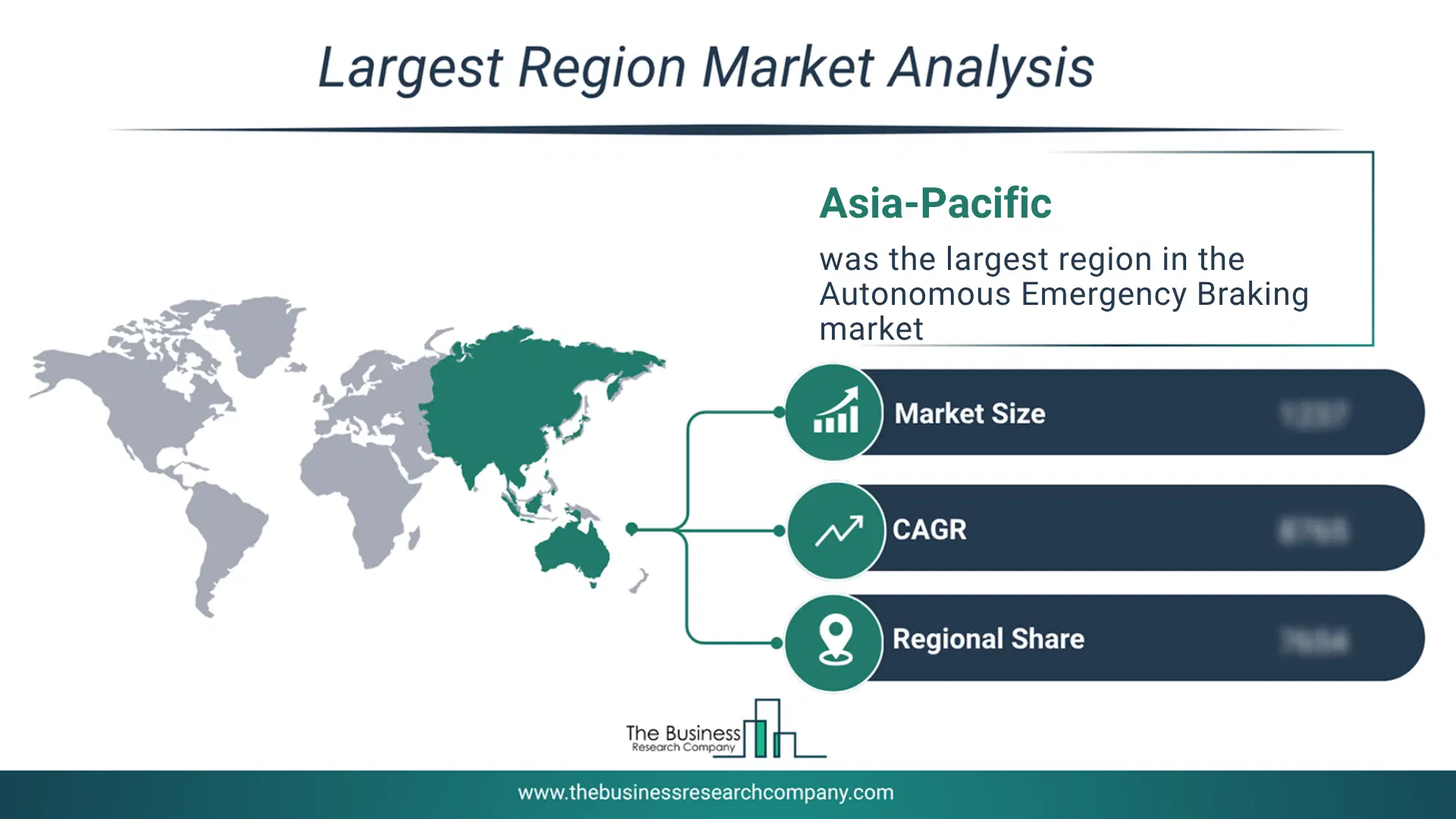
Regional Outlook
Asia-Pacific was the largest region in the autonomous emergency braking market in 2025. The regions covered in this market report include Asia-Pacific, South East Asia, Western Europe, Eastern Europe, North America, South America, Middle East, Africa. The countries covered in this market report include Australia, Brazil, China, France, Germany, India, Indonesia, Japan, Taiwan, Russia, South Korea, UK, USA, Canada, Italy, SpainWhat Defines the Autonomous Emergency Braking Market?
The automotive emergency braking market includes revenues earned by entities by electromagnetic, flywheel, spring, and hydraulic brakes. The market value includes the value of related goods sold by the service provider or included within the service offering. Only goods and services traded between entities or sold to end consumers are included.How is Market Value Defined and Measured?
The market value is defined as the revenues that enterprises gain from the sale of goods and/or services within the specified market and geography through sales, grants, or donations in terms of the currency (in USD unless otherwise specified). The revenues for a specified geography are consumption values that are revenues generated by organizations in the specified geography within the market, irrespective of where they are produced. It does not include revenues from resales along the supply chain, either further along the supply chain or as part of other products.
This chart presents market attractiveness based on a quantitative evaluation of growth, competition, strategic alignment, and risk, offering a clear view of opportunity areas for decision-making. This chart is for illustrative purposes; the full report contains the complete analysis.

This chart highlights the Total Addressable Market (TAM) by estimating the maximum revenue opportunity using an assumption-driven approach, supporting strategic planning and opportunity sizing across markets. The chart is illustrative; the full report provides a more comprehensive analysis.
What Key Data and Analysis Are Included in the Autonomous Emergency Braking Market Report 2026?
The autonomous emergency braking market research report is one of a series of new reports from The Business Research Company that provides market statistics, including industry global market size, regional shares, competitors with the market share, detailed market segments, market trends and opportunities, and any further data you may need to thrive in the autonomous emergency braking industry. The market research report delivers a complete perspective of everything you need, with an in-depth analysis of the current and future state of the industry.Autonomous Emergency Braking Market Report Forecast Analysis
| Report Attribute | Details |
|---|---|
| Market Size Value In 2026 | $69.08 billion |
| Revenue Forecast In 2030 | $125.37 billion |
| Growth Rate | CAGR of 16.2% from 2026 to 2030 |
| Base Year For Estimation | 2025 |
| Actual Estimates/Historical Data | 2020-2025 |
| Forecast Period | 2026 - 2030 - 2030 |
| Market Representation | Revenue in USD Billion and CAGR from 2026 to 2030 |
| Segments Covered | Vehicle Type, Technology, System |
| Regional Scope | Asia-Pacific, Western Europe, Eastern Europe, North America, South America, Middle East, Africa |
| Country Scope | The countries covered in the report are Australia, Brazil, China, France, Germany, India, Indonesia, Japan, Taiwan, Russia, South Korea, UK, USA, Canada, Italy, Spain. |
| Key Companies Profiled | Robert Bosch GmbH, Continental AG, ZF Friedrichshafen AG, Mobileye NV, Autoliv Inc., Hyundai Mobis Co Ltd., Aisin Corporation, Hitachi Automotive Systems Pvt Ltd., Mando Corporation, Tesla Inc., Magna International Inc., DENSO Corporation, Valeo SA, General Motors Company, Delphi Technologies plc, Aptiv plc, WABCO Holdings Inc., Hella KGaA Hueck & Co., TRW Automotive Holdings Corp., Ficosa International SA, Knorr-Bremse AG |
| Customization Scope | Request for Customization |
| Pricing And Purchase Options | Explore Purchase Options |