
Autonomous Trains Market Report 2026
Global Outlook – By Train Type (Suburban Trains, Tram, Monorail, Subway Or Metro, Long Distance Trains ), By Technology (Automatic Train Control (ATC), Communication-Based Train Control (CBTC), European Railway Traffic Management System (ERTMS), Positive Train Control (PTC) ), By Grade of Automation (GOA1, GOA2, GOA3, GOA4 ), By Application (Passenger Train, Freight, Mining ) – Market Size, Trends, Strategies, and Forecast to 2030
Autonomous Trains Market Overview
• Autonomous Trains market size has reached to $11.12 billion in 2025 • Expected to grow to $15.15 billion in 2030 at a compound annual growth rate (CAGR) of 6.4% • Growth Driver: Increasing Urbanization Fuels Growth In Autonomous Trains Market • Market Trend: 4am Robotics Launches Ati Tugger Train To Revolutionize Intralogistics With Advanced Automation • Western Europe was the largest region in 2025 and Asia-Pacific is the fastest growing region.Market Gains By 2030 – Top Opportunities By Segment
Market Gain identifies the most promising market opportunities by highlighting the segments or products expected to generate the highest incremental revenue growth over the next five years.
What Is Covered Under Autonomous Trains Market?
Autonomous train refers to a rail system that operates with minimal or no human intervention by using advanced sensors, communication systems, automation, and artificial intelligence to control train movement and safety functions. It is used for improving operational efficiency, enhancing safety, reducing human error, and enabling reliable and optimized rail transportation services. The main train types in the autonomous train market are suburban trains, trams, monorails, subways, and long-distance trains. A tram is an electric vehicle that transports people, mainly in cities, along metal tracks. The technologies involved are automatic train control (ATC), communication-based train control (CBC), the European Railway Traffic Management System (TERMS), and positive train control (PTC). The grades of automation involved are GOA1, GOA2, GOA3, and GOA4. The applications involved are passenger trains, freight, and mining.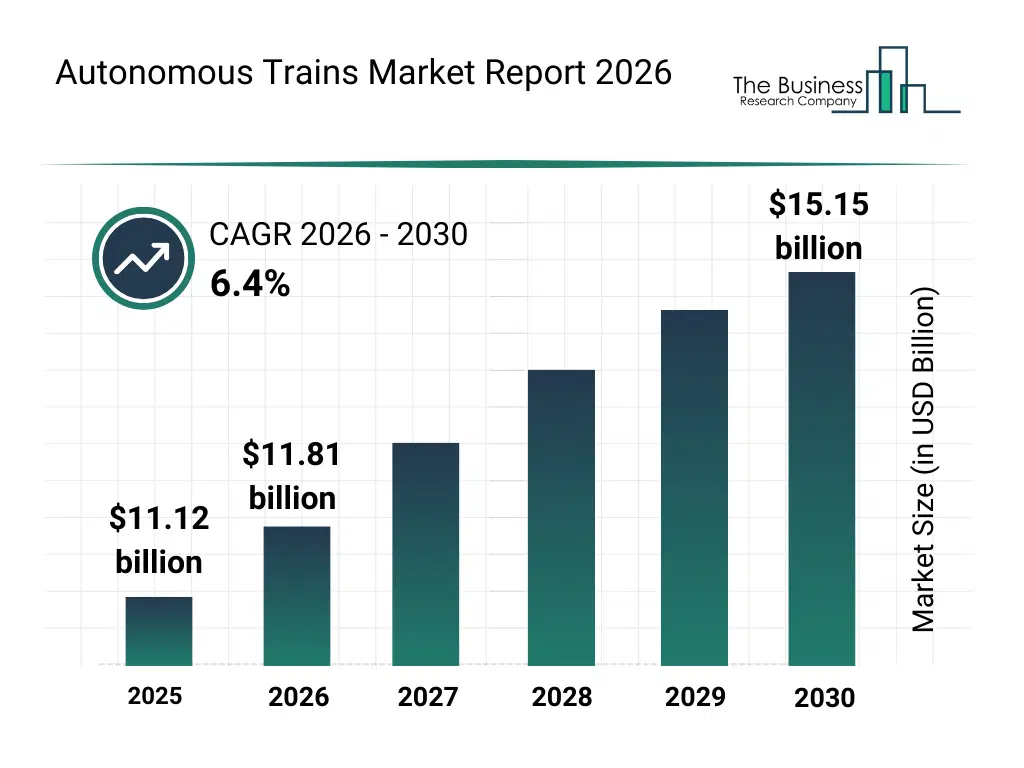
What Is The Autonomous Trains Market Size and Share 2026?
The autonomous trains market size has grown strongly in recent years. It will grow from $11.12 billion in 2025 to $11.81 billion in 2026 at a compound annual growth rate (CAGR) of 6.2%. The growth in the historic period can be attributed to metro network growth, safety regulation enforcement, reduction of driver dependency, adoption of automatic train protection, urban mobility demand.What Is The Autonomous Trains Market Growth Forecast?
The autonomous trains market size is expected to see strong growth in the next few years. It will grow to $15.15 billion in 2030 at a compound annual growth rate (CAGR) of 6.4%. The growth in the forecast period can be attributed to expansion of smart cities, investment in autonomous rail, demand for reliable mass transit, digital signaling upgrades, energy-efficient train operations. Major trends in the forecast period include deployment of fully automated trains, expansion of driverless metro lines, adoption of atp and atc systems, integration of remote monitoring, focus on passenger safety.
Global Autonomous Trains Market Segmentation
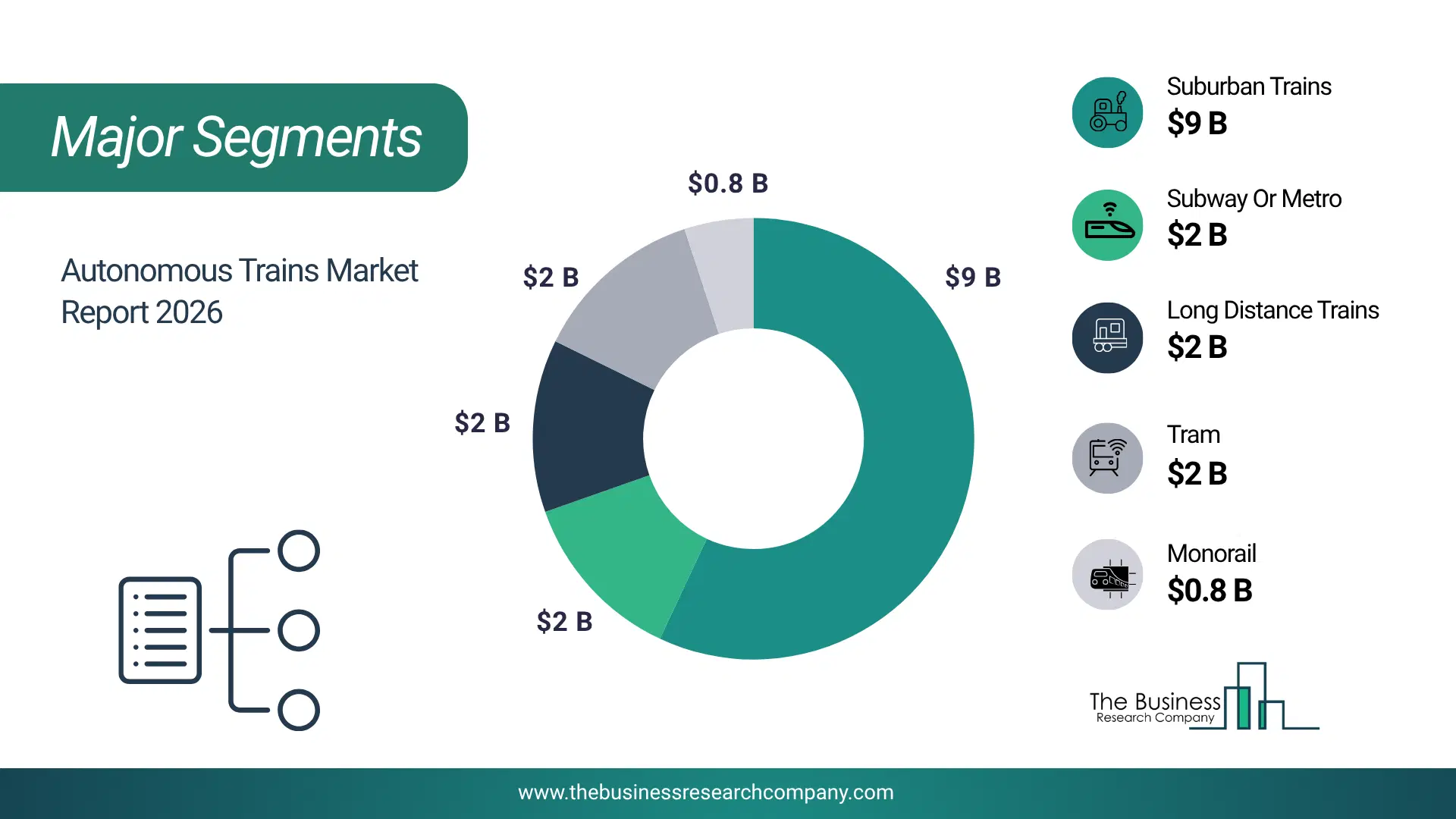
1) By Train Type: Suburban Trains, Tram, Monorail, Subway Or Metro, Long Distance Trains 2) By Technology: Automatic Train Control (ATC), Communication-Based Train Control (CBTC), European Railway Traffic Management System (ERTMS), Positive Train Control (PTC) 3) By Grade of Automation: GOA1, GOA2, GOA3, GOA4 4) By Application: Passenger Train, Freight, Mining Subsegments: 1) By Suburban Trains: Electric Suburban Trains, Diesel Suburban Trains 2) By Tram: Light Rail Trams, Street Trams 3) By Monorail: Elevated Monorails, At-Grade Monorails 4) By Subway Or Metro: Underground Subway Systems, Elevated Metro Systems 5) By Long Distance Trains: High-Speed Trains, Intercity Trains, Freight Trains The top segments in the autonomous trains market will be: • Suburban Trains will reach $8.88 Billion by 2030. • Subway Or Metro will reach $2.45 Billion by 2030. • Long Distance Trains will reach $1.85 Billion by 2030. • Tram will reach $1.59 Billion by 2030. • Monorail will reach $0.8 Billion by 2030.What Is The Driver Of The Autonomous Trains Market?
The increasing urbanization is expected to propel the growth of the autonomous trains market going forward. Urbanization refers to the process by which an increasing percentage of a population moves from rural areas to urban areas, leading to the growth of cities and towns. Increasing urbanization is driven by factors such as better job opportunities, improved infrastructure, access to education and healthcare, and the pursuit of a higher standard of living. Autonomous trains contribute to urbanization by enhancing public transportation efficiency, reducing traffic congestion, and promoting sustainable mobility, making cities more accessible and connected. For instance, in July 2023, according to a report published by the Federal Reserve Board of Governors, a US-based governmental organization, in 2023, US industrial production rose by 1.0% compared to the previous year, with manufacturing output increasing by 1.2%. Therefore, the increasing urbanization is driving the growth of the autonomous trains industry.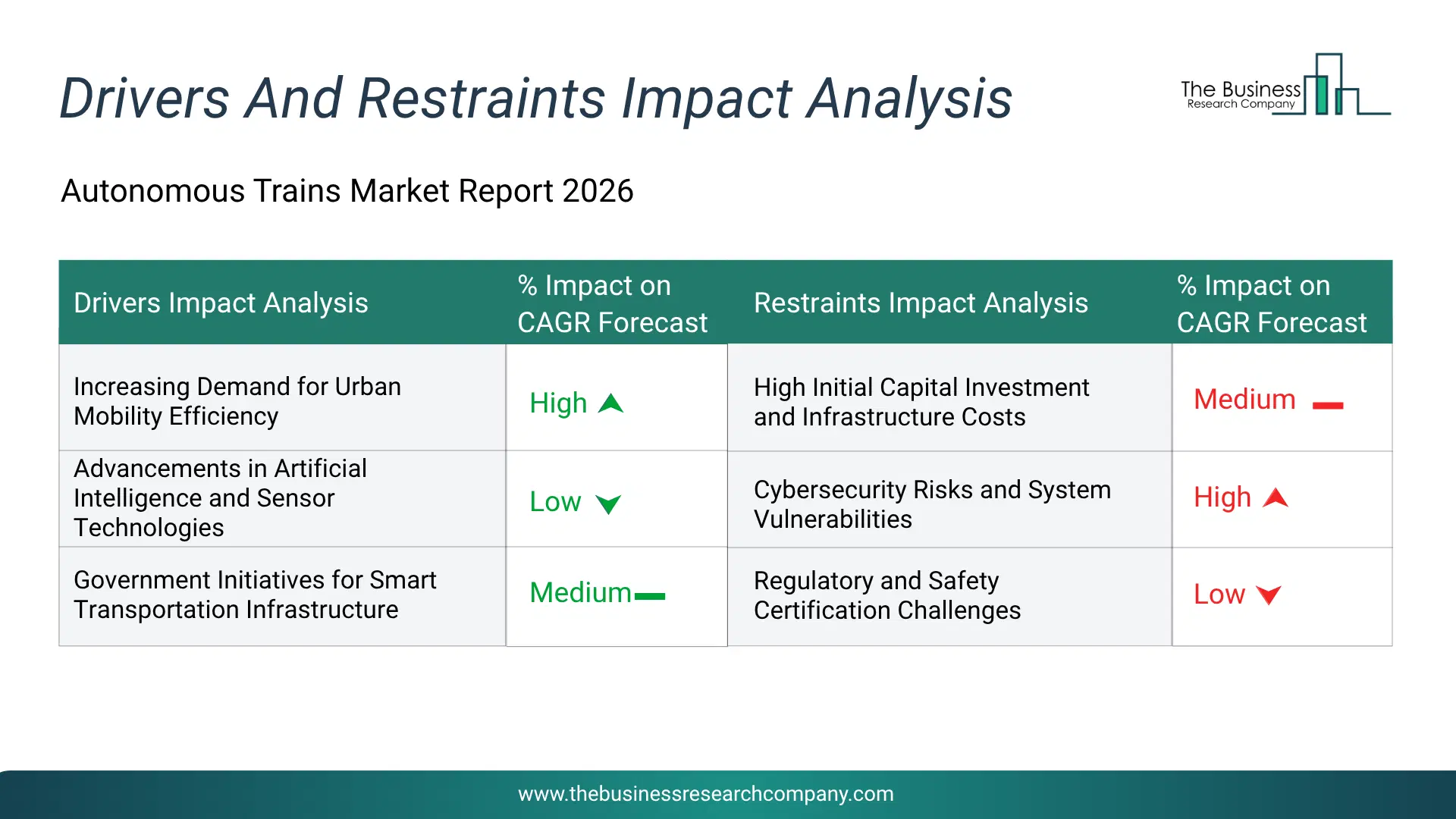
Infographic Chart Showing Key Market Drivers Analysis And Restraints For Autonomous Trains Market
The chart presents an impact analysis of key drivers and restraints, quantifying their relative influence on the market's growth rate and helping assess the balance between growth enablers and limiting factors. This chart offers a high-level perspective; the full report contains more detailed insights.
How Will The Drivers Impact Growth In The Global Autonomous Trains Market?
• Increasing Demand for Urban Mobility Efficiency (High) – During the forecast period, the increasing demand for urban mobility efficiency is expected to become a key growth driver for the autonomous trains market by 2030. Rapid urban population growth and rising congestion levels in major cities are placing immense pressure on existing transportation systems, necessitating more efficient, high-capacity transit solutions. Autonomous trains enable optimized scheduling, reduced headways, and improved network reliability, allowing operators to transport more passengers with minimal delays. These systems also enhance energy efficiency through optimized acceleration and braking patterns, contributing to lower operational costs. Transit authorities are increasingly adopting automated rail solutions to meet growing commuter demand while maintaining service consistency. • Advancements in Artificial Intelligence and Sensor Technologies (Low) – During the forecast period, the advancements in artificial intelligence and sensor technologies are expected to emerge as a major factor driving the expansion of the autonomous trains market by 2030. The integration of AI-driven analytics, real-time monitoring systems, and advanced sensors such as LiDAR, radar, and vision-based systems is significantly improving train autonomy and safety. These technologies enable precise train positioning, obstacle detection, predictive maintenance, and automated decision-making, reducing dependency on manual intervention. Continuous innovation in machine learning algorithms is further enhancing system reliability and operational efficiency across rail networks. As railway operators adopt these advanced technologies to modernize infrastructure and improve service quality, the demand for autonomous train systems is expected to rise. • Government Initiatives for Smart Transportation Infrastructure (Medium) – During the forecast period, the government initiatives for smart transportation infrastructure are expected to act as a key growth catalyst for the autonomous trains market by 2030. Governments across developed and emerging economies are investing heavily in the modernization of rail systems, focusing on digital signaling, automation, and integrated mobility solutions. Smart city programs and national transportation strategies are encouraging the deployment of driverless metro systems and advanced rail control technologies to improve safety, reduce operational costs, and enhance passenger experience. Public-private partnerships and long-term infrastructure funding are further supporting the adoption of autonomous rail solutions. Additionally, regulatory frameworks are evolving to accommodate higher levels of automation in rail operations.How Will The Restraints Impact Growth In The Global Autonomous Trains Market?
• High Initial Capital Investment and Infrastructure Costs (High) – During the forecast period, high initial capital investment and infrastructure costs are significantly restricting the growth of the autonomous trains market. The substantial expenditure required for signaling systems, control technologies, upgraded rail networks, and digital infrastructure is limiting adoption, particularly in developing and budget-constrained regions. • Cybersecurity Risks and System Vulnerabilities (Low) – During the forecast period, cybersecurity risks and system vulnerabilities are significantly restricting the growth of the autonomous trains market. Increasing reliance on connected systems, cloud-based control platforms, and AI-driven operations exposes rail networks to potential cyber threats, data breaches, and system disruptions, raising safety and reliability concerns. • Regulatory and Safety Certification Challenges (Medium) – During the forecast period, regulatory and safety certification challenges are significantly restricting the growth of the autonomous trains market. Strict safety standards, complex certification processes, and lengthy approval timelines for autonomous rail technologies are delaying commercialization and limiting rapid deployment across regions.Key Players In The Global Autonomous Trains Market
Major companies operating in the autonomous trains market report include Alstom SA, Siemens AG, CRRC Corporation Limited, Hitachi Ltd., Kawasaki Heavy Industries Ltd., Mitsubishi Heavy Industries Ltd., CAF Construcciones y Auxiliar de Ferrocarriles S.A., Stadler Rail AG, Hyundai Rotem Company, Transmashholding, Talgo S.A., Škoda Transportation a.s., Chinese National Railway Group Co. Ltd., Deutsche Bahn AG, SNCF, East Japan Railway Company, Central Japan Railway Company, West Japan Railway Company, Beijing Mass Transit Railway Operation Corporation, Shanghai Shentong Metro Group Co. Ltd.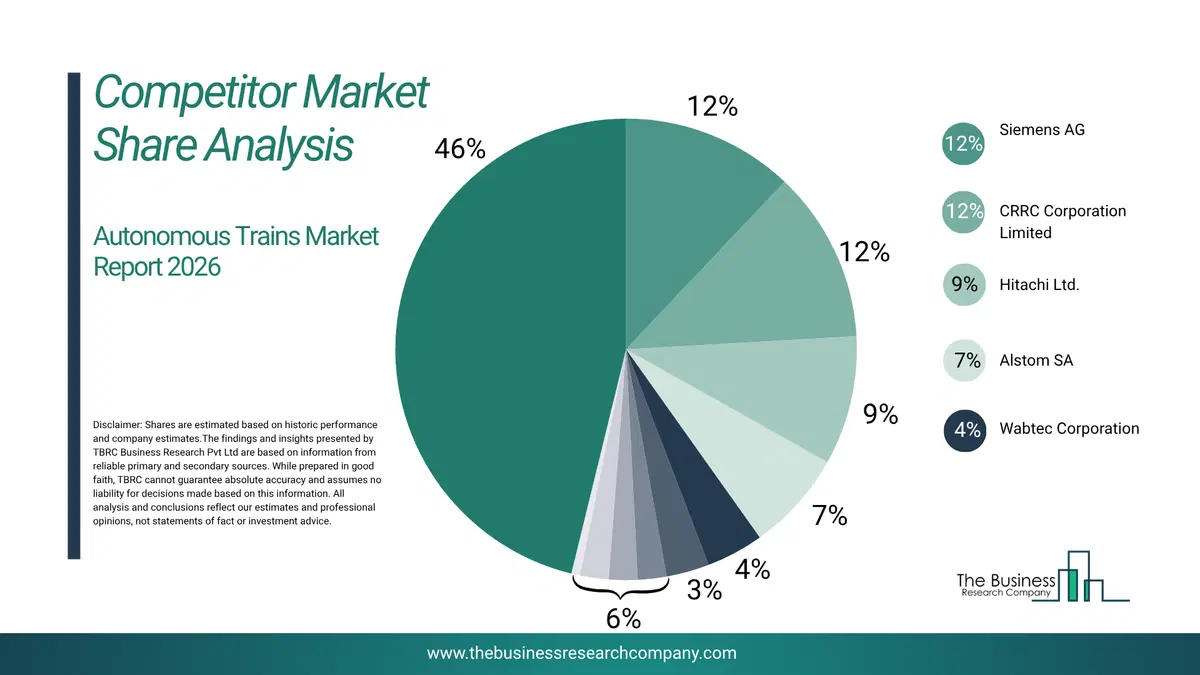
This chart is for illustrative purposes; the full report includes a detailed competitor analysis and comprehensive overview of the top 10 companies in the market.
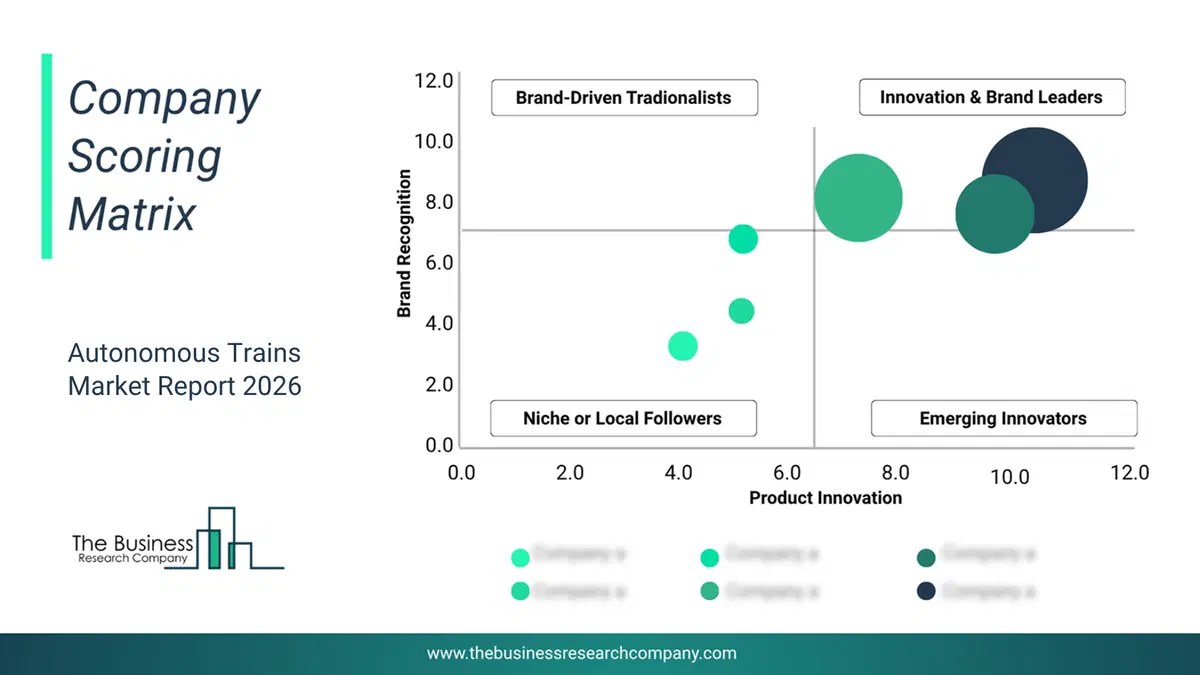
This chart maps companies by product innovation and brand strength, with bubble size indicating relative revenue, helping identify market leaders, challengers, and niche players. This is an illustrative chart; the full report provides a complete and accurate competitive analysis.
Global Autonomous Trains Market Trends and Insights
Major companies operating in the autonomous train market are focusing on developing advanced solutions, such as new-generation autonomous tuggers, to enhance intralogistics by automating the internal flow of goods in various industrial settings. A new generation autonomous tugger refers to an advanced, self-driving vehicle used in material handling within industrial environments, particularly in warehouses, factories, or distribution centers. For instance, in May 2024, 4am Robotics GmbH, a Germany-based automation company, launched the ATi Tugger Train. It offers unique features such as dual-use operation for both autonomous and manual modes, rapid scalability for easy transition between modes, seamless integration into existing systems, high reliability with operational availability of up to 99.9%, intelligent navigation with obstacle detection, and automatic coupling for streamlined logistics processes.What Are Latest Mergers And Acquisitions In The Autonomous Trains Market?
In July 2023, Mineral Resources Limited (MinRes), an Australia-based mining company, partnered with Hexagon AB. Through this collaboration, Mineral Resources Limited (MinRes) aims to enhance safety, productivity, and sustainability in mining operations, particularly for the Onslow Iron project in Western Australia. Hexagon AB is a Sweden-based technology company that involves autonomous trains.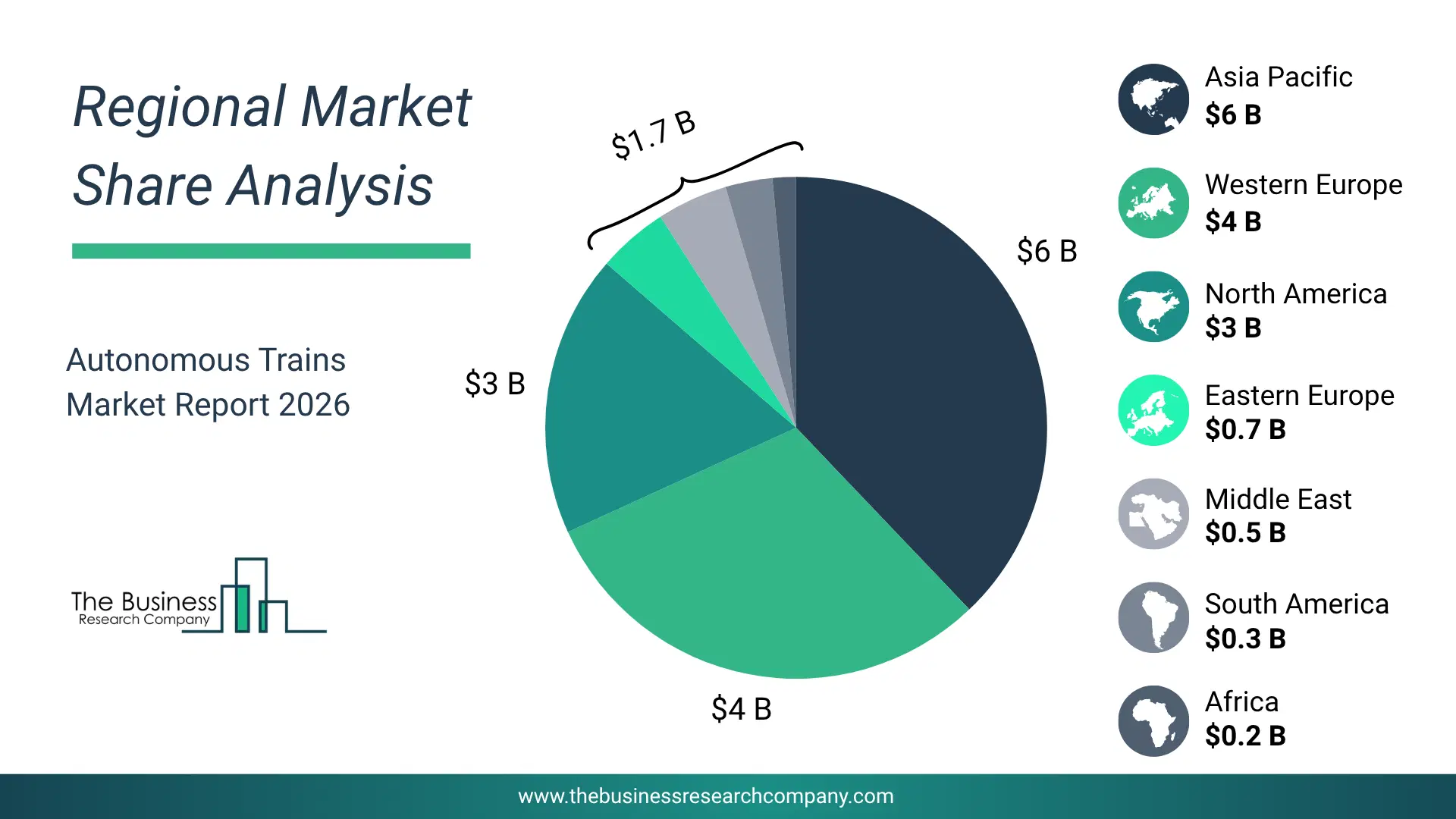
Regional Outlook
Western Europe was the largest region in the autonomous trains market in 2025. Asia-Pacific was the second largest region in the autonomous trains market. The regions covered in this market report include Asia-Pacific, South East Asia, Western Europe, Eastern Europe, North America, South America, Middle East, Africa. The countries covered in this market report include Australia, Brazil, China, France, Germany, India, Indonesia, Japan, Taiwan, Russia, South Korea, UK, USA, Canada, Italy, SpainWhat Defines the Autonomous Trains Market?
The autonomous trains market consists of sales of light trains, rapid transit trains, commuter trains, intercity trains, and high-speed trains. Values in this market are factory gate values, that is the value of goods sold by the manufacturers or creators of the goods, whether to other entities (including downstream manufacturers, wholesalers, distributors, and retailers) or directly to end customers. The value of goods in this market includes related services sold by the creators of the goods.How is Market Value Defined and Measured?
The market value is defined as the revenues that enterprises gain from the sale of goods and/or services within the specified market and geography through sales, grants, or donations in terms of the currency (in USD unless otherwise specified). The revenues for a specified geography are consumption values that are revenues generated by organizations in the specified geography within the market, irrespective of where they are produced. It does not include revenues from resales along the supply chain, either further along the supply chain or as part of other products.
This chart presents market attractiveness based on a quantitative evaluation of growth, competition, strategic alignment, and risk, offering a clear view of opportunity areas for decision-making. This chart is for illustrative purposes; the full report contains the complete analysis.

This chart highlights the Total Addressable Market (TAM) by estimating the maximum revenue opportunity using an assumption-driven approach, supporting strategic planning and opportunity sizing across markets. The chart is illustrative; the full report provides a more comprehensive analysis.
What Key Data and Analysis Are Included in the Autonomous Trains Market Report 2026?
The autonomous trains market research report is one of a series of new reports from The Business Research Company that provides market statistics, including industry global market size, regional shares, competitors with the market share, detailed market segments, market trends and opportunities, and any further data you may need to thrive in the autonomous trains industry. The market research report delivers a complete perspective of everything you need, with an in-depth analysis of the current and future state of the industry.Autonomous Trains Market Report Forecast Analysis
| Report Attribute | Details |
|---|---|
| Market Size Value In 2026 | $11.81 billion |
| Revenue Forecast In 2030 | $15.15 billion |
| Growth Rate | CAGR of 6.2% from 2026 to 2030 |
| Base Year For Estimation | 2025 |
| Actual Estimates/Historical Data | 2020-2025 |
| Forecast Period | 2026 - 2030 |
| Market Representation | Revenue in USD Billion and CAGR from 2026 to 2030 |
| Segments Covered | Train Type, Technology, Grade of Automation, Application |
| Regional Scope | Asia-Pacific, Western Europe, Eastern Europe, North America, South America, Middle East, Africa |
| Country Scope | The countries covered in the report are Australia, Brazil, China, France, Germany, India, Indonesia, Japan, Taiwan, Russia, South Korea, UK, USA, Canada, Italy, Spain. |
| Key Companies Profiled | Alstom SA, Siemens AG, CRRC Corporation Limited, Hitachi Ltd., Kawasaki Heavy Industries Ltd., Mitsubishi Heavy Industries Ltd., CAF Construcciones y Auxiliar de Ferrocarriles S.A., Stadler Rail AG, Hyundai Rotem Company, Transmashholding, Talgo S.A., Škoda Transportation a.s., Chinese National Railway Group Co. Ltd., Deutsche Bahn AG, SNCF, East Japan Railway Company, Central Japan Railway Company, West Japan Railway Company, Beijing Mass Transit Railway Operation Corporation, Shanghai Shentong Metro Group Co. Ltd. |
| Customization Scope | Request for Customization |
| Pricing And Purchase Options | Explore Purchase Options |