
Building Occupancy Light Detection And Ranging (LiDAR) Display Market Report 2026
Global Outlook – By Component ( Hardware, Software, Services), By Deployment Mode ( On-Premises, Cloud-Based), By Application ( Commercial Buildings, Residential Buildings, Industrial Facilities, Public Infrastructure, Other Applications), By End-User ( Real Estate, Facility Management, Government, Healthcare, Education, Other End-Users) – Market Size, Trends, Strategies, and Forecast to 2030
Building Occupancy Light Detection And Ranging (LiDAR) Display Market Overview
• Building Occupancy Light Detection And Ranging (LiDAR) Display market size has reached to $1.14 billion in 2025 • Expected to grow to $2.74 billion in 2030 at a compound annual growth rate (CAGR) of 19.1% • Growth Driver: Rising Demand For Green Buildings Driving The Market Growth Due To Focus On Energy Efficiency And Sustainable Infrastructure • Market Trend: Advancements In High-Precision And Energy-Efficient Occupancy Detection Technologies • North America was the largest region in 2025 and Asia-Pacific is the fastest growing region.What Is Covered Under Building Occupancy Light Detection And Ranging (LiDAR) Display Market?
Building occupancy light detection and ranging (LiDAR) display is a technology that applies laser-based scanning to capture and illustrate the presence and distribution of people within a building. It functions by transmitting laser signals and calculating the return time after they reflect off surrounding surfaces, producing detailed spatial information. The main components of building occupancy light detection and ranging (LiDAR) displays include hardware, software, and services. In building occupancy LiDAR displays, hardware refers to the physical equipment that makes data capture possible. It includes the LiDAR sensors, laser transmitters, receivers, mirrors, scanning modules, and processors that collect depth and spatial information. It offers various deployment modes, including on-premises and cloud-based, and is applied for commercial buildings, residential buildings, industrial facilities, public infrastructure, and others. It is used by several end-users, including real estate, facility management, government, healthcare, education, and others.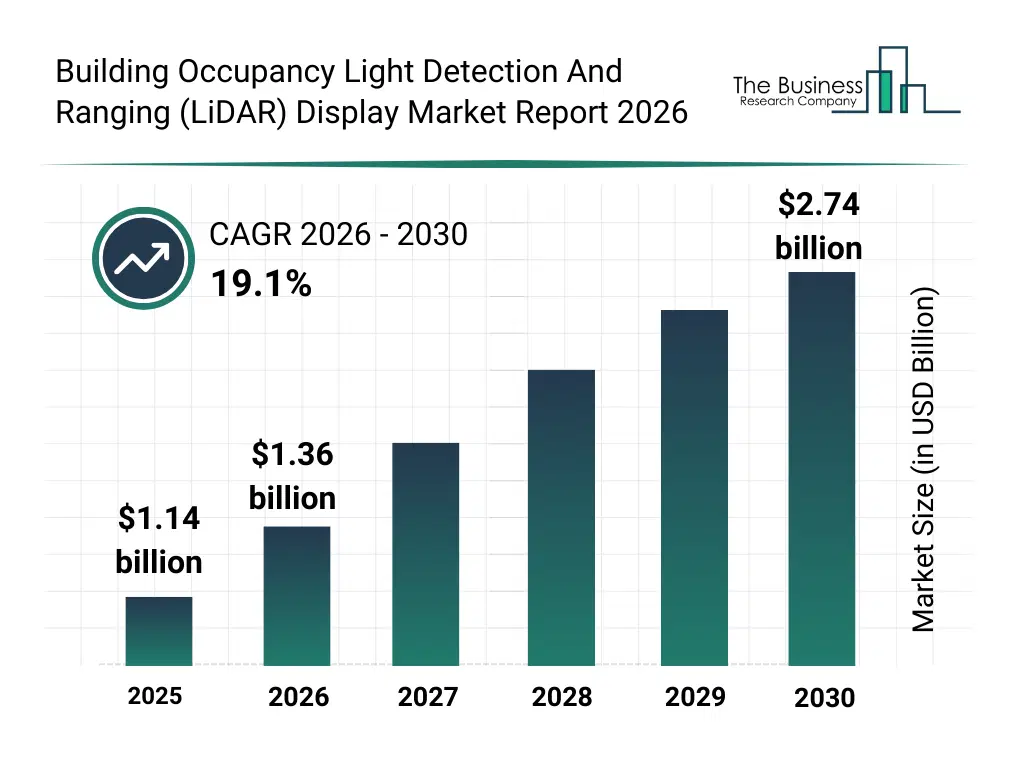
What Is The Building Occupancy Light Detection And Ranging (LiDAR) Display Market Size 2026 And Growth Rate?
The building occupancy light detection and ranging (lidar) display market size has grown rapidly in recent years. It will grow from $1.14 billion in 2025 to $1.36 billion in 2026 at a compound annual growth rate (CAGR) of 19.4%. The growth in the historic period can be attributed to growth of smart building automation, rising demand for energy efficiency, adoption of laser-based sensing technologies, increasing commercial real estate digitization, early integration of occupancy sensors in facility management.What Is The Building Occupancy Light Detection And Ranging (LiDAR) Display Market Growth Forecast?
The building occupancy light detection and ranging (lidar) display market size is expected to see rapid growth in the next few years. It will grow to $2.74 billion in 2030 at a compound annual growth rate (CAGR) of 19.1%. The growth in the forecast period can be attributed to expansion of ai-powered building intelligence, stricter energy efficiency regulations, increasing deployment of cloud-based building management systems, demand for real-time occupancy visualization, integration with digital twins and smart infrastructure. Major trends in the forecast period include AI-driven occupancy analytics, real-time smart building integration, predictive space utilization optimization, privacy-preserving lidar sensing, energy-efficient building operations.
Global Building Occupancy Light Detection And Ranging (LiDAR) Display Market Segmentation
1) By Component: Hardware, Software, Services 2) By Deployment Mode: On-Premises, Cloud-Based 3) By Application: Commercial Buildings, Residential Buildings, Industrial Facilities, Public Infrastructure, Other Applications 4) By End-User: Real Estate, Facility Management, Government, Healthcare, Education, Other End-Users Subsegments: 1) By Hardware: Laser Scanners, Navigation And Positioning Systems, Beam-Steering And MEMS Mirrors, Photodetectors Or Receivers, Data Processing Units 2) By Software: Mapping Software, Simulation Software, Processing And Analysis Software 3) By Services: Aerial Surveying, Ground-Based Surveying, Asset Management, Geographic Information Systems (GIS), Consulting And CustomizationWhat Is The Driver Of The Building Occupancy Light Detection And Ranging (LiDAR) Display Market?
The growing preference for green buildings is expected to propel the growth of the building occupancy light detection and ranging (LiDAR) display market going forward. Green buildings are environmentally responsible structures that optimize resource efficiency, reduce ecological impact, and create healthier spaces for occupants. Green buildings are rising due to the growing demand for energy-efficient infrastructure, as organizations and governments increasingly prioritize reducing carbon emissions while cutting long-term operational costs. Building occupancy LiDAR displays support green buildings by precisely tracking how spaces are used, allowing lighting and HVAC systems to operate only when needed, which improves energy efficiency. For instance, in December 2024, according to the Green Building Council of Australia, an Australia-based non-profit organization, Green Star certification was awarded to 64 million square meters of building space in 2023-24. Moreover, the number of sustainability certification submissions has doubled compared to the previous year, with more than 120 projects submitted and over 150 queries recorded in just a three-month period. Therefore, the growing preference for green buildings is driving the growth of the building occupancy light detection and ranging (LiDAR) display industry.What Is The Driver Of The Building Occupancy Light Detection And Ranging (LiDAR) Display Market?
The expansion of the healthcare sector and hospitals is expected to propel the growth of the building occupancy light detection and ranging (LiDAR) display market going forward. The healthcare sector includes all organizations and services that offer medical care, and hospitals are specialized facilities within this sector that provide treatment, care, and medical support to patients. The healthcare sector and hospitals are expanding due to the rising demand for quality medical services driven by growing populations and increasing prevalence of chronic diseases. Building occupancy LiDAR displays help hospitals and the healthcare sector by tracking patient and staff movements in real time, allowing for more efficient use of space and optimal allocation of medical resources. For instance, in May 2023, according to the Department of Health and Social Care, a UK-based government department, under the New Hospital Programme, the government plans to redevelop five major hospitals by 2030 and has announced a landmark investment exceeding $27.02 billion (£20 billion) for new hospital infrastructure. Therefore, the expansion of the healthcare sector and hospitals is driving the growth of the building occupancy light detection and ranging (LiDAR) display industry.Key Players In The Global Building Occupancy Light Detection And Ranging (LiDAR) Display Market
Major companies operating in the building occupancy light detection and ranging (lidar) display market are Hexagon AB, Trimble Inc., HesAI Technology Co. Ltd., SICK AG, Topcon Corporation, Ouster Inc., GeoDigital International Inc., LeddarTech Inc., Robosense, GENESYS International Corporation Ltd., GeoSLAM Ltd., Firmatek LLC, Benewake (Beijing) Co. Ltd., Quanergy Systems Inc., Cepton Technologies Inc., Velodyne LiDAR Inc., Goodland Surveys Private Limited, Quantum Spatial Inc., Mira Solutions Inc., SenSource Inc., Beijing SureStar Technology Co. Ltd.
This chart is for illustrative purposes; the full report includes a detailed competitor analysis and comprehensive overview of the top 10 companies in the market.
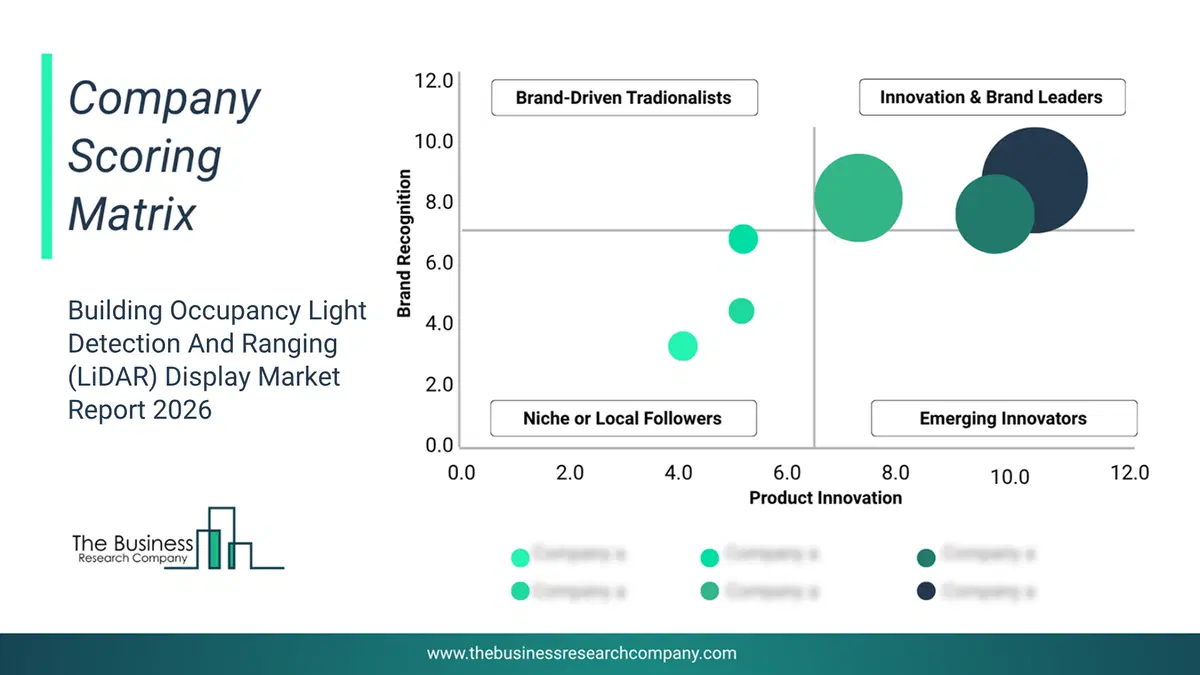
This chart maps companies by product innovation and brand strength, with bubble size indicating relative revenue, helping identify market leaders, challengers, and niche players. This is an illustrative chart; the full report provides a complete and accurate competitive analysis.
Global Building Occupancy Light Detection And Ranging (LiDAR) Display Market Trends and Insights
Major companies operating in the building occupancy light detection and ranging (LiDAR) display market are focusing on developing advanced solutions, such as solid-state LiDAR, to gain a competitive advantage. Solid-state LiDAR eliminates moving parts by using semiconductor-based scanning, which increases reliability, reduces costs, and enables compact designs suitable for building integration. For instance, in March 2023, Innoviz Technologies, an Israel-based LiDAR technology company, launched the InnovizTwo LiDAR sensor. This sensor delivers higher resolution at longer ranges, supports a wider field of view, and offers automotive-grade durability, making it adaptable for infrastructure and occupancy monitoring applications. Such innovations demonstrate how LiDAR systems are evolving to provide more precise, energy-efficient, and scalable solutions for real-time occupancy visualization.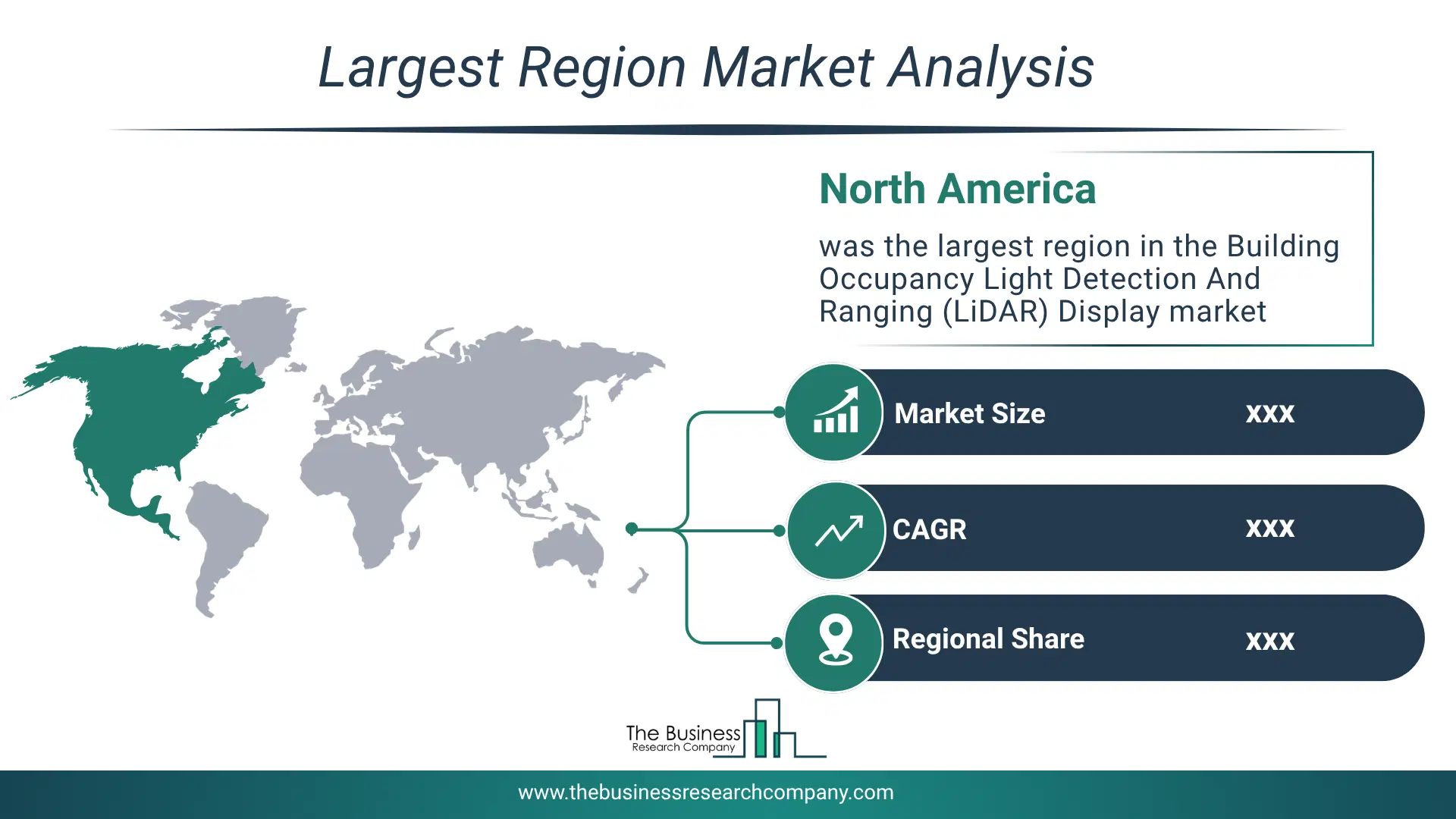
Regional Outlook
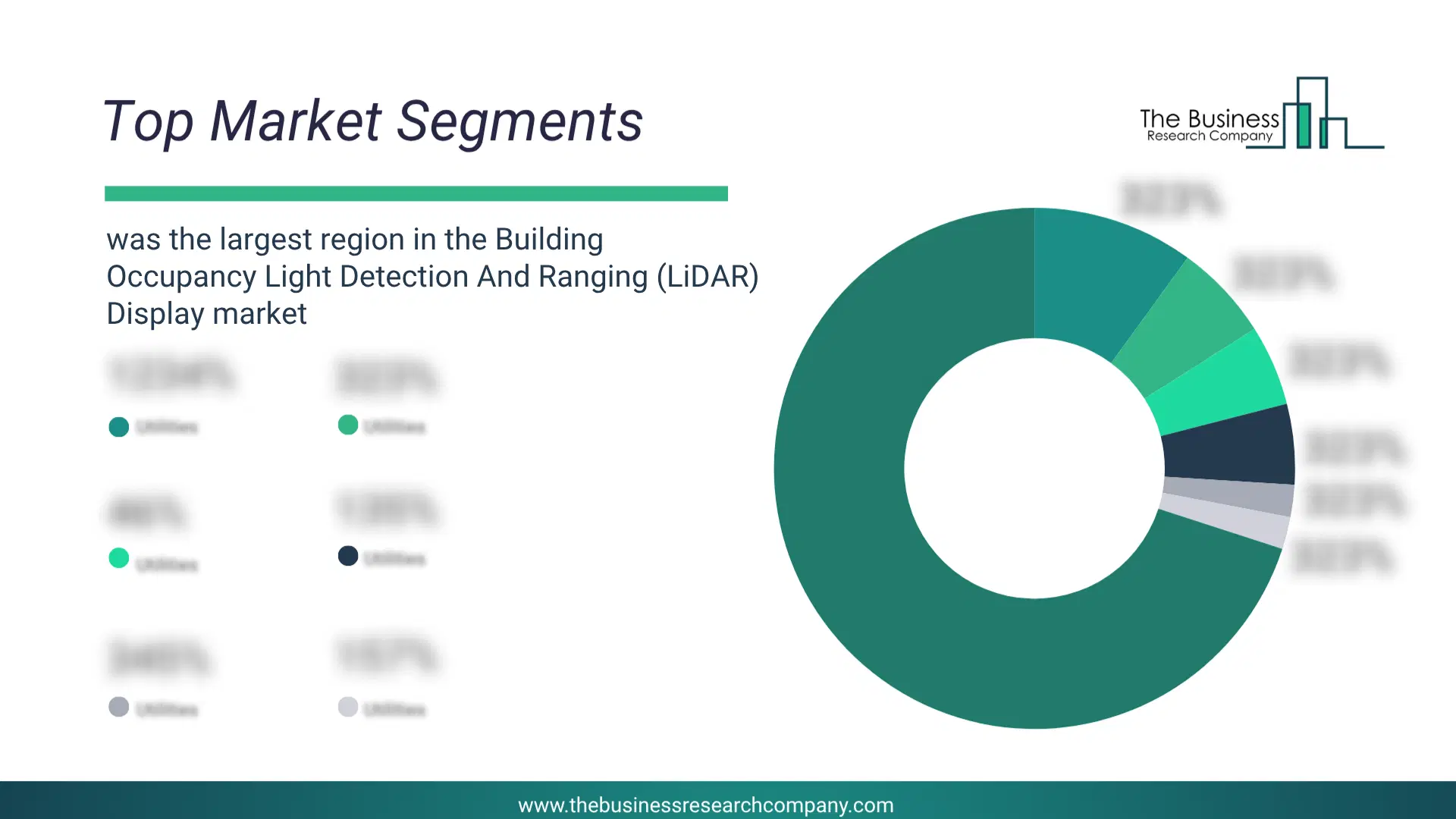
North America was the largest region in the building occupancy light detection and ranging (LiDAR) display market in 2025. Asia-Pacific is expected to be the fastest-growing region in the forecast period. The regions covered in this market report are Asia-Pacific, South East Asia, Western Europe, Eastern Europe, North America, South America, Middle East, Africa. The countries covered in this market report are Australia, Brazil, China, France, Germany, India, Indonesia, Japan, Taiwan, Russia, South Korea, UK, USA, Canada, Italy, Spain.What Defines the Building Occupancy Light Detection And Ranging (LiDAR) Display Market?
The building occupancy light detection and ranging (LiDAR) display market consists of revenues earned by entities by providing services such as point-cloud acquisition, as-built documentation, occupancy detection, clash detection, and space utilization. The market value includes the value of related goods sold by the service provider or included within the service offering. The building occupancy light detection and ranging (LiDAR) display market also includes sales of sensors, scanners, mapping devices, and mounting accessories. Values in this market are ‘factory gate’ values, that is the value of goods sold by the manufacturers or creators of the goods, whether to other entities (including downstream manufacturers, wholesalers, distributors and retailers) or directly to end customers. The value of goods in this market includes related services sold by the creators of the goods.How is Market Value Defined and Measured?
The market value is defined as the revenues that enterprises gain from the sale of goods and/or services within the specified market and geography through sales, grants, or donations in terms of the currency (in USD unless otherwise specified). The revenues for a specified geography are consumption values that are revenues generated by organizations in the specified geography within the market, irrespective of where they are produced. It does not include revenues from resales along the supply chain, either further along the supply chain or as part of other products.
This chart presents market attractiveness based on a quantitative evaluation of growth, competition, strategic alignment, and risk, offering a clear view of opportunity areas for decision-making. This chart is for illustrative purposes; the full report contains the complete analysis.

This chart highlights the Total Addressable Market (TAM) by estimating the maximum revenue opportunity using an assumption-driven approach, supporting strategic planning and opportunity sizing across markets. The chart is illustrative; the full report provides a more comprehensive analysis.
What Key Data and Analysis Are Included in the Building Occupancy Light Detection And Ranging (LiDAR) Display Market Report 2026?
The building occupancy light detection and ranging (lidar) display market research report is one of a series of new reports from The Business Research Company that provides market statistics, including industry global market size, regional shares, competitors with the market share, detailed market segments, market trends and opportunities, and any further data you may need to thrive in the building occupancy light detection and ranging (lidar) display industry. The market research report delivers a complete perspective of everything you need, with an in-depth analysis of the current and future state of the industry.Building Occupancy Light Detection And Ranging (LiDAR) Display Market Report Forecast Analysis
| Report Attribute | Details |
|---|---|
| Market Size Value In 2026 | $1.36 billion |
| Revenue Forecast In 2030 | $2.74 billion |
| Growth Rate | CAGR of 19.1% from 2026 to 2030 |
| Base Year For Estimation | 2025 |
| Actual Estimates/Historical Data | 2020-2025 |
| Forecast Period | 2026 - 2030 |
| Market Representation | Revenue in USD Billion and CAGR from 2026 to 2030 |
| Segments Covered | Component, Deployment Mode, Application, End-User |
| Regional Scope | Asia-Pacific, Western Europe, Eastern Europe, North America, South America, Middle East, Africa |
| Country Scope | The countries covered in the report are Australia, Brazil, China, France, Germany, India, Indonesia, Japan, Taiwan, Russia, South Korea, UK, USA, Canada, Italy, Spain. |
| Key Companies Profiled | Hexagon AB, Trimble Inc., HesAI Technology Co. Ltd., SICK AG, Topcon Corporation, Ouster Inc., GeoDigital International Inc., LeddarTech Inc., Robosense, GENESYS International Corporation Ltd., GeoSLAM Ltd., Firmatek LLC, Benewake (Beijing) Co. Ltd., Quanergy Systems Inc., Cepton Technologies Inc., Velodyne LiDAR Inc., Goodland Surveys Private Limited, Quantum Spatial Inc., Mira Solutions Inc., SenSource Inc., Beijing SureStar Technology Co. Ltd. |
| Customization Scope | Request for Customization |
| Pricing And Purchase Options | Explore Purchase Options |