
Computer Vision For Retail Market Report 2026
Global Outlook – By Component (Hardware, Software, Services), By Deployment Mode (On-Premises, Cloud), By Retail Type (Supermarkets Or Hypermarkets, Convenience Stores, Specialty Stores, Online Retailers, Other Retail Types), By Application (Customer Analytics, Inventory Management, Loss Prevention, Checkout Optimization, Other Applications), By End User (Large Enterprises, Small And Medium Enterprises) – Market Size, Trends, Strategies, and Forecast to 2030
Computer Vision For Retail Market Overview
• Computer Vision For Retail market size has reached to $4.23 billion in 2025 • Expected to grow to $12.19 billion in 2030 at a compound annual growth rate (CAGR) of 23.5% • Growth Driver: Surge In Demand For Automated Solutions Fueling The Growth Of The Market Due To Rising Need For Efficiency And Reduced Operational Costs • Market Trend: Artificial Intelligence (AI)-Powered Loss Prevention Solution Enhancing Retail Security And Operational Efficiency • North America was the largest region in 2025 and Asia-Pacific is the fastest growing region.What Is Covered Under Computer Vision For Retail Market?
Computer vision for retail is a technology that uses smart cameras and artificial intelligence to help stores analyze and manage their operations. It assists in tasks such as inventory management, faster checkout, and understanding customer behavior. The main goal is to improve store efficiency, reduce losses, and enhance the customer experience through automation of activities like checkout, shelf monitoring, and customer analysis. The main components of computer vision for retail are hardware, software, services. Computer vision for retail is the use of cameras, sensors, and AI-powered software to automatically monitor, analyze, and optimize in-store operations, customer behavior, and inventory management. These are deployed through various deployment mode such as on-premises, cloud with various retail types such as supermarkets or hypermarkets, convenience stores, specialty stores, online retailers, others. These are used in various applications such as customer analytics, inventory management, loss prevention, checkout optimization, others and also by various end users such as large enterprises, small and medium enterprises.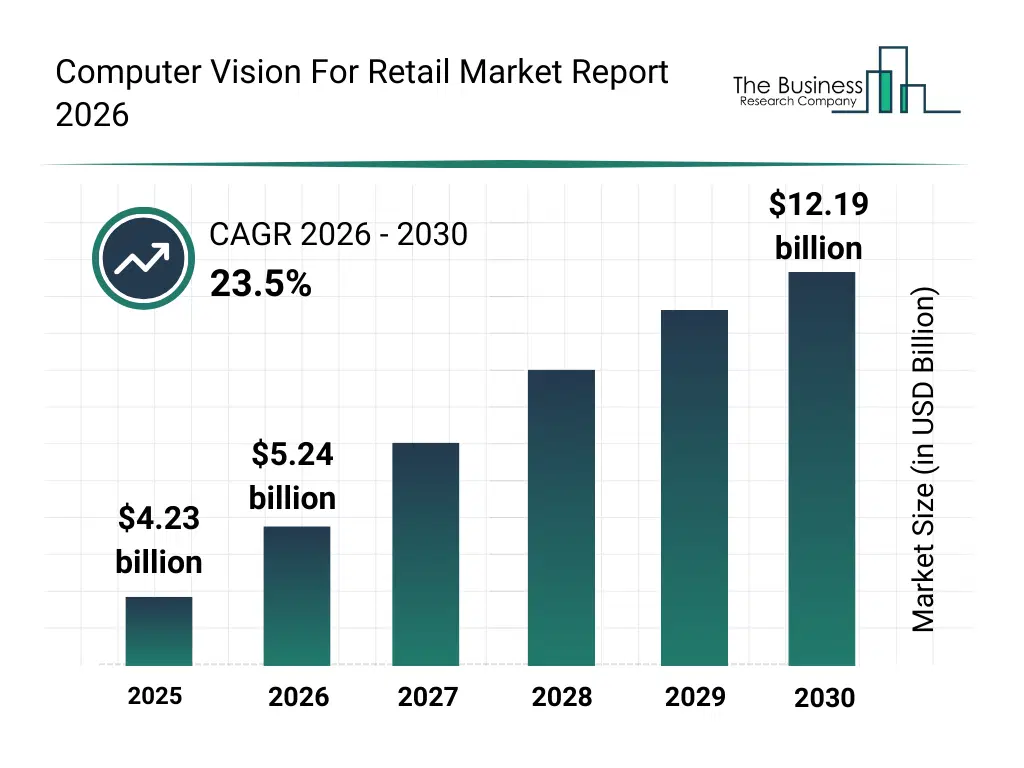
What Is The Computer Vision For Retail Market Size and Share 2026?
The computer vision for retail market size has grown exponentially in recent years. It will grow from $4.23 billion in 2025 to $5.24 billion in 2026 at a compound annual growth rate (CAGR) of 23.8%. The growth in the historic period can be attributed to growth of organized retail chains, increasing retail shrinkage rates, declining costs of camera hardware, adoption of data-driven retail strategies, rising labor costs in retail.What Is The Computer Vision For Retail Market Growth Forecast?
The computer vision for retail market size is expected to see exponential growth in the next few years. It will grow to $12.19 billion in 2030 at a compound annual growth rate (CAGR) of 23.5%. The growth in the forecast period can be attributed to expansion of autonomous store formats, advancements in AI model accuracy, demand for personalized shopping experiences, increasing cloud infrastructure adoption, scalability needs across multi-store retail networks. Major trends in the forecast period include AI-driven real-time shelf monitoring, computer vision enabled frictionless checkout, advanced in-store customer behavior analytics, automated loss prevention and theft detection, omnichannel retail intelligence integration.
Global Computer Vision For Retail Market Segmentation
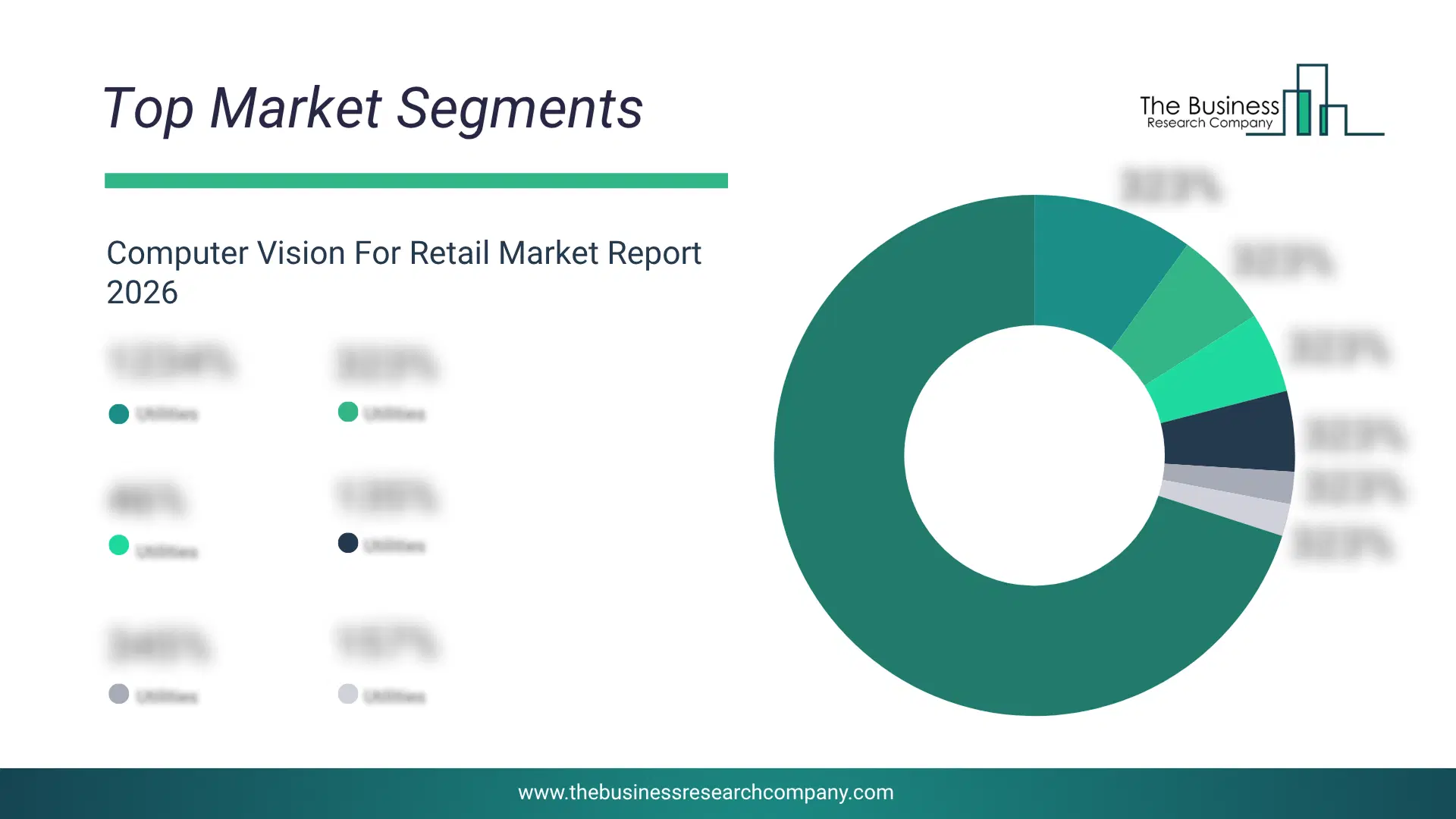
1) By Component: Hardware, Software, Services 2) By Deployment Mode: On-Premises, Cloud 3) By Retail Type: Supermarkets Or Hypermarkets, Convenience Stores, Specialty Stores, Online Retailers, Other Retail Types 4) By Application: Customer Analytics, Inventory Management, Loss Prevention, Checkout Optimization, Other Applications 5) By End User: Large Enterprises, Small And Medium Enterprises Subsegments: 1) By Hardware: Cameras, Sensors, Processors, Display Units, Networking Devices 2) By Software: Video Analytics Software, Image Recognition Software, Artificial Intelligence Algorithms, Data Management Platforms, Cloud-Based Analytics Tools 3) By Services: Installation And Integration Services, Maintenance And Support Services, Consulting Services, Training And Implementation Services, Managed ServicesWhat Is The Driver Of The Computer Vision For Retail Market?
Increasing demand for automated solutions is expected to propel the growth of computer vision for the retail market going forward. Automated solutions refer to systems, technologies, or processes designed to perform tasks, operations, or workflows with minimal or no human intervention. Increasing demand for automated solutions is due to the need to reduce operational expenses and enhance efficiency while minimizing human errors and improving productivity and scalability across industries. Computer vision for retail supports automated solutions by providing real-time product recognition, inventory management, and customer behavior analysis, enabling stores to optimize stock levels, enhance shopping experiences, and reduce manual labor. For instance, in March 2025, QuantumBlack AI, a UK-based company, reported use of artificial intelligence (AI) increased in 2024 with 78 percent of respondents say their organizations use AI in at least one business function, up from 72 percent in early 2024 and 55 percent a year earlier. Therefore, increasing demand for automated solutions is driving the growth of computer vision for the retail market.Key Players In The Global Computer Vision For Retail Market
Major companies operating in the computer vision for retail market are Google LLC, Microsoft Corporation, Amazon Web Services Inc., Sony Corporation, International Business Machines Corporation, Intel Corporation, Honeywell International Inc., NVIDIA Corporation, Zebra Technologies Corporation, SenseTime Group Inc., Metropolis Technologies Inc., Trax Technology Solutions Pte. Ltd., Scandit AG., Trigo Vision Ltd., Vispera Information Technologies Inc., Standard AI Inc., Malong Technologies Inc., Graymatics Inc., SeeChange Technologies Inc., StrataVision Inc.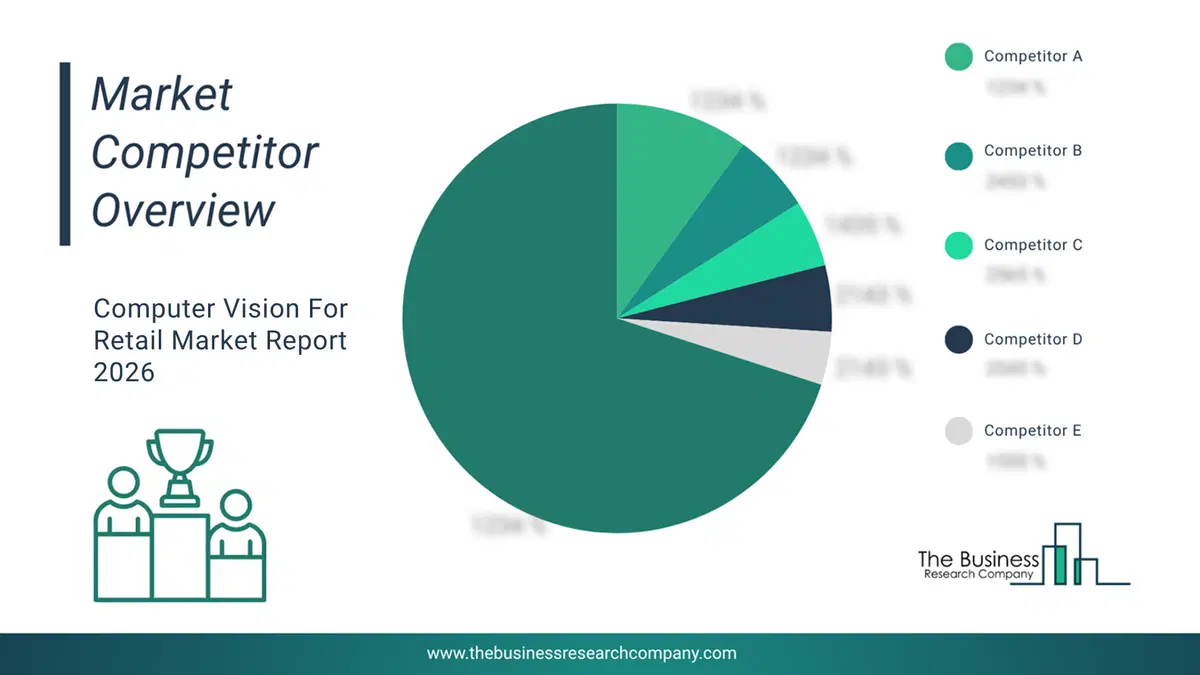
This chart is for illustrative purposes; the full report includes a detailed competitor analysis and comprehensive overview of the top 10 companies in the market.
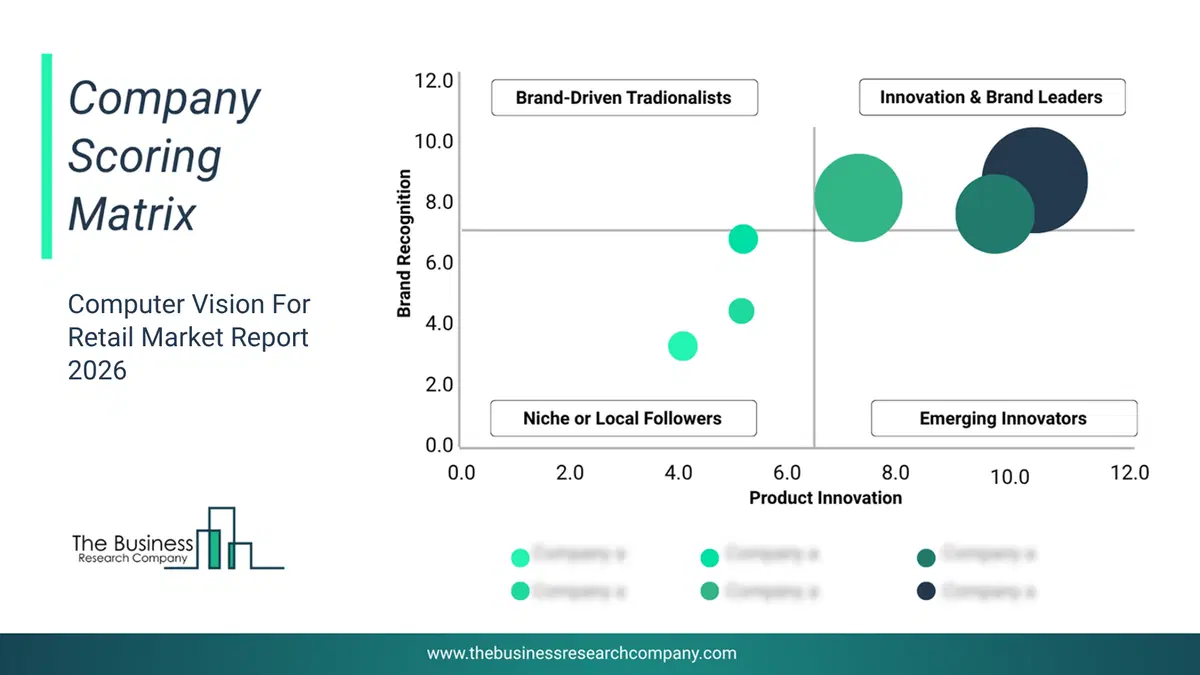
This chart maps companies by product innovation and brand strength, with bubble size indicating relative revenue, helping identify market leaders, challengers, and niche players. This is an illustrative chart; the full report provides a complete and accurate competitive analysis.
Global Computer Vision For Retail Market Trends and Insights
Major companies operating in the computer vision for retail market are focusing on technological advancements such as loss prevention technology, which leverages artificial intelligence (AI)-powered computer vision to detect, track, and prevent theft in real time while maintaining a seamless shopping experience and ensuring customer privacy. Loss prevention technology refers to systems and solutions designed to minimize retail shrinkage by detecting, monitoring, and preventing theft, fraud, and inventory mismanagement. For instance, in June 2025, Trigo Vision Ltd., an Israel-based company, launched a Computer Vision-artificial intelligence (AI) Powered Loss Prevention Solution. A computer vision-artificial intelligence (AI)-powered loss prevention solution offers real-time monitoring of shopper activities to detect potential theft and inventory mismatches. It tracks products picked up by shoppers and cross-references them with scanned items at checkout, ensuring accurate transactions. The system provides instant alerts to store security when discrepancies occur, reducing shrinkage and losses. It enhances coverage beyond traditional closed-circuit television (CCTV) by identifying concealed items before they reach the tills.What Are Latest Mergers And Acquisitions In The Computer Vision For Retail Market?
In January 2025, GK Software SE, a Germany-based provider of commerce solutions for retailers, acquired Nomitri GmbH for an undisclosed amount. With this acquisition, GK Software aims to enhance its self-checkout capabilities by integrating Nomitri’s advanced artificial intelligence (AI)-driven computer vision solutions into its platform to optimize store operations and reduce fraud. Nomitri GmbH is a Germany-based provider of artificial intelligence (AI)-powered computer vision technology for self-checkout systems, offering real-time product recognition, fraud detection, and age verification.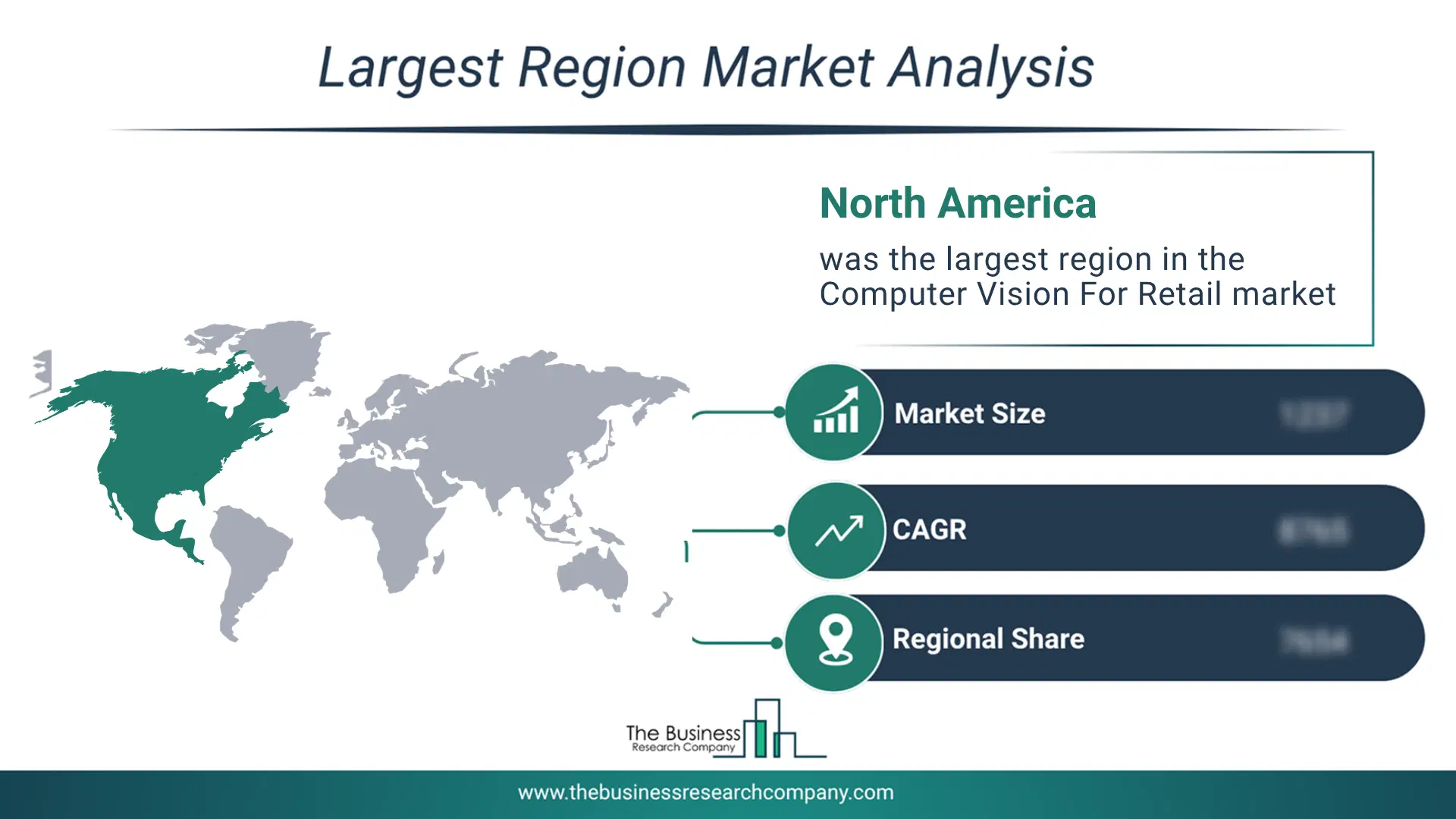
Regional Outlook
North America was the largest region in the computer vision for retail market in 2025. Asia-Pacific is expected to be the fastest-growing region in the forecast period. The regions covered in this market report are Asia-Pacific, South East Asia, Western Europe, Eastern Europe, North America, South America, Middle East and Africa. The countries covered in this market report are Australia; Brazil; China; France; Germany; India; Indonesia; Japan; Taiwan; Russia; South Korea; UK; USA; Canada; Italy; Spain.What Defines the Computer Vision For Retail Market?
The computer vision for retail market consists of revenues earned by entities by providing services such as store traffic analysis, planogram compliance monitoring, queue management systems, pricing optimization, and visual merchandising analysis. The market value includes the value of related goods sold by the service provider or included within the service offering. The computer vision for retail market also includes sales of smart surveillance systems, real-time video analytics platforms, computer vision-enabled robots, interactive digital displays, and automated inventory tracking devices. Values in this market are ‘factory gate’ values, that is the value of goods sold by the manufacturers or creators of the goods, whether to other entities (including downstream manufacturers, wholesalers, distributors and retailers) or directly to end customers. The value of goods in this market includes related services sold by the creators of the goods.How is Market Value Defined and Measured?
The market value is defined as the revenues that enterprises gain from the sale of goods and/or services within the specified market and geography through sales, grants, or donations in terms of the currency (in USD unless otherwise specified). The revenues for a specified geography are consumption values that are revenues generated by organizations in the specified geography within the market, irrespective of where they are produced. It does not include revenues from resales along the supply chain, either further along the supply chain or as part of other products.
This chart presents market attractiveness based on a quantitative evaluation of growth, competition, strategic alignment, and risk, offering a clear view of opportunity areas for decision-making. This chart is for illustrative purposes; the full report contains the complete analysis.

This chart highlights the Total Addressable Market (TAM) by estimating the maximum revenue opportunity using an assumption-driven approach, supporting strategic planning and opportunity sizing across markets. The chart is illustrative; the full report provides a more comprehensive analysis.
What Key Data and Analysis Are Included in the Computer Vision For Retail Market Report 2026?
The computer vision for retail market research report is one of a series of new reports from The Business Research Company that provides market statistics, including industry global market size, regional shares, competitors with the market share, detailed market segments, market trends and opportunities, and any further data you may need to thrive in the computer vision for retail industry. The market research report delivers a complete perspective of everything you need, with an in-depth analysis of the current and future state of the industry.Computer Vision For Retail Market Report Forecast Analysis
| Report Attribute | Details |
|---|---|
| Market Size Value In 2026 | $727.85 billion |
| Revenue Forecast In 2030 | $802.05 billion |
| Growth Rate | CAGR of 1.4% from 2026 to 2030 |
| Base Year For Estimation | 2025 |
| Actual Estimates/Historical Data | 2020-2025 |
| Forecast Period | 2026 - 2030 |
| Market Representation | Revenue in USD Billion and CAGR from 2026 to 2030 |
| Segments Covered | Component, Deployment Mode, Retail Type, Application, End User |
| Regional Scope | Asia-Pacific, Western Europe, Eastern Europe, North America, South America, Middle East, Africa |
| Country Scope | The countries covered in the report are Australia, Brazil, China, France, Germany, India, Indonesia, Japan, Taiwan, Russia, South Korea, UK, USA, Canada, Italy, Spain. |
| Key Companies Profiled | Google LLC, Microsoft Corporation, Amazon Web Services Inc., Sony Corporation, International Business Machines Corporation, Intel Corporation, Honeywell International Inc., NVIDIA Corporation, Zebra Technologies Corporation, SenseTime Group Inc., Metropolis Technologies Inc., Trax Technology Solutions Pte. Ltd., Scandit AG., Trigo Vision Ltd., Vispera Information Technologies Inc., Standard AI Inc., Malong Technologies Inc., Graymatics Inc., SeeChange Technologies Inc., StrataVision Inc. |
| Customization Scope | Request for Customization |
| Pricing And Purchase Options | Explore Purchase Options |