

Exoplanetary Exploration Market Report 2026
Global Outlook – By Technology (Spacecraft, Telescopes, Rovers, Probes), By Application (Scientific Research, Commercial, Defense), By End User (Government Agencies, Private Enterprises, Research Institutes) – Market Size, Trends, Strategies, and Forecast to 2030
Exoplanetary Exploration Market Overview
• Exoplanetary Exploration market size has reached to $9.15 billion in 2025 • Expected to grow to $16.43 billion in 2030 at a compound annual growth rate (CAGR) of 12.4% • Growth Driver: The Increasing Investments In Space Missions Is Fueling The Market Growth Due To Advancements In Observational Technologies And Exploration Capabilities • Market Trend: Innovations In Space telescopes Enhance Exoplanet Atmospheric Studies • North America was the largest region in 2025 and Asia-Pacific is the fastest growing region.What Is Covered Under Exoplanetary Exploration Market?
Exoplanetary exploration refers to the scientific study and investigation of planets that exist outside our solar system, known as exoplanets. This field involves the detection, observation, and analysis of these planets to understand their characteristics, such as size, mass, orbit, atmospheric composition, and potential habitability. The goal of exoplanetary exploration is to gain insights into planetary system formation, evolution, and the possibility of life beyond Earth. The main technologies of exoplanetary exploration are spacecraft, telescopes, rovers, and probes. A spacecraft is a vehicle or device designed for travel or operation in outer space, used for missions such as exploration, communication, observation, or transportation beyond Earth's atmosphere. These technologies enable a wide range of applications in scientific research, commercial initiatives, and defense operations. The primary end users include government agencies, private enterprises, and research institutions.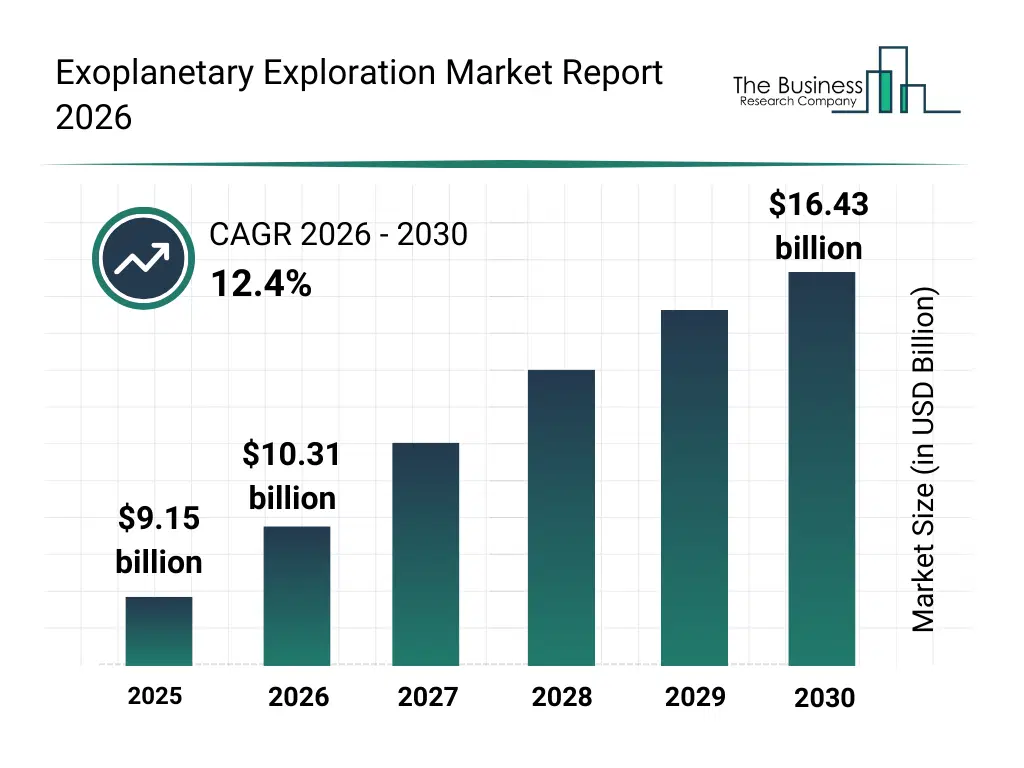
What Is The Exoplanetary Exploration Market Size and Share 2026?
The exoplanetary exploration market size has grown rapidly in recent years. It will grow from $9.15 billion in 2025 to $10.31 billion in 2026 at a compound annual growth rate (CAGR) of 12.7%. The growth in the historic period can be attributed to advancements in space-based telescopes enabling detection of distant exoplanets, development of observational instruments improving measurement of planetary size and orbit, increasing availability of data analysis software supporting complex exoplanet modeling, expansion of international research collaborations driving scientific discoveries, rising deployment of dedicated exoplanet missions improving detection sensitivity.What Is The Exoplanetary Exploration Market Growth Forecast?
The exoplanetary exploration market size is expected to see rapid growth in the next few years. It will grow to $16.43 billion in 2030 at a compound annual growth rate (CAGR) of 12.4%. The growth in the forecast period can be attributed to growing demand for high-precision observational technologies to study exoplanet atmospheres, rising investment in next-generation space telescopes enabling deeper universe exploration, increasing adoption of ai-driven analytics to process large volumes of exoplanetary data, expansion of commercial participation in space science boosting instrument and mission development, development of advanced spectrometry tools enhancing characterization of potentially habitable exoplanets. Major trends in the forecast period include artificial intelligence & autonomous intelligence, digitalization, cloud, big data & cybersecurity, internet of things (iot), smart infrastructure & connected ecosystems, autonomous systems, robotics and smart mobility, sustainability, climate tech & circular economy.
Global Exoplanetary Exploration Market Segmentation
1) By Technology: Spacecraft, Telescopes, Rovers, Probes 2) By Application: Scientific Research, Commercial, Defense 3) By End User: Government Agencies, Private Enterprises, Research Institutes Subsegments: 1) By Spacecraft: Orbiter Spacecrafts, Flyby Spacecrafts, Lander Spacecrafts, Observatory Spacecrafts, Interstellar Spacecrafts 2) By Telescopes: Space-Based Telescopes, Ground-Based Telescopes, Optical Telescopes, Infrared Telescopes, Radio Telescopes 3) By Rovers: Autonomous Rovers, Remote-controlled Rovers, Surface Analysis Rovers, Terrain Navigation Rovers, Sample Collection Rovers 4) By Probes: Atmospheric Probes, Magnetospheric Probes, Entry Probes, Gravity Assist Probes, Deep Space ProbesWhat Is Driver Of The Exoplanetary Exploration Market?
The increasing frequency of space launches is expected to propel the growth of the exoplanetary exploration market going forward. Space launches refer to the events or missions where rockets are propelled into space, typically to deploy satellites, transport cargo, or carry astronauts beyond earth's atmosphere. The increasing frequency of space launches is primarily driven by the rising demand for satellite-based services such as communication, earth observation, navigation, and broadband internet, which require frequent deployment and replenishment of satellite constellations. Exoplanetary exploration drives demand for advanced space launches, as missions like Pandora require precise orbital deployments and next-generation telescopes, fostering innovation in rocket technology and satellite delivery capabilities. For instance, in January 2025, according to the report published by Space Foundation, a US-based non-profit organization, orbital launch attempts rose by 16% in 2024, reaching a total of 259 launches, averaging one every 34 hours, which is five hours more frequent than the average in 2023. Therefore, the increasing frequency of space launches is driving the growth of the exoplanetary exploration industry.Key Players In The Global Exoplanetary Exploration Market
Major companies operating in the exoplanetary exploration market are The Boeing Company, Northrop Grumman Corporation, BAE Systems plc, L3Harris Technologies Inc., Leonardo S.p.A., Airbus Defence and Space SE, Space Exploration Technologies Corp., Teledyne Technologies Incorporated, Blue Origin L.L.C., Thales Alenia Space SAS, Ball Aerospace And Technologies Corp., Maxar Technologies Inc., Sierra Space Corporation, Rocket Lab Inc., Firefly Aerospace Inc., Blue Skies Space Ltd., Surrey Satellite Technology Limited, Astrolab, Elecnor Deimos S.L.U., Orbital ATK Inc.
This chart is for illustrative purposes; the full report includes a detailed competitor analysis and comprehensive overview of the top 10 companies in the market.
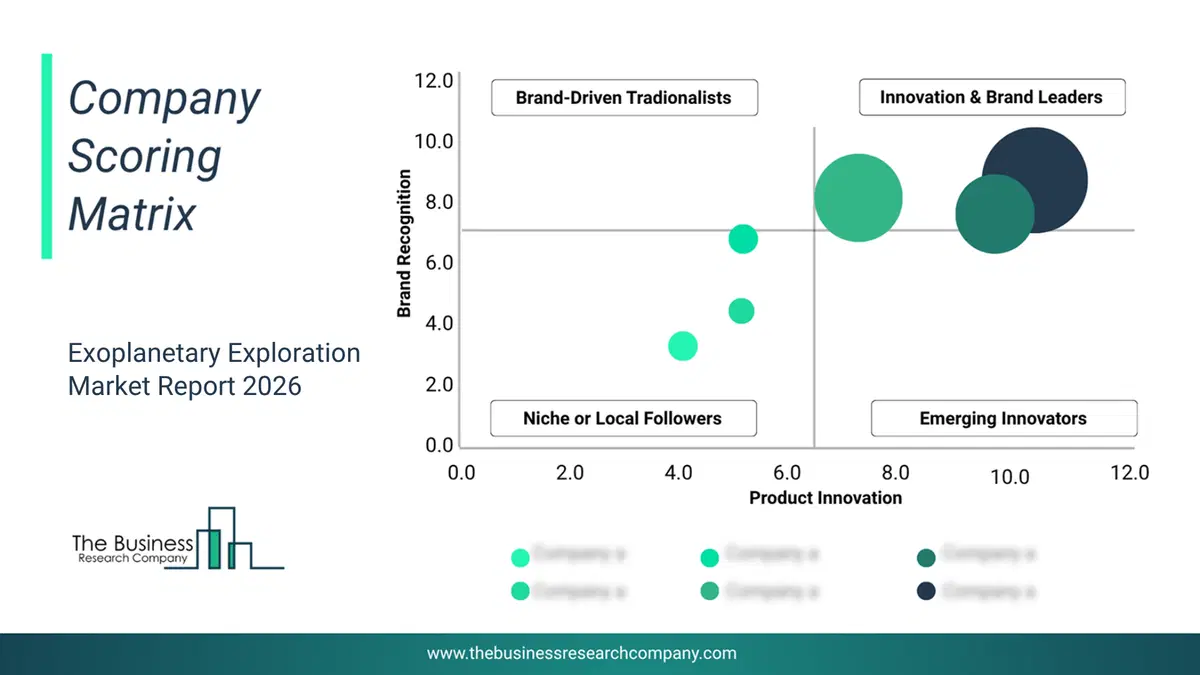
This chart maps companies by product innovation and brand strength, with bubble size indicating relative revenue, helping identify market leaders, challengers, and niche players. This is an illustrative chart; the full report provides a complete and accurate competitive analysis.
Global Exoplanetary Exploration Market Trends and Insights
Major companies operating in the exoplanet exploration market are focusing on developing innovative solutions such as space-based telescopes to enhance the detection and characterization of exoplanet atmospheres. Space-based telescopes are astronomical instruments placed in orbit around Earth or in space to observe celestial objects without atmospheric interference. They help capture clearer and more detailed images across various wavelengths such as ultraviolet, X-ray, and infrared that are often blocked by Earth’s atmosphere, enabling more accurate study of stars, galaxies, and exoplanets. For instance, in February 2025, the National Aeronautics and Space Administration (NASA), a US-based government agency, selected SpaceX to launch the Pandora smallsat mission as part of its Astrophysics Pioneers program. Pandora is a space-based telescope equipped with a 45-centimeter optical and infrared instrument designed to study the atmospheres of exoplanets by observing 20 stars known to host them. The mission will use transmission spectroscopy to differentiate whether atmospheric spectral signatures originate from planetary gases such as hydrogen or water, or from variability in the host stars themselves. This initiative reflects NASA’s ongoing efforts to advance exoplanetary science through innovative, cost-effective satellite missions.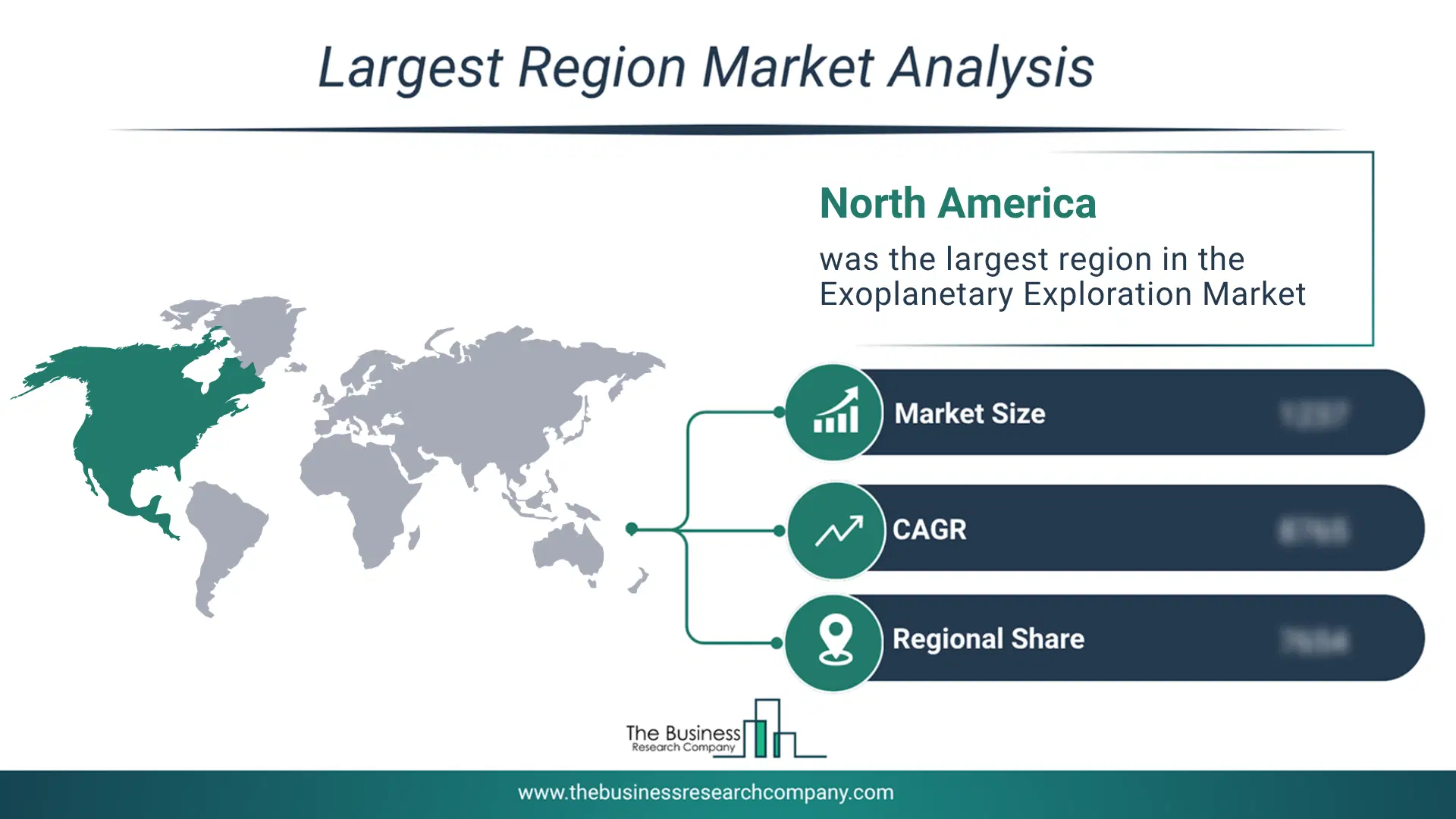
Regional Insights
North America was the largest region in the exoplanetary exploration market in 2025. Asia-Pacific is expected to be the fastest-growing region in the forecast period. The regions covered in this market report are Asia-Pacific, South East Asia, Western Europe, Eastern Europe, North America, South America, Middle East, Africa. The countries covered in this market report are Australia, Brazil, China, France, Germany, India, Indonesia, Japan, Taiwan, Russia, South Korea, UK, USA, Canada, Italy, SpainWhat Defines the Exoplanetary Exploration Market?
The exoplanetary exploration market consists of revenues earned by entities by providing services such as developing, manufacturing, and deploying technologies and services for the detection, observation, and study of planets outside our solar system. The market value includes the value of related goods sold by the service provider or included within the service offering. Only goods and services traded between entities or sold to end consumers are included. The exoplanetary exploration market also includes sales of space-based telescopes, observational instruments and data analysis software. Values in this market are ‘factory gate’ values, that is the value of goods sold by the manufacturers or creators of the goods, whether to other entities (including downstream manufacturers, wholesalers, distributors and retailers) or directly to end customers. The value of goods in this market includes related services sold by the creators of the goods.How is Market Value Defined and Measured?
The market value is defined as the revenues that enterprises gain from the sale of goods and/or services within the specified market and geography through sales, grants, or donations in terms of the currency (in USD unless otherwise specified). The revenues for a specified geography are consumption values that are revenues generated by organizations in the specified geography within the market, irrespective of where they are produced. It does not include revenues from resales along the supply chain, either further along the supply chain or as part of other products.
This chart presents market attractiveness based on a quantitative evaluation of growth, competition, strategic alignment, and risk, offering a clear view of opportunity areas for decision-making. This chart is for illustrative purposes; the full report contains the complete analysis.

This chart highlights the Total Addressable Market (TAM) by estimating the maximum revenue opportunity using an assumption-driven approach, supporting strategic planning and opportunity sizing across markets. The chart is illustrative; the full report provides a more comprehensive analysis.
What Key Data and Analysis Are Included in the Exoplanetary Exploration Market Report 2026?
The exoplanetary exploration market research report is one of a series of new reports from The Business Research Company that provides market statistics, including industry global market size, regional shares, competitors with the market share, detailed market segments, market trends and opportunities, and any further data you may need to thrive in the exoplanetary exploration industry. The market research report delivers a complete perspective of everything you need, with an in-depth analysis of the current and future state of the industry.Exoplanetary Exploration Market Report Forecast Analysis
| Report Attribute | Details |
|---|---|
| Market Size Value In 2026 | $10.31 billion |
| Revenue Forecast In 2030 | $16.43 billion |
| Growth Rate | CAGR of 12.4% from 2026 to 2030 |
| Base Year For Estimation | 2025 |
| Actual Estimates/Historical Data | 2020-2025 |
| Forecast Period | 2026 - 2030 |
| Market Representation | Revenue in USD Billion and CAGR from 2026 to 2030 |
| Segments Covered | Technology, Application, End User |
| Regional Scope | Asia-Pacific, Western Europe, Eastern Europe, North America, South America, Middle East, Africa |
| Country Scope | The countries covered in the exoplanetary exploration market report are Australia, Brazil, China, France, Germany, India, Indonesia, Japan, Taiwan, Russia, South Korea, UK, USA, Canada, Italy, Spain |
| Key Companies Profiled | The Boeing Company, Northrop Grumman Corporation, BAE Systems plc, L3Harris Technologies Inc., Leonardo S.p.A., Airbus Defence and Space SE, Space Exploration Technologies Corp., Teledyne Technologies Incorporated, Blue Origin L.L.C., Thales Alenia Space SAS, Ball Aerospace And Technologies Corp., Maxar Technologies Inc., Sierra Space Corporation, Rocket Lab Inc., Firefly Aerospace Inc., Blue Skies Space Ltd., Surrey Satellite Technology Limited, Astrolab, Elecnor Deimos S.L.U., Orbital ATK Inc. |
| Customization Scope | Request for Customization |
| Pricing And Purchase Options | Explore Purchase Options |