
B2B for Food in Foodservice Market Report 2026
Global Outlook – By Product Type (Fresh Produce, Meat And Seafood, Dairy Products, Bakery And Confectionery Products, Beverages, Packaged And Processed Foods), By Service Type (Food Procurement And Sourcing Services, Food Distribution And Logistics, Inventory And Supply Chain Management, Procurement Financing And Credit Services, Cold Storage And Temperature-Controlled Services), By Distribution Channel (Direct Sales, Wholesalers, Online Platforms), By End-User (Restaurants And Cafés, Hotels And Resorts, Catering Services, Institutional Foodservice, Schools, Universities, Hospitals, And Corporate Cafeterias, Quick Service And Fast Food Chains) – Market Size, Trends, Strategies, and Forecast to 2030
B2B for Food in Foodservice Market Overview
• B2B for Food in Foodservice market size has reached to $152.96 billion in 2025 • Expected to grow to $229.04 billion in 2030 at a compound annual growth rate (CAGR) of 8.3% • Growth Driver: The Increasing Demand For Convenient And Ready-To-Eat Meal Solutions Drove The Market Due To Efficiency And Quality Needs • Market Trend: Digital Marketplaces Transforming The Foodservice Business-To-Business Landscape • North America was the largest region in 2025 and Asia-Pacific is the fastest growing region.Market Gains By 2030 – Top Opportunities By Segment
Market Gain identifies the most promising market opportunities by highlighting the segments or products expected to generate the highest incremental revenue growth over the next five years.
What Is Covered Under B2B for Food in Foodservice Market?
Business-to-business (B2B) for food in foodservice refers to the commercial exchange of food products, ingredients, or related services between food manufacturers, suppliers, or distributors and businesses operating in the foodservice sector, such as restaurants, hotels, and catering companies. It helps to streamline supply chains, ensure consistent quality and availability of food products, and support foodservice businesses in meeting operational and customer demands efficiently. The main product types of business-to-business (B2B) for food in foodservice are fresh produce, meat and seafood, dairy products, bakery and confectionery products, beverages, and packaged and processed foods. Fresh produce refers to unprocessed, perishable fruits and vegetables supplied directly to restaurants, hotels, caterers, and other foodservice businesses. It serves various service types encompassing food procurement and sourcing services, food distribution and logistics, inventory and supply chain management, procurement financing and credit services, and cold storage and temperature-controlled services. These solutions are delivered through multiple distribution channels, including direct sales, retailers, wholesalers, and online platforms, and cater to a diverse range of end-users, such as restaurants and cafés, hotels and resorts, catering services, institutional foodservice providers, schools, universities, hospitals, corporate cafeterias, and quick service and fast food chains.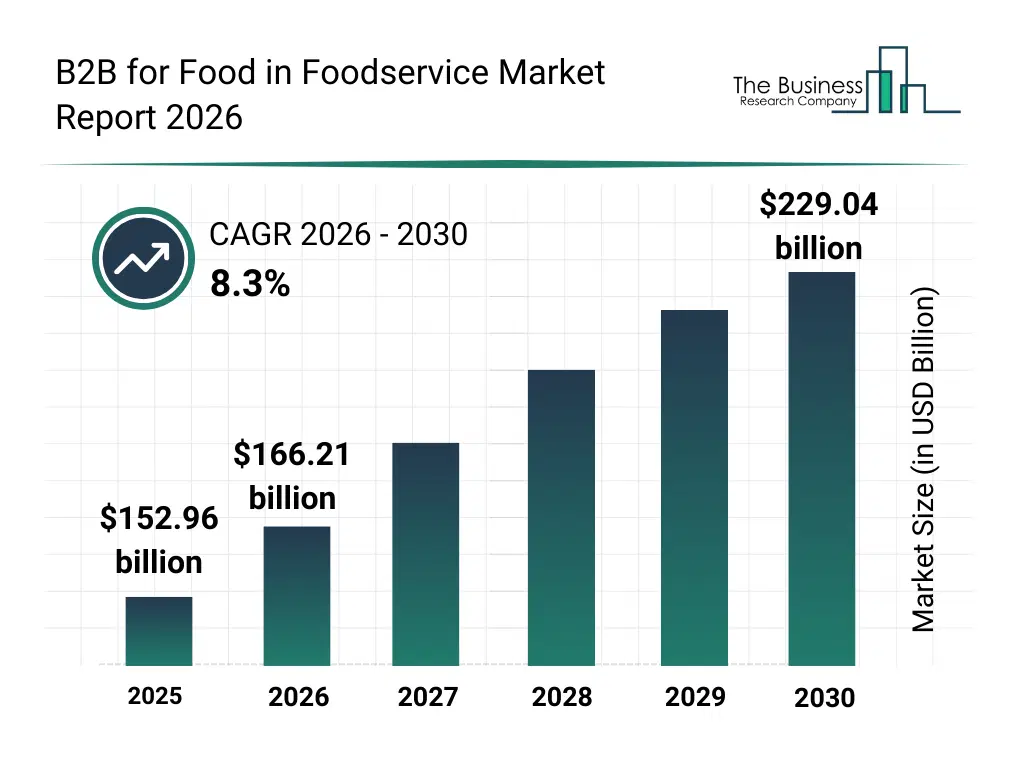
What Is The B2B for Food in Foodservice Market Size and Share 2026?
The b2b for food in foodservice market size has grown strongly in recent years. It will grow from $152.96 billion in 2025 to $166.21 billion in 2026 at a compound annual growth rate (CAGR) of 8.7%. The growth in the historic period can be attributed to expansion of organized foodservice sector, increasing outsourcing of food procurement, growth of distributor-led supply models, rising demand for consistent food quality, development of large-scale food distribution networks.What Is The B2B for Food in Foodservice Market Growth Forecast?
The b2b for food in foodservice market size is expected to see strong growth in the next few years. It will grow to $229.04 billion in 2030 at a compound annual growth rate (CAGR) of 8.3%. The growth in the forecast period can be attributed to increasing digitalization of foodservice operations, growing focus on supply chain resilience, rising demand for sustainable food sourcing, expansion of online B2B marketplaces, increased adoption of financing and credit solutions. Major trends in the forecast period include increasing adoption of digital food procurement platforms, rising demand for transparent and traceable food supply chains, growing use of data-driven inventory management, expansion of cold chain and logistics services, enhanced focus on cost optimization in food sourcing.
Global B2B for Food in Foodservice Market Segmentation
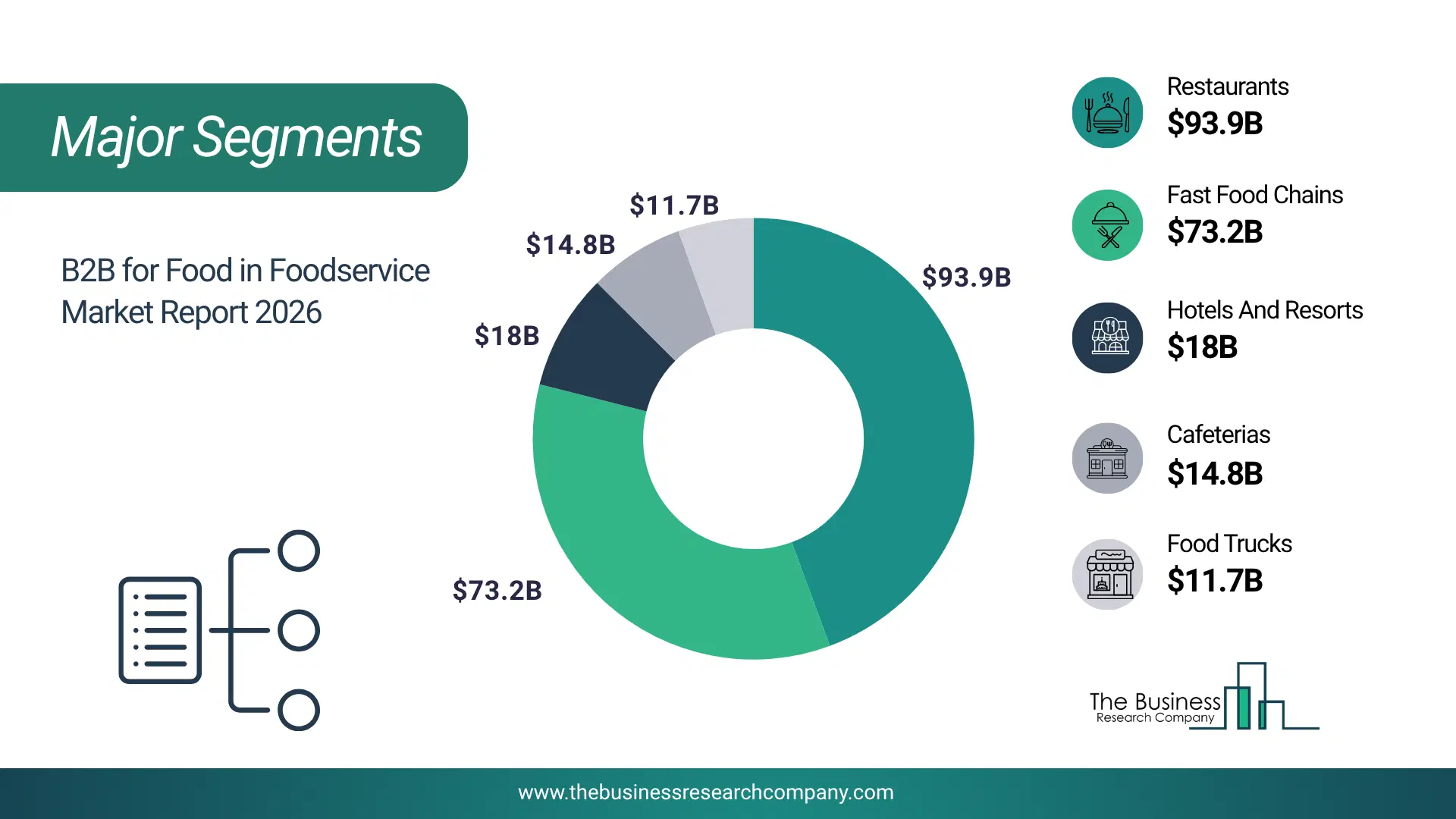
1) By Product Type: Fresh Produce, Meat And Seafood, Dairy Products, Bakery And Confectionery Products, Beverages, Packaged And Processed Foods 2) By Service Type: Food Procurement And Sourcing Services, Food Distribution And Logistics, Inventory And Supply Chain Management, Procurement Financing And Credit Services, Cold Storage And Temperature-Controlled Services 3) By Distribution Channel: Direct Sales, Wholesalers, Online Platforms 4) By End-User: Restaurants And Cafés, Hotels And Resorts, Catering Services, Institutional Foodservice, Schools, Universities, Hospitals, And Corporate Cafeterias, Quick Service And Fast Food Chains Subsegments: 1) By Fresh Produce: Fruits, Vegetables, Herbs And Spices, Mushrooms And Fungi, Fresh Cut And Packaged Produce 2) By Meat And Seafood: Beef, Pork, Chicken, Goat, Fish, Shellfish, Crustaceans, Mollusks, Cephalopods 3) By Dairy Products: Milk, Cheese, Butter, Yogurt, Cream, Ice Cream, Whey Products, Condensed Milk, Powdered Milk, Ghee 4) By Bakery And Confectionery Products: Bread, Cakes, Pastries, Cookies, Muffins, Croissants, Doughnuts, Pies, Biscuits, Others 5) By Beverages: Hot Beverages, Cold Beverages, Alcoholic Beverages, Dairy And Non-Dairy Drinks, Functional And Energy Drinks 6) By Packaged And Processed Foods: Snacks, Frozen Foods, Dairy Products, Bakery Products, Beverages, Sauces And Condiments, Ready-To-Eat Meals, Canned Foods The top segments in the b2b for food in foodservice market will be: • Restaurants will reach $93.82 billion by 2030. • Fast Food Chains will reach $73.19 billion by 2030. • Hotels And Resorts will reach $17.97 billion by 2030. • Cafeterias will reach $14.73 billion by 2030. • Food Trucks will reach $11.63 billion by 2030.What Is The Driver Of The B2B for Food in Foodservice Market?
The increasing demand for convenient and ready-to-eat meal solutions has driven the growth of the business-to-business food in the foodservice market during the historic period. Convenient and ready-to-eat meal solutions refer to pre-prepared or partially prepared food products designed to reduce preparation time and labor requirements for foodservice operators, such as restaurants, cafeterias, and catering businesses. The growing adoption of these solutions is primarily due to the rising need for operational efficiency, consistency in quality, and the ability to meet consumer demand for quick, high-quality meals. Ready-to-eat and convenience-focused offerings enable foodservice businesses to streamline kitchen operations, reduce waste, and maintain menu variety without extensive cooking processes. For instance, in April 2024, according to the data published by the National Association of Convenience Stores (NACS), a US-based trade association, total industry foodservice sales made up 26.9% of in-store sales in 2023, rising from 25.6% in 2022, with prepared food sales increasing by 12.2% per store per month, making it the leading in-store category. Therefore, the increasing demand for convenient and ready-to-eat meal solutions has propelled the growth of the business-to-business food in the foodservice market.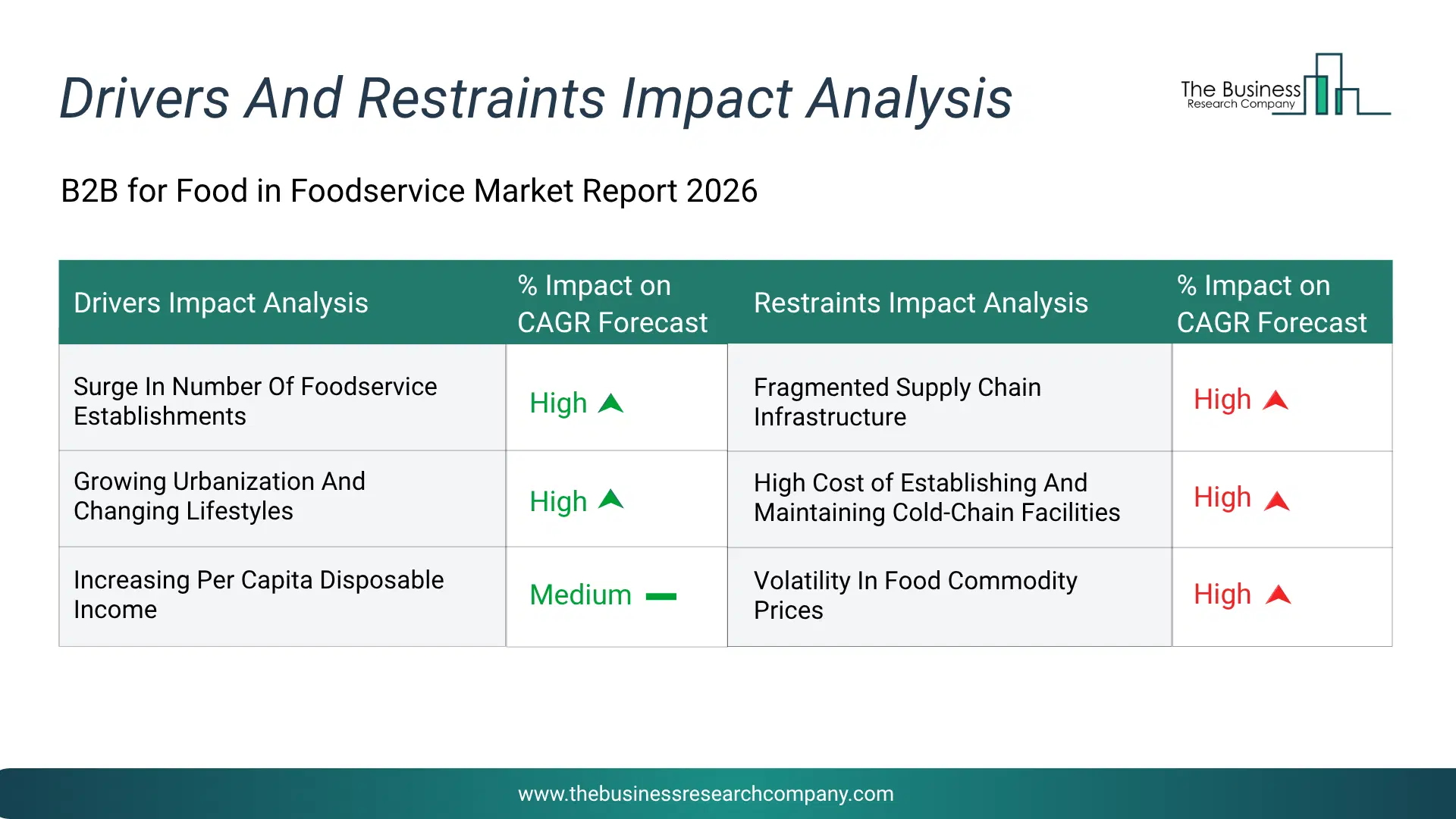
Infographic Chart Showing Key Market Drivers Analysis And Restraints For B2B For Food In Foodservice Market
The chart presents an impact analysis of key drivers and restraints, quantifying their relative influence on the market's growth rate and helping assess the balance between growth enablers and limiting factors. This chart offers a high-level perspective; the full report contains more detailed insights.
How Will The Drivers Impact Growth In The Global B2B for Food in Foodservice Market?
• Surge In Number Of Foodservice Establishments (High) – During the forecast period, the surge in the number of foodservice establishments is expected to become a key growth driver for the b2b for food in the foodservice market by 2030. The rising number of foodservice establishments, including restaurants, cafés, hotels, and catering services, is significantly driving the business -to -business (b2b) foodservice market. As new outlets continue to open to meet increasing consumer demand for varied dining experiences, the requirement for dependable food suppliers and distributors grows accordingly. This expansion supports higher bulk procurement of ingredients, packaged foods, and beverages through b2b channels. Furthermore, businesses increasingly prioritize efficient supply chains, consistent product quality, and cost -effective sourcing solutions, strengthening b2b collaborations. • Growing Urbanization And Changing Lifestyles (High) – During the forecast period, the growing urbanization and changing lifestyles are expected to emerge as a major factor driving the expansion of the b2b for food in the foodservice market by 2030. Rapid urbanization and evolving consumer lifestyles are key contributors to the growth of the b2b foodservice market. As more individuals migrate to urban areas and adopt fast-paced routines, the demand for convenient, high-quality, and ready-to-eat food options continues to rise. This trend increases reliance on restaurants, cafés, and catering services, which depend on efficient b2b suppliers for timely and consistent product delivery. Additionally, urban consumers’ preference for diverse cuisines and premium ingredients encourages foodservice operators to source specialized offerings through b2b networks. Consequently, these shifting lifestyle patterns are driving expansion and innovation across the foodservice value chain. • Increasing Per Capita Disposable Income (Medium) – During the forecast period, the increasing per capita disposable income is expected to act as a key growth catalyst for the b2b for food in the foodservice market by 2030. Rising per capita disposable income enables consumers to spend more beyond essential needs, directly influencing demand within the foodservice sector. This leads to increased spending at restaurants, hotels, and catering services, as consumers show a greater willingness to dine out and opt for premium food options. In response, foodservice businesses enhance menu offerings and procure higher-quality ingredients, thereby increasing demand across b2b supply channels. As a result, suppliers and distributors benefit from higher order volumes and revenue growth. Overall, increased disposable income stimulates expansion throughout the foodservice ecosystem.How Will The Restraints Impact Growth In The Global B2B for Food in Foodservice Market?
• Fragmented Supply Chain Infrastructure (High) – During the forecast period, the fragmented supply chain infrastructure refers to a system where sourcing, production, distribution, and logistics are scattered across multiple players without strong coordination. In the b2b foodservice market, this fragmentation can lead to inconsistent product quality, delays in delivery, and higher operational costs. Businesses may struggle to maintain a steady supply of ingredients, especially for perishable items, which affects service reliability. It also makes scaling operations or adopting technology-driven solutions more challenging. Overall, this lack of integration restrains market growth and efficiency in foodservice b2b operations. • High Cost of Establishing And Maintaining Cold-Chain Facilities (High) – During the forecast period, the the high cost of establishing and maintaining cold-chain facilities is a major restraining factor for the b2b foodservice market. Cold-chain infrastructure, including refrigerated storage, temperature-controlled transport, and monitoring systems, requires significant capital investment. Operational costs, such as energy consumption, maintenance, and skilled labor, further increase expenses. Small and medium suppliers often struggle to afford these systems, limiting their ability to supply perishable food products reliably. This financial burden slows market expansion and affects consistent quality and safety in the foodservice supply chain. As a result, companies may hesitate to enter or scale within the b2b foodservice sector. • Volatility In Food Commodity Prices (High) – During the forecast period, the the b2b foodservice market is highly sensitive to fluctuations in the prices of agricultural commodities, dairy products, meat, seafood, and other food ingredients. Changes in weather conditions, geopolitical events, and supply-demand imbalances can significantly impact procurement costs. Frequent price volatility makes budgeting and contract management more challenging for suppliers and foodservice operators. These uncertainties can reduce profit margins and create instability across the foodservice supply chain.Key Players In The Global B2B for Food in Foodservice Market
Major companies operating in the b2b for food in foodservice market are Sysco Corporation, Performance Food Group Company, US Foods Holding Corp., Compass Group plc, JBS S.A., Tyson Foods Inc., Nestlé S.A., PepsiCo Inc., Archer-Daniels-Midland Company, Cargill Incorporated, The Kraft Heinz Company, Conagra Brands Inc., General Mills Inc., Bid Corporation Limited, Reinhart Foodservice, Olam Group, Gordon Food Service (GFS), Dot Foods Inc., McLane Company Inc., Reyes Holdings LLC, Ben E. Keith Company, The Chefs’ Warehouse Inc., Dole plc, Edward Don & Company, Nicholas & Company Inc., Hyperpure, and Brakes Group.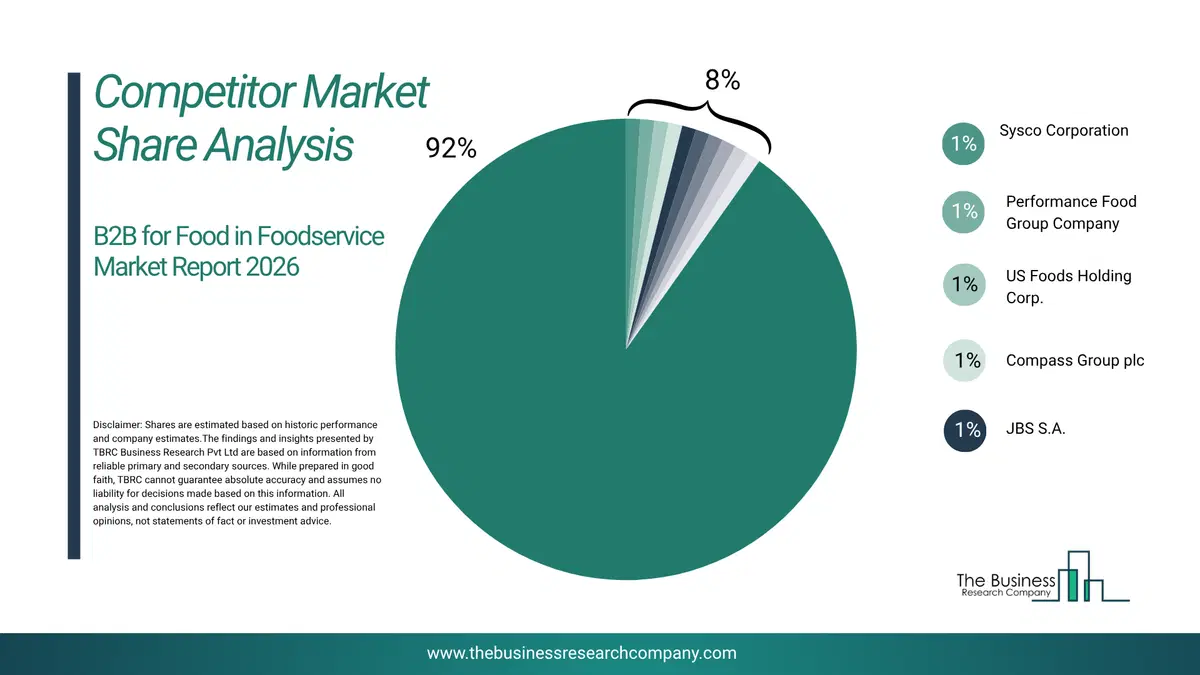
This chart is for illustrative purposes; the full report includes a detailed competitor analysis and comprehensive overview of the top 10 companies in the market.
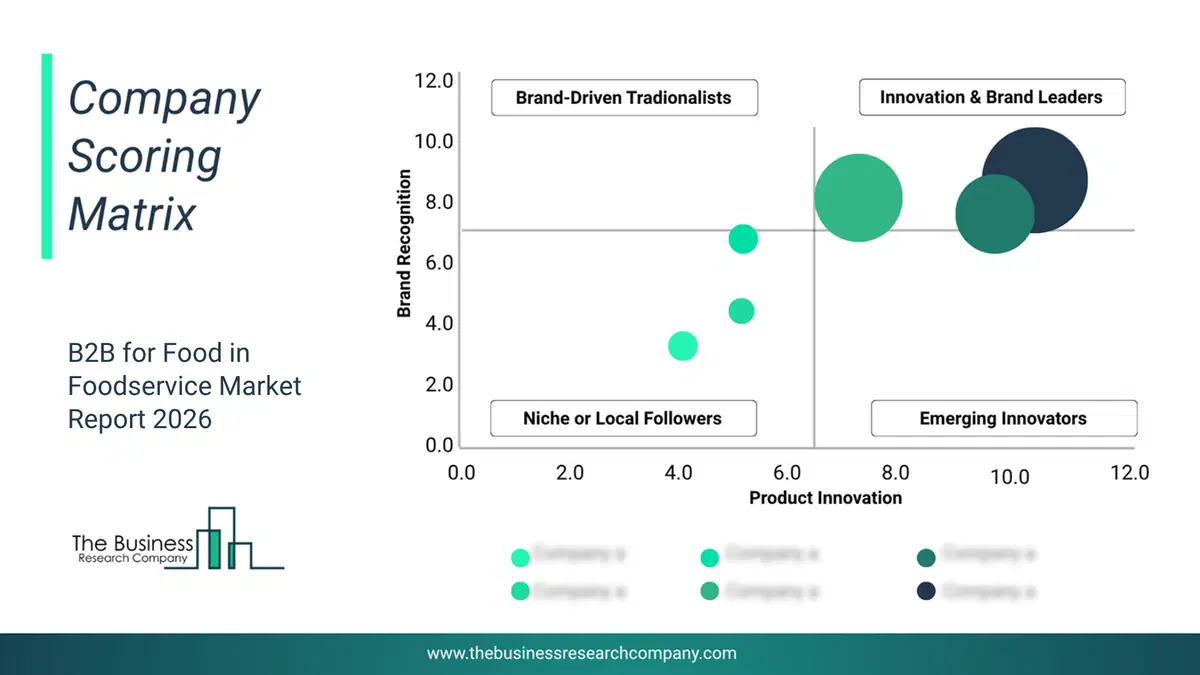
This chart maps companies by product innovation and brand strength, with bubble size indicating relative revenue, helping identify market leaders, challengers, and niche players. This is an illustrative chart; the full report provides a complete and accurate competitive analysis.
Global B2B for Food in Foodservice Market Trends and Insights
Major companies operating in the business-to-business (B2B) for food in foodservice market are focusing on developing innovative advancements such as B2B foodservice digital marketplaces to enhance sourcing efficiency and expand product accessibility for foodservice businesses through digital integration of suppliers and buyers. A B2B foodservice digital marketplace is an online platform that connects food distributors, suppliers, and foodservice operators, enabling direct transactions, product discovery, and order management within a centralized digital environment to enhance procurement efficiency and product accessibility. For instance, in May 2024, Sysco Corporation, a US-based global foodservice distributor, launched the Sysco Marketplace, powered by Mirakl technology. The platform offers access to over 15,000 third-party products, including niche and specialty food items, through a unified digital shopping interface that simplifies purchasing and payment processes. This launch marks a significant step toward digital transformation in foodservice procurement, allowing operators to source diverse products more efficiently while supporting smaller and specialty suppliers within the industry ecosystem.What Are Latest Mergers And Acquisitions In The B2B for Food in Foodservice Market?
In August 2024, Buyers Edge Platform, a US-based provider of foodservice procurement software, analytics, and digital supply chain solutions, acquired S&F-Gruppe for an undisclosed amount. Through this acquisition, Buyers Edge Platform aimed to expand its European presence and strengthen its position as a leading digital procurement network for the foodservice industry across Europe. S&F-Gruppe is a Germany-based provider of food and non-food procurement, consulting, and planning services, offers Business-to-Business (B2B) services for food in the foodservice sector.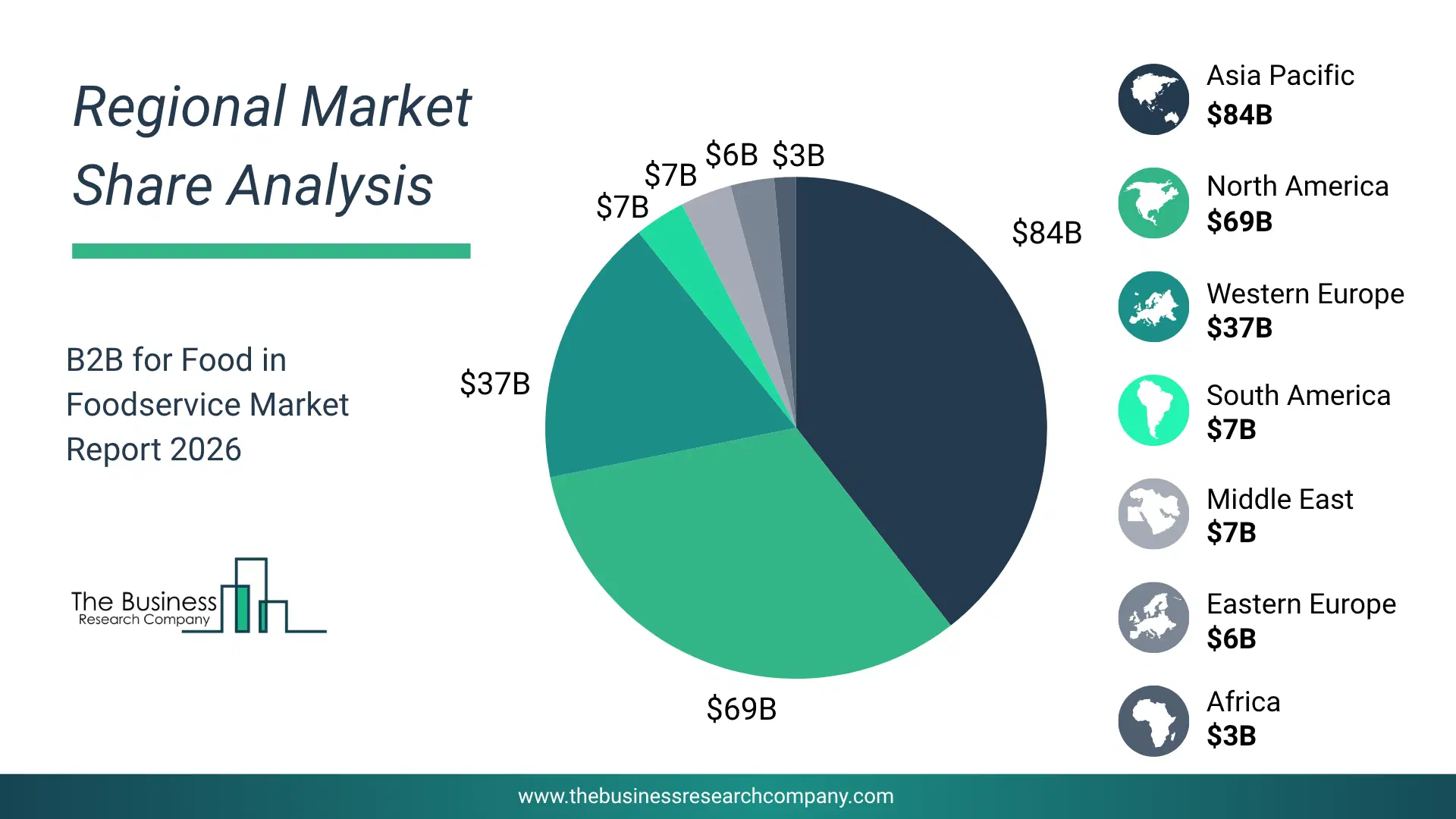
Regional Outlook
North America was the largest region in the business-to-business (B2B) for food in foodservice market in 2025. Asia-Pacific is expected to be the fastest-growing region in the forecast period. The regions covered in this market report are Asia-Pacific, South East Asia, Western Europe, Eastern Europe, North America, South America, Middle East and Africa. The countries covered in this market report are Australia, Brazil, China, France, Germany, India, Indonesia, Japan, Taiwan, Russia, South Korea, UK, USA, Italy, Spain, CanadaWhat Defines the B2B for Food in Foodservice Market?
The business-to-business (B2B) for food in foodservice market includes revenues earned by entities through training and consultancy for kitchen operations, food safety and hygiene audits, inventory management solutions, cold chain management, packaging and labeling services, customized product development, marketing support, and technical assistance. The market value includes the value of related goods sold by the service provider or included within the service offering. Only goods and services traded between entities or sold to end consumers are included.How is Market Value Defined and Measured?
The market value is defined as the revenues that enterprises gain from the sale of goods and/or services within the specified market and geography through sales, grants, or donations in terms of the currency (in USD unless otherwise specified). The revenues for a specified geography are consumption values that are revenues generated by organizations in the specified geography within the market, irrespective of where they are produced. It does not include revenues from resales along the supply chain, either further along the supply chain or as part of other products.
This chart presents market attractiveness based on a quantitative evaluation of growth, competition, strategic alignment, and risk, offering a clear view of opportunity areas for decision-making. This chart is for illustrative purposes; the full report contains the complete analysis.

This chart highlights the Total Addressable Market (TAM) by estimating the maximum revenue opportunity using an assumption-driven approach, supporting strategic planning and opportunity sizing across markets. The chart is illustrative; the full report provides a more comprehensive analysis.
What Key Data and Analysis Are Included in the B2B for Food in Foodservice Market Report 2026?
The b2b for food in foodservice market research report is one of a series of new reports from The Business Research Company that provides market statistics, including industry global market size, regional shares, competitors with the market share, detailed market segments, market trends and opportunities, and any further data you may need to thrive in the b2b for food in foodservice industry. The market research report delivers a complete perspective of everything you need, with an in-depth analysis of the current and future state of the industry.B2B for Food in Foodservice Market Report Forecast Analysis
| Report Attribute | Details |
|---|---|
| Market Size Value In 2026 | $166.21 billion |
| Revenue Forecast In 2030 | $229.04 billion |
| Growth Rate | CAGR of 8.3% from 2026 to 2030 |
| Base Year For Estimation | 2025 |
| Actual Estimates/Historical Data | 2020-2025 |
| Forecast Period | 2026 - 2030 |
| Market Representation | Revenue in USD Billion and CAGR from 2026 to 2030 |
| Segments Covered | Product Type, Service Type, Distribution Channel, End-User |
| Regional Scope | Asia-Pacific, Western Europe, Eastern Europe, North America, South America, Middle East, Africa |
| Country Scope | The countries covered in the report are Australia, Brazil, China, France, Germany, India, ... |
| Key Companies Profiled | Sysco Corporation, Performance Food Group Company, US Foods Holding Corp., Compass Group plc, JBS S.A., Tyson Foods Inc., Nestlé S.A., PepsiCo Inc., Archer-Daniels-Midland Company, Cargill Incorporated, The Kraft Heinz Company, Conagra Brands Inc., General Mills Inc., Bid Corporation Limited, Reinhart Foodservice, Olam Group, Gordon Food Service (GFS), Dot Foods Inc., McLane Company Inc., Reyes Holdings LLC, Ben E. Keith Company, The Chefs’ Warehouse Inc., Dole plc, Edward Don & Company, Nicholas & Company Inc., Hyperpure, and Brakes Group. </b> |
| Customization Scope | Request for Customization |
| Pricing And Purchase Options | Explore Purchase Options |