
Biologics Manufacturing Market Report 2026
Global Outlook – By Mode of Manufacturing (Contract Manufacturing, In-House Manufacturing), By Modality (Monoclonal Antibodies (mAbs), Biosimilar And Recombinant Proteins, Vaccines (recombinant/mRNA/Viral), Cell And Gene Therapies, Ribonucleic Acid-Based Therapeutics), By Disease Indication (Oncology, Autoimmune Disorders, Infectious Diseases, Neurological Disorders, Other Disease Indications) – Market Size, Trends, Strategies, and Forecast to 2035
Biologics Manufacturing Market Overview
• Biologics Manufacturing market size has reached to $42.04 billion in 2025 • Expected to grow to $106.08 billion in 2030 at a compound annual growth rate (CAGR) of 20.3% • Growth Driver: Rising Prevalence Of Chronic Diseases Fueling The Growth Of The Market Due To Increasing Demand For Targeted Therapies • Market Trend: Advanced Biologics CDMO Platforms Enable Faster Development Timelines • North America was the largest region in 2025 and Asia-Pacific is the fastest growing region.What Is Covered Under Biologics Manufacturing Market?
Biologics manufacturing is the complex process of producing medicines derived from living organisms or their components. It involves cultivating genetically engineered cells or microorganisms in bioreactors to generate therapeutic proteins or other biological products, followed by purification techniques like filtration and chromatography to ensure safety and quality. This process enables the development of safe, effective, and high-quality biologic drugs, supporting personalized medicine and improving patient outcomes. The main modes of manufacturing in biologics manufacturing are contract manufacturing and in-house manufacturing. Contract manufacturing refers to a production approach in which a company outsources the manufacturing of its biologic products to a specialized third-party organization. The different modalities include monoclonal antibodies (mAbs), biosimilar and recombinant proteins, vaccines, cell and gene therapies, and ribonucleic acid-based therapeutics, and are indicated for oncology, autoimmune disorders, infectious diseases, neurological disorders, and other disease indications.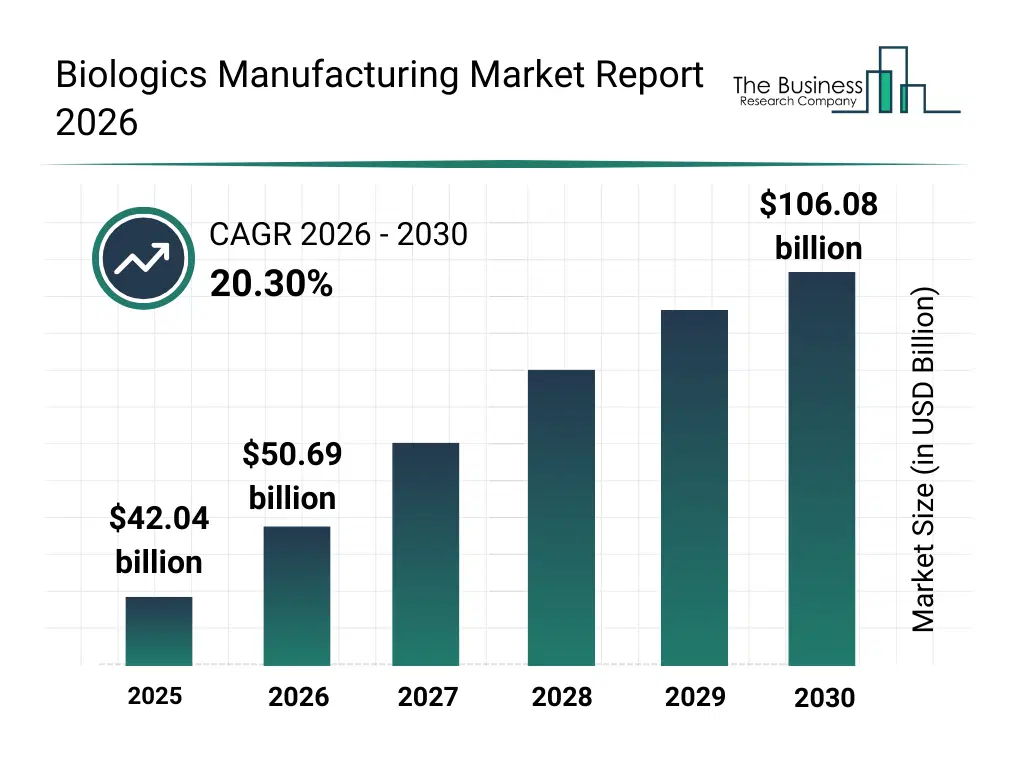
What Is The Biologics Manufacturing Market Size and Share 2026?
The biologics manufacturing market size has grown exponentially in recent years. It will grow from $42.04 billion in 2025 to $50.69 billion in 2026 at a compound annual growth rate (CAGR) of 20.6%. The growth in the historic period can be attributed to expansion of recombinant protein therapeutics, early adoption of mammalian cell culture systems, growth in vaccine manufacturing capacity, increasing outsourcing of biologics production, advancements in purification technologies.What Is The Biologics Manufacturing Market Growth Forecast?
The biologics manufacturing market size is expected to see exponential growth in the next few years. It will grow to $106.08 billion in 2030 at a compound annual growth rate (CAGR) of 20.3%. The growth in the forecast period can be attributed to increasing demand for personalized biologics, rising investments in flexible manufacturing platforms, expansion of biosimilar development, growing adoption of digital bioprocessing tools, focus on cost-efficient large-scale production. Major trends in the forecast period include increasing adoption of single-use bioprocessing systems, rising deployment of continuous biomanufacturing, growing demand for high-volume monoclonal antibody production, expansion of modular biologics facilities, enhanced integration of advanced process control.
Global Biologics Manufacturing Market Segmentation
1) By Mode of Manufacturing: Contract Manufacturing, In-House Manufacturing 2) By Modality: Monoclonal Antibodies (mAbs), Biosimilar And Recombinant Proteins, Vaccines (recombinant/mRNA/Viral), Cell And Gene Therapies, Ribonucleic Acid-Based Therapeutics 3) By Disease Indication: Oncology, Autoimmune Disorders, Infectious Diseases, Neurological Disorders, Other Disease Indications Subsegments: 1) By Contract Manufacturing: Mammalian Cell-Based Production, Microbial Fermentation Production, Cell-Free Protein Synthesis, Hybrid Manufacturing Systems 2) By In-House Manufacturing: Mammalian Cell Culture Production, Microbial Expression Systems, Continuous Bioprocessing, Single-Use Technology ProductionWhat Is The Driver Of The Biologics Manufacturing Market?
The rising prevalence of chronic diseases is expected to propel the growth of the biologics manufacturing market going forward. Chronic diseases are persistent health conditions that develop slowly and last for an extended period, often requiring continuous medical care. The growing prevalence of chronic diseases is partly due to inactive lifestyles, as prolonged sitting and minimal physical activity raise the risk of diseases such as heart conditions and diabetes. Biologics manufacturing enhances chronic disease management by producing targeted therapies, making them effective for conditions such as diabetes, cancer, and autoimmune disorders. It reduces disease burden by providing consistent, high-quality biologic medicines, improving patient outcomes and treatment efficiency. For instance, in June 2024, according to the National Health Service, a UK-based government department, 3,615,330 individuals registered with a general practitioner (GP) were diagnosed with non-diabetic hyperglycemia or pre-diabetes (a condition with elevated blood sugar levels, not high enough to be classified as diabetes) in 2023, marking an 18% increase from 3,065,825 cases in 2022. Therefore, the rising prevalence of chronic diseases is driving the growth of the biologics manufacturing industry.Key Players In The Global Biologics Manufacturing Market
Major companies operating in the biologics manufacturing market are Johnson & Johnson, F. Hoffmann La-Roche Ltd., Pfizer Inc, AbbVie Inc., Eli Lilly and Company, Novartis AG, Bristol-Myers Squibb Company, Thermo Fisher Scientific Inc., LG Life Sciences Ltd., Novo Nordisk A/S, Amgen Inc., FUJIFILM Holdings Corporation, Boehringer Ingelheim International GmbH, Teva Pharmaceutical Industries Ltd., Lonza Group Ltd., Intas Pharmaceuticals Ltd., Samsung Biologics Co. Ltd., Fareva SA, Celltrion Inc., Evotec SEGlobal Biologics Manufacturing Market Trends and Insights
Major companies operating in the biologics manufacturing market are focusing on developing advanced solutions, such as integrated biologics contract development and manufacturing organization platforms, to enhance end-to-end biologics development, production efficiency, and supply chain integration across multiple therapeutic modalities. Integrated biologics contract development and manufacturing organization (CDMO) platform refers to a comprehensive framework that combines biologics development, production, and supply services within a single, unified system. For instance, in June 2023, Catalent Inc., a US-based contract development and manufacturing company, expanded its OneBio Suite for integrated development, manufacturing, and supply across biologic modalities. The enhanced OneBio Suite offers a fully integrated biologics Contract Development and Manufacturing Organization (CDMO) platform that supports antibodies, cell and gene therapies, and mRNA-based products. It provides end-to-end services from development to fill-finish and packaging through a single contract and harmonized project management, enabling faster development timelines, improved scalability, and seamless global supply integration.What Are Latest Mergers And Acquisitions In The Biologics Manufacturing Market?
In September 2025, Terumo Corporation, a Japan-based medical technology company, acquired WuXi Biologics (Cayman) Inc. for an undisclosed amount. Through this acquisition, Terumo aims to expand its CDMO production capacity and global presence, enhancing its ability to provide integrated biologics manufacturing and fill-finish services for injectable therapies. WuXi Biologics (Cayman) Inc. is a China-based company offering end-to-end solutions for the discovery, development, and manufacturing of biologics.Regional Insights
North America was the largest region in the biologics manufacturing market in 2025. Asia-Pacific is expected to be the fastest-growing region in the forecast period. The regions covered in this market report are Asia-Pacific, South East Asia, Western Europe, Eastern Europe, North America, South America, Middle East, Africa. The countries covered in this market report are Australia, Brazil, China, France, Germany, India, Indonesia, Japan, Taiwan, Russia, South Korea, UK, USA, Canada, Italy, Spain.What Defines the Biologics Manufacturing Market?
The biologics manufacturing market consists of sales of therapeutic proteins, enzymes, recombinant DNA products, blood factors, and other biologic-based therapeutics. Values in this market are ‘factory gate’ values, that is, the value of goods sold by the manufacturers or creators of the goods, whether to other entities (including downstream manufacturers, wholesalers, distributors, and retailers) or directly to end customers. The value of goods in this market includes related services sold by the creators of the goods.How is Market Value Defined and Measured?
The market value is defined as the revenues that enterprises gain from the sale of goods and/or services within the specified market and geography through sales, grants, or donations in terms of the currency (in USD unless otherwise specified). The revenues for a specified geography are consumption values that are revenues generated by organizations in the specified geography within the market, irrespective of where they are produced. It does not include revenues from resales along the supply chain, either further along the supply chain or as part of other products.What Key Data and Analysis Are Included in the Biologics Manufacturing Market Report 2026?
The biologics manufacturing market research report is one of a series of new reports from The Business Research Company that provides market statistics, including industry global market size, regional shares, competitors with the market share, detailed market segments, market trends and opportunities, and any further data you may need to thrive in the biologics manufacturing industry. The market research report delivers a complete perspective of everything you need, with an in-depth analysis of the current and future state of the industry.Biologics Manufacturing Market Report Forecast Analysis
| Report Attribute | Details |
|---|---|
| Market Size Value In 2026 | $50.69 billion |
| Revenue Forecast In 2035 | $106.08 billion |
| Growth Rate | CAGR of 20.6% from 2026 to 2035 |
| Base Year For Estimation | 2025 |
| Actual Estimates/Historical Data | 2020-2025 |
| Forecast Period | 2026 - 2030 - 2035 |
| Market Representation | Revenue in USD Billion and CAGR from 2026 to 2035 |
| Segments Covered | Mode of Manufacturing, Modality, Disease Indication |
| Regional Scope | Asia-Pacific, Western Europe, Eastern Europe, North America, South America, Middle East, Africa |
| Country Scope | The countries covered in the report are Australia, Brazil, China, France, Germany, India, ... |
| Key Companies Profiled | Johnson & Johnson, F. Hoffmann La-Roche Ltd., Pfizer Inc, AbbVie Inc., Eli Lilly and Company, Novartis AG, Bristol-Myers Squibb Company, Thermo Fisher Scientific Inc., LG Life Sciences Ltd., Novo Nordisk A/S, Amgen Inc., FUJIFILM Holdings Corporation, Boehringer Ingelheim International GmbH, Teva Pharmaceutical Industries Ltd., Lonza Group Ltd., Intas Pharmaceuticals Ltd., Samsung Biologics Co. Ltd., Fareva SA, Celltrion Inc., Evotec SE |
| Customization Scope | Request for Customization |
| Pricing And Purchase Options | Explore Purchase Options |