
Food Service Facility Management Market Report 2026
Global Outlook – By Service Type (Cleaning, Maintenance, Security, Catering, Other Service Types), By Technology Utilization (Automated Management Systems, Inventory Management Software, Customer Relationship Management (CRM) Tools, Point Of Sale (POS) Systems, Online Ordering Platforms), By Mode Of Service (In-House, Outsourced), By Facility Size (Small Food Service Facilities, Medium-Sized Food Service Facilities, Large Food Service Facilities), By End User (Restaurants, Hotels, Healthcare Facilities, Educational Institutes, Catering Services, Corporate Cafeterias) – Market Size, Trends, Strategies, and Forecast to 2030
Food Service Facility Management Market Overview
• Food Service Facility Management market size has reached to $26 billion in 2025 • Expected to grow to $36.98 billion in 2030 at a compound annual growth rate (CAGR) of 7.2% • Growth Driver: The Rising Shift Toward Food-Away-From-Home Fueling The Growth Of The Market Due To Changing Consumer Lifestyles • Market Trend: Adoption Of AI-Driven Kitchen And Facility Automation Transforming The Market Through Enhanced Efficiency And Safety • North America was the largest region in 2025 and Asia-Pacific is the fastest growing region.Market Gains By 2030 – Top Opportunities By Segment
Market Gain identifies the most promising market opportunities by highlighting the segments or products expected to generate the highest incremental revenue growth over the next five years.
What Is Covered Under Food Service Facility Management Market?
Food service facility management refers to the professional planning, coordination, and supervision of operations within food service environments to ensure efficiency, safety, and quality. It involves managing resources, maintaining hygiene standards, and streamlining processes to optimize overall performance. The main service types of food service facility management are cleaning, maintenance, security, catering, and other service types that ensure smooth, safe, and hygienic operation of food service environments. Cleaning refers to routine and deep sanitation activities that maintain hygiene, safety, and cleanliness across kitchen and dining areas. It utilizes technologies such as automated management systems, inventory management software, customer relationship management (CRM) tools, point of sale (POS) systems, and online ordering platforms, and is delivered through in-house teams or outsourced providers. Food service facility management supports facilities of varying sizes, including small, medium-sized, and large food service establishments, and serves diverse end users, such as restaurants, hotels, healthcare facilities, educational institutes, catering services, and corporate cafeterias.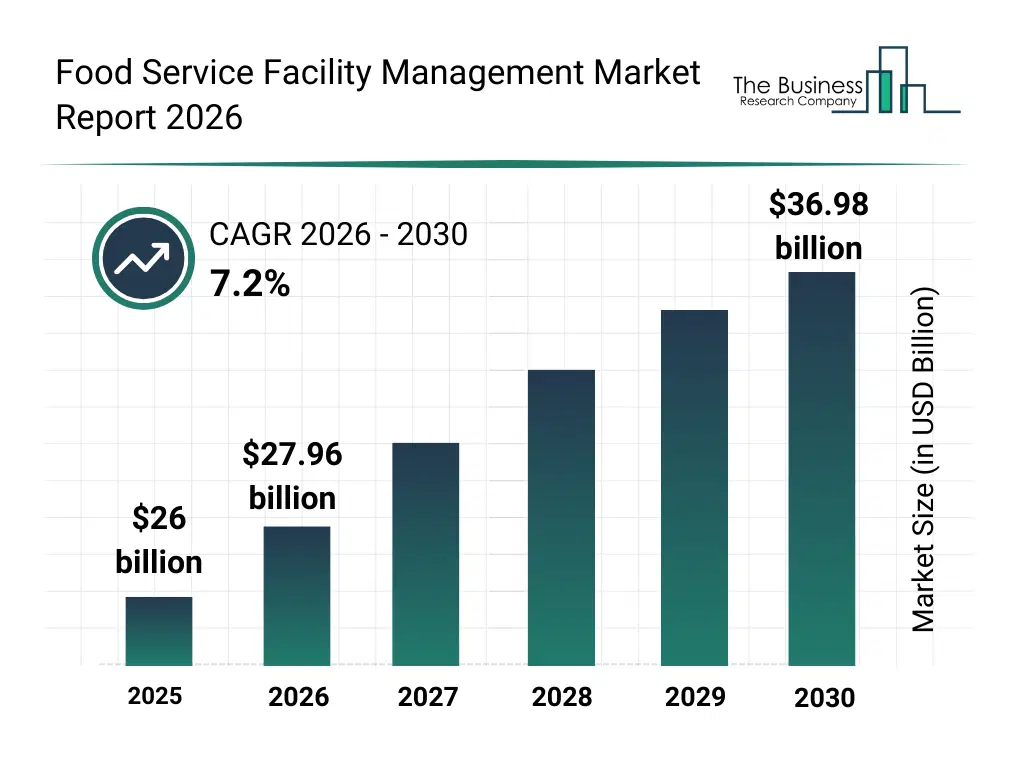
What Is The Food Service Facility Management Market Size and Share 2026?
The food service facility management market size has grown strongly in recent years. It will grow from $26 billion in 2025 to $27.96 billion in 2026 at a compound annual growth rate (CAGR) of 7.6%. The growth in the historic period can be attributed to expansion of commercial food service establishments, rising demand for standardized facility operations, increasing regulatory oversight on hygiene standards, growth in institutional food facilities, adoption of professional facility management services.What Is The Food Service Facility Management Market Growth Forecast?
The food service facility management market size is expected to see strong growth in the next few years. It will grow to $36.98 billion in 2030 at a compound annual growth rate (CAGR) of 7.2%. The growth in the forecast period can be attributed to increasing outsourcing of food facility operations, rising investments in smart kitchen technologies, expansion of large-scale catering facilities, growing focus on sustainability in facility operations, increasing adoption of data-driven management platforms. Major trends in the forecast period include increasing adoption of integrated facility management solutions, rising use of automated food service systems, growing focus on hygiene and compliance management, expansion of technology-enabled operational monitoring, enhanced emphasis on cost optimization practices.
Global Food Service Facility Management Market Segmentation
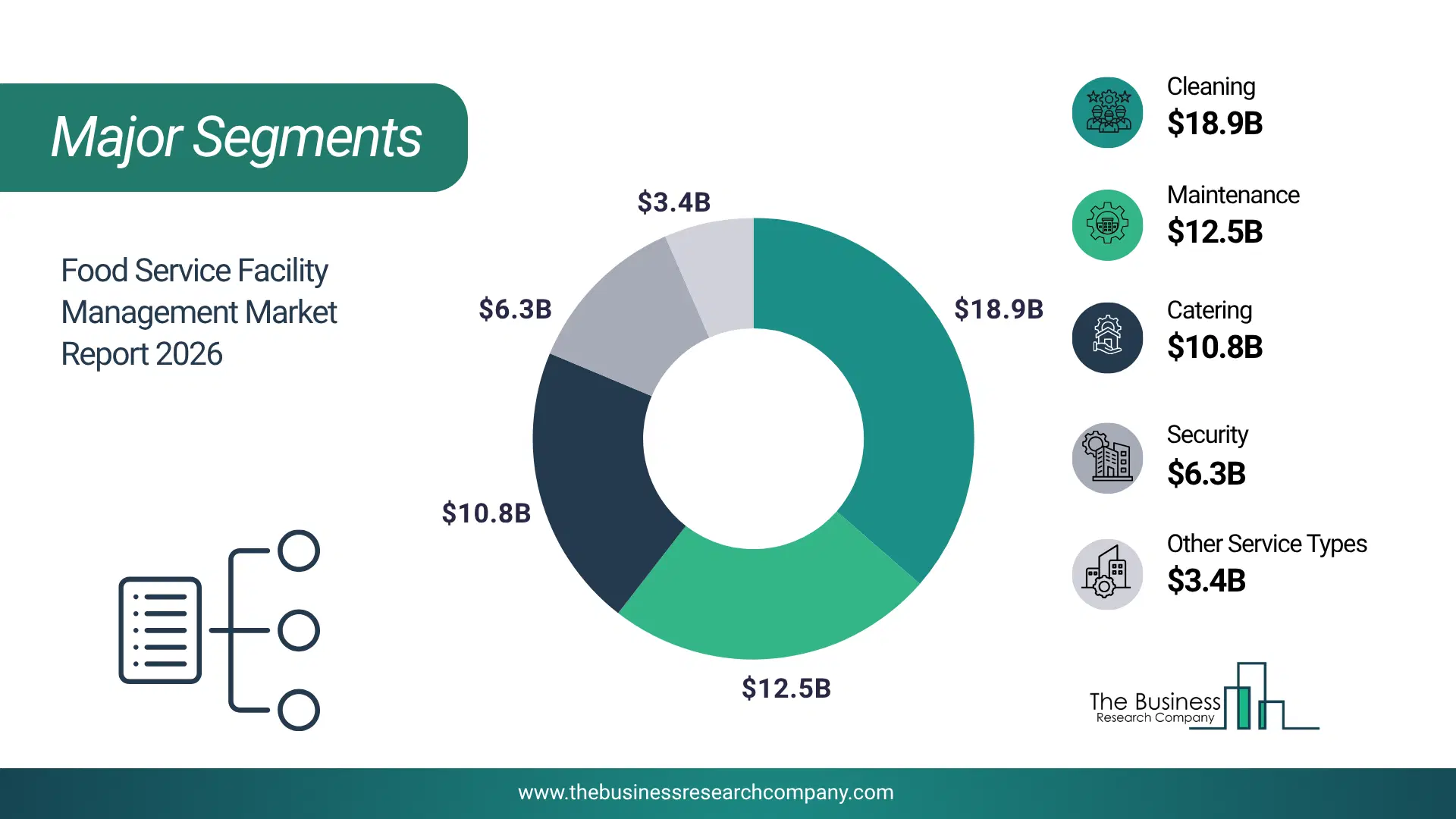
1) By Service Type: Cleaning, Maintenance, Security, Catering, Other Service Types 2) By Technology Utilization: Automated Management Systems, Inventory Management Software, Customer Relationship Management (CRM) Tools, Point Of Sale (POS) Systems, Online Ordering Platforms 3) By Mode Of Service: In-House, Outsourced 4) By Facility Size: Small Food Service Facilities, Medium-Sized Food Service Facilities, Large Food Service Facilities 5) By End User: Restaurants, Hotels, Healthcare Facilities, Educational Institutes, Catering Services, Corporate Cafeterias Subsegments: 1) By Cleaning: Janitorial Services, Waste Management, Pest Control, Sanitation Services 2) By Maintenance: Equipment Maintenance, Heating, Ventilation, And Air Conditioning (HVAC) Maintenance, Plumbing Services, Electrical Maintenance 3) By Security: Guard Services, Surveillance Services, Access Control, Emergency Response 4) By Catering: Corporate Catering, Event Catering, Institutional Catering, Retail Catering 5) By Other Services: Laundry Services, Landscaping Services, Pest Management, Consulting Services The top segments in the food service facility management market will be: • Cleaning will reach $18.87 billion by 2030. • Maintenance will reach $12.49 billion by 2030. • Catering will reach $10.74 billion by 2030. • Security will reach $6.2 billion by 2030. • Other Service Types will reach $3.38 billion by 2030.What Is The Driver Of The Food Service Facility Management Market?
The rising shift toward food-away-from-home (FAFH) is expected to propel the growth of the food service facility management market going forward. FAFH refers to meals and food services consumed outside the home or purchased as ready-to-eat or prepared meals requiring minimal preparation. The increase in FAFH expenditure is driven by changing consumer lifestyles characterized by busy work schedules, dual-income households, urbanization, and a growing preference for quick and hassle-free meal options. Food service facility management supports this trend by optimizing kitchen operations, ensuring food safety, streamlining production and delivery processes, and improving service efficiency and customer satisfaction. For instance, in October 2024, according to the United States Department of Agriculture (USDA), via its Economic Research Service (ERS), a US-based government agency, in 2023, US per-capita spending on food away from home rose to US$ 4, 485, up from US$ 4, 004 in 2022, marking a 12.0% increase, at the same time, spending on food at home rose only modestly. Therefore, the rising shift toward food-away-from-home is driving the growth of the food service facility management industry.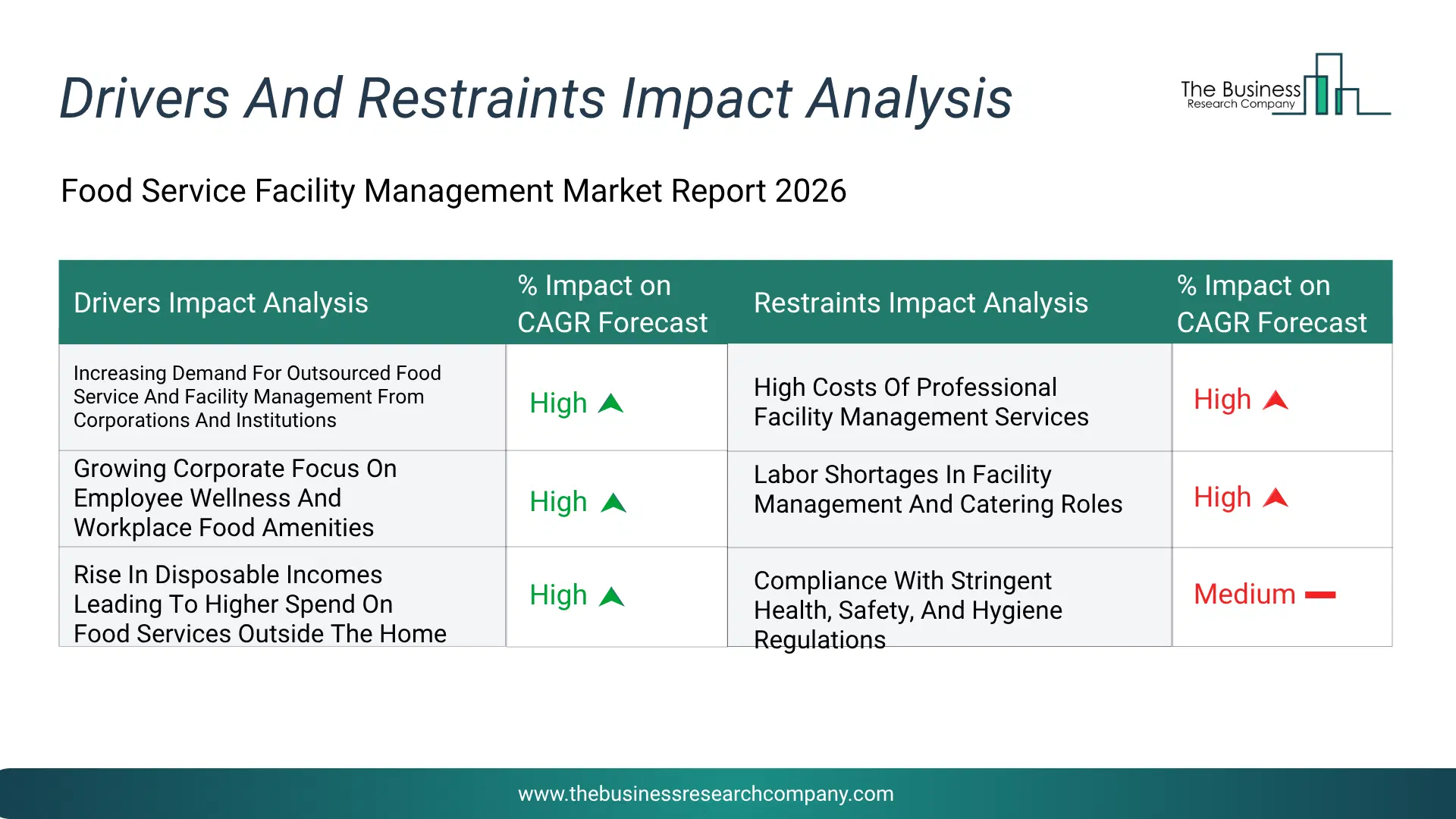
Infographic Chart Showing Key Market Drivers Analysis And Restraints For Food Service Facility Management Market
The chart presents an impact analysis of key drivers and restraints, quantifying their relative influence on the market's growth rate and helping assess the balance between growth enablers and limiting factors. This chart offers a high-level perspective; the full report contains more detailed insights.
How Will The Drivers Impact Growth In The Global Food Service Facility Management Market?
• Increasing Demand For Outsourced Food Service And Facility Management From Corporations And Institutions (High) – During the forecast period, the increasing demand for outsourced food service and facility management is expected to become a key growth driver for the market by 2030. Organizations are focusing on core operations while entrusting dining and facility functions to specialized providers, which ensures better efficiency, cost control, and compliance with health and safety regulations. Outsourced services also provide access to skilled professionals, advanced technologies, and standardized service quality across multiple sites. As companies expand operations and require consistent service delivery, reliance on expert providers continues to grow. • Growing Corporate Focus On Employee Wellness And Workplace Food Amenities (High) – During the forecast period, the growing corporate focus on employee wellness and workplace food amenities is expected to act as a significant driver for the market by 2030. Organizations are investing in healthier, diverse, and professionally managed meal options to enhance employee satisfaction, productivity, and overall well-being. Initiatives such as modern cafeterias, wellness-driven menus, and sustainable catering solutions are becoming standard in employee-centric workplace environments. Facility management providers are expanding their services to meet these evolving corporate wellness goals. • Rise In Disposable Incomes Leading To Higher Spend On Food Services Outside The Home (High) – During the forecast period, the rise in disposable incomes is expected to be another key factor driving the food service facility management market by 2030. As urban populations grow and lifestyles become busier, consumers are increasingly seeking convenient, high-quality dining options in workplaces, institutions, and commercial settings. Higher spending power supports the expansion of corporate cafeterias, quick-service restaurants, and institutional dining facilities. Professionally managed food services ensure consistency, hygiene, and variety, catering to the evolving expectations of consumers.How Will The Restraints Impact Growth In The Global Food Service Facility Management Market?
• High Costs Of Professional Facility Management Services (High) – During the forecast period, the the high costs of professional facility management services act as a major restraint for the food service facility management market by limiting accessibility for small and medium-sized organizations. Many institutions and businesses operate on tight budgets, making it difficult to justify the expense of outsourcing these services. The costs associated with skilled labor, advanced technologies, and compliance with health and safety standards further add to financial pressure. As a result, several operators prefer in-house management despite efficiency drawbacks. This cost barrier ultimately slows down the overall adoption of professional facility management solutions. • Labor Shortages In Facility Management And Catering Roles (High) – During the forecast period, the labor shortages in facility management and catering roles act as a restraint for the food service facility management market by reducing the availability of skilled professionals needed to maintain quality standards. The industry often faces challenges in recruiting and retaining trained staff due to demanding work conditions and wage competition. This shortage leads to service delays, increased operational costs, and inconsistent performance across sites. As a result, companies struggle to meet client expectations and compliance requirements. The persistent talent gap hampers the efficiency and scalability of food service facility management operations. • Compliance With Stringent Health, Safety, And Hygiene Regulations (Medium) – During the forecast period, the food service facility management providers must comply with strict food safety, sanitation, workplace safety, and environmental regulations across multiple facilities. Maintaining compliance requires continuous monitoring, employee training, audits, and investments in updated equipment and processes. Any failure to meet regulatory standards can result in penalties, reputational damage, and operational disruptions. These compliance requirements increase operational complexity and overall service delivery costs.Key Players In The Global Food Service Facility Management Market
Major companies operating in the food service facility management market report are Compass Group plc, Sodexo S.A., Aramark Corporation, ISS Facility Services A/S, Elior Group SA, Delaware North Companies Inc., Mitie Group plc, ABM Industries Incorporated, Atalian Servest Group Limited, OCS Group Limited, Healthcare Services Group Inc., AVI Foodsystems Inc., Thompson Hospitality Corporation, Guckenheimer Enterprises Inc., HHS LLC, Taher Inc., Fresh Ideas Food Management, Serco Group plc, WSH Group Limited, Interserve Group Ltd.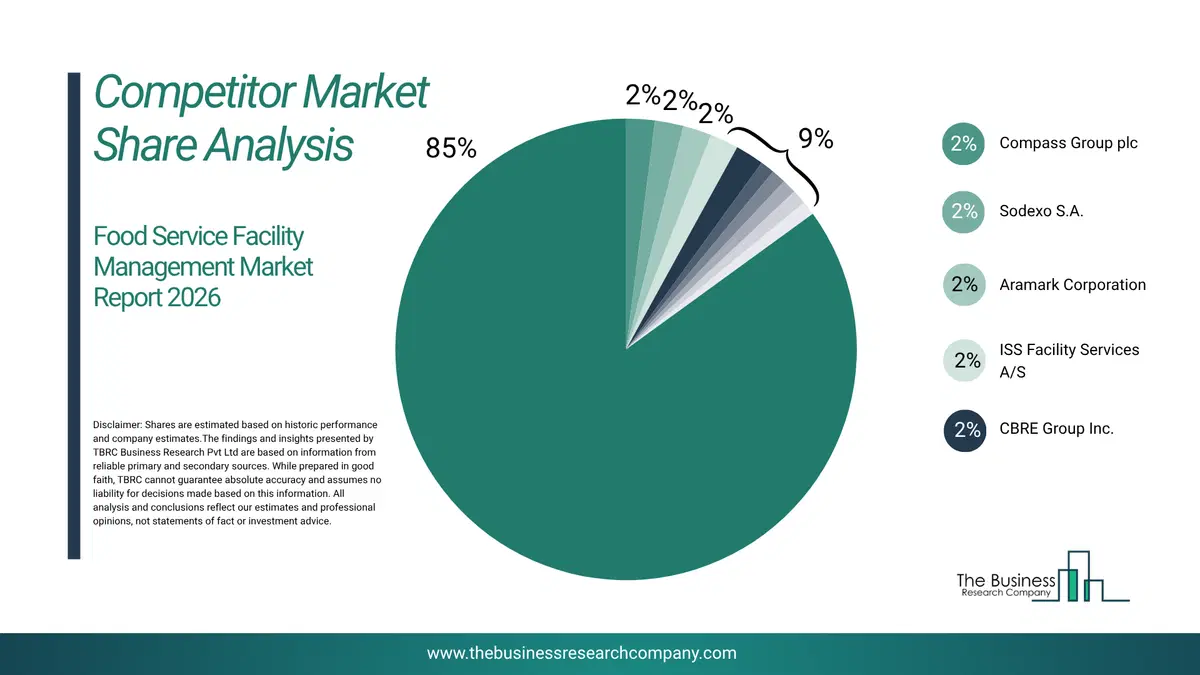
This chart is for illustrative purposes; the full report includes a detailed competitor analysis and comprehensive overview of the top 10 companies in the market.
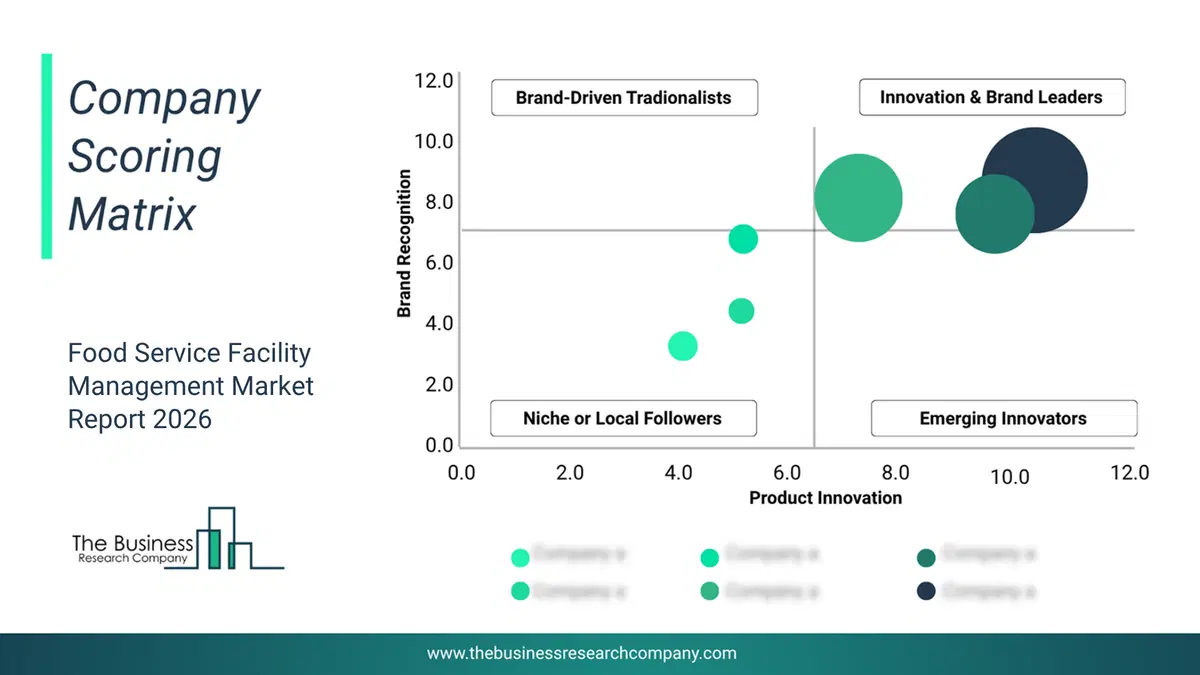
This chart maps companies by product innovation and brand strength, with bubble size indicating relative revenue, helping identify market leaders, challengers, and niche players. This is an illustrative chart; the full report provides a complete and accurate competitive analysis.
Global Food Service Facility Management Market Trends and Insights
Major companies operating in the food service facility management market are focusing on AI-driven kitchen and facility automation to enhance operational efficiency, reduce labor costs, and improve service quality. AI-driven kitchen and facility automation refers to the use of artificial intelligence technologies to control, optimize, and streamline kitchen operations and facility management tasks, such as cooking, cleaning, maintenance, and energy use. For instance, in 2025, Miso Robotics Inc a US-based food robotics company, launched the Flippy Fry Station (next-generation), an AI-powered robotic fry station designed for QSR kitchens to automate frying operations. The new system features a smaller footprint, faster installation, and enhanced AI capabilities that improve speed, precision, and safety in food preparation. This innovation helps restaurants address labor shortages, reduce operational costs, and maintain consistent food quality across high-volume operations.What Are Latest Mergers And Acquisitions In The Food Service Facility Management Market?
In July 2023, Sodexo S.A. a France-based food services and facilities management company acquired A.H. Management Group for an undisclosed amount. With this acquisition, Sodexo aims to reinforce its North American convenience-services footprint particularly through its in reach business by expanding offerings such as micro-markets, vending machines, and office coffee or pantry services. A.H. Management Group is a US-based company thar provide provided food service facility management solutions.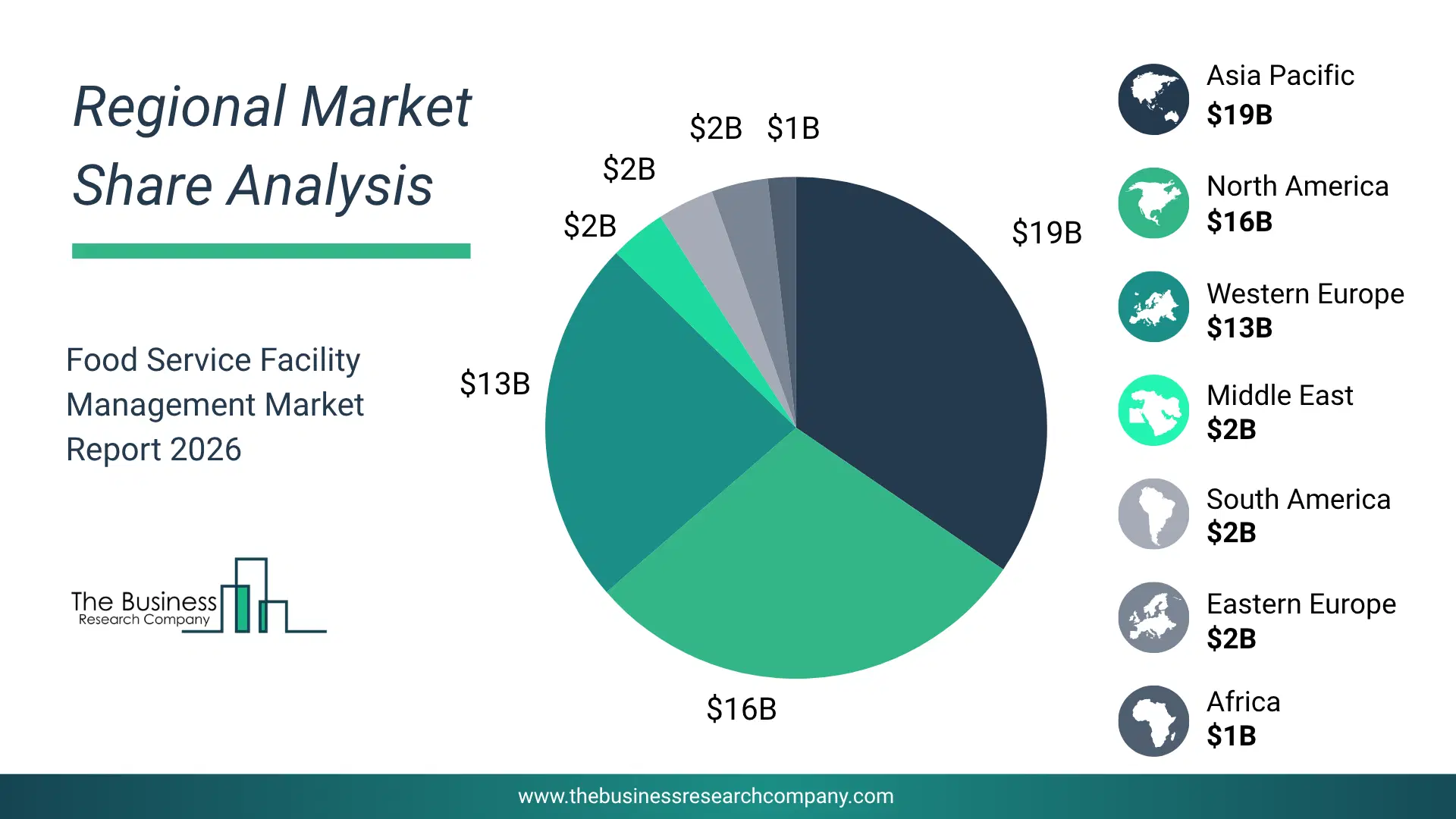
Regional Outlook
North America was the largest region in the food service facility management market in 2025. Asia-Pacific is expected to be the fastest-growing region in the forecast period. The regions covered in this market report are Asia-Pacific, South East Asia, Western Europe, Eastern Europe, North America, South America, Middle East, Africa. The countries covered in this market report are Australia, Brazil, China, France, Germany, India, Indonesia, Japan, Taiwan, Russia, South Korea, UK, USA, Canada, Italy, SpainWhat Defines the Food Service Facility Management Market?
The food service facility management market includes revenues earned by entities through facility planning and management, catering management, kitchen operations management, menu planning, staff training and management, procurement and supply chain management, hygiene and safety compliance, and equipment maintenance services. The market value includes the value of related goods sold by the service provider or included within the service offering. Only goods and services traded between entities or sold to end consumers are included.How is Market Value Defined and Measured?
The market value is defined as the revenues that enterprises gain from the sale of goods and/or services within the specified market and geography through sales, grants, or donations in terms of the currency (in USD unless otherwise specified). The revenues for a specified geography are consumption values that are revenues generated by organizations in the specified geography within the market, irrespective of where they are produced. It does not include revenues from resales along the supply chain, either further along the supply chain or as part of other products.
This chart presents market attractiveness based on a quantitative evaluation of growth, competition, strategic alignment, and risk, offering a clear view of opportunity areas for decision-making. This chart is for illustrative purposes; the full report contains the complete analysis.

This chart highlights the Total Addressable Market (TAM) by estimating the maximum revenue opportunity using an assumption-driven approach, supporting strategic planning and opportunity sizing across markets. The chart is illustrative; the full report provides a more comprehensive analysis.
What Key Data and Analysis Are Included in the Food Service Facility Management Market Report 2026?
The food service facility management market research report is one of a series of new reports from The Business Research Company that provides market statistics, including industry global market size, regional shares, competitors with the market share, detailed market segments, market trends and opportunities, and any further data you may need to thrive in the food service facility management industry. The market research report delivers a complete perspective of everything you need, with an in-depth analysis of the current and future state of the industry.Food Service Facility Management Market Report Forecast Analysis
| Report Attribute | Details |
|---|---|
| Market Size Value In 2026 | $27.96 billion |
| Revenue Forecast In 2030 | $36.98 billion |
| Growth Rate | CAGR of 7.2% from 2026 to 2030 |
| Base Year For Estimation | 2025 |
| Actual Estimates/Historical Data | 2020-2025 |
| Forecast Period | 2026 - 2030 |
| Market Representation | Revenue in USD Billion and CAGR from 2026 to 2030 |
| Segments Covered | Service Type, Technology Utilization, Mode Of Service, Facility Size, End User |
| Regional Scope | Asia-Pacific, Western Europe, Eastern Europe, North America, South America, Middle East, Africa |
| Country Scope | The countries covered in the report are Australia, Brazil, China, France, Germany, India, ... |
| Key Companies Profiled | Compass Group plc, Sodexo S.A., Aramark Corporation, ISS Facility Services A/S, Elior Group SA, Delaware North Companies Inc., Mitie Group plc, ABM Industries Incorporated, Atalian Servest Group Limited, OCS Group Limited, Healthcare Services Group Inc., AVI Foodsystems Inc., Thompson Hospitality Corporation, Guckenheimer Enterprises Inc., HHS LLC, Taher Inc., Fresh Ideas Food Management, Serco Group plc, WSH Group Limited, Interserve Group Ltd. |
| Customization Scope | Request for Customization |
| Pricing And Purchase Options | Explore Purchase Options |