
Hydrogen Powered Transport Market Report 2026
Global Outlook – By Fuel Cell Technology Type (Proton Exchange Membrane Fuel Cells, Alkaline and Other Transport-Focused Fuel Cells), By Vehicle Type (Cars, Buses, Trucks, Other Vehicles ), By End Use (Passenger Vehicle, Commercial Vehicle) – Market Size, Trends, Strategies, and Forecast to 2030
Hydrogen Powered Transport Market Overview
• Hydrogen Powered Transport market size has reached to $20.49 billion in 2025 • Expected to grow to $204.9 billion in 2030 at a compound annual growth rate (CAGR) of 58.5% • Growth Driver: Rising Commercial Vehicle Adoption Fuels Momentum In The Hydrogen-Powered Transport Market • Market Trend: Revolutionizing Hydrogen-Powered Transport By Innovating High-Performance Fuel Cell Electric Vehicle Platforms • North America was the largest region in 2025.Market Gains By 2030 – Top Opportunities By Segment
Market Gain identifies the most promising market opportunities by highlighting the segments or products expected to generate the highest incremental revenue growth over the next five years.
What Is Covered Under Hydrogen Powered Transport Market?
Hydrogen powered transport is a vehicle that uses hydrogen as its internal fuel. The powertrains of hydrogen vehicles use either internal combustion engines to burn hydrogen or fuel cells, which use hydrogen and oxygen to react to produce mechanical energy and power electric motors. The hydrogen powered transport market covered in the report is segmented by fuel cell technology type into proton exchange membrane fuel cells, phosphoric acid fuel cells, and others; by vehicle type into cars, buses, trucks, and others; and by end-use into passenger vehicles, commercial vehicles.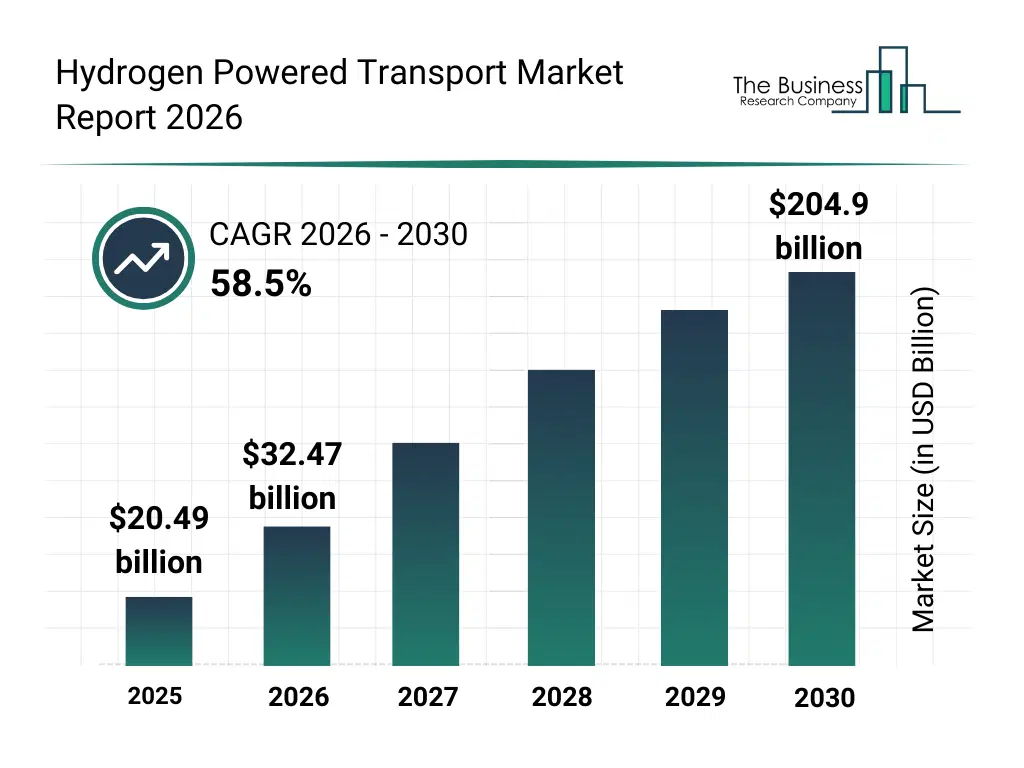
What Is The Hydrogen Powered Transport Market Size and Share 2026?
The hydrogen powered transport market size has grown exponentially in recent years. It will grow from $20.49 billion in 2025 to $32.47 billion in 2026 at a compound annual growth rate (CAGR) of 58.5%. The growth in the historic period can be attributed to early fuel cell research programs, government clean energy initiatives, pilot hydrogen mobility projects, rising fossil fuel concerns, initial commercial fuel cell deployments.What Is The Hydrogen Powered Transport Market Growth Forecast?
The hydrogen powered transport market size is expected to see exponential growth in the next few years. It will grow to $204.9 billion in 2030 at a compound annual growth rate (CAGR) of 58.5%. The growth in the forecast period can be attributed to hydrogen infrastructure expansion, decarbonization mandates, growth of commercial hydrogen fleets, declining fuel cell costs, public private hydrogen investments. Major trends in the forecast period include expansion of fuel cell vehicle deployment, rising investment in hydrogen refueling infrastructure, growing adoption in commercial transportation, increased focus on long range zero emission mobility, integration of hydrogen powertrains in heavy vehicles.
Global Hydrogen Powered Transport Market Segmentation
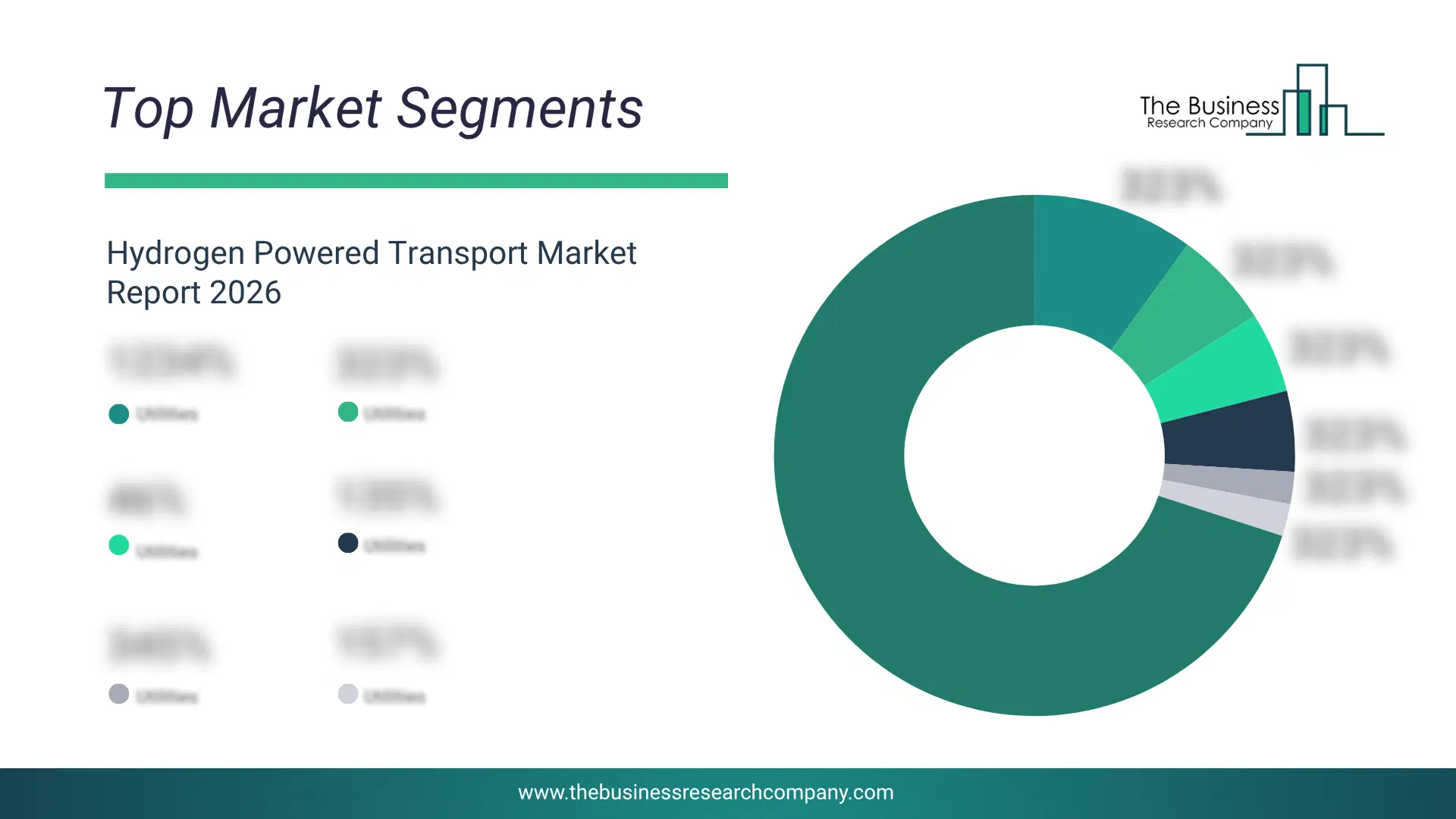
1) By Fuel Cell Technology Type: Proton Exchange Membrane Fuel Cells, Alkaline and Other Transport-Focused Fuel Cells 2) By Vehicle Type: Cars, Buses, Trucks, Other Vehicles 3) By End Use: Passenger Vehicle, Commercial Vehicle Subsegments: 1) By Proton Exchange Membrane Fuel Cells: Automotive Applications, Bus and Commercial Vehicle Applications, Portable Power Applications 2) By Alkaline and Other Transport-Focused Fuel Cells: Specialized Vehicle Applications, Light Commercial and Delivery Vehicles, Demonstration and Pilot Projects The top segments in the hydrogen powered transport market will be: • Proton Exchange Membrane Fuel Cells will reach $103.89 Billion by 2030. • Alkaline Transport-Focused Fuel Cells will reach $10.12 Billion by 2030. • Other Transport-Focused Fuel Cells will reach $5.9 Billion by 2030.What Is The Driver Of The Hydrogen Powered Transport Market?
The growing number of commercial vehicles is expected to propel the growth of the hydrogen-powered transport market going forward. Commercial vehicles are automobiles primarily designed and used for transporting goods or passengers for commercial purposes. Hydrogen-powered transport in commercial vehicles offers zero emissions, reduced air pollution, energy efficiency, versatility, reduced dependence on fossil fuels, noise reduction, and quick refueling. For instance, in September 2024, according to the Society of Motor Manufacturers and Traders (SMMT), a UK-based trade association, the commercial vehicle (CV) plants have produced 78,805 units in 2024, a rise of 5.8% from 74,505 in 2023. Therefore, the growing number of commercial vehicles is driving the growth of the hydrogen-powered transport market.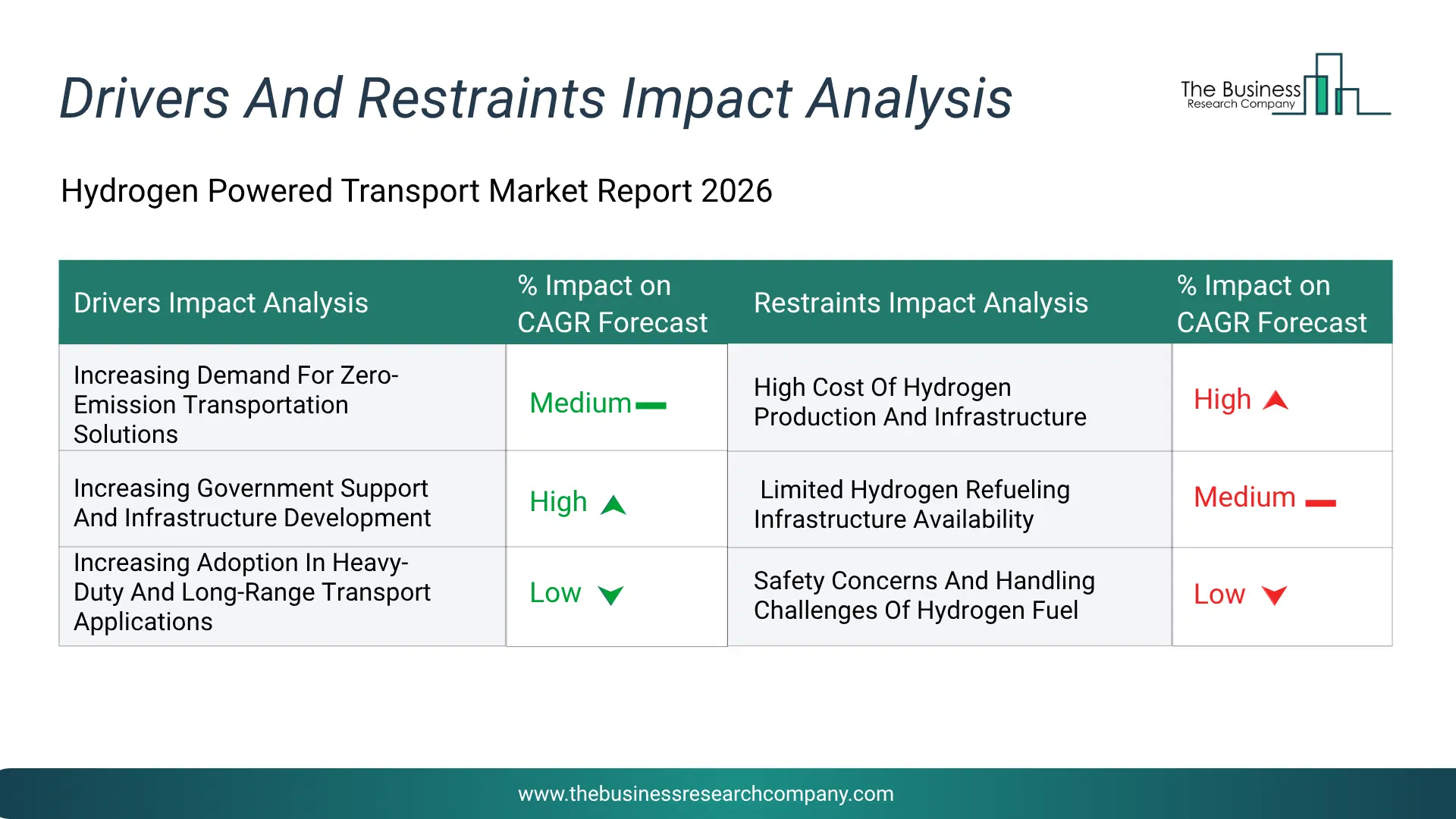
Infographic Chart Showing Key Market Drivers Analysis And Restraints For Hydrogen Powered Transport Market
The chart presents an impact analysis of key drivers and restraints, quantifying their relative influence on the market's growth rate and helping assess the balance between growth enablers and limiting factors. This chart offers a high-level perspective; the full report contains more detailed insights.
How Will The Drivers Impact Growth In The Global Hydrogen Powered Transport Market?
• Increasing Demand For Zero-Emission Transportation Solutions (Medium) – During the forecast period, the increasing demand for zero-emission transportation solutions is expected to become a key growth driver for the hydrogen powered transport market by 2030. The growing need to reduce carbon emissions from transport is a major driver for hydrogen-powered vehicles. Based on the definition, hydrogen fuel cells produce only water as a byproduct, making them highly aligned with global decarbonization goals. Governments and industries are actively promoting zero-emission alternatives, especially in heavy transport segments such as buses, trains, and ships. This accelerates adoption across multiple vehicle categories included in the market scope. As regulatory pressure intensifies, hydrogen transport becomes a viable long-term clean mobility solution. • Increasing Government Support And Infrastructure Development (High) – During the forecast period, the increasing government support and infrastructure development is expected to emerge as a major factor driving the expansion of the hydrogen powered transport market by 2030. Government policies, subsidies, and investments in hydrogen infrastructure significantly drive market growth. As per the definition, the market includes multiple transport modes, all of which require fueling networks and ecosystem support. Countries are investing in hydrogen refueling stations, pilot projects for trains and buses, and national hydrogen strategies. These initiatives reduce adoption barriers and improve commercial viability for manufacturers and fleet operators. As infrastructure expands, hydrogen-powered transport becomes more scalable and accessible. • Increasing Adoption In Heavy-Duty And Long-Range Transport Applications (Low) – During the forecast period, the increasing adoption in heavy-duty and long-range transport applications is expected to act as a key growth catalyst for the hydrogen powered transport market by 2030. Hydrogen technology is particularly suited for heavy-duty and long-distance transport such as trucks, ships, and trains. Based on the definition, these segments are core components of the hydrogen transport market. Compared to batteries, hydrogen offers faster refueling and longer range, making it ideal for commercial and industrial applications. This drives demand from logistics, public transport, and defense sectors. As these high-consumption segments adopt hydrogen, they significantly contribute to overall market expansion.How Will The Restraints Impact Growth In The Global Hydrogen Powered Transport Market?
• High Cost Of Hydrogen Production And Infrastructure (Medium) – During the forecast period, the high cost associated with hydrogen production, storage, and distribution acts as a major restraint for the market. Based on the definition, hydrogen-powered transport spans multiple vehicle types, all requiring dedicated fueling infrastructure. Green hydrogen production remains expensive due to reliance on renewable energy and electrolysis technologies. Additionally, setting up refueling stations and transport logistics increases capital expenditure. These cost barriers slow down widespread adoption and limit commercialization across many regions. • Limited Hydrogen Refueling Infrastructure Availability (High) – During the forecast period, the lack of widespread hydrogen refueling stations restricts the usability of hydrogen-powered vehicles. As per the market definition, vehicles such as buses, trains, and automobiles depend on consistent fuel availability for operations. However, current infrastructure is concentrated in select regions, making long-distance or cross-border operations challenging. This creates range anxiety and operational uncertainty for fleet operators. As a result, adoption remains limited despite technological readiness. • Safety Concerns And Handling Challenges Of Hydrogen Fuel (Low) – During the forecast period, the hydrogen’s physical properties, including high flammability and low ignition energy, create safety and handling challenges. Within the defined market, transportation, storage, and usage across multiple vehicle types require strict safety protocols and advanced engineering systems. These requirements increase system complexity and compliance costs for manufacturers. Public perception regarding hydrogen safety can also hinder acceptance. Consequently, these factors slow down large-scale deployment in the transport sector.Key Players In The Global Hydrogen Powered Transport Market
Major companies operating in the hydrogen powered transport market report include Toyota Motor Corporation, Hyundai Motor Group, Honda Motor Co. Ltd., BMW, Mercedes-Benz Group AG, General Motors Company, Volkswagen Group, Kia Corporation, Volvo Group AB, Groupe Renault, Tata Motors Limited, Nikola Corporation, Hyzon Motors Inc., Tevva Motors Ltd., ZeroAvia Inc., ULEMCo Limited, Hyperion Motors, Dayun Group, Beiqi Foton Motor Co. Ltd., Mazda Motor Corporation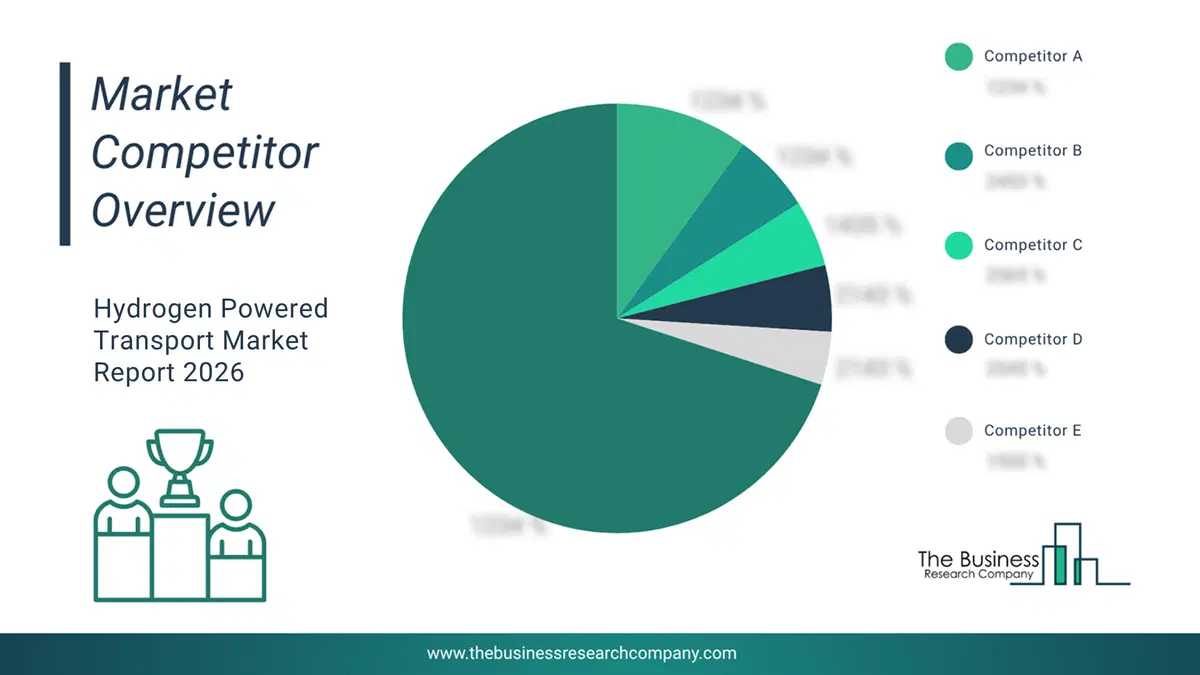
This chart is for illustrative purposes; the full report includes a detailed competitor analysis and comprehensive overview of the top 10 companies in the market.
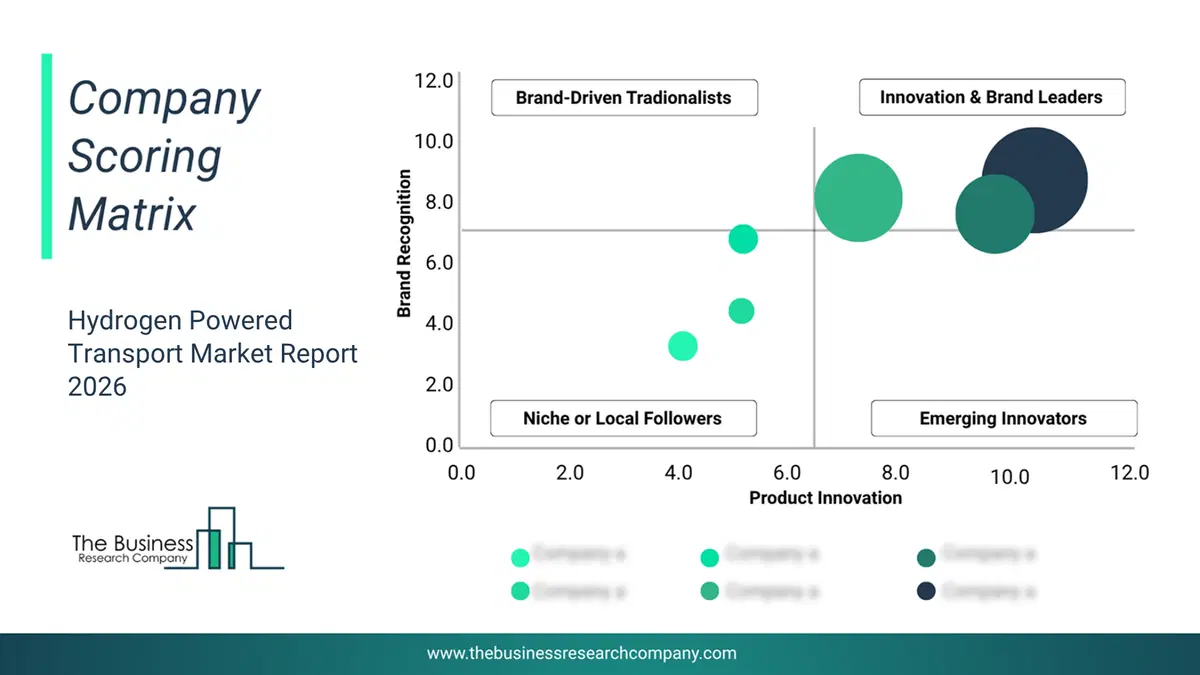
This chart maps companies by product innovation and brand strength, with bubble size indicating relative revenue, helping identify market leaders, challengers, and niche players. This is an illustrative chart; the full report provides a complete and accurate competitive analysis.
Global Hydrogen Powered Transport Market Trends and Insights
Major companies operating in the hydrogen-powered transport market are developing new products such as high-performance hydrogen fuel cell electric vehicle platform to gain a competitive edge in the market. A high-performance hydrogen fuel cell electric vehicle (FCEV) platform refers to an advanced and versatile foundation for designing and manufacturing vehicles that use hydrogen fuel cells as their primary source of power. For instance, in September 2023, WAE Technologies Ltd., a UK-based technology and engineering services company launched EVRh. The platform has a lightweight composite frame and is intended to showcase the capabilities of hydrogen-powered powertrain systems. The platform's main component is a liquid-cooled FCEV battery pack with 430kW of power capacity. EVRh can produce 550kW when combined with the 120kW hydrogen fuel cell. Due to the platform's design versatility, manufacturers are able to produce roadgoing versions of both fixed-roof GT type and open-roof Targa vehicles with maximum power-to-weight.What Are Latest Mergers And Acquisitions In The Hydrogen Powered Transport Market?
In August 2023, Hyundai Motor Company, a South Korea-based automotive manufacturing company acquired General Motors Company for an undisclosed amount. With this acquisition, the South Korean auto giant hopes to double the number of vehicles it can produce annually in the nation to 10 lakh manufacturing facilities and the factory will start producing goods in 2025. General Motors Company is a US-based automobile manufacturing company that sells light commercial vehicles.Regional Outlook
North America was the largest region in the hydrogen powered transport market in 2025. The regions covered in this market report include Asia-Pacific, South East Asia, Western Europe, Eastern Europe, North America, South America, Middle East, Africa. The countries covered in this market report include Australia, Brazil, China, France, Germany, India, Indonesia, Japan, Taiwan, Russia, South Korea, UK, USA, Canada, Italy, SpainWhat Defines the Hydrogen Powered Transport Market?
The hydrogen powered transport market consists of sales of airplanes, automobiles, auto racing, buses, trams and trains, ships, bicycles and military vehicles. Values in this market are ‘factory gate’ values, that is the value of goods sold by the manufacturers or creators of the goods, whether to other entities (including downstream manufacturers, wholesalers, distributors and retailers) or directly to end customers. The value of goods in this market includes related services sold by the creators of the goods.How is Market Value Defined and Measured?
The market value is defined as the revenues that enterprises gain from the sale of goods and/or services within the specified market and geography through sales, grants, or donations in terms of the currency (in USD unless otherwise specified). The revenues for a specified geography are consumption values that are revenues generated by organizations in the specified geography within the market, irrespective of where they are produced. It does not include revenues from resales along the supply chain, either further along the supply chain or as part of other products.
This chart presents market attractiveness based on a quantitative evaluation of growth, competition, strategic alignment, and risk, offering a clear view of opportunity areas for decision-making. This chart is for illustrative purposes; the full report contains the complete analysis.

This chart highlights the Total Addressable Market (TAM) by estimating the maximum revenue opportunity using an assumption-driven approach, supporting strategic planning and opportunity sizing across markets. The chart is illustrative; the full report provides a more comprehensive analysis.
What Key Data and Analysis Are Included in the Hydrogen Powered Transport Market Report 2026?
The hydrogen powered transport market research report is one of a series of new reports from The Business Research Company that provides market statistics, including industry global market size, regional shares, competitors with the market share, detailed market segments, market trends and opportunities, and any further data you may need to thrive in the hydrogen powered transport industry. The market research report delivers a complete perspective of everything you need, with an in-depth analysis of the current and future state of the industry.Hydrogen Powered Transport Market Report Forecast Analysis
| Report Attribute | Details |
|---|---|
| Market Size Value In 2026 | $32.47 billion |
| Revenue Forecast In 2030 | $204.9 billion |
| Growth Rate | CAGR of 58.5% from 2026 to 2030 |
| Base Year For Estimation | 2025 |
| Actual Estimates/Historical Data | 2020-2025 |
| Forecast Period | 2026 - 2030 |
| Market Representation | Revenue in USD Billion and CAGR from 2026 to 2030 |
| Segments Covered | Fuel Cell Technology Type, Vehicle Type, End Use |
| Regional Scope | Asia-Pacific, Western Europe, Eastern Europe, North America, South America, Middle East, Africa |
| Country Scope | The countries covered in the report are Australia, Brazil, China, France, Germany, India, Indonesia, Japan, Taiwan, Russia, South Korea, UK, USA, Canada, Italy, Spain. |
| Key Companies Profiled | Toyota Motor Corporation, Hyundai Motor Group, Honda Motor Co. Ltd., BMW, Mercedes-Benz Group AG, General Motors Company, Volkswagen Group, Kia Corporation, Volvo Group AB, Groupe Renault, Tata Motors Limited, Nikola Corporation, Hyzon Motors Inc., Tevva Motors Ltd., ZeroAvia Inc., ULEMCo Limited, Hyperion Motors, Dayun Group, Beiqi Foton Motor Co. Ltd., Mazda Motor Corporation |
| Customization Scope | Request for Customization |
| Pricing And Purchase Options | Explore Purchase Options |