

Hydrolyzed Vegetable Proteins Market Report 2026
Global Outlook – By Source (Soy, Wheat, Corn, Pea, Other Sources), By Form (Dry Powder, Liquid), By Function (Flavoring Agent, Emulsifying Agent), By Application (Processed Food Products, Meat Substitutes) – Market Size, Trends, Strategies, and Forecast to 2030
Hydrolyzed Vegetable Proteins Market Overview
• Hydrolyzed Vegetable Proteins market size has reached to $1.75 billion in 2025 • Expected to grow to $2.63 billion in 2030 at a compound annual growth rate (CAGR) of 8.7% • Growth Driver: Vegetarian And Vegan Surge Fueling Hydrolyzed Vegetable Protein Market Growth • Market Trend: Innovation Focus On Texturizing & Hydrolyzed Solutions To Improve Product Quality • North America was the largest region in 2025 and Asia-Pacific is the fastest growing region.What Is Covered Under Hydrolyzed Vegetable Proteins Market?
Hydrolyzed Vegetable Proteins (HVP) refer to proteins obtained from vegetables that are broken down into amino acids through hydrolysis. It is commonly used as a flavor enhancer in processed foods, soups, sauces, and seasonings. HVP adds savory, umami taste to food products, improving their overall flavor profile. The main sources of hydrolyzed vegetable protein are soy, wheat, corn, peas, and others. Soy refers to a kind of tiny bean that is extensively raised for human and animal consumption, and hydrolyzed protein is made from soy to be used as a flavor enhancer in food. They are produced in dry powder and liquid forms with various functions such as flavoring agents, emulsifying agents, and others that are used in various applications such as bakery and confectionery, processed food products, meat substitutes, beverages, and others.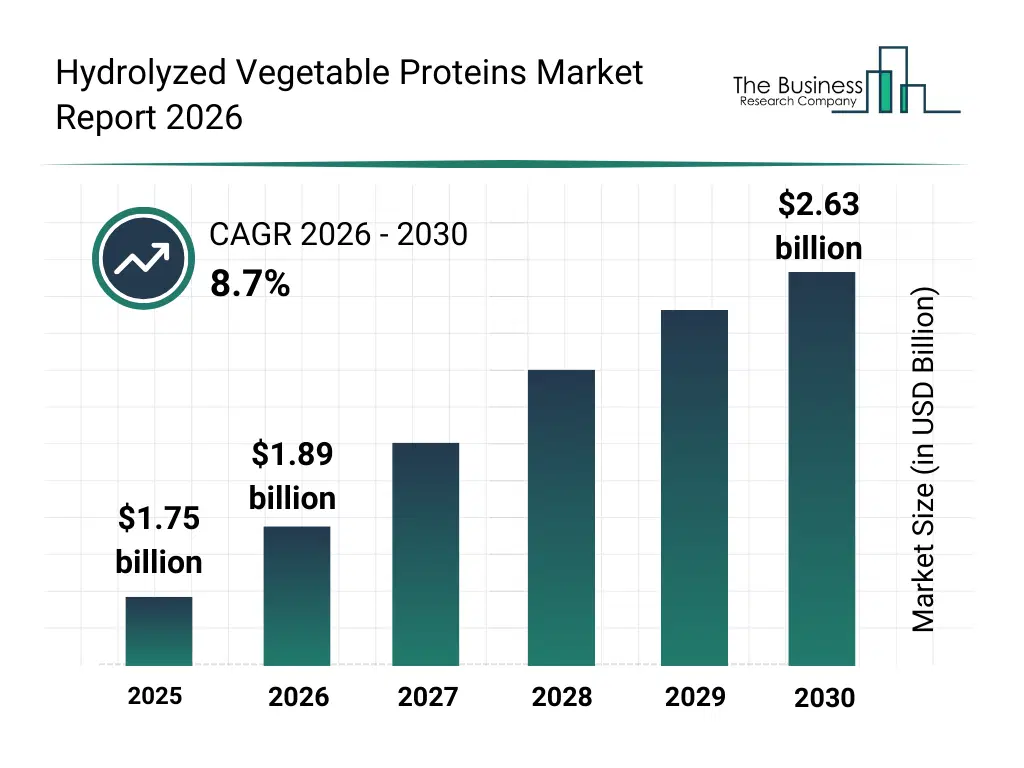
What Is The Hydrolyzed Vegetable Proteins Market Size and Share 2026?
The hydrolyzed vegetable proteins market size has grown strongly in recent years. It will grow from $1.75 billion in 2025 to $1.89 billion in 2026 at a compound annual growth rate (CAGR) of 7.4%. The growth in the historic period can be attributed to growth of processed food manufacturing, rising use of flavor enhancers in packaged foods, availability of soy and wheat protein sources, expansion of convenience food consumption, adoption of industrial food processing.What Is The Hydrolyzed Vegetable Proteins Market Growth Forecast?
The hydrolyzed vegetable proteins market size is expected to see strong growth in the next few years. It will grow to $2.63 billion in 2030 at a compound annual growth rate (CAGR) of 8.7%. The growth in the forecast period can be attributed to increasing demand for plant-based foods, rising focus on natural flavor solutions, expansion of meat alternative products, growing investment in food ingredient innovation, increasing regulatory scrutiny on synthetic additives. Major trends in the forecast period include increasing use of plant-based flavor enhancers, rising demand for clean-label food ingredients, growing adoption in meat substitute formulations, expansion of hydrolyzed protein applications, enhanced focus on umami flavor optimization.
Global Hydrolyzed Vegetable Proteins Market Segmentation
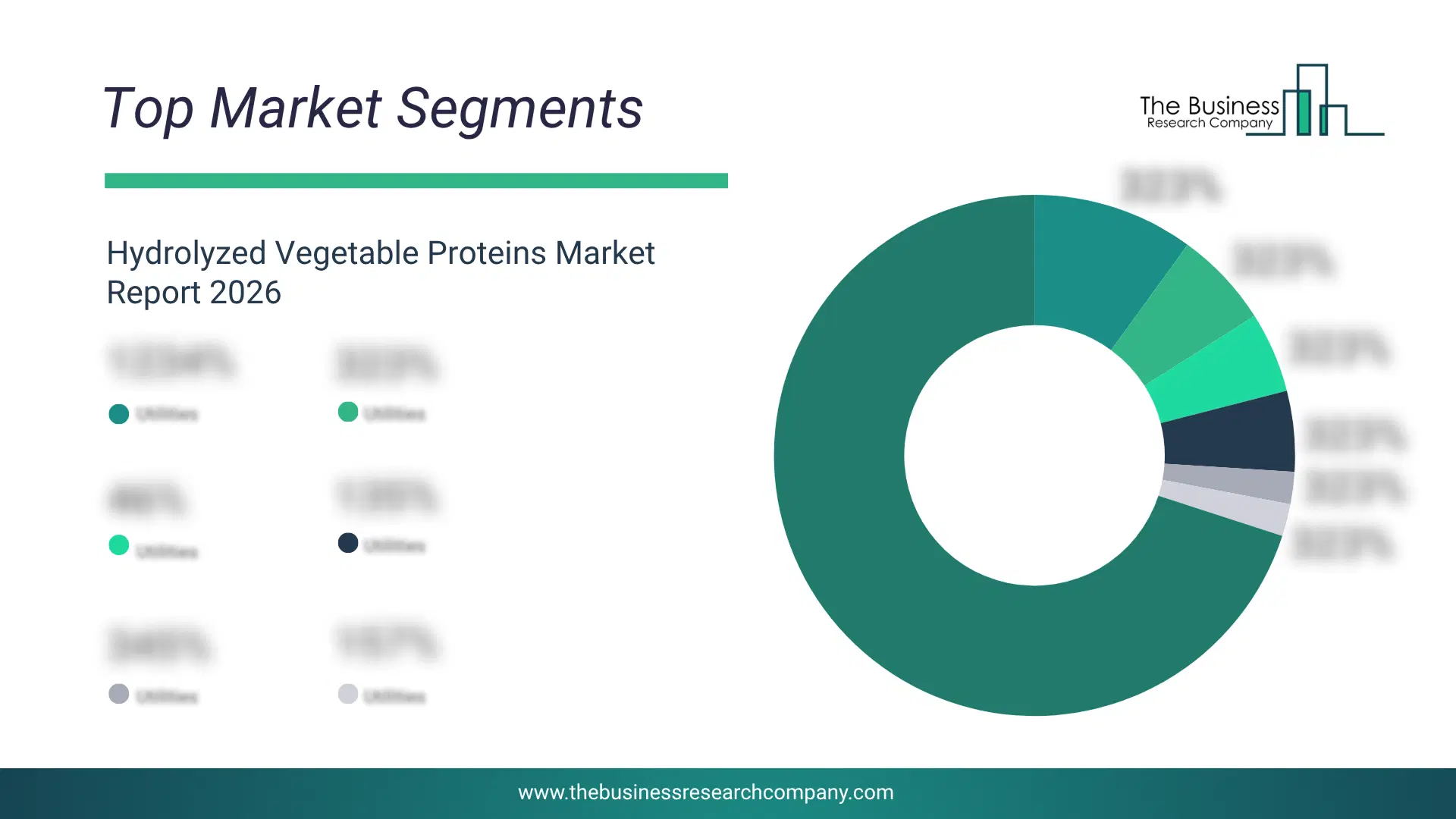
1) By Source: Soy, Wheat, Corn, Pea, Other Sources 2) By Form: Dry Powder, Liquid 3) By Function: Flavoring Agent, Emulsifying Agent 4) By Application: Processed Food Products, Meat Substitutes Subsegments: 1) By Soy: Hydrolyzed Soy Protein (Acid-Hydrolyzed), Hydrolyzed Soy Protein (Enzyme-Hydrolyzed), Partially Hydrolyzed Soy Protein 2) By Wheat: Hydrolyzed Wheat Protein (Acid-Hydrolyzed), Hydrolyzed Wheat Protein (Enzyme-Hydrolyzed) 3) By Corn: Hydrolyzed Corn Protein, Hydrolyzed Corn Gluten 4) By Pea: Hydrolyzed Pea Protein, Enzyme-Hydrolyzed Pea Protein 5) By Other Sources: Hydrolyzed Rice Protein, Hydrolyzed Potato Protein, Hydrolyzed Sunflower Protein, Hydrolyzed Mixed Vegetable ProteinsWhat Are The Drivers Of The Hydrolyzed Vegetable Proteins Market?
The growing popularity of vegetarian and vegan diets is expected to propel the growth of the hydrolyzed vegetable protein market going forward. Vegetarian and vegan diets refer to different variations of vegetarianism in which no food of animal origin is consumed. Hydrolyzed vegetable protein, derived from plant sources, serves as a versatile and sustainable option for meeting the protein needs of vegetarian and vegan consumers. For instance, in February 2023, according to Veganuary, a UK-based nonprofit organization that promotes vegan lifestyles through its annual January campaign, The number of official campaign participants rose from 629,000 in 2022 to 706,965 in 2023, reflecting an increase of participants. Therefore, the growing popularity of vegetarian and vegan diets is driving the growth of the hydrolyzed vegetable protein industry. The increasing health consciousness among consumers is expected to propel the growth of the hydrolyzed vegetable protein market in the coming future. Health consciousness is defined as an individual's or a group's consciousness, worries, and proactive effort to preserve and improve the well-being and health of others. Consumers are becoming more aware of their health, and hydrolyzed vegetable protein sources are frequently seen as healthier alternatives to animal-derived proteins. For instance, in Jun 2024, according to the International Food Information Council (IFIC), a US based non profit organization, the proportion of Americans following a specific diet or eating pattern over the past year remains high at 54%. Most people are looking to increase their protein intake, with interest climbing from 59% in 2022 to 67% in 2023, and reaching 71% in 2024. Additionally, roughly half of consumers aim to eat more fresh foods, which are widely considered the healthiest options. Therefore, increasing health consciousness is driving the hydrolyzed vegetable protein industry.Key Players In The Global Hydrolyzed Vegetable Proteins Market
Major companies operating in the hydrolyzed vegetable proteins market are Cargill Inc., Archer Daniels Midland Company, Ajinomoto Co. Inc., Kerry Group plc, Symrise AG, Koninklijke DSM N.V., Givaudan SA, Tate and Lyle plc, Sensient Technologies Corporation, Griffith Foods Inc., Caremoli S.p.A., Caremoli Dien Inc., Dien Inc., Nactis Flavours, Aipu Food Industry Co. Ltd., Titan Biotech Limited, Chaitanya Biologicals Pvt. Ltd., Aarkay Food Products Ltd., PMV Nutrient Products Pvt. Ltd., Henan Hengernuo Biotechnology Co. Ltd., Shandong Jianyuan Group Co. Ltd., Jones-Hamilton Co., Sun Impex International Foods LLC, Shanghai Bichain Industrial Chemical Co. Ltd., Astron Chemicals S.A.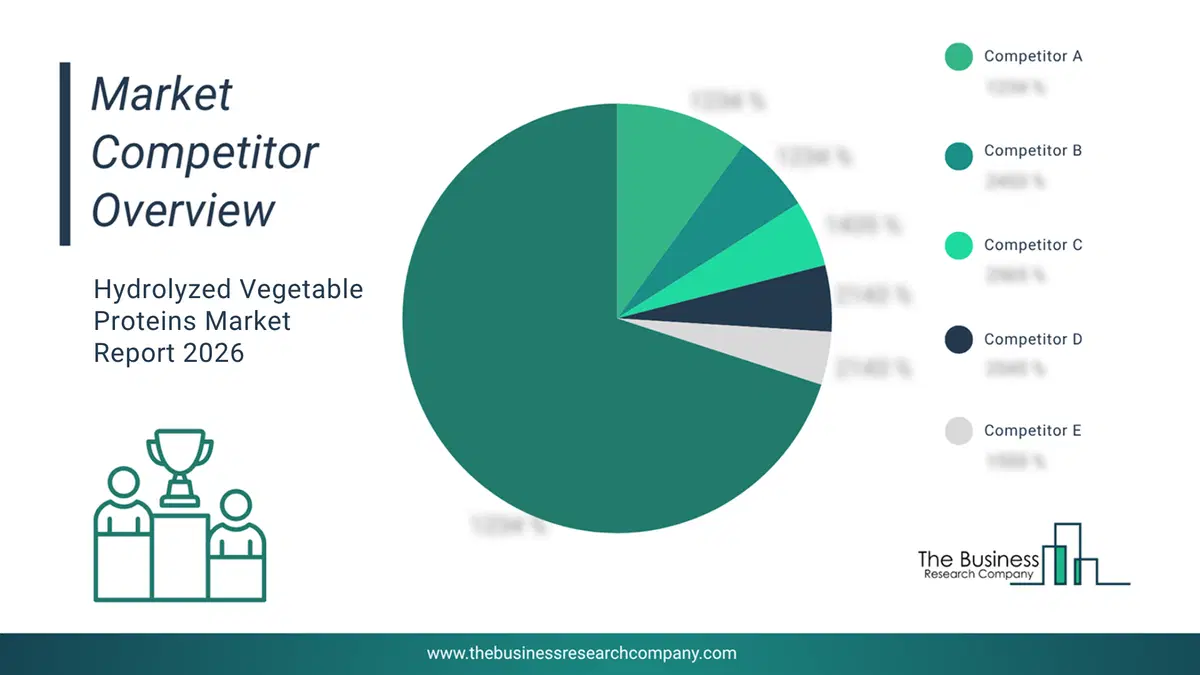
This chart is for illustrative purposes; the full report includes a detailed competitor analysis and comprehensive overview of the top 10 companies in the market.
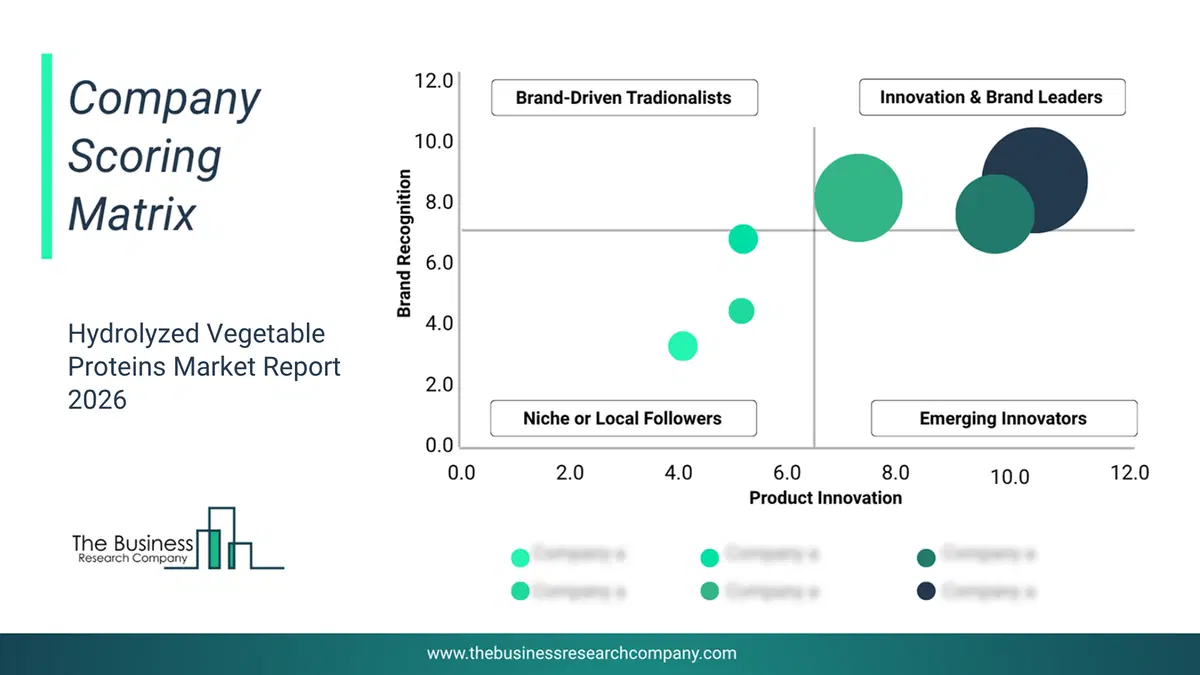
This chart maps companies by product innovation and brand strength, with bubble size indicating relative revenue, helping identify market leaders, challengers, and niche players. This is an illustrative chart; the full report provides a complete and accurate competitive analysis.
What Are Latest Mergers And Acquisitions In The Hydrolyzed Vegetable Proteins Market?
Regional Outlook
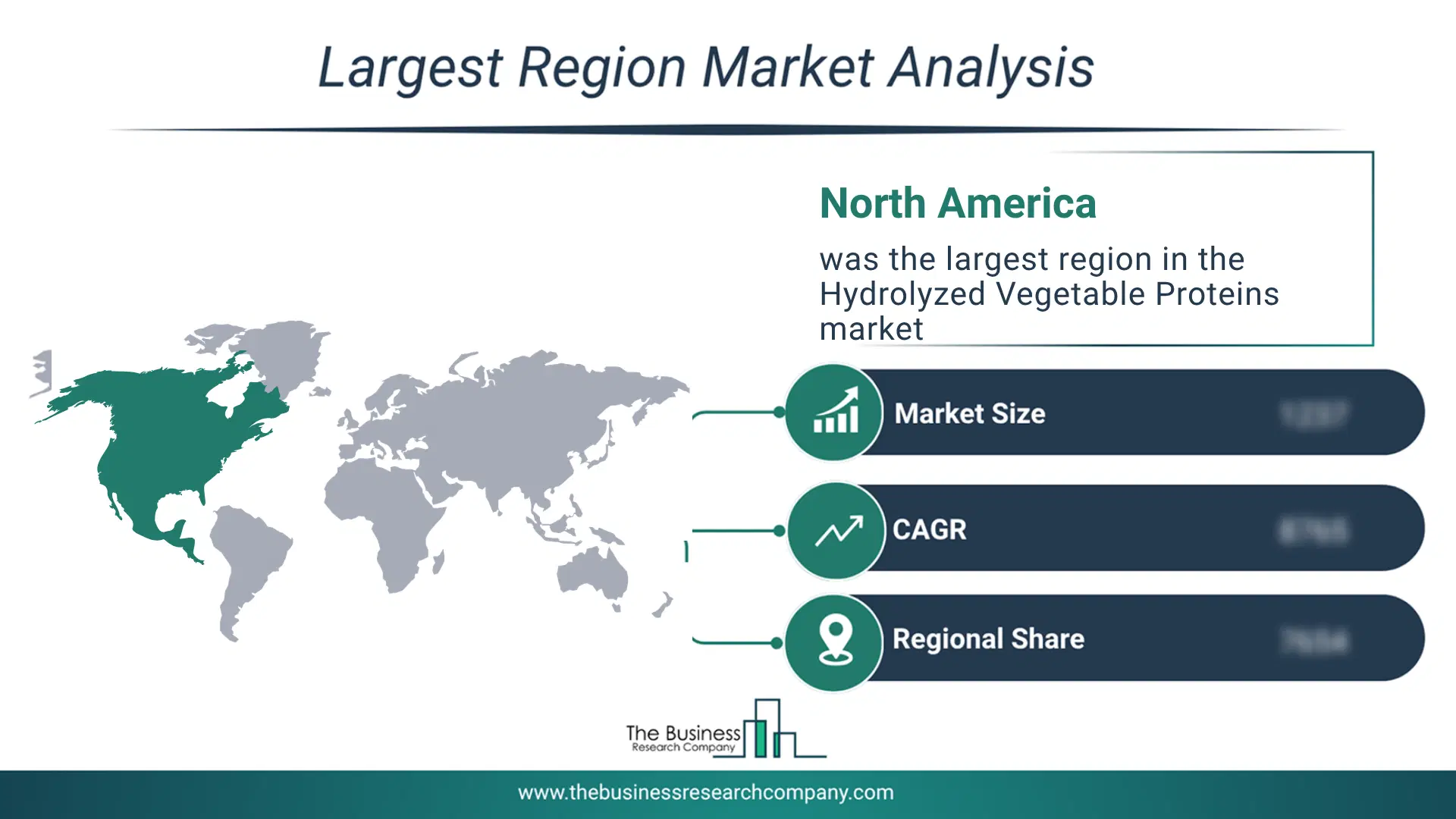
North America was the largest region in the hydrolyzed vegetable proteins market in 2025. Asia-Pacific is expected to be the fastest-growing region in the forecast period. The regions covered in this market report are Asia-Pacific, South East Asia, Western Europe, Eastern Europe, North America, South America, Middle East and Africa. The countries covered in this market report are Australia, Brazil, China, France, Germany, India, Indonesia, Japan, Taiwan, Russia, South Korea, UK, USA, Italy, Spain, CanadaWhat Defines the Hydrolyzed Vegetable Proteins Market?
The hydrolyzed vegetable protein market consists of sales of hydrolyzed sunflower protein and hydrolyzed almond protein. Values in this market are ‘factory gate’ values, that is the value of goods sold by the manufacturers or creators of the goods, whether to other entities (including downstream manufacturers, wholesalers, distributors, and retailers) or directly to end customers. The value of goods in this market includes related services sold by the creators of the goods.How is Market Value Defined and Measured?
The market value is defined as the revenues that enterprises gain from the sale of goods and/or services within the specified market and geography through sales, grants, or donations in terms of the currency (in USD unless otherwise specified). The revenues for a specified geography are consumption values that are revenues generated by organizations in the specified geography within the market, irrespective of where they are produced. It does not include revenues from resales along the supply chain, either further along the supply chain or as part of other products.
This chart presents market attractiveness based on a quantitative evaluation of growth, competition, strategic alignment, and risk, offering a clear view of opportunity areas for decision-making. This chart is for illustrative purposes; the full report contains the complete analysis.

This chart highlights the Total Addressable Market (TAM) by estimating the maximum revenue opportunity using an assumption-driven approach, supporting strategic planning and opportunity sizing across markets. The chart is illustrative; the full report provides a more comprehensive analysis.
What Key Data and Analysis Are Included in the Hydrolyzed Vegetable Proteins Market Report 2026?
The hydrolyzed vegetable proteins market research report is one of a series of new reports from The Business Research Company that provides market statistics, including industry global market size, regional shares, competitors with the market share, detailed market segments, market trends and opportunities, and any further data you may need to thrive in the hydrolyzed vegetable proteins industry. The market research report delivers a complete perspective of everything you need, with an in-depth analysis of the current and future state of the industry.Hydrolyzed Vegetable Proteins Market Report Forecast Analysis
| Report Attribute | Details |
|---|---|
| Market Size Value In 2026 | $1.89 billion |
| Revenue Forecast In 2030 | $2.63 billion |
| Growth Rate | CAGR of 7.4% from 2026 to 2030 |
| Base Year For Estimation | 2025 |
| Actual Estimates/Historical Data | 2020-2025 |
| Forecast Period | 2026 - 2030 |
| Market Representation | Revenue in USD Billion and CAGR from 2026 to 2030 |
| Segments Covered | Source, Form, Function, Application |
| Regional Scope | Asia-Pacific, Western Europe, Eastern Europe, North America, South America, Middle East, Africa |
| Country Scope | The countries covered in the report are Australia, Brazil, China, France, Germany, India, Indonesia, Japan, Taiwan, Russia, South Korea, UK, USA, Canada, Italy, Spain. |
| Key Companies Profiled | Cargill Inc., Archer Daniels Midland Company, Ajinomoto Co. Inc., Kerry Group plc, Symrise AG, Koninklijke DSM N.V., Givaudan SA, Tate and Lyle plc, Sensient Technologies Corporation, Griffith Foods Inc., Caremoli S.p.A., Caremoli Dien Inc., Dien Inc., Nactis Flavours, Aipu Food Industry Co. Ltd., Titan Biotech Limited, Chaitanya Biologicals Pvt. Ltd., Aarkay Food Products Ltd., PMV Nutrient Products Pvt. Ltd., Henan Hengernuo Biotechnology Co. Ltd., Shandong Jianyuan Group Co. Ltd., Jones-Hamilton Co., Sun Impex International Foods LLC, Shanghai Bichain Industrial Chemical Co. Ltd., Astron Chemicals S.A. |
| Customization Scope | Request for Customization |
| Pricing And Purchase Options | Explore Purchase Options |