
Textured Vegetable Protein Market Report 2026
Global Outlook – By Product Type (Textured Soy Protein, Textured Wheat Protein, Textured Pea Protein), By Nature (Organic, Conventional), By Application (Food Products, Animal Nutrition Or Pet Food) – Market Size, Trends, Strategies, and Forecast to 2030
Textured Vegetable Protein Market Overview
• Textured Vegetable Protein market size has reached to $2.03 billion in 2025 • Expected to grow to $2.69 billion in 2030 at a compound annual growth rate (CAGR) of 5.7% • Growth Driver: The Growing Vegan Population Fuels The Demand For Textured Vegetable Protein • Market Trend: Innovative Extrusion Technology Reshapes Sustainability And Performance In Textured Proteins • North America was the largest region in 2025.What Is Covered Under Textured Vegetable Protein Market?
Textured vegetable protein is a soybean-derived synthetic protein used to make burger patties, frankfurters, and others to provide the right quality, texture, binding power, and proper chewiness to firm up the product. The textured vegetable protein is used as a high-protein, low-cost, and functional dietary component to replace meat products or as a meat substitute. The main product types of textured vegetable protein are textured soy protein, textured wheat protein, textured pea protein, and other product types which may be organic and conventional. The textured soy proteins are used as a meat analogue or meat extender. Textured Vegetable (Soy) Protein refers to a meat substitute made from defatted soy flour, a by-product of the soybean oil manufacturing process. The textured vegetable protein is used as food products and animal nutrition/pet food.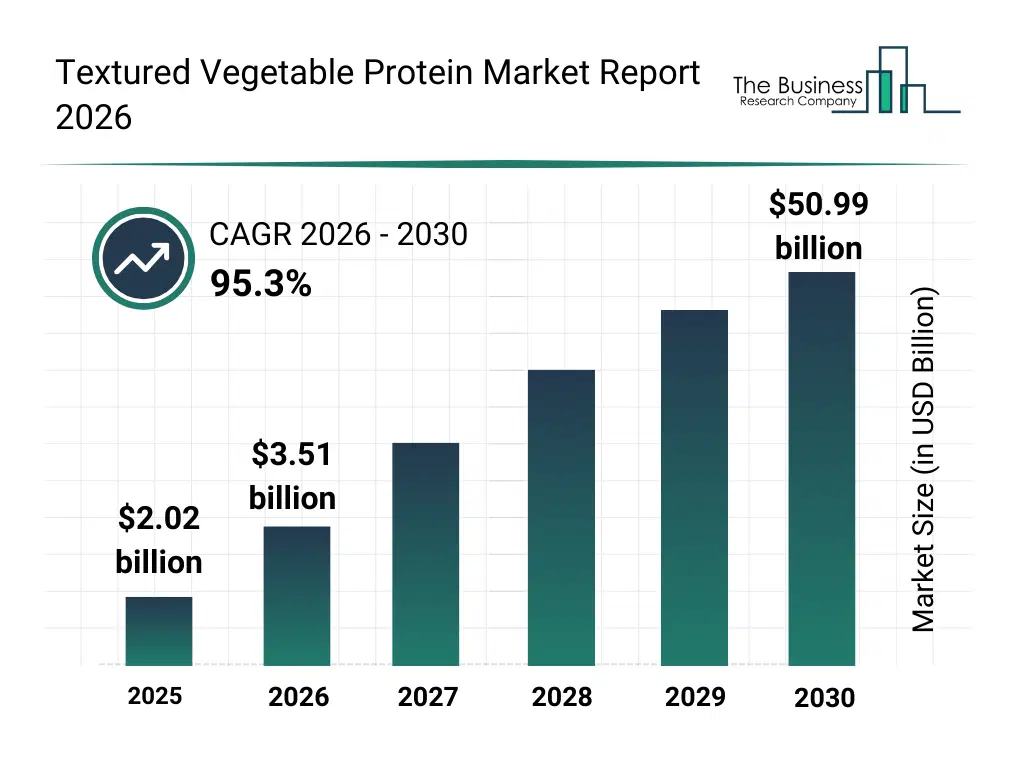
What Is The Textured Vegetable Protein Market Size and Share 2026?
The textured vegetable protein market size has grown strongly in recent years. It will grow from $2.03 billion in 2025 to $2.16 billion in 2026 at a compound annual growth rate (CAGR) of 6.2%. The growth in the historic period can be attributed to rising consumer demand for meat substitutes, expansion of soy processing infrastructure, growth of processed food consumption, increased availability of plant protein sources, cost advantages over animal protein.What Is The Textured Vegetable Protein Market Growth Forecast?
The textured vegetable protein market size is expected to see strong growth in the next few years. It will grow to $2.69 billion in 2030 at a compound annual growth rate (CAGR) of 5.7%. The growth in the forecast period can be attributed to increasing shift toward plant-based diets, rising investments in alternative protein innovation, expansion of food service plant-based offerings, growing focus on clean-label protein ingredients, increasing demand for sustainable food production. Major trends in the forecast period include increasing adoption of plant-based meat alternatives, rising demand for high-protein functional ingredients, growing use of textured proteins in ready-to-eat foods, expansion of organic textured protein products, enhanced focus on texture and mouthfeel optimization.
Global Textured Vegetable Protein Market Segmentation
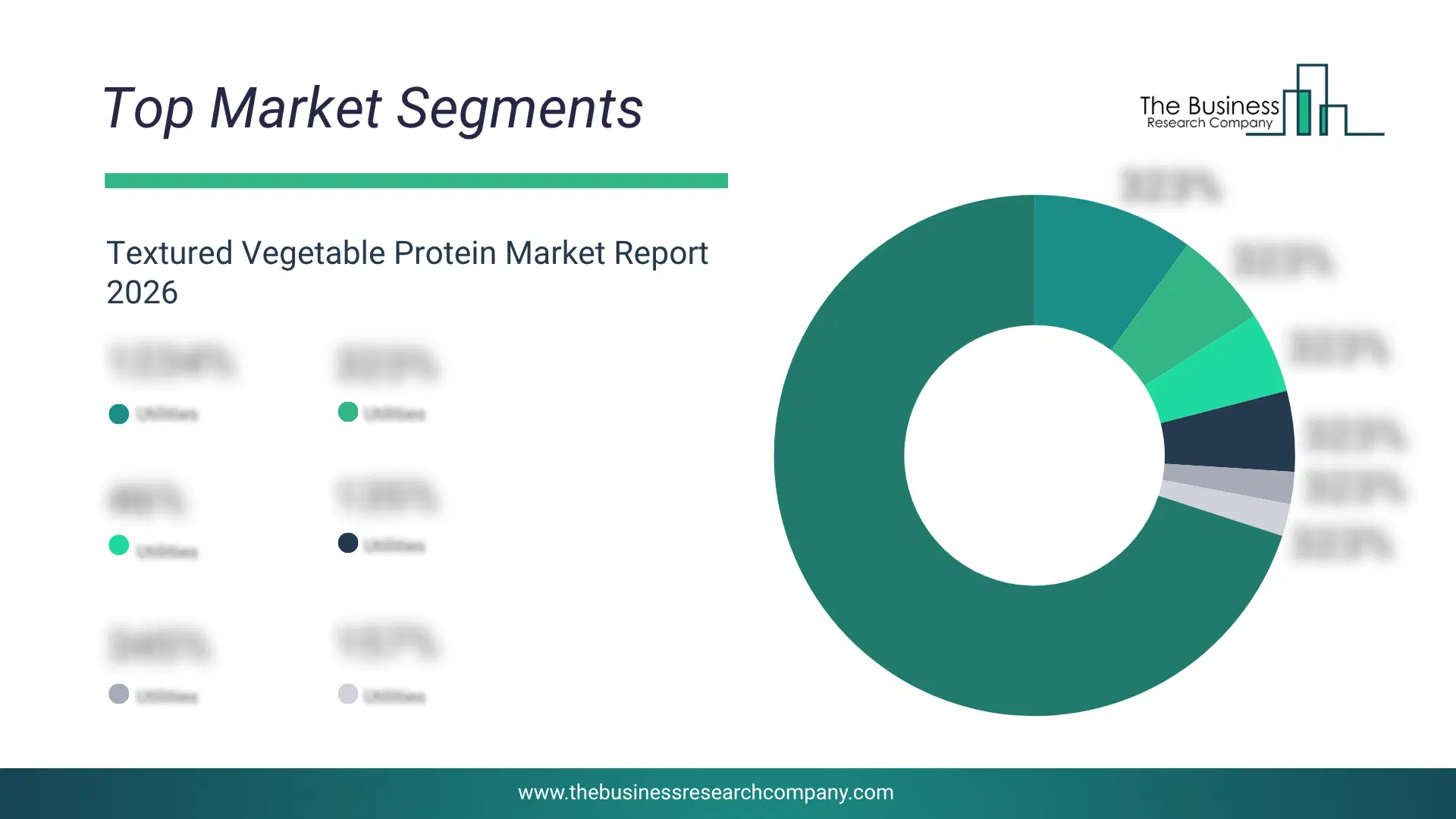
2) By Nature: Organic, Conventional 3) By Application: Food Products, Animal Nutrition Or Pet Food Subsegments: 1) By Textured Soy Protein: Soy Protein Isolate, Soy Protein Concentrate, Soy Protein Nuggets 2) By Textured Wheat Protein: Vital Wheat Gluten, Wheat Protein Isolate, Wheat Protein Concentrate 3) By Textured Pea Protein: Pea Protein Isolate, Pea Protein Concentrate, Textured Pea Protein ProductsWhat Is The Driver Of The Textured Vegetable Protein Market?
The rise in the vegan population is expected to propel the growth of the textured vegetable protein market going forward. The vegan population refers to individuals who embrace a vegan lifestyle, characterized by the avoidance of both animal products and by-products in their diet and daily choices. Textured vegetable protein plays a crucial role in the diets of the vegan population as a versatile and protein-rich meat substitute, providing a sustainable and plant-based alternative for meeting nutritional needs. For instance, in April 2024 according to Finder, a US-based personal finance comparison site, in 2024, approximately 2.5 million individuals in the UK are vegan, making up 4.7% of the population, up from 1.4 million vegans (2.5%) in 2023. This indicates a rise of 1.1 million vegans in the UK between 2023 and 2024. Therefore, the rise in the vegan population is driving the growth of the textured vegetable protein industry.Key Players In The Global Textured Vegetable Protein Market
Major companies operating in the textured vegetable protein market are Archer Daniels Midland Company, Cargill Incorporated, Roquette Freres SA, Shandong Yuxin Biotechnology Co. Ltd, Axiom Foods Inc., Kansas Protein Foods LLC, Crown Soya Protein Group, Wilmar International Ltd, Fuji Oil Co. Ltd, Vestkron A/S, Ingredion Inc, Beneo GmbH, Cosucra Groupe Warcoing SA, Devansoy Inc., Emsland Group, Gushen Biological Technology Group Co. Ltd., Kerry Group PLC, MGP Ingredients Inc., Nutri Pea Ltd., Puris Proteins LLC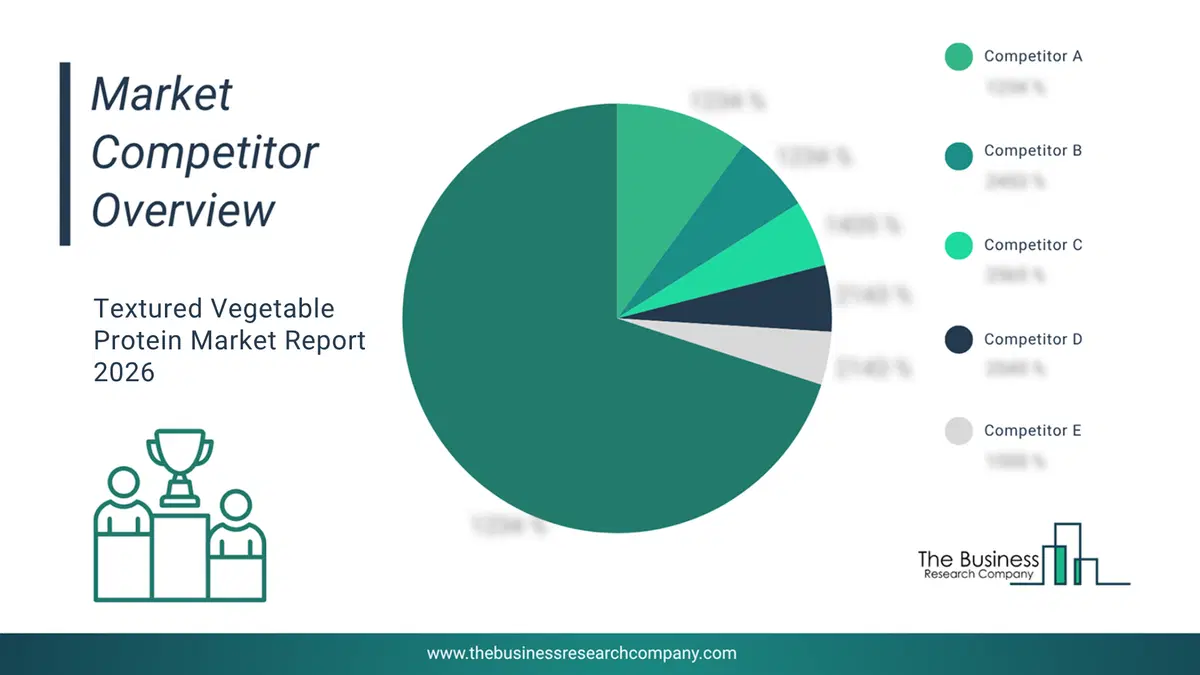
This chart is for illustrative purposes; the full report includes a detailed competitor analysis and comprehensive overview of the top 10 companies in the market.
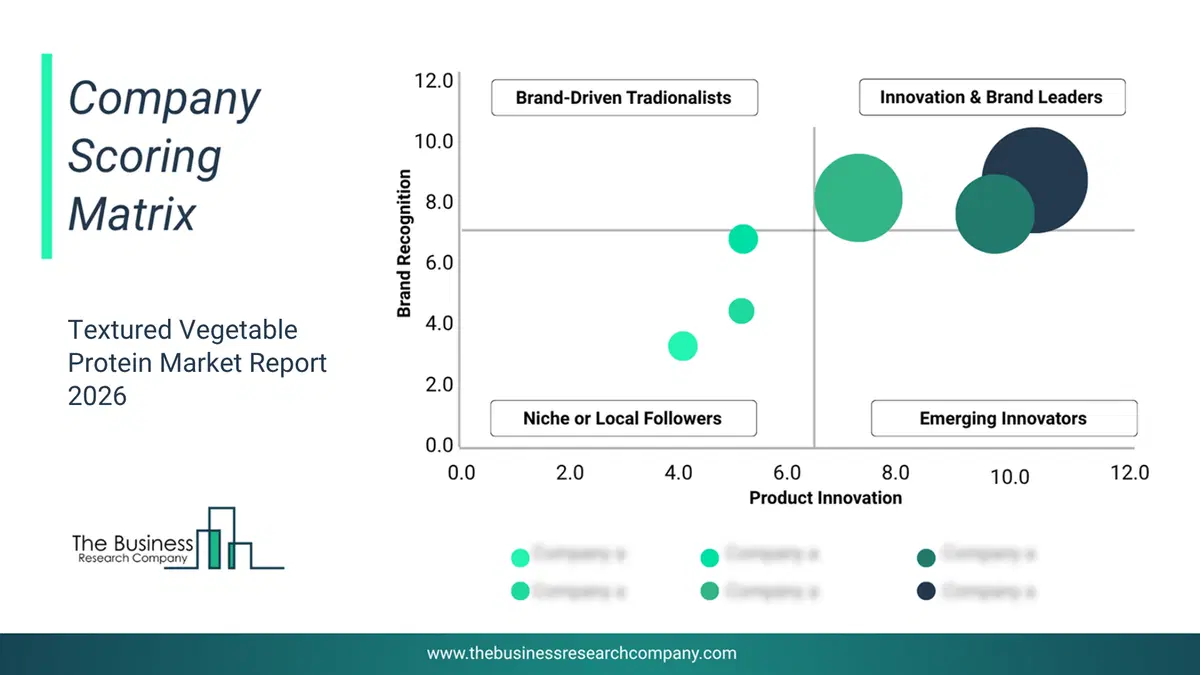
This chart maps companies by product innovation and brand strength, with bubble size indicating relative revenue, helping identify market leaders, challengers, and niche players. This is an illustrative chart; the full report provides a complete and accurate competitive analysis.
Global Textured Vegetable Protein Market Trends and Insights
Major companies operating in the textured vegetable protein market are focusing on developing innovative products such as clean-label TVP ingredients to improve sustainability, simplify processing, and enhance functional performance in plant-based and hybrid food applications. A clean-label TVP ingredient is a naturally processed textured protein created without chemical extraction, offering improved flavor neutrality, adaptability, and usability in diverse food formulations. For instance, in December 2025, Happy Plant Protein, a Finland-based food technology company specializing in plant protein innovation, announced its faba bean TVP. The ingredient is produced through a patented dry extrusion process that eliminates chemical extraction, cuts water and energy use, and reduces bitterness and beany off-notes commonly found in legume proteins. Its adaptable structure and compatibility with various flours allow manufacturers to achieve customizable textures while supporting regional sourcing and lowering production complexity.What Are Latest Mergers And Acquisitions In The Textured Vegetable Protein Market?
In February 2024, Cargill, a US-based global food corporation, expanded its partnership with Enough, a sustainable protein company, through a commercial agreement to utilize and market Enough's Abunda protein. This extended partnership aims to co-create nutritious and sustainable alternative meat and dairy products by leveraging Cargill's expertise in plant-based proteins, texturizers, fats, and its formulations and applications capabilities. Enough is a UK-based food technology company specializing in sustainable protein solutions.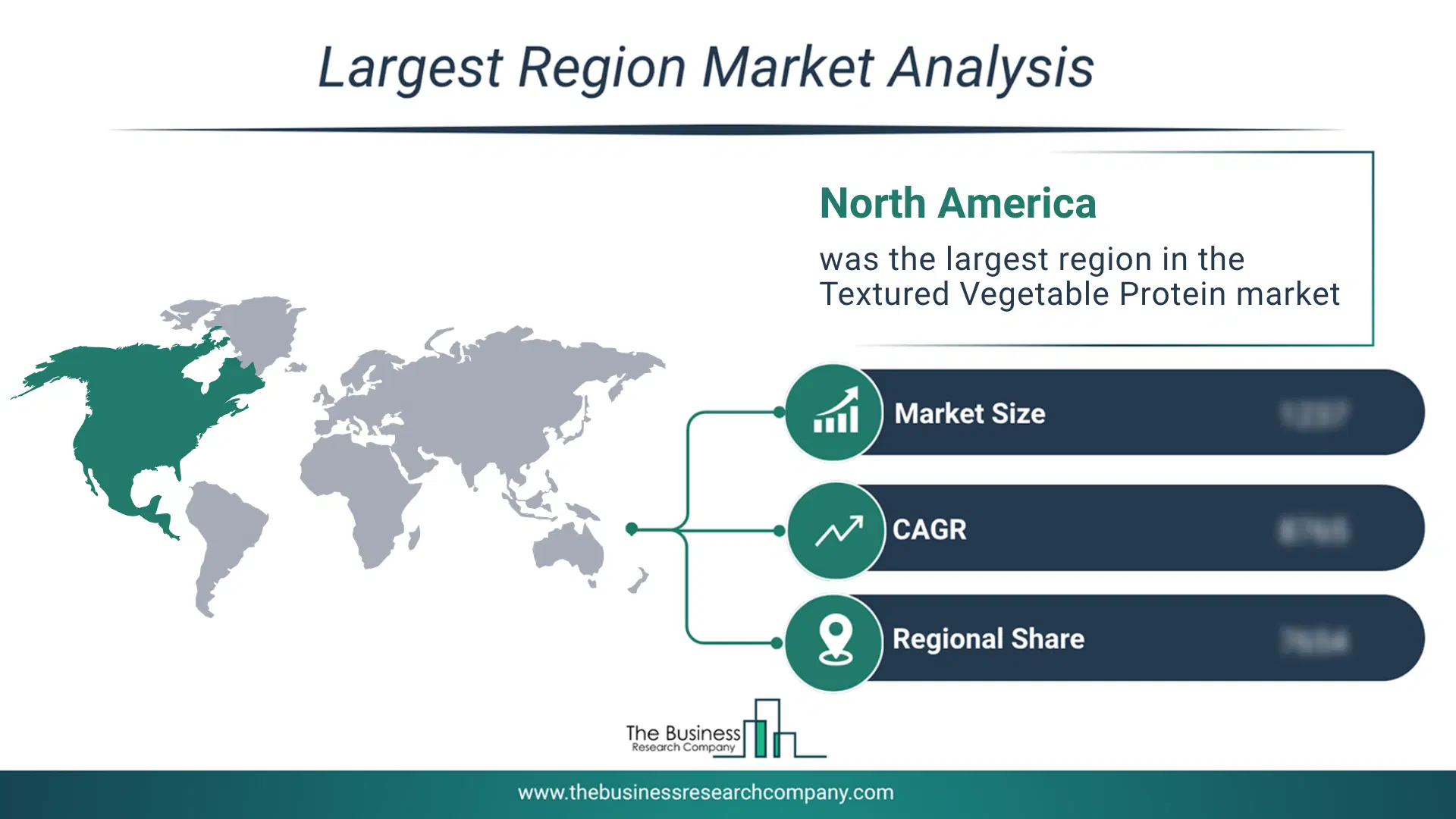
Regional Outlook
North America was the largest region in the textured vegetable protein market in 2025. The regions covered in this market report are Asia-Pacific, South East Asia, Western Europe, Eastern Europe, North America, South America, Middle East, Africa. The countries covered in this market report are Australia, Brazil, China, France, Germany, India, Indonesia, Japan, Taiwan, Russia, South Korea, UK, USA, Canada, Italy, Spain.What Defines the Textured Vegetable Protein Market?
The textured vegetable protein market consists of sales of chunks, flakes, slices and granules. Values in this market are 'factory gate' values, that is the value of goods sold by the manufacturers or creators of the goods, whether to other entities (including downstream manufacturers, wholesalers, distributors and retailers) or directly to end customers. The value of goods in this market includes related services sold by the creators of the goods.How is Market Value Defined and Measured?
The market value is defined as the revenues that enterprises gain from the sale of goods and/or services within the specified market and geography through sales, grants, or donations in terms of the currency (in USD unless otherwise specified). The revenues for a specified geography are consumption values that are revenues generated by organizations in the specified geography within the market, irrespective of where they are produced. It does not include revenues from resales along the supply chain, either further along the supply chain or as part of other products.
This chart presents market attractiveness based on a quantitative evaluation of growth, competition, strategic alignment, and risk, offering a clear view of opportunity areas for decision-making. This chart is for illustrative purposes; the full report contains the complete analysis.

This chart highlights the Total Addressable Market (TAM) by estimating the maximum revenue opportunity using an assumption-driven approach, supporting strategic planning and opportunity sizing across markets. The chart is illustrative; the full report provides a more comprehensive analysis.
What Key Data and Analysis Are Included in the Textured Vegetable Protein Market Report 2026?
The textured vegetable protein market research report is one of a series of new reports from The Business Research Company that provides market statistics, including industry global market size, regional shares, competitors with the market share, detailed market segments, market trends and opportunities, and any further data you may need to thrive in the textured vegetable protein industry. The market research report delivers a complete perspective of everything you need, with an in-depth analysis of the current and future state of the industry.Textured Vegetable Protein Market Report Forecast Analysis
| Report Attribute | Details |
|---|---|
| Market Size Value In 2026 | $2.16 billion |
| Revenue Forecast In 2030 | $2.69 billion |
| Growth Rate | CAGR of 5.7% from 2026 to 2030 |
| Base Year For Estimation | 2025 |
| Actual Estimates/Historical Data | 2020-2025 |
| Forecast Period | 2026 - 2030 |
| Market Representation | Revenue in USD Billion and CAGR from 2026 to 2030 |
| Segments Covered | Product Type, Nature, Application |
| Regional Scope | Asia-Pacific, Western Europe, Eastern Europe, North America, South America, Middle East, Africa |
| Country Scope | The countries covered in the report are Australia, Brazil, China, France, Germany, India, Indonesia, Japan, Taiwan, Russia, South Korea, UK, USA, Canada, Italy, Spain. |
| Key Companies Profiled | Archer Daniels Midland Company, Cargill Incorporated, Roquette Freres SA, Shandong Yuxin Biotechnology Co. Ltd, Axiom Foods Inc., Kansas Protein Foods LLC, Crown Soya Protein Group, Wilmar International Ltd, Fuji Oil Co. Ltd, Vestkron A/S, Ingredion Inc, Beneo GmbH, Cosucra Groupe Warcoing SA, Devansoy Inc., Emsland Group, Gushen Biological Technology Group Co. Ltd., Kerry Group PLC, MGP Ingredients Inc., Nutri Pea Ltd., Puris Proteins LLC |
| Customization Scope | Request for Customization |
| Pricing And Purchase Options | Explore Purchase Options |