
Maritime Simulators Market Report 2026
Global Outlook – By Type (Ship Bridge Simulators, Engine Room Simulators, Cargo Handling Simulators, Communication Or Global Maritime Distress And Safety System (GMDSS) Simulators, Remotely Operated Vehicle Simulators), By Component (Hardware, Software, Services), By Application (Maritime Schools, Training Centers, Shipping Companies, Port Authorities, Oil And Gas Companies, Governmental Authorities, Navies And Coast Guards, Other Applications), By End User (Civilian And Commercial, Military And Defense) – Market Size, Trends, Strategies, and Forecast to 2030
Maritime Simulators Market Overview
• Maritime Simulators market size has reached to $1.78 billion in 2025 • Expected to grow to $2.42 billion in 2030 at a compound annual growth rate (CAGR) of 6.2% • Growth Driver: Rising Focus On Maritime Safety Fueling The Growth Of The Market Due To Accident Prevention And Regulatory Compliance • Market Trend: Enhancing Maritime Performance Advanced Simulation And Real-Time Adjustments For Operational Excellence • North America was the largest region in 2025 and Asia-Pacific is the fastest growing region.Market Gains By 2030 – Top Opportunities By Segment
Market Gain identifies the most promising market opportunities by highlighting the segments or products expected to generate the highest incremental revenue growth over the next five years.
What Is Covered Under Maritime Simulators Market?
Maritime simulators are sophisticated technologies designed to simulate various aspects of maritime operations, such as navigation, ship handling, and emergency response, providing a realistic, interactive environment for training and skill development, ultimately improving safety, efficiency, and performance in the global maritime industry. The main types of maritime simulators include ship bridge simulators, engine room simulators, cargo handling simulators, communication or global maritime distress and safety system (GMDSS) simulators, and remotely operated vehicle simulators. Ship bridge simulators replicate the navigation and control environment of a ship’s bridge, incorporating systems like radar, communication tools, and engine controls to provide a comprehensive training environment for maritime professionals to practice ship handling and decision-making in realistic maritime conditions. The components are categorized into hardware, software, and services used in applications such as maritime schools, training centers, shipping companies, port authorities, oil and gas companies, governmental authorities, navies and coast guards, and others and end users, including civilian, commercial, military, and defense.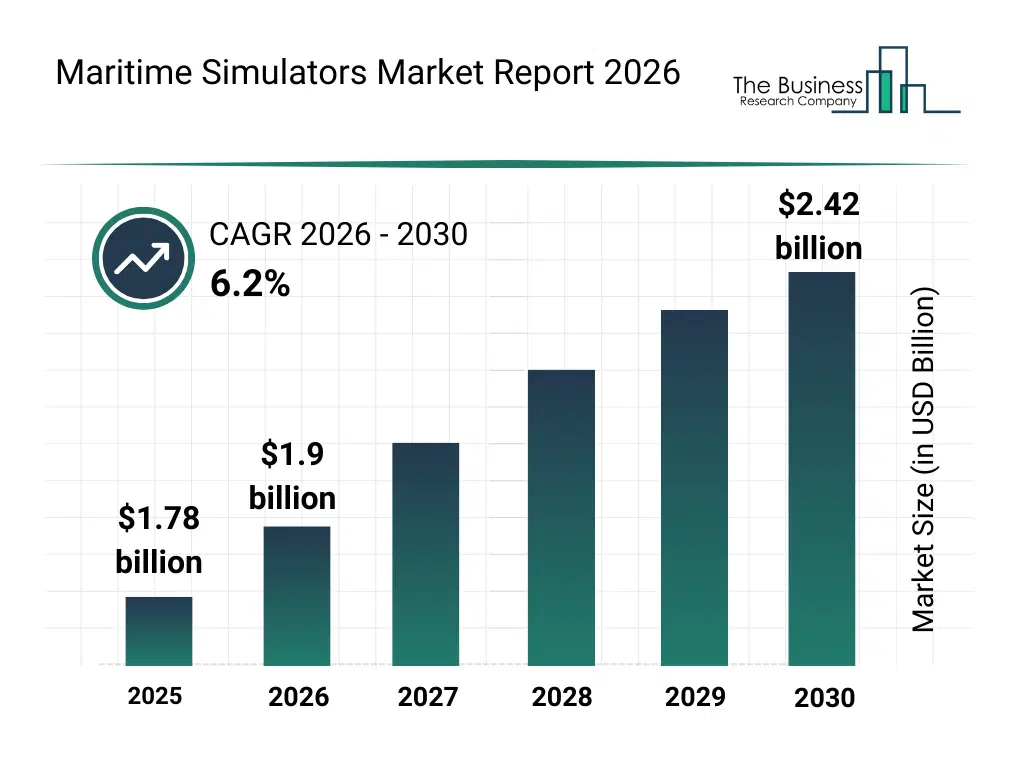
What Is The Maritime Simulators Market Size and Share 2026?
The maritime simulators market size has grown strongly in recent years. It will grow from $1.78 billion in 2025 to $1.9 billion in 2026 at a compound annual growth rate (CAGR) of 6.7%. The growth in the historic period can be attributed to increasing global maritime traffic and demand for skilled personnel, regulatory mandates for maritime safety and crew certification, advancements in simulation technologies such as high-fidelity visual and motion systems, rising adoption of virtual reality (VR) and augmented reality (AR) in maritime training, growing investment by shipping companies and maritime academies in crew training infrastructure.What Is The Maritime Simulators Market Growth Forecast?
The maritime simulators market size is expected to see strong growth in the next few years. It will grow to $2.42 billion in 2030 at a compound annual growth rate (CAGR) of 6.2%. The growth in the forecast period can be attributed to expansion of autonomous and smart ship technologies driving simulator requirements, integration of artificial intelligence (AI) and machine learning for predictive training, rising emphasis on environmental compliance and emission reduction in maritime operations, increasing demand for remote and cloud-based maritime simulation solutions, growth in emerging markets with expanding maritime trade and training infrastructure. Major trends in the forecast period include integration of vr and ar for immersive maritime training, growth in cloud-based simulator platforms for remote access, customization of simulators for specific vessel types and operations, increased adoption of simulation-based certification and compliance programs, expansion of maritime simulator training for offshore oil & gas and rov operations.
Global Maritime Simulators Market Segmentation
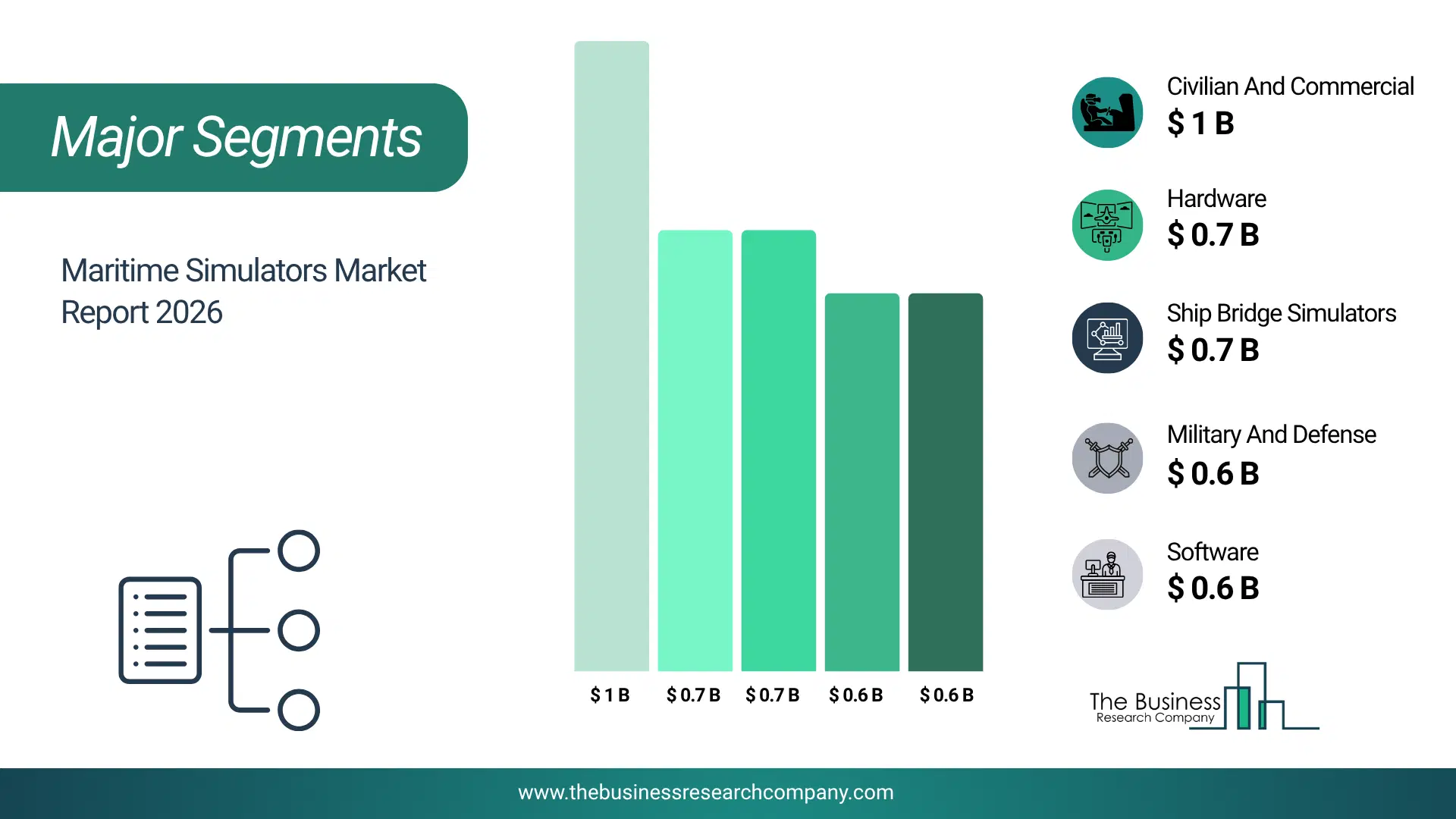
1) By Type: Ship Bridge Simulators, Engine Room Simulators, Cargo Handling Simulators, Communication Or Global Maritime Distress And Safety System (GMDSS) Simulators, Remotely Operated Vehicle Simulators 2) By Component: Hardware, Software, Services 3) By Application: Maritime Schools, Training Centers, Shipping Companies, Port Authorities, Oil And Gas Companies, Governmental Authorities, Navies And Coast Guards, Other Applications 4) By End User: Civilian And Commercial, Military And Defense Subsegments: 1) By Ship Bridge Simulators: Full Mission Bridge Simulators, Part Task Bridge Simulators, Desktop Bridge Simulators, Tugboat Bridge Simulators, Naval Bridge Simulators 2) By Engine Room Simulators: Full Mission Engine Room Simulators, Operational Engine Room Simulators, Desktop Engine Room Simulators, Auxiliary Systems Simulators, Emergency Response Engine Simulators 3) By Cargo Handling Simulators: Liquid Cargo Handling Simulators, Dry Bulk Cargo Handling Simulators, Container Terminal Operations Simulators, Refrigerated Cargo Handling Simulators, Hazardous Material (HAZMAT) Cargo Simulators 4) By Communication Or Global Maritime Distress And Safety System (GMDSS) Simulators: Basic GMDSS Simulators, Advanced GMDSS Simulators, Coast Station GMDSS Simulators, SAR (Search And Rescue) Communication Simulators, Emergency Radio Communication Simulators 5) By Remotely Operated Vehicle (ROV) Simulators: Observation-Class ROV Simulators, Work-Class ROV Simulators, Autonomous Underwater Vehicle (AUV) Simulators, Deep-Sea Exploration ROV Simulators, Offshore Oil And Gas ROV Simulators The top segments in the maritime simulators market will be: • Civilian And Commercial will reach $1089.64 Million by 2025. • Hardware will reach $764.44 Million by 2025. • Ship Bridge Simulators will reach $702.29 Million by 2025. • Military And Defense will reach $690.36 Million by 2025. • Software will reach $639.4 Million by 2025.What Is Driver Of The Maritime Simulators Market?
The increasing focus on maritime safety is expected to propel the growth of the maritime simulators market going forward. The increasing focus on maritime safety is driven by the need to minimize accidents, protect lives, prevent environmental disasters, and comply with stringent international safety regulations. Maritime accidents can result in significant financial and environmental damage. Simulators enable risk-free training for emergency scenarios, improving crew preparedness and reducing the likelihood of human error. For instance, in 2023, the Seamen’s Church Institute (SCI), a US-based nonprofit organization, provides maritime education, legal advocacy, and welfare services to support the safety, training, and well-being of seafarers worldwide, reported a 13% increase in mariner training activities compared to the previous year, highlighting the growing emphasis on safety and skill development. Therefore, increasing focus on maritime safety is driving growth in the maritime simulators industry.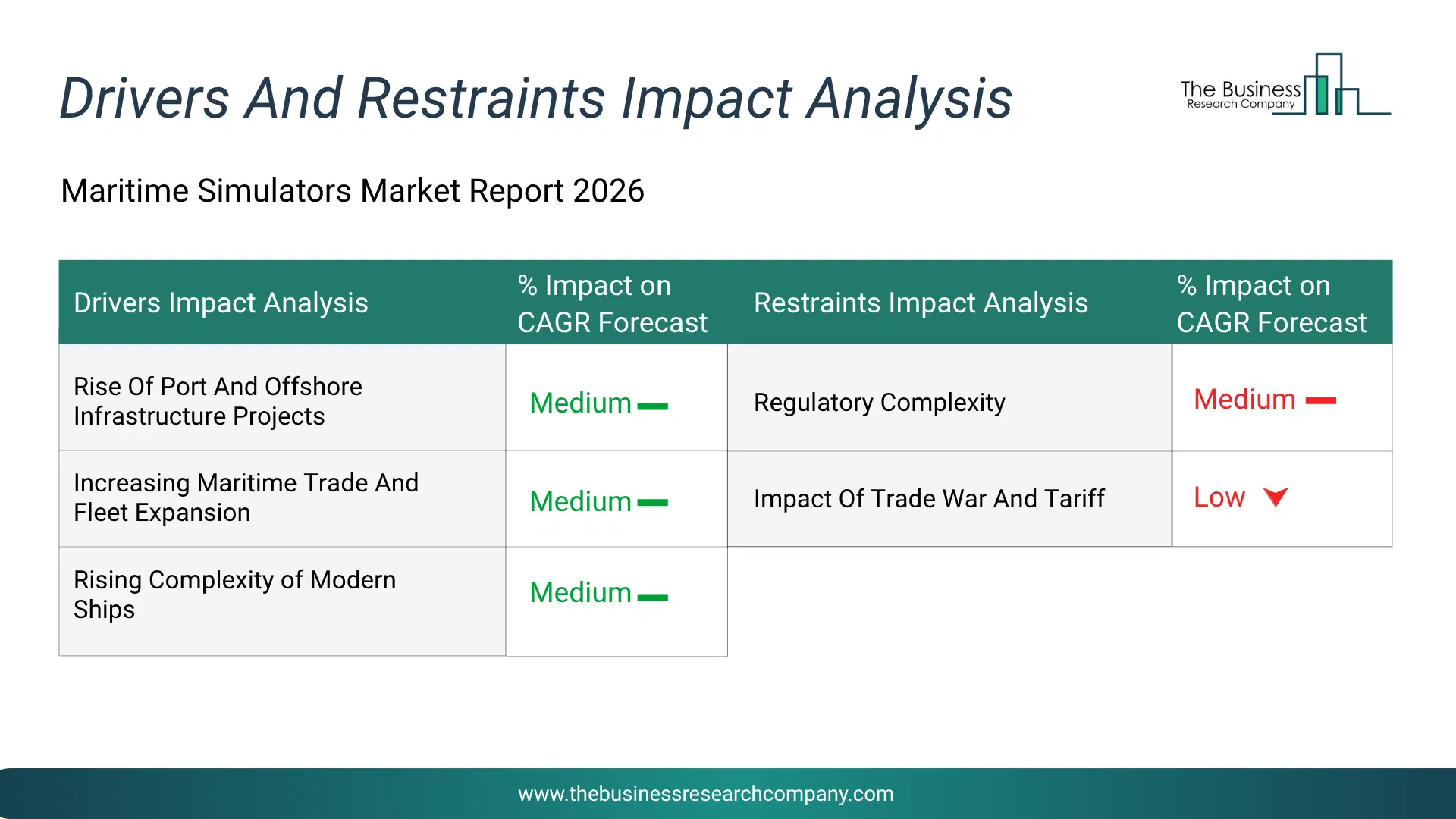
Infographic Chart Showing Key Market Drivers Analysis And Restraints For Maritime Simulators Market
The chart presents an impact analysis of key drivers and restraints, quantifying their relative influence on the market's growth rate and helping assess the balance between growth enablers and limiting factors. This chart offers a high-level perspective; the full report contains more detailed insights.
How Will The Drivers Impact Growth In The Global Maritime Simulators Market?
• Rise Of Port And Offshore Infrastructure Projects (Medium) – The rise of port and offshore infrastructure projects will become a key driver of growth in the maritime simulators market by 2030. As investments increase in port expansions, new terminals, and offshore facilities like oil rigs, wind farms, and LNG terminals, the demand for highly skilled operators to manage these complex environments safely and efficiently rises accordingly. Specialized training is essential due to the operational challenges and risks associated with navigating congested waters, managing heavy cargo, and responding to emergencies in these settings. Maritime simulators offer a controlled, realistic platform for crews to develop these critical skills without risking vessels or infrastructure. As a result, the rise of port and offshore infrastructure projects is anticipated to contributing to a 1.8% annual growth in the market. • Increasing Maritime Trade And Fleet Expansion (Medium) – The increasing maritime trade and fleet expansion will emerge as a major factor driving the expansion of the maritime simulators market by 2030. As international trade intensifies, the construction and deployment of new vessels accelerate to meet cargo transport needs worldwide. This fleet growth necessitates a larger pool of skilled seafarers capable of safely and efficiently managing complex operations. Simulator-based training offers a realistic, risk-free environment that enhances crew preparedness, safety, and operational performance. Additionally, stricter regulatory requirements make simulator training essential for certification and compliance. This combination of market expansion, safety priorities, and regulations is fueling strong growth in the maritime simulators market. Consequently, the increasing maritime trade and fleet expansion is projected to contributing to a 1.3% annual growth in the market. • Rising Complexity of Modern Ships (Medium) – The rising complexity of modern ships within digital manufacturing processes will serve as a key growth catalyst for the maritime simulators market by 2030. The increasing complexity of modern ships, featuring advanced systems like integrated bridges, automated propulsion, and digital navigation. Operating these complex systems requires specialized expertise, prompting maritime organizations to invest in high-fidelity simulators that provide safe, immersive environments for skill development. Maritime simulators provide a safe, efficient solution for developing these skills while minimizing operational risk. They enable scenario-based training for emergencies and reduce reliance on onboard instruction, lowering costs and downtime. With global operations and dispersed crews, cloud-based and (virtual reality) VR-enabled simulators offer flexible, standardized training across locations, driving their growing adoption in the maritime sector. Therefore, this rising complexity of modern ships is projected to supporting to a 1.1% annual growth in the market. • Growth In Naval Defense Budgets (Low) – The growth in naval defense budgets will become a significant driver contributing to the growth of the maritime simulators market by 2030. As nations boost their defense expenditure to modernize and expand naval capabilities, the demand for advanced training solutions to prepare personnel for complex maritime operations intensifies. Maritime simulators offer realistic, cost-effective environments to train crews in navigation, tactical maneuvers, and combat scenarios, eliminating the risks of live exercises. Modern naval vessels incorporate sophisticated technologies and weaponry that require highly skilled operators. Simulator-based training allows naval forces to practice handling these complex systems safely, enhancing operational readiness. Increased defense funding enables investment in state-of-the-art simulators that replicate real-world conditions, improving training effectiveness. Consequently, the growth in naval defense budgets is projected to contributing to a 0.8% annual growth in the market.How Will The Restraints Impact Growth In The Global Maritime Simulators Market?
• Shortage Of Skilled Trainers (Medium) – Shortage Of Skilled Trainers will restrict the growth of the Maritime Simulators market during the forecast period. Maritime simulator training requires qualified instructors with maritime experience and teaching skills. The shortage of skilled trainers limits the capacity of maritime training institutions to conduct simulator-based courses. Trainer shortages can affect training quality and limit the utilization of simulator equipment, impacting market growth. • Regulatory Complexity (Medium) – Regulatory Complexity will restrict the growth of the Maritime Simulators market during the forecast period. Maritime training requirements and certification standards vary across different flag states and regulatory bodies. Regulatory complexity creates challenges for simulator manufacturers and training institutions in developing compliant solutions. Changing regulations can affect training curricula and simulator design, impacting market growth. • Impact Of Trade War And Tariff (Low) – Impact Of Trade War And Tariff will restrict the growth of the Maritime Simulators market during the forecast period. Maritime simulators rely on imported electronic components, software, and specialized hardware. Trade tariffs and restrictions can increase production costs and affect product availability. Trade barriers may also impact maritime trade and shipping activities, affecting demand for simulator training.Key Players In The Global Maritime Simulators Market
Major companies operating in the maritime simulators market are Lockheed Martin Corporation, BAE Systems Plc, Thales Group, L3 Harris Technology, Rheinmetall AG, Wartsila Oyj Abp, General Dynamics Information Technology Inc., Kongsberg Maritime AS (KM), CAE Inc., FORCE Technology, Furuno Electric Co. Ltd., RH Marine Group, STORM SIM GEO LLC, GSE Systems, Applied Research International Simulation, Virtual Marine Technology Incorporated, Poseidon Simulation, Cruden, PC Maritime, Marine Learning Systems, Oceanus Marine Solutions, VSTEP Simulation, Imagesoft Pty Ltd.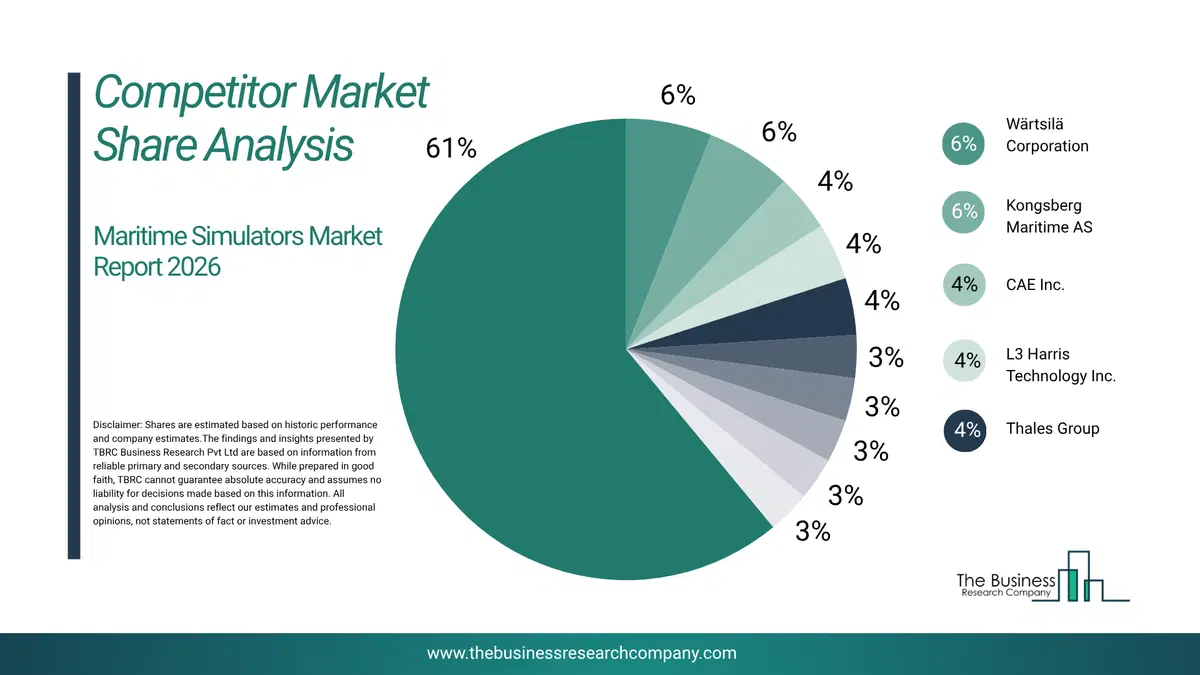
This chart is for illustrative purposes; the full report includes a detailed competitor analysis and comprehensive overview of the top 10 companies in the market.
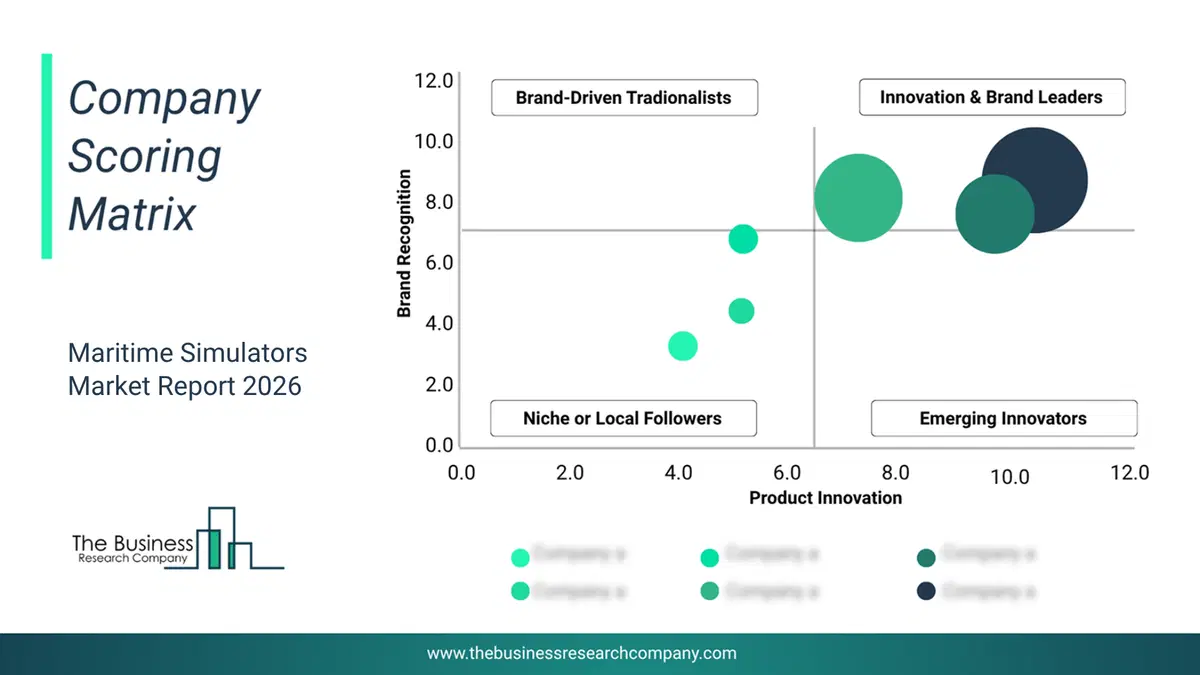
This chart maps companies by product innovation and brand strength, with bubble size indicating relative revenue, helping identify market leaders, challengers, and niche players. This is an illustrative chart; the full report provides a complete and accurate competitive analysis.
Global Maritime Simulators Market Trends and Insights
Major companies operating in the maritime simulators market are focusing on realistic ship handling simulation platforms, such as real-time, voyage-specific optimization, to provide maritime professionals with state-of-the-art training solutions that improve decision-making and operational performance. Real-time, voyage-specific optimization refers to the dynamic adjustment of operational settings during a voyage based on real-time data, such as weather, cargo conditions, and route changes, to enhance efficiency and performance. For instance, in August 2024, Danelec Electronics A/S, a Denmark-based maritime technology company, launched a simulation tool designed to enhance collaboration between LNG carrier commercial and operations teams. The platform addresses challenges such as balancing charter party requirements, cargo conditions, and efficient voyage planning amid weather and route complexities. It simulates vessel performance, optimizing operational settings for routes, cargo, and forecasted conditions, enabling real-time adjustments to improve efficiency. Operators can save over 100 MT of LNG per voyage, translating to $360k annually per vessel. Additionally, it ensures accurate performance tracking, early issue detection, and compliance with charter agreements.What Are Latest Mergers And Acquisitions In The Maritime Simulators Market? Danelec Electronics Acquires Nautilus Labs To Enhance Maritime Technology And Sustainability Solutions
In November 2023, Danelec Electronics A/S, a Denmark-based maritime technology company, acquired Nautilus Labs Inc. for an undisclosed amount. Through this acquisition, Danelec aims to enhance its capabilities by leveraging Nautilus Labs’ AI-driven platform for vessel optimization, fleet performance monitoring, and digital transformation, advancing maritime safety, efficiency, and sustainability. Nautilus Labs Inc. is a US-based maritime technology company that specializes in maritime simulators, sustainability, and safety in the ocean supply chain.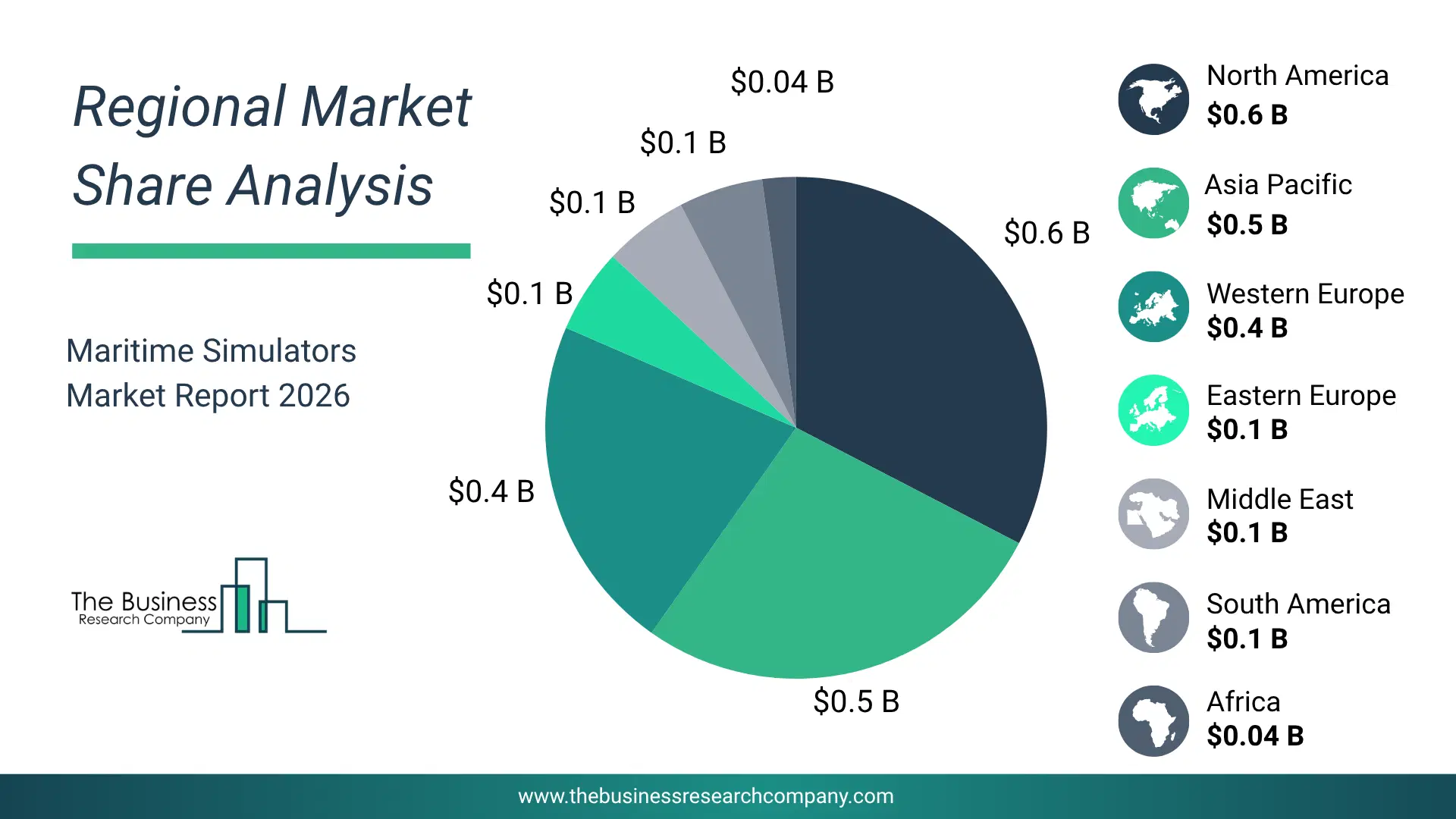
Regional Insights
North America was the largest region in the maritime simulators market in 2025. Asia-Pacific is expected to be the fastest-growing region in the forecast period. The regions covered in this market report are Asia-Pacific, South East Asia, Western Europe, Eastern Europe, North America, South America, Middle East, Africa. The countries covered in this market report are Australia, Brazil, China, France, Germany, India, Indonesia, Japan, Taiwan, Russia, South Korea, UK, USA, Canada, Italy, SpainWhat Defines the Maritime Simulators Market?
The maritime simulators market consists of revenues earned by entities by providing services such as training and certification services, customization and integration services, maintenance and support services, and consultation and development services. The market value includes the value of related goods sold by the service provider or included within the service offering. The maritime simulators market also includes sales of simulation stations, visual displays, motion platforms, sound systems, sensors & controls, virtual reality (VR), and augmented reality (AR) devices. Values in this market are ‘factory gate’ values, that is, the value of goods sold by the manufacturers or creators of the goods, whether to other entities (including downstream manufacturers, wholesalers, distributors, and retailers) or directly to end customers. The value of goods in this market includes related services sold by the creators of the goods.How is Market Value Defined and Measured?
The market value is defined as the revenues that enterprises gain from the sale of goods and/or services within the specified market and geography through sales, grants, or donations in terms of the currency (in USD unless otherwise specified). The revenues for a specified geography are consumption values that are revenues generated by organizations in the specified geography within the market, irrespective of where they are produced. It does not include revenues from resales along the supply chain, either further along the supply chain or as part of other products.
This chart presents market attractiveness based on a quantitative evaluation of growth, competition, strategic alignment, and risk, offering a clear view of opportunity areas for decision-making. This chart is for illustrative purposes; the full report contains the complete analysis.

This chart highlights the Total Addressable Market (TAM) by estimating the maximum revenue opportunity using an assumption-driven approach, supporting strategic planning and opportunity sizing across markets. The chart is illustrative; the full report provides a more comprehensive analysis.
What Key Data and Analysis Are Included in the Maritime Simulators Market Report 2026?
The maritime simulators market research report is one of a series of new reports from The Business Research Company that provides market statistics, including industry global market size, regional shares, competitors with the market share, detailed market segments, market trends and opportunities, and any further data you may need to thrive in the maritime simulators industry. The market research report delivers a complete perspective of everything you need, with an in-depth analysis of the current and future state of the industry.Maritime Simulators Market Report Forecast Analysis
| Report Attribute | Details |
|---|---|
| Market Size Value In 2026 | $1.9 billion |
| Revenue Forecast In 2030 | $2.42 billion |
| Growth Rate | CAGR of 6.7% from 2026 to 2030 |
| Base Year For Estimation | 2025 |
| Actual Estimates/Historical Data | 2020-2025 |
| Forecast Period | 2026 - 2030 |
| Market Representation | Revenue in USD Billion and CAGR from 2026 to 2030 |
| Segments Covered | Type, Component, Application, End User |
| Regional Scope | Asia-Pacific, Western Europe, Eastern Europe, North America, South America, Middle East, Africa |
| Country Scope | The countries covered in the report are Australia, Brazil, China, France, Germany, India, Indonesia, Japan, Taiwan, Russia, South Korea, UK, USA, Canada, Italy, Spain. |
| Key Companies Profiled | Lockheed Martin Corporation, BAE Systems Plc, Thales Group, L3 Harris Technology, Rheinmetall AG, Wartsila Oyj Abp, General Dynamics Information Technology Inc., Kongsberg Maritime AS (KM), CAE Inc., FORCE Technology, Furuno Electric Co. Ltd., RH Marine Group, STORM SIM GEO LLC, GSE Systems, Applied Research International Simulation, Virtual Marine Technology Incorporated, Poseidon Simulation, Cruden, PC Maritime, Marine Learning Systems, Oceanus Marine Solutions, VSTEP Simulation, Imagesoft Pty Ltd. |
| Customization Scope | Request for Customization |
| Pricing And Purchase Options | Explore Purchase Options |