

Optical Wireless Backhaul Market Report 2026
Global Outlook – By Component (Transmitter, Receiver, Modulator, Demodulator, Other Components), By Transmission Type (Free Space Optics, Visible Light Communication, Infrared Communication, Other Transmission Types), By Deployment (Urban, Suburban, Rural), By Application (Telecommunications, Enterprise, Government, Defense, Other Applications) – Market Size, Trends, Strategies, and Forecast to 2030
Optical Wireless Backhaul Market Overview
• Optical Wireless Backhaul market size has reached to $1.33 billion in 2025 • Expected to grow to $3.13 billion in 2030 at a compound annual growth rate (CAGR) of 18.6% • Growth Driver: Growing Expansion Of 5G Networks Driving The Market Due To Increasing Demand For High-capacity, Low-latency Data Transmission • Market Trend: Adoption Of Ultra-Fast Optical Wireless Backhaul For High-Capacity Connectivity • North America was the largest region in 2025 and Asia-Pacific is the fastest growing region.What Is Covered Under Optical Wireless Backhaul Market?
Optical wireless backhaul refers to the use of optical wireless technologies, such as free-space optics, to transmit high-capacity data between network nodes. It provides fiber-like performance without the need for physical cables. This approach is ideal for rapid deployment in areas where laying fiber is costly or impractical. The main components of optical wireless backhaul include transmitters, receivers, modulators, demodulators, and others. Transmitters refer to devices that generate and send optical signals through wireless mediums such as free space, visible light, or infrared communication to establish high-capacity backhaul links. These systems support transmission types including free space optics, visible light communication, and infrared communication, and are deployed across urban, suburban, and rural environments. They are widely applied in telecommunications, enterprises, government, defense, and others.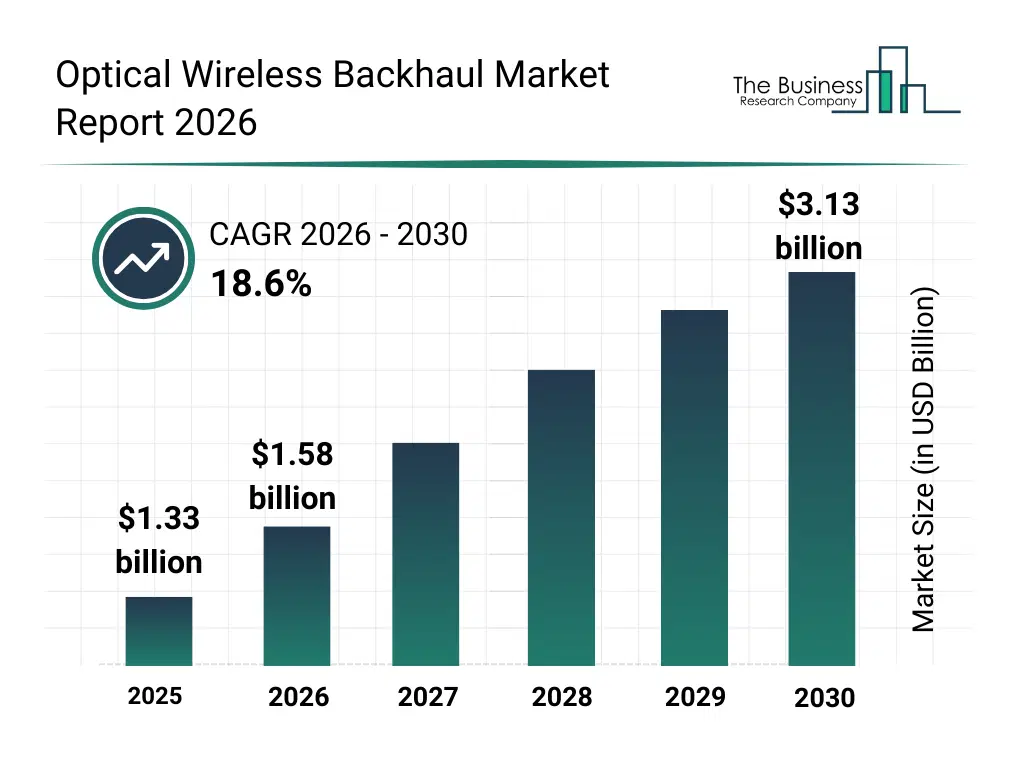
What Is The Optical Wireless Backhaul Market Size and Share 2026?
The optical wireless backhaul market size has grown rapidly in recent years. It will grow from $1.33 billion in 2025 to $1.58 billion in 2026 at a compound annual growth rate (CAGR) of 18.7%. The growth in the historic period can be attributed to limitations of fiber deployment in dense urban areas, growing mobile data traffic, need for rapid network rollout, high cost of trenching and right-of-way approvals, adoption of free-space optics for enterprise links.What Is The Optical Wireless Backhaul Market Growth Forecast?
The optical wireless backhaul market size is expected to see rapid growth in the next few years. It will grow to $3.13 billion in 2030 at a compound annual growth rate (CAGR) of 18.6%. The growth in the forecast period can be attributed to expansion of 5G and future 6g networks, increasing demand for ultra-high-capacity backhaul, growth of smart cities and connected infrastructure, deployment in rural and underserved regions, advancements in optical beam tracking technologies. Major trends in the forecast period include rapid fiber-like backhaul deployment, high-capacity line-of-sight connectivity, adaptive beam steering and alignment, weather-resilient optical wireless links, scalable last-mile backhaul solutions.
Global Optical Wireless Backhaul Market Segmentation
1) By Component: Transmitter, Receiver, Modulator, Demodulator, Other Components 2) By Transmission Type: Free Space Optics, Visible Light Communication, Infrared Communication, Other Transmission Types 3) By Deployment: Urban, Suburban, Rural 4) By Application: Telecommunications, Enterprise, Government, Defense, Other Applications Subsegments: 1) By Transmitter: Laser Diode, Light Emitting Diode (LED), Optical Amplifier, Beam Steering Unit 2) By Receiver: Photodiode, Optical Filter, Optical Amplifier, Signal Conditioning Circuit 3) By Modulator: Electro-Optic Modulator, Acousto-Optic Modulator, Mach–Zehnder Modulator, Phase Or Intensity Modulator 4) By Demodulator: Coherent Demodulator, Direct Detection Demodulator, Heterodyne Demodulator, Digital Signal Processing (DSP) Unit 5) By Other Components: Optical Fiber Patch Or Connector, Beam Alignment And Tracking System, Cooling And Thermal Management Unit, Power Supply And Control ElectronicsWhat Is The Driver Of The Optical Wireless Backhaul Market?
The growing expansion of 5G networks is expected to propel the growth of the optical wireless backhaul market going forward. 5G networks refer to the fifth generation of wireless cellular technology designed to deliver significantly faster data speeds, lower latency, and enhanced connectivity for a vast number of devices simultaneously. The expansion of 5G networks is rising primarily due to the rapid increase in mobile data consumption driven by widespread use of video streaming, cloud gaming, and mobile applications demanding higher speeds and bandwidth. Optical wireless backhaul supports this expansion by enabling high-capacity, low-latency data transmission, which is essential for meeting the dense and high-speed requirements of 5G networks. For instance, in September 2023, according to 5G Americas, a US-based industry trade organization, the 5G penetration rate in North America had reached 40%, with a growth rate of 25.5% in the first half of 2023. Projections indicate that North America's 5G connections will reach 669 million by 2028. Therefore, the growing expansion of 5G networks is expected to contribute to the growth of the optical wireless backhaul industry.Key Players In The Global Optical Wireless Backhaul Market
Major companies operating in the optical wireless backhaul market are Huawei Technologies Company Limited, Mitsubishi Electric Corporation, Fujitsu Limited, Telefonaktiebolaget LM Ericsson, NEC Corporation, ZTE Corporation, Aviat Networks Inc., Ceragon Networks Limited, Intracom Telecom Holdings S.A., Radwin Ltd., SIAE Microelettronica S.p.A., Cambium Networks Ltd., Skyloom Inc., Plaintree Systems Inc., CableFree Ltd., Mostcom Ltd., Transcelestial Pte. Ltd., Attochron Inc., Taara Corporation, KORUZA Ltd.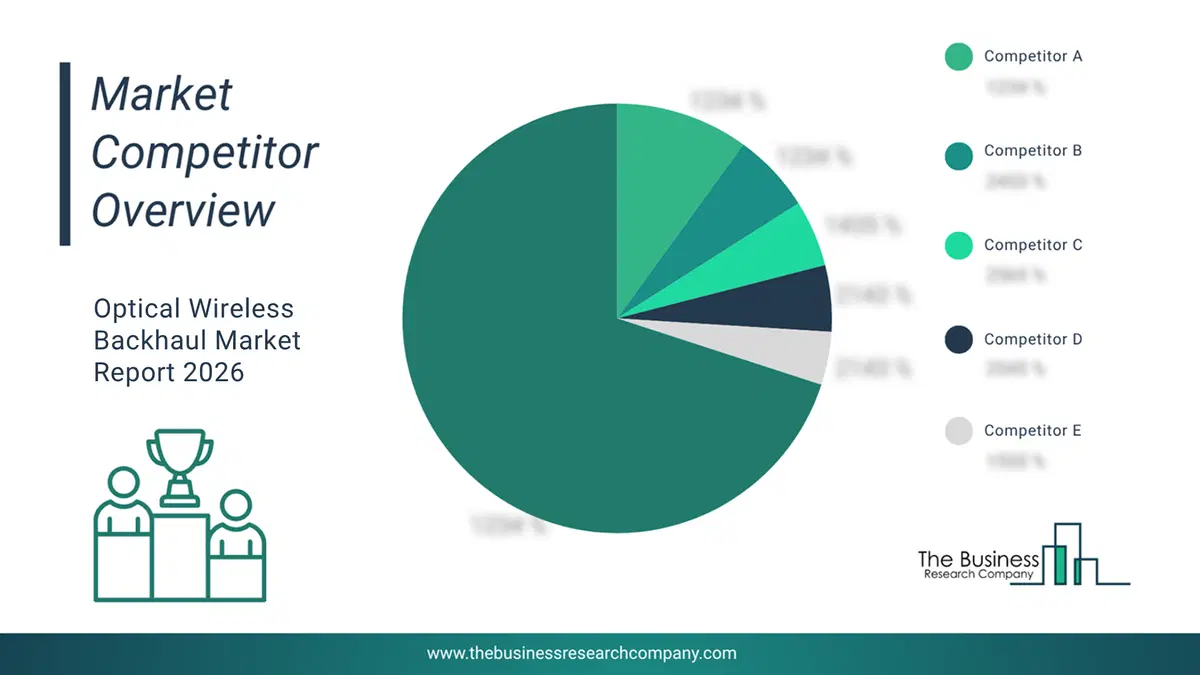
This chart is for illustrative purposes; the full report includes a detailed competitor analysis and comprehensive overview of the top 10 companies in the market.
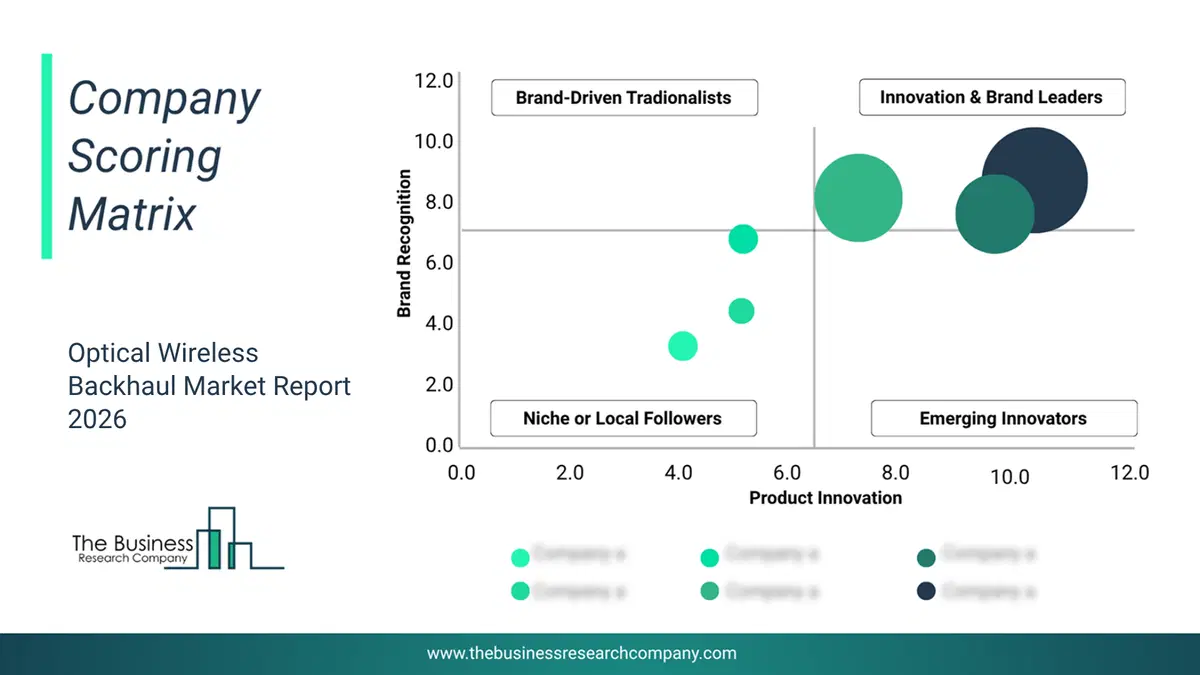
This chart maps companies by product innovation and brand strength, with bubble size indicating relative revenue, helping identify market leaders, challengers, and niche players. This is an illustrative chart; the full report provides a complete and accurate competitive analysis.
Global Optical Wireless Backhaul Market Trends and Insights
Major companies operating in the optical wireless backhaul market are focusing on technological advancements such as high-capacity optical wireless links to enhance data transmission capabilities, reduce interference, and provide efficient backhaul solutions in dense network environments. High-capacity optical wireless links refer to point-to-point communication connections that transmit data through free space using lasers or LEDs, offering fiber-like speeds without physical cables, though their performance depends on maintaining a clear line-of-sight. For instance, in June 2024, Lumeova Inc., a US-based photonics company, launched WiRays, designed to deliver wireless data speeds up to 100 gigabits per second, supporting low-latency point-to-point links and compact photonic hardware integration. The product improves network deployment options by offering interference-resistant transmission and efficient backhaul for urban and private networks, although environmental conditions and line-of-sight requirements must be considered for optimal performance. WiRays also enhances installation flexibility through a lightweight, modular design that supports relatively quick setup across compatible site environments.What Are Latest Mergers And Acquisitions In The Optical Wireless Backhaul Market?
In October 2023, Ceragon Networks Ltd., an Israel-based provider of 5G wireless transport and backhaul solutions, acquired Siklu for an undisclosed amount. Through this acquisition, Ceragon aims to expand its capabilities in millimeter-wave wireless fiber solutions and strengthen its position in delivering multi-gigabit connectivity for 5G networks, fixed wireless access, and smart city infrastructure. Siklu is an Israel-based provider of millimeter-wave radios for wireless backhaul and broadband access.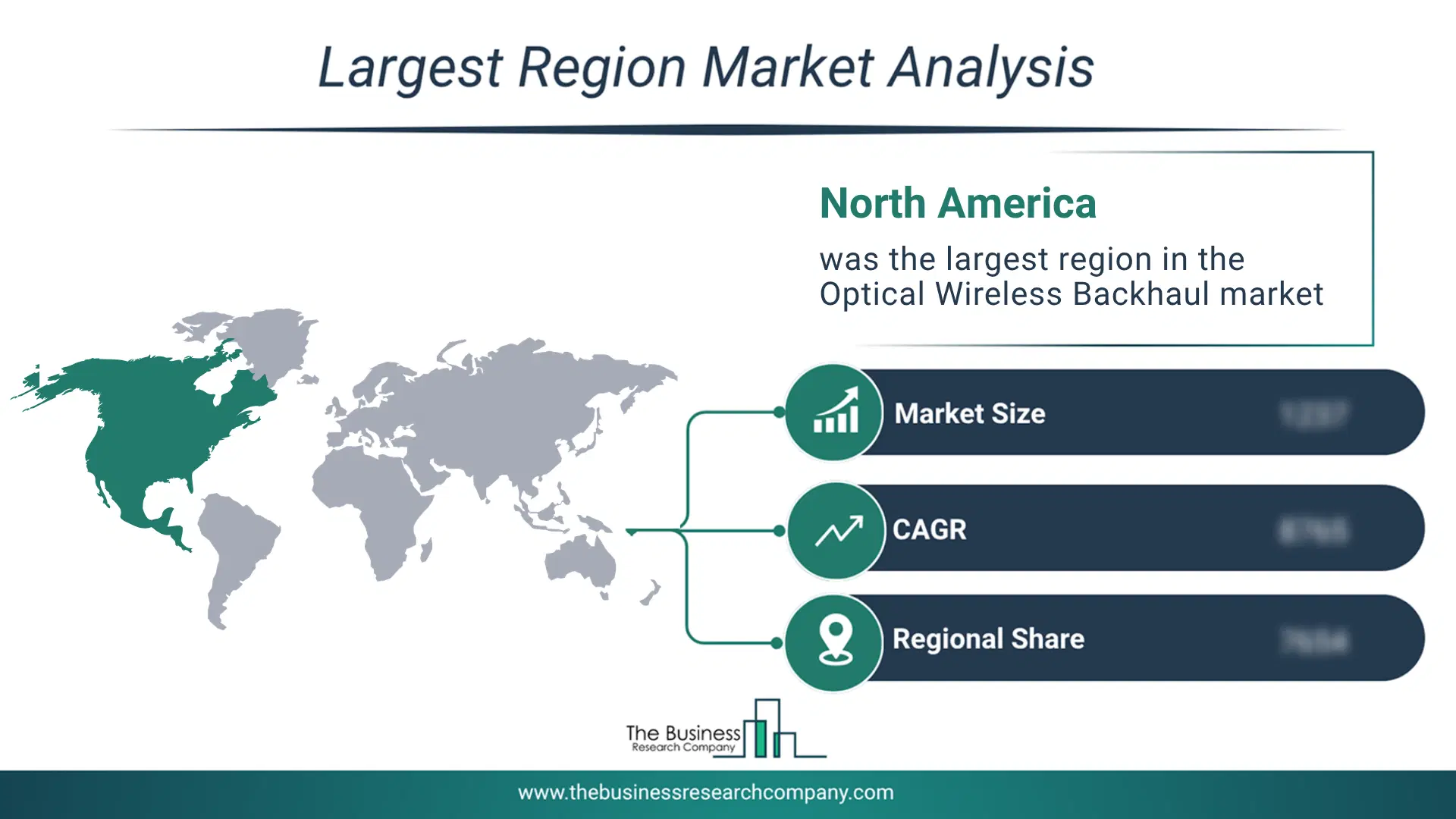
Regional Insights
North America was the largest region in the optical wireless backhaul market in 2025. Asia-Pacific is expected to be the fastest-growing region in the forecast period. The regions covered in this market report are Asia-Pacific, South East Asia, Western Europe, Eastern Europe, North America, South America, Middle East, Africa. The countries covered in this market report are Australia, Brazil, China, France, Germany, India, Indonesia, Japan, Taiwan, Russia, South Korea, UK, USA, Canada, Italy, Spain.What Defines the Optical Wireless Backhaul Market?
The optical wireless backhaul market includes revenues earned by entities through system integration, site survey and feasibility study, training and consultancy, network upgrades, and remote monitoring. The market value includes the value of related goods sold by the service provider or included within the service offering. The optical wireless backhaul market includes sales of optical wireless terminals, laser diodes, optical amplifiers, backhaul switches, and optical alignment systems. Values in this market are 'factory gate' values; that is, the value of goods sold by the manufacturers or creators of the goods, whether to other entities (including downstream manufacturers, wholesalers, distributors, and retailers) or directly to end customers. The value of goods in this market includes related services sold by the creators of the goods.How is Market Value Defined and Measured?
The market value is defined as the revenues that enterprises gain from the sale of goods and/or services within the specified market and geography through sales, grants, or donations in terms of the currency (in USD unless otherwise specified). The revenues for a specified geography are consumption values that are revenues generated by organizations in the specified geography within the market, irrespective of where they are produced. It does not include revenues from resales along the supply chain, either further along the supply chain or as part of other products.
This chart presents market attractiveness based on a quantitative evaluation of growth, competition, strategic alignment, and risk, offering a clear view of opportunity areas for decision-making. This chart is for illustrative purposes; the full report contains the complete analysis.

This chart highlights the Total Addressable Market (TAM) by estimating the maximum revenue opportunity using an assumption-driven approach, supporting strategic planning and opportunity sizing across markets. The chart is illustrative; the full report provides a more comprehensive analysis.
What Key Data and Analysis Are Included in the Optical Wireless Backhaul Market Report 2026?
The optical wireless backhaul market research report is one of a series of new reports from The Business Research Company that provides market statistics, including industry global market size, regional shares, competitors with the market share, detailed market segments, market trends and opportunities, and any further data you may need to thrive in the optical wireless backhaul industry. The market research report delivers a complete perspective of everything you need, with an in-depth analysis of the current and future state of the industry.Optical Wireless Backhaul Market Report Forecast Analysis
| Report Attribute | Details |
|---|---|
| Market Size Value In 2026 | $1.58 billion |
| Revenue Forecast In 2030 | $3.13 billion |
| Growth Rate | CAGR of 18.6% from 2026 to 2030 |
| Base Year For Estimation | 2025 |
| Actual Estimates/Historical Data | 2020-2025 |
| Forecast Period | 2026 - 2030 |
| Market Representation | Revenue in USD Billion and CAGR from 2026 to 2030 |
| Segments Covered | Component, Transmission Type, Deployment, Application |
| Regional Scope | Asia-Pacific, Western Europe, Eastern Europe, North America, South America, Middle East, Africa |
| Country Scope | The Countries Covered In This Market Report Are Australia, Brazil, China, France, Germany, India, Indonesia, Japan, Taiwan, Russia, South Korea, Uk, Usa, Canada, Italy, Spain. |
| Key Companies Profiled | Huawei Technologies Company Limited, Mitsubishi Electric Corporation, Fujitsu Limited, Telefonaktiebolaget LM Ericsson, NEC Corporation, ZTE Corporation, Aviat Networks Inc., Ceragon Networks Limited, Intracom Telecom Holdings S.A., Radwin Ltd., SIAE Microelettronica S.p.A., Cambium Networks Ltd., Skyloom Inc., Plaintree Systems Inc., CableFree Ltd., Mostcom Ltd., Transcelestial Pte. Ltd., Attochron Inc., Taara Corporation, KORUZA Ltd. |
| Customization Scope | Request for Customization |
| Pricing And Purchase Options | Explore Purchase Options |