
Rocket Airborne Launch Market Report 2026
Global Outlook – By Launch Platform (Aircraft, Balloon, Unmanned Aerial Vehicle (UAV)), By Payload Type (Satellite, Cargo, Other Payload Types), By End-User (Commercial, Military, Government, Research) – Market Size, Trends, Strategies, and Forecast to 2030
Rocket Airborne Launch Market Overview
• Rocket Airborne Launch market size has reached to $3.85 billion in 2025 • Expected to grow to $5.97 billion in 2030 at a compound annual growth rate (CAGR) of 9.1% • Growth Driver: The Rise in Satellite Launches Is Fueling the Growth of the Market Due to Increasing Demand for Flexible and Rapid Deployment Solutions • North America was the largest region in 2025 and Asia-Pacific is the fastest growing region.What Is Covered Under Rocket Airborne Launch Market?
Rocket airborne launch is a technique where rockets are deployed from aircraft while in flight, rather than from traditional ground-based platforms. This method offers greater flexibility in launch locations, faster response times, and less reliance on permanent infrastructure. It is particularly effective for deploying small satellites and supporting time-sensitive space missions. Additionally, it enhances launch reliability by minimizing weather-related delays. The main types of rocket airborne launch platforms are aircraft, balloons, and unmanned aerial vehicles (UAVs). Aircraft-based rocket launches use planes to release rockets at high altitudes, enabling rapid, flexible, and cost-effective deployment of small satellites into low Earth orbit. The payload types include satellite, cargo, and others, and are used by various end-users such as commercial, military, government, and research.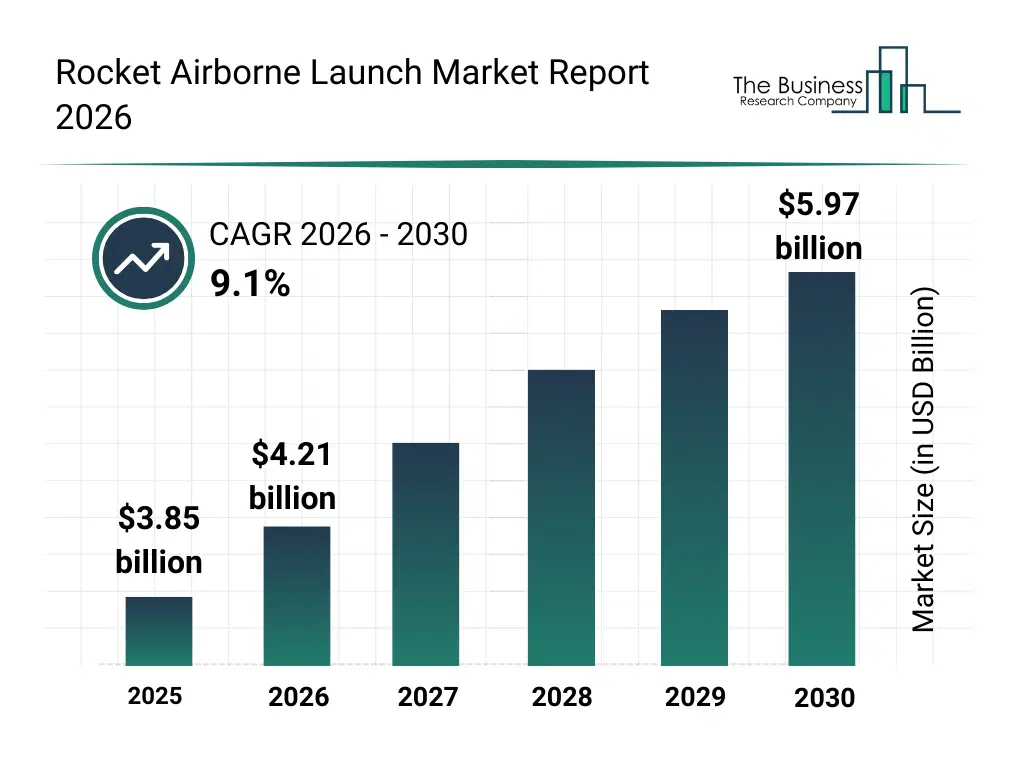
What Is The Rocket Airborne Launch Market Size and Share 2026?
The rocket airborne launch market size has grown strongly in recent years. It will grow from $3.85 billion in 2025 to $4.21 billion in 2026 at a compound annual growth rate (CAGR) of 9.4%. The growth in the historic period can be attributed to growing adoption of airborne launch methods to reduce dependency on fixed ground infrastructure, increasing demand for small satellite deployment supporting commercial and defense missions, early development of aero-structural support systems enabling safe rocket carriage and release, rising use of responsive launch services for time-sensitive orbital insertion, expansion of testing and demonstration flights validating airborne launch concepts.What Is The Rocket Airborne Launch Market Growth Forecast?
The rocket airborne launch market size is expected to see strong growth in the next few years. It will grow to $5.97 billion in 2030 at a compound annual growth rate (CAGR) of 9.1%. The growth in the forecast period can be attributed to rising demand for on-demand and rapid-response launch services for defense and commercial applications, increasing adoption of advanced avionics and interface units to improve launch integration and reliability, growing development of larger airborne-launched rockets to support higher payload capacities, expansion of global commercial operators entering the airborne launch ecosystem, technological advancements enabling improved aircraft–rocket integration and optimized release mechanisms. Major trends in the forecast period include increasing demand for responsive small-satellite deployment services, expansion of airborne launch platform development and integration, growing emphasis on rapid turnaround and on-demand launch capability, standardization of avionics and interface units for air-launched rockets, strengthening of regulatory and airspace integration frameworks.
Global Rocket Airborne Launch Market Segmentation
1) By Launch Platform: Aircraft, Balloon, Unmanned Aerial Vehicle (UAV) 2) By Payload Type: Satellite, Cargo, Other Payload Types 3) By End-User: Commercial, Military, Government, Research Subsegments: 1) By Aircraft: Fixed-Wing Aircraft, Fighter Jets, Cargo Or Transport Aircraft, Supersonic Aircraft 2) By Balloon: Zero-Pressure Balloons, Super-Pressure Balloons, High-Altitude Research Balloons, Sounding Balloons 3) By Unmanned Aerial Vehicle (UAV): Fixed-Wing Unmanned Aerial Vehicles (UAVs), Rotary-Wing Unmanned Aerial Vehicle (UAVs), High-Altitude Long Endurance (HALE) Unmanned Aerial Vehicle (UAVs), Medium-Altitude Long Endurance (MALE) Unmanned Aerial Vehicle (UAVs)What Is Driver Of The Rocket Airborne Launch Market?
The rising geopolitical tensions are expected to propel the growth of the rocket airborne launch market going forward. Geopolitical tensions refer to conflicts or heightened competition between nations or regions driven by political, economic, or military factors. Geopolitical tensions are rising due to increasing competition over strategic resources, as nations seek to secure energy, minerals, and technology essential for economic and military dominance. Rocket airborne launch supports strategic readiness amid geopolitical tensions by enabling swift and flexible deployment of defense and surveillance satellites. Its mobility ensures reliable space access even in conflict zones or areas lacking ground infrastructure. For instance, in December 2024, according to the Armed Conflict Location & Event Data Project (ACLED), a US-based non-profit research organization specializing in conflict data analysis, over 165,273 political violence events were recorded globally between July 2023 and June 2024, marking a 15% increase compared to the previous year. Therefore, the rising geopolitical tensions are driving the growth of the rocket airborne launch industry.Key Players In The Global Rocket Airborne Launch Market
Major companies operating in the rocket airborne launch market are Lockheed Martin Corporation, Raytheon Technologies Corporation, The Boeing Company, Airbus, General Dynamics, Northrop Grumman Corporation, The National Aeronautics and Space Administration, Thales Group, Leonardo, MBDA, Kongsberg Defence & Aerospace, Aerojet Rocketdyne, Firefly Aerospace, Defense Advanced Research Projects Agency, Virgin Orbit, Stratolaunch, PLD Space, Exos Aerospace Systems & Technologies, The Indian Space Research Organisation, Zero 2 Infinity
This chart is for illustrative purposes; the full report includes a detailed competitor analysis and comprehensive overview of the top 10 companies in the market.
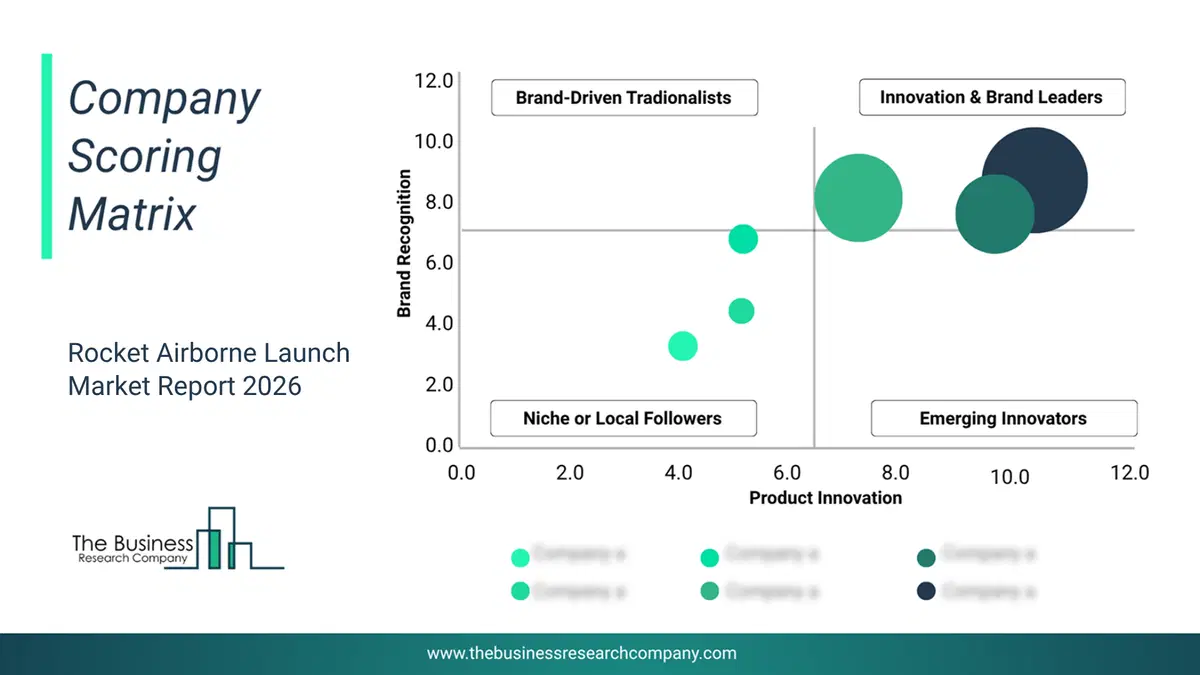
This chart maps companies by product innovation and brand strength, with bubble size indicating relative revenue, helping identify market leaders, challengers, and niche players. This is an illustrative chart; the full report provides a complete and accurate competitive analysis.
Regional Insights
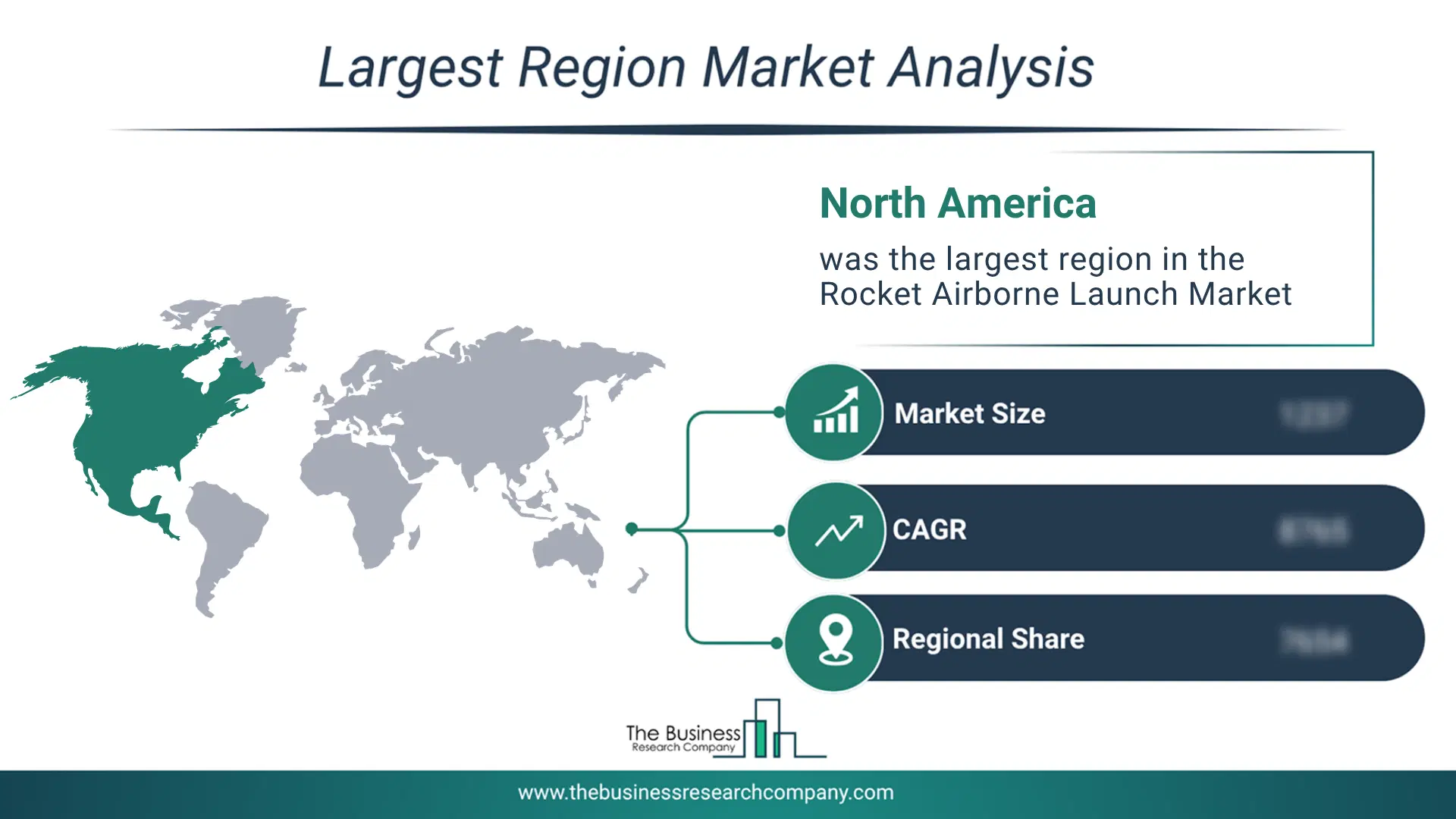
North America was the largest region in the rocket airborne launch market in 2025. Asia-Pacific is expected to be the fastest-growing region in the forecast period. The regions covered in the rocket airborne launch market report are Asia-Pacific, South East Asia, Western Europe, Eastern Europe, North America, South America, Middle East, Africa. The countries covered in the rocket airborne launch market report are Australia, Brazil, China, France, Germany, India, Indonesia, Japan, Taiwan, Russia, South Korea, UK, USA, Canada, Italy, SpainWhat Defines the Rocket Airborne Launch Market?
The rocket airborne launch market consists of revenues earned by entities by providing services such as satellite deployment, responsive and on-demand launch services, and testing and demonstration flights. The market value includes the value of related goods sold by the service provider or included within the service offering. The rocket airborne launch market also includes sales of aero-structural support systems, avionics and interface units, and launch platform integration hardware. Values in this market are ‘factory gate’ values, that is, the value of goods sold by the manufacturers or creators of the goods, whether to other entities (including downstream manufacturers, wholesalers, distributors, and retailers) or directly to end customers. The value of goods in this market includes related services sold by the creators of the goods.How is Market Value Defined and Measured?
The market value is defined as the revenues that enterprises gain from the sale of goods and/or services within the specified market and geography through sales, grants, or donations in terms of the currency (in USD unless otherwise specified). The revenues for a specified geography are consumption values that are revenues generated by organizations in the specified geography within the market, irrespective of where they are produced. It does not include revenues from resales along the supply chain, either further along the supply chain or as part of other products.
This chart presents market attractiveness based on a quantitative evaluation of growth, competition, strategic alignment, and risk, offering a clear view of opportunity areas for decision-making. This chart is for illustrative purposes; the full report contains the complete analysis.

This chart highlights the Total Addressable Market (TAM) by estimating the maximum revenue opportunity using an assumption-driven approach, supporting strategic planning and opportunity sizing across markets. The chart is illustrative; the full report provides a more comprehensive analysis.
What Key Data and Analysis Are Included in the Rocket Airborne Launch Market Report 2026?
The rocket airborne launch market research report is one of a series of new reports from The Business Research Company that provides market statistics, including industry global market size, regional shares, competitors with the market share, detailed market segments, market trends and opportunities, and any further data you may need to thrive in the rocket airborne launch industry. The market research report delivers a complete perspective of everything you need, with an in-depth analysis of the current and future state of the industry.Rocket Airborne Launch Market Report Forecast Analysis
| Report Attribute | Details |
|---|---|
| Market Size Value In 2026 | $4.21 billion |
| Revenue Forecast In 2030 | $5.97 billion |
| Growth Rate | CAGR of 9.1% from 2026 to 2030 |
| Base Year For Estimation | 2025 |
| Actual Estimates/Historical Data | 2020-2025 |
| Forecast Period | 2026 - 2030 |
| Market Representation | Revenue in USD Billion and CAGR from 2026 to 2030 |
| Segments Covered | Launch Platform, Payload Type, End-User |
| Regional Scope | Asia-Pacific, Western Europe, Eastern Europe, North America, South America, Middle East, Africa |
| Country Scope | The countries covered in the rocket airborne launch market report are Australia, Brazil, China, France, Germany, India, Indonesia, Japan, Taiwan, Russia, South Korea, UK, USA, Canada, Italy, Spain |
| Key Companies Profiled | Lockheed Martin Corporation, Raytheon Technologies Corporation, The Boeing Company, Airbus, General Dynamics, Northrop Grumman Corporation, The National Aeronautics and Space Administration, Thales Group, Leonardo, MBDA, Kongsberg Defence & Aerospace, Aerojet Rocketdyne, Firefly Aerospace, Defense Advanced Research Projects Agency, Virgin Orbit, Stratolaunch, PLD Space, Exos Aerospace Systems & Technologies, The Indian Space Research Organisation, Zero 2 Infinity |
| Customization Scope | Request for Customization |
| Pricing And Purchase Options | Explore Purchase Options |