Contact Us
  Search
The Business Research Company Logo

Semi-Trailer Market 2025

Buy Now
Semi-Trailer Market 2025
Published :May 2025
Pages :334
Format :PDF
Delivery Time :2-3 Business Days
Why 2-3 days? We update the report with the latest data and news before delivery. Let us know if you need us to expedite.
Report Price :$4,490.00

Semi-Trailer Market 2025

By Type (Flatbed, Lowboy, Dry Van, Refrigerated, Tankers, Other Types), By Length (Up To 45 Feet, Above 45 Feet), By End-Use (Heavy Industry, FMCG (Fast Moving Consumer Goods), Chemical, Automotive, Oil And Gas, Healthcare, Logistics, Other End-Users), And By Region, Opportunities And Strategies – Global Forecast To 2035

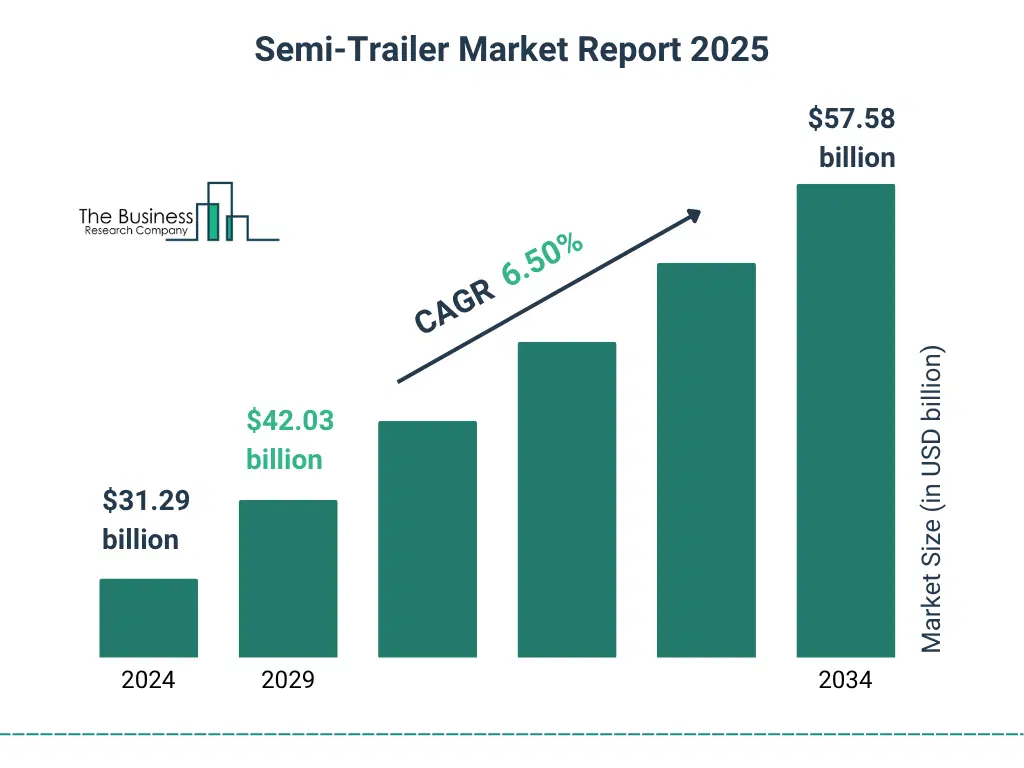
Semi-Trailer Market Size and growth rate 2025 to 2029: Graph

Semi-Trailer Market Definition

A semi-trailer is a type of trailer that lacks a front axle and is designed to be attached to a truck tractor for transportation of goods and materials. Semi-trailers play a crucial role in the logistics and freight industry, enabling the efficient movement of goods across short and long distances. The semi-trailer market consists of sales by entities (organizations, sole traders and partnerships) of semi-trailers used for transporting large volumes of cargo, including bulk materials, perishable goods, hazardous chemicals, industrial equipment and consumer products. Their usage spans across road freight operations, distribution networks and cross-border trade.


Research Expert

Book your 30 minutes free consultation with our research experts

Semi-Trailer Market Size

The global semi-trailer market reached a value of nearly $31,286.51 million in 2024, having grown at a compound annual growth rate (CAGR) of 3.67% since 2019. The market is expected to grow from $31,286.51 million in 2024 to $42,031.15 million in 2029 at a rate of 6.08%. The market is then expected to grow at a CAGR of 6.50% from 2029 and reach $57,582.37 million in 2034. Growth in the historic period resulted from the rising industrialization, strong economic growth in emerging markets, growth in food and beverage industry and increasing automotive industry. Factors that negatively affected growth in the historic period was fluctuating fuel prices. Going forward, the rise in urbanization, growing demand for e-commerce and online retail, rise in construction activities globally and favorable government support will drive the growth. Factor that could hinder the growth of the semi-trailer market in the future include supply chain disruptions and labor shortages.

Semi-Trailer Market Drivers

The key drivers of the semi-trailer market include: Rise In Urbanization During the forecast period, rise in urbanization will support the growth of the semi-trailer market. As urban areas grow, there is a surge in construction activities, retail distribution and e-commerce, all of which require large-scale logistics solutions. Semi-trailers play a crucial role in transporting goods, raw materials and consumer products between manufacturing hubs, warehouses and retail outlets. Additionally, infrastructure development, such as roads and highways, improves connectivity, making long-haul and last-mile deliveries more efficient. For instance, according to the World Bank, India's urbanization is accelerating, with towns and cities projected to house 600 million people or 40% of the population by 2036, up from 31% in 2011. Urban areas will contribute nearly 70% to the gross domestic product (GDP). Additionally, according to the National Economic and Social Council of Ireland, the country is expected to have the highest annual urbanization rate in the European Union (EU) at 1.3%. Across the European Union (EU), urbanization is projected to rise from just under 70% in 2010 to over 90% by 2050. Therefore, rise in urbanization is expected to generate high demand for the semi-trailer market during the forecast period.

Semi-Trailer Market Restraints

The key restraints on the semi-trailer market include: Supply Chain Disruptions Supply chain disruptions are expected to restrict the growth of the semi-trailer market going forward. Disruptions such as raw material shortages, labor constraints and logistical bottlenecks can lead to delays in manufacturing new semi-trailers and servicing existing fleets. Global crises, trade restrictions and port congestions can slow down the movement of goods, reducing demand for freight transportation. Fluctuations in fuel prices and supply chain inefficiencies also impact operational costs for logistics companies, making fleet expansion less viable. For instance, according to the Wall Street Journal, a US-based business- and economic-focused international daily newspaper, in 2024, global supply chains will face disruptions at vital trade routes like the Panama Canal and the Suez Canal. Rising geopolitical tensions may further impact sourcing and distribution strategies, prompting countries and companies to reconsider established trade routes and networks developed over decades. Therefore, supply chain disruptions may hinder the growth of the semi-trailer market.

Need data on a specific region in this market?

Opportunities And Recommendations In The Semi-Trailer Market

Opportunities – The top opportunities in the semi-trailer market segmented by type will arise in the dry van segment, which will gain $3,445.27 million of global annual sales by 2029. The top opportunities in the semi-trailer market segmented by length will arise in the up to 45 feet segment, which will gain $5,621.75 million of global annual sales by 2029. The top opportunities in the semi-trailer market segmented by end use will arise in the logistics segment, which will gain $3,528.16 million of global annual sales by 2029. The semi-trailer market size will gain the most in the USA at $2,868.67 million. Recommendations- To take advantage of the opportunities, The Business Research Company recommends the semi-trailer companies to focus on specialized solutions for the entertainment sector, focus on advancing electric semi-trailer integration to improve efficiency and sustainability, focus on electric auxiliary traction systems to improve efficiency and performance, focus on enhancing product efficiency through design innovation, focus on the flatbed segment to capture high-growth opportunities, focus on above 45 feet semi-trailers for long-term growth, expand in emerging markets, focus on optimizing regional coverage and multi-channel distribution, focus on tiered pricing and value-based differentiation, prioritize targeted digital campaigns over broad outreach, leverage in-store promotions and sampling and strengthen business to business (B2B) engagement through industry-specific channels.
Research Expert

Book your 30 minutes free consultation with our research experts

Chat with us