
Space-Qualified Propellant Tank Market Report 2026
Global Outlook – By Propellant Tank Type (Diaphragm Tanks, High Pressure Tanks, Helium, Nitrogen, And Xenon Tanks, Other Propellant Tank Types), By Material (Carbon Fiber, Aluminium and Titanium Alloys, Thermoset and Thermoplastic, Nanomaterials, Other Materials), By Satellite (Nano And Microsatellite, Small Satellite, Medium Satellite, Large Satellite) – Market Size, Trends, Strategies, and Forecast to 2030
Space-Qualified Propellant Tank Market Overview
• Space-Qualified Propellant Tank market size has reached to $1.8 billion in 2025 • Expected to grow to $2.53 billion in 2030 at a compound annual growth rate (CAGR) of 7.1% • Growth Driver: Rapid Escalation In Satellite Production And Launch Driving Growth In The Market Due To Increasing Demand For Space Capabilities • Market Trend: Revolutionizing Satellite Launch With Advanced Oxidizer Tanks • North America was the largest region in 2025 and Asia-Pacific is the fastest growing region.What Is Covered Under Space-Qualified Propellant Tank Market?
A space-qualified propellant tank is a storage vessel specifically designed, built, and tested to meet the stringent requirements for use in space missions. These tanks hold liquid or gaseous propellants used by spacecraft propulsion systems (such as chemical or electric thrusters) and must perform reliably in the harsh space environment. The main propellant tank types of the space-qualified propellant tank include diaphragm tanks, high pressure tanks, helium, nitrogen, and xenon tanks, and other propellant tank types. Diaphragm tanks are specialized propellant storage systems that use a flexible membrane to separate the propellant from pressurant gases, ensuring controlled propellant delivery, maintaining system stability, and preventing gas ingestion in space propulsion applications. There are material options such as carbon fiber, aluminium and titanium alloys, thermoset and thermoplastic materials, nanomaterials, and others, and they are used by several satellites such as nano and microsatellite, small satellite, medium satellite, and large satellite.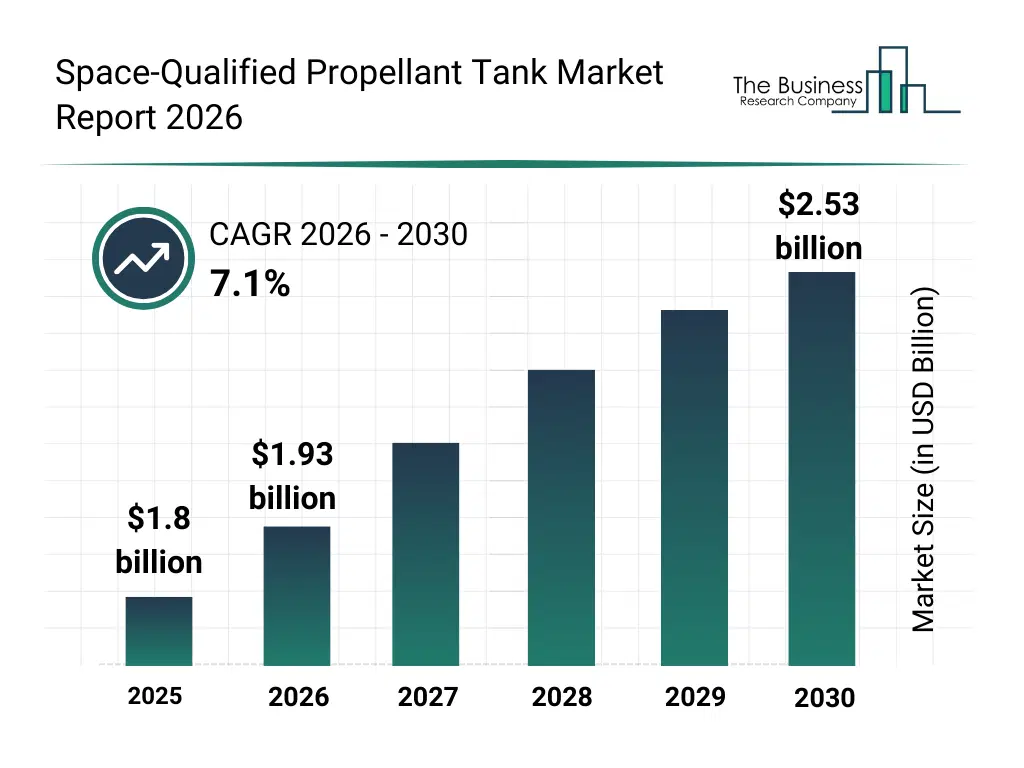
What Is The Space-Qualified Propellant Tank Market Size and Share 2026?
The space-qualified propellant tank market size has grown strongly in recent years. It will grow from $1.8 billion in 2025 to $1.93 billion in 2026 at a compound annual growth rate (CAGR) of 7.1%. The growth in the historic period can be attributed to increasing demand for cryogenic and metallic propellant tanks in space missions, advancements in composite overwrapped pressure vessel technology, growth in satellite and spacecraft launch programs, development of reusable and high-reliability storage systems, rising collaboration between aerospace manufacturers and space agencies.What Is The Space-Qualified Propellant Tank Market Growth Forecast?
The space-qualified propellant tank market size is expected to see strong growth in the next few years. It will grow to $2.53 billion in 2030 at a compound annual growth rate (CAGR) of 7.1%. The growth in the forecast period can be attributed to focus on lightweight and high-strength composite materials, expansion of commercial space exploration and satellite deployment, integration of advanced monitoring and telemetry systems for propellant management, development of modular and multi-use tank systems, adoption of next-generation propulsion technologies requiring specialized storage solutions. Major trends in the forecast period include adoption of lightweight composite propellant tanks for improved launch efficiency, increasing demand for pressure vessels supporting electric propulsion systems, growth in tank production for small satellite constellations, expansion of cryogenic tank usage for deep space missions, development of green and non-toxic propellant storage solutions.
Global Space-Qualified Propellant Tank Market Segmentation
1) By Propellant Tank Type: Diaphragm Tanks, High Pressure Tanks, Helium, Nitrogen, And Xenon Tanks, Other Propellant Tank Types 2) By Material: Carbon Fiber, Aluminium and Titanium Alloys, Thermoset and Thermoplastic, Nanomaterials, Other Materials 3) By Satellite: Nano And Microsatellite, Small Satellite, Medium Satellite, Large Satellite Subsegments: 1) By Diaphragm Tanks: Single Diaphragm Tanks, Double Diaphragm Tanks, Flexible Diaphragm Tanks 2) By High Pressure Tanks: Composite Material Tanks, Metal Alloy Tanks, Hybrid Tanks 3) By Helium, Nitrogen, And Xenon Tanks: Helium Tanks, Nitrogen Tanks, Xenon Tanks 4) By Other Propellant Tank Types: Cryogenic Propellant Tanks, Hypergolic Propellant Tanks, Green Propellant Tanks, Pressurized Fluid TanksWhat Is Driver Of The Space-Qualified Propellant Tank Market?
The increasingly rapid escalation of the production and launch of satellites is expected to propel the growth of the space-qualified propellant tank market going forward. Production and launch of satellites refers to the end-to-end process of designing, manufacturing, testing, and deploying satellites into orbit using launch vehicles. The rapid escalation of the production and launch of satellites is driven by the increasing demand for communication, navigation, and earth observation capabilities. Space-qualified propellant tanks are essential in the rapid escalation of satellite production and launch, as they store and manage the fuel required for satellite propulsion, maneuvering, and orbital stability. For instance, in July 2023, according to The United Nations Office for Outer Space Affairs (UNOOSA), an Austria-based organization promotes international cooperation in the peaceful use and exploration of outer space, as of June 2023, there were 11,330 individual satellites orbiting Earth, reflecting a significant 37.94% growth since January 2022. Therefore, the rising rate of satellite deployment will drive demand for space-qualified propellant tanks.Key Players In The Global Space-Qualified Propellant Tank Market
Major companies operating in the space-qualified propellant tank market are Lockheed Martin Corporation, Northrop Grumman Corporation, Mitsubishi Heavy Industries (MHI), Eaton Corporation plc, IHI Aerospace Co., Space Exploration Technologies Corp (SpaceX), Rafael Advanced Defense Systems, Moog Inc., ArianeGroup SAS, MT Aerospace AG, OHB SE, RUAG Space, Nammo AS, Firefly Aerospace Inc., AVIO S.p.A., Dawn Aerospace B.V., Agile Space Industries, Antrix Corporation, Microcosm Inc, Innovative Space Carrier Inc.
This chart is for illustrative purposes; the full report includes a detailed competitor analysis and comprehensive overview of the top 10 companies in the market.
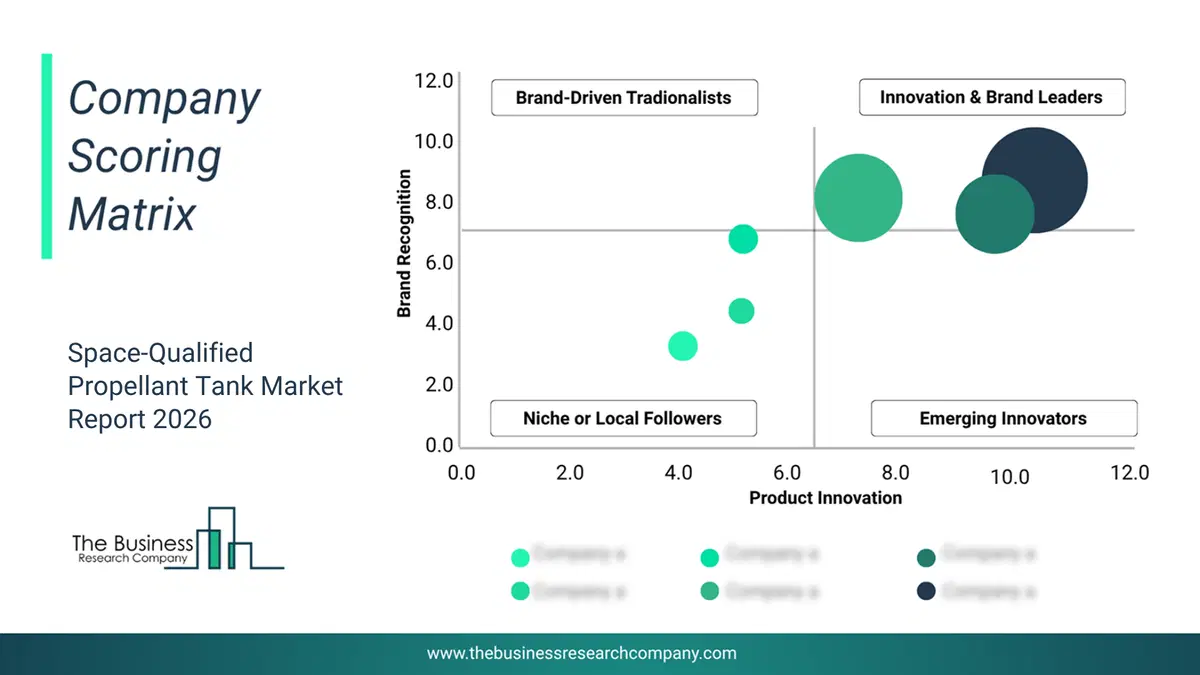
This chart maps companies by product innovation and brand strength, with bubble size indicating relative revenue, helping identify market leaders, challengers, and niche players. This is an illustrative chart; the full report provides a complete and accurate competitive analysis.
Global Space-Qualified Propellant Tank Market Trends and Insights
Major companies operating in the space-qualified propellant tank market are focusing on technological advancements such as cryogenic oxidizer tanks to enhance fuel efficiency, reduce launch costs, and improve the safety and reliability of space missions. A cryogenic oxidizer tank is a specialized container designed to store oxidizing propellants in their liquid form at extremely low temperatures, typically for use in rocket propulsion systems. For instance, In July 2024, Scorpius Space Launch, a US-based aerospace firm, partnered with Vaya Space, a US-based space company, to develop their largest Class V linerless cryogenic oxidizer tank to date. This six-foot-diameter, 22.6-foot-long tank is designed for Vaya's Dauntless launch vehicle and utilizes non-toxic, recycled HDPE fuel, aiming to reduce launch costs and enhance safety.What Are Latest Mergers And Acquisitions In The Space-Qualified Propellant Tank Market? L3harris Acquires Aerojet Rocketdyne To Boost Missile Propulsion And Space Systems Capabilities
In July 2023, L3Harris Technologies, Inc., a US-based defense and aerospace technology company, acquired Aerojet Rocketdyne Holdings, Inc. for $4.7 billion. With this acquisition, L3Harris Technologies aims to enhance L3Harris’s capabilities in missile propulsion, hypersonics, and space systems while strengthening supply chain resilience through vertical integration. Aerojet Rocketdyne Holdings, Inc. is a US-based aerospace and defense company specializing in designing, developing, and manufacturing space-qualified propulsion systems, including propellant tanks as integral components.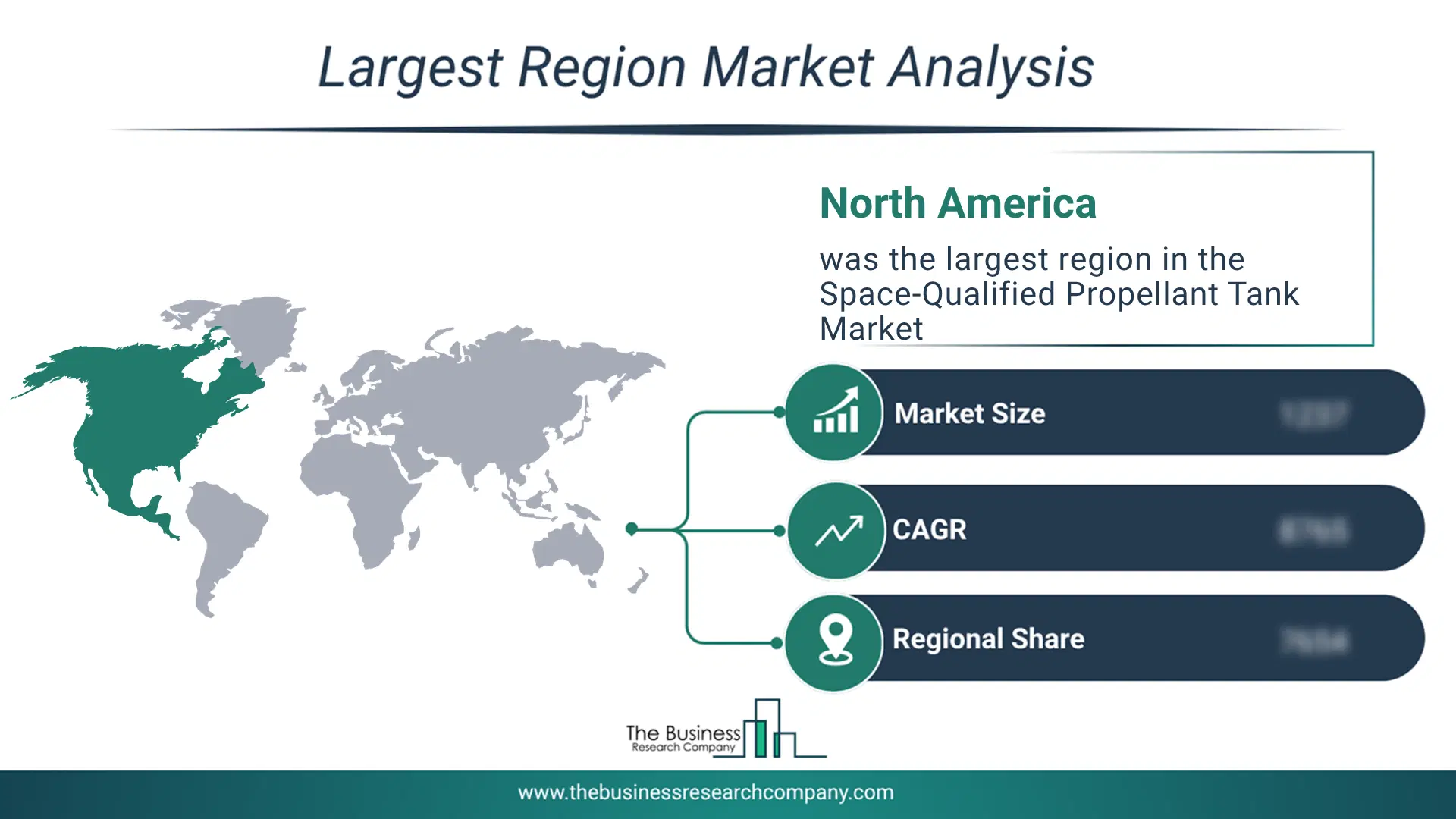
Regional Insights
North America was the largest region in the space-qualified propellant tank market in 2025. Asia-Pacific is expected to be the fastest-growing region in the forecast period. The regions covered in this market report are Asia-Pacific, South East Asia, Western Europe, Eastern Europe, North America, South America, Middle East, Africa. The countries covered in this market report are Australia, Brazil, China, France, Germany, India, Indonesia, Japan, Taiwan, Russia, South Korea, UK, USA, Canada, Italy, SpainWhat Defines the Space-Qualified Propellant Tank Market?
The space-qualified propellant tank market consists of sales of spherical propellant tanks, cryogenic propellant tanks, metallic propellant tanks, and composite overwrapped pressure vessels. Values in this market are ‘factory gate’ values, that is, the value of goods sold by the manufacturers or creators of the goods, whether to other entities (including downstream manufacturers, wholesalers, distributors, and retailers) or directly to end customers. The value of goods in this market includes related services sold by the creators of the goods.How is Market Value Defined and Measured?
The market value is defined as the revenues that enterprises gain from the sale of goods and/or services within the specified market and geography through sales, grants, or donations in terms of the currency (in USD unless otherwise specified). The revenues for a specified geography are consumption values that are revenues generated by organizations in the specified geography within the market, irrespective of where they are produced. It does not include revenues from resales along the supply chain, either further along the supply chain or as part of other products.
This chart presents market attractiveness based on a quantitative evaluation of growth, competition, strategic alignment, and risk, offering a clear view of opportunity areas for decision-making. This chart is for illustrative purposes; the full report contains the complete analysis.

This chart highlights the Total Addressable Market (TAM) by estimating the maximum revenue opportunity using an assumption-driven approach, supporting strategic planning and opportunity sizing across markets. The chart is illustrative; the full report provides a more comprehensive analysis.
What Key Data and Analysis Are Included in the Space-Qualified Propellant Tank Market Report 2026?
The space-qualified propellant tank market research report is one of a series of new reports from The Business Research Company that provides market statistics, including industry global market size, regional shares, competitors with the market share, detailed market segments, market trends and opportunities, and any further data you may need to thrive in the space-qualified propellant tank industry. The market research report delivers a complete perspective of everything you need, with an in-depth analysis of the current and future state of the industry.Space-Qualified Propellant Tank Market Report Forecast Analysis
| Report Attribute | Details |
|---|---|
| Market Size Value In 2026 | $1.93 billion |
| Revenue Forecast In 2030 | $2.53 billion |
| Growth Rate | CAGR of 7.1% from 2026 to 2030 |
| Base Year For Estimation | 2025 |
| Actual Estimates/Historical Data | 2020-2025 |
| Forecast Period | 2026 - 2030 |
| Market Representation | Revenue in USD Billion and CAGR from 2026 to 2030 |
| Segments Covered | Propellant Tank Type, Material, Satellite |
| Regional Scope | Asia-Pacific, Western Europe, Eastern Europe, North America, South America, Middle East, Africa |
| Country Scope | The countries covered in the space-qualified propellant tank market report are Australia, Brazil, China, France, Germany, India, Indonesia, Japan, Taiwan, Russia, South Korea, UK, USA, Canada, Italy, Spain |
| Key Companies Profiled | Lockheed Martin Corporation, Northrop Grumman Corporation, Mitsubishi Heavy Industries (MHI), Eaton Corporation plc, IHI Aerospace Co., Space Exploration Technologies Corp (SpaceX), Rafael Advanced Defense Systems, Moog Inc., ArianeGroup SAS, MT Aerospace AG, OHB SE, RUAG Space, Nammo AS, Firefly Aerospace Inc., AVIO S.p.A., Dawn Aerospace B.V., Agile Space Industries, Antrix Corporation, Microcosm Inc, Innovative Space Carrier Inc. |
| Customization Scope | Request for Customization |
| Pricing And Purchase Options | Explore Purchase Options |