
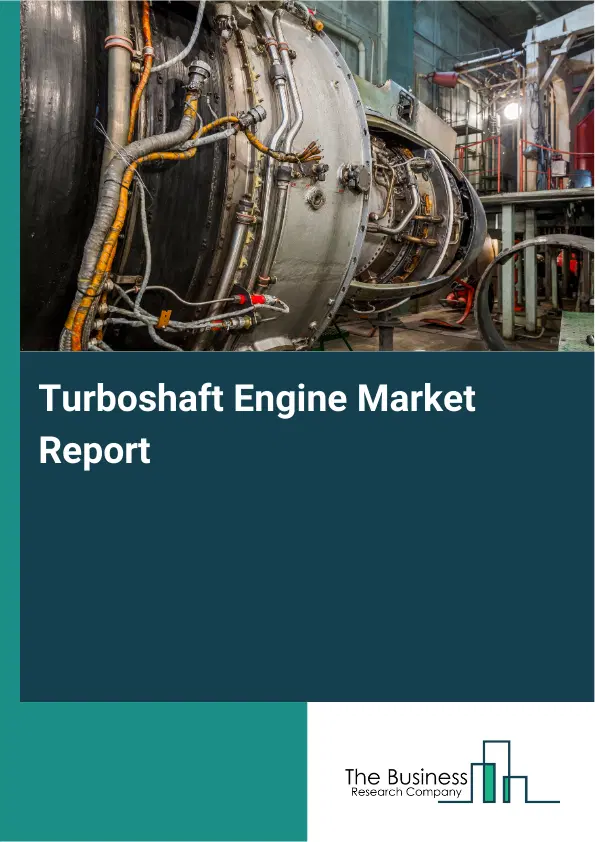
Turboshaft Engine Market Report 2026
Global Outlook – By Engine Type (Single-Spool Turboshaft Engines, Multi-Spool Turboshaft Engines, Turbocharged Turboshaft Engines), By Fuel Type (Aviation Turbine Fuel (ATF), Biofuels, Diesel, Jet Fuel), By Power Rating (Below 500 HP, 500–2000 HP, Above 2000 HP), By Application (Aerospace, Defense, Commercial Aviation, Industrial, Marine), By End-User (Commercial Operators, Military Or Government, Original Equipment Manufacturers (OEMs), Maintenance Repair And Overhaul (MRO) Providers) – Market Size, Trends, Strategies, and Forecast to 2030
Turboshaft Engine Market Overview
• Turboshaft Engine market size has reached to $5.54 billion in 2025 • Expected to grow to $7.84 billion in 2030 at a compound annual growth rate (CAGR) of 7.1% • Growth Driver: The Rising Defense Budget Is Driving The Market Due To Increasing Military Modernization Needs • Market Trend: European Turboshaft Engine Advancements Drive Efficiency And Strategic Autonomy • North America was the largest region in 2025 and Asia-Pacific is the fastest growing region.What Is Covered Under Turboshaft Engine Market?
A turboshaft engine is a type of gas turbine engine specifically designed to convert the majority of its produced energy into shaft power rather than thrust, utilizing a high-speed rotating shaft connected to a power transmission system and incorporating components such as a compressor, combustion chamber, turbine stages, and reduction gearbox to efficiently deliver mechanical energy for driving external loads. These engines are primarily employed in applications requiring reliable, continuous rotational power output for propulsion or operation of heavy machinery, particularly in environments demanding high power-to-weight ratios and compact, efficient energy conversion. The main engine types in turboshaft engines are single-spool turboshaft engines, multi-spool turboshaft engines, and turbocharged turboshaft engines. A single-spool turboshaft engine is a type of turboshaft engine in which all compressor and turbine stages are mounted on a single rotating shaft, producing mechanical power efficiently through a single continuous rotational axis. The fuel types in these are aviation turbine fuel (ATF), biofuels, diesel, and jet fuel, by power ratings as below 500 hp, 500-2000 hp, and above 2000 hp, used in applications such as aerospace, defense, commercial aviation, industrial, and marine, by the end-users including commercial operators, military or government, original equipment manufacturers (OEMs), and maintenance repair and overhaul (MRO) providers.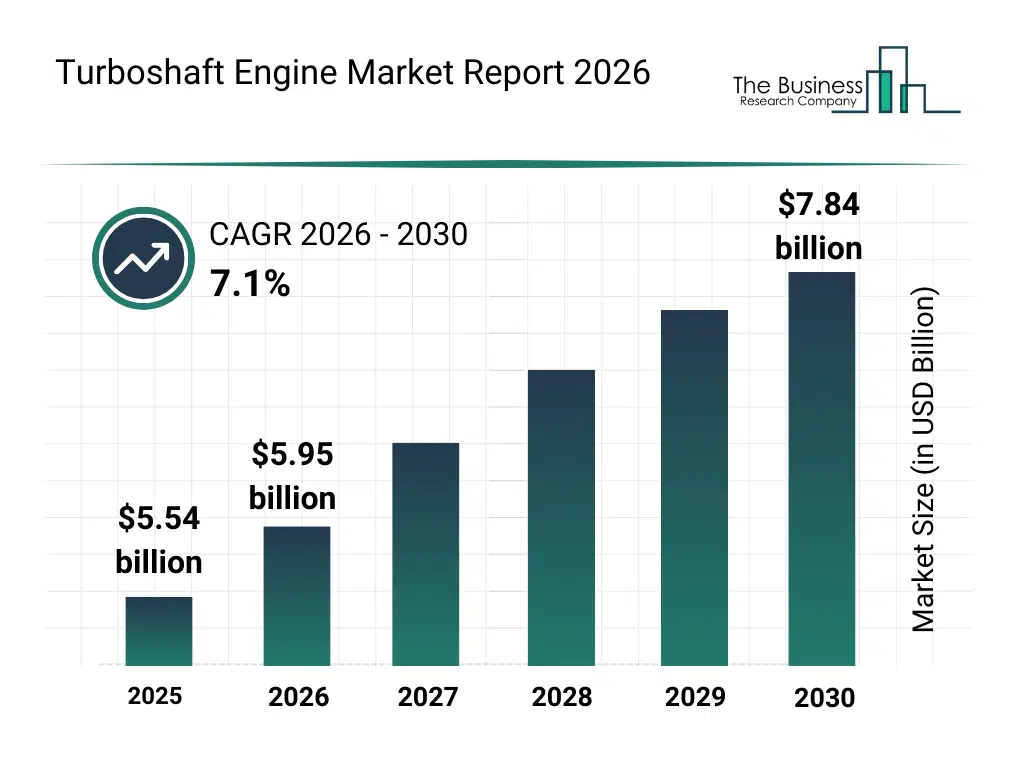
What Is The Turboshaft Engine Market Size and Share 2026?
The turboshaft engine market size has grown strongly in recent years. It will grow from $5.54 billion in 2025 to $5.95 billion in 2026 at a compound annual growth rate (CAGR) of 7.4%. The growth in the historic period can be attributed to growth in military helicopter procurement, increased offshore oil and gas exploration, adoption in industrial power generation, improvements in fuel efficiency, advancements in lightweight composite materials.What Is The Turboshaft Engine Market Growth Forecast?
The turboshaft engine market size is expected to see strong growth in the next few years. It will grow to $7.84 billion in 2030 at a compound annual growth rate (CAGR) of 7.1%. The growth in the forecast period can be attributed to rising demand for urban air mobility and eVTOL applications, expansion of defense rotorcraft programs, development of hybrid turboshaft engines, stricter emission regulations driving engine optimization, increasing use in maritime propulsion systems. Major trends in the forecast period include rising demand for turboshaft engines in expanding civil and parapublic helicopter fleets, increasing adoption of modular and upgradeable turboshaft engine platforms, growing focus on extended time-between-overhaul (tbo) and lifecycle cost optimization, expansion of turboshaft use in marine propulsion and industrial mechanical drive applications, consolidation and strategic partnerships between engine oems and airframe manufacturers.
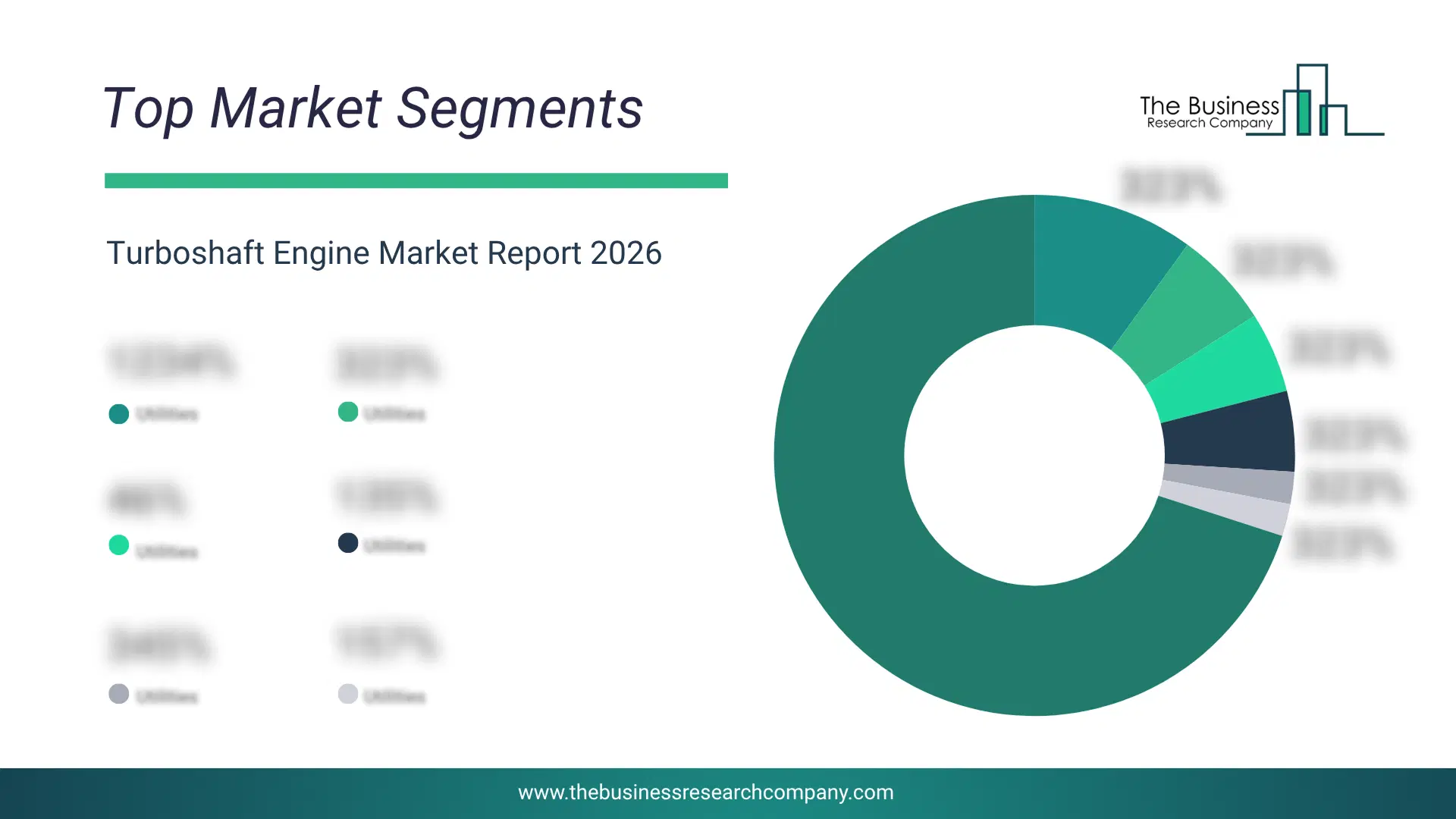
Global Turboshaft Engine Market Segmentation
1) By Engine Type: Single-Spool Turboshaft Engines, Multi-Spool Turboshaft Engines, Turbocharged Turboshaft Engines 2) By Fuel Type: Aviation Turbine Fuel (ATF), Biofuels, Diesel, Jet Fuel 3) By Power Rating: Below 500 HP, 500–2000 HP, Above 2000 HP 4) By Application: Aerospace, Defense, Commercial Aviation, Industrial, Marine 5) By End-User: Commercial Operators, Military Or Government, Original Equipment Manufacturers (OEMs), Maintenance Repair And Overhaul (MRO) Providers Subsegments: 1) By Single-Spool Turboshaft Engines: Light Duty Engines, Medium Duty Engines, Heavy Duty Engines 2) By Multi-Spool Turboshaft Engines: Twin Spool Engines, Triple Spool Engines, Variable Spool Engines 3) By Turbocharged Turboshaft Engines: Low Pressure Turbocharged Engines, Medium Pressure Turbocharged Engines, High Pressure Turbocharged EnginesWhat Is Driver Of The Turboshaft Engine Market?
The rising defense budget is expected to propel the growth of the turboshaft engine market going forward. Defense budgets refer to the allocated financial resources by a nation's government specifically designated for the planning, development, procurement, maintenance, and operational readiness of its armed forces and related defense infrastructure. A primary factor driving rising defense budgets is the increasing complexity of national security threats, as governments are compelled to invest more heavily in advanced technologies, training, and capabilities to ensure strategic deterrence and maintain a robust defense posture. Turboshaft engines enable enhanced performance, efficiency, and operational reliability of military helicopters and other rotary-wing aircraft, thereby supporting the objectives of modernized and well-funded defense programs. For instance, in February 2025, according to the International Institute for Strategic Studies (IISS), a UK-based non-governmental think tank, global defense spending rose to USD 2.46 trillion in 2024 from USD 2.24 trillion in 2023, with real-term growth accelerating to 7.4 percent compared to 6.5 percent in 2023 and 3.5 percent in 2022, resulting in an average allocation of 1.9 percent of gross domestic product in 2024, up from 1.6 percent in 2022 and 1.8 percent in 2023. Therefore, the rising defense budget is driving the growth of the turboshaft engine industry.Key Players In The Global Turboshaft Engine Market
Major companies operating in the turboshaft engine market are Honeywell Aerospace Inc., GE Aerospace, Pratt & Whitney, Rolls-Royce Plc, Aero Engine Corporation of China, Kawasaki Heavy Industries (KHI), IHI Corporation, AVIC Engine Corporation, MTU Aero Engines AG, Safran Group, ITP Aero S.A. (Bain Capital), Harbin Engine Group Co. Ltd., PBS GROUP, TUSAS Engine Industries Inc., Avio Aero S.p.A., Jakadofsky GmbH, Klimov JSC, Konner S.r.l., Motor Sich JSC, Astro Mechanica
This chart is for illustrative purposes; the full report includes a detailed competitor analysis and comprehensive overview of the top 10 companies in the market.
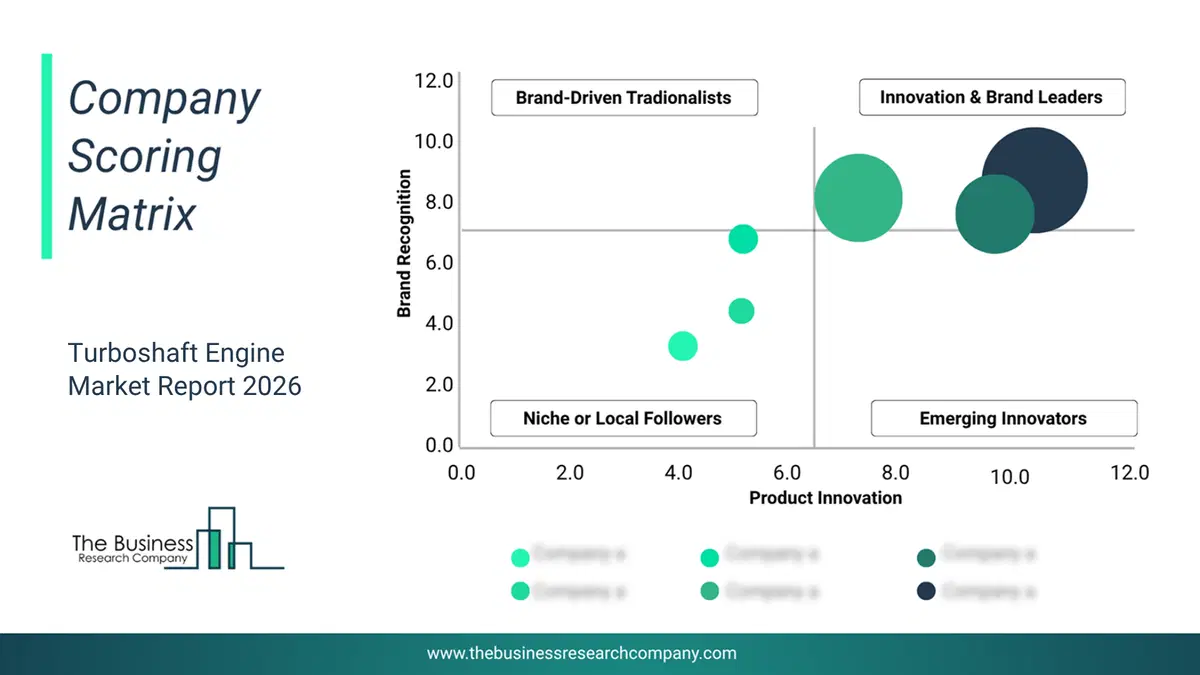
This chart maps companies by product innovation and brand strength, with bubble size indicating relative revenue, helping identify market leaders, challengers, and niche players. This is an illustrative chart; the full report provides a complete and accurate competitive analysis.
Global Turboshaft Engine Market Trends and Insights
Major companies in the turboshaft engine market are increasingly focusing on strategic collaborations to develop advanced free power turbines and high-efficiency engine components, aiming to enhance performance, reduce fuel consumption, and meet the stringent reliability and safety standards required for modern military and civil helicopters. A free power turbine (FPT) is a turbine in a turboshaft engine that operates independently of the engine's gas generator, extracting energy from exhaust gases to drive an output shaft such as a helicopter rotor without being mechanically connected to the compressor or turbine producing the engine's gas flow. For example, in June 2025, Avio Aero, an Italy-based company specializing in aviation propulsion systems, partnered with Safran Helicopter Engines, a France-based manufacturer of helicopter engines, and MTU Aero Engines, a Germany-based manufacturer of commercial and military aircraft engines, to develop next-generation military helicopter engines. This partnership is set to deliver advanced turboshaft engines featuring higher power-to-weight ratios, improved fuel efficiency, durable free power turbines, modular designs, and digital monitoring systems, enabling easier maintenance and enhanced helicopter performance while supporting European strategic autonomy.What Are Latest Mergers And Acquisitions In The Turboshaft Engine Market? McFarlane Acquires PMA To Expand FAA-PMA Parts Portfolio
In March 2024, McFarlane Aviation, a US-based aerospace manufacturer and distributor, acquired PMA Products, Inc. for an undisclosed amount. This acquisition aims to expand McFarlane's portfolio of FAA-PMA-approved replacement parts, strengthen its position in the general aviation aftermarket, and enhance its offerings for aircraft models including Piper, Beechcraft, Cessna, and PT6 turboshaft engines. PMA Products, Inc. is a US-based company that manufactures FAA-PMA-certified aircraft parts, including components for aircraft such as turboshaft engines.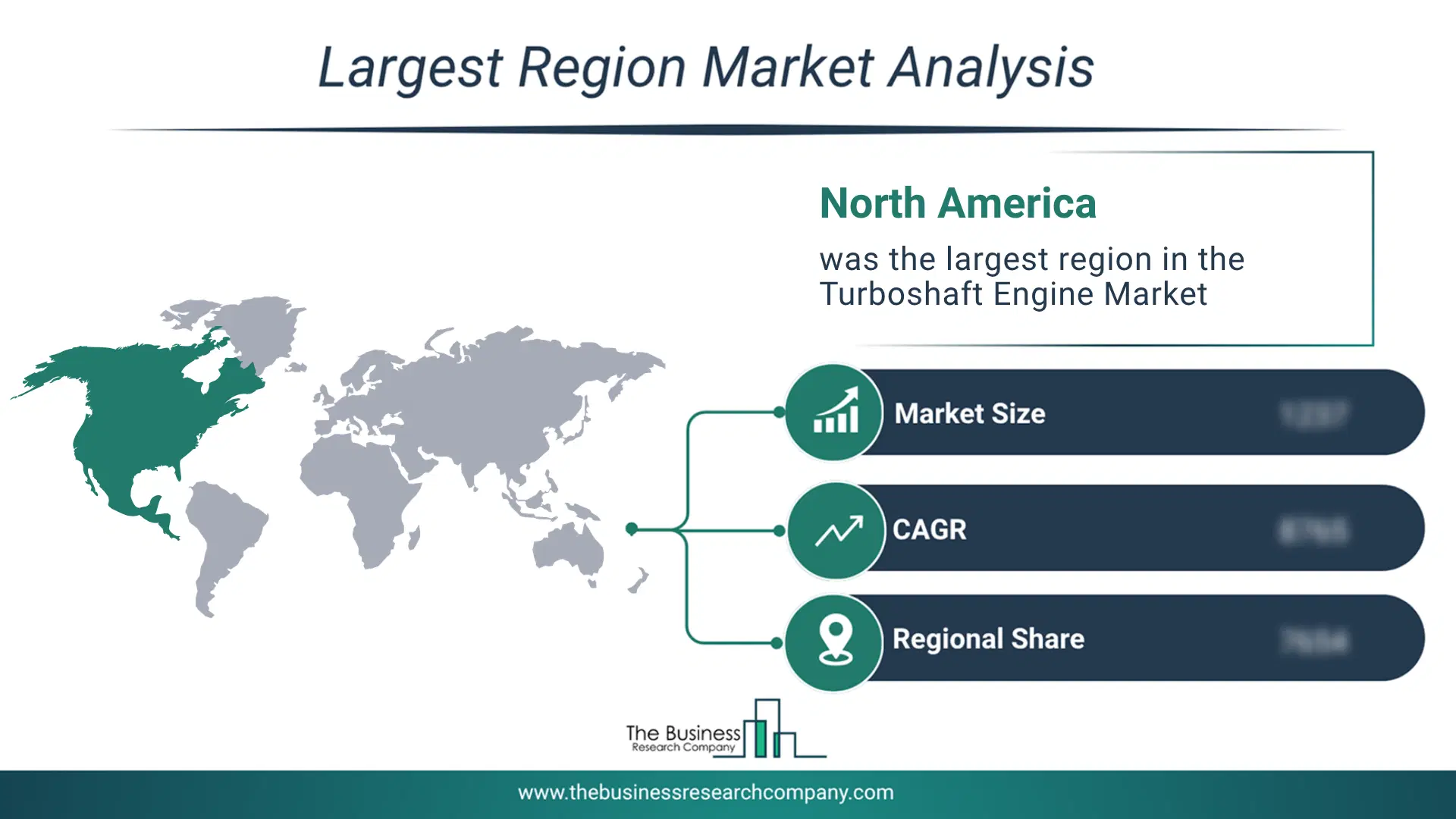
Regional Insights
North America was the largest region in the turboshaft engine market in 2025. Asia-Pacific is expected to be the fastest-growing region in the forecast period. The regions covered in this market report are Asia-Pacific, South East Asia, Western Europe, Eastern Europe, North America, South America, Middle East, Africa. The countries covered in this market report are Australia, Brazil, China, France, Germany, India, Indonesia, Japan, Taiwan, Russia, South Korea, UK, USA, Canada, Italy, SpainWhat Defines the Turboshaft Engine Market?
The turboshaft engine market consists of sales of products such as turbojet-turboshaft hybrid engines, free-turbine turboshaft engines, geared turboshaft engines, marine turboshaft engines, and industrial turboshaft engines. Values in this market are 'factory gate' values that is, the value of goods sold by the manufacturers or creators of the goods, whether to other entities (including downstream manufacturers, wholesalers, distributors, and retailers) or directly to end customers. The value of goods in this market includes related services sold by the creators of the goods.How is Market Value Defined and Measured?
The market value is defined as the revenues that enterprises gain from the sale of goods and/or services within the specified market and geography through sales, grants, or donations in terms of the currency (in USD unless otherwise specified). The revenues for a specified geography are consumption values that are revenues generated by organizations in the specified geography within the market, irrespective of where they are produced. It does not include revenues from resales along the supply chain, either further along the supply chain or as part of other products.
This chart presents market attractiveness based on a quantitative evaluation of growth, competition, strategic alignment, and risk, offering a clear view of opportunity areas for decision-making. This chart is for illustrative purposes; the full report contains the complete analysis.

This chart highlights the Total Addressable Market (TAM) by estimating the maximum revenue opportunity using an assumption-driven approach, supporting strategic planning and opportunity sizing across markets. The chart is illustrative; the full report provides a more comprehensive analysis.
What Key Data and Analysis Are Included in the Turboshaft Engine Market Report 2026?
The turboshaft engine market research report is one of a series of new reports from The Business Research Company that provides market statistics, including industry global market size, regional shares, competitors with the market share, detailed market segments, market trends and opportunities, and any further data you may need to thrive in the turboshaft engine industry. The market research report delivers a complete perspective of everything you need, with an in-depth analysis of the current and future state of the industry.Turboshaft Engine Market Report Forecast Analysis
| Report Attribute | Details |
|---|---|
| Market Size Value In 2026 | $5.95 billion |
| Revenue Forecast In 2030 | $7.84 billion |
| Growth Rate | CAGR of 7.1% from 2026 to 2030 |
| Base Year For Estimation | 2025 |
| Actual Estimates/Historical Data | 2020-2025 |
| Forecast Period | 2026 - 2030 |
| Market Representation | Revenue in USD Billion and CAGR from 2026 to 2030 |
| Segments Covered | Engine Type, Fuel Type, Power Rating, Application, End-User |
| Regional Scope | Asia-Pacific, Western Europe, Eastern Europe, North America, South America, Middle East, Africa |
| Country Scope | The countries covered in the turboshaft engine market report are Australia, Brazil, China, France, Germany, India, Indonesia, Japan, Taiwan, Russia, South Korea, UK, USA, Canada, Italy, Spain |
| Key Companies Profiled | Honeywell Aerospace Inc., GE Aerospace, Pratt & Whitney, Rolls-Royce Plc, Aero Engine Corporation of China, Kawasaki Heavy Industries (KHI), IHI Corporation, AVIC Engine Corporation, MTU Aero Engines AG, Safran Group, ITP Aero S.A. (Bain Capital), Harbin Engine Group Co. Ltd., PBS GROUP, TUSAS Engine Industries Inc., Avio Aero S.p.A., Jakadofsky GmbH, Klimov JSC, Konner S.r.l., Motor Sich JSC, Astro Mechanica |
| Customization Scope | Request for Customization |
| Pricing And Purchase Options | Explore Purchase Options |