
Ultra Pure Water Market Report 2026
Global Outlook – By Equipment (Filtration, Reverse Osmosis, Ultraviolet, Electro Deionization, Other Equipment), By Capacity Consideration (Large Scale, Small Scale), By Application (Washing Fluid, Process Feed ), By End User (Semiconductor, Power Generation, Flat Panel Display, Pharmaceuticals, Other End Users) – Market Size, Trends, Strategies, and Forecast to 2030
Ultra Pure Water Market Overview
• Ultra Pure Water market size has reached to $11.52 billion in 2025 • Expected to grow to $20.11 billion in 2030 at a compound annual growth rate (CAGR) of 11.8% • Growth Driver: Surging Demand For Ultrapure Water Fueled By Semiconductor Manufacturing Industry • Market Trend: Innovative Centralized Systems Redefine Ultra Pure Water Solutions • Asia-Pacific was the largest region and fastest growing region.What Is Covered Under Ultra Pure Water Market?
Ultrapure Water (UPW), also referred to as high-purity water or highly purified water, is water that has been subjected to exceptionally stringent purification processes to eliminate a wide array of contaminants, including organic and inorganic compounds, dissolved gases, and particulate matter, ensuring it meets the rigorous quality standards required for critical applications in industries such as semiconductors and pharmaceuticals. The main equipment of ultra-pure water are filtration, reverse osmosis, ultraviolet, electro deionization and other equipment. The filtration equipment of ultra-pure water are used to eliminate the chlorine, taste, and odor, and to remove many different contaminants from water. The ultra-pure water capacity comes in large scale and small scale that are applied in washing fluid and process feed, used in semiconductor, power generation, flat panel display, pharmaceuticals, and other end users.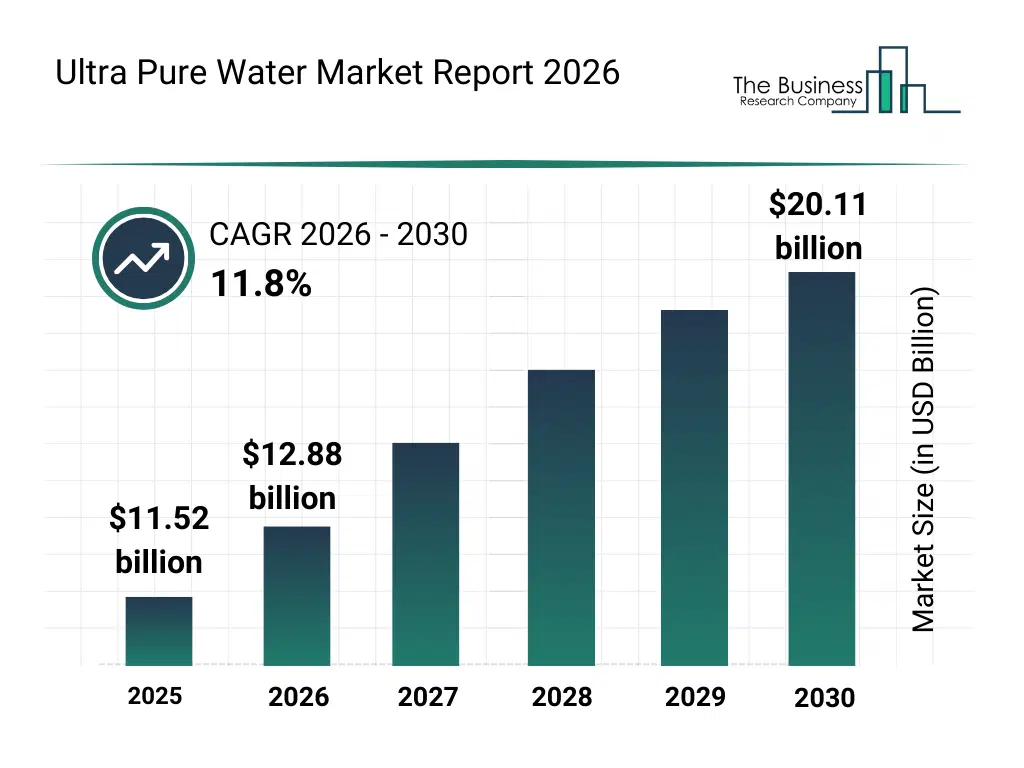
What Is The Ultra Pure Water Market Size and Share 2026?
The ultra pure water market size has grown rapidly in recent years. It will grow from $11.52 billion in 2025 to $12.88 billion in 2026 at a compound annual growth rate (CAGR) of 11.8%. The growth in the historic period can be attributed to growth of semiconductor fabrication plants, expansion of pharmaceutical manufacturing, increasing electronics production, rising industrial water purification needs, availability of advanced water treatment equipment.What Is The Ultra Pure Water Market Growth Forecast?
The ultra pure water market size is expected to see rapid growth in the next few years. It will grow to $20.11 billion in 2030 at a compound annual growth rate (CAGR) of 11.8%. The growth in the forecast period can be attributed to growth in chip manufacturing capacity, rising biologics production, increasing investment in cleanroom facilities, stricter water purity standards, technological advancements in water purification. Major trends in the forecast period include rising demand from semiconductor manufacturing, increasing use in pharmaceutical production, growing adoption of advanced filtration technologies, expansion of ultrapure water systems in electronics, rising focus on water quality consistency.
Global Ultra Pure Water Market Segmentation
1) By Equipment: Filtration, Reverse Osmosis, Ultraviolet, Electro Deionization, Other Equipment 2) By Capacity Consideration: Large Scale, Small Scale 3) By Application: Washing Fluid, Process Feed 4) By End User: Semiconductor, Power Generation, Flat Panel Display, Pharmaceuticals, Other End Users Subsegments: 1) By Filtration: Microfiltration, Ultrafiltration 2) By Reverse Osmosis: Single-Stage Reverse Osmosis, Multi-Stage Reverse Osmosis 3) By Ultraviolet: UV Disinfection Systems, UV Water Purification Systems 4) By Electro Deionization: Continuous Electro Deionization, Batch Electro Deionization 5) By Other Equipment: Ion Exchange Systems, Distillation UnitsWhat Is The Driver Of The Ultra Pure Water Market?
The increased usage in the semiconductor manufacturing industry is driving the demand for the ultrapure water market. The semiconductor manufacturing industry refers to the sector that includes companies involved in the production of semiconductors, where electronic devices are assembled by a series of nanofabrication procedures carried out on the surface of substrates consisting of extremely pure single crystal silicon. Ultrapure water is required at every semiconductor industry's manufacturing stage. Processes and water treatment technologies are needed to treat intake water to high-quality levels to eliminate pollutants, minerals, microbes, and trace organic and nonorganic compounds. For instance, in July 2024, according to a report published by the World Economic Forum, a Switzerland-based organization, producing ultrapure water requires approximately 1,400 to 1,600 gallons of municipal water to generate 1,000 gallons of ultrapure water. Currently, an average chip manufacturing facility can consume up to 10 million gallons of ultrapure water daily, which is equivalent to the daily water usage of 33,000 US households. Therefore, the increased use of ultra-pure water in the semiconductor manufacturing industry will drive the growth of the ultra-pure water market.Key Players In The Global Ultra Pure Water Market
Major companies operating in the ultra pure water market are General Electric Company, Veolia Environnement S.A., 3M Company, Danaher Corporation, Nalco Water an Ecolab Company, Ecolab Inc., DuPont de Nemours Inc., Suez S.A., Sartorius AG, Pentair plc, Pall Corporation, Kurita Water Industries Ltd., Evoqua Water Technologies LLC, Organo Corporation, Veolia Water Technologies Deutschland GmbH, Ovivo Inc., Osmoflo Holdings Pty Ltd., Applied Membranes Inc., Komal Water Industries, RODI Systems Corporation, EnviroFALK PharmaWaterSystems GmbH, Aqua Solutions Inc., MembraPure GmbH, Labtec Services AG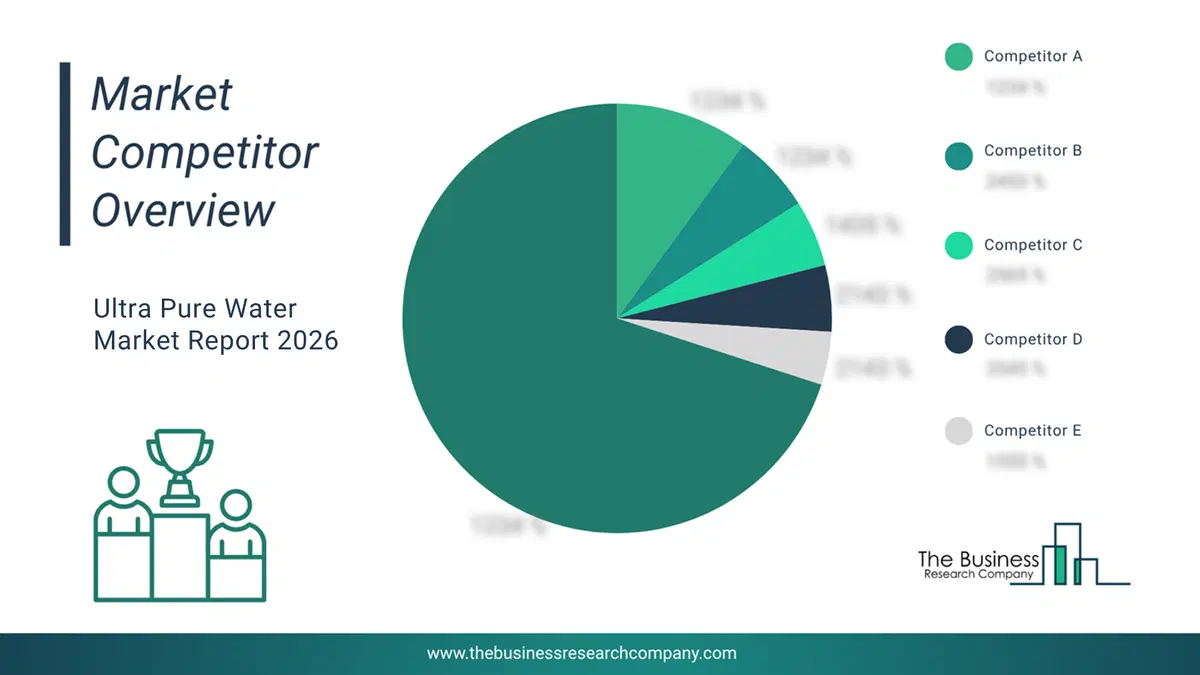
This chart is for illustrative purposes; the full report includes a detailed competitor analysis and comprehensive overview of the top 10 companies in the market.
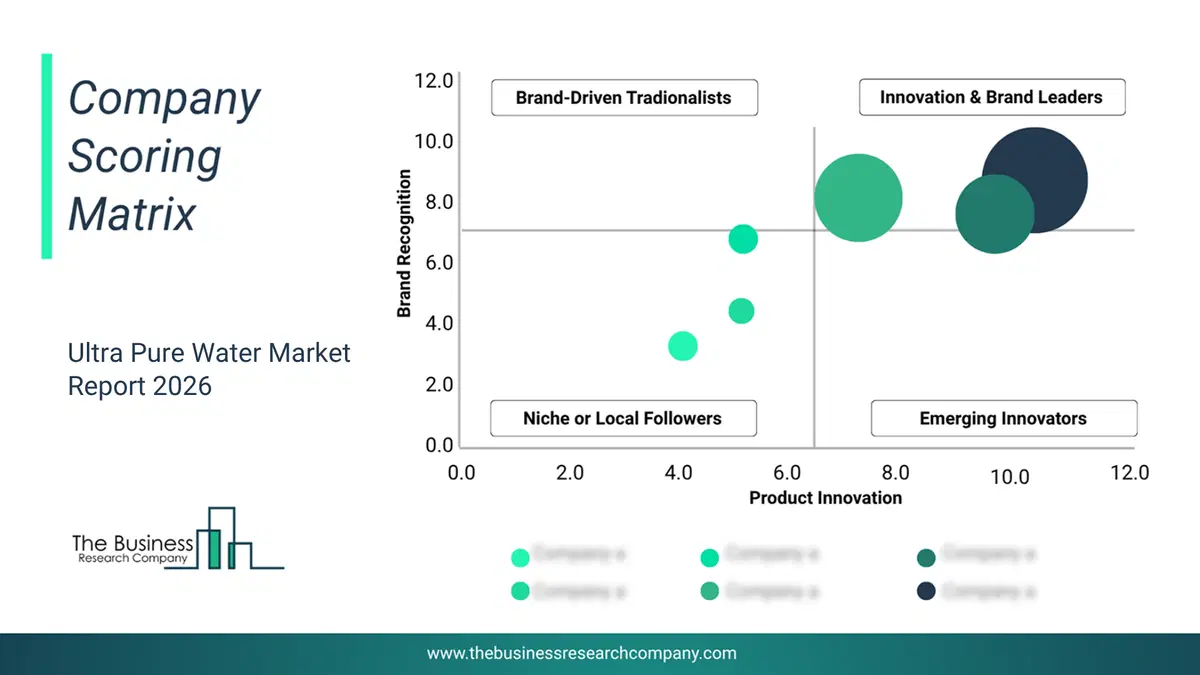
This chart maps companies by product innovation and brand strength, with bubble size indicating relative revenue, helping identify market leaders, challengers, and niche players. This is an illustrative chart; the full report provides a complete and accurate competitive analysis.
Global Ultra Pure Water Market Trends and Insights
Major companies operating in the ultra-pure water market are focusing on innovative products such as centralized laboratory water purification systems that fulfill different laboratory requirements and can be integrated with various water treatment technologies. A centralized laboratory water purification system is a cost-effective and efficient solution for providing high-purity, laboratory-grade water (Types I, II, and III) to multiple laboratory applications within a building. For instance, in January 2023, Envirogen Group, a UK-based industrial engineering company, launched LabPure, which is a centralized, energy-efficient ultra-pure water purification system designed for lab environments requiring ultra-pure water Type 1. It uses chemical-free RO-EDI technology and offers 150 to 1000 l/h flow rates for various applications. It meets regulatory and design compliance standards and can be adjusted to meet specific requirements, optimizing energy savings and space efficiency.What Are Latest Mergers And Acquisitions In The Ultra Pure Water Market?
In January 2023, MECO Inc., a US-based water purification solutions company, acquired the Water Works for an undisclosed amount. With this acquisition, Meco will strengthen its ultrapure water treatment portfolio for life science and biopharmaceutical customers. Water Works is a US-based manufacturer of water features, storm, sanitary sewer, and erosion control products, including ultra-pure water systems.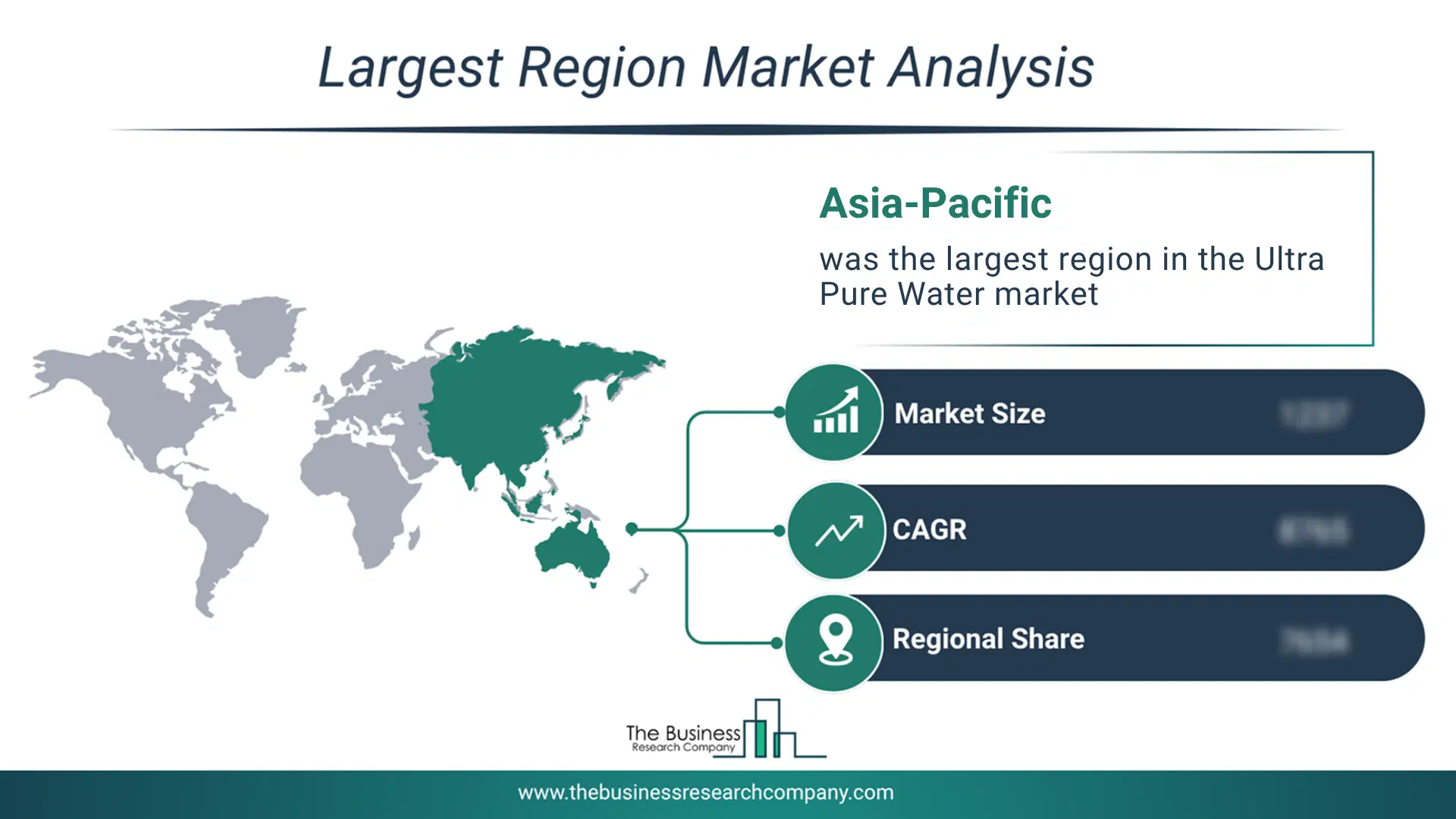
Regional Insights
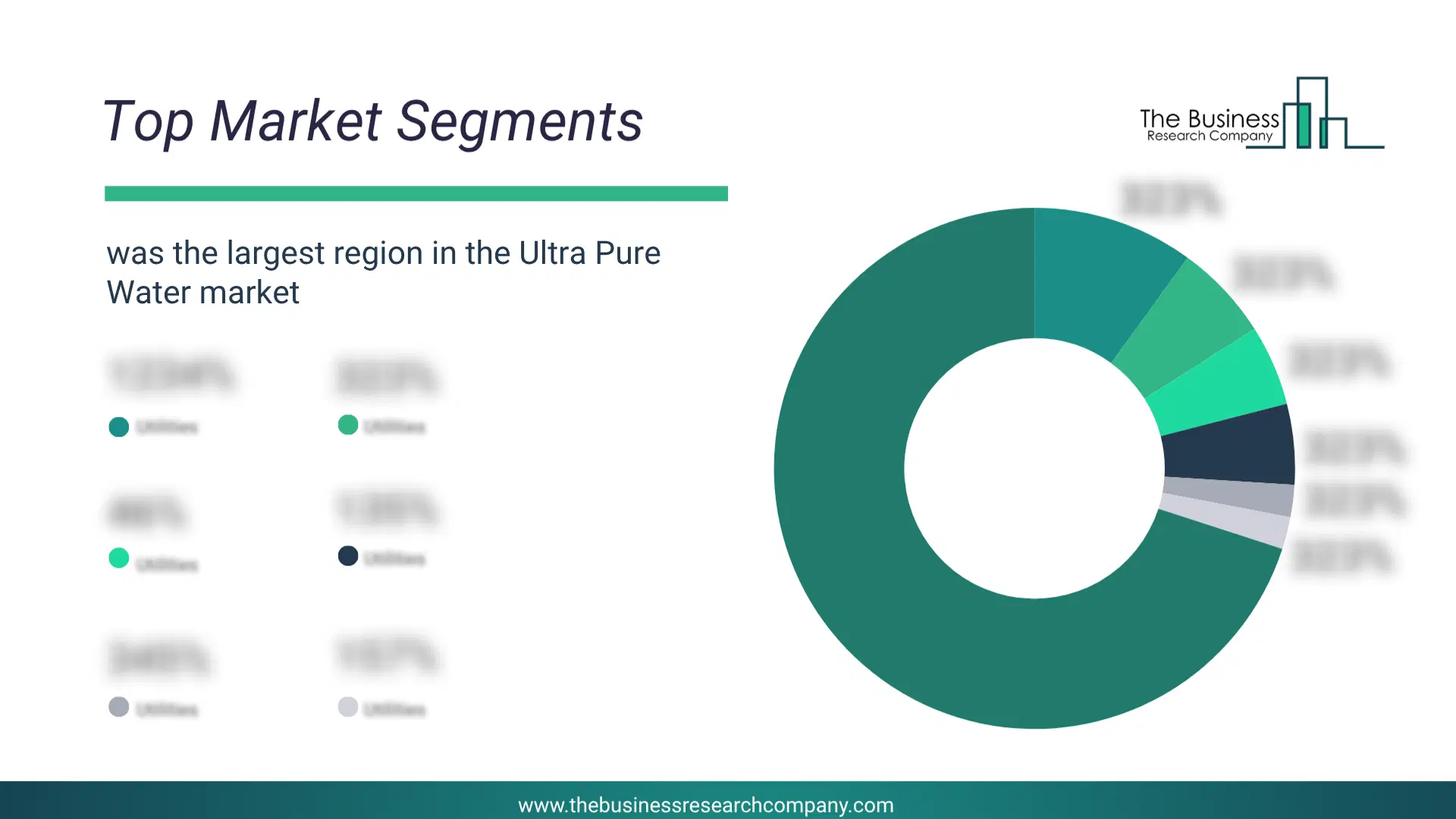
Asia-Pacific was the largest region in the ultra-pure water market in 2025. North America is expected to be the fastest-growing region in the forecast period. The regions covered in this market report are Asia-Pacific, South East Asia, Western Europe, Eastern Europe, North America, South America, Middle East, Africa The countries covered in this market report are Australia, Brazil, China, France, Germany, India, Indonesia, Japan, Taiwan, Russia, South Korea, UK, USA, Canada, Italy, SpainWhat Defines the Ultra Pure Water Market?
The ultra pure water market consists of sales of ultra-pure water used as consumables and others. The ultra pure water market includes filtration, reverse osmosis, ultraviolet, electro deionization. The market value includes the value of related goods sold by the service provider or included within the service offering. Only goods and services traded between entities or sold to end consumers are included.How is Market Value Defined and Measured?
The market value is defined as the revenues that enterprises gain from the sale of goods and/or services within the specified market and geography through sales, grants, or donations in terms of the currency (in USD unless otherwise specified). The revenues for a specified geography are consumption values that are revenues generated by organizations in the specified geography within the market, irrespective of where they are produced. It does not include revenues from resales along the supply chain, either further along the supply chain or as part of other products.
This chart presents market attractiveness based on a quantitative evaluation of growth, competition, strategic alignment, and risk, offering a clear view of opportunity areas for decision-making. This chart is for illustrative purposes; the full report contains the complete analysis.

This chart highlights the Total Addressable Market (TAM) by estimating the maximum revenue opportunity using an assumption-driven approach, supporting strategic planning and opportunity sizing across markets. The chart is illustrative; the full report provides a more comprehensive analysis.
What Key Data and Analysis Are Included in the Ultra Pure Water Market Report 2026?
The ultra pure water market research report is one of a series of new reports from The Business Research Company that provides market statistics, including industry global market size, regional shares, competitors with the market share, detailed market segments, market trends and opportunities, and any further data you may need to thrive in the ultra pure water industry. The market research report delivers a complete perspective of everything you need, with an in-depth analysis of the current and future state of the industry.Ultra Pure Water Market Report Forecast Analysis
| Report Attribute | Details |
|---|---|
| Market Size Value In 2026 | $12.88 billion |
| Revenue Forecast In 2030 | $20.11 billion |
| Growth Rate | CAGR of 11.8% from 2026 to 2030 |
| Base Year For Estimation | 2025 |
| Actual Estimates/Historical Data | 2020-2025 |
| Forecast Period | 2026 - 2030 |
| Market Representation | Revenue in USD Billion and CAGR from 2026 to 2030 |
| Segments Covered | Equipment, Capacity Consideration, Application, End User |
| Regional Scope | Asia-Pacific, Western Europe, Eastern Europe, North America, South America, Middle East, Africa |
| Country Scope | The countries covered in this market report are Australia, Brazil, China, France, Germany, India, Indonesia, Japan, Taiwan, Russia, South Korea, UK, USA, Canada, Italy, Spain |
| Key Companies Profiled | General Electric Company, Veolia Environnement S.A., 3M Company, Danaher Corporation, Nalco Water an Ecolab Company, Ecolab Inc., DuPont de Nemours Inc., Suez S.A., Sartorius AG, Pentair plc, Pall Corporation, Kurita Water Industries Ltd., Evoqua Water Technologies LLC, Organo Corporation, Veolia Water Technologies Deutschland GmbH, Ovivo Inc., Osmoflo Holdings Pty Ltd., Applied Membranes Inc., Komal Water Industries, RODI Systems Corporation, EnviroFALK PharmaWaterSystems GmbH, Aqua Solutions Inc., MembraPure GmbH, Labtec Services AG |
| Customization Scope | Request for Customization |
| Pricing And Purchase Options | Explore Purchase Options |