
Connected Retail Market Report 2026
Global Outlook – By Component (Hardware, Software, Services), By Technology (ZigBee, NFC (Near Field Communication), Bluetooth Low Energy, Wi-Fi, Other Technologies), By Application (Electronics And Appliances, Home And Personal Care, Food And Beverage, Apparel, Sporting Goods And Toys, Other Applications) – Market Size, Trends, Strategies, and Forecast to 2030
Connected Retail Market Overview
• Connected Retail market size has reached to $51.32 billion in 2025 • Expected to grow to $123.94 billion in 2030 at a compound annual growth rate (CAGR) of 19.3% • Growth Driver: The Increasing Adoption Of IoT Fueling The Growth Of The Connected Retail Market Due To Enhanced Device Connectivity And Data-Driven Retail Operations • Market Trend: 2D Barcodes With GS1 Digital Link Accelerate Omnichannel Experiences And POS Interoperability • North America was the largest region in 2025.What Is Covered Under Connected Retail Market?
Connected retail refers to the integration of various digital technologies and platforms to create a seamless and unified shopping experience for consumers across online and offline channels. It is used to seamlessly connect businesses with customers by using personalised marketing, fusing the analogue and digital shopping experiences, enhancing the supply chain, offering a variety of payment options, and equipping staff with the resources they need to collaborate more effectively. The main components of connected retail are hardware, software, and services. Software such as point-of-sale (POS) software is used at checkout counters in retail stores to process sales transactions, manage inventory, and handle payment processing. The various technologies include Zigbee, NFC (Near Field Communication), Bluetooth low energy, wi-fi, and other technologies, that are used in various applications such as electronics and appliances, home and personal care, food and beverage, apparel, sporting goods and toys, and others.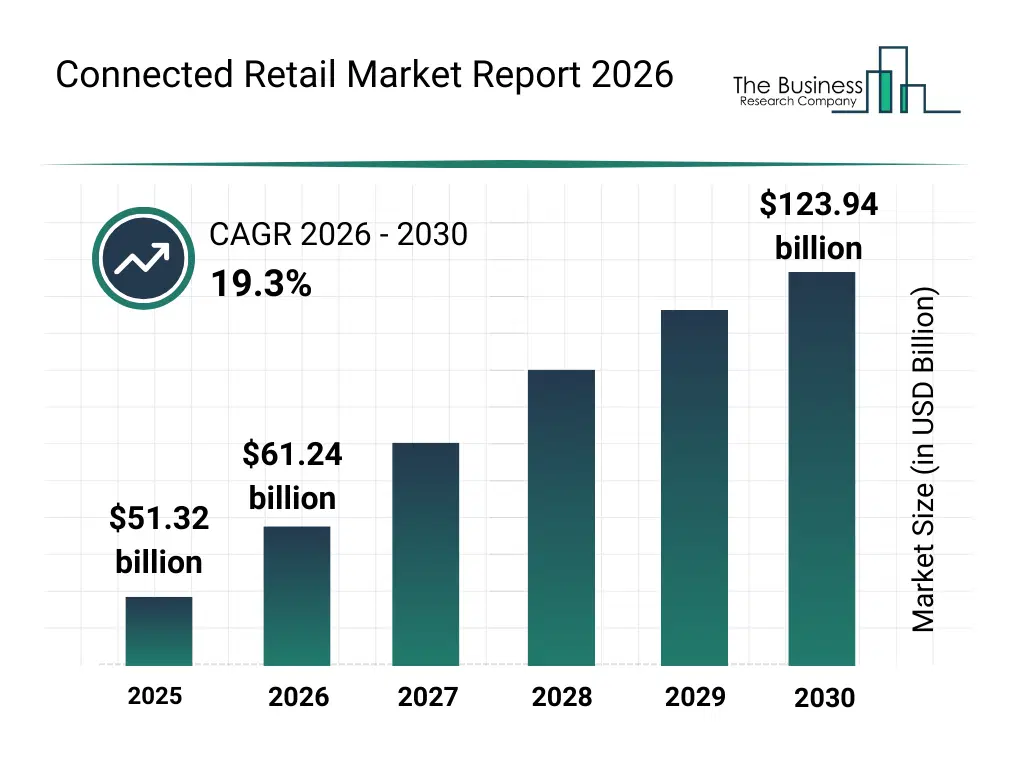
What Is The Connected Retail Market Size and Share 2026?
The connected retail market size has grown rapidly in recent years. It will grow from $51.32 billion in 2025 to $61.24 billion in 2026 at a compound annual growth rate (CAGR) of 19.3%. The growth in the historic period can be attributed to growth of e-commerce platforms, demand for seamless shopping experiences, adoption of digital payment systems, rise of customer analytics tools, expansion of retail automation.What Is The Connected Retail Market Growth Forecast?
The connected retail market size is expected to see rapid growth in the next few years. It will grow to $123.94 billion in 2030 at a compound annual growth rate (CAGR) of 19.3%. The growth in the forecast period can be attributed to integration of ai-driven personalization, adoption of iot-enabled retail systems, growth of contactless payments, demand for data-driven merchandising, expansion of smart retail stores. Major trends in the forecast period include omnichannel retail integration, smart in-store technologies, personalized customer engagement platforms, connected payment and checkout systems, real-time inventory visibility solutions.
Global Connected Retail Market Segmentation
1) By Component: Hardware, Software, Services 2) By Technology: ZigBee, NFC (Near Field Communication), Bluetooth Low Energy, Wi-Fi, Other Technologies 3) By Application: Electronics And Appliances, Home And Personal Care, Food And Beverage, Apparel, Sporting Goods And Toys, Other Applications Subsegments: 1) By Hardware: Point Of Sale (POS) Systems, IoT Devices, Digital Signage, Self-Service Kiosks 2) By Software: Inventory Management Systems, Customer Relationship Management (CRM) Software, Analytics And Reporting Software, Payment Processing Software 3) By Services: Consulting Services, Integration Services, Support And Maintenance Services, Managed ServicesWhat Is The Driver Of The Connected Retail Market?
The increasing adoption of the Internet of Things (IoT) is expected to propel the growth of the connected retail market going forward. The Internet of Things (IoT) is a networked system of interconnected computing devices, mechanical and electronic machinery with unique identities (UIDs), and the capacity to transfer data without needing human-to-human or human-to-computer contact. The rise of IoT adoption is due to businesses and consumers seeking real-time connectivity, automated operations, and smarter decision-making through seamless device integration and data-driven insights. The Internet of Things (IoT) enables connected retail by utilising interconnected devices to gather real-time data, enhance customer experiences, and optimise operational efficiency. For instance, in February 2025, according to Ubisense, an England-based software company, in 2023, connected Internet of Things (IoT) devices reached 16.6 billion, a 15% increase from 2022. Therefore, the increasing adoption of the Internet of Things is driving the growth of the connected retail industry.Key Players In The Global Connected Retail Market
Major companies operating in the connected retail market are Microsoft Corporation; Zebra Technologies Corporation; Intel Corporation; PTC Inc.; SAP SE; Cisco Systems Inc.; International Business Machines Corporation; Google LLC; NXP Semiconductors N.V.; Softweb Solutions Inc.; Honeywell International Inc.; Sonata Software Limited; iVend Retail; Avanade Inc.; Fujitsu Limited; Verizon Enterprise Solutions; Amazon Inc.; ARM Holdings PLC.; Belatrix Software Private Limited; Samsung Electronics Co. Ltd.; Toshiba Corporation; Siemens AG; Wipro Limited; Accenture plc; Capgemini SE; Infosys Limited; NEC Corporation; Tata Consultancy Services Limited; DXC Technology Company
This chart is for illustrative purposes; the full report includes a detailed competitor analysis and comprehensive overview of the top 10 companies in the market.
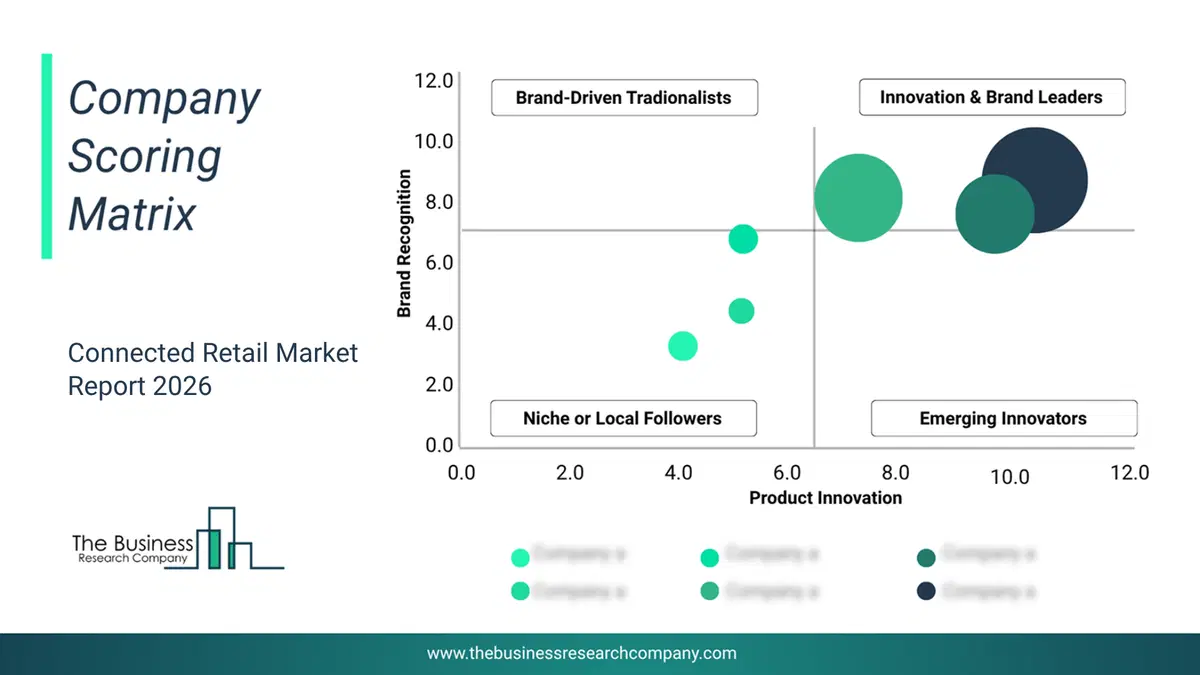
This chart maps companies by product innovation and brand strength, with bubble size indicating relative revenue, helping identify market leaders, challengers, and niche players. This is an illustrative chart; the full report provides a complete and accurate competitive analysis.
Global Connected Retail Market Trends and Insights
Major companies operating in the connected retail market are focusing on developing advanced solutions, such as digital product interaction, to enhance customer engagement, provide transparent product information, and improve shopping experiences. Digital product interaction refers to a technological feature that allows consumers to access detailed product information, origin, and sustainability data directly through a digital interface, helping them make informed purchasing decisions. For instance, in October 2024, Carrefour SA, a France-based retail company, introduced “QR Codes powered by GS1” on its private-label wine range. The rollout gives shoppers transparent product details and origin information at scan and prepares stores for POS compatibility with next-generation 2D symbols that support richer customer engagement and supply chain visibility.What Are Latest Mergers And Acquisitions In The Connected Retail Market?
In July 2023, Omnicom Media Group, a US-based cloud-based retail media network company, announced the acquisition of Outpromo and Global Shopper for an undisclosed amount. Through this acquisition, Omnicom Media Group is establishing the groundwork for a specialised e-commerce and retail media performance agency in the Brazilian market. Outpromo is a Brazil-based omnichannel commerce agency focused on strategising and implementing brand encounters across both physical and digital landscapes, and Global Shopper is a Brazil-based connected commerce agency.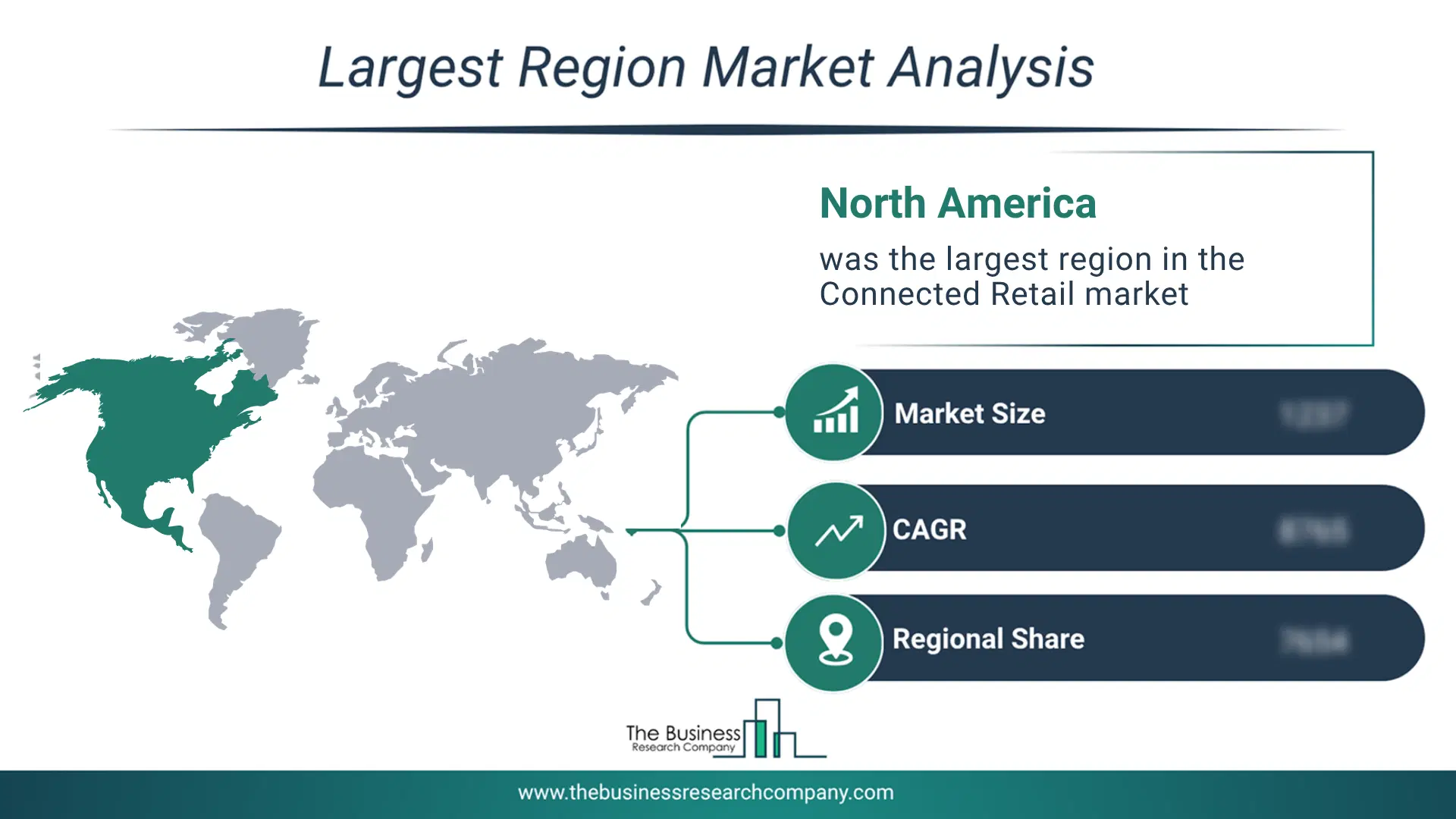
Regional Insights
North America was the largest region in the connected retail market in 2025. Asia-Pacific is expected to be the fastest-growing region in the global connected retail market during the forecast period. The regions covered in this market report are Asia-Pacific, South East Asia, Western Europe, Eastern Europe, North America, South America, Middle East, Africa. The countries covered in this market report are Australia, Brazil, China, France, Germany, India, Indonesia, Japan, Taiwan, Russia, South Korea, UK, USA, Canada, Italy, SpainWhat Defines the Connected Retail Market?
The connected retail market includes revenues earned by providing click-and-collect or BOPIS (buy online, pick up in-store) services, in-store navigation and wayfinding, mobile payments and checkout, supply chain optimization, virtual and augmented reality (VR and AR) experiences, loyalty programs, and smart shelf management. The market value includes the value of related goods sold by the service provider or included within the service offering. The connected retail market also includes sales of connected systems and IoT-enabled devices, which are used for providing connected retail services. Values in this market are ‘factory gate’ values, that is the value of goods sold by the manufacturers or creators of the goods, whether to other entities (including downstream manufacturers, wholesalers, distributors and retailers) or directly to end customers. The value of goods in this market includes related services sold by the creators of the goods.How is Market Value Defined and Measured?
The market value is defined as the revenues that enterprises gain from the sale of goods and/or services within the specified market and geography through sales, grants, or donations in terms of the currency (in USD unless otherwise specified). The revenues for a specified geography are consumption values that are revenues generated by organizations in the specified geography within the market, irrespective of where they are produced. It does not include revenues from resales along the supply chain, either further along the supply chain or as part of other products.
This chart presents market attractiveness based on a quantitative evaluation of growth, competition, strategic alignment, and risk, offering a clear view of opportunity areas for decision-making. This chart is for illustrative purposes; the full report contains the complete analysis.

This chart highlights the Total Addressable Market (TAM) by estimating the maximum revenue opportunity using an assumption-driven approach, supporting strategic planning and opportunity sizing across markets. The chart is illustrative; the full report provides a more comprehensive analysis.
What Key Data and Analysis Are Included in the Connected Retail Market Report 2026?
The connected retail market research report is one of a series of new reports from The Business Research Company that provides market statistics, including industry global market size, regional shares, competitors with the market share, detailed market segments, market trends and opportunities, and any further data you may need to thrive in the connected retail industry. The market research report delivers a complete perspective of everything you need, with an in-depth analysis of the current and future state of the industry.Connected Retail Market Report Forecast Analysis
| Report Attribute | Details |
|---|---|
| Market Size Value In 2026 | $61.24 billion |
| Revenue Forecast In 2030 | $123.94 billion |
| Growth Rate | CAGR of 19.3% from 2026 to 2030 |
| Base Year For Estimation | 2025 |
| Actual Estimates/Historical Data | 2020-2025 |
| Forecast Period | 2026 - 2030 |
| Market Representation | Revenue in USD Billion and CAGR from 2026 to 2030 |
| Segments Covered | Component, Technology, Application |
| Regional Scope | Asia-Pacific, Western Europe, Eastern Europe, North America, South America, Middle East, Africa |
| Country Scope | The Countries Covered In This Market Report Are Australia, Brazil, China, France, Germany, India, Indonesia, Japan, Taiwan, Russia, South Korea, Uk, Usa, Canada, Italy, Spain. |
| Key Companies Profiled | Microsoft Corporation, Zebra Technologies Corporation, Intel Corporation, PTC Inc., SAP SE, Cisco Systems Inc., International Business Machines Corporation, Google LLC, NXP Semiconductors N.V., Softweb Solutions Inc., Honeywell International Inc., Sonata Software Limited, iVend Retail, Avanade Inc., Fujitsu Limited, Verizon Enterprise Solutions, Amazon Inc., ARM Holdings PLC., Belatrix Software Private Limited, Samsung Electronics Co. Ltd., Toshiba Corporation, Siemens AG, Wipro Limited, Accenture plc, Capgemini SE, Infosys Limited, NEC Corporation, Tata Consultancy Services Limited, DXC Technology Company |
| Customization Scope | Request for Customization |
| Pricing And Purchase Options | Explore Purchase Options |