
Food Away From Home Market Report 2026
Global Outlook – By Type Of Occasion (Entertainment, Travel, Retail, Freestanding), By Ownership Type (Independent, Chains), By Delivery Model (Dine In, Take Away, Home Delivery), By Application (Restaurants, Schools And Colleges, Hotels And Motels, Retail Stores And Vending, Other Applications) – Market Size, Trends, Strategies, and Forecast to 2030
Food Away From Home Market Overview
• Food Away From Home market size has reached to $4833.08 billion in 2025 • Expected to grow to $5952.18 billion in 2030 at a compound annual growth rate (CAGR) of 4.2% • Growth Driver: Expansion Of Fast-Food Restaurants Driving Growth In Food-Away-From-Home Market • Market Trend: Enhancing Operational Efficiency And Empowering Workforce Through AI-First Strategy In Fast Food Chains • North America was the largest region in 2025 and Asia-Pacific is the fastest growing region.Market Gains By 2030 – Top Opportunities By Segment
Market Gain identifies the most promising market opportunities by highlighting the segments or products expected to generate the highest incremental revenue growth over the next five years.
What Is Covered Under Food Away From Home Market?
Food away from home refers to meals made and consumed outside of one's home, usually in restaurants, cafes, or other dining venues. The main objectives of food away from home are convenience, socialization, and enjoyment, allowing people to try new foods, socialize with others, and enjoy professionally cooked meals without having to cook themselves. The main types of occasions for food away from home are entertainment, travel, retail, and freestanding. Entertainment refers to dining experiences linked with leisure activities such as movies, concerts, or sports events. The ownership type includes independents and chains, for several delivery models such as dine-in, take-away, and home delivery. They are used in various applications including restaurants, schools and colleges, hotels and motels, retail stores and vending, and others.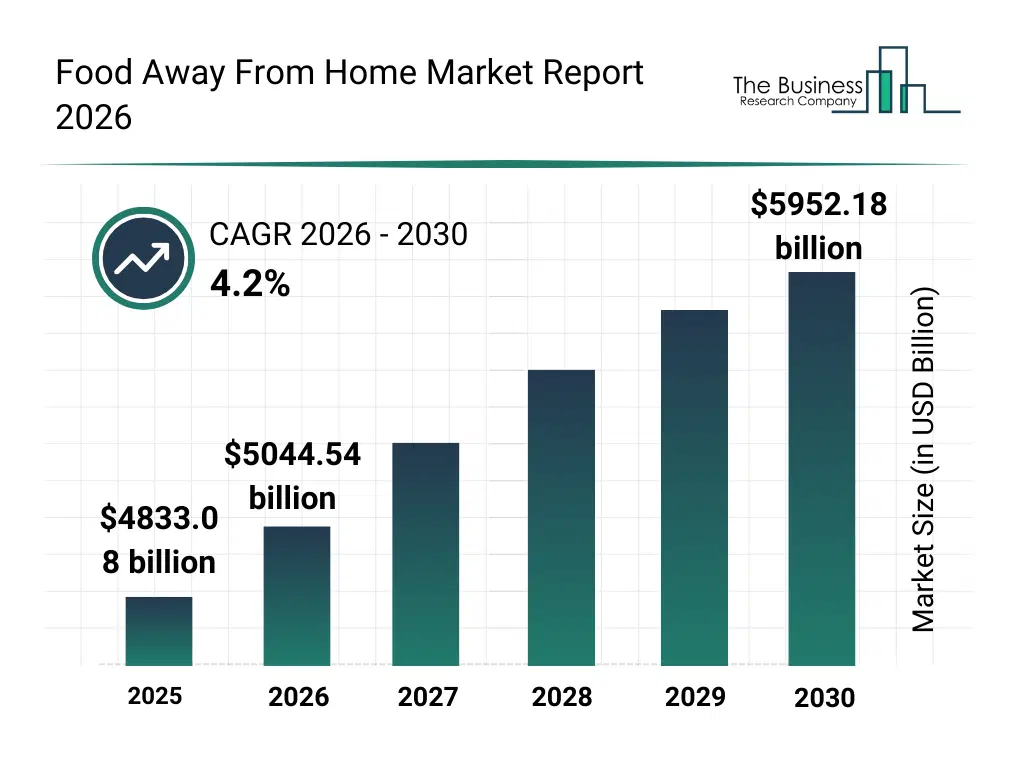
What Is The Food Away From Home Market Size and Share 2026?
The food away from home market size has grown steadily in recent years. It will grow from $4833.08 billion in 2025 to $5044.54 billion in 2026 at a compound annual growth rate (CAGR) of 4.4%. The growth in the historic period can be attributed to urbanization and changing lifestyles, growth of restaurant culture, rising disposable incomes, expansion of tourism and travel dining, increasing participation of women in the workforce.What Is The Food Away From Home Market Growth Forecast?
The food away from home market size is expected to see steady growth in the next few years. It will grow to $5952.18 billion in 2030 at a compound annual growth rate (CAGR) of 4.2%. The growth in the forecast period can be attributed to increasing penetration of food delivery apps, expansion of cloud kitchens, rising demand for personalized dining experiences, growth of sustainable and ethical dining, increasing use of digital payments in food services. Major trends in the forecast period include increasing adoption of online food ordering platforms, rising demand for convenience dining options, growing expansion of chain restaurants, enhanced focus on experiential dining concepts, expansion of delivery and takeaway models.
Global Food Away From Home Market Segmentation
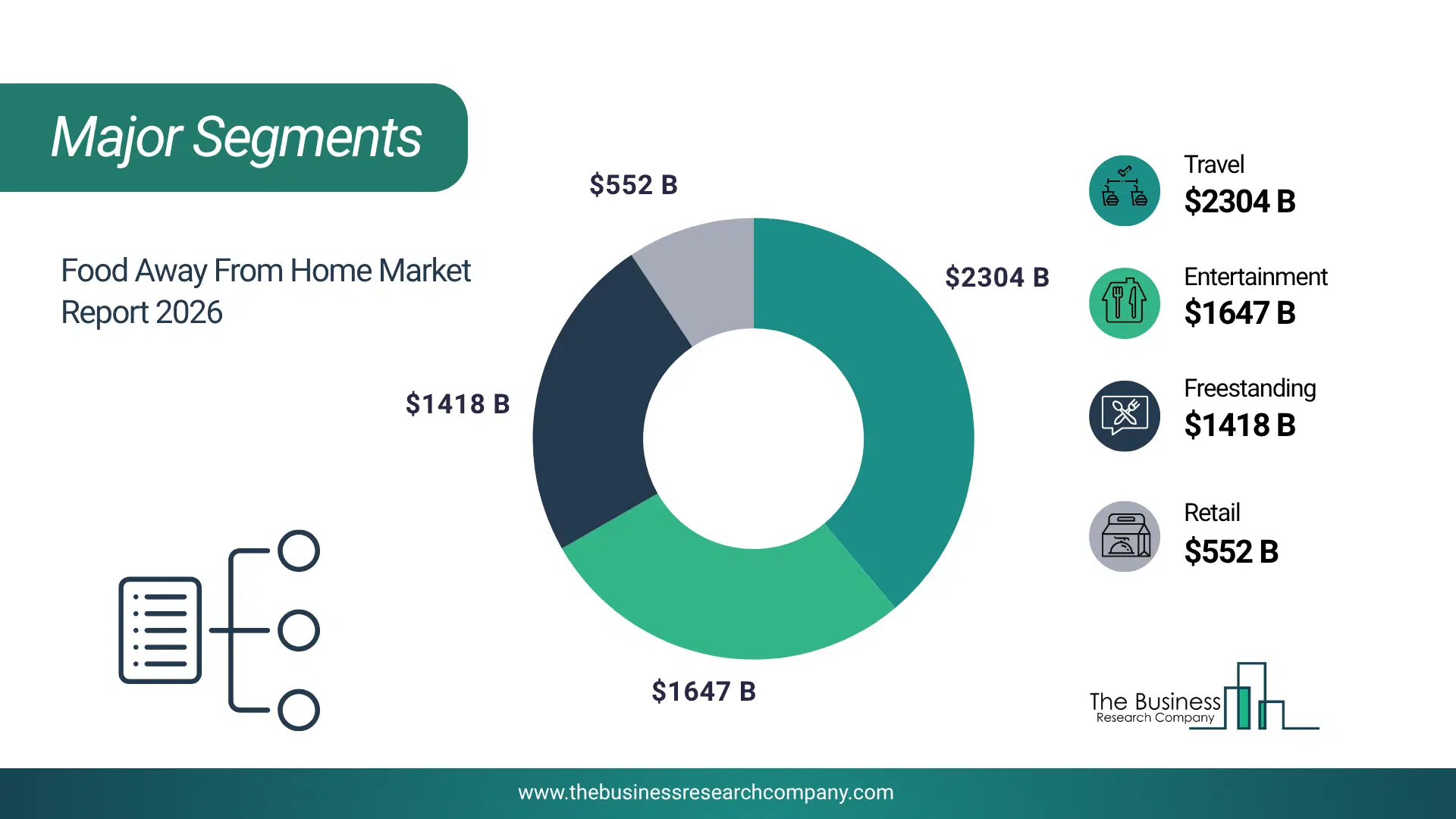
1) By Type Of Occasion: Entertainment, Travel, Retail, Freestanding 2) By Ownership Type: Independent, Chains 3) By Delivery Model: Dine In, Take Away, Home Delivery 4) By Application: Restaurants, Schools And Colleges, Hotels And Motels, Retail Stores And Vending, Other Applications Subsegments: 1) By Entertainment: Theater Dining, Concert And Event Catering, Amusement Park Food Services, Sports Venue Concessions, Cinema Food And Beverage Services 2) By Travel: Airport Food Services, Railway Station Food Outlets, Highway Rest Stop Dining, On-Board Catering (Airlines, Trains, Cruises), Hotel Restaurants 3) By Retail: Food Courts, In-Store Cafes, Supermarket And Grocery Deli Counters, Convenience Store Food Services, Specialty Retail Cafes (e.g., Bookstore Cafes) 4) By Freestanding: Casual Dining Restaurants, Fine Dining Restaurants, Fast Food Outlets, Food Trucks And Street Vendors, Coffee Shops And Cafés The top segments in the food away from home market will be: • Travel will reach $2303.83 Billion by 2030. • Entertainment will reach $1647.32 Billion by 2030. • Freestanding will reach $1418.24 Billion by 2030. • Retail will reach $551.51 Billion by 2030.What Is The Driver Of The Food Away From Home Market?
The growing expansion of fast-food restaurants is expected to propel the growth of the food-away-from-home market going forward. Fast-food restaurants also referred to as fast food outlets, are a type of restaurant that serves quickly prepared and pre-cooked meals with limited table service. The rise of fast-food restaurants is driven by demand for convenient and diverse dining options, busy lifestyles, and evolving taste preferences. Fast-food restaurants, offering quick and affordable meal options, attract busy individuals and cost-conscious consumers with their value meals and promotions. For instance, in 2024, according to Aviko, a Netherlands-based food company, the UK fast food industry rose from 20.61 billion in 2022 to 22.04 billion in 2023. The number of UK consumers who ate in fast-food restaurants increased to 45% in 2023. Therefore, the growing expansion of fast-food restaurants is driving the growth of the food-away-from-home market.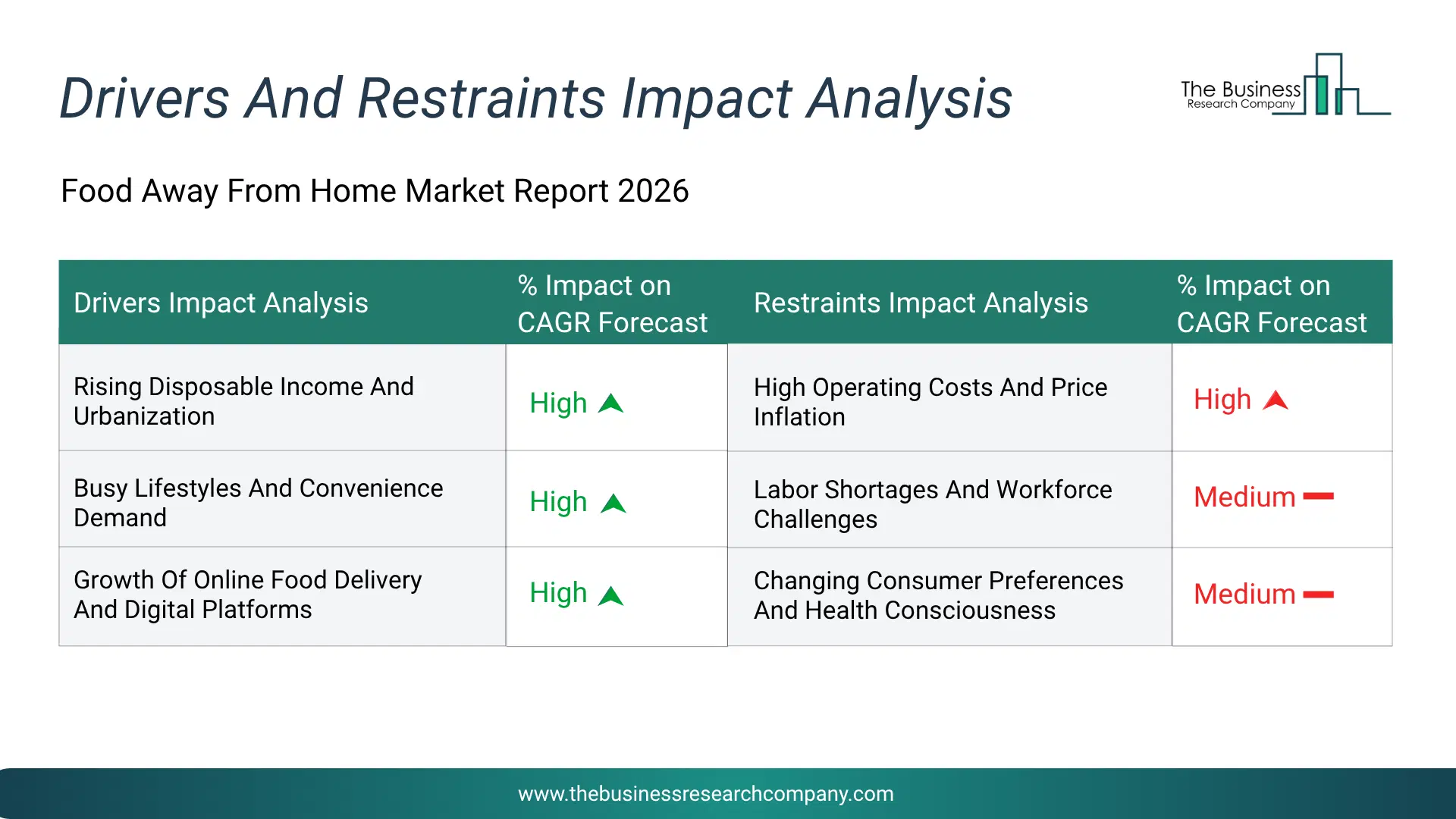
Infographic Chart Showing Key Market Drivers Analysis And Restraints For Food Away From Home Market
The chart presents an impact analysis of key drivers and restraints, quantifying their relative influence on the market's growth rate and helping assess the balance between growth enablers and limiting factors. This chart offers a high-level perspective; the full report contains more detailed insights.
How Will The Drivers Impact Growth In The Global Food Away From Home Market?
• Rising Disposable Income And Urbanization (High) – During the forecast period, the rising disposable income and urbanization are expected to become key growth drivers for the food away from home market by 2030. Expanding middle-class populations and improving purchasing power are encouraging consumers to spend more on dining experiences outside the home. Rapid urban development is also increasing access to restaurants, cafés, food courts, and other foodservice establishments. As cities continue to expand, consumers are seeking greater variety, convenience, and premium food offerings that support higher spending on away-from-home meals. This shift toward increased foodservice consumption is reinforcing sustained market expansion. • Busy Lifestyles And Convenience Demand (High) – During the forecast period, the busy lifestyles and convenience demand are expected to emerge as major factors driving the expansion of the food away from home market by 2030. Increasing workforce participation, longer commuting times, and fast-paced daily routines are reducing the time available for home meal preparation. Consumers are increasingly relying on quick-service restaurants, ready-to-eat meals, and convenient dining formats to meet their food consumption needs. Foodservice providers are responding by enhancing speed, accessibility, and menu flexibility to attract time-conscious customers. • Growth Of Online Food Delivery And Digital Platforms (High) – During the forecast period, the growth of online food delivery and digital platforms is expected to act as a key growth catalyst for the food away from home market by 2030. The widespread adoption of mobile applications, digital payment systems, and integrated ordering platforms is making food purchasing more accessible and efficient for consumers. Restaurants and foodservice operators are increasingly leveraging technology to expand customer reach, improve order management, and enhance consumer engagement. The growing digital ecosystem is also enabling personalized promotions and seamless purchasing experiences that encourage higher order frequency.How Will The Restraints Impact Growth In The Global Food Away From Home Market?
• High Operating Costs And Price Inflation (High) – During the forecast period, the high operating costs and rising price inflation act as a major restraint in the food away from home market by increasing overall business expenses for restaurants and dining establishments. Expenses such as rent, utilities, ingredients, and maintenance continuously fluctuate, making profit margins tighter for operators. Additionally, food price inflation directly impacts menu pricing, which can reduce customer demand as dining out becomes more expensive. This creates a balancing challenge between maintaining affordability and sustaining profitability. As a result, many small and medium food service providers struggle to remain competitive in the market. • Labor Shortages And Workforce Challenges (High) – During the forecast period, the labor shortages and workforce-related challenges significantly restrain the growth of the food away from home market by affecting service quality and operational efficiency. The industry heavily depends on skilled chefs, servers, and support staff, but high turnover rates and difficulty in hiring reduce workforce stability. Increasing labor costs further add pressure on businesses, especially small restaurants with limited budgets. This often leads to reduced operating hours or compromised service standards. Consequently, these challenges hinder smooth business operations and limit market expansion potential. • Changing Consumer Preferences And Health Consciousness (High) – During the forecast period, the changing consumer preferences and increasing health consciousness act as a restraint for the food away from home market by reducing frequent dining out behavior. Many consumers are becoming more aware of nutrition, calories, and ingredient quality, leading them to prefer home-cooked or healthier alternatives. Demand for organic, low-fat, and clean-label foods puts additional pressure on food service providers to modify menus, which can increase operational complexity. Additionally, shifting lifestyle habits such as home delivery and meal prepping reduce restaurant visits. This evolving consumer behavior impacts overall revenue growth in the sector.Key Players In The Global Food Away From Home Market
Major companies operating in the food away from home market are Starbucks Corporation, Compass Group PLC, Sodexo, McDonald's, Aramark, Subway IP LLC, Darden Concepts Inc., Chipotle Mexican Grill, Yum Brands, Restaurant Brands International Inc., Zensho Holdings Co. Ltd., Whataburger, Domino's Pizza, Panda Restaurant Group Inc., Brinker International Inc., Greene King, SATS Ltd., Burger King Company LLC, Papa John's International Inc., Shake Shack, Jubilant FoodWorks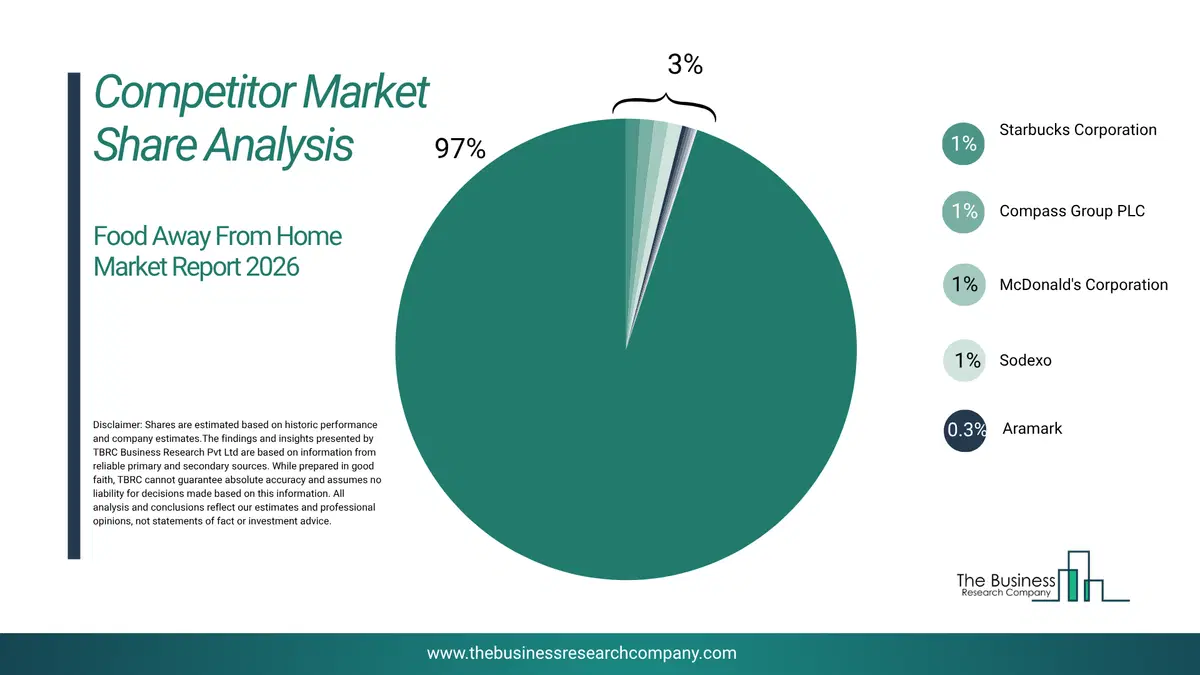
This chart is for illustrative purposes; the full report includes a detailed competitor analysis and comprehensive overview of the top 10 companies in the market.
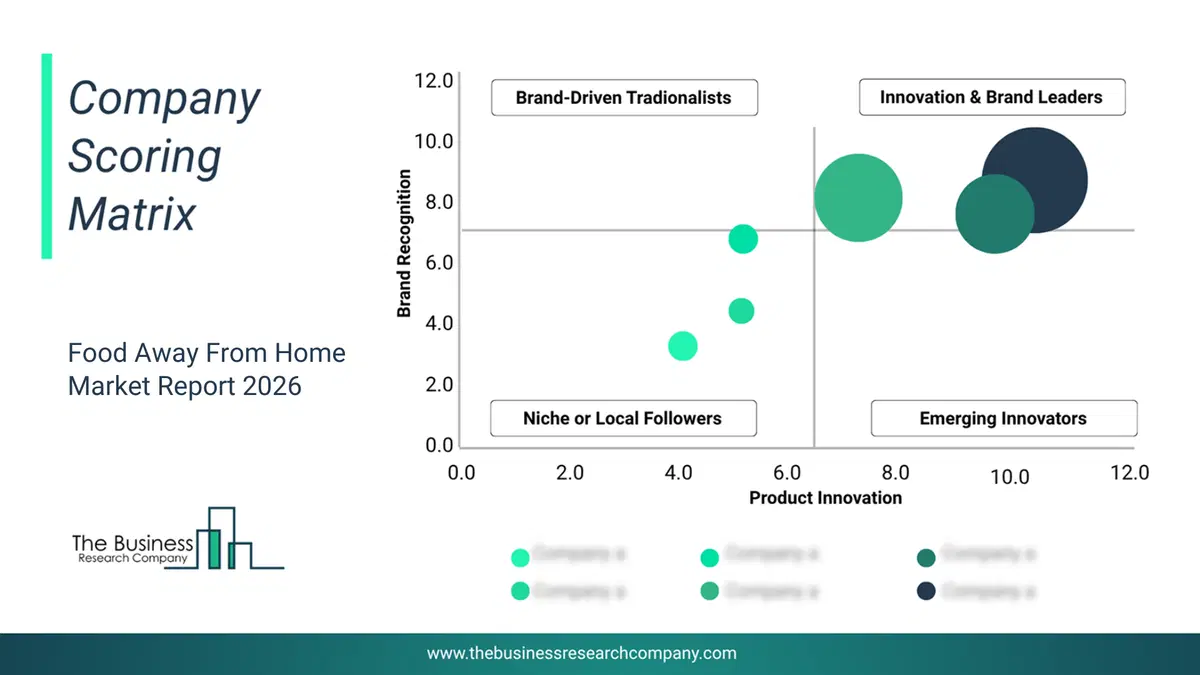
This chart maps companies by product innovation and brand strength, with bubble size indicating relative revenue, helping identify market leaders, challengers, and niche players. This is an illustrative chart; the full report provides a complete and accurate competitive analysis.
Global Food Away From Home Market Trends and Insights
Major companies operating in the food away from home market are focused on developing next-generation technology, such as an 'AI-first' strategy to enhance efficiency and empower their workforce across their fast-food restaurant chains. The AI-first strategy is a business strategy that prioritizes the integration and optimization of artificial intelligence across all parts of a fast-food chain's operations in order to increase efficiency, reduce costs, and provide better customer experiences. For instance, in April 2024, Yum! Brands, a US-based fast food corporation, introduced the SuperApp platform. It is an AI-first strategy smartphone app for restaurant managers that is presently used by over 8,700 Pizza Hut and KFC restaurants. The app enables restaurant staff to ask operational queries, such as how to adjust oven temperatures and receive responses via a generative AI chatbot. This eliminates the need for traditional training manuals. Employees use the SuperApp to manage their work schedules as well as order goods and supplies, which helps restaurants run smoothly.What Are Latest Mergers And Acquisitions In The Food Away From Home Market?
In May 2024, Restaurant Brands International Inc., a Canada-based quick-service restaurant company, acquired Carrols Restaurant Group, Inc. for $1.0 billion. The acquisition expands RBI's footprint and market position in the fast food hamburger and chicken divisions of the food away from home market in the United States. The planned refurbishment and refranchising will help enhance RBI's brand recognition and franchisee relationships. Carrols Restaurant Group Inc. is a US-based provider of food away from home services through its operation of over 1,000 Burger King and Popeyes restaurants.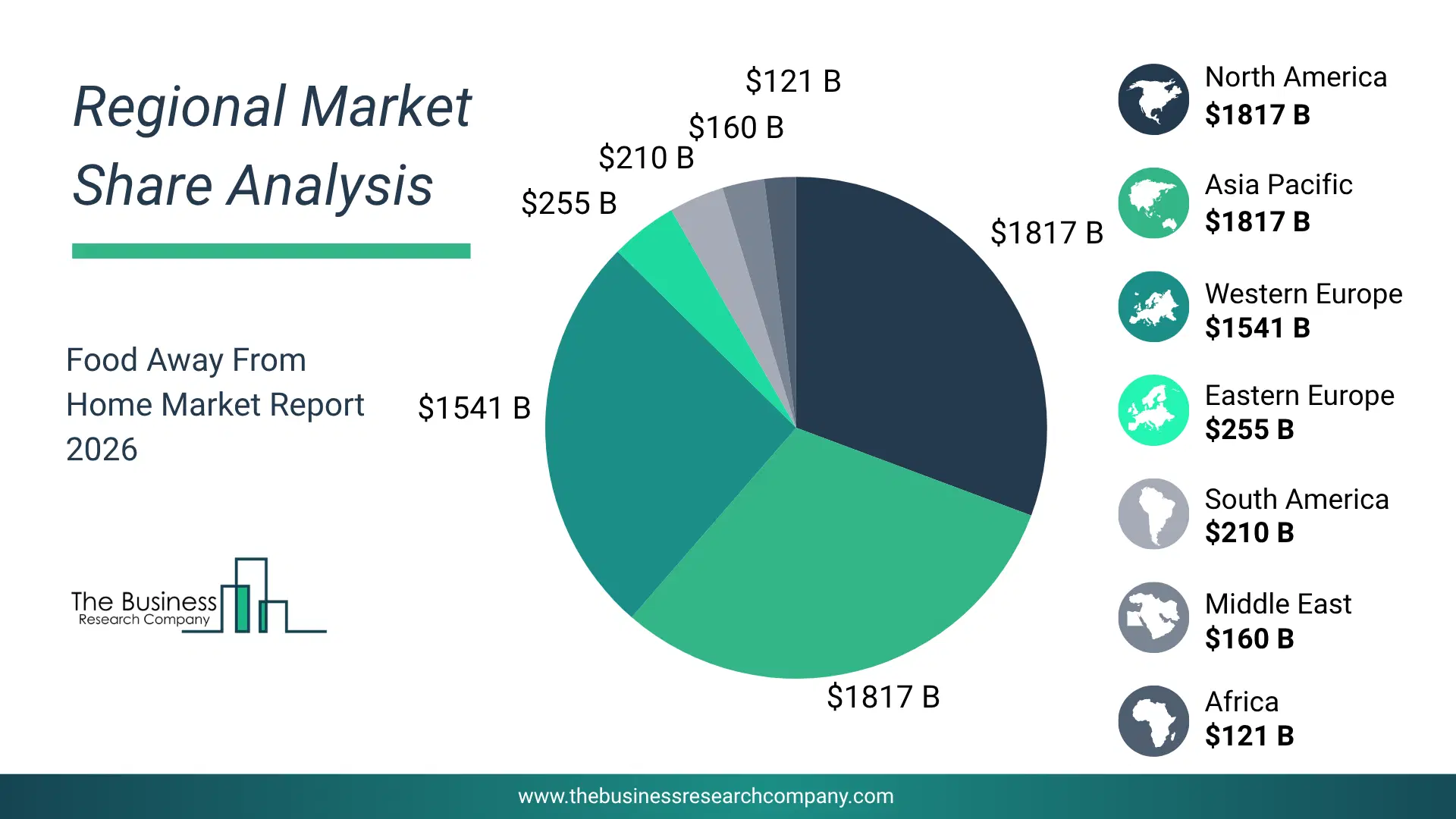
Regional Outlook
North America was the largest region in the food away from home market in 2025. Asia-Pacific is expected to be the fastest-growing region in the forecast period. The regions covered in this market report are Asia-Pacific, South East Asia, Western Europe, Eastern Europe, North America, South America, Middle East and Africa. The countries covered in this market report are Australia, Brazil, China, France, Germany, India, Indonesia, Japan, Taiwan, Russia, South Korea, UK, USA, Italy, Spain, CanadaWhat Defines the Food Away From Home Market?
The food away from home market includes revenues earned by entities by providing services such as meal preparation, dining experience, menu variety, and buffet service. The market value includes the value of related goods sold by the service provider or included within the service offering. Only goods and services traded between entities or sold to end consumers are included.How is Market Value Defined and Measured?
The market value is defined as the revenues that enterprises gain from the sale of goods and/or services within the specified market and geography through sales, grants, or donations in terms of the currency (in USD unless otherwise specified). The revenues for a specified geography are consumption values that are revenues generated by organizations in the specified geography within the market, irrespective of where they are produced. It does not include revenues from resales along the supply chain, either further along the supply chain or as part of other products.
This chart presents market attractiveness based on a quantitative evaluation of growth, competition, strategic alignment, and risk, offering a clear view of opportunity areas for decision-making. This chart is for illustrative purposes; the full report contains the complete analysis.

This chart highlights the Total Addressable Market (TAM) by estimating the maximum revenue opportunity using an assumption-driven approach, supporting strategic planning and opportunity sizing across markets. The chart is illustrative; the full report provides a more comprehensive analysis.
What Key Data and Analysis Are Included in the Food Away From Home Market Report 2026?
The food away from home market research report is one of a series of new reports from The Business Research Company that provides market statistics, including industry global market size, regional shares, competitors with the market share, detailed market segments, market trends and opportunities, and any further data you may need to thrive in the food away from home industry. The market research report delivers a complete perspective of everything you need, with an in-depth analysis of the current and future state of the industry.Food Away From Home Market Report Forecast Analysis
| Report Attribute | Details |
|---|---|
| Market Size Value In 2026 | $5044.54 billion |
| Revenue Forecast In 2030 | $5952.18 billion |
| Growth Rate | CAGR of 4.4% from 2026 to 2030 |
| Base Year For Estimation | 2025 |
| Actual Estimates/Historical Data | 2020-2025 |
| Forecast Period | 2026 - 2030 |
| Market Representation | Revenue in USD Billion and CAGR from 2026 to 2030 |
| Segments Covered | Type Of Occasion, Ownership Type, Delivery Model, Application |
| Regional Scope | Asia-Pacific, Western Europe, Eastern Europe, North America, South America, Middle East, Africa |
| Country Scope | The countries covered in the report are Australia, Brazil, China, France, Germany, India, Indonesia, Japan, Taiwan, Russia, South Korea, UK, USA, Canada, Italy, Spain. |
| Key Companies Profiled | Starbucks Corporation, Compass Group PLC, Sodexo, McDonald's, Aramark, Subway IP LLC, Darden Concepts Inc., Chipotle Mexican Grill, Yum Brands, Restaurant Brands International Inc., Zensho Holdings Co. Ltd., Whataburger, Domino's Pizza, Panda Restaurant Group Inc., Brinker International Inc., Greene King, SATS Ltd., Burger King Company LLC, Papa John's International Inc., Shake Shack, Jubilant FoodWorks |
| Customization Scope | Request for Customization |
| Pricing And Purchase Options | Explore Purchase Options |