
Food Inclusions Market Report 2026
Global Outlook – By Type (Chocolate, Fruit And Nut, Cereal, Flavored Sugar And Caramel, Confectionery, Other Types), By Form (Pieces, Nuts, Chips, Flakes And Crunches, Powder, Liquid), By Application (Cereal Products, Snacks And Bars, Bakery Products, Dairy And Frozen Desserts, Chocolate And Confectionery Products, Other Applications Products) – Market Size, Trends, Strategies, and Forecast to 2030
Food Inclusions Market Overview
• Food Inclusions market size has reached to $15.59 billion in 2025 • Expected to grow to $22.53 billion in 2030 at a compound annual growth rate (CAGR) of 7.7% • Growth Driver: Processed Food Boom Fuels Growth In The Food Inclusion Market • Market Trend: Introduction Of No Added Sugar Clean Label Inclusions By Icon Foods • North America was the largest region in 2025.What Is Covered Under Food Inclusions Market?
Food inclusions are ingredients that are added to food to improve its texture or organoleptic properties. They are food additives that have been applied to increase the value and improve the sensory qualities of foods. Ingredients can help food items by adding flavor, texture, smell, color, and nutrition. The main types of food inclusions are chocolate, fruit and nut, cereal, flavored sugar and caramel, confectionery, and others. A chocolate inclusion refers to a natural element that is added to or on top of chocolate bars, beverages, paste, or liquor. The various form involved are pieces, nuts, chips, flakes and crunches, powder and liquid that are used for cereal products, snacks and bars, bakery products, dairy and frozen desserts, chocolate and confectionery products and others.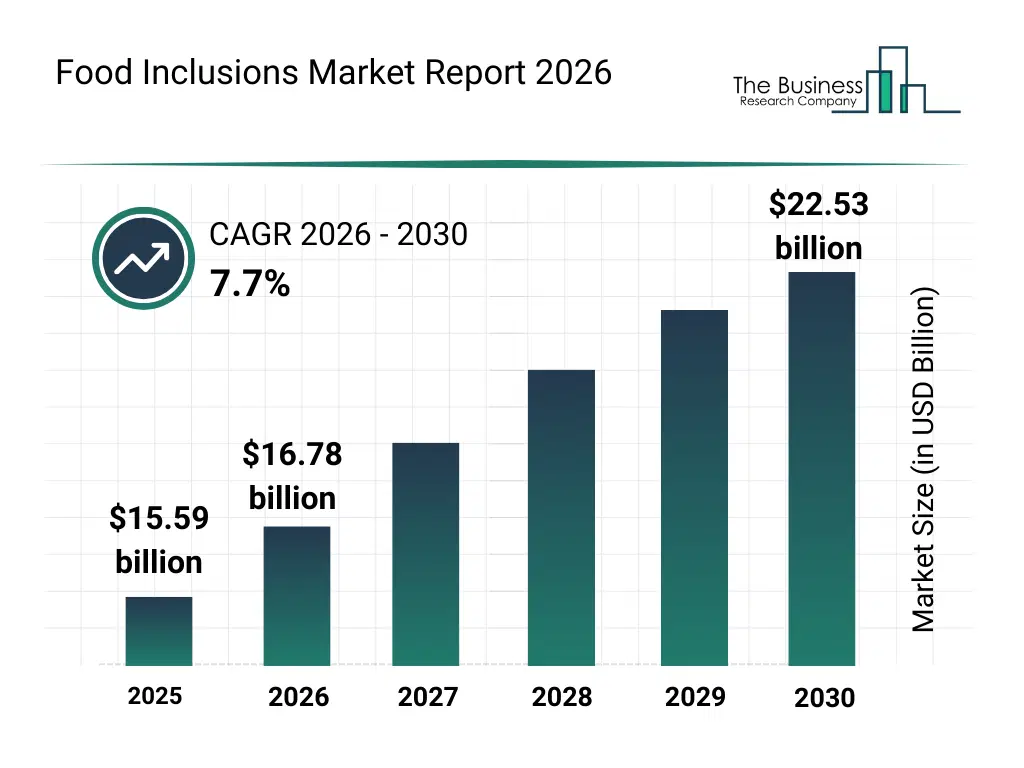
What Is The Food Inclusions Market Size and Share 2026?
The food inclusions market size has grown strongly in recent years. It will grow from $15.59 billion in 2025 to $16.78 billion in 2026 at a compound annual growth rate (CAGR) of 7.6%. The growth in the historic period can be attributed to growth of bakery and confectionery consumption, rising demand for value-added food products, expansion of processed and packaged foods, increased innovation in ingredient formulation, availability of diverse inclusion formats.What Is The Food Inclusions Market Growth Forecast?
The food inclusions market size is expected to see strong growth in the next few years. It will grow to $22.53 billion in 2030 at a compound annual growth rate (CAGR) of 7.7%. The growth in the forecast period can be attributed to increasing demand for indulgent and experiential foods, rising focus on clean-label ingredient solutions, expansion of functional snacking products, growing customization in food formulations, increasing innovation in inclusion processing. Major trends in the forecast period include increasing use of texture-enhancing inclusions, rising demand for premium and artisanal food products, growing adoption of clean-label inclusions, expansion of functional and nutrient-rich inclusions, enhanced focus on sensory experience.
Global Food Inclusions Market Segmentation
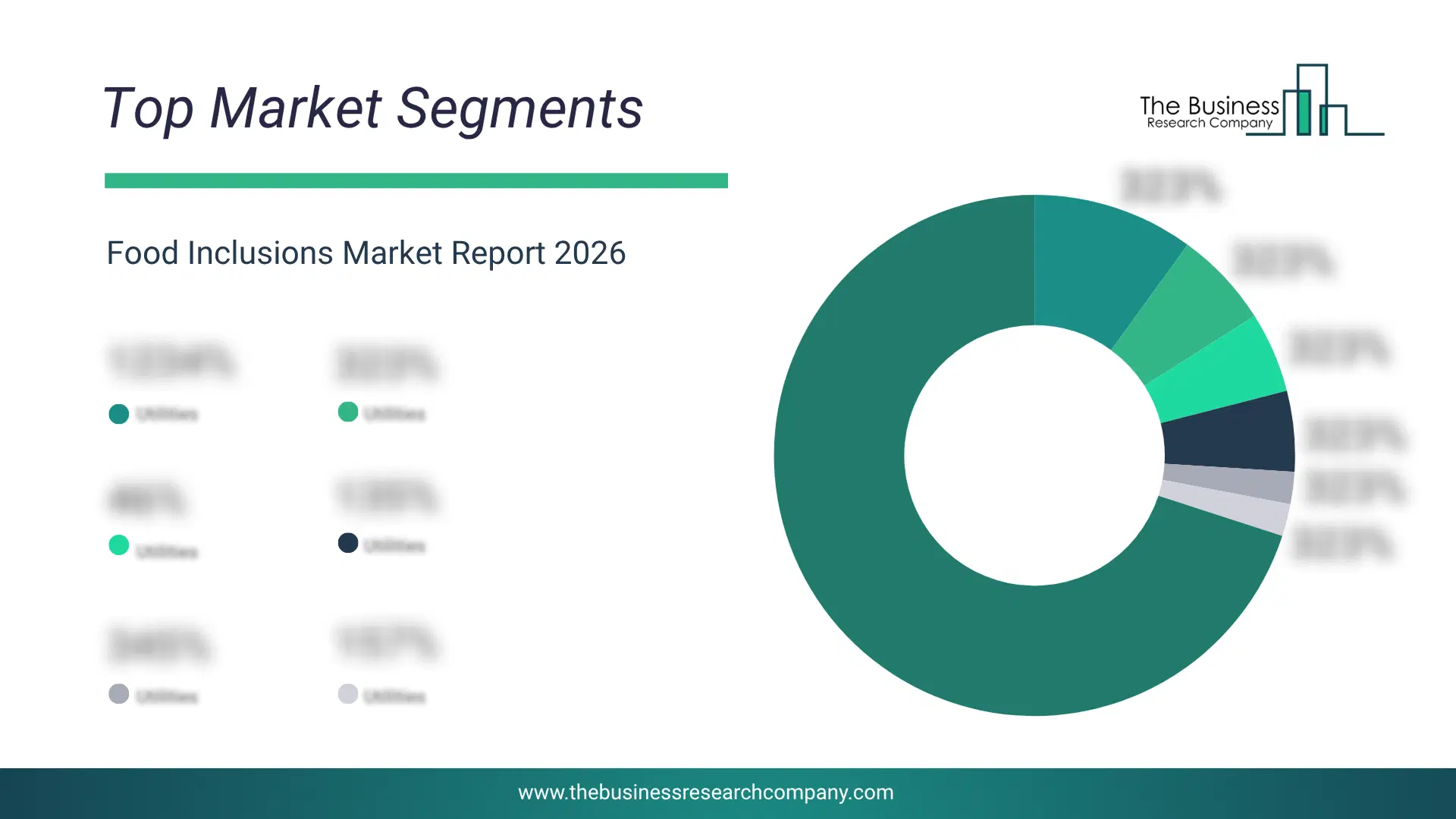
1) By Type: Chocolate, Fruit And Nut, Cereal, Flavored Sugar And Caramel, Confectionery, Other Types 2) By Form: Pieces, Nuts, Chips, Flakes And Crunches, Powder, Liquid 3) By Application: Cereal Products, Snacks And Bars, Bakery Products, Dairy And Frozen Desserts, Chocolate And Confectionery Products, Other Applications Products Subsegments: 1) By Chocolate: Chocolate Chips, Chocolate Chunks, Cocoa Nibs 2) By Fruit And Nut: Dried Fruits, Nuts 3) By Cereal: Granola Clusters, Cereal Bits 4) By Flavored Sugar And Caramel: Flavored Sugar Crystals, Caramel Bits 5) By Confectionery: Gummies, Marshmallows 6) By Other Types: Spices And Seasonings, Savory InclusionsWhat Is The Driver Of The Food Inclusions Market?
Rising demand for processed food is expected to propel the growth of the food inclusion market going forward. Processed food is any raw agricultural commodity that has been washed, cleansed, milled, chopped, heated, pasteurized, blanched, cooked, canned, frozen, dried, dehydrated, blended, or packed. It includes the addition of preservatives, flavors, nutrients, and other food additives, as well as ingredients allowed for use in food items such as salt, sugars, and fats. Food inclusions contribute to flavor, texture, fragrance, color, and nutrition to the processed food which makes the product unique, capturing the consumer's attention and distinguishing it from other foods. For instance, in April 2024, according to the data published by the National Association of Convenience Stores (NACS), a US-based trade association, total industry foodservice sales made up 26.9% of in-store sales in 2023, rising from 25.6% in 2022, with prepared food sales increasing by 12.2% per store per month, making it the leading in-store category. Therefore, the rising demand for processed food will drive the demand for the food inclusion industry.Key Players In The Global Food Inclusions Market
Major companies operating in the food inclusions market are Archer Daniels Midland Company, Agarna Beteiligungs AG, Barry Callebaut AG, Cargill Inc., Georgia Nut Company Inc., Kerry Group PLC, Puratos N.V., Sensient Technologies Corporation, Tate And Lyle Plc., Taura Natural Ingredients Ltd., Nimbus Foods Ltd, Trufoodmfg LLC., Inclusion Technologies LLC, Diana Food SAS, Doehler, Olam International, GEA Group, Pecan Deluxe Candy Company, Sensapure, Kanegrade, PreGel, Skjodt-Barrett, Tree Top, DMH Ingredients, The Scoular Company, Chaucer Foods, Paradiesfrucht, Dawn Foods, Candico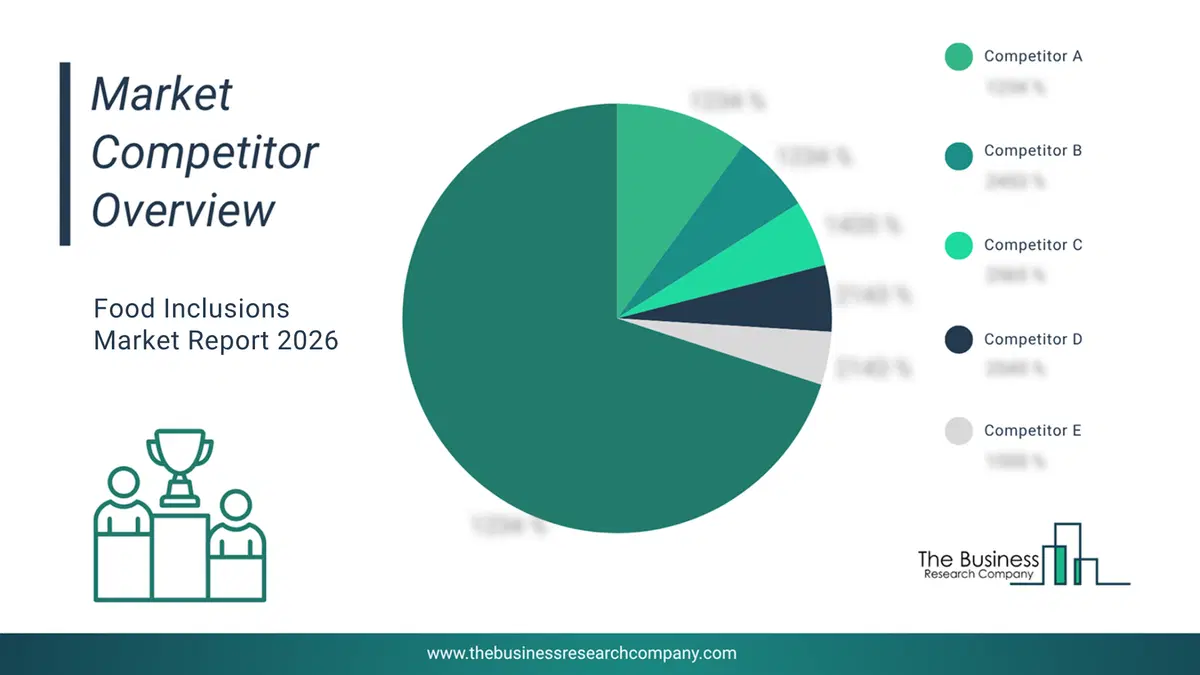
This chart is for illustrative purposes; the full report includes a detailed competitor analysis and comprehensive overview of the top 10 companies in the market.
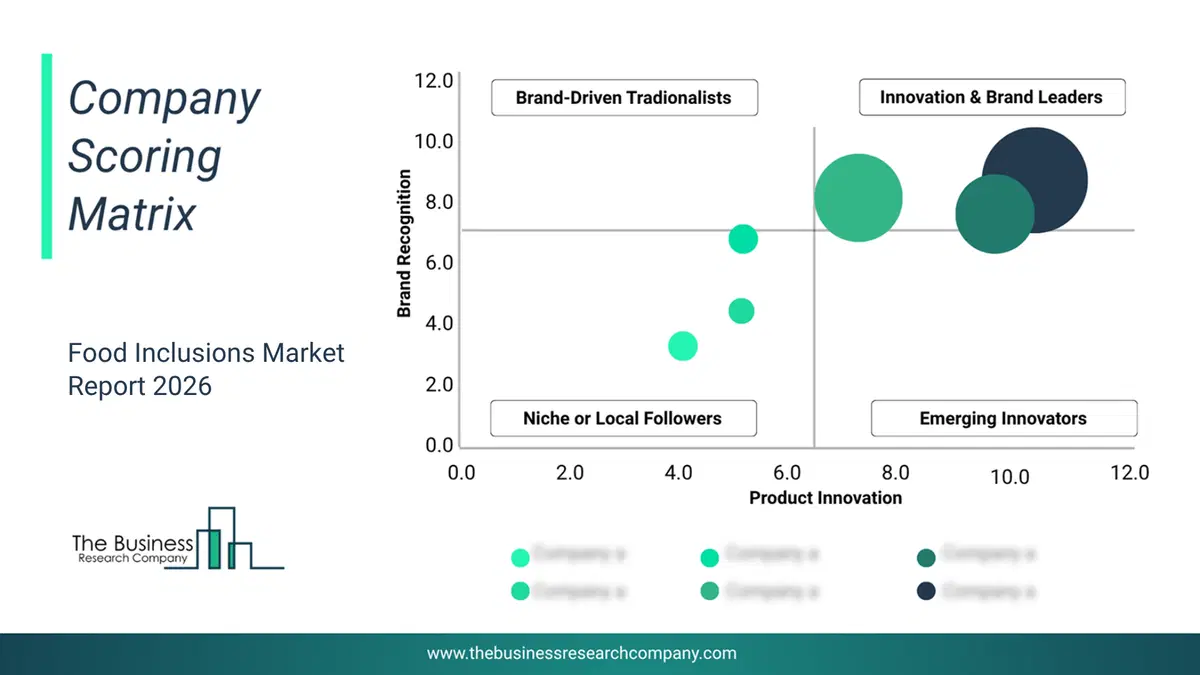
This chart maps companies by product innovation and brand strength, with bubble size indicating relative revenue, helping identify market leaders, challengers, and niche players. This is an illustrative chart; the full report provides a complete and accurate competitive analysis.
Global Food Inclusions Market Trends and Insights
Major companies operating in the food inclusions market are focusing on developing advanced solutions, such as no-added-sugar clean-label inclusions, to replace traditional high-sugar and artificial-ingredient toppings. A no-added-sugar solution refers to a healthier formulation that enhances nutritional value by reducing sugar content, eliminating artificial additives, and supporting better-for-you product development. For instance, in September 2025, Icon Foods Inc a US-based clean-label ingredient manufacturer, launched its SweetBitz Inclusions to provide guilt-free indulgence across applications such as cookies, bars, ice creams, and baked goods. This innovation replaces conventional sugar-dense inclusions by offering flavorful, shelf-stable inclusions made with natural sweeteners and clean-label ingredients that meet modern dietary preferences. It delivers improved texture, balanced sweetness, and versatile application possibilities while enabling manufacturers to enhance product appeal without added sugars. Integrated with Icon Foods’ broader portfolio of reduced-sugar solutions, SweetBitz supports healthier product formulations, improves consumer satisfaction, and helps brands meet rising demand for nutritious, clean-label treats.What Are Latest Mergers And Acquisitions In The Food Inclusions Market?
In August 2024, QualiTech, LLC, a US–based manufacturing company acquired Ellison Bakery LLC for an undisclosed amount. With this acquisition, QualiTech aimed to strategically expand its capabilities by adding baked-goods and inclusion ingredients to its portfolio thereby broadening its sensory-ingredients platform and enabling it to serve a larger addressable market across retail, food-service, and private-label channels. Ellison Bakery LLC is a US-based company that manufactures baked inclusions, crunches, bits, cookie components, and bars.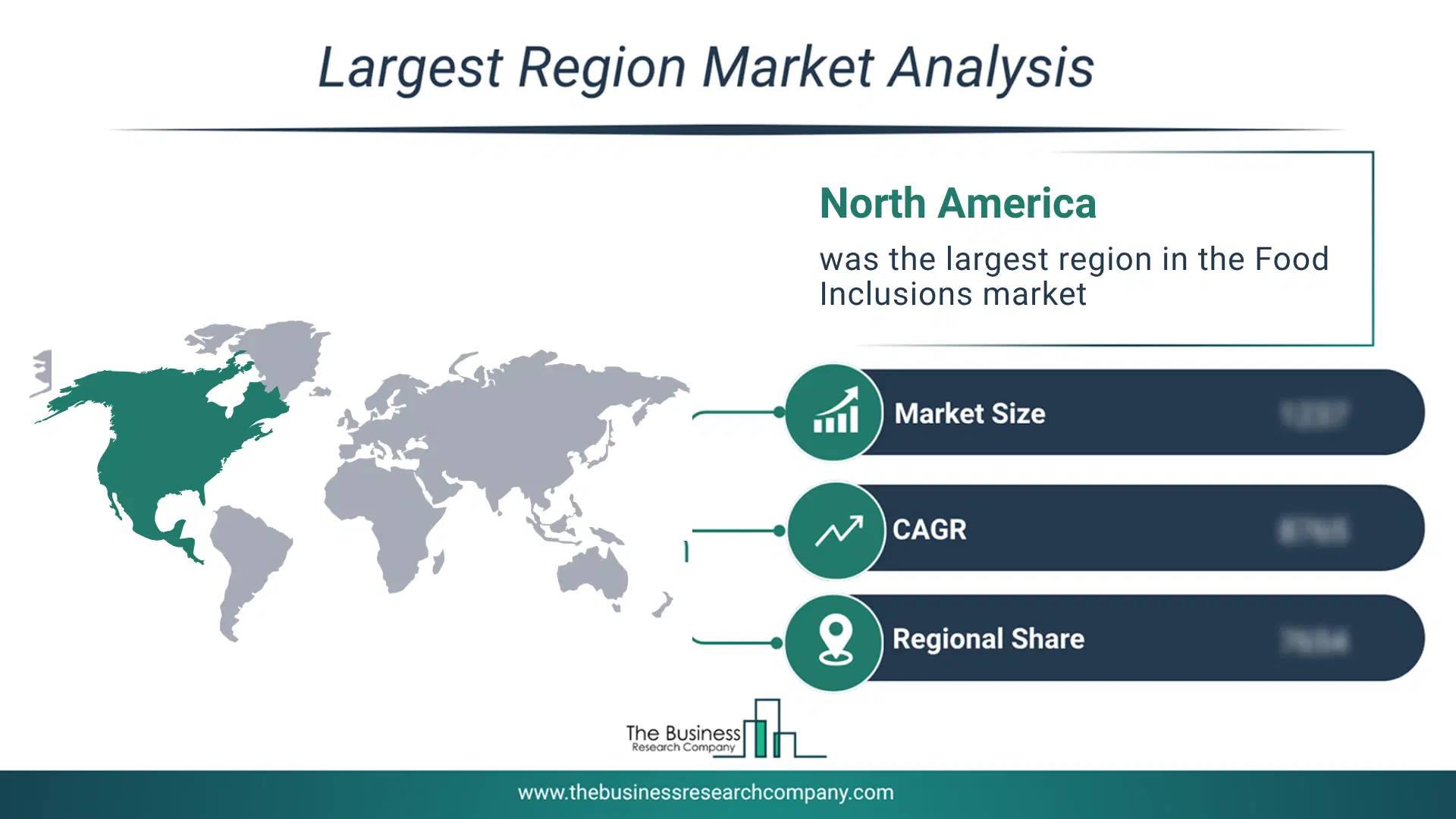
Regional Outlook
North America was the largest region in the food inclusion market in 2025. The regions covered in this market report are Asia-Pacific, South East Asia, Western Europe, Eastern Europe, North America, South America, Middle East and Africa. The countries covered in this market report are Australia, Brazil, China, France, Germany, India, Indonesia, Japan, Taiwan, Russia, South Korea, UK, USA, Italy, Spain, CanadaWhat Defines the Food Inclusions Market?
The food inclusion market consists of sales of herbs, spices, aromatic seeds, fruits, and vegetables. Values in this market are ‘factory gate’ values, that is the value of goods sold by the manufacturers or creators of the goods, whether to other entities (including downstream manufacturers, wholesalers, distributors, and retailers) or directly to end customers. The value of goods in this market includes related services sold by the creators of the goods.How is Market Value Defined and Measured?
The market value is defined as the revenues that enterprises gain from the sale of goods and/or services within the specified market and geography through sales, grants, or donations in terms of the currency (in USD unless otherwise specified). The revenues for a specified geography are consumption values that are revenues generated by organizations in the specified geography within the market, irrespective of where they are produced. It does not include revenues from resales along the supply chain, either further along the supply chain or as part of other products.
This chart presents market attractiveness based on a quantitative evaluation of growth, competition, strategic alignment, and risk, offering a clear view of opportunity areas for decision-making. This chart is for illustrative purposes; the full report contains the complete analysis.

This chart highlights the Total Addressable Market (TAM) by estimating the maximum revenue opportunity using an assumption-driven approach, supporting strategic planning and opportunity sizing across markets. The chart is illustrative; the full report provides a more comprehensive analysis.
What Key Data and Analysis Are Included in the Food Inclusions Market Report 2026?
The food inclusions market research report is one of a series of new reports from The Business Research Company that provides market statistics, including industry global market size, regional shares, competitors with the market share, detailed market segments, market trends and opportunities, and any further data you may need to thrive in the food inclusions industry. The market research report delivers a complete perspective of everything you need, with an in-depth analysis of the current and future state of the industry.Food Inclusions Market Report Forecast Analysis
| Report Attribute | Details |
|---|---|
| Market Size Value In 2026 | $16.78 billion |
| Revenue Forecast In 2030 | $22.53 billion |
| Growth Rate | CAGR of 7.6% from 2026 to 2030 |
| Base Year For Estimation | 2025 |
| Actual Estimates/Historical Data | 2020-2025 |
| Forecast Period | 2026 - 2030 |
| Market Representation | Revenue in USD Billion and CAGR from 2026 to 2030 |
| Segments Covered | Type, Form, Application |
| Regional Scope | Asia-Pacific, Western Europe, Eastern Europe, North America, South America, Middle East, Africa |
| Country Scope | The countries covered in the report are Australia, Brazil, China, France, Germany, India, Indonesia, Japan, Taiwan, Russia, South Korea, UK, USA, Canada, Italy, Spain. |
| Key Companies Profiled | Archer Daniels Midland Company, Agarna Beteiligungs AG, Barry Callebaut AG, Cargill Inc., Georgia Nut Company Inc., Kerry Group PLC, Puratos N.V., Sensient Technologies Corporation, Tate And Lyle Plc., Taura Natural Ingredients Ltd., Nimbus Foods Ltd, Trufoodmfg LLC., Inclusion Technologies LLC, Diana Food SAS, Doehler, Olam International, GEA Group, Pecan Deluxe Candy Company, Sensapure, Kanegrade, PreGel, Skjodt-Barrett, Tree Top, DMH Ingredients, The Scoular Company, Chaucer Foods, Paradiesfrucht, Dawn Foods, Candico |
| Customization Scope | Request for Customization |
| Pricing And Purchase Options | Explore Purchase Options |