
Fuel Cards Market Report 2026
Global Outlook – By Type (Branded, Universal, Merchant), By Technology (Smart Cards, Standard Cards), By Application (Fuel Refill, Parking, Vehicle Service, Toll Charges, Other Applications), By Vehicle (Heavy Fleet, Light Fleet) – Market Size, Trends, Strategies, and Forecast to 2030
Fuel Cards Market Overview
• Fuel Cards market size has reached to $978.26 billion in 2025 • Expected to grow to $1669.58 billion in 2030 at a compound annual growth rate (CAGR) of 11.4% • Growth Driver: Rising Logistics Sector Fuels, The Growth Of The Fuel Card Market • Market Trend: Revolutionizing Fuel Management With Digital Technology Applications • Europe was the largest region in 2025.What Is Covered Under Fuel Cards Market?
A fuel card is an alternate payment option for drivers that enables spending tracking, use restrictions, and more effective expenditure reporting. It can assist in controlling the gasoline expenses for company vehicles. The main types of fuel cards are branded, universal, and merchant. Branded fuel cards refer to the cards that are issued by a particular kind of fuel or gasoline station. The technology includes smart cards and standard cards for fuel refill, parking, vehicle service, toll charges, and other applications by heavy and light fleet vehicles.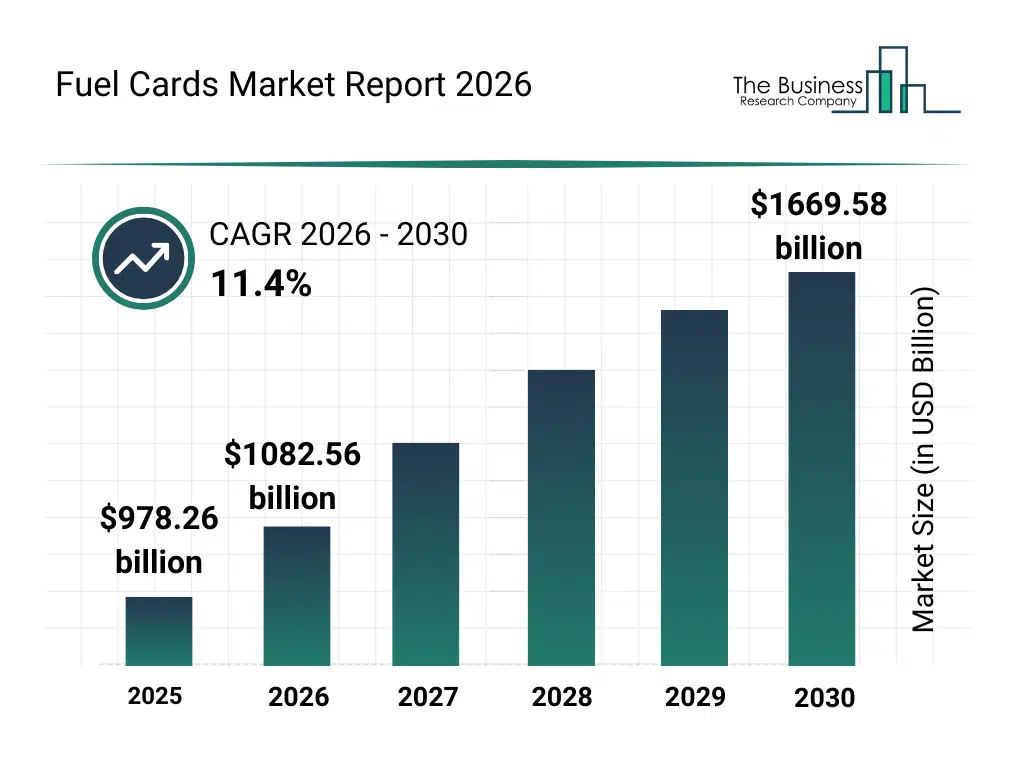
What Is The Fuel Cards Market Size and Share 2026?
The fuel cards market size has grown rapidly in recent years. It will grow from $978.26 billion in 2025 to $1082.56 billion in 2026 at a compound annual growth rate (CAGR) of 10.7%. The growth in the historic period can be attributed to fleet fuel cost monitoring needs, growth in commercial vehicle fleets, adoption of cashless payments, rising fuel price volatility, early fleet digitization initiatives.What Is The Fuel Cards Market Growth Forecast?
The fuel cards market size is expected to see rapid growth in the next few years. It will grow to $1669.58 billion in 2030 at a compound annual growth rate (CAGR) of 11.4%. The growth in the forecast period can be attributed to expansion of corporate fleets, demand for real time fuel analytics, growth of smart card adoption, integration with EV charging payments, increased focus on cost transparency. Major trends in the forecast period include digital fuel payment solutions, enhanced expense tracking tools, integration with fleet management systems, fraud detection and spending controls, multi service payment capabilities.
Global Fuel Cards Market Segmentation
1) By Type: Branded, Universal, Merchant 2) By Technology: Smart Cards, Standard Cards 3) By Application: Fuel Refill, Parking, Vehicle Service, Toll Charges, Other Applications 4) By Vehicle: Heavy Fleet, Light Fleet Subsegments: 1) By Branded: Specific Fuel Station Cards, Fleet Programs With Brand Loyalty 2) By Universal: Multi-Brand Acceptance Cards, Cards Usable At Various Fuel Stations 3) By Merchant: Cards Issued By Retailers Or Merchants, Loyalty Programs Associated With MerchantsWhat Is The Driver Of The Fuel Cards Market?
The expanding logistic sector is expected to propel the growth of the fuel card market going forward. The logistics sector collects, manufactures, and delivers materials and goods at the proper location and quantity. The fuel card allows operators to manage finances carefully, keep track of each driver's spending, and monitor fueling habits. For instance, in June 2023, according to the Council of Supply Chain Management Professionals (CSCMP), a US-based key organization of the logistics and supply chain management sectors, the total expense of corporate logistics in the US reached a record high of $2.3 trillion in 2023, up from $1.85 trillion in 2022, which equals 9.1% of the country's GDP, the highest GDP proportion ever. Therefore, the expanding logistic sector is driving the fuel card industry.Key Players In The Global Fuel Cards Market
Major companies operating in the fuel cards market report include Exxon Mobil Corporation, TotalEnergies SE, Chevron Corporation, BP plc, Valero Energy Corporation, Repsol S.A., Suncor Energy Inc., Shell plc, U.S. Bancorp, Libya Oil Holdings Ltd., Puma Energy Holdings Pte Ltd., FirstRand Limited, Absa Bank Limited, Fleetcor Technologies Inc., Comdata Inc., WEX Inc., First National Bank, Fuel Genie Systems, CSI Voyager Fleet, W. A. G. Payment Solutions plc, Singapore Petroleum Company Limited, Wilhelm Hoyer GmbH & Co. KG, Edenred Essentials, Engen Petroleum Ltd., Fuelman Inc.
This chart is for illustrative purposes; the full report includes a detailed competitor analysis and comprehensive overview of the top 10 companies in the market.
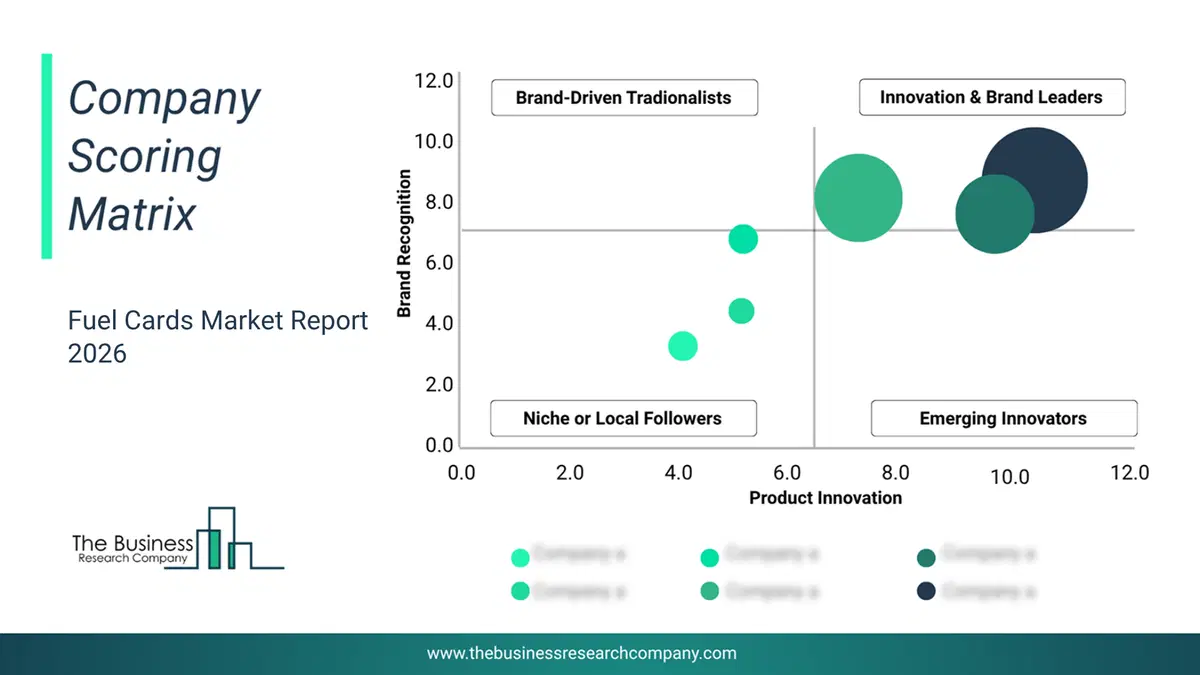
This chart maps companies by product innovation and brand strength, with bubble size indicating relative revenue, helping identify market leaders, challengers, and niche players. This is an illustrative chart; the full report provides a complete and accurate competitive analysis.
Global Fuel Cards Market Trends and Insights
Major companies operating in the fuel card market are concentrating their efforts on developing advanced solutions such as digital fuel technology applications. Digital Fuel Technology applications encompass a range of digital solutions and technologies designed to optimize and streamline various aspects of fuel management and consumption. For instance, in April 2023, Transflo, a US-based software company, and Comdata Inc., a US-based company in commercial payment solutions, launched the ‘Transflo Wallet’. It is a mobile-app-based cardless fuel payment solution that enables freight brokers to send digital fuel to drivers and carriers. Utilizing Transflo's cutting-edge mobile app technology in conjunction with Comdata's exclusive virtual card capabilities, the solution facilitates the most secure and user-friendly fuel payment experience in the industry.What Are Latest Mergers And Acquisitions In The Fuel Cards Market?
In October 2023, DKV Mobility, a Germany-based company that provides on-the-road payment solutions, acquired Road Solution PRO S.L. for an undisclosed amount. The strategic partnership will bolster DKV Mobility’s market presence and customer base in Spain. It will also support Road Solution PRO, S.L.’s growth strategy and contribute to the development and expansion of Andamur’s Service Area business line. Road Solution PRO S.L. is a Spain-based provider of fuel cards.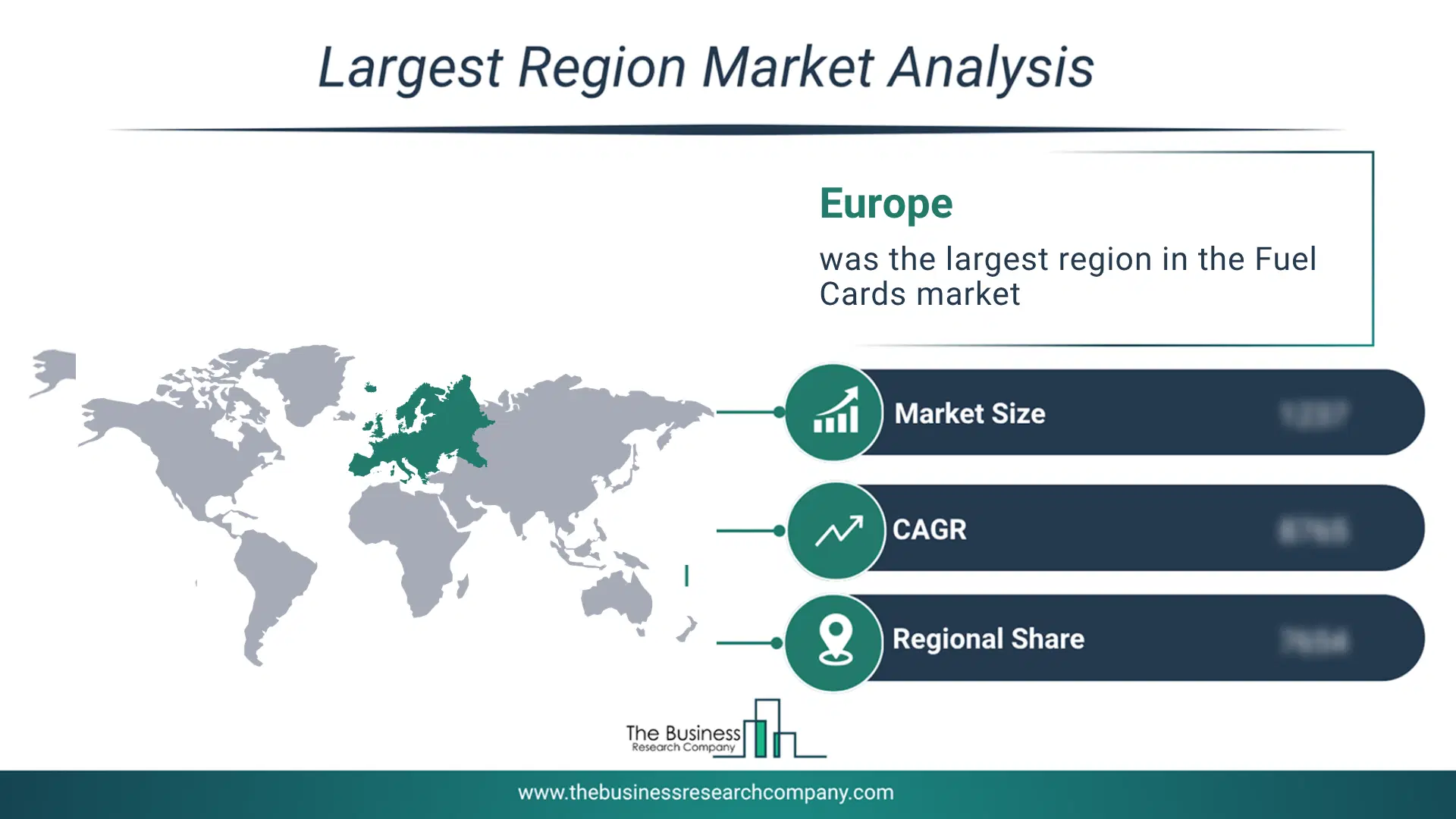
Regional Outlook
Europe was the largest region in the fuel card market in 2025. The regions covered in this market report include Asia-Pacific, South East Asia, Western Europe, Eastern Europe, North America, South America, Middle East, Africa. The countries covered in this market report include Australia, Brazil, China, France, Germany, India, Indonesia, Japan, Taiwan, Russia, South Korea, UK, USA, Canada, Italy, SpainWhat Defines the Fuel Cards Market?
The fuel card market consists of revenues earned by entities providing services such as fuel purchases, fuel expense tracking, fuel discounts, and customizable purchasing controls. The market value includes the value of related goods sold by the service provider or included within the service offering. The fuel card market also includes sales of fuel credit cards, major oil and gas cards, card lock network cards, and over-the-road fuel cards (OTR cards), which are used in providing fuel card services. Values in this market are ‘factory gate’ values, that is the value of goods sold by the manufacturers or creators of the goods, whether to other entities (including downstream manufacturers, wholesalers, distributors and retailers) or directly to end customers. The value of goods in this market includes related services sold by the creators of the goods.How is Market Value Defined and Measured?
The market value is defined as the revenues that enterprises gain from the sale of goods and/or services within the specified market and geography through sales, grants, or donations in terms of the currency (in USD unless otherwise specified). The revenues for a specified geography are consumption values that are revenues generated by organizations in the specified geography within the market, irrespective of where they are produced. It does not include revenues from resales along the supply chain, either further along the supply chain or as part of other products.
This chart presents market attractiveness based on a quantitative evaluation of growth, competition, strategic alignment, and risk, offering a clear view of opportunity areas for decision-making. This chart is for illustrative purposes; the full report contains the complete analysis.

This chart highlights the Total Addressable Market (TAM) by estimating the maximum revenue opportunity using an assumption-driven approach, supporting strategic planning and opportunity sizing across markets. The chart is illustrative; the full report provides a more comprehensive analysis.
What Key Data and Analysis Are Included in the Fuel Cards Market Report 2026?
The fuel cards market research report is one of a series of new reports from The Business Research Company that provides market statistics, including industry global market size, regional shares, competitors with the market share, detailed market segments, market trends and opportunities, and any further data you may need to thrive in the fuel cards industry. The market research report delivers a complete perspective of everything you need, with an in-depth analysis of the current and future state of the industry.Fuel Cards Market Report Forecast Analysis
| Report Attribute | Details |
|---|---|
| Market Size Value In 2026 | $1082.56 billion |
| Revenue Forecast In 2030 | $1669.58 billion |
| Growth Rate | CAGR of 10.7% from 2026 to 2030 |
| Base Year For Estimation | 2025 |
| Actual Estimates/Historical Data | 2020-2025 |
| Forecast Period | 2026 - 2030 - 2030 |
| Market Representation | Revenue in USD Billion and CAGR from 2026 to 2030 |
| Segments Covered | Type, Technology, Application, Vehicle |
| Regional Scope | Asia-Pacific, Western Europe, Eastern Europe, North America, South America, Middle East, Africa |
| Country Scope | The countries covered in the report are Australia, Brazil, China, France, Germany, India, Indonesia, Japan, Taiwan, Russia, South Korea, UK, USA, Canada, Italy, Spain. |
| Key Companies Profiled | Exxon Mobil Corporation, TotalEnergies SE, Chevron Corporation, BP plc, Valero Energy Corporation, Repsol S.A., Suncor Energy Inc., Shell plc, U.S. Bancorp, Libya Oil Holdings Ltd., Puma Energy Holdings Pte Ltd., FirstRand Limited, Absa Bank Limited, Fleetcor Technologies Inc., Comdata Inc., WEX Inc., First National Bank, Fuel Genie Systems, CSI Voyager Fleet, W. A. G. Payment Solutions plc, Singapore Petroleum Company Limited, Wilhelm Hoyer GmbH & Co. KG, Edenred Essentials, Engen Petroleum Ltd., Fuelman Inc. |
| Customization Scope | Request for Customization |
| Pricing And Purchase Options | Explore Purchase Options |