
Vehicle As A Service Market Report 2026
Global Outlook – By Service Type (Subscription Management, Asset Management, Vehicle And Status Monitoring Service, Other Service Types), By Engine (Electric, IC Engine), By Vehicle (Passenger Cars, Trucks, Utility Trailers, Motorcycles), By Service Provider (Automotive Original Equipment Manufacturer (OEM), Auto Dealerships, Auto Tech Startups, Car Subscription Software Providers), By End-User (Enterprise Users, Private Users) – Market Size, Trends, Strategies, and Forecast to 2030
Vehicle As A Service Market Overview
• Vehicle As A Service market size has reached to $8.79 billion in 2025 • Expected to grow to $20.97 billion in 2030 at a compound annual growth rate (CAGR) of 18.9% • Growth Driver: Rising Global Traffic Congestion Driving Growth In Vehicle-As-A-Service Market • Market Trend: Expanding Flexible And Personalized Mobility Solutions For Urban Drivers • North America was the largest region in 2025 and Asia-Pacific is the fastest growing region.What Is Covered Under Vehicle As A Service Market?
Vehicle as a Service (VaaS) refers to a business model where vehicles are offered to customers as a service rather than as a product to be purchased. This model encompasses a range of transportation solutions that are typically subscription-based or pay-per-use. VaaS is designed to provide a more flexible and user-friendly approach to transportation, leveraging technology to meet evolving mobility needs. The main vehicle as a service engine types are subscription management, asset management, vehicle status monitoring services, and others. Asset management refers to the administration and optimization of vehicle fleets and other assets, including maintenance and usage tracking. The vehicle-as-a-service approach relies on efficient asset management to ensure that vehicles are well-maintained and utilized effectively. It includes electric and IC engines types used for passenger cars, trucks, utility trailers, and motorcycles. The different service providers are automotive original equipment manufacturers (OEM), auto dealerships, auto tech startups, and car subscription software providers. It is used for by several end-users such as enterprise users and private users.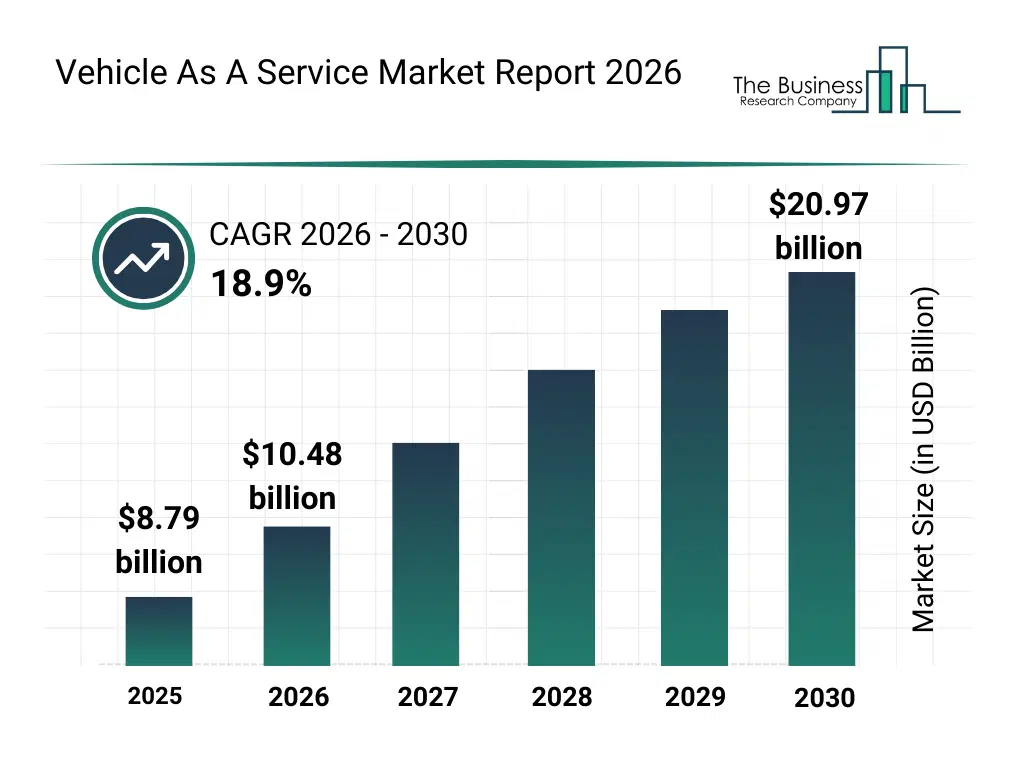
What Is The Vehicle As A Service Market Size and Share 2026?
The vehicle as a service market size has grown rapidly in recent years. It will grow from $8.79 billion in 2025 to $10.48 billion in 2026 at a compound annual growth rate (CAGR) of 19.3%. The growth in the historic period can be attributed to urban mobility challenges, rise of shared mobility platforms, fleet digitization, demand for cost predictability, growth of leasing models.What Is The Vehicle As A Service Market Growth Forecast?
The vehicle as a service market size is expected to see rapid growth in the next few years. It will grow to $20.97 billion in 2030 at a compound annual growth rate (CAGR) of 18.9%. The growth in the forecast period can be attributed to expansion of electric vehicle subscriptions, enterprise mobility demand, smart city integration, data-driven fleet optimization, regulatory support for shared mobility. Major trends in the forecast period include growth of subscription-based mobility models, expansion of fleet-based services, integration of telematics and analytics, rising demand for flexible vehicle access, shift from ownership to usage.
Global Vehicle As A Service Market Segmentation
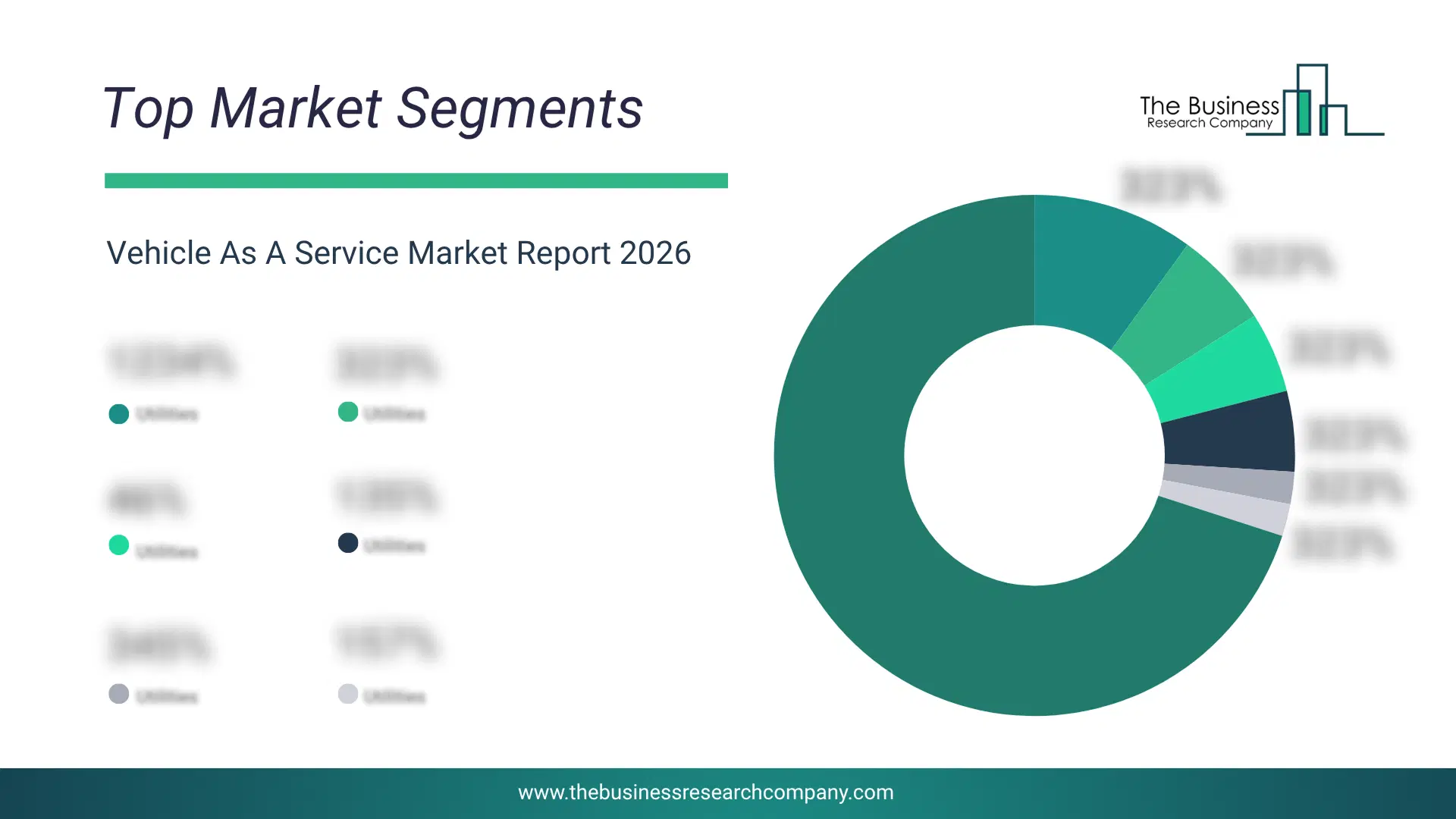
1) By Service Type: Subscription Management, Asset Management, Vehicle And Status Monitoring Service, Other Service Types 2) By Engine: Electric, IC Engine 3) By Vehicle: Passenger Cars, Trucks, Utility Trailers, Motorcycles 4) By Service Provider: Automotive Original Equipment Manufacturer (OEM), Auto Dealerships, Auto Tech Startups, Car Subscription Software Providers 5) By End-User: Enterprise Users, Private Users Subsegments: 1) By Subscription Management: Fleet Subscription Services, Short-Term Subscription Services 2) By Asset Management: Vehicle Tracking and Maintenance, Inventory Management 3) By Vehicle And Status Monitoring Service: Real-Time Monitoring, Diagnostic Services 4) By Other Service Types: Route Optimization, Customer Support ServicesWhat Is The Driver Of The Vehicle As A Service Market?
The rising global traffic congestion and jams are expected to propel the growth of the vehicle-as-a service market going forward. Traffic congestion refers to the condition where vehicles on a road network experience delays due to excessive volume, resulting in slower speeds and longer travel times. Rising global traffic congestion and jams are primarily due to increasing urbanization, population growth, inadequate infrastructure development, and a growing number of vehicles on the road. Vehicle-as-a-Service (VaaS) can alleviate traffic congestion and jams by promoting shared mobility and reducing the number of individual vehicles on the road, leading to more efficient and optimized transportation. For instance, in January 2024, according to a report published by INRIX, a US-based provider of real-time traffic information and connected driving services, traffic congestion worsened in 98 of the top 100 urban areas in 2023 compared to the previous year. 71 of these cities experienced double-digit percentage increases in traffic delays in 2022. Additionally, drivers in New York City lost an average of 101 hours to traffic jams in 2023, resulting in economic losses exceeding $9.1 billion due to wasted time. Therefore, rising global traffic congestion and traffic jams will drive the growth of the vehicle as a service industry.Key Players In The Global Vehicle As A Service Market
Major companies operating in the vehicle as a service market report include Volkswagen AG, Toyota Motor Corporation, Tata Group, Ford Motor Company, Mercedes-Benz Group, General Motors, Bayerische Motoren Werke AG (BMW Group), Hyundai Motor Group, Accenture Plc, AB Volvo, Porsche AG, Uber Technologies Inc., AutoNation, Nokia Corporation, DiDi Chuxing, LeasePlan Corporation NV, Hertz Corporation, Orange Business Services, Lyft Inc., Sixt SE, Kelsian Group, CarNext B.V., Zoomcar, Cluno GmbH, Bipi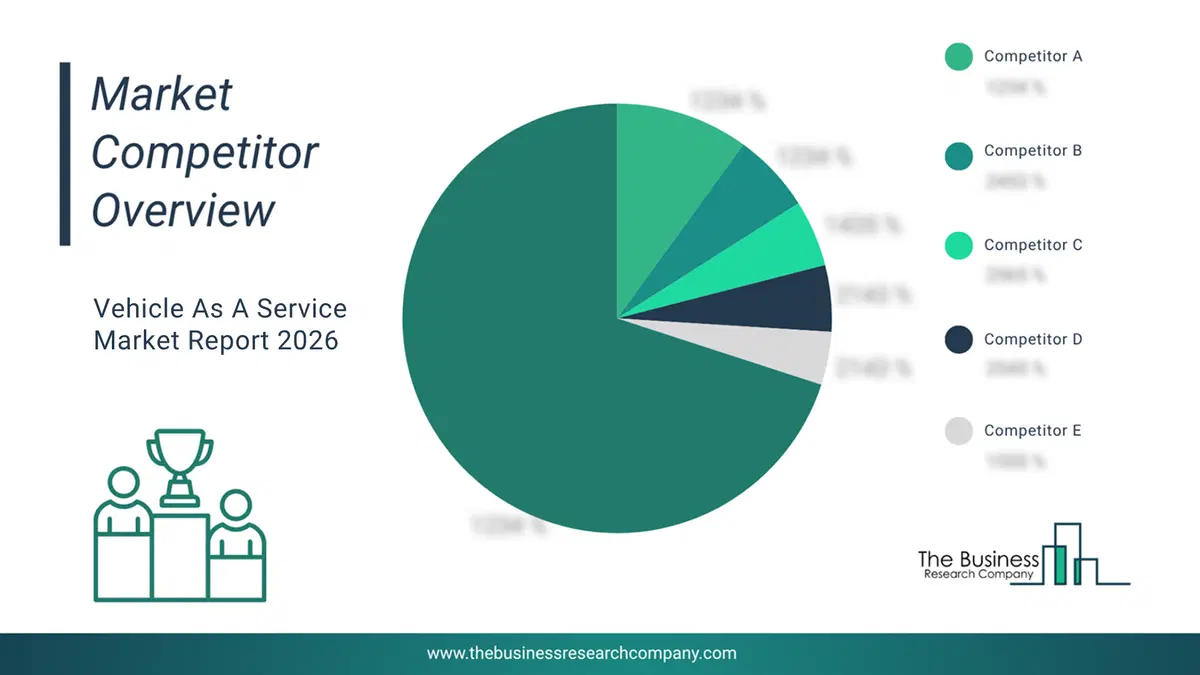
This chart is for illustrative purposes; the full report includes a detailed competitor analysis and comprehensive overview of the top 10 companies in the market.
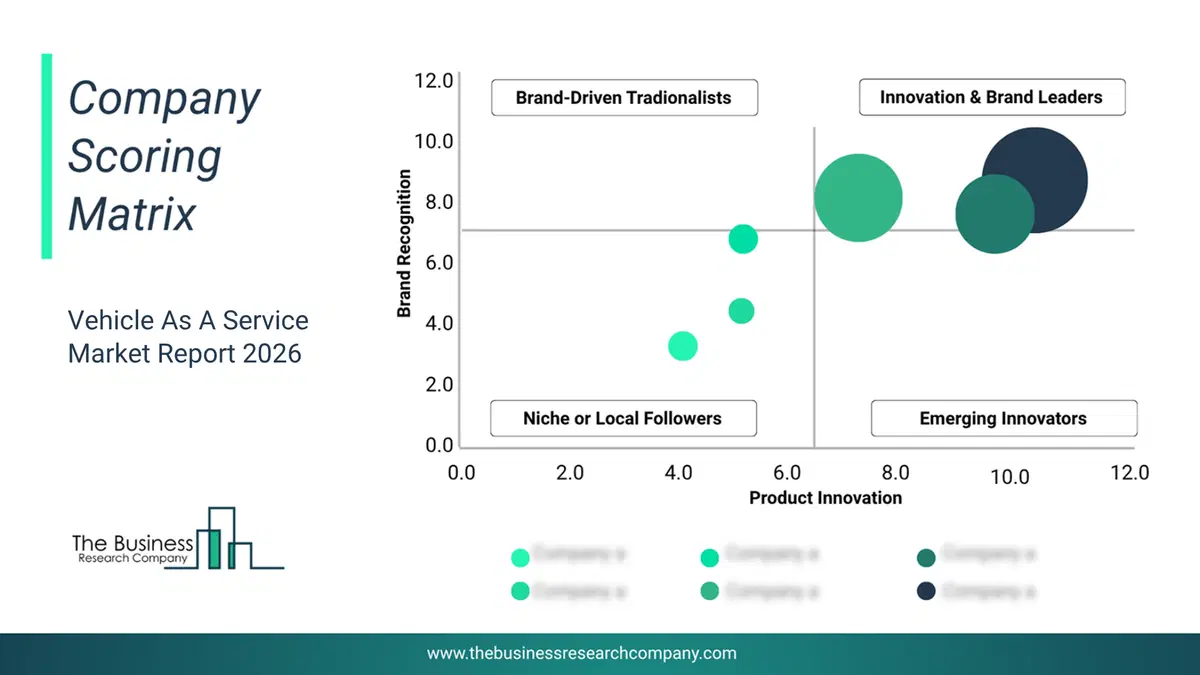
This chart maps companies by product innovation and brand strength, with bubble size indicating relative revenue, helping identify market leaders, challengers, and niche players. This is an illustrative chart; the full report provides a complete and accurate competitive analysis.
Global Vehicle As A Service Market Trends and Insights
Major companies operating in the vehicle-as-a-service market are focusing on developing innovative solutions such as flexible subscription platforms to offer convenient, cost-effective access to vehicles without long-term ownership. A flexible subscription platform is a service that allows users to access vehicles for a recurring fee covering rental, maintenance, insurance, and other services, helping by providing convenience, cost predictability, and the freedom to switch or cancel vehicles as needed. For instance, in October 2024, Drivalia UK Ltd., a UK‑based automotive company, launched CarCloud, a new car‑subscription service dedicated to the Omoda 5 SUV. Through this launch, Drivalia aims to give customers the flexibility to use a vehicle without the burden of ownership, offering monthly renewals, no long‑term commitment, and including services like maintenance and insurance. CarCloud is positioned to serve both private individuals and corporate clients, reflecting growing demand for flexible mobility solutions in Europe.What Are Latest Mergers And Acquisitions In The Vehicle As A Service Market?
In October 2024, Carwow Group, a UK-based technology and online marketplace company, acquired Gridserve Car Leasing for an undisclosed amount. This acquisition represents a key move for Carwow in strengthening its position as a leading vehicle leasing marketplace in the UK. By expanding its offerings beyond electric vehicles (EVs) and enhancing its comparison tools, Carwow aims to attract a wider customer base and improve service delivery in the evolving automotive market. Gridserve, is a UK-based company, that specializes in leasing electric vehicles.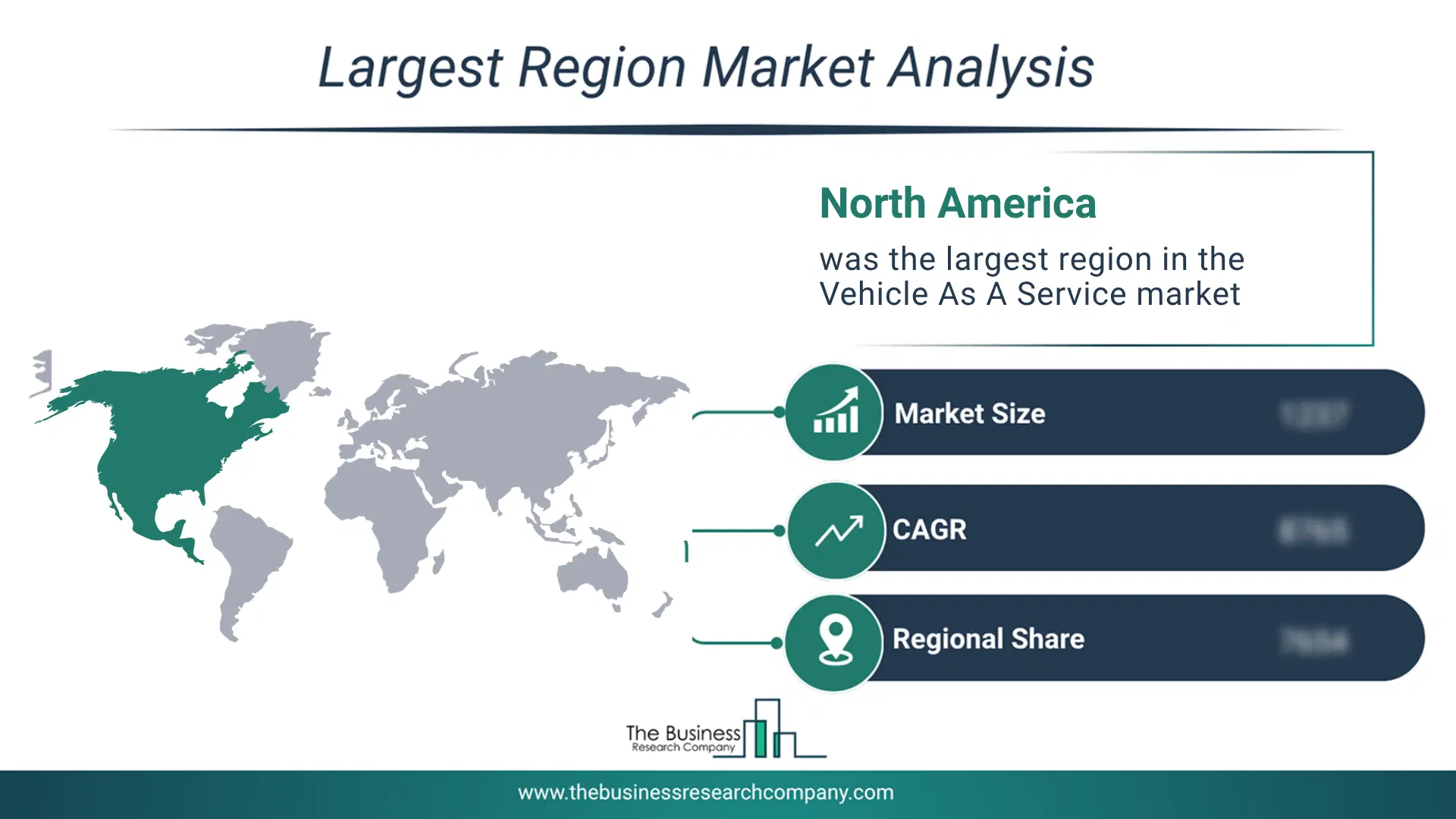
Regional Outlook
North America was the largest region in the vehicle as a service market in 2025. Asia-Pacific is expected to be the fastest-growing region in the forecast period. The regions covered in this market report include Asia-Pacific, South East Asia, Western Europe, Eastern Europe, North America, South America, Middle East, Africa. The countries covered in this market report include Australia, Brazil, China, France, Germany, India, Indonesia, Japan, Taiwan, Russia, South Korea, UK, USA, Canada, Italy, SpainWhat Defines the Vehicle As A Service Market?
The vehicle as a service market includes revenues earned by entities by car sharing, ride-hailing, long-term rentals, fleet management services and autonomous vehicle services. The market value includes the value of related goods sold by the service provider or included within the service offering. Only goods and services traded between entities or sold to end consumers are included.How is Market Value Defined and Measured?
The market value is defined as the revenues that enterprises gain from the sale of goods and/or services within the specified market and geography through sales, grants, or donations in terms of the currency (in USD unless otherwise specified). The revenues for a specified geography are consumption values that are revenues generated by organizations in the specified geography within the market, irrespective of where they are produced. It does not include revenues from resales along the supply chain, either further along the supply chain or as part of other products.
This chart presents market attractiveness based on a quantitative evaluation of growth, competition, strategic alignment, and risk, offering a clear view of opportunity areas for decision-making. This chart is for illustrative purposes; the full report contains the complete analysis.

This chart highlights the Total Addressable Market (TAM) by estimating the maximum revenue opportunity using an assumption-driven approach, supporting strategic planning and opportunity sizing across markets. The chart is illustrative; the full report provides a more comprehensive analysis.
What Key Data and Analysis Are Included in the Vehicle As A Service Market Report 2026?
The vehicle as a service market research report is one of a series of new reports from The Business Research Company that provides market statistics, including industry global market size, regional shares, competitors with the market share, detailed market segments, market trends and opportunities, and any further data you may need to thrive in the vehicle as a service industry. The market research report delivers a complete perspective of everything you need, with an in-depth analysis of the current and future state of the industry.Vehicle As A Service Market Report Forecast Analysis
| Report Attribute | Details |
|---|---|
| Market Size Value In 2026 | $10.48 billion |
| Revenue Forecast In 2030 | $20.97 billion |
| Growth Rate | CAGR of 19.3% from 2026 to 2030 |
| Base Year For Estimation | 2025 |
| Actual Estimates/Historical Data | 2020-2025 |
| Forecast Period | 2026 - 2030 - 2030 |
| Market Representation | Revenue in USD Billion and CAGR from 2026 to 2030 |
| Segments Covered | Service Type, Engine, Vehicle, Service Provider, End-User |
| Regional Scope | Asia-Pacific, Western Europe, Eastern Europe, North America, South America, Middle East, Africa |
| Country Scope | The countries covered in the report are Australia, Brazil, China, France, Germany, India, Indonesia, Japan, Taiwan, Russia, South Korea, UK, USA, Canada, Italy, Spain. |
| Key Companies Profiled | Volkswagen AG, Toyota Motor Corporation, Tata Group, Ford Motor Company, Mercedes-Benz Group, General Motors, Bayerische Motoren Werke AG (BMW Group), Hyundai Motor Group, Accenture Plc, AB Volvo, Porsche AG, Uber Technologies Inc., AutoNation, Nokia Corporation, DiDi Chuxing, LeasePlan Corporation NV, Hertz Corporation, Orange Business Services, Lyft Inc., Sixt SE, Kelsian Group, CarNext B.V., Zoomcar, Cluno GmbH, Bipi |
| Customization Scope | Request for Customization |
| Pricing And Purchase Options | Explore Purchase Options |