
Rare Disease Genome Editing Market Report 2026
Global Outlook – By Technology (Clustered Regularly Interspaced Short Palindromic Repeats (CRISPR) Or CRISPR-Associated Protein 9, Transcription Activator-Like Effector Nucleases (TALEN), Zinc Finger Nucleases (ZFN), Other Technologies), By Disease Type (Monogenic Disorders, Multifactorial Disorders, Chromosomal Disorders), By Application (Therapeutics, Research), By End User (Biotechnology And Pharmaceutical Companies, Academic And Government Research Institutes, Hospitals) – Market Size, Trends, Strategies, and Forecast to 2030
Rare Disease Genome Editing Market Overview
• Rare Disease Genome Editing market size has reached to $1.29 billion in 2025 • Expected to grow to $2.88 billion in 2030 at a compound annual growth rate (CAGR) of 17.5% • Growth Driver: Increasing Focus On Precision Medicine Fueling The Growth Of The Market Due To Advances In Genomic Sequencing And Biomarker Identification • Market Trend: CRISPR-Based Gene Editing Enhances Precision And Outcomes • North America was the largest region in 2025 and Asia-Pacific is the fastest growing region.What Is Covered Under Rare Disease Genome Editing Market?
Rare disease genome editing refers to the use of precise genetic modification technologies to correct or alter disease-causing mutations in patients with rare genetic disorders. It helps to restore normal gene function, prevent disease progression, and develop personalized therapeutic solutions for conditions that currently have limited or no treatment options. This approach aims to address the root cause of the disease at the DNA level rather than managing symptoms. The main technologies used in rare disease genome editing are clustered regularly interspaced short palindromic repeats (CRISPR) or CRISPR-associated protein 9, transcription activator-like effector nucleases (TALEN), zinc finger nucleases (ZFN), and others. Clustered regularly interspaced short palindromic repeats (CRISPR) or CRISPR-associated protein 9 is a genome editing tool that uses a guide RNA and the Cas9 enzyme to precisely cut and modify DNA for research and therapeutic purposes. It is used for different disease types such as monogenic disorders, multifactorial disorders, and chromosomal disorders, and finds application in therapeutics and research, serving end users such as biotechnology and pharmaceutical companies, academic and government research institutes, and hospitals.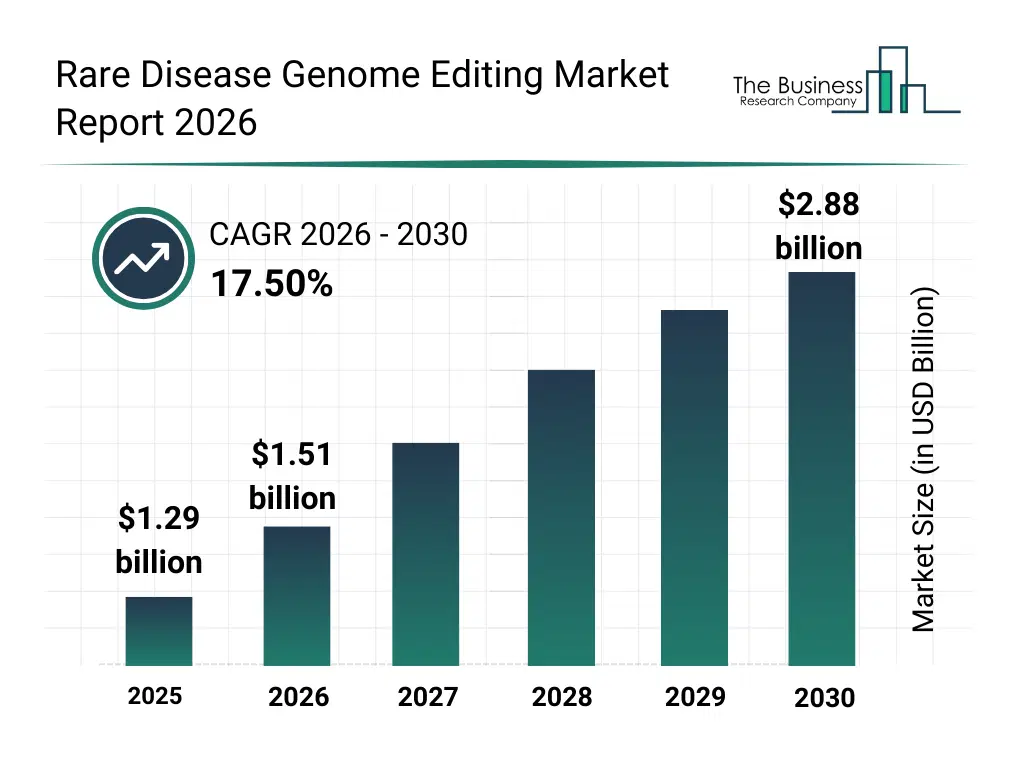
What Is The Rare Disease Genome Editing Market Size and Share 2026?
The rare disease genome editing market size has grown rapidly in recent years. It will grow from $1.29 billion in 2025 to $1.51 billion in 2026 at a compound annual growth rate (CAGR) of 17.8%. The growth in the historic period can be attributed to advancements in gene editing technologies, increasing identification of rare genetic mutations, expansion of genomic research funding, early success of gene therapy trials, growing academic research initiatives.What Is The Rare Disease Genome Editing Market Growth Forecast?
The rare disease genome editing market size is expected to see rapid growth in the next few years. It will grow to $2.88 billion in 2030 at a compound annual growth rate (CAGR) of 17.5%. The growth in the forecast period can be attributed to increasing investment in curative rare disease therapies, rising adoption of precision medicine approaches, expansion of clinical genome editing trials, growing regulatory support for orphan drugs, increasing collaboration between biotech and healthcare providers. Major trends in the forecast period include increasing adoption of crispr-based therapeutics, rising focus on gene editing for monogenic disorders, growing use of personalized genome editing approaches, expansion of advanced editing platforms, enhanced integration of genomic data analytics.
Global Rare Disease Genome Editing Market Segmentation
1) By Technology: Clustered Regularly Interspaced Short Palindromic Repeats (CRISPR) Or CRISPR-Associated Protein 9, Transcription Activator-Like Effector Nucleases (TALEN), Zinc Finger Nucleases (ZFN), Other Technologies 2) By Disease Type: Monogenic Disorders, Multifactorial Disorders, Chromosomal Disorders 3) By Application: Therapeutics, Research 4) By End User: Biotechnology And Pharmaceutical Companies, Academic And Government Research Institutes, Hospitals Subsegments: 1) By Clustered Regularly Interspaced Short Palindromic Repeats (CRISPR) Or CRISPR-Associated Protein 9: Clustered Regularly Interspaced Short Palindromic Repeats (CRISPR)-Associated Protein 9, Clustered Regularly Interspaced Short Palindromic Repeats (CRISPR)-Associated Protein 12, Clustered Regularly Interspaced Short Palindromic Repeats (CRISPR)-Associated Protein 13, Base Editing, Prime Editing 2) By Transcription Activator-Like Effector Nucleases (TALEN): Standard Transcription Activator-Like Effector Nucleases (TALEN), Designer Transcription Activator-Like Effector Nucleases (dTALEN), Transcription Activator-Like Effector Nucleases (TALEN) Paired Nucleases 3) By Zinc Finger Nucleases (ZFN): Standard Zinc Finger Nucleases (ZFN), Engineered Zinc Finger Nucleases (ZFN), Modular Zinc Finger Nucleases (ZFN) 4) By Other Technologies: Meganucleases, Ribonucleic Acid (RNA)-Guided Nucleases, Clustered Regularly Interspaced Short Palindromic Repeats (CRISPR)-Associated TransposasesWhat Is The Driver Of The Rare Disease Genome Editing Market?
The increasing focus on precision medicine is expected to propel the growth of the rare disease genome editing market going forward. Precision medicine refers to a tailored healthcare approach that uses a patient’s genetics, environment, and lifestyle to provide more accurate and effective treatments. The increasing focus on precision medicine is due to advances in genomic sequencing and biomarker identification, as they enable precise detection and targeted therapies. Rare disease genome editing market supports precision medicine by enabling targeted correction of genetic mutations, making treatments more personalized and effective. It advances healthcare by addressing the root cause of rare disorders, improving patient outcomes and reducing reliance on symptomatic management. For instance, in March 2024, Novotech, an Australia-based biotechnology company, in 2023, 43% of the 217 FDA-approved oncology therapies were precision oncology treatments, with 78 incorporating DNA or NGS-detectable biomarkers. Therefore, the increasing focus on precision medicine is driving the growth of the rare disease genome editing industry.Key Players In The Global Rare Disease Genome Editing Market
Major companies operating in the rare disease genome editing market are Regeneron Pharmaceuticals Inc., Sarepta Therapeutics Inc., Ultragenyx Pharmaceutical Inc., Beam Therapeutics Inc., CRISPR Therapeutics AG, Rocket Pharmaceuticals Inc., Sangamo Therapeutics Inc., Arcturus Therapeutics Holdings Inc., Editas Medicine Inc., Krystal Biotech Inc., Caribou Biosciences Inc, Bluebird Bio Inc., SpliceBio S.L., Cellectis SA, Generation Bio Co., iECURE Inc., Affinia Therapeutics Inc., Precision Biosciences Inc., Intellia Therapeutics Inc., MeiraGTx Holdings plc
This chart is for illustrative purposes; the full report includes a detailed competitor analysis and comprehensive overview of the top 10 companies in the market.
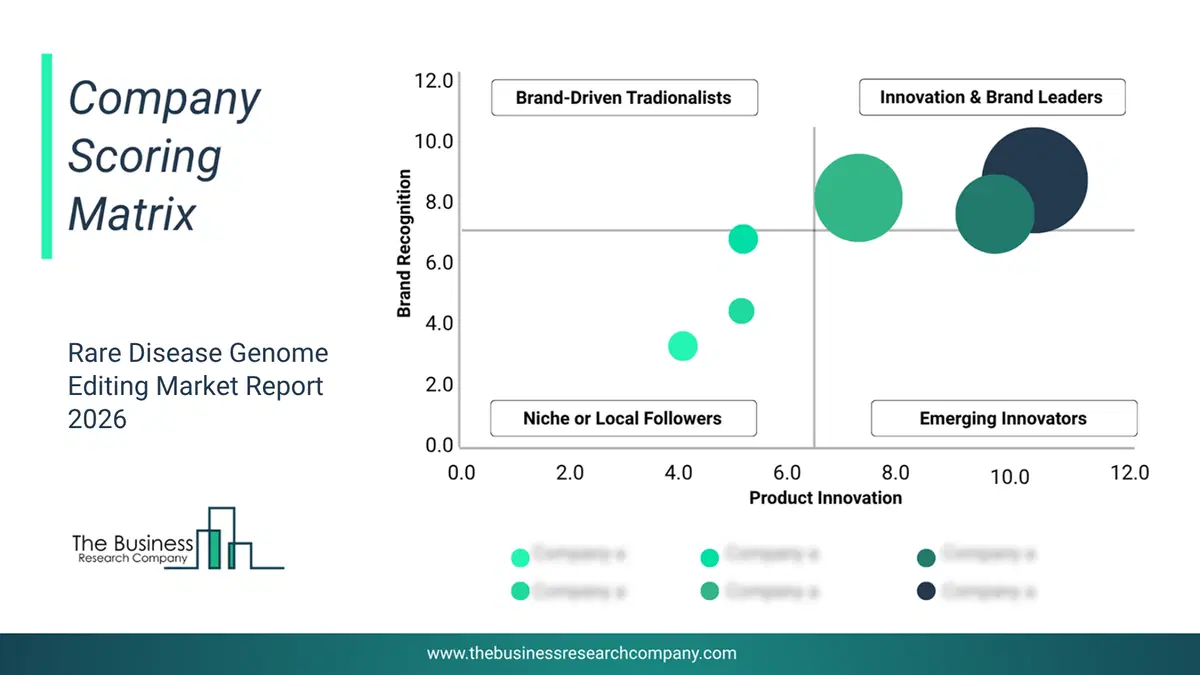
This chart maps companies by product innovation and brand strength, with bubble size indicating relative revenue, helping identify market leaders, challengers, and niche players. This is an illustrative chart; the full report provides a complete and accurate competitive analysis.
Global Rare Disease Genome Editing Market Trends and Insights
Major companies operating in the rare disease genome editing market are focusing on developing advanced therapeutic platforms, such as CRISPR-based gene editing systems, to enhance treatment precision, improve therapeutic outcomes, and address previously incurable genetic diseases. CRISPR-based gene editing systems refer to innovative technologies that enable precise modifications to the genome, allowing for the correction of genetic defects or the introduction of therapeutic genes into cells. For instance, in December 2023, Vertex Pharmaceuticals Inc., a US-based biopharmaceutical company, partnered with CRISPR Therapeutics Inc., a US-based biotechnology research company, and received conditional marketing authorization from the United Kingdom (U.K.) Medicines and Healthcare products Regulatory Agency (MHRA) for CASGEVY (exagamglogene autotemcel, exa-cel). It is indicated for patients aged 12 and older with sickle cell disease (SCD) and recurrent vaso-occlusive crises or transfusion-dependent beta thalassemia (TDT). Casgevy works by editing a patient’s hematopoietic stem cells to reactivate fetal hemoglobin production, which reduces or eliminates disease symptoms and offers a potential functional cure for these conditions.What Are Latest Mergers And Acquisitions In The Rare Disease Genome Editing Market?
In May 2024, Arbor Biotechnologies Inc., a US-based biotechnology company, acquired Serendipity Biosciences for an undisclosed amount. With this acquisition, Arbor aimed to bolster its technological capabilities by integrating Serendipity’s novel gene‑editing platforms, including Fanzor‑based and IsrB‑based systems, to expand its therapeutic reach, especially in reverse transcriptase–based editing and large DNA insertions. Serendipity Biosciences Inc. is a US-based biotechnology company specializing in the discovery and development of unique, programmable gene-editing technologies.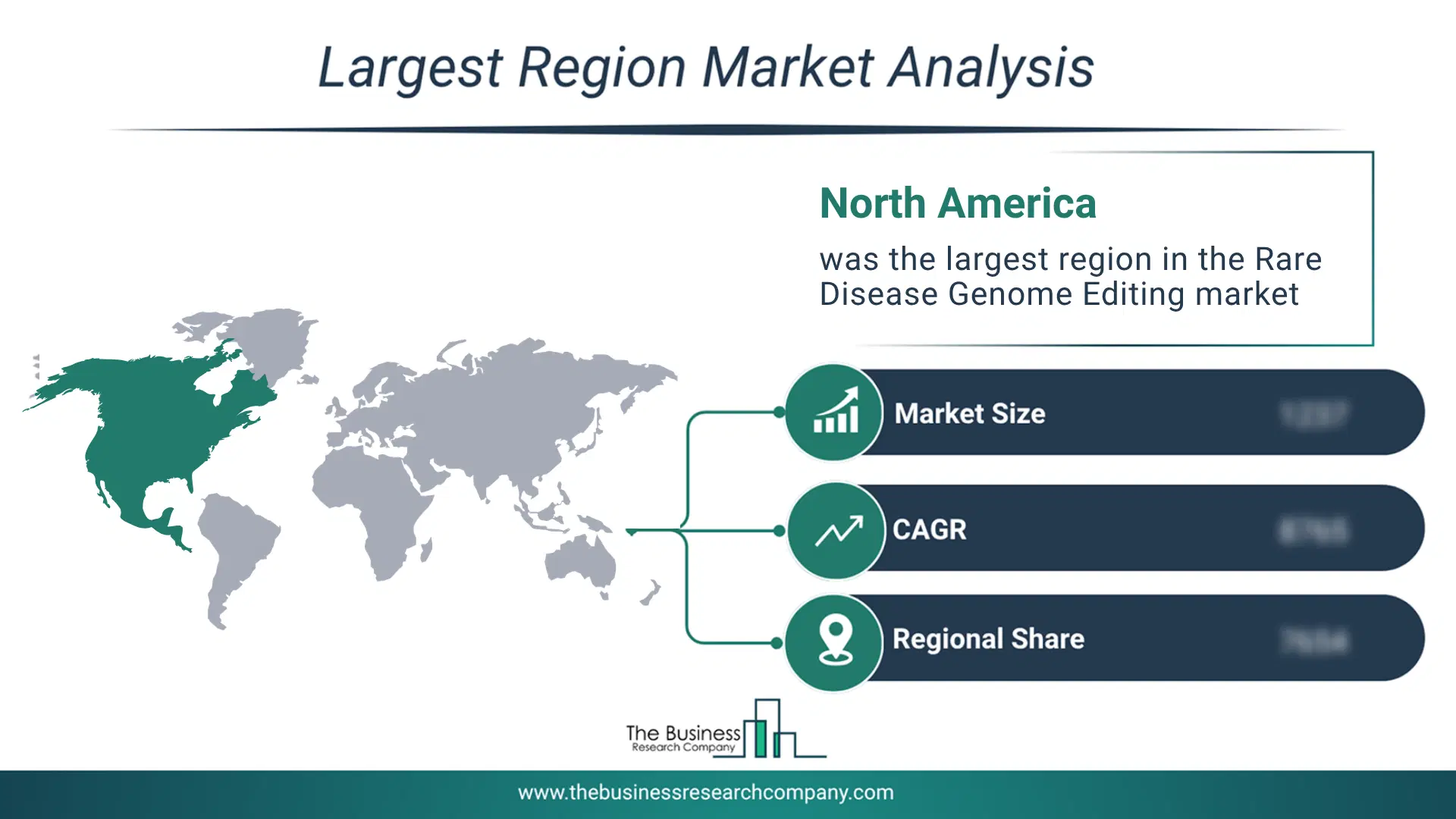
Regional Insights
North America was the largest region in the rare disease genome editing market in 2025. Asia-Pacific is expected to be the fastest-growing region in the forecast period. The regions covered in this market report are Asia-Pacific, South East Asia, Western Europe, Eastern Europe, North America, South America, Middle East, Africa. The countries covered in this market report are Australia, Brazil, China, France, Germany, India, Indonesia, Japan, Taiwan, Russia, South Korea, UK, USA, Canada, Italy, Spain.What Defines the Rare Disease Genome Editing Market?
The rare disease genome editing market consists of revenues earned by entities by providing services such as gene editing therapy development, genetic testing and diagnostics, preclinical research and validation, clinical trial management, and regulatory consulting for genome-based therapeutics. The market value includes the value of related goods sold by the service provider or included within the service offering. The rare disease genome editing market also includes sales of zinc finger nucleases, delivery vectors, modified cells, and therapeutic genome-editing formulations. Values in this market are ‘factory gate’ values, that is the value of goods sold by the manufacturers or creators of the goods, whether to other entities (including downstream manufacturers, wholesalers, distributors and retailers) or directly to end customers. The value of goods in this market includes related services sold by the creators of the goods.How is Market Value Defined and Measured?
The market value is defined as the revenues that enterprises gain from the sale of goods and/or services within the specified market and geography through sales, grants, or donations in terms of the currency (in USD unless otherwise specified). The revenues for a specified geography are consumption values that are revenues generated by organizations in the specified geography within the market, irrespective of where they are produced. It does not include revenues from resales along the supply chain, either further along the supply chain or as part of other products.
This chart presents market attractiveness based on a quantitative evaluation of growth, competition, strategic alignment, and risk, offering a clear view of opportunity areas for decision-making. This chart is for illustrative purposes; the full report contains the complete analysis.

This chart highlights the Total Addressable Market (TAM) by estimating the maximum revenue opportunity using an assumption-driven approach, supporting strategic planning and opportunity sizing across markets. The chart is illustrative; the full report provides a more comprehensive analysis.
What Key Data and Analysis Are Included in the Rare Disease Genome Editing Market Report 2026?
The rare disease genome editing market research report is one of a series of new reports from The Business Research Company that provides market statistics, including industry global market size, regional shares, competitors with the market share, detailed market segments, market trends and opportunities, and any further data you may need to thrive in the rare disease genome editing industry. The market research report delivers a complete perspective of everything you need, with an in-depth analysis of the current and future state of the industry.Rare Disease Genome Editing Market Report Forecast Analysis
| Report Attribute | Details |
|---|---|
| Market Size Value In 2026 | $1.51 billion |
| Revenue Forecast In 2030 | $2.88 billion |
| Growth Rate | CAGR of 17.8% from 2026 to 2030 |
| Base Year For Estimation | 2025 |
| Actual Estimates/Historical Data | 2020-2025 |
| Forecast Period | 2026 - 2030 |
| Market Representation | Revenue in USD Billion and CAGR from 2026 to 2030 |
| Segments Covered | Technology, Disease Type, Application, End User |
| Regional Scope | Asia-Pacific, Western Europe, Eastern Europe, North America, South America, Middle East, Africa |
| Country Scope | The countries covered in the report are Australia, Brazil, China, France, Germany, India, Indonesia, Japan, Taiwan, Russia, South Korea, UK, USA, Canada, Italy, Spain. |
| Key Companies Profiled | Regeneron Pharmaceuticals Inc., Sarepta Therapeutics Inc., Ultragenyx Pharmaceutical Inc., Beam Therapeutics Inc., CRISPR Therapeutics AG, Rocket Pharmaceuticals Inc., Sangamo Therapeutics Inc., Arcturus Therapeutics Holdings Inc., Editas Medicine Inc., Krystal Biotech Inc., Caribou Biosciences Inc, Bluebird Bio Inc., SpliceBio S.L., Cellectis SA, Generation Bio Co., iECURE Inc., Affinia Therapeutics Inc., Precision Biosciences Inc., Intellia Therapeutics Inc., MeiraGTx Holdings plc |
| Customization Scope | Request for Customization |
| Pricing And Purchase Options | Explore Purchase Options |