
Smart Home Market Report 2026
Global Outlook – By Type (Audio Equipment, Video Devices, Gaming Consoles), By Device Type (Safety And Security Access Control, Home Appliances, Heating, Ventilation And Air Conditioning, Lighting Control, Smart Entertainment Devices, Smart Kitchen Appliances, Other Device Types), By Protocol (Wired, Wireless), By Sales Channel (Direct-To-Consumer (DTC) Or Online, Retail, Professional Or System Integrators), By Application (Retrofit, New Construction) – Market Size, Trends, Strategies, and Forecast to 2030
Smart Home Market Overview
• Smart Home market size has reached to $175.33 billion in 2025 • Expected to grow to $490.30 billion in 2030 at a compound annual growth rate (CAGR) of 22.8% • Growth Driver: Growing Adoption Of IoT-Enabled Devices Fueling The Growth Of The Market Due To Rising Connected Technology Usage • Market Trend: Integrating Energy-Optimizing Thermostats To Enhance Efficiency And Streamline Home Energy Management • North America was the largest region in 2025 and Asia-Pacific is the fastest growing region.Market Gains By 2030 – Top Opportunities By Segment
Market Gain identifies the most promising market opportunities by highlighting the segments or products expected to generate the highest incremental revenue growth over the next five years.
What Is Covered Under Smart Home Market?
A smart home refers to a residence equipped with interconnected devices and systems that can be remotely monitored, controlled, and automated through the Internet or mobile applications. It enhances convenience, energy efficiency, and security for residents. The primary purpose of a smart home is to provide automated, efficient, and user-friendly control over household functions, improving comfort, safety, and overall quality of living. The main types of smart home are including audio equipment, video devices, and gaming consoles. Audio equipment refers to devices designed to capture, process, or reproduce sound for listening, communication, or entertainment purposes. The device types include safety and security access control, home appliances, heating, ventilation and air conditioning, lighting control, smart entertainment devices, smart kitchen appliances, and others. The protocols include wired and wireless. The sales channels include direct-to-consumer (DTC) or online, retail, and professional or system integrators. The applications such as retrofit and new construction.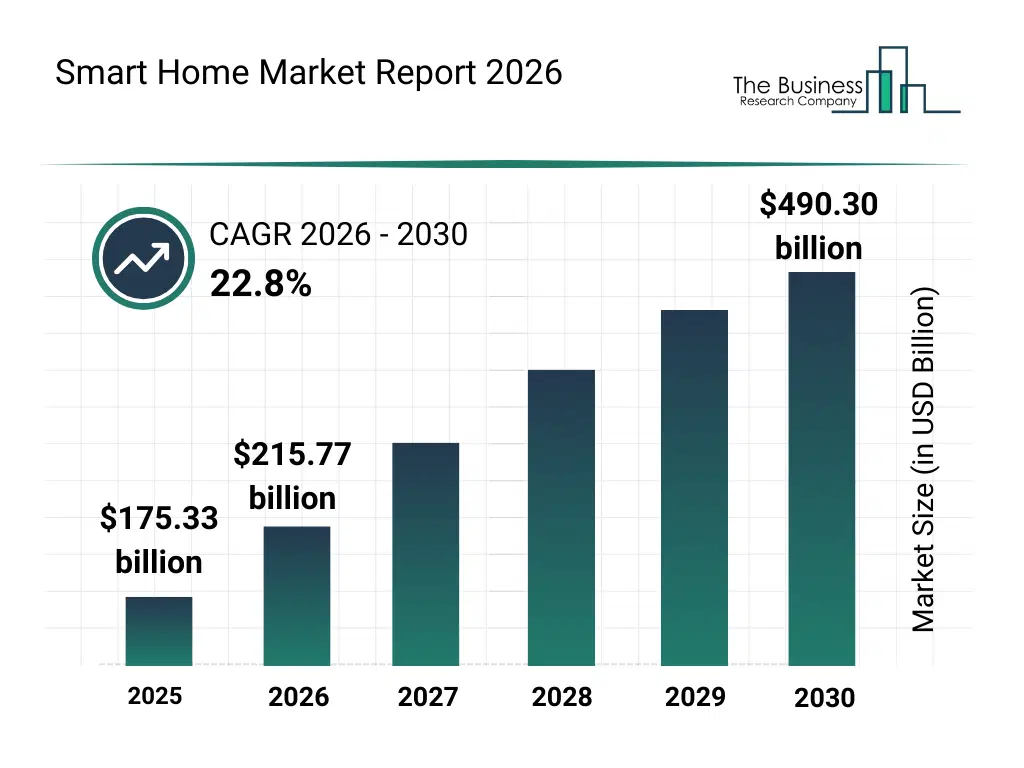
What Is The Smart Home Market Size and Share 2026?
The smart home market size has grown exponentially in recent years. It will grow from $175.33 billion in 2025 to $215.77 billion in 2026 at a compound annual growth rate (CAGR) of 23.1%. The growth in the historic period can be attributed to increasing adoption of IoT devices, rising consumer demand for home automation, growing awareness about energy efficiency, expanding use of smart security systems, and increasing penetration of smartphones and mobile applications.What Is The Smart Home Market Growth Forecast?
The smart home market size is expected to see exponential growth in the next few years. It will grow to $490.30 billion in 2030 at a compound annual growth rate (CAGR) of 22.8%. The growth in the forecast period can be attributed to rising investment in smart home infrastructure, growing integration of AI and machine learning, increasing adoption of voice-controlled devices, expanding demand for retrofit solutions, rising focus on sustainable and energy-efficient solutions, and Major trends in the forecast period include technological advancements in AI-driven automation, innovations in matter protocol interoperability, developments in 5G and edge computing integration, research into sustainable home solutions, and advancements in predictive maintenance and smart appliance management.
Global Smart Home Market Segmentation
1) By Type: Audio Equipment, Video Devices, Gaming Consoles 2) By Device Type: Safety And Security Access Control, Home Appliances, Heating, Ventilation And Air Conditioning, Lighting Control, Smart Entertainment Devices, Smart Kitchen Appliances, Other Device Types 3) By Protocol: Wired, Wireless 4) By Sales Channel: Direct-To-Consumer (DTC) Or Online, Retail, Professional Or System Integrators 5) By Application: Retrofit, New Construction Subsegments: 1) By Audio Equipment: Smart Speakers, Wireless Home Audio Systems, Sound Bars, Multi Room Audio Devices, Home Theater Audio Systems 2) By Video Devices: Smart Televisions, Streaming Media Players, Projectors, Video Casting Devices, Smart Display Screens 3) By Gaming Consoles: Home Gaming Consoles, Portable Gaming Consoles, Virtual Reality Gaming Devices, Motion Sensing Gaming Devices, Cloud Based Gaming Consoles The top segments in the smart home market will be: • Security And Access Control will reach $130.46 Billion by 2030. • Home Appliances will reach $87.4 Billion by 2030. • Smart Speaker will reach $64.1 Billion by 2030. • Lighting Control will reach $60.32 Billion by 2030. • Heating,Ventilation And Air Conditioning (HVAC) Control will reach $59.78 Billion by 2030.What Is The Driver Of The Smart Home Market?
The growing adoption of internet of things (IoT)-enabled devices is expected to propel the growth of the smart home market going forward. IoT-enabled devices are electronics equipped with sensors, software, and network connectivity that allow them to collect data and communicate with other systems, enabling remote monitoring and automation. The adoption of IoT-enabled devices is rising as organizations seek real-time data and automation to optimize operations reduce costs and improve decision-making across homes cities and industries. The smart home supports IoT-enabled devices by integrating IoT capabilities into climate control, security systems, lighting, and household appliances, which strengthens convenience, efficiency, and energy management. For instance, in September 2024, according to IoT Analytics, a Germany-based research firm focused on IoT market insights, the number of connected IoT devices reached 16.6 billion in 2023, reflecting a 15% increase from 14.4 billion in 2022. Therefore, the growing adoption of internet of things (IoT)-enabled devices is driving the growth of the smart home industry.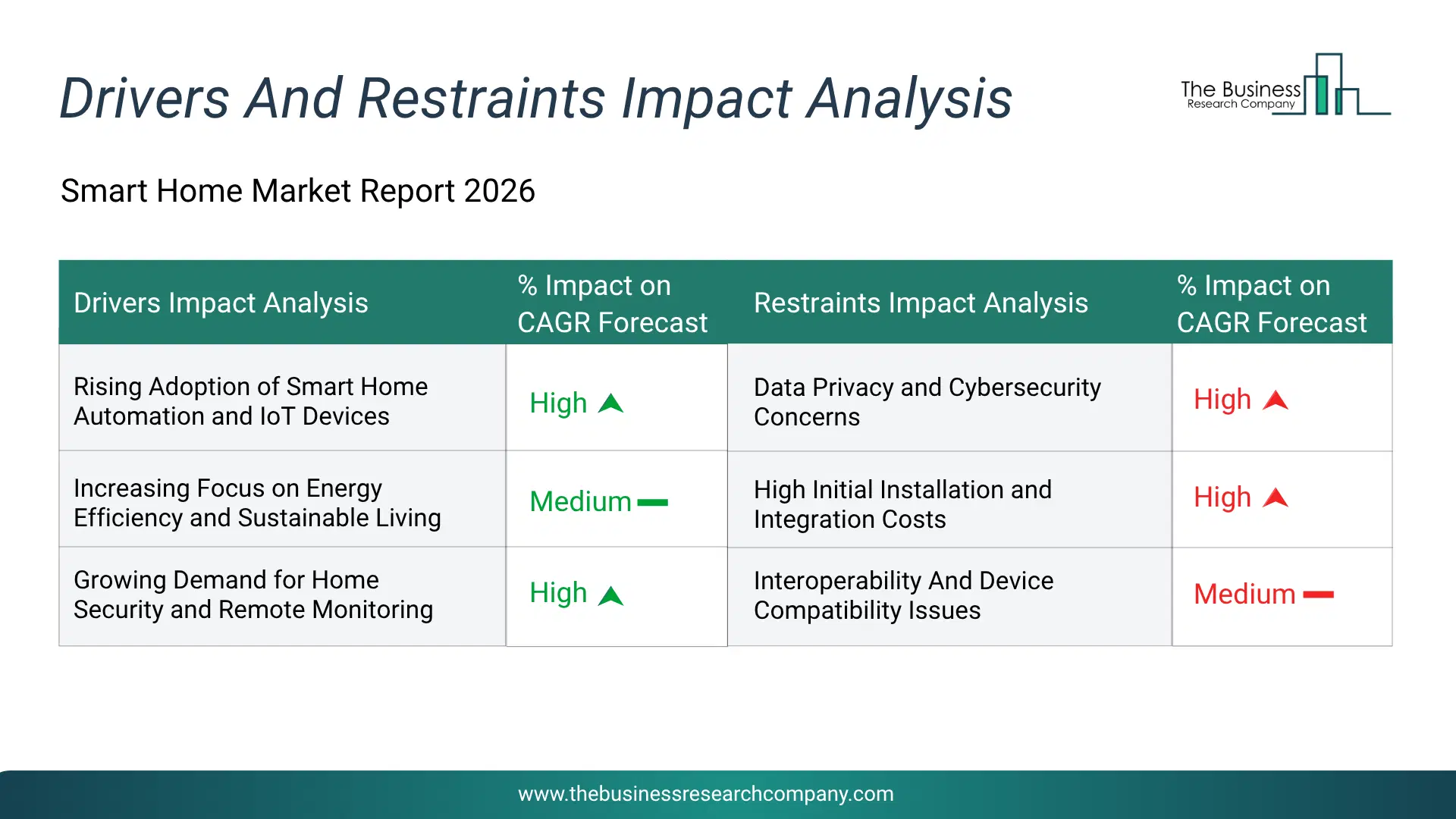
Infographic Chart Showing Key Market Drivers Analysis And Restraints For Smart Home Market
The chart presents an impact analysis of key drivers and restraints, quantifying their relative influence on the market's growth rate and helping assess the balance between growth enablers and limiting factors. This chart offers a high-level perspective; the full report contains more detailed insights.
How Will The Drivers Impact Growth In The Global Smart Home Market?
• Rising Adoption of Smart Home Automation and IoT Devices (High) – During the forecast period, the rising adoption of smart home automation and IoT devices is expected to become a key growth driver for the smart home market by 2030. The increasing adoption of Internet of Things (IoT) devices is a major driver of the smart home market. Consumers are integrating connected lighting, security systems, appliances, and climate control devices into their homes for greater convenience. Interoperability among devices and centralized mobile applications have improved the overall user experience. The growing availability of affordable smart products has further accelerated adoption across both developed and emerging economies. • Increasing Focus on Energy Efficiency and Sustainable Living (Medium) – During the forecast period, the increasing focus on energy efficiency and sustainable living is expected to emerge as a major factor driving the expansion of the smart home market by 2030. Consumers and governments are emphasizing energy conservation to reduce electricity consumption and carbon emissions. Smart thermostats, lighting controls, and energy monitoring systems help optimize energy usage through automation and real-time insights. Incentive programs and stricter energy-efficiency regulations are encouraging homeowners to adopt intelligent home technologies. Rising electricity costs are also motivating consumers to invest in energy-saving smart devices. • Growing Demand for Home Security and Remote Monitoring (High) – During the forecast period, the growing demand for home security and remote monitoring is expected to act as a key growth catalyst for the smart home market by 2030. Increasing concerns regarding home safety, theft, and property surveillance are driving the adoption of smart security systems. Connected cameras, video doorbells, smart locks, motion sensors, and alarm systems enable homeowners to monitor their properties remotely through smartphones. AI-powered analytics and real-time notifications enhance the effectiveness of these security solutions. The growing popularity of remote access and cloud-based monitoring further supports market expansion.How Will The Restraints Impact Growth In The Global Smart Home Market?
• Data Privacy and Cybersecurity Concerns (High) – During the forecast period, the smart home devices continuously collect and transmit personal data, raising concerns about privacy and cybersecurity. Connected devices can become targets for cyberattacks if not properly secured. Consumers remain cautious about unauthorized access to cameras, microphones, and home networks. Compliance with evolving data protection regulations also increases complexity for manufacturers. These concerns may slow adoption among privacy-conscious consumers. • High Initial Installation and Integration Costs (Medium) – During the forecast period, the although device prices have declined, setting up a fully integrated smart home can still require significant upfront investment. Costs associated with premium devices, professional installation, networking infrastructure, and system integration may discourage price-sensitive consumers. Compatibility issues among products from different brands can further increase implementation expenses. Small households and consumers in developing markets may delay adoption due to budget constraints. As a result, cost remains a key barrier to broader market penetration. • Interoperability And Device Compatibility Issues (High) – During the forecast period, the interoperability and device compatibility issues act as a significant restraint for the smart home market because devices from different manufacturers often use proprietary communication protocols, platforms, and ecosystems that are not fully compatible with one another. Consumers may experience difficulties integrating smart lighting, security systems, appliances, and voice assistants into a unified home automation environment. Resolving compatibility issues may require additional hubs, software updates, or replacement of existing devices, increasing overall costs and complexity. These challenges can reduce consumer satisfaction and slow the adoption of smart home technologies.Key Players In The Global Smart Home Market
Major companies operating in the smart home market are Amazon.com Inc., Apple Inc., Samsung Electronics Co. Ltd., Robert Bosch GmbH, LG Electronics Inc., Schneider Electric SE, Xiaomi Corporation, Honeywell International Inc., ABB Ltd., Legrand SA, Signify N.V., TP-Link Technologies Co. Ltd., Somfy SA, Anker Innovations Technology Co. Ltd., Lutron Electronics Co. Inc., Control4 Corporation, iRobot Corporation, Aqara, ecobee Inc., Tuya Inc., Nanoleaf Ltd., Eve Systems GmbH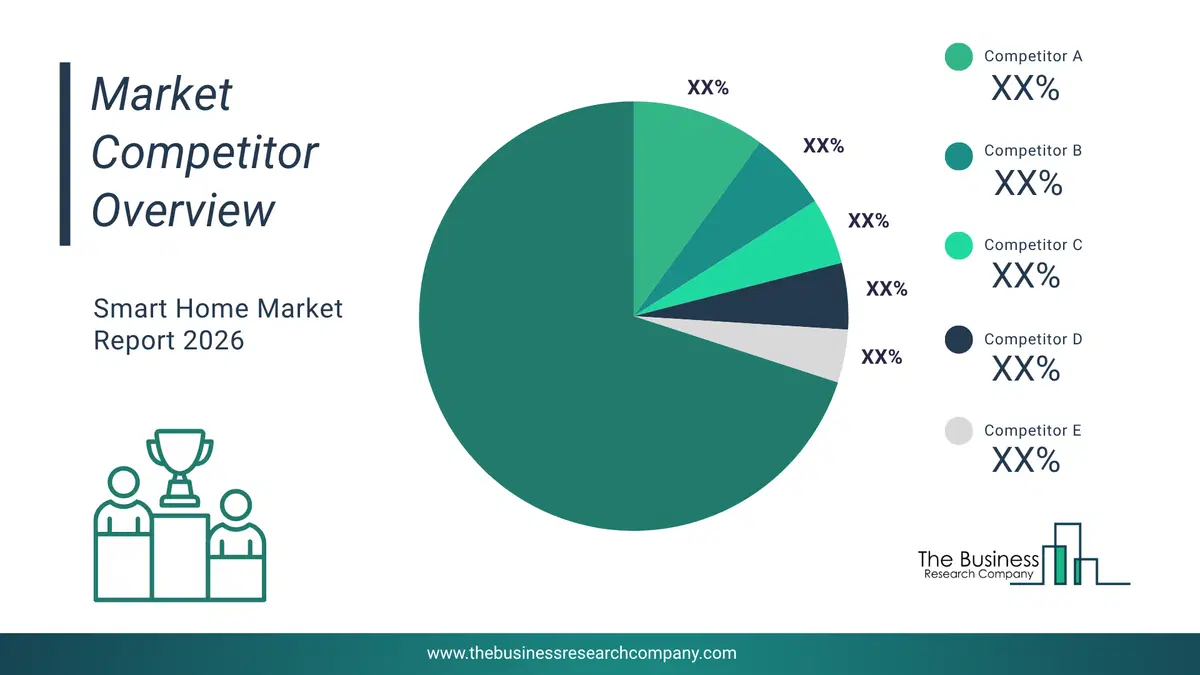
This chart is for illustrative purposes; the full report includes a detailed competitor analysis and comprehensive overview of the top 10 companies in the market.
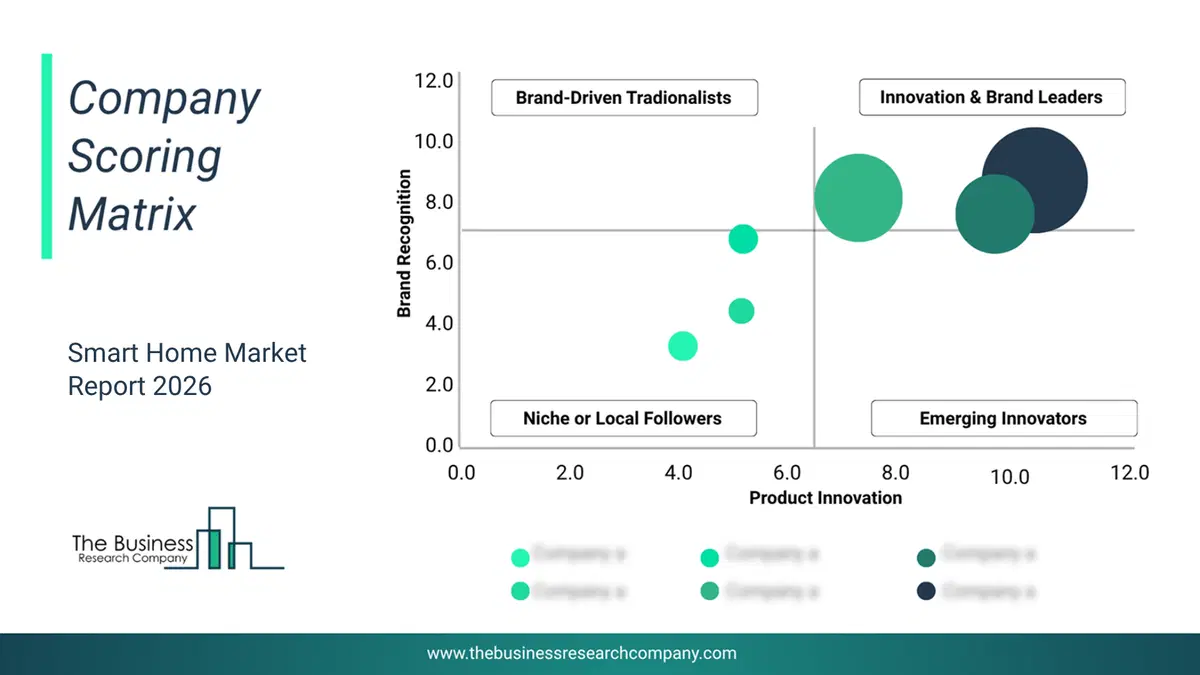
This chart maps companies by product innovation and brand strength, with bubble size indicating relative revenue, helping identify market leaders, challengers, and niche players. This is an illustrative chart; the full report provides a complete and accurate competitive analysis.
Global Smart Home Market Trends and Insights
Major companies operating in the smart home market are focusing on developing energy-optimizing solutions, such as integrated smart thermostats, to improve home energy efficiency, reduce electricity costs, and enhance automated climate control. Integrated smart thermostats refer to connected devices that intelligently regulate heating and cooling, coordinate with energy storage or backup systems, and adapt to occupancy patterns to optimize energy use. For instance, in May 2025, Generac Holdings Inc., a US-based energy technology company, launched the ecobee by Generac Smart Thermostat Enhanced with Home Energy Management. This integrated smart thermostat features occupancy-based climate adjustment, integration with PWRcell solar battery storage for reduced grid dependence, and seamless coordination with Generac Home Standby Generators to maintain comfort during power outages.What Are Latest Mergers And Acquisitions In The Smart Home Market?
In June 2023, ABB Asea Brown Boveri Ltd., a Switzerland-based electrification and automation company, acquired Eve Systems GmbH for an undisclosed amount. With this acquisition, ABB aims to strengthen its smart home technology portfolio and expand its interoperable home automation offerings by integrating Eve’s expertise in Matter and Thread protocols, enhancing energy management and security solutions, and accelerating innovation in connected home devices to drive long-term market growth. Eve Systems GmbH is a German smart home provider offering connected energy, security, and automation devices.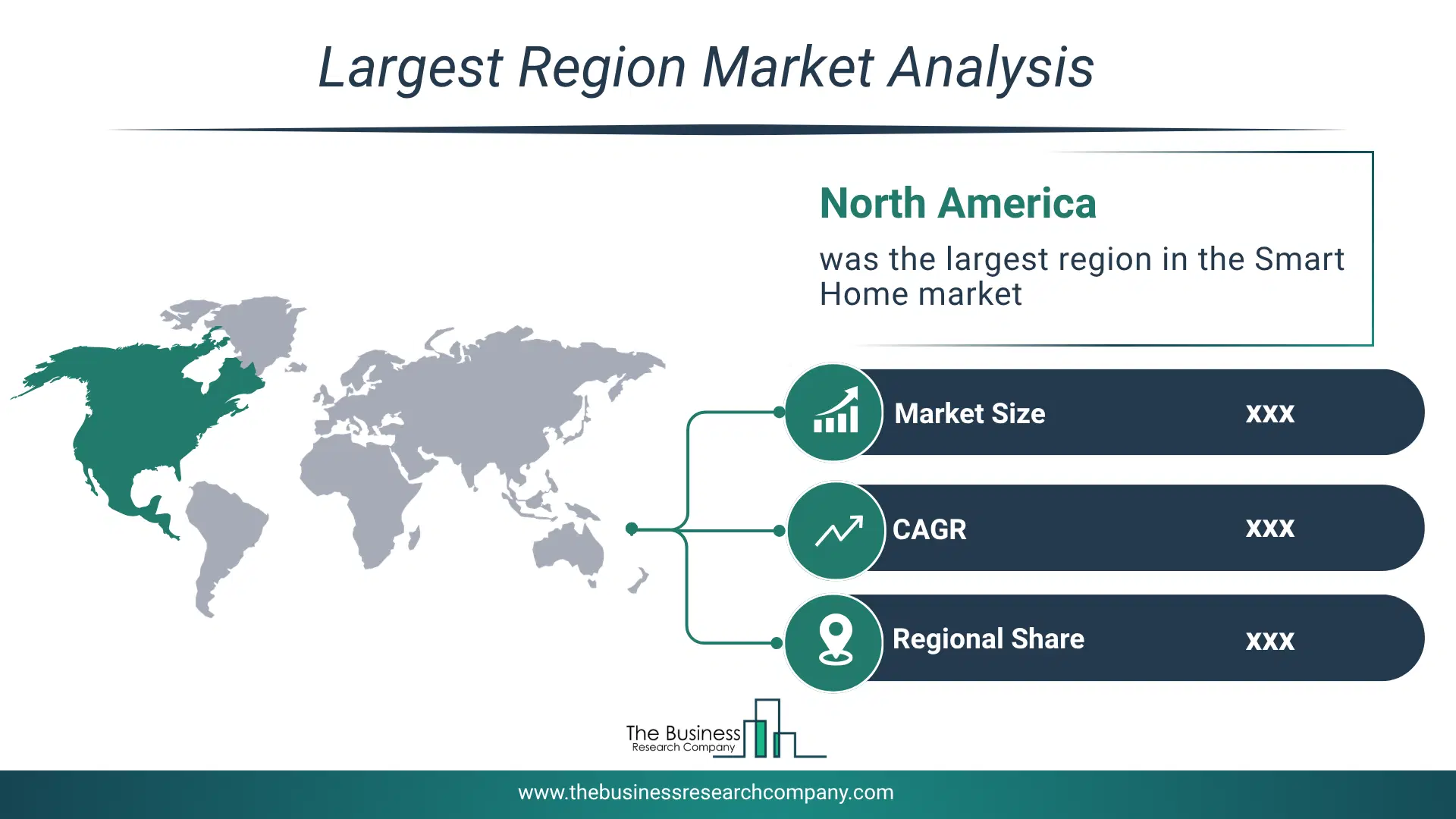
Regional Insights
North America was the largest region in the smart home market in 2025. Asia-Pacific is expected to be the fastest-growing region in the forecast period. The regions covered in this market report are Asia-Pacific, South East Asia, Western Europe, Eastern Europe, North America, South America, Middle East, Africa. The countries covered in this market report are Australia, Brazil, China, France, Germany, India, Indonesia, Japan, Taiwan, Russia, South Korea, UK, USA, Canada, Italy, Spain.What Defines the Smart Home Market?
The smart home market consists of revenues earned by entities by providing services such as home automation services, remote monitoring services, energy management services, security and surveillance services, maintenance and support services, installation and integration services, voice assistant services, and smart appliance management services. The market value includes the value of related goods sold by the service provider or included within the service offering. The smart home market includes smart lighting, smart thermostats, smart security cameras, smart door locks, smart speakers, smart plugs, smart appliances, smart smoke and carbon monoxide detectors, smart garage door openers, and smart sensors. Values in this market are ‘factory gate’ values, that is, the value of goods sold by the manufacturers or creators of the goods, whether to other entities (including downstream manufacturers, wholesalers, distributors, and retailers) or directly to end customers. The value of goods in this market includes related services sold by the creators of the goods.How is Market Value Defined and Measured?
The market value is defined as the revenues that enterprises gain from the sale of goods and/or services within the specified market and geography through sales, grants, or donations in terms of the currency (in USD unless otherwise specified). The revenues for a specified geography are consumption values that are revenues generated by organizations in the specified geography within the market, irrespective of where they are produced. It does not include revenues from resales along the supply chain, either further along the supply chain or as part of other products.
This chart presents market attractiveness based on a quantitative evaluation of growth, competition, strategic alignment, and risk, offering a clear view of opportunity areas for decision-making. This chart is for illustrative purposes; the full report contains the complete analysis.

This chart highlights the Total Addressable Market (TAM) by estimating the maximum revenue opportunity using an assumption-driven approach, supporting strategic planning and opportunity sizing across markets. The chart is illustrative; the full report provides a more comprehensive analysis.
What Key Data and Analysis Are Included in the Smart Home Market Report 2026?
The smart home market research report is one of a series of new reports from The Business Research Company that provides market statistics, including industry global market size, regional shares, competitors with the market share, detailed market segments, market trends and opportunities, and any further data you may need to thrive in the smart home industry. The market research report delivers a complete perspective of everything you need, with an in-depth analysis of the current and future state of the industry.Smart Home Market Report Forecast Analysis
| Report Attribute | Details |
|---|---|
| Market Size Value In 2026 | $215.77 billion |
| Revenue Forecast In 2030 | $490.30 billion |
| Growth Rate | CAGR of 23.1% from 2026 to 2030 |
| Base Year For Estimation | 2025 |
| Actual Estimates/Historical Data | 2020-2025 |
| Forecast Period | 2026 - 2030 |
| Market Representation | Revenue in USD Billion and CAGR from 2026 to 2030 |
| Segments Covered | Type, Device Type, Protocol, Sales Channel, Application |
| Regional Scope | Asia-Pacific, Western Europe, Eastern Europe, North America, South America, Middle East, Africa |
| Country Scope | The countries covered in the report are Australia, Brazil, China, France, Germany, India, ... |
| Key Companies Profiled | Amazon.com Inc., Apple Inc., Samsung Electronics Co. Ltd., Robert Bosch GmbH, LG Electronics Inc., Schneider Electric SE, Xiaomi Corporation, Honeywell International Inc., ABB Ltd., Legrand SA, Signify N.V., TP-Link Technologies Co. Ltd., Somfy SA, Anker Innovations Technology Co. Ltd., Lutron Electronics Co. Inc., Control4 Corporation, iRobot Corporation, Aqara, ecobee Inc., Tuya Inc., Nanoleaf Ltd., Eve Systems GmbH |
| Customization Scope | Request for Customization |
| Pricing And Purchase Options | Explore Purchase Options |